The post Drumnacoub – A Bloody Battle in the Far North appeared first on ScotClans | Scottish Clans.
]]>
The Kyle of Tongue
This battle was an internal feud among the men of Clan MacKay but also involved some Sutherland men. A disastrous battle, it led to the loss of many senior members of the clan and most of the belligerents on both sides.
The origins of the battle begin with an ongoing feud between the MacKays and their neighbours the Sutherland Clan. In 1370 the MacKay chief had been murdered by the Sutherlands in Dingwall. This had led to considerable acrimony between both clans as you can imagine and finally in 1426 Angus Du MacKay and his son Neil marched into Sutherland lands to take revenge. They met the Sutherland clan at Harpisdale.
The battle was more or less fought to a stalemate with no clear winner and considerable slaughter on either side. News of the conflict reached James I in Edinburgh. James wasn’t exactly having the easiest of times and frustrated by yet another inter-clan war he rode north to Inverness and demanded that the clan leaders submit to him. Angus duly complied and volunteered his son as a hostage to guarantee his clan’s good behaviour. Neil was taken to the Bass rock. an island prison in the outer Firth of Forth. During his imprisonment he was given the nickname ‘Vass’ a phonetic spelling of ‘Bass’
While this was going on three cousins of Angus Du: the brothers Thomas Mackay, Morgan Mackay, and Neil Neilson Mackay had a dispute with the Laird of Freswick – a man by the name of Mowat. Thomas pursued him to the chapel of St Duffus in the town of Tain. Mowat claimed sanctuary at the chapel but Thomas killed him anyway and burned down the chapel for good measure. As anyone who has followed the fortunes of Robert the Bruce will know murdering someone in a house of worship was a serious breach of etiquette and burning it down was even worse, so once again James I was forced to intervene so he denounced and outlawed Thomas, promising his land and possessions as a reward for his capture dead or alive.
Angus Moray (of Clan Sutherland) apprehended Thomas and handed him over to the law, however there was clear suspicion that Thomas’ own brothers; Morgan and Neil Neilson had assisted Angus Murray for a share of the spoils. Thomas was carted off to Inverness and executed and this apparent betrayal within the clan (made even worse by conspiring with a Sutherland) split the clan.
The Earl of Sutherland – seeing a good opportunity to break the power of the MacKay clan further supported Morgan and Neil Neilson by offering his own daughters in marriage (though they had already married Moray’s daughters). As well as helping them make a bid for the MacKay lands.
Back in Caithness Angus Du and his illegitimate son John Aberach Mackay were in a tight spot. Angus was by now an old man and had no will to fight, preferring to make some sort of settlement with his cousins. He offered all his land apart from Strathnaver but they refused the deal, intending to take all of MacKay lands for themselves. At this point Angus’ illegitimate second son John Aberach Mackay stepped in to advise the elderly chief and offered to defend the MacKay lands or die trying.
Some time between 1427 and 1433 (exact dates are unclear) the two sides met at Drumnacoub (Druim na coub, Drum-ne-coub) a few miles from the coastal village of Tongue on the North East coast.
The battle was a long and terrible one with both sides suffering heavy losses, by the end of the day Neil Mackay, Morgan Mackay and Angus Moray were all dead, John Aberach Mackay was severely wounded (possibly loosing an arm) and lay critical on the battlefield and very few from around 3,000 men (around 1,500 on either side by some estimates) were left standing.
Angus Du in despair asked to be carried to the battlefield to search for his son John but an opportunistic Sutherland archer spotted him and killed him with a well aimed arrow.
Shortly after the battle the remaining MacKay clan had to consider who would succeed as chief. Many supported John despite his illegitimacy but as fortune would have it Neil ‘Vass’ MacKay escaped from imprisonment at the Bass rock and made his way back north (it turned out the governor was married to a MacKay and she possibly helped him break out). John deferred to the legitimate heir and Neil was made chief. John was given lands around Lochnaver.
Neil pursued the Sutherlands who had supported the potential usurpers and a year later took revenge at the Battle of Sandside Chase. The widow of Neil Neilson and his son were given fairly rough treatment at the hands of those loyal to Angus Du’s side and for their own safety the moved to Olrig in Caithness. John dropped the name MacKay and became known as John Bain, progenitor of the Bain Family.
The post Drumnacoub – A Bloody Battle in the Far North appeared first on ScotClans | Scottish Clans.
]]>The post Highland Clearances Influence Composer appeared first on ScotClans | Scottish Clans.
]]>
Robert Aitken’s new soundtrack ‘Kildonan’
A new soundtrack by a Scottish composer has been influenced by the infamous Highland Clearances of the 18th and 19th Centuries. Kildonan, the latest work by Sutherland based composer Robert Aitken, draws on traditional, contemporary and classical styles to create an album that evokes the forced eviction of people from their lands.
During the industrial revolution, landowners in Scotland sought to make more capital by shipping people out and making way for shooting estates and large industrialised deer and sheep farms. Tracks on the soundtrack include Last Footsteps of Home which tells the story of a young girl on her way to an emigrant ship that lies in wait, and Red River Rant, a tribute to a piper on board an emigrant ship bound for Canada.
Aitken, who was born and brought up in Brora in Sutherland, said: “My aim is to drop the listener into a particular point in time and experience the life-story of a situation. I want the music to be felt rather than just heard. With Kildonan it was also important to examine the big themes of life, then and now – to connect the past with our present in what I do not see as time immemorial, but the ever moving cycle of life as time orbital.”
The soundtrack has received praise from Emmy-winning documentary producer Guy Perotta who called Kildonan a breath of fresh air. “Kildonan is very different from what is found in some works involving Scottish history, which sometimes resorts to what seems like a stereotypical take on what the music ought to sound like.”
Songs from the soundtrack feature on an app released in 2012 to mark the 200th anniversary of clearances in the Strath of Kildonan. Musuems Without Walls: Scotland’s Clearances Trail App uses GPS navigation, archival information and new media to guide users around important clearance sites, bringing the area’s history alive.
Several of the evicted Kildonan families sailed to Hudson Bay, in north east Canada, where they were forced to build their own shelters to protect themselves against severe winter conditions. The following spring, they set off on foot for the Red River Settlement around Lake Winnipeg in Canada where Scottish aristocrat, the Earl of Selkirk, had promised them land. Many made the 100 mile (161km) journey in handmade snowshoes.
Among the travelers was Catherine McPherson, who nursed the sick after typhoid broke out aboard ship on the journey from Scotland to Canada. She also survived a severe flood that carried away her log-built home. Her story is told in the app.
The soundtrack is available for purchase on Spotify, iTunes and Amazon.
The post Highland Clearances Influence Composer appeared first on ScotClans | Scottish Clans.
]]>The post The Scottish Nobility appeared first on ScotClans | Scottish Clans.
]]>The times they have a changed. The Great Estates are still there, but are a shadow of their former glories; the castles now lie open to the public to raise enough revenue to heat the huge halls and ballrooms that once sat at the fulcrum of society; and the lords of the manor themselves reduced to living in former servants quarters to save on the electric bill. Political changes over the last 100 years have altered the role the nobility play in our legislative procedures, and no longer is the wealth concentrated in their hands. The Middle Class, political creatures and the Nuevo Riche have stolen a march on their erstwhile lords and masters. Still, the fire is not quite out. Having a noble title still infers a certain amount of wealth; a large degree of privilege and influence and will certainly open doors (there are plenty lords of the realm sitting on boardroom tables); and of course a residual amount of deference. To visitors from overseas our castles and titles, lords and ladies can be archaic if not downright incomprehensible. But, thousand year old ways are ingrained and hard to shift.

- Dunrobin Castle – Seat of the Countess Sutherland

Scotland was born out of warring factions and semi-kingdoms; a baptism of fire, and any king ruled only by the grace of his great lords. Traditionally, the nation was split into six provinces, each governed by a sub-king; such as Atholl, Moray and Fife. Our understanding of this social organisation comes from ancient, but not contemporary texts and may give an unclear, politically motivated or distorted view of Scotland1200 years ago. Indeed, like all Celtic-based societies of the time it is likely to have been far more complex, fluid and personal. The Church too played a big role and was a major landowner. The king had lots of juggling to do. By 1100, Scotland following on from the revolution in England after the Norman Conquest was introducing the Feudal System – a body politick that placed the king at the apex and then a screed of layered nobility below him ranked in order of precedence. At the bottom of course as always was the peasant who propped up the system.
The Feudal System involved reorganising trade, erecting towns and markets, streamlining authority and the wielding of real power. It was fully introduced into Lowland Scotland by 1200, but its adoption in the Highlands was far more haphazard, and in truth never fully implemented. Instead there was a two-tier system layering the aristocratic feudal structure against a traditional clan heritage. As authority became increasingly centralised around a powerful monarchy the royal house took control of lordships across the country as a tool in maintaining their authority, often displacing the native nobility: it was an omelette out of which our modern nobility was born.
From the early kinglets and a patchwork of lordships new titles emerge around 1000 – Mormaers, Thanes and Toisichs: the first two perhaps an interchangeable title that conveyed either noble rights or as placemen of the king and second only to him; the term toisich is Gaelic and probably equates to Chief, as would emerge in the developed clan system. The earliest mormaers are noted as far back as the 960s with the lords of Atholl; but by the middle of the 12th century the title had been merged with others, including thanages, to become Earl. This is an Anglo-Saxon title, similar to the Scandinavian Jarl and comparable to the continental title Count. The adoption of the English title is symptomatic of the changes in Scottish society and language away from a traditional Celtic one; and part of a wider reorganisation.
William the Conqueror had tried to supplant the title Earl with Count in England, but without success; however, the wife of an earl would be Countess, his son a Viscount and the land under his jurisdiction a County – all European terms. In England, as in the emerging feudal Scotland, the king had parcelled the land into Shires; counties were essentially the same thing and then as now the term is interchangeable. Women can hold the rank under their own right and pass it on to their children, but use the title Countess; for example the Countess of Sutherland (her son will be the next earl).
Some earls had greater responsibilities – perhaps their lands lay along important boundaries, or controlled valuable resources; and they were given a higher rank to donate this added role. From the old French Marchis meaning a border, the title of Marquess emerged. Today there are only four marquisettes in Scotland, the oldest and most senior being the Marquess of Huntly, who is the head of the Gordon family. Ranked even higher than a marquess is that of a Duke. From the Latin Dux, the title was originally a military one, given in Roman times to province commanders. In some countries Dukes or Archdukes are ruling monarchs; and in Scotland the title was originally reserved only for senior members of the royal family – the Duke of Rothesay for example is the official Scottish title for the heir to the throne (not Prince of Wales). Not until 1643 did a non-royal receive the title – the Duke of Hamilton. Today there are seven Scottish dukes, including the Duke of Buccleuch –Britain’s largest landowner – and the Duke of Montrose, who still sits in the House of Lords.

- Arms of the now extinct Earldom of Breadalbane
The wife of a duke is called a duchess, but a woman cannot hold the title on her own accord; even if she’s a queen. Thus a king is also Duke of Normandy (for the Channel Islands) and Duke of Lancaster; but the present Queen is not – although she holds the titles in privilege. She is the Duchess of Edinburgh however, as she is married to the Duke of Edinburgh. There are several Royal Dukes, Edinburgh being one, including the Duke of York (Prince Andrew) and Duke of Cambridge (Prince William) – dukes are addressed as ‘your grace’, but royal dukes as ‘your royal highness’.
Ranked lower than an earl are viscounts (often the courtesy title for the eldest son of an earl), such as the Viscount Falkland; and Lords of Parliament, such as Lord Lovat. There are no Barons in the peerage of Scotland as such, and Lord of Parliament is the equivalent. However, none were created after the Union of Parliaments in 1707 instead new hereditary Scottish lords were ennobled as United Kingdom barons.
By 1900 the aristocracy owned virtually every square inch of Scotland, with vast estates such as those held by the Dukes of Sutherland, Dukes of Atholl, Earls of Breadalbane, Dukes of Argyll, Dukes of Montrose, Earls of Angus and so on. Some titles are now extinct; two world wars and subsequent social upheaval changed the landscape forever. Many have found a new role, perhaps in business; others spending more time in their roles as clan chiefs, while others a quiet life on their estates. But, the age of the warrior aristocracy which has ruled Scotland for 2500 years is in its twilight and it will probably be gone by the end of the century.
The post The Scottish Nobility appeared first on ScotClans | Scottish Clans.
]]>The post Sutherland Beach One of the Best in the World appeared first on ScotClans | Scottish Clans.
]]>
Sandwood Bay
Sandwood Bay in Sutherland has been named as one of the best 50 beaches in the world by Travel magazine; and only one of five listed from the UK. The bay is around 5 miles south of Cape Wrath, the mainland’s most north-westerly point, and lies in a very remote part of the country. With no roads leading to the beach you have to travel down a 4 mile track to get to it. The travel guide highlighted Sandwood’s ‘swathe of soft pink sand’, and commented upon its remoteness by adding that the beach is only visited by ‘the most determined Crusoes’.
There are in fact a number of legends connected with Sandwood Bay.
One story tells of a mermaid seen sitting on rocks in the bay in 1900 by a local farmer called Alexander Gunn. It is said that one day in early January he was out walking his Collie along Sandwood Bay when all of a sudden the dog let out a loud howl and recoiled in terror at what it saw. Sitting on a rock protruding out of the sea was a mermaid with greenish-blue eyes, reddish-yellow hair, and was about 7 feet long. Alexander couldn’t believe what he was seeing, nor could he believe the beauty of the creature. To the day he died Alexander Gunn remained adamant that what he saw was real, even though it was never seen since.
A common tale is the sighting of the ghosts of sailors at the beach. One particular ghost is said to have knocked on the windows of a, now disused, bothy on stormy nights. However, it is not surprising that there are stories of such ghosts associated with the Sandwood. Before the lighthouse at Cape Wrath was built in 1828, the bay is said to have been the site of many a shipwreck.
Sandwood Bay is part of the Sandwood Estate, and is looked after by the John Muir Trust.
The post Sutherland Beach One of the Best in the World appeared first on ScotClans | Scottish Clans.
]]>The post Life On The Edge appeared first on ScotClans | Scottish Clans.
]]>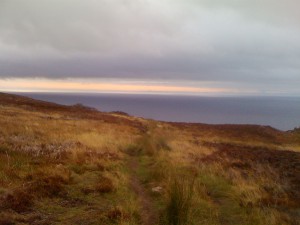
View from Badbea out to the North Sea
On the Caithness east coast, five miles north of the town of Helmsdale, you will see the ruinous remains of the once inhabited village of Badbea which saw its last resident leave at the start of the 20th century.
The Highland Clearances affected thousands of Highland families who were made to move from their homes. Some were persuaded through finacial means, such as having their fare to North America or Australia or New Zealand paid for, whilst the more unfortunate were forced out through violence and intimidation, where it wouldn’t be uncommon to see landlords have crofts burnt down. The people of the Highlands who fled ended up settling all over the place; with families moving to the lowlands or cities of Scotland and northern England looking for work in textile or shipping industries; or they emigrated to foreign countries; or some relocated to nearby coastal areas which were deemed unhabitable for the money-making sheep which replaced them.
Badbea was one of these coastal areas that some families were moved to. It was a cliff-top village established in 1793 when a number of tenant crofters were evicted from their homes to make way for the much more profitable sheep. The families were displaced on a steep, rough, small area of land. They were forced onto the tight area between the high Berriedale cliffs facing the North Sea and a large drystone wall built to protect the sheep.
Sir John Sinclair of Ulbster was the landowner who forced out many of the families from the nearby town of Ousdale, destroying their crofts to create room for the sheep. Sinclair was a politician, and also a writer on finance and agriculture who was a strong advocate for the protection and improvement of British wool.

The Badbea Monuement
Badbea was a tough place to live in; the conditions were horrendous with the land being barely fertile enough for the crofters to live on. Many of the families living there were from Ousdale, though there some from Auchencraig and Kildonan.
Each family who arrived was given their own plot of land to live on and farm. However there were no buildings actually present, and the families would have to clear their area and hack away at the difficult terrain and then build the houses from the stones they found. Each plot had enough space for a longhouse with a shed at the end, a couple of outbuildings and a kailyard. The rest of their land was then used for some cattle, a pig, and a few chickens. It was kind of primitive living for the most part as the whole village only had one horse, and so had no plough. Instead the fields were ploughed manually with the men using a spade-like instrument called a chaib. The harrow needed to be pulled by the men instead, and the manure was carried by the women on their backs in creels.
The families were industrious and frugal, with each household having a spinning wheel in the home where the young women would learn spinning and carding.
With the land provided it was impossible to be able to make a living from farming. The area wasn’t incredibly fertile, with the land being quite rocky. Also being right on the coast like they were the winds coming in from the North Sea were so violent that it would have been practically impossible to grow anything substantial there anyway. In fact, the winds were so strong that when the adults were working any children or livestock outdoors had to be tethered to rocks or posts to stop them being blown over the precipice.
Herring fishing was the the main source of income. The men would go to sea, and the women would gut what was caught. Fishing was a very dangerous occupation, especially in the North Sea. Before the Clearances most of these people lived in the sheltered inlands of the straths and the glens, and so were not accostumed to being out at the sea. However, at its height there were 13 fishing boats in use, and the herring fishing provided a lot of food for all families, including for the widows who had children to support children.
By 1814 the Laird’s Estate had been sold to James Horne. At this point the population of Badbea was 80 people within 12 different families. Though for the families in Badbea, this would turn out to have unfortunate consequences.
Donald Horne, James’ nephew, put a stop to the herring fishing, favouring to fish salmon instead. This put a stop to the community’s main form of employment, meaning that the people had to survive on much less, and the widowed families having to occasionally do without. However there were other means of income. Some of the women would weave baskets, or make flails of birch for threshing corn corps and then sell them at Dunbeath Market in November.

Inscription on Badbea Monument
On the landlord’s estate there would sometimes be some menial jobs to be done by people from Badbea, but the rate of pay would be very low, and in no way appropriate. This would encourage some of the men to look for work on other estates or elsewhere. However, if they were caught doing this by their landlord, as punishment the men and their familied could face being evicted from Badbea.
A notable resident of Badbea was John “Badbea” Sutherland. John was a very popular and respected member of the community. He lived most of his life in Badbea where he was preacher and doctor to all. John was thought of as a man of great piety and worth, and it is said that he possessed the only watch in the village. John died in his house at the age of 76 on the 31st August, 1864 and was burried in the burial ground at Berriedale.
The village of Badbea was occupied for over 100 years, with the last resident leaving in the early 1900s. In 1911 a memorial was errected in honour of the families who lived in Badbea and suffered during the Highland Clearances. The man who commissioned the monument was David Sutherland who visited Badbea in 1901 when only two tenants were left. Born in New Zealand, David was the son of Alexander Robert Sutherland who was born in Badbea and brought up by John “Badbea” Sutherland. Alexander emigrated to New Zealand in his 30s in 1839 and although he prospered in his new country, he never forgot Scotland. The memorial was built using the stones from the croft that was lived in by John “Badbea”.
The post Life On The Edge appeared first on ScotClans | Scottish Clans.
]]>