The post The Battle of Baugé appeared first on ScotClans | Scottish Clans.
]]>
Battle of Baugé
Background:
The Battle was part of the ‘Hundred Years War’ between England and France. In 1419 King Henry V of England had turned the course of the war at Agincourt, a battle that has become synonymous with Anglo French ‘sparring’ ever since. There had been a formal alliance between France and Scotland since 1295, known as the ‘Auld Alliance’ though the ties between the two nations goes back much further, indeed the tradition of a ‘Guarde Eccosais’ goes back to the time of Charlemagne.
After Agincourt the French were in disarray. Charles VI of France was mad, and his heir, the future Charles VII, was only sixteen. Normandy was lost to the English and the Dukes of Burgundy were taking Paris. With the situation getting desperate the Dauphin appealed to Scotland for help.
King James I of Scotland was imprisoned by the English and the country was being ruled in his place by Robert Stewart, first duke of Albany. Albany decided to send a force of 6,000 volunteers to France under the command of Archibald Douglas, earl of Wigtown and Albany’s second son John Steward, third earl of Buchan. A fleet of ships from Castile reached Scotland in September 1419, and on 29 October 1419 the Scottish army reached the Dauphin’s court at Bourges.
The Scots made up by far the largest component of the Dauphin’s defensive forces in the Loire Valley. The English army still recording successes in France was commanded by Henry V’s oldest brother Thomas of Lancaster, duke of Clarence. Estimates of the strength of this force vary from between 7,000 to 12,000 men, a considerable number of which were drawn from the English nobility.
In March 1421 Clarence led a series of raids through the Anjou and Maine and by Good Friday they were camped near the little town of Vieil-Baugé where their progress was halted by the Franco-Scots army who had also arrived in the area. Clarence was keen to engage them but some of his forces were dispersed and also Easter Sunday was unthinkable as a date to start a battle. The following day a party of English who had been on a foraging mission returned to their camp with some captured Scots soldiers, The party had stumbled upon the Scot’s forces and Clarence keen to press his advantage of surprise and also to avoid a conflict on a holy day decided to engage despite his weakened force.
The Battle

Carmichael Clan Crest
Clarence made the fateful decision to attack immediately with a small force of mounted men-at-arms, leaving The earl of Salisbury to gather the other troops who were still out foraging on their return. Clarence headed for the bridge at Baugé, the only crossing available to reach the Scots. It would appear he was desperate to match the exploits of his brother at Agincourt. The Franco-Scots army were largely unprepared for the attack, many were at morning prayers or playing sports. As they attempted to cross the Bridge a small Scottish force nearby raised the alarm and the English were immediately held by a rain of arrows. It took them some time to force a crossing of the river. In his haste he had not brought his own archers and the remainder of this initial force were stretched back along the road.
Despite this Clarence still pressed forward towards the village, only to be met by the main bulk of the Scots and French who were concealed behind a ridge on the approach. The Scots came over the crest and charged headlong at the English army. Clarence was an early casualty. John Carmichael of Douglasdale unhorsed him, breaking his lance in the process – an event which is immortalised in the crest of clan Carmichael. The battle was reduced to a vicious hand to hand melee and its unclear who stuck the final blow that finished off Clarence. Alexander Makcaustelayn (a Lennox highlander), the lord of Fontaines, Charles le Bouteiller and William de Swinton have all been credited with finishing off the King’s brother.
Aftermath
The result was a crushing defeat for the English which set them back on the course of the war, Henry was forced to return to France but he contracted an illness and died during the campaign. Many of the English who had never even made it to the battle were able to escape and the war raged on for many years to come with victories and defeats on both sides.
The Scots Army in France who had been largely criticised by many French before the battle were now seen in an altogether different light and this French guard in later years formed the core of the Royal Scots – the oldest regiment in the British army, honoured for their antiquity by their nickname ‘Pontius Pilate’s Bodyguard’
The post The Battle of Baugé appeared first on ScotClans | Scottish Clans.
]]>The post Royal Stewart Descendents Alive and Well appeared first on ScotClans | Scottish Clans.
]]>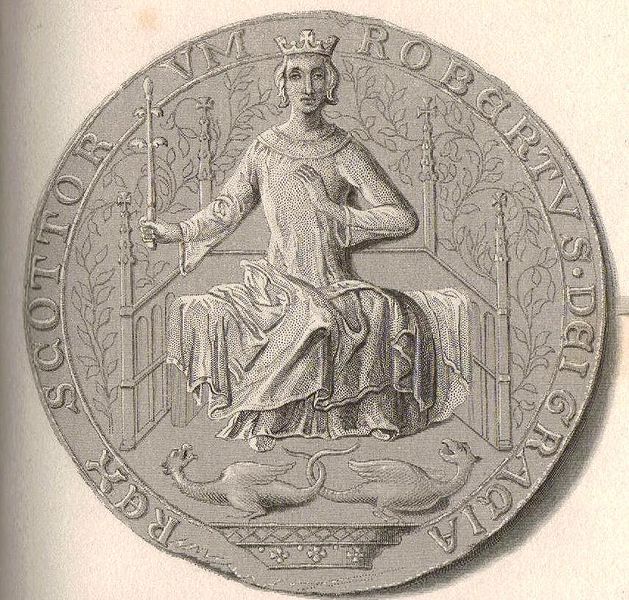
The Seal of Robert II, King of Scots. 1316-1390
Half of all men in the United Kingdom with the surname Stewart, or Stuart, can claim ancestry from Scotland’s Royal family. Research released by ScotlandsDNA has revealed for the first time the individual in the 13th century who founded a branch of the Royal Stewart line.
In the United Kingdom alone there are about 70,000 people with the surname, meaning that around 17,5000 men can now claim descent from the royal bloodline. The source of the line is Sir John Stewart of Bonkyll, who met his demise at the Battle of Falkirk in 1298 fighting alongside William Wallace. The Stewart family’s well-documented pedigree allowed ScotlandsDNA to carry out tests on his descendants, and those of his brother James, the 5th High Steward of Scotland and the grandfather of Robert II, the first Stewart king.
Dr Jim Wilson, the group’s chief scientist, discovered a marker that originated more than 700 years ago when ancestry tests were carried out on the descendants of James and Sir John’s sons Richard and Angus. The results show that that the modern descendants of both sons of Sir John carry a Y chromosome marker S781+ that is absent in the descendants of James.
Dr Wilson added: “By a straightforward process of deduction that means that the marker arose in Sir John Stewart of Bonkyll, and not in his father. If it had, the descendants of James would also carry it, and they do not.” Having made the discovery, ScotlandsDNA checked its database of ancestry tests for men with the Stewart surname and found that 20 per cent of them share Sir John’s lineage, while 30 per cent are descended from his brother James.
James’s son Walter, married Marjorie Bruce, the daughter of Robert I, having helped him win the great victory at Bannockburn, and their son became Robert II.
Alistair Moffat, co-founder of ScotlandsDNA, added: “In the year of the 700th anniversary of Bannockburn, thousands of Scottish men can claim to be directly descended from the Stewarts who fought alongside Bruce, and they can directly identify with generations of famous figures who shaped Scotland and Britain.” The Duke of Buccleuch, Scotland’s biggest private landowner, who is directly descended from Sir John, and a long line of Scottish and British kings, said he was fascinated by the DNA detective work.
He added: “My family’s history has always been closely involved with the history of Scotland and Britain, but the fact that the rise of a DNA marker has been identified in an individual brings the past even closer, and makes it more personal.
“I am delighted to have been a guinea pig for the sort of history it is now possible to write thanks to DNA research.” The sampling has also, for the first time, distinguished clearly between different cadet branches of the royal Stewarts.
The four branches are the Appin Stewarts who fought at Culloden, the Lennox Stewarts who were direct ancestors of James VI and I, and the Albany and Moray Stewarts who acted as regents.
The post Royal Stewart Descendents Alive and Well appeared first on ScotClans | Scottish Clans.
]]>The post Mary, Queen of Scots Returns to Edinburgh appeared first on ScotClans | Scottish Clans.
]]>
Chambers Street, Edinburgh
In August 1561 Mary, Queen of Scots returned to Edinburgh from France as a Catholic queen in a newly reformed Protestant Scotland. Initially greeted with crowds curious to catch a glimpse of their new queen, Mary Stewart was regarded with suspicion and faced a volatile political situation from the fervent Protestant ascendancy.
450 years on, Mary has made a triumphant return to the Scottish capital in the form of an exclusive major exhibition currently on show at the National Museum of Scotland. Entitled Mary, Queen of Scots, the exhibition chronicles one of the most well-known and captivating royals of all time. It brings together jewels, furniture, tapestry, portraits and documents, providing an insightful view of a fascinating woman and the tumultuous era in which she lived.
Last week I attended a talk highlighting the exhibition’s star pieces by George Dalgliesh – Keeper of Scottish History and Archaeology at the National Museum for over 20 years. He explained that the 200+ items on display aim to present a slightly different view of Mary’s life, focusing on her personal rule in Scotland. He added that Mary still excites controversy to this day, with debates ensuing as to whether the Scottish queen was a Catholic martyr or a scheming adulteress.

Blairs Memorial Portrait of Mary
On entrance to the exhibition the giant Blairs Memorial portrait of Mary towers over you, providing a commanding view of Mary on her way to the executioners block. Commissioned by Elizabeth Curle, a companion to Mary in the final years of her life, the portrait was painted 10-15 years after Mary’s death and was used as a piece of Catholic propaganda to promote Mary’s martyrdom. The portrait also includes visual vignettes of Mary’s grieving ladies in waiting and a scene from the execution.
The exhibition is set out chronologically, with the pinnacle point her reign as Queen of Scotland. Amongst the 16th century artifacts, which include a handwritten letter from Mary to her mother Mary of Guise, an innovative 21st century video shows a 3D image of what Mary would have looked like during her reign. Costume sketches and models by Jasper Conran for a recent production of Donizetti’s tragic opera Maria Stuarda show her renowned regal fashion sense and striking figure that continues to inspire artists today. Even John Knox, the leading light of protestant reformation is said to have described her features as “pleasing”.
Among the most fascinating of the items on display are the documents in the concluding section of the exhibition which include a set of cipher codes, the death warrant issued by Mary’s second cousin Elizabeth I, and a letter from Mary’s son James VI pleading Elizabeth for mercy. The original death warrant disappeared during the legal accusations following the execution, however the surviving copy on display was made for court records and includes the signature of Elizabeth I. The warrant instructs Elizabeth’s commissioners to:
“…repaire to our Castle of Fotheringhaye where the said Queene of Scottes is in custodie of our right trustie servant and Counsellor Sir Amyas Poulet Knight, and then taking her into your charge to cause by your commandment execution to be done upon her person.”

The Penicuik Jewels
Today very little survives that belonged to Mary for a number of reasons. Following her death her belongings were burned to try and stop the creation of a cult of relics around a martyred Queen. Mary’s half-brother, James Stewart Earl of Moray, is also said to have sold his sister’s jewels following her abdication to pay for troops. A surviving relic on display are the Penicuik Jewels. Originally from a rosary, the jewels are now strung as a necklace and include a locket set with Scottish river pearls. Dalgleish thinks the jewels were probably commissioned by Mary to be given away, as they are not regal enough to be fit for a queen. Giving jewels as gifts was a common practice during the 16th Century as a way of binding a person to your cause.
To this day Mary continues to hold a place in Edinburgh’s heart, as buses make their way through the city’s streets with her face displayed on their sides. The exhibition provides a wondrous insight into the life of a controversial Queen whose legacy still lives on, almost 450 years after her death.
‘Mary, Queen of Scots’ runs until Sunday 17th November 2013. You can read more about the exhibition by clicking here.
The post Mary, Queen of Scots Returns to Edinburgh appeared first on ScotClans | Scottish Clans.
]]>The post University Brings Mary, Queen of Scots Back to Life appeared first on ScotClans | Scottish Clans.
]]>
3D Facial Reconstruction of Mary, Queen of Scots
A renowned team of experts at the University of Dundee have revealed a 3D virtual image of Mary, Queen of Scots as she would have looked at the time of her reign. The image was released to coincide with a major new exhibition on the life of the iconic figure that opened at the National Museum of Scotland in Edinburgh last Friday.
Professor Caroline Wilkinson, from the Forensic and Medical Art Research Group, worked from existing portraits and from what is known of Mary’s biography to reconstruct her face as it would have been following during her reign in Scotland from the ages of 19 to 26, a period when there is no portrait record of her.
Professor Wilkinson created a head-and-neck model using the portraits of Mary as templates. The model was created using 3D modelling software and craniofacial templates before digital artist Janice Aitken sculpted clothing and hair then added textures and lighting to create the finished image. The team have previously worked on major projects to reconstruct the faces of Bach, Cleopatra’s sister, Simon of Sudbury and Richard III among others.
“There were no portraits painted during Mary’s time in Scotland, but there were both before and after this period,” explained Professor Wilkinson. “Normally we would begin the process of craniofacial reconstruction by examining skeletal remains, but of course we didn’t have a skull to work from in this case so had to work from portraits earlier and later than the depiction we were asked to create.
 “This meant it was a very different challenge for me and the model is more of an artistic representation rather than the scientific interpretation we would normally produce from skeletal remains. We had to get the facial proportions and size of her features from portraits which, luckily, were from slightly different angles so we could look at her face from more than one viewpoint.
“What we wanted to do was depict how she would have looked at the time she lived in Scotland. This was a difficult time for her marked with illness, grief, miscarriage, and imprisonment so we wanted to show the stresses and strains of life on her face because later portraits make her look significantly older than her years.
“She is not what you would describe as a classic beauty. Mary had quite a big nose and a strong chin so when you describe her verbally she doesn’t sound attractive, but the paleness of her skin, red hair, and strong features meant she had a very striking appearance.”
Janice Aitken then put textures on the model and coloured the skin, hair and eyes to ensure it looked as realistic as possible. She created a short movie of the face being shown from several different angles to give the viewer a more complete impression of Mary during the time of her reign in Scotland.
The post University Brings Mary, Queen of Scots Back to Life appeared first on ScotClans | Scottish Clans.
]]>The post Twilight of the Stewarts appeared first on ScotClans | Scottish Clans.
]]>The Stewarts rose from relative obscurity to a place of importance in the Scottish Court through the 13th century, and during the Wars of Independence they sided with the Bruce faction; and Walter Stewart married Robert the Bruce’s daughter Marjorie. Eventually, in 1371 after a half-century wait for his uncle to die Robert Stewart became king ofScotland. It was the beginning of a dynastic rule that would last 343 years until the death of Queen Anne in 1714. Throughout that time, the family – which employed mafia tactics – extended their control over Scotland, and finally reached the giddy heights of the throne of England.
As British kings their successes were less evident – one was executed and another deposed; and their increasing disengagement with the political momentum and religious intolerance of the times would see the great House permanently exiled. From James VII to his grandson Charles Edward the exiled Stuarts (French spelling) would set up counter-courts in France and Italy; where they’d be hocked from palace to palace maintaining a veneer of royalty and influence. It was back to this fantasy world that the L’Heureux would bring the young Pretender following the disaster of the ’45: but in reality it was to an alcohol fuelled life of obscurity.
Charles’ stay in France was short-lived, for within a couple of years of the rising the British and the French signed the Treaty of Aix-la-Chapelle’ effectively ending the War of the Austrian Succession, which the Jacobite rebellion was essentially part of; and with the deal the Pretender was expelled. He returned to Italy, where his father still held a degree of social influence. Shattered by the failure of the Cause, and haunted by ghosts of Culloden Charles began a string of affairs and sought solace in the bottom of a bottle. His principal mistress was the Scottish socialite, Clementina Walkinshaw, who in 1753 bore him a daughter, Charlotte.
Henry Stuart, Charles’ younger brother took a different route after 1746, perhaps armed with more realism, and entered the Catholic Church. His father was on good terms with the Pope, who still recognised him as the rightful king, and Henry made a meteoric rise through the ranks of the episcopacy, becoming Cardinal-Bishop of Frascati in 1761. While his brother became a Prince of the Church; Charles, drunk half the time, still entertained dreams of fantasy thrones.
In 1759, at the height of the Seven Years War, a conflict that for the first time took on a global perspective, the French drew up plans for a full-scale invasion of England. As part of the project he wanted to enlist the support of the still-loyal Jacobites; and Charles was summoned to Paris. Boorish and unrealistic, the French government were soon repelled by him, and sent him packing: he’d play no part in the operation. However, significant British victories overseas essentially put paid to the expedition and it was permanently shelved. This was Charles’ last true, albeit slim, chance to be king. His drinking worsened, his life increasingly nomadic and his treatment of Clementina increasingly abusive. In 1760 she left him, and took Charlotte with her. There is a strong suspicion that Prince James helped out, and gave her an allowance.

Prince Charles Edward Stuart in later life
As she grew up, Charlotte was bounced from convent to convent as her father refused to provide for her or her mother; and with James dead in 1766 that avenue dried up as well. James Francis Stuart, born in 1688 to James VII was the last prince of the House of Stewart to be born in Britain and to the reigning dynasty. As such the Pope and kings across Europe still either recognised his claim, or treated him on an equal footing. The world by 1766 had moved on, and neither the Papacy nor the crowned heads would give the increasingly distant, melancholic and unpopular Charles the same recognition. His downward spiral continued.
In 1772 he married Princess Louise of Stolberg-Geden; but, due to the nature of the man, now a broken alcoholic, it was doomed to failure: she left him eight years later. Now an old man in ill-health he reached out again to his family, and was reconciled with his daughter; who also engaged her uncle, the Cardinal Henry, to bring the once-Bonnie Prince back to Rome, where she would care for him until he died of a stroke in 1788. Chronically ill herself, she died three years later.
Charles Edward Stuart had lit up Scotland like a firework during the 1745 rebellion; but the rest of his life had been an unfulfilled damp-squib; and on his death the Jacobite claim fell to his brother: Cardinal Henry Stuart. As a successful and powerful clergyman (Henry was raised to the Dean of the College of Cardinals in 1803) he did not press his case. He died in 1807: last of the Royal Stewarts. Both he and Charles were buried within the Basilica of St Peter’s in the Vatican. He may have been the last of the dynasty; but not last of the bloodline.
In the years before she returned to her father, Charlotte Stuart had a long term affair with Ferdinand de Rohan, Archbishop of Bordeaux, which considering his position was a risky enterprise. She had three children by him: Marie Victoire, Charlotte and a boy, Charles Edward. Little is known about the two girls, or whether they married and had children – it is believed that Marie Victoire ended up in Poland (Charles’ mother was Polish) and that Charlotte was absorbed into polite society in England. Either way, they and any possible descendants vanished into anonymity.
The son, Charles became a distinguished soldier and something of a globetrotter; and while he never pressed his Jacobite claim, he did maintain links with leading Scots. Indeed, it was while returning from a meeting with the Duke of Atholl in 1854 he was killed in a coaching accident; and is buried in the grounds of Dunkeld Cathedral in Perthshire. With him, the last of the true direct bloodline ended. Meanwhile, fanatical Jacobites searched around for an heir to Henry Stuart; and with his death the ‘claim’ passed to King Charles Emmanuel IV of Sardinia; the senior living descendant of Charles I Stuart through his daughter Henrietta. In a parallel universe the line has passed down to Franz von Wittelsbach, Duke of Bavaria; although he declines ever to talk about his Stewart ancestry.
The bitter wars of the 17th and 18th centuries shaped the modern Britain that emerged, the nature of the monarchy, and indeed the dynastic future itself. The Royal Stewarts had their time; their crown slipped, fell and it was eventually buried in the setting sun amid the hallowed walls of Dunkeld. And few were there to mourn it.
The post Twilight of the Stewarts appeared first on ScotClans | Scottish Clans.
]]>The post Lochranza Castle appeared first on ScotClans | Scottish Clans.
]]>
Lochranza Castle
Lochranza Castle on Arran was built in the 13th century. It passed to the Stewarts of Menteith and became a royal castle when Robert Stewart became King in 1371. In the 1450s the Tower House was granted to the Montgomeries. They held the castle for the next 250 years.
In the 16th Century the castle’s owner decided to modernise it. Two new storeys and a tower provided extra room. The old spacious interior was subdivided into smaller more private, family-orientated chambers. Gone were the days when a laird had to greet all his vassals in one vast hall.
The post Lochranza Castle appeared first on ScotClans | Scottish Clans.
]]>