<br />
<b>Deprecated</b>:  mysql_connect(): The mysql extension is deprecated and will be removed in the future: use mysqli or PDO instead in <b>/var/www/apps/scotclans_wp/wp-includes/wp-db.php</b> on line <b>1142</b><br />
<?xml version="1.0" encoding="UTF-8"?>
<rss version="2.0"
	xmlns:content="http://purl.org/rss/1.0/modules/content/"
	xmlns:wfw="http://wellformedweb.org/CommentAPI/"
	xmlns:dc="http://purl.org/dc/elements/1.1/"
	xmlns:atom="http://www.w3.org/2005/Atom"
	xmlns:sy="http://purl.org/rss/1.0/modules/syndication/"
	xmlns:slash="http://purl.org/rss/1.0/modules/slash/"
	>

<channel>
	<title>ScotClans &#124; Scottish Clans &#187; St. Andrew</title>
	<atom:link href="http://109.74.200.198/tag/st-andrew/feed/" rel="self" type="application/rss+xml" />
	<link>http://109.74.200.198</link>
	<description></description>
	<lastBuildDate>Fri, 20 Jan 2017 08:08:09 +0000</lastBuildDate>
	<language>en-US</language>
	<sy:updatePeriod>hourly</sy:updatePeriod>
	<sy:updateFrequency>1</sy:updateFrequency>
	<generator>http://wordpress.org/?v=3.6.1</generator>
		<item>
		<title>The Naming of Edinburgh&#8217;s New Town&#8230;</title>
		<link>http://109.74.200.198/the-naming-of-edinburghs-new-town/</link>
		<comments>http://109.74.200.198/the-naming-of-edinburghs-new-town/#comments</comments>
		<pubDate>Fri, 23 Sep 2016 08:29:01 +0000</pubDate>
		<dc:creator>Andy</dc:creator>
				<category><![CDATA[Edinburgh]]></category>
		<category><![CDATA[Scottish History]]></category>
		<category><![CDATA[Scottish Places & Buildings]]></category>
		<category><![CDATA[edinburgh]]></category>
		<category><![CDATA[Hanover]]></category>
		<category><![CDATA[King George III]]></category>
		<category><![CDATA[New Town]]></category>
		<category><![CDATA[Scotland]]></category>
		<category><![CDATA[scottish history]]></category>
		<category><![CDATA[St. Andrew]]></category>
		<category><![CDATA[thistle]]></category>

		<guid isPermaLink="false">http://www.scotclans.com/?p=61521</guid>
		<description><![CDATA[<p>The New Town in Edinburgh is a beautiful area right smack bang in the centre of the city, contrasting greatly with it&#8217;s counterpart the Old Town. One straight and neat, in fact considered to be a masterpiece of city planning, the other jumbled and confused but layered in history. Let&#8217;s take a look at a very [&#8230;]</p>
<p>The post <a rel="nofollow" href="http://109.74.200.198/the-naming-of-edinburghs-new-town/">The Naming of Edinburgh&#8217;s New Town&#8230;</a> appeared first on <a rel="nofollow" href="http://109.74.200.198">ScotClans | Scottish Clans</a>.</p>
]]></description>
				<content:encoded><![CDATA[<p>The New Town in Edinburgh is a beautiful area right smack bang in the centre of the city, contrasting greatly with it&#8217;s counterpart the Old Town. One straight and neat, in fact considered to be a masterpiece of city planning, the other jumbled and confused but layered in history. Let&#8217;s take a look at a very interesting little detail about the New Town&#8230;<a title="City planning" href="https://en.wikipedia.org/wiki/City_planning"><br />
</a></p>
<p><a href="https://uk.pinterest.com/pin/142707881922167444/"><img class="aligncenter size-full wp-image-61522" alt="New-Town-Edinburgh-Infographic-blog" src="http://www.scotclans.com/wp-content/uploads/2016/09/New-Town-Edinburgh-Infographic-blog.jpg" width="750" height="2076" /></a></p>
<p>The post <a rel="nofollow" href="http://109.74.200.198/the-naming-of-edinburghs-new-town/">The Naming of Edinburgh&#8217;s New Town&#8230;</a> appeared first on <a rel="nofollow" href="http://109.74.200.198">ScotClans | Scottish Clans</a>.</p>
]]></content:encoded>
			<wfw:commentRss>http://109.74.200.198/the-naming-of-edinburghs-new-town/feed/</wfw:commentRss>
		<slash:comments>0</slash:comments>
		</item>
		<item>
		<title>Saltire &#8211; The Flag of Scotland!</title>
		<link>http://109.74.200.198/saltire-the-flag-of-scotland/</link>
		<comments>http://109.74.200.198/saltire-the-flag-of-scotland/#comments</comments>
		<pubDate>Fri, 22 Jul 2016 10:00:59 +0000</pubDate>
		<dc:creator>Andy</dc:creator>
				<category><![CDATA[Scottish Heraldry]]></category>
		<category><![CDATA[Scottish History]]></category>
		<category><![CDATA[Scottish Kings and Queens]]></category>
		<category><![CDATA[Scottish Regiments]]></category>
		<category><![CDATA[Flag of Scotland]]></category>
		<category><![CDATA[Saltire]]></category>
		<category><![CDATA[St. Andrew]]></category>

		<guid isPermaLink="false">http://www.scotclans.com/?p=61267</guid>
		<description><![CDATA[<p>The Flag of Scotland is called the Saltire or the St Andrews Cross. It is a white diagonal cross on a blue field. The legend of it&#8217;s origins as the national flag go all the way back to 832AD. A joint force of Picts and Scots under King Angus (or Óengus) of The Picts met [&#8230;]</p>
<p>The post <a rel="nofollow" href="http://109.74.200.198/saltire-the-flag-of-scotland/">Saltire &#8211; The Flag of Scotland!</a> appeared first on <a rel="nofollow" href="http://109.74.200.198">ScotClans | Scottish Clans</a>.</p>
]]></description>
				<content:encoded><![CDATA[<p><a href="http://www.scotclans.com/scottish-shop/?search=saltire"><img class="alignleft size-thumbnail wp-image-61271" alt="BC-FL02-large" src="http://www.scotclans.com/wp-content/uploads/2016/07/BC-FL02-large-150x150.jpg" width="150" height="150" /></a>The Flag of Scotland is called the Saltire or the St Andrews Cross. It is a white diagonal cross on a blue field. The legend of it&#8217;s origins as the national flag go all the way back to 832AD.</p>
<p>A joint force of Picts and Scots under King Angus (or Óengus) of The Picts met a Northumbrian army under King Athelstan at a location near what would become Athelstaneford, four miles north east of Haddington, in East Lothian. The Pictish army were surrounded by superior numbers and prayed for assistance. That night Saint Andrew who was martyred on a Saltire shaped cross appeared to Angus and assured him of victory.</p>
<p>The following morning the two armies formed up for battle. As they did so, a strange cloud formation appeared, forming a broad diagonal white cross against the background of bright blue sky. The Picts and Scots believed this to be an omen: and so did the Angles. The battle that followed was an improbable victory for the outnumbered Picts and Scots. From then onwards the Saltire has been used as Scotland&#8217;s national flag.</p>
<p>Use of the familiar iconography of St Andrews martyrdom, showing the apostle bound to an X-shaped cross, first <a href="http://www.scotclans.com/product/saltire-keyring/"><img class="alignright size-thumbnail wp-image-61275" alt="saltire" src="http://www.scotclans.com/wp-content/uploads/2016/07/saltire-150x150.jpg" width="150" height="150" /></a>appears in the Kingdom of Scotland in 1180 during the reign of William I. The earliest physical evidence of the Saltires use as a national symbol can be traced to 1286, were it was used on the seal of the Guardians of Scotland, and evidence of the symbol being used on a flag rather than a seal, brooch or surcoat dates to much later. The earliest reference to the Saint Andrew&#8217;s Cross as a flag is found in the Vienna Book of Hours, circa 1503, in which a white saltire is depicted with a red background. In the case of Scotland, use of a blue background for the Saint Andrew&#8217;s Cross is said to date from at least the 15th century, with the first certain illustration of a flag depicting such appearing in Sir David Lyndsay of the Mount&#8217;s Register of Scottish Arms, circa 1542, although the massive heraldic standard of the &#8216;Great Michael&#8217;, a great ship of the Royal Scottish Navy which was launched around 1510, had the &#8220;Sanct Androis cors&#8221; on a blue background in the Hoist.</p>
<p>Traditionally the Saltire is blue (some say to represent the sky in the vision) but some versions have existed which have the white cross on a black background (due to the shortage of vegetable dyes that could reproduce the colour) and even green or red.</p>
<p><a href="http://www.scotclans.com/product/saltire-cufflinks--2/"><img class="alignleft size-thumbnail wp-image-61276" alt="SC-LL-17" src="http://www.scotclans.com/wp-content/uploads/2016/07/SC-LL-17-150x150.jpg" width="150" height="150" /></a>In modern Scotland the Scottish Government has ruled that the Saltire should, where possible, fly on all its buildings every day from 8am until sunset. Th only exception to this is during United Kingdom &#8216;National Days&#8217;, were the Saltire is replaced by the Union Flag if only one flag pole is present. Likewise on St Andrews Day, the Union Flag is only flown if more than one flag pole is present. In recent years, embassies of the United Kingdom have also flown the Saltire to mark St Andrew&#8217;s Day.</p>
<p>The seven British Army Infantry battalions of the Scottish Division, plus the Scots Guards and Royal Scots Dragoon Guards regiments, use the Saltire in a variety of forms to this day. Combat and transport vehicles of these Army units may be adorned with a small, 130mm x 80mm in size, representation of the Saltire. Such decals being displayed on the front and/or rear of the vehicle and on tanks these may also be displayed on the vehicle turret. In Iraq, during both Operation Granby and the subsequent Operation Telic, the Saltire was seen to be flown from the communications whip antenna of vehicles belonging to these units. Funerals, conducted with full military honours, of casualties of these operations in Iraq and Afghanistan, have also been seen to include the Saltire; the flag being draped over the coffin of the deceased.</p>
<p>There are several areas around the world that use a variation of the Saltire as their own flag, usually due to a connection <a href="http://www.scotclans.com/product/highland-saltire-kilt-belt-antique-buckle/"><img class="alignright size-thumbnail wp-image-61269" alt="10622858_805426702843623_2250753529097399260_n" src="http://www.scotclans.com/wp-content/uploads/2016/07/10622858_805426702843623_2250753529097399260_n-150x150.jpg" width="150" height="150" /></a>with Scotland. The Canadian province of Nova Scotia (Latin for &#8216;New Scotland&#8217;) uses an inverse version of the flag, with a blue cross on a field of white. Nova Scotia has more than just a name to connect it to Scotland, as it was the first colonial venture of the Kingdom of Scotland in the Americas and as such has a great number of Scottish descendants.</p>
<p>The Dutch area of Sint-Oedenrode, which is named after the Scottish princess Saint Oda, uses a version of the flag of Scotland, defaced with a gold castle having on both sides a battlement.</p>
<p>The flag of Tenerife is identical to the Scottish flag except for the shade of blue, Tenerife&#8217;s flag using a much darker colour. Although some theories claim a connection between the flags, their similarity is likely coincidental.</p>
<p><a href="http://www.scotclans.com/product/scotland-the-brave-t-shirt/"><img class="aligncenter size-medium wp-image-61279" alt="Scotland-the-Brave-Tshirt" src="http://www.scotclans.com/wp-content/uploads/2016/07/Scotland-the-Brave-Tshirt-300x150.jpg" width="300" height="150" /></a></p>
<p>&nbsp;</p>
<p><a href="http://www.scotclans.com/product/friendship-double-flag-pin-badges-new/"><img class="aligncenter size-medium wp-image-61280" alt="Friendship" src="http://www.scotclans.com/wp-content/uploads/2016/07/Friendship-300x150.jpg" width="300" height="150" /></a></p>
<p><a href="http://www.scotclans.com/product/saltire-plaid-brooch/"><img class="aligncenter size-medium wp-image-61278" alt="Saltire-Plaid-Brooch" src="http://www.scotclans.com/wp-content/uploads/2016/07/Saltire-Plaid-Brooch-300x150.jpg" width="300" height="150" /></a></p>
<p>&nbsp;</p>
<p>The post <a rel="nofollow" href="http://109.74.200.198/saltire-the-flag-of-scotland/">Saltire &#8211; The Flag of Scotland!</a> appeared first on <a rel="nofollow" href="http://109.74.200.198">ScotClans | Scottish Clans</a>.</p>
]]></content:encoded>
			<wfw:commentRss>http://109.74.200.198/saltire-the-flag-of-scotland/feed/</wfw:commentRss>
		<slash:comments>0</slash:comments>
		</item>
		<item>
		<title>Alex Salmond&#8217;s Christmas Card Too &#8216;Political&#8217;</title>
		<link>http://109.74.200.198/alex-salmonds-christmas-card-too-political/</link>
		<comments>http://109.74.200.198/alex-salmonds-christmas-card-too-political/#comments</comments>
		<pubDate>Tue, 08 Dec 2009 16:16:04 +0000</pubDate>
		<dc:creator>donald</dc:creator>
				<category><![CDATA[Scottish News]]></category>
		<category><![CDATA[Christmas]]></category>
		<category><![CDATA[Politics]]></category>
		<category><![CDATA[St. Andrew]]></category>

		<guid isPermaLink="false">http://www.scotclans.com/bletherskite/?p=1589</guid>
		<description><![CDATA[<p>Alex Salmond&#8217;s annual Christmas card has been criticised by members of the opposition parties because of its inclusion of the St. Andrew&#8217;s Cross. Both David McLetchie, Scottish Conservative chief whip, and Mike Rumbles, chief whip for the Scottish Liberal Democrats have spoken out on what they view as the First Minister taking advantage of the [&#8230;]</p>
<p>The post <a rel="nofollow" href="http://109.74.200.198/alex-salmonds-christmas-card-too-political/">Alex Salmond&#8217;s Christmas Card Too &#8216;Political&#8217;</a> appeared first on <a rel="nofollow" href="http://109.74.200.198">ScotClans | Scottish Clans</a>.</p>
]]></description>
				<content:encoded><![CDATA[<div id="attachment_1590" class="wp-caption alignright" style="width: 236px"><a href="http://www.letsbuyscottish.com/wp-content/uploads/2009/12/alexsalmondxmascard1.jpg" target="_blank" data-lightboxplus="lightbox[1589]" title="alexsalmondxmascard"><img class="size-full wp-image-1590" title="alexsalmondxmascard" alt="Alex Salmond's Christmas Card" src="http://www.letsbuyscottish.com/wp-content/uploads/2009/12/alexsalmondxmascard1.jpg" width="226" height="282" /></a><p class="wp-caption-text">Alex Salmond&#8217;s Christmas Card</p></div>
<p>Alex Salmond&#8217;s annual Christmas card has been criticised by members of the opposition parties because of its inclusion of the St. Andrew&#8217;s Cross.</p>
<p>Both David McLetchie, Scottish Conservative chief whip, and Mike Rumbles, chief whip for the Scottish Liberal Democrats have spoken out on what they view as the First Minister taking advantage of the Christmas period to once again highlight his nationalistic views and his desire for independence.</p>
<p>Mike Rumbles said, &#8220;I&#8217;m sure people would be more impressed if the first minister had thought about the message of Christmas rather than spent time picking out the most nationalistic Christmas card he could find.</p>
<p>&#8220;Everybody knows that the SNP are only interested in independence &#8211; the first minister doesn&#8217;t need to stick it on his Christmas cards too.&#8221;</p>
<p>However, Mr. Salmond described his choice of card, entitled &#8216;A New Journey&#8217; by Scottish artist Gerard Burns, as &#8220;an enchanting and evocative image by a talented artist&#8221;, addding &#8220;The proceeds from the sale of the canvas will be shared equally between four extremely worthwhile charities, CLIC Sargent, Glasgow the Caring City, J-A-C-K Foundation and Mary&#8217;s Meals.&#8221;</p>
<p>A spokesman for the SNP leader said, &#8220;Messrs McLetchie and Rumbles should lighten up and get with the Christmas spirit. They are obviously badly in need of a festive break.</p>
<p>&#8220;The Saltire is for all of Scotland, and the artist has presented it in his own style. They also seem to have entirely forgotten that Andrew was Jesus&#8217;s first apostle.&#8221;</p>
<div id="attachment_1591" class="wp-caption alignleft" style="width: 213px"><a href="http://www.letsbuyscottish.com/wp-content/uploads/2009/12/iaingrayxmascard1.jpg" target="_blank" data-lightboxplus="lightbox[1589]" title="iaingrayxmascard"><img class="size-full wp-image-1591" title="iaingrayxmascard" alt="Scottish Labour Leader, Iain Gray's Christmas card design." src="http://www.letsbuyscottish.com/wp-content/uploads/2009/12/iaingrayxmascard1.jpg" width="203" height="152" /></a><p class="wp-caption-text">Scottish Labour Leader, Iain Gray&#8217;s Christmas card design.</p></div>
<p>Scottish Labour leader, Iain Gray has also recently released his Christmas card. It depicts a snowy, winter scene outside the Scottish Parliament, and it was designed by 11 year old P7 pupil Emma Caughey from Longniddry Primary School in Gray&#8217;s East Lothian constituency.</p>
<p>The post <a rel="nofollow" href="http://109.74.200.198/alex-salmonds-christmas-card-too-political/">Alex Salmond&#8217;s Christmas Card Too &#8216;Political&#8217;</a> appeared first on <a rel="nofollow" href="http://109.74.200.198">ScotClans | Scottish Clans</a>.</p>
]]></content:encoded>
			<wfw:commentRss>http://109.74.200.198/alex-salmonds-christmas-card-too-political/feed/</wfw:commentRss>
		<slash:comments>2</slash:comments>
		</item>
		<item>
		<title>St Andrew&#8217;s Day</title>
		<link>http://109.74.200.198/st-andrews-day/</link>
		<comments>http://109.74.200.198/st-andrews-day/#comments</comments>
		<pubDate>Mon, 30 Nov 2009 16:03:23 +0000</pubDate>
		<dc:creator>donald</dc:creator>
				<category><![CDATA[Scottish Myths]]></category>
		<category><![CDATA[Battle of Athelstaneford]]></category>
		<category><![CDATA[St. Andrew]]></category>
		<category><![CDATA[St. Andrew's Day]]></category>

		<guid isPermaLink="false">http://www.scotclans.com/bletherskite/?p=1567</guid>
		<description><![CDATA[<p>The 30th of November is celebrated by Christians across the world as Saint Andrew&#8217;s day; remembering the day that Andrew, one of the Jesus&#8217; twelve apostles, was martyred by crucifixion on an X-shaped cross, also known now as a &#8216;St Andrew&#8217;s Cross&#8217;, in Patras, in Greece. However, for Scots, the day is more about celebrating [&#8230;]</p>
<p>The post <a rel="nofollow" href="http://109.74.200.198/st-andrews-day/">St Andrew&#8217;s Day</a> appeared first on <a rel="nofollow" href="http://109.74.200.198">ScotClans | Scottish Clans</a>.</p>
]]></description>
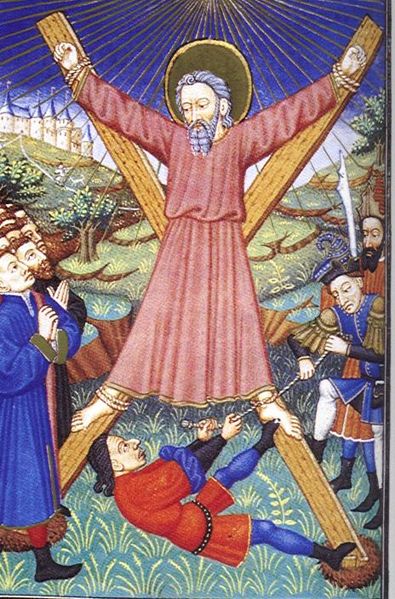
				<content:encoded><![CDATA[<div id="attachment_38899" class="wp-caption aligncenter" style="width: 405px"><a href="/wp-content/uploads/2009/11/395px-martyrdom_of_andrew.jpg" data-lightboxplus="lightbox[1567]" title="St Andrew's Day"><img class="size-full wp-image-38899" alt="Crucifixion of St Andrew" src="/wp-content/uploads/2009/11/395px-martyrdom_of_andrew.jpg" width="395" height="599" /></a><p class="wp-caption-text">Crucifixion of St Andrew</p></div>
<p>The 30th of November is celebrated by Christians across the world as <a href="http://www.scotclans.com/scotland/scottish-myths/religious-legends/st-andrew/">Saint Andrew&#8217;s day</a>; remembering the day that Andrew, one of the Jesus&#8217; twelve apostles, was martyred by crucifixion on an X-shaped cross, also known now as a &#8216;St Andrew&#8217;s Cross&#8217;, in Patras, in Greece.</p>
<p>However, for Scots, the day is more about celebrating and embracing their culture and heritage, and basically everything Scottish, rather than the traditional acknowledement of a Christian hero&#8217;s sacrifice, and his actual connection with Scotland.</p>
<p>Though <a href="http://www.scotclans.com/scotland/scottish-myths/religious-legends/st-andrew">Saint Andrew</a> is not only the patron saint of Scotland, but of Russia, Ukraine, Greece, and Romania amongst other places, plus of fishermen and singers too.</p>
<p>Born around sometime in the very early part of the first century AD, Andrew, along with his brother Saint Peter, was a fisher from Bethsaida, on the sea of Galilee. He was a disciple of John the Baptist and is said to have been the very first of Jesus&#8217; twelve apostles.</p>
<p>Tradition has it that Andrew travelled around, carrying out missionary work, particularly around the Black Sea. It&#8217;s claimed that he even travelled as far as Kiev and the Volga, hence how he become patron saint of countries such as Russia and the Ukraine.</p>
<p>Andrew was martyred in Patras sometime between 60 and 70AD. He was crucified (though records suggest that he was bound with rope rathern than nailed on) on an X-shaped cross, however, it isn&#8217;t until sometime in the tenth century, at the earliest, that his cross is described as being shaped diagonally.</p>
<p>Just like many important saints, Andrew&#8217;s remains weren&#8217;t left in peace, but instead, according to Saint Jerome, were taken from Patras to Constantinople sometime in the fourth century. They were removed by order of Roman emperor, Constantine, but a few body parts were saved and taken to Scotland by Saint Rule (also known as St Regulus) before they reached Constantinople. Legend has it that Rule was warned by an angel to move as much of the body as possible and take it for safekeeping as far away as possible. On his journey he was shipwrecked off the Fife coast and came ashore where the modern-day town of St Andrews now is, and was welcomed by the Pictish king.</p>
<p>The relics (claimed to be three fingers from Andrew&#8217;s right hand, a knee-cap, the upper bone of an arm, and a tooth) were held at a monastery in St Andrews, but were likely to have been destroyed during the Scottish Reformation in the 16th century.</p>
<p>The rest of the body was moved to Constantinople, but in 1208, following the sack of Constantinople, they were taken to the Cathedral of Sant&#8217; Andrea in the Italian town of Amalfi, and sometime during the 15th century Andrew&#8217;s head was taken to St. Peter&#8217;s Basilica in the Vatican.</p>
<p>Saint Andrew has been recognised as Scotland&#8217;s patron saint since as early as 1320 at the signing of the Declaration of Arbroath, believing that having an apostle of Jesus (a heavy-weight Saint) as patron of the country would help with independence on the religious front. However, there is a legend that sees Saint Andrew being made the patron saint in 832AD, at the battle of Athelstaneford between the Scots and the Angles. It is said that not long before the battle the king of the Scots prayed for help from Saint Andrew, and vowed, after seeing white clouds form an X-shape in the blue sky, that if his army were victorious he would proclaim Andrew the country&#8217;s patron saint. The Scots won the battle against their southern enemy, putting it down to the blessing from Saint Andrew, and in turn adopted the white cross on the blue background as their flag and Saint Andrew as their patron saint.</p>
<p>In more recent times other relics of Saint Andrew have been given to Scotland. In 1879, the Archbishop of Amalfi sent one of Saint Andrew&#8217;s shoulder blades to the re-established Catholic community in Scotland, whilst in 1969, Gordon Gray was in Rome to be appointed as the first Cardinal in Scotland since the Reformation, and was given some relics of Saint Andrew with the words &#8220;Saint Peter gives you his brother.&#8221; They are on display at St. Mary&#8217;s Roman Catholic Cathedral in Edinburgh.</p>
<p><a href="http://www.scotclans.com/scotland/scottish-myths/religious-legends/st-andrew">Saint Andrew</a> has been recognised as Scotland&#8217;s patron saint since as early as 1320 at the signing of the Declaration of Arbroath, believing that having an apostle of Jesus (considered a heavy-weight Saint) as patron of the country would help with independence on the religious front. However, there is a legend that sees Saint Andrew being made the patron saint in 832AD, at the battle of Athelstaneford between the Scots and the Angles. It is said that not long before the battle the king of the Scots prayed for help from Saint Andrew, and vowed, after seeing white clouds form an X-shape in the blue sky, that if his army were victorious he would proclaim Andrew the country&#8217;s patron saint. The Scots won the battle against their southern enemy, putting it down to the blessing from Saint Andrew, and in turn adopted the white cross on the blue background as their flag and Saint Andrew as their patron saint.</p>
<p>The post <a rel="nofollow" href="http://109.74.200.198/st-andrews-day/">St Andrew&#8217;s Day</a> appeared first on <a rel="nofollow" href="http://109.74.200.198">ScotClans | Scottish Clans</a>.</p>
]]></content:encoded>
			<wfw:commentRss>http://109.74.200.198/st-andrews-day/feed/</wfw:commentRss>
		<slash:comments>0</slash:comments>
		</item>
	</channel>
</rss>