The post The Scott Monument appeared first on ScotClans | Scottish Clans.
]]>
The Scott Monument, sometimes referred to as the ‘gothic rocket’, is a Victorian Gothic monument to the author Sir Walter Scott. It stands towards the east end of Princes Street in Edinburgh, and happens to be the largest monument to a writer in the world, and was completed on August 1st 1846.
Scott was a poet, novelist, ballad-collector, critic and man of letters, but is probably most renowned as the founder of the genre of the historical novel, involving tales of gallantry, romance and chivalry. Beginning with the publication of Waverley in 1814, one of the most significant books of the nineteenth-century, his anonymously published Waverley novels proved hugely popular in Europe and America, and established his reputation as a major international literary force. It is a measure of Scott’s influence that Edinburgh’s central railway station, opened in 1854, is called Waverley Station, the only station in the world to be named for a book.
By the 1820s, Scott was probably the most famous of living Scotsmen, and was consequently chosen to organise the visit to Edinburgh in 1822 of George IV. He was heavily criticised by his Scottish contemporaries for the resultant tartan pageantry, in which the King appeared in Highland dress complete with salmon-pink leggings.
In 1825, his financial state deteriorated drastically, and rather than declare bankruptcy he placed his home, Abbotsford, and income into a trust belonging to his creditors, and proceeded to write his way out of debt. He continued to live at Abbotsford near Melrose, where he died on the 21st September 1832. Among other tributes, the Scott monument was raised on Princes Street in Edinburgh…

Upon his death the great and good of Edinburgh came together to agree on a fitting monument to this outstanding Scottish man. In 1836, an architectural competition was launched, inviting designs for an appropriate memorial. One entrant went under the unlikely name of ‘John Morvo’, a name shared by the medieval architect of Melrose Abbey. Morvo was in fact George Meikle Kemp, a 45 year old joiner, draughtsman and self-taught architect. Kemp had feared his lack of architectural qualifications and reputation would influence judges against his design. In 1838 it was announced that Kemp’s design had won the competition and his monument was to be built. At the same time the result was announced, Sir John Steell was unanimously selected to undertake the sculpture of Scott at the base of the monument.
The foundation stone was laid on the 15th August 1840, the anniversary of Scott’s birthday. In the foundations were deposited a glass jar ‘time capsule’ and two bronze plaques – one from the Freemasons, the other celebrating the author.
A silver trowel with a mahogany handle was used during the ceremony for laying the foundation stone of the monument. It has an engraved border of a rolling thistle flower and leaf, and on it is written:
‘To Commemorate the Laying of the Foundation Stone of the Monument at Edinburgh in honour of the Immortal Scott.
This trowel to be used at the ceremonial was presented to the Right Honourable Sir James Forrest of Comiston Bart., Lord Provost of Edinburgh, Most Worshipful Grand Mason over all Scotland.
The Right Worshipful Master, Office Bearers and Brethren of the Grand Masters Mother Lodge, The Ancient Lodge of Edinburgh No.92. Aug 15th 1840.’
The trowel can be found on display at the Writers’ Museum, Lady Stair’s Close, Lawnmarket, Edinburgh.

Construction began in 1841 following permission by an Act of Parliament. Specifically the Monument to Sir Walter Scott Act 1841, which allowed the monument to be built on the site chosen, as there was a ban on any construction between Princes Street and the Old Town, so as not to obscure the historic view.
Tragically George Meikle Kemp died when the monument was only half completed, on the night of 6th March 1844. It is thought he was to have lost his way in very thick fog after visiting his contractor near the old Canal Basin in Fountainbridge. His body was found in the canal one week later. Over 1000 people attended his funeral. His coffin was carried to St Cuthberts graveyard by his workmen, who by all accounts, thoroughly respected his humble origins and great depth of knowledge.
After Kemp’s death, work continued under the supervision of his brother-in-law, William Bonnar. He proposed an amendment to the height from 176 feet to 200 feet and six inches. For a while there was dissent from outsiders, especially when a rise in costs from £10,000 to £12,000 was forecast. However, when workmen on the project offered two weeks labour without pay in order to support Bonnar, the money was found.

Taking nearly four years, construction ran until August of 1844 with Kemp’s son placing the finial in that month.
The actual date of the inauguration ceremony seems to have been lost to time, but most accounts give it as the 17th or 18th of August 1846, with contemporary newspapers stating that it was the 15th (Scott’s Birthday).
Thousands of people attended the inauguration ceremony, some travelling great distances to see the monument. The steamer ‘Britannia’ brought nearly 300, the evening before some 400 people came from Dundee, other ferries arrived in the morning from Fife, and a train came from Burns country with hundreds aboard.
The procession comprised the Monument Committees, the Town Council of Edinburgh, the Magistrates of Edinburgh, Canongate, Leith and Portsburgh, various Masonic Lodges and Officials, who all assembled in the Royal High School. It was described in The Scotsman newspaper as “a moving stream of umbrellas, with long lines of stationary umbrellas for its banks”, although there is not an umbrella to be seen in this image.
It was preceded by mounted military band, and a detachment of Dragoons. There was an opening address by Lord Glenlyon, Grand Master of Scotland and a reply by the Lord Provost of Edinburgh, the Right Honourable Adam Black – whose statue is 100 yards to the west of the monument.

From the ground the pinnacle of the monument rises 200ft and 6in above Princes Street and the gardens surrounding it. The foundations were sunk 52ft into the ground to support its considerable weight, and added considerably to the total cost of the structure which amounted to £16,154 which today would be around £1.5m.
The monument was constructed of Binny sandstone, from the local Ecclesmachan quarry in West Lothian, which has left it’s own unique stamp on the structure. As it is an oily stone it has prematurely aged the appearance of the structure, although the soot of Victorian times and the exhaust fumes of the modern road and rail routes close by will have contributed a great deal.
On the ground, in the centre of the monument on a platform up seven massive steps, there is a statue of Scott carved from carrara marble and scale at double life-size. This was the work of the aforementioned Sir John Steell. It features Scott in a seated position, book in hand, with one of his favourite dogs, Maida, reclining at his feet.
This statue was carved from a 30 ton block imported from Livorno in Italy, which was no easy task. The block had to be retrieved from the bottom of the city harbour, as it was so heavy it ended up crashing through the hull of the ship and when it eventually arrived in Edinburgh, at Leith docks, it took a total of 25 horses to drag the cart carrying it through the streets to Steell’s studio on Princes Street.
It is actually the first marble statue to ever be displayed in Scotland and almost glows out from under the monument and the dark stone that surrounds it.

The monument also features a total of 68 figurative statues (not including Scott and his dog), placed all over the structure. 64 are visible from the ground, but 4 are hidden away above the final viewing gallery.
Each statue represents a famous Scottish person or a character from Scott’s literary work. Just a few of the figures that can be seen are Rob Roy MacGregor, Robert Burns, Mary, Queen of Scots, Bonnie Prince Charlie, Robert the Bruce, and John Knox.
Also featured are several ‘grotesques’. The grotesque character faces are a typical stonemasons ‘joke’. Common in Gothic Architecture when medieval stonemasons carved all manner of weird and wonderful faces, gargoyles and other ‘grotesques’, on the great cathedrals of Europe.

Today the monument still stands proud in the heart of Edinburgh, instantly recognisable and loved by the cities residents. Of the visitors that flock to Edinburgh every year, thousands still visit this fantastic attraction and take on it’s 287 steps to get access to some of the best views of the city centre.
The post The Scott Monument appeared first on ScotClans | Scottish Clans.
]]>The post Border Reivers- Hobbie Noble of the Crew in Bewcastle appeared first on ScotClans | Scottish Clans.
]]>The story of Hobbie Noble of the Crew, one of the English Border Reivers of somewhat dubious reknown, is one such example of Scots and English coming together. He would aid the Armstrongs of Liddesdale, a Scottish Border clan, in their hour of need, yet eventually be betrayed by one of their own.
The Pathetic Remains of Crew Castle. Now nothing more than a Sheep Pen.

Hobbie Flees to the Scottish Borders.
Hobbie was from Bewcastle in what was known in his time as the Waste of north Cumberland; his home was Crew Castle. Little of what would once have been a formidable tower remains today; the earthworks, however, easily recognised, bear testimony to a place of formidable strength: the home of a family of prominence and importance in the region. The Waste is still there to this day. It is a harsh and unforgiving country yet delights in little pockets of sylvan beauty which are a delight to the eyes.
Hobbie spent many years raiding in Tynedale (Northumberland) and even parts of his homeland, to the south of his Cumberland fortress. It would seem that allegiance to his countrymen was of little concern to a man bent on raiding wherever the opportunity presented itself. The product of theft, the ‘reive’, meant more to Hobbie than allegiance to his own countrymen, his own people.
Eventually they disowned him as they tired of the retribution exacted on them by the surnames (families) he had raided within his own country and the clans to the north of the Border. Their lives were dominated by the relentless raids from Tynedale, other parts of Cumberland, and southern Scotland which, with regular monotony, raided the homesteads of the folk of Bewcastledale.
He was much prized by the English West March Warden, the law in Cumberland. Doubtless there were many crimes laid at his door in which he had taken no part.
Hobbie fled to Liddesdale in the Scottish Borders were he was well received by the Laird of Mangerton, head of the Armstrongs. Anyone on run from the law, irrespective of nationality, was welcomed by the Armstrongs of Liddesdale.
Hobbie is True to his Scottish Hosts.
When Jock Armstrong of the ‘Side’, a stalwart and leading member of the Scottish clan was captured and thrown into gaol in Newcastle to await a fate which would inevitably see him dangle at the end of a rope, Hobbie was a major force in planning and achieving his rescue. He was lauded by the Armstrongs of Mangerton for the sterling part he played in the rescue of Jock but there were other Armstrongs, within Scottish Liddesdale, who resented the popularity of the Englishman.
Mangerton Tower. Once home to the Chief of the Armstrongs of Liddesdale.

The remains of Mangerton Tower, Liddesdale
Hobbie is asked to lead a raid into England by the Armstrongs of the Mains
Sim Armstrong was Laird of the Mains, today a peaceful farm in Liddesdale, but in the days of the Border Reivers, the most dangerous valley in the whole of Europe. Sim had grown to hate the great English Reiver whilst the English Warden was bent on wresting Hobbie from the Scottish Border lands and bringing him to account for his crimes in England. Sim and the Warden made a deal whereby, in return for English gold, Sim would betray Hobbie into the Warden’s hands. Accordingly, on the pretext that Hobbie knew the English ground better than he did, Sim persuaded Hobbie to lead a raid south of the Border into England. The cattle and sheep were fat and ripe for the picking.
Hobbie is betrayed by Sim of the Mains
Hobbie led the Armstrongs of the Mains into England but at the same time Sim Armstrong sent word to the English Keeper of Askerton that Hobbie was back on English ground. Hobbie and the Armstrongs had rested overnight before their final assault on their target. At the first light of the following day Hobbie woke to see the English confronting him. He was not unduly concerned because he knew the ground right well. His fertile mind instantly recognised the path in which he and the Armstrongs could evade any confrontation. But it was not to be. The Armstrongs at his back suddenly voiced their allegiance to the English and Hobbie was betrayed for gold.
Askerton Castle.

Defence against the Border Reivers of Liddesdale
Hobbie is bound and taken to Carlisle
Hobbie was bound with his own bow-string and led ignominiously to Carlisle and thrown in the dark damp cells of Carlisle castle. He was told he would hang next day unless he would confess to stealing Peter of Winfield’s horse, a crime that had hung over his head for some time. There is some doubt that Hobbie was involved, that the charge was trumped up by the English to see an end to the great English Border Reiver. He denied the allegation and prepared himself for death. Next morning he was hanged. There was a lot of sympathy in the watching crowd for the man who had risked life and limb to rescue Jock of the ‘Side’ from the Black Tower of Newcastle.
Sir Walter Scott, avid lover of Scottish English Border history and eminent writer of the early nineteenth century gathered the story of Hobbie Noble and committed it to verse in his ‘Minstrelsy of the Scottish Border’.
Here are two particularly poignant verses from the ballad:
‘And fare thee weel , sweet Liddesdale, (weel = well)
Baith the hie land and the law;
Keep ye weel frae the traitor Mains,
For gould and gear he’ll sell ye a’ (goud = gold, a’ = all)
‘Yet wad I rather be ca’d Hobbie Noble, ( wad = would, ca’d = called)
In Carlisle , where he suffers for his fau’t, (fau’t = fault)
Than I’d be ca’d the traitor Mains,
That eats and drinks of the meal and maut’. ( maut = malt)
English Gold was no benefit to Sim of the Mains
When the Laird of Mangerton, head of the Armstrongs, heard of Hobbie’s fate and Sim’s involvement, he was furious. Normally, as Hobbie was executed by the English, his retribution would have been aimed against the English families who dared to steal in his domain, Liddesdale or its surrounds. For once he directed his wrath against his own. He planned a great reprisal against the Armstrongs of Mains even though they were a sect of the clan. Sim fled to England but within two months, thanks to intelligence furnished to the English by Mangerton, Sim of the Mains also dangled at the end of a rope on Harrabee Hill, the killing ground of Carlisle. No tears were wept by a crowd who were pleased that he had got his come-uppance for the betrayal of Hobbie Noble of the Crew.
Noblestown today. Home of the Nobles following the Union of the Crown and the Pacification of the Borders.

The post Border Reivers- Hobbie Noble of the Crew in Bewcastle appeared first on ScotClans | Scottish Clans.
]]>The post Sir Walter Scott’s ‘lost poem’ discovered appeared first on ScotClans | Scottish Clans.
]]>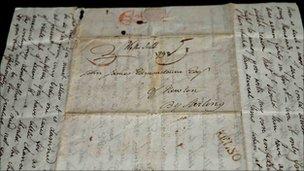
The poem is part of a collection of documents kept at Cambusmore House
The discovery of the unpublished poem and letters by one of Scotland’s greatest writers, Sir Walter Scott was made in Cambusmore House near Callander where Sir Walter spent many holidays at the house as a young lawyer. They have laid hidden here for over 200 years in the care of the Baillie-Hamilton family
The poem, called The Hills of Killearn, is be read in public for the first time. Its first reading will be on 14 September in Roman Camp Country House Hotel in Callander.
The nine letters in the collection, written over a number of years, will be going on display in Callander. The letters were written to an associate of Sir Walter who used to live there. The letters will be on display at the town’s McLaren Leisure Centre on 11 September and then at the Loch Lomond and Trossachs National Park office the following week.
The post Sir Walter Scott’s ‘lost poem’ discovered appeared first on ScotClans | Scottish Clans.
]]>