<br />
<b>Deprecated</b>:  mysql_connect(): The mysql extension is deprecated and will be removed in the future: use mysqli or PDO instead in <b>/var/www/apps/scotclans_wp/wp-includes/wp-db.php</b> on line <b>1142</b><br />
<?xml version="1.0" encoding="UTF-8"?>
<rss version="2.0"
	xmlns:content="http://purl.org/rss/1.0/modules/content/"
	xmlns:wfw="http://wellformedweb.org/CommentAPI/"
	xmlns:dc="http://purl.org/dc/elements/1.1/"
	xmlns:atom="http://www.w3.org/2005/Atom"
	xmlns:sy="http://purl.org/rss/1.0/modules/syndication/"
	xmlns:slash="http://purl.org/rss/1.0/modules/slash/"
	>

<channel>
	<title>ScotClans &#124; Scottish Clans &#187; Scottish</title>
	<atom:link href="http://109.74.200.198/tag/scottish/feed/" rel="self" type="application/rss+xml" />
	<link>http://109.74.200.198</link>
	<description></description>
	<lastBuildDate>Fri, 20 Jan 2017 08:08:09 +0000</lastBuildDate>
	<language>en-US</language>
	<sy:updatePeriod>hourly</sy:updatePeriod>
	<sy:updateFrequency>1</sy:updateFrequency>
	<generator>http://wordpress.org/?v=3.6.1</generator>
		<item>
		<title>Prophecy &#8211; Scottish Second Sight</title>
		<link>http://109.74.200.198/prophecy-scottish-second-sight/</link>
		<comments>http://109.74.200.198/prophecy-scottish-second-sight/#comments</comments>
		<pubDate>Thu, 02 Feb 2012 07:57:26 +0000</pubDate>
		<dc:creator>davemcnicoll</dc:creator>
				<category><![CDATA[Gaelic Heritage]]></category>
		<category><![CDATA[Scottish Mystery]]></category>
		<category><![CDATA[black rain]]></category>
		<category><![CDATA[brahan seer]]></category>
		<category><![CDATA[Cameron]]></category>
		<category><![CDATA[Campbell]]></category>
		<category><![CDATA[Clan]]></category>
		<category><![CDATA[clan donald]]></category>
		<category><![CDATA[clan heritage]]></category>
		<category><![CDATA[clearances]]></category>
		<category><![CDATA[highland]]></category>
		<category><![CDATA[highland clearnaces]]></category>
		<category><![CDATA[Inverness]]></category>
		<category><![CDATA[predictions]]></category>
		<category><![CDATA[prophecy]]></category>
		<category><![CDATA[prophets]]></category>
		<category><![CDATA[Scotland]]></category>
		<category><![CDATA[Scottish]]></category>
		<category><![CDATA[second sight]]></category>
		<category><![CDATA[seers]]></category>
		<category><![CDATA[sheep]]></category>
		<category><![CDATA[Thomas the Rhymer]]></category>

		<guid isPermaLink="false">http://www.scotclans.com/bletherskite/?p=3275</guid>
		<description><![CDATA[<p>The Scots are superstitious, and one of our most strongly held beliefs is that of the gift of second sight; the ability to predict events before they occur. Prophets, or seers, are well recorded in Scottish history and mythology from the Brahan Seer to Thomas the Rhymer; and this article looks at how their predictions cast a long shadow over the lives of people of Scotland</p>
<p>The post <a rel="nofollow" href="http://109.74.200.198/prophecy-scottish-second-sight/">Prophecy &#8211; Scottish Second Sight</a> appeared first on <a rel="nofollow" href="http://109.74.200.198">ScotClans | Scottish Clans</a>.</p>
]]></description>
				<content:encoded><![CDATA[<p class="MsoNormal" style="margin: 0cm 0cm 0pt;"><span style="font-family: Arial;"><span style="font-size: small;"><strong>The Scots are a superstitious people. We have a strong sense of the &#8216;otherworld&#8217; of portents, fairy people and tempting of fate: Scottish grannies are particularly good at spinning yarns of mysterious goings-on. One belief which has remained strong throughout the ages is that of Second Sight: the ability to see into the future and predict events ahead of time. The history of the Highlands is littered with prophets, or seers as they&#8217;re known; and very often their words foretold doom and disaster for one clan or another.</strong> </span></span></p>
<p class="MsoNormal" style="margin: 0cm 0cm 0pt;"><span style="font-family: Arial;"><span style="font-size: small;"> </span></span></p>
<p class="MsoNormal" style="margin: 0cm 0cm 0pt;"><span style="font-family: Arial;"><span style="font-size: small;">Easily the best known and most popular of Highland prophets is Kenneth Mackenzie, The Brahan Seer; who may (or may not) have lived around 400 years ago to the north and west of Inverness. The story goes that his mother cut a deal with the spirit of a Danish princess, and in return for letting the wraith return to her grave the power of second sight would be gifted upon her child. In the morning Kenneth awoke to find a stone with a hole cut through the middle next to his bed. On looking through the stone he was engulfed with visions, good and bad, of a future yet to come. In time he would learn to control this gift and make numerous predictions for his own people and for the Highlands as a whole.</span></span></p>
<div><span style="font-family: Arial;"><span style="font-size: small;"> </span></span></div>
<p><span style="font-family: Arial;"><span style="font-size: small;"> </span></span></p>
<p>&nbsp;</p>
<div id="attachment_5946" class="wp-caption aligncenter" style="width: 610px"><a href="/wp-content/uploads/2012/02/brahan-seer.jpg" data-lightboxplus="lightbox[5732]" title="Prophecy - Scottish Second Sight"><img class="size-full wp-image-5946" alt="The Brahan Seer" src="/wp-content/uploads/2012/02/brahan-seer.jpg" width="600" height="800" /></a><p class="wp-caption-text">The Brahan Seer</p></div>
<p class="MsoNormal" style="margin: 0cm 0cm 0pt;"><span style="font-family: Arial;"><span style="font-size: small;"> </span></span></p>
<p class="MsoNormal" style="margin: 0cm 0cm 0pt;"><span style="font-family: Arial;"><span style="font-size: small;">Although he is most famous for predicting the downfall of his own clan, the Mackenzies of Seaforth, with a dramatic vision of deaf chiefs, white-hooded lassies and tragedy; he also foresaw the destinies of many other clans as well, for example – &#8220;<em style="mso-bidi-font-style: normal;">When the big-thumbed sheriff officer and the blind man of the twenty-four fingers shall meet, then MacNeil of Barra shall prepare for a flitting</em>&#8220;. It is known that this prophecy came true in 1838 when the last of the MacNeils of Barra left Kisimul Castle behind bankrupt (a &#8216;flitting&#8217; in Scotland is to move house). Most of his predictions follow this vein, with many being very specific. Many of the prophecies are about battles or hardship ahead, and often a little macabre: &#8220;<em style="mso-bidi-font-style: normal;">The day will come when the raven will drink its three fills of the blood of Clan Donald on top of the Hills of Minaraidh in Lewis</em>&#8220;; ravens drinking the blood is a recurring theme. He would also foresee the changes that ravaged the Highlands during the Clearances of the 18<sup>th</sup> and 19<sup>th</sup> century that began in Ross-shire.</span></span></p>
<p class="MsoNormal" style="margin: 0cm 0cm 0pt;"><span style="font-family: Arial;"><span style="font-size: small;"> </span></span></p>
<p class="MsoNormal" style="margin: 0cm 0cm 0pt;"><span style="font-family: Arial;"><span style="font-size: small;">&#8220;<em style="mso-bidi-font-style: normal;">The day will come when there will be a road through the hills of Ross-shire from sea to sea, and a bridge on every stream. Then the people of the land will degenerate and grow weak as their country improves . . . and the clansmen will flee from their native country before an army of sheep</em>&#8221; Anyone who knows something of the history of the Highlands will know just how much that sadly came to pass, with sheep replacing men, and whole glens emptied of their people by a brutal aristocracy and their agents. Still, the seer goes on in another vision: <em style="mso-bidi-font-style: normal;">&#8220;the people will emigrate to islands now unknown in the boundless oceans, after which the deer and other wild animals shall be exterminated by horrid Black Rains. The people will then return and take undisturbed possession of the lands of their ancestors.</em>&#8221; This is a reference to the mass emigration from Scotland in the 19<sup>th</sup> century; but we still await the horrid black rain, and this is one of the most feared predictions in the Highlands still to be fulfilled. </span></span></p>
<p class="MsoNormal" style="margin: 0cm 0cm 0pt;"><span style="font-family: Arial;"><span style="font-size: small;"> </span></span></p>
<p class="MsoNormal" style="margin: 0cm 0cm 0pt;"><span style="font-family: Arial;"><span style="font-size: small;">The Brahan Seer wasn&#8217;t the only prophet to foretell the Clearances, and considering the social and personal upheavals it caused it&#8217;s no wonder. In the 1640s on the shores of Loch Tay in Highland Perthshire lived a seer known as the &#8216;Lady of Lawers&#8217;. It is likely she was Mary Campbell who married John Stewart of Appin, and lived at the big house in the now deserted village of Lawers. She too saw the coming of the sheep and the evicting of the people: &#8220;<em style="mso-bidi-font-style: normal;">The land will first be sifted and then riddled of its people, and the jaw of the sheep will drive the plough from the ground. The homes on Loch Tay shall become so scarce that a cock crowing will not be heard from one to the other.</em>&#8221; Today, the once heavily cultivated slopes of Loch Tay are now almost exclusively put over to sheep grazing. </span></span></p>
<p class="MsoNormal" style="margin: 0cm 0cm 0pt;"><span style="font-family: Arial;"><span style="font-size: small;"> </span></span></p>
<p class="MsoNormal" style="margin: 0cm 0cm 0pt;"><span style="font-family: Arial;"><span style="font-size: small;">The landlord was the Marquess of Breadalbane, who&#8217;s estate in the 19<sup>th</sup> century was nearly half a million acres; and he was instrumental in evicting at least 3000 people from Lochtayside during the worst excesses of the Clearances. Not that his family would be spared from the foresight of the Lady of Lawers either: &#8220;<em style="mso-bidi-font-style: normal;">The day will come when the Campbells of Breadalbane will have a thousand rents, then one rent, then no rents at all; what was put together in hides shall be rent asunder in laces. The last laird will pass over Glenogle with a grey pony leaving nothing behind.</em>&#8221; In the 1920s the estate fell into a sharp decline with mounting debts and by the 30s it was bust. Countess Breadalbane sold the last of the estate in 1948 and left the area in a trap pulled by a grey pony.</span></span></p>
<div></div>
<p>&nbsp;</p>
<div id="attachment_3283" class="wp-caption aligncenter" style="width: 494px"><img class="size-full wp-image-3283" title="Loch Tay" alt="Breadalbane - Hard hit by the Clearances" src="http://www.letsbuyscottish.com/wp-content/uploads/2012/02/loch-tayside.jpg" width="484" height="294" /><p class="wp-caption-text">Breadalbane &#8211; Hard hit by the Clearances</p></div>
<p>&nbsp;</p>
<p>&nbsp;</p>
<p class="MsoNormal" style="margin: 0cm 0cm 0pt;"><span style="font-family: Arial;"><span style="font-size: small;"> </span></span></p>
<p class="MsoNormal" style="margin: 0cm 0cm 0pt;"><span style="font-family: Arial;"><span style="font-size: small;">Sometimes landowners made the mistake of evicting seers as well, and one such soothsayer forcibly removed from Jura in the early 1700s left her Campbell landlord with an ominous prediction: &#8220;<em style="mso-bidi-font-style: normal;">The last Campbell laird of Jura will be blind in one eye, and will leave the island with all of his belongings tied to a cart pulled by a lone white horse</em>.&#8221; This was well known to the islanders, and finally came true in 1938 when Charles Campbell, who&#8217;d been blinded in the First World War fell on hard times, sold up and left the island behind with nothing but a cart and horse. Today, the Isle of Jura distillery produces a whisky commemorating the story, called &#8220;Prophecy&#8221;</span></span></p>
<p class="MsoNormal" style="margin: 0cm 0cm 0pt;"><span style="font-family: Arial;"><span style="font-size: small;"> </span></span></p>
<p class="MsoNormal" style="margin: 0cm 0cm 0pt;"><span style="font-family: Arial;"><span style="font-size: small;">Not all prophecies are doom and gloom; some have a more positive aspect. For example it is well known to the Clan Cameron that &#8220;<em style="mso-bidi-font-style: normal;">As long as there&#8217;s snow on Ben Nevis the Camerons will command Locheil</em>&#8220;. At 4409ft, Ben Nevis is the highest mountain in the British isles and looms high and large over the Cameron estates of Locheil; being so high the snow has only melted six times in the last 120 years, only to remain the next year. The Camerons I think are safe. But, eventually we may all be doomed by the famous words of the Border prophet known as &#8216;Thomas the Rhymer&#8217;: &#8220;<em style="mso-bidi-font-style: normal;">When the Cows of Gowrie come to land, the Judgement Day is near at hand.</em>&#8221; The Cows of Gowrie are two boulders sitting in the sands of the Firth of Tay near Dundee, and it is said they move landward at about an inch a year. </span></span></p>
<p class="MsoNormal" style="margin: 0cm 0cm 0pt;"><span style="font-family: Arial;"><span style="font-size: small;"> </span></span></p>
<p class="MsoNormal" style="margin: 0cm 0cm 0pt;"><span style="font-family: Arial;"><span style="font-size: small;">The legend goes that Thomas the Rhymer, who lived in the 13<sup>th</sup> century in the village of Earlston near Melrose, was enchanted by a fairy queen dwelling deep within the Eildon Hills. He was allowed to return to the mortal world for a short time, and was granted the gift of second sight; before eventually spending eternity in the world of the fairies. The story is similar in theme to the &#8216;gifting&#8217; of the power to the Brahan Seer; and the <em style="mso-bidi-font-style: normal;">sidhe</em>, or fairy people play a large part in old superstitions and legends in Scotland. It may be a folk-memory of an older, lost culture that had certain shamanic ritual, and thus lots of prophecies. Many people across the globe, through their own natural shrewdness and perhaps with the help of hallucinogens have been venerated in their culture as being able to divine the future. The seers are our version of this, and many people have claimed the gift, or curse, right down to the present day – it may well have its origins in our very ancient past. It certainly makes for great storytelling. </span></span></p>
<p class="MsoNormal" style="margin: 0cm 0cm 0pt;"><span style="font-family: Arial;"><span style="font-size: small;">This article was written by David McNicoll, who runs Vacation Scotland &#8211; a travel company specialising in tours and vacation packages to Scotland. For more info &#8211; <a title="Vacation Scotland" href="http://www.vacationscotland.biz" target="_blank">www.vacationscotland.biz</a> </span></span></p>
<p>The post <a rel="nofollow" href="http://109.74.200.198/prophecy-scottish-second-sight/">Prophecy &#8211; Scottish Second Sight</a> appeared first on <a rel="nofollow" href="http://109.74.200.198">ScotClans | Scottish Clans</a>.</p>
]]></content:encoded>
			<wfw:commentRss>http://109.74.200.198/prophecy-scottish-second-sight/feed/</wfw:commentRss>
		<slash:comments>2</slash:comments>
		</item>
		<item>
		<title>A Hidden Gem &#8211; New Lanark</title>
		<link>http://109.74.200.198/a-hidden-gem-new-lanark/</link>
		<comments>http://109.74.200.198/a-hidden-gem-new-lanark/#comments</comments>
		<pubDate>Sat, 20 Aug 2011 07:38:33 +0000</pubDate>
		<dc:creator>davemcnicoll</dc:creator>
				<category><![CDATA[Scottish Places & Buildings]]></category>
		<category><![CDATA[edinburgh]]></category>
		<category><![CDATA[enlightenment]]></category>
		<category><![CDATA[glasgow]]></category>
		<category><![CDATA[History]]></category>
		<category><![CDATA[industry]]></category>
		<category><![CDATA[Lowlands]]></category>
		<category><![CDATA[Reformation]]></category>
		<category><![CDATA[Scotland]]></category>
		<category><![CDATA[Scottish]]></category>

		<guid isPermaLink="false">http://www.scotclans.com/bletherskite/?p=3104</guid>
		<description><![CDATA[<p>Scotland has four World Heritage Sites, and  perhaps the least well know, New Lanark, has its own very interesting tale. To me the story of the enterprise village is part and parcel of the change that embraced Scotland during the Industrial Revolution, and Enlightenment period.</p>
<p>The post <a rel="nofollow" href="http://109.74.200.198/a-hidden-gem-new-lanark/">A Hidden Gem &#8211; New Lanark</a> appeared first on <a rel="nofollow" href="http://109.74.200.198">ScotClans | Scottish Clans</a>.</p>
]]></description>
				<content:encoded><![CDATA[<p class="MsoNormal" style="margin: 0cm 0cm 0pt;"><span style="font-size: small;"><span style="font-family: Arial;">Scotland</span><span style="font-family: Arial;"> has four World Heritage sites: The Heart of Neolithic Orkney; St Kilda; Old and New Town Edinburgh and perhaps the least well known, New Lanark. Sitting just below the dramatic Falls of Clyde about 30 miles from Glasgow, the living museum of New Lanark reflects the extraordinary changes that took place is Scottish society over the course of the 18<sup>th</sup> and 19<sup>th</sup> centuries: changes that had their roots in some very unlikely places.</span></span></p>
<p class="MsoNormal" style="margin: 0cm 0cm 0pt;">
<p>&nbsp;</p>
<p class="MsoNormal" style="margin: 0cm 0cm 0pt;">
<p class="MsoNormal" style="margin: 0cm 0cm 0pt;"><span style="font-family: Arial;"><span style="font-size: small;">The Scottish Reformation of the 17<sup>th</sup> century was at times brutal, destructive and reactionary; and yet, for the most part it was liberating and enlightening. The new church, the Kirk, established poorhouses in every parish, engaged the local population in clerical affairs and brought the Bible and Sermon down to serve the people. The Church of Scotland has a Calvinist doctrine, and at the heart of this theology is the belief that faith is a personal covenant with the Almighty and an understanding of the gospels and laws of the Old Testament. Thus, education stood as a central pillar of the Kirk. It would have unforeseen consequences.</span></span></p>
<p class="MsoNormal" style="margin: 0cm 0cm 0pt;">
<p>&nbsp;</p>
<p class="MsoNormal" style="margin: 0cm 0cm 0pt; text-align: center;"><span style="font-family: Arial;"><span style="font-size: small;"><img class="size-full wp-image-3112 aligncenter" title="johnknox1" alt="johnknox1" src="http://www.letsbuyscottish.com/wp-content/uploads/2011/08/johnknox1.jpg" width="411" height="290" /></span></span></p>
<p class="MsoNormal" style="margin: 0cm 0cm 0pt; text-align: center;"><span style="font-family: Arial;"><span style="font-size: small;"><strong>John Knox &#8211; Father of the Scottish Reformation</strong></span></span></p>
<p>&nbsp;</p>
<p class="MsoNormal" style="margin: 0cm 0cm 0pt;">
<p>&nbsp;</p>
<p class="MsoNormal" style="margin: 0cm 0cm 0pt;">
<p class="MsoNormal" style="margin: 0cm 0cm 0pt;"><span style="font-family: Arial;"><span style="font-size: small;">It was a key principal of the new regime that everyone could read the Bible, and so a school was established in virtually every parish in Scotland. As a result, children in Scotland would throughout the 18<sup>th</sup> and 19<sup>th</sup> centuries receive a full education until the age of 14; something that was completely unheard off across Europe at that time. By 1800 over 75% of all Scots were literate, the highest rate on earth. What the Church hadn&#8217;t taken into account was that people would read books other than the Bible; they did, and they ate up literature, mathematics, philosophy, classical texts and humanities with a voracious appetite. Our unique universal education policy laid the foundation for the Scottish Enlightenment. </span></span></p>
<p class="MsoNormal" style="margin: 0cm 0cm 0pt;">
<p>&nbsp;</p>
<p class="MsoNormal" style="margin: 0cm 0cm 0pt;">
<p class="MsoNormal" style="margin: 0cm 0cm 0pt;"><span style="font-family: Arial;"><span style="font-size: small;">It took more than education to change Scotland though, it took money as well. Scotland was historically one of the poorest nations in Europe; a problem compounded by an unfavourable climate, and a dearth of good agricultural land. Yet, the Scots are hard working, and following the Treaty of Union with England in 1707 new agricultural techniques arrived into the country, and Lowland Scotland went through a rapid agrarian revolution. Like the Highland Clearances that followed a century later, there was a large population shift, as farming became less labour intensive and smaller units were merged into larger ones. But, for the farmers and the markets they served, it was boom time; and a new middle class began to emerge.</span></span></p>
<p class="MsoNormal" style="margin: 0cm 0cm 0pt;">
<p>&nbsp;</p>
<p class="MsoNormal" style="margin: 0cm 0cm 0pt;">
<p class="MsoNormal" style="margin: 0cm 0cm 0pt;"><span style="font-family: Arial;"><span style="font-size: small;">The money being generated, and the wealth flowing across the border also helped to finance new innovation and entrepreneurship. Opportunities in England&#8217;s overseas colonies was also breeding a burgeoning merchant class; slowly at first, but then like a hare out of the trap Scotland&#8217;s economy blossomed like the heathland being converted to farms across the nation. However, many of these farmers, especially in Ayrshire, around Glasgow and in Fife never realised the untapped wealth their fields covered – a new revolution was coming and like the Reformation before it, it would change the country forever.</span></span></p>
<p class="MsoNormal" style="margin: 0cm 0cm 0pt;">
<p>&nbsp;</p>
<p class="MsoNormal" style="margin: 0cm 0cm 0pt;">
<p class="MsoNormal" style="margin: 0cm 0cm 0pt;"><span style="font-family: Arial;"><span style="font-size: small;">The City of Glasgow was well placed on the Clyde to trade with the colonies of North America; and by the mid 1700s was the key tobacco and sugar port in the British Isles. This made the mercantile class very rich indeed, but more was to come. As well as trading with the world, it would be here on the Clyde the world&#8217;s shipping would be built. In addition huge coal reserves and iron deposits were discovered across the Central Belt. Forges, steelworks, factories, mills and all sorts of industries sprung up and thrived from Ayr in the south to Dundee in the east. By 1850 Scotland had become the Engine Room of the British Empire. It was a remarkable transformation.</span></span></p>
<p class="MsoNormal" style="margin: 0cm 0cm 0pt;">
<p>&nbsp;</p>
<p class="MsoNormal" style="margin: 0cm 0cm 0pt;">
<p class="MsoNormal" style="margin: 0cm 0cm 0pt;"><span style="font-family: Arial;"><span style="font-size: small;">The cities also provided a home for the many in the countryside who couldn&#8217;t find work at home, but conditions were grim. Places like the Gorbals in Glasgow or the Hilltown area of Dundee were among the worst slums in Europe – the Gorbals would be forever etched in the national psyche as the epitome of horrific housing and poverty. Still, they poured in, fuelling the Industrial Revolution as much as the coal, steel, ships or jute they were working with. Edinburgh too had its slums and industrial heart, but nothing like Glasgow; and the Scottish capital has long since drawn its wealth and employment opportunities from the service industry. </span></span></p>
<p class="MsoNormal" style="margin: 0cm 0cm 0pt;">
<p>&nbsp;</p>
<p class="MsoNormal" style="margin: 0cm 0cm 0pt;">
<p class="MsoNormal" style="margin: 0cm 0cm 0pt;"><span style="font-family: Arial;"><span style="font-size: small;">It was here that the new finance available was sown into something very different, and the &#8216;Athens of the North&#8217; would become the fulcrum of the Enlightenment. Throughout the late 18<sup>th</sup> and all of the 19<sup>th</sup> centuries, it would be greatest intellectual seat in Europe; and as the money poured in on the back of all the philosophical advancements so a strong banking sector developed. It was here that Scotland&#8217;s special education system perhaps shone the brightest. Yet, across the nation, that great gift of learning was paying dividends: from Watt&#8217;s steam engine, and Adam Smith&#8217;s economic theories; from the poems of Robert Burns to the medical advancements pioneered by the likes of Joseph Lister. These were gifts that Scotland would export around the world as the British Empire grew to cover a quarter of the globe.</span></span></p>
<p class="MsoNormal" style="margin: 0cm 0cm 0pt;">
<p>&nbsp;</p>
<p class="MsoNormal" style="margin: 0cm 0cm 0pt;">
<p class="MsoNormal" style="margin: 0cm 0cm 0pt;"><span style="font-family: Arial;"><span style="font-size: small;">The River Clyde crashes over the Bonnington and Corra Linn waterfalls with an incredible force, a power that industrialists had long coveted. In 1786, one of them, David Dale and his son-in-law Robert Owen took the strength of the river and built a set of new mills in the valley bellow the old medieval town of Lanark. Unlike the slave drivers in Glasgow, these two had a more utopian vision of how a workforce should be treated. New Lanark was, from the very beginning, meant to be something different and more socially enlightened. Owen was the real driving force in this project, a man of real philanthropic ideals. He would take hundreds of families from the slums and bring them to the leafy Clyde valley, and give them a proper life, and from that good, hard workers. It was, and is a fantastic concept. The craziest part is that it worked. Owen even bought out his less enlightened partners to pursue his welfare programmes. </span></span></p>
<p class="MsoNormal" style="margin: 0cm 0cm 0pt;">
<p>&nbsp;</p>
<p class="MsoNormal" style="margin: 0cm 0cm 0pt; text-align: center;"><span style="font-family: Arial;"><span style="font-size: small;"><img class="size-full wp-image-3113 aligncenter" title="new-lanark" alt="new-lanark" src="http://www.letsbuyscottish.com/wp-content/uploads/2011/08/new-lanark-clyde.jpg" width="474" height="333" /></span></span></p>
<p class="MsoNormal" style="margin: 0cm 0cm 0pt; text-align: center;"><span style="font-family: Arial;"><span style="font-size: small;"><strong>The Mills and Houses of New Lanark</strong></span></span></p>
<p>&nbsp;</p>
<p class="MsoNormal" style="margin: 0cm 0cm 0pt;">
<p>&nbsp;</p>
<p class="MsoNormal" style="margin: 0cm 0cm 0pt;">
<p class="MsoNormal" style="margin: 0cm 0cm 0pt;"><span style="font-family: Arial;"><span style="font-size: small;">It became a model village, and enterprise; and the great and good from rags to royalty came to see it in action. It was more often than not an eye-opening experience. When the Mills finally shut in 1968, a number of ventures worked to keep the essence of the site intact; and today both the village and the falls are among Scotland&#8217;s best kept secret attractions. It remains a fantastic testament to our nation&#8217;s industrial spirit and enlightened zeal.</span></span></p>
<p class="MsoNormal" style="margin: 0cm 0cm 0pt;">
<p>&nbsp;</p>
<p class="MsoNormal" style="margin: 0cm 0cm 0pt;">Written by David McNicoll, owner of Highland Experience USA &#8211; and for anyone interested in our heritage. www.highlandexperience-usa.com</p>
<p>The post <a rel="nofollow" href="http://109.74.200.198/a-hidden-gem-new-lanark/">A Hidden Gem &#8211; New Lanark</a> appeared first on <a rel="nofollow" href="http://109.74.200.198">ScotClans | Scottish Clans</a>.</p>
]]></content:encoded>
			<wfw:commentRss>http://109.74.200.198/a-hidden-gem-new-lanark/feed/</wfw:commentRss>
		<slash:comments>1</slash:comments>
		</item>
		<item>
		<title>The Parallel Roads of Glen Roy</title>
		<link>http://109.74.200.198/the-parallel-roads-of-glen-roy/</link>
		<comments>http://109.74.200.198/the-parallel-roads-of-glen-roy/#comments</comments>
		<pubDate>Wed, 03 Aug 2011 20:43:07 +0000</pubDate>
		<dc:creator>davemcnicoll</dc:creator>
				<category><![CDATA[Scottish Places & Buildings]]></category>
		<category><![CDATA[Charles Darwin]]></category>
		<category><![CDATA[Geography]]></category>
		<category><![CDATA[Geology]]></category>
		<category><![CDATA[Glaciation]]></category>
		<category><![CDATA[Glaciers]]></category>
		<category><![CDATA[Glen Roy]]></category>
		<category><![CDATA[Great Glen]]></category>
		<category><![CDATA[Highlands]]></category>
		<category><![CDATA[ice]]></category>
		<category><![CDATA[James Hutton]]></category>
		<category><![CDATA[lakes]]></category>
		<category><![CDATA[landscapes]]></category>
		<category><![CDATA[Louis Agassiz]]></category>
		<category><![CDATA[prehistoric]]></category>
		<category><![CDATA[scenery]]></category>
		<category><![CDATA[Scotland]]></category>
		<category><![CDATA[Scottish]]></category>

		<guid isPermaLink="false">http://www.scotclans.com/bletherskite/?p=3071</guid>
		<description><![CDATA[<p>For centuries the Parallel Roads of Glen Roy had baffled both scientists and myth-makers alike; and solving the puzzle would reveal an amazing picture of our geological past. Glen Roy, in Lochaber has three distinct, parallel terraces running the length of both sides of the valley; and it wasn't until the mid 19th century did geologists realise that they were looking at ancients shorelines from a lake dammed back by huge glaciers. The understanding that Scotland was once glaciated opened up the study across the world; but it was here that scientists had their ah-ha moment.</p>
<p>The post <a rel="nofollow" href="http://109.74.200.198/the-parallel-roads-of-glen-roy/">The Parallel Roads of Glen Roy</a> appeared first on <a rel="nofollow" href="http://109.74.200.198">ScotClans | Scottish Clans</a>.</p>
]]></description>
				<content:encoded><![CDATA[<p class="MsoNormal" style="margin: 0cm 0cm 0pt;"><span style="font-family: Arial;">They were a mystery that baffled scientists and legend makers alike; a conundrum with a thousand answers, each as wonderful and often ludicrous as the other – and for hundreds of years the Parallel Roads of Glen Roy provided a ready source for the kind of folk tales enjoyed by Highlanders. The solving of the puzzle would however reveal a story far more fantastical and unimaginable than any fairy tale could conjure; and gives us an insight to the incredible story of Scotland, and the world.</span></p>
<p class="MsoNormal" style="margin: 0cm 0cm 0pt;"><span style="font-family: Arial;"></p>
<p></span></p>
<p class="MsoNormal" style="margin: 0cm 0cm 0pt;"><span style="font-family: Arial;"> </span></p>
<p class="MsoNormal" style="margin: 0cm 0cm 0pt;"><span style="font-family: Arial;">Glen Roy is a narrow, steep-sided valley branching off from the wider Glen Spean about 15 miles north of Fort William and the high peaks of the Ben Nevis Range. Glen Spean in turn opens into the broad, straight and imposing Glen Mòr, or Great Glen. This geographical arrangement would have a significant bearing on the story. Curiously, Glen Roy has a ring of terraces or &#8216;roads&#8217; running the entire length of the valley on one side which is then mirrored at the exact same altitude on the other. They look man-made, but are so precise in keeping their height and remain parallel to each other that some other-worldly influence seems present in the formation. There are three distinct terraces ringing the valley, one at 850ft, the next at 1066ft and the highest at 1150ft above sea-level. This uniformity and curious nature of their existence in this one valley spawned countless myths and stories.</span></p>
<p class="MsoNormal" style="margin: 0cm 0cm 0pt;"><span style="font-family: Arial;"></p>
<p></span></p>
<p class="MsoNormal" style="margin: 0cm 0cm 0pt;"><span style="font-family: Arial;"> </span></p>
<p class="MsoNormal" style="margin: 0cm 0cm 0pt;"><span style="font-family: Arial;">Legend had it, they were built by the Romans to race their chariots; or perhaps by our Pictish ancestors as a running track to prove one&#8217;s manliness. Others suggested they were constructed by the legendary Fionn MacCuimhaill as an aid to hunting some mysterious beast in the mountains of Lochaber. The fairies built them as part of their ancient magic, or the Gods for us to worship; and, religion would be a major player when the real investigation started. </span></p>
<p class="MsoNormal" style="margin: 0cm 0cm 0pt;"><span style="font-family: Arial;"></p>
<p></span></p>
<p class="MsoNormal" style="margin: 0cm 0cm 0pt;"><span style="font-family: Arial;"> </span></p>
<p class="MsoNormal" style="margin: 0cm 0cm 0pt;"><span style="font-family: Arial;">The Scottish Highlands are littered with large mounds; boulders in the wrong places, knows as erratics; and high terraces lining many of the straths and glens. There didn&#8217;t seem to be any natural reason or cause for this, or indeed why the landscape should be the shape it is. Until the middle of the 19<sup>th</sup> century the only plausible explanation was Noah&#8217;s Flood – and that these phenomena were thus created by the receding waters; and, this simplistic biblical mindset was stubbornly resistant. However, in-roads and alternatives were being espoused. Scottish geologists <a title="James Hutton" href="http://en.wikipedia.org/wiki/James_Hutton" target="_blank">James Hutton</a> and Charles Lyell had begun to explain the processes of how the earth was formed over huge eons of time, and that these processes are on-going. This was of course a direct challenge to the 7 Day Creation story, and it took a lot of persuading for it to become mainstream. </span></p>
<p class="MsoNormal" style="margin: 0cm 0cm 0pt;"><span style="font-family: Arial;"></p>
<p></span></p>
<p class="MsoNormal" style="margin: 0cm 0cm 0pt;"><span style="font-family: Arial;"> </span></p>
<p class="MsoNormal" style="margin: 0cm 0cm 0pt;"><span style="font-family: Arial;">Thus, they said, geological action over vast periods of time, and weathering could account for many of the features found in the Highlands; but, the Parallel Roads of Glen Roy had them stumped. These were clearly not river terraces, nor laid down in geological sequence. Lyell, and even Charles Darwin looked to explain the mystery. In the 1830s both men became convinced that what they were looking at were ancient coastlines, beaches formed when the sea was much higher (or the land much lower) than today. This kind of correlated with the Flood proposal, and many stuck to the older theory. They would all be proved wrong; and when the answer finally came, it would revolutionise the story of the planet, and rock the scientific world to its core.</span></p>
<p class="MsoNormal" style="margin: 0cm 0cm 0pt;"><span style="font-family: Arial;"></p>
<p></span></p>
<p class="MsoNormal" style="margin: 0cm 0cm 0pt;"><span style="font-family: Arial;"> </span></p>
<p class="MsoNormal" style="margin: 0cm 0cm 0pt;"><span style="font-family: Arial;">During the 1830s the revolutionary Swiss geologist <a title="Louis Agassiz" href="http://en.wikipedia.org/wiki/Louis_Agassiz" target="_blank">Louis Agassiz</a> proposed that his Alpine homeland had once been covered by a massive ice sheet similar to that of Greenland, rather than the network of sinuous glaciers snaking down from peaks as now. This had been brought about by detailed work examining rocks, terraces and deposits; and, in 1837 he published the idea that the world had once been subject to an enhanced glacial episode. So, armed with the know-how he came to Scotland in 1840. Here, where no glaciers existed, Agassiz and his colleague William Buckland showed substantial and evidential proof that the mountains and glens had been in the past subjected to intense glaciation – the same mounds, deposits, scratches (known as striations) and erratics found in the Alps were all over the Highland landscape. It was empirical confirmation that Scotland too had once been under the action of an ice sheet and multiple glaciers. But, what of Glen Roy and those pesky roads?</span></p>
<p class="MsoNormal" style="margin: 0cm 0cm 0pt;"><span style="font-family: Arial;"></p>
<p></span></p>
<p class="MsoNormal" style="margin: 0cm 0cm 0pt;"><span style="font-family: Arial;"> </span></p>
<p class="MsoNormal" style="margin: 0cm 0cm 0pt;"><span style="font-family: Arial;">In a moment of clarity, Agassiz, who dedicated much of his research in this area concluded that the terraces were shorelines formed by fresh-water lakes dammed by ice in the main valley. In 1863 Thomas Jamieson published a paper on the ice-age origins of the parallel roads: his conclusions settled the debate once and for all. </span></p>
<p class="MsoNormal" style="margin: 0cm 0cm 0pt;"><span style="font-family: Arial;"></p>
<p></span></p>
<p class="MsoNormal" style="margin: 0cm 0cm 0pt;"><span style="font-family: Arial;"> </span></p>
<p class="MsoNormal" style="margin: 0cm 0cm 0pt;"><span style="font-family: Arial;">Towards the end of the last Ice Age, around 11,000 years ago, ice once again thickened and spread to fill the wide basin of the Great Glen in Lochaber; which as it grew spilled into Glen Spean. This then blocked off the potential for meltwater in Glen Roy (and also in Glen Gloy) to escape to the sea. So, what are known as &#8216;ice-dammed lakes&#8217; formed, leaving the tell-tale shorelines. As the ice continued to thicken, the lake level rose: marked out by the three terraces. Eventually, the water level reached the point where it exceeded the altitude of the watershed at the head of the glen, and over-spilled into the River Spey catchment and flowed to the North Sea.</span></p>
<p class="MsoNormal" style="margin: 0cm 0cm 0pt;"><span style="font-family: Arial;"></p>
<p></span></p>
<p class="MsoNormal" style="margin: 0cm 0cm 0pt;"><span style="font-family: Arial;"> </span></p>
<p class="MsoNormal" style="margin: 0cm 0cm 0pt;"><span style="font-family: Arial;">Around 10,000 years ago the climate warmed dramatically and the ice melted quickly away; and, with the blockage gone the lake could drain down into the Atlantic – it may have been quite an explosive event, and the valley all the way to Fort William is littered with gravels from the disgorging of the lake. Understanding the processes involved in the formation of the parallel roads completely re-wrote our understanding of the earth&#8217;s glacial past; revolutionised the study of ancient landform creation (evidence of enormous ice-dammed lakes would be found in North America for example); and, without the mystery of the Parallel Roads of Glen Roy those discoveries may have been decades in the finding. Figuring out this enduring mystery was the Eureka moment in the study of the world&#8217;s landscape history; and aught not to be forgotten. </span></p>
<p class="MsoNormal" style="margin: 0cm 0cm 0pt;"><span style="font-family: Arial;"></p>
<p></span></p>
<p class="MsoNormal" style="margin: 0cm 0cm 0pt;">
<p class="MsoNormal" style="margin: 0cm 0cm 0pt;"><span style="font-family: Arial;">This blog was written by David McNicoll, owner of Highland Experience USA; who specialise in Scottish Travel Packages. Tours to explore Scotland&#8217;s incredible geography and scenery can be arranged.</span></p>
<p class="MsoNormal" style="margin: 0cm 0cm 0pt;"><span style="font-family: Arial;">Link &#8211; <a title="www.highlandexperience-usa.com" href="http://www.highlandexperience-usa.com" target="_blank">www.highlandexperience-usa.com</a></p>
<p></span></p>
<p class="MsoNormal" style="margin: 0cm 0cm 0pt;"><span style="font-family: Arial;"> </span></p>
<p class="MsoNormal" style="margin: 0cm 0cm 0pt;">
<p>The post <a rel="nofollow" href="http://109.74.200.198/the-parallel-roads-of-glen-roy/">The Parallel Roads of Glen Roy</a> appeared first on <a rel="nofollow" href="http://109.74.200.198">ScotClans | Scottish Clans</a>.</p>
]]></content:encoded>
			<wfw:commentRss>http://109.74.200.198/the-parallel-roads-of-glen-roy/feed/</wfw:commentRss>
		<slash:comments>0</slash:comments>
		</item>
		<item>
		<title>Argentina Has Highest Population of Scottish Descent Outwith English Speaking Countries</title>
		<link>http://109.74.200.198/argentina-has-highest-population-of-scottish-descent-outwith-english-speaking-countries/</link>
		<comments>http://109.74.200.198/argentina-has-highest-population-of-scottish-descent-outwith-english-speaking-countries/#comments</comments>
		<pubDate>Thu, 17 Mar 2011 18:18:08 +0000</pubDate>
		<dc:creator>donald</dc:creator>
				<category><![CDATA[Grierson]]></category>
		<category><![CDATA[Hutton]]></category>
		<category><![CDATA[Stewart]]></category>
		<category><![CDATA[Watson]]></category>
		<category><![CDATA[Argentina]]></category>
		<category><![CDATA[Scotland]]></category>
		<category><![CDATA[Scottish]]></category>

		<guid isPermaLink="false">http://www.scotclans.com/bletherskite/?p=2646</guid>
		<description><![CDATA[<p>I just found out that outside of the English speaking world, Argentina has the largest number of people of Scottish descent, which I thought was pretty interesting. The Argentine-Scot population currently stands at an estimated 100,000, and has existed, at varying levels, for over 180 years. Over the years there have been some very notable [&#8230;]</p>
<p>The post <a rel="nofollow" href="http://109.74.200.198/argentina-has-highest-population-of-scottish-descent-outwith-english-speaking-countries/">Argentina Has Highest Population of Scottish Descent Outwith English Speaking Countries</a> appeared first on <a rel="nofollow" href="http://109.74.200.198">ScotClans | Scottish Clans</a>.</p>
]]></description>
				<content:encoded><![CDATA[<p>I just found out that outside of the English speaking world, Argentina has the largest number of people of Scottish descent, which I thought was pretty interesting. The Argentine-Scot population currently stands at an estimated 100,000, and has existed, at varying levels, for over 180 years.</p>
<p><a href="/wp-content/uploads/2011/03/flag-pins-argentina-scotland-300x240.jpg" data-lightboxplus="lightbox[2646]" title="Argentina Has Highest Population of Scottish Descent Outwith English Speaking Countries"><img class="aligncenter size-full wp-image-5892" alt="flag-pins-argentina-scotland-300x240" src="/wp-content/uploads/2011/03/flag-pins-argentina-scotland-300x240.jpg" width="300" height="240" /></a>Over the years there have been some very notable Scottish-Argentinians. These include</p>
<ul>
<li>Cecilia <a href="http://www.scotclans.com/scottish-clans/clan-grierson/" target="_blank">Grierson</a> -  Cecilia was the first Argentine woman to earn a Doctor in Medicine degree, and had Scottish ancestry.</li>
<li>Alexander <a href="http://www.scotclans.com/scottish-clans/clan-watson/" target="_blank">Watson</a> <a href="http://www.scotclans.com/scottish-clans/clan-hutton/" target="_blank">Hutton</a> &#8211; a Glasgow schoolteacher, Hutton emigrated to Argentina in his late twenties. He taught for a few years in Buenos Aries, before going on to found the Argentine Association Football League, now known as the <span class="mw-redirect">Asociación del Fútbol Argentino, in 1893.</span> It was the first football league outwith the the UK. He is known as the &#8216;father of Argentinian football&#8217;.</li>
<li>Duncan Antonio <a href="http://www.scotclans.com/scottish-clans/clan-stewart/" target="_blank">Stewart</a> Agell &#8211; Born in Buenos Aries in 1833 to a Scottish father and Uruguayan mother, Duncan Stewart was for a very brief time the President of Uruguay.</li>
</ul>
<p>The post <a rel="nofollow" href="http://109.74.200.198/argentina-has-highest-population-of-scottish-descent-outwith-english-speaking-countries/">Argentina Has Highest Population of Scottish Descent Outwith English Speaking Countries</a> appeared first on <a rel="nofollow" href="http://109.74.200.198">ScotClans | Scottish Clans</a>.</p>
]]></content:encoded>
			<wfw:commentRss>http://109.74.200.198/argentina-has-highest-population-of-scottish-descent-outwith-english-speaking-countries/feed/</wfw:commentRss>
		<slash:comments>3</slash:comments>
		</item>
		<item>
		<title>ScotClans at Aviemore Tradeshow</title>
		<link>http://109.74.200.198/scotclans-at-aviemore-tradeshow/</link>
		<comments>http://109.74.200.198/scotclans-at-aviemore-tradeshow/#comments</comments>
		<pubDate>Mon, 27 Apr 2009 09:01:29 +0000</pubDate>
		<dc:creator>Amanda Moffet</dc:creator>
				<category><![CDATA[Scottish News]]></category>
		<category><![CDATA[Aviemore]]></category>
		<category><![CDATA[Scottish]]></category>
		<category><![CDATA[Tradeshow]]></category>

		<guid isPermaLink="false">http://www.scotclans.com/bletherskite/?p=473</guid>
		<description><![CDATA[<p>This is the third year ScotClans has attended the tradeshow at Aviemore. Unlike the Scottish tradeshow in Glasgow here each exhibitor has to guarantee that at least 90% of their goods are designed and made here in Scotland. Because we try to sell only Scottish made products at http://www.scotclans.com it&#8217;s refreshing to not have to [&#8230;]</p>
<p>The post <a rel="nofollow" href="http://109.74.200.198/scotclans-at-aviemore-tradeshow/">ScotClans at Aviemore Tradeshow</a> appeared first on <a rel="nofollow" href="http://109.74.200.198">ScotClans | Scottish Clans</a>.</p>
]]></description>
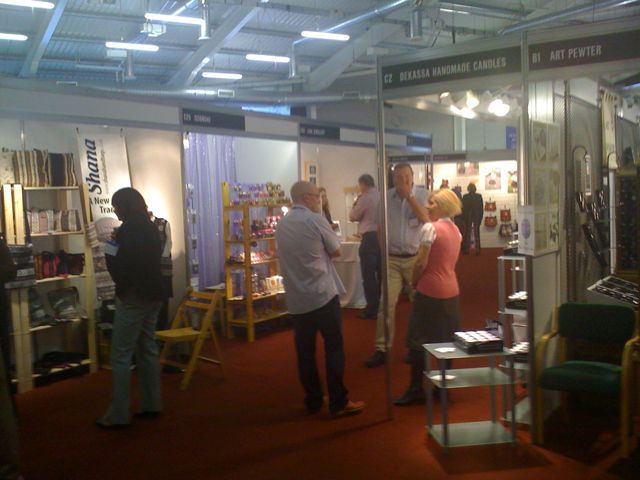
				<content:encoded><![CDATA[<div id="attachment_39647" class="wp-caption aligncenter" style="width: 650px"><a href="/wp-content/uploads/2009/04/AVIEMORE.jpg" data-lightboxplus="lightbox[5662]" title="ScotClans at Aviemore Tradeshow"><img class="size-full wp-image-39647" alt="AVIEMORE TRADESHOW" src="/wp-content/uploads/2009/04/AVIEMORE.jpg" width="640" height="480" /></a><p class="wp-caption-text">AVIEMORE TRADESHOW</p></div>
<p>This is the third year ScotClans has attended the tradeshow at Aviemore. Unlike the Scottish tradeshow in Glasgow here each exhibitor has to guarantee that at least 90% of their goods are designed and made here in Scotland. Because we try to sell only Scottish made products at <a href="http://www.scotclans.com">http://www.scotclans.com</a> it&#8217;s refreshing to not have to ask the question &#8220;where are your products made?&#8221;<br />
This year our highlights were; a great conversation with Wallis <a href="http://www.scotclans.com/scottish-clans/clan-hunter/">Hunter</a> who&#8217;s opening question was &#8220;how can we make things better for you?&#8221; now that&#8217;s customer service! They have some beautiful new designs we are looking forward to getting on the site. It was also good to see Art Pewter&#8217;s stand there, again more great products we need to add.<br />
Apart from our existing suppliers we had some interesting talks with some new companies we are looking forward to working with. Jewellery and kilt pins by Lava Design, his work uses the Scottish landscape as an inspiration, the shapes of Lochs, pathways are used in this stunning modern, cleanly designed jewellery. Lava designs have also produced a range of Jewellery using the writing of Robert Burns. It was lovely to see modern jewellery entwined with Scottish nature and history.<br />
We also will be getting some rather wonderful hats on our site from &#8216;The Frilly Ghillie&#8217; and Tulloch Designs.<br />
Also Saltire designs &#8211; beautiful cashmere, gorgous colours , some fantastic bags. We are in talks about using their products in a photoshoot. They have knitted for Captain Corellis Mandolin and Doctor Who!<br />
Shana exhibited a collection of Shetland wool and traditional Fair Isle designs which we&#8217;d love to get on our site.<br />
So all in all a good show &#8211; we have be honoured to support.</p>
<p>The post <a rel="nofollow" href="http://109.74.200.198/scotclans-at-aviemore-tradeshow/">ScotClans at Aviemore Tradeshow</a> appeared first on <a rel="nofollow" href="http://109.74.200.198">ScotClans | Scottish Clans</a>.</p>
]]></content:encoded>
			<wfw:commentRss>http://109.74.200.198/scotclans-at-aviemore-tradeshow/feed/</wfw:commentRss>
		<slash:comments>0</slash:comments>
		</item>
	</channel>
</rss>