The post Royal Stewart Descendents Alive and Well appeared first on ScotClans | Scottish Clans.
]]>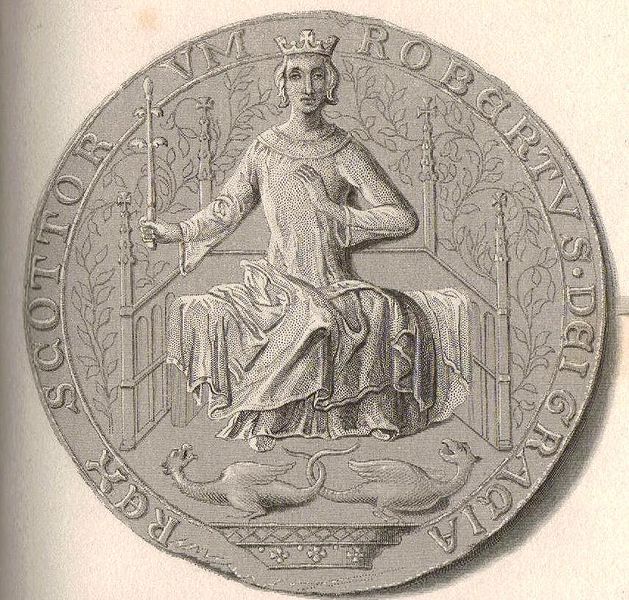
The Seal of Robert II, King of Scots. 1316-1390
Half of all men in the United Kingdom with the surname Stewart, or Stuart, can claim ancestry from Scotland’s Royal family. Research released by ScotlandsDNA has revealed for the first time the individual in the 13th century who founded a branch of the Royal Stewart line.
In the United Kingdom alone there are about 70,000 people with the surname, meaning that around 17,5000 men can now claim descent from the royal bloodline. The source of the line is Sir John Stewart of Bonkyll, who met his demise at the Battle of Falkirk in 1298 fighting alongside William Wallace. The Stewart family’s well-documented pedigree allowed ScotlandsDNA to carry out tests on his descendants, and those of his brother James, the 5th High Steward of Scotland and the grandfather of Robert II, the first Stewart king.
Dr Jim Wilson, the group’s chief scientist, discovered a marker that originated more than 700 years ago when ancestry tests were carried out on the descendants of James and Sir John’s sons Richard and Angus. The results show that that the modern descendants of both sons of Sir John carry a Y chromosome marker S781+ that is absent in the descendants of James.
Dr Wilson added: “By a straightforward process of deduction that means that the marker arose in Sir John Stewart of Bonkyll, and not in his father. If it had, the descendants of James would also carry it, and they do not.” Having made the discovery, ScotlandsDNA checked its database of ancestry tests for men with the Stewart surname and found that 20 per cent of them share Sir John’s lineage, while 30 per cent are descended from his brother James.
James’s son Walter, married Marjorie Bruce, the daughter of Robert I, having helped him win the great victory at Bannockburn, and their son became Robert II.
Alistair Moffat, co-founder of ScotlandsDNA, added: “In the year of the 700th anniversary of Bannockburn, thousands of Scottish men can claim to be directly descended from the Stewarts who fought alongside Bruce, and they can directly identify with generations of famous figures who shaped Scotland and Britain.” The Duke of Buccleuch, Scotland’s biggest private landowner, who is directly descended from Sir John, and a long line of Scottish and British kings, said he was fascinated by the DNA detective work.
He added: “My family’s history has always been closely involved with the history of Scotland and Britain, but the fact that the rise of a DNA marker has been identified in an individual brings the past even closer, and makes it more personal.
“I am delighted to have been a guinea pig for the sort of history it is now possible to write thanks to DNA research.” The sampling has also, for the first time, distinguished clearly between different cadet branches of the royal Stewarts.
The four branches are the Appin Stewarts who fought at Culloden, the Lennox Stewarts who were direct ancestors of James VI and I, and the Albany and Moray Stewarts who acted as regents.
The post Royal Stewart Descendents Alive and Well appeared first on ScotClans | Scottish Clans.
]]>The post Twilight of the Stewarts appeared first on ScotClans | Scottish Clans.
]]>The Stewarts rose from relative obscurity to a place of importance in the Scottish Court through the 13th century, and during the Wars of Independence they sided with the Bruce faction; and Walter Stewart married Robert the Bruce’s daughter Marjorie. Eventually, in 1371 after a half-century wait for his uncle to die Robert Stewart became king ofScotland. It was the beginning of a dynastic rule that would last 343 years until the death of Queen Anne in 1714. Throughout that time, the family – which employed mafia tactics – extended their control over Scotland, and finally reached the giddy heights of the throne of England.
As British kings their successes were less evident – one was executed and another deposed; and their increasing disengagement with the political momentum and religious intolerance of the times would see the great House permanently exiled. From James VII to his grandson Charles Edward the exiled Stuarts (French spelling) would set up counter-courts in France and Italy; where they’d be hocked from palace to palace maintaining a veneer of royalty and influence. It was back to this fantasy world that the L’Heureux would bring the young Pretender following the disaster of the ’45: but in reality it was to an alcohol fuelled life of obscurity.
Charles’ stay in France was short-lived, for within a couple of years of the rising the British and the French signed the Treaty of Aix-la-Chapelle’ effectively ending the War of the Austrian Succession, which the Jacobite rebellion was essentially part of; and with the deal the Pretender was expelled. He returned to Italy, where his father still held a degree of social influence. Shattered by the failure of the Cause, and haunted by ghosts of Culloden Charles began a string of affairs and sought solace in the bottom of a bottle. His principal mistress was the Scottish socialite, Clementina Walkinshaw, who in 1753 bore him a daughter, Charlotte.
Henry Stuart, Charles’ younger brother took a different route after 1746, perhaps armed with more realism, and entered the Catholic Church. His father was on good terms with the Pope, who still recognised him as the rightful king, and Henry made a meteoric rise through the ranks of the episcopacy, becoming Cardinal-Bishop of Frascati in 1761. While his brother became a Prince of the Church; Charles, drunk half the time, still entertained dreams of fantasy thrones.
In 1759, at the height of the Seven Years War, a conflict that for the first time took on a global perspective, the French drew up plans for a full-scale invasion of England. As part of the project he wanted to enlist the support of the still-loyal Jacobites; and Charles was summoned to Paris. Boorish and unrealistic, the French government were soon repelled by him, and sent him packing: he’d play no part in the operation. However, significant British victories overseas essentially put paid to the expedition and it was permanently shelved. This was Charles’ last true, albeit slim, chance to be king. His drinking worsened, his life increasingly nomadic and his treatment of Clementina increasingly abusive. In 1760 she left him, and took Charlotte with her. There is a strong suspicion that Prince James helped out, and gave her an allowance.

Prince Charles Edward Stuart in later life
As she grew up, Charlotte was bounced from convent to convent as her father refused to provide for her or her mother; and with James dead in 1766 that avenue dried up as well. James Francis Stuart, born in 1688 to James VII was the last prince of the House of Stewart to be born in Britain and to the reigning dynasty. As such the Pope and kings across Europe still either recognised his claim, or treated him on an equal footing. The world by 1766 had moved on, and neither the Papacy nor the crowned heads would give the increasingly distant, melancholic and unpopular Charles the same recognition. His downward spiral continued.
In 1772 he married Princess Louise of Stolberg-Geden; but, due to the nature of the man, now a broken alcoholic, it was doomed to failure: she left him eight years later. Now an old man in ill-health he reached out again to his family, and was reconciled with his daughter; who also engaged her uncle, the Cardinal Henry, to bring the once-Bonnie Prince back to Rome, where she would care for him until he died of a stroke in 1788. Chronically ill herself, she died three years later.
Charles Edward Stuart had lit up Scotland like a firework during the 1745 rebellion; but the rest of his life had been an unfulfilled damp-squib; and on his death the Jacobite claim fell to his brother: Cardinal Henry Stuart. As a successful and powerful clergyman (Henry was raised to the Dean of the College of Cardinals in 1803) he did not press his case. He died in 1807: last of the Royal Stewarts. Both he and Charles were buried within the Basilica of St Peter’s in the Vatican. He may have been the last of the dynasty; but not last of the bloodline.
In the years before she returned to her father, Charlotte Stuart had a long term affair with Ferdinand de Rohan, Archbishop of Bordeaux, which considering his position was a risky enterprise. She had three children by him: Marie Victoire, Charlotte and a boy, Charles Edward. Little is known about the two girls, or whether they married and had children – it is believed that Marie Victoire ended up in Poland (Charles’ mother was Polish) and that Charlotte was absorbed into polite society in England. Either way, they and any possible descendants vanished into anonymity.
The son, Charles became a distinguished soldier and something of a globetrotter; and while he never pressed his Jacobite claim, he did maintain links with leading Scots. Indeed, it was while returning from a meeting with the Duke of Atholl in 1854 he was killed in a coaching accident; and is buried in the grounds of Dunkeld Cathedral in Perthshire. With him, the last of the true direct bloodline ended. Meanwhile, fanatical Jacobites searched around for an heir to Henry Stuart; and with his death the ‘claim’ passed to King Charles Emmanuel IV of Sardinia; the senior living descendant of Charles I Stuart through his daughter Henrietta. In a parallel universe the line has passed down to Franz von Wittelsbach, Duke of Bavaria; although he declines ever to talk about his Stewart ancestry.
The bitter wars of the 17th and 18th centuries shaped the modern Britain that emerged, the nature of the monarchy, and indeed the dynastic future itself. The Royal Stewarts had their time; their crown slipped, fell and it was eventually buried in the setting sun amid the hallowed walls of Dunkeld. And few were there to mourn it.
The post Twilight of the Stewarts appeared first on ScotClans | Scottish Clans.
]]>