<br />
<b>Deprecated</b>:  mysql_connect(): The mysql extension is deprecated and will be removed in the future: use mysqli or PDO instead in <b>/var/www/apps/scotclans_wp/wp-includes/wp-db.php</b> on line <b>1142</b><br />
<?xml version="1.0" encoding="UTF-8"?>
<rss version="2.0"
	xmlns:content="http://purl.org/rss/1.0/modules/content/"
	xmlns:wfw="http://wellformedweb.org/CommentAPI/"
	xmlns:dc="http://purl.org/dc/elements/1.1/"
	xmlns:atom="http://www.w3.org/2005/Atom"
	xmlns:sy="http://purl.org/rss/1.0/modules/syndication/"
	xmlns:slash="http://purl.org/rss/1.0/modules/slash/"
	>

<channel>
	<title>ScotClans &#124; Scottish Clans &#187; Rosslyn Chapel</title>
	<atom:link href="http://109.74.200.198/tag/rosslyn-chapel/feed/" rel="self" type="application/rss+xml" />
	<link>http://109.74.200.198</link>
	<description></description>
	<lastBuildDate>Fri, 20 Jan 2017 08:08:09 +0000</lastBuildDate>
	<language>en-US</language>
	<sy:updatePeriod>hourly</sy:updatePeriod>
	<sy:updateFrequency>1</sy:updateFrequency>
	<generator>http://wordpress.org/?v=3.6.1</generator>
		<item>
		<title>That&#8217;s a Wrap! Scotland on Screen</title>
		<link>http://109.74.200.198/thats-a-wrap-scotland-on-screen/</link>
		<comments>http://109.74.200.198/thats-a-wrap-scotland-on-screen/#comments</comments>
		<pubDate>Mon, 19 Aug 2013 14:21:57 +0000</pubDate>
		<dc:creator>Nadine Lee</dc:creator>
				<category><![CDATA[Campbell]]></category>
		<category><![CDATA[CLANS - Big List of Scottish Clans]]></category>
		<category><![CDATA[MacDougall]]></category>
		<category><![CDATA[Scottish History]]></category>
		<category><![CDATA[Sinclair]]></category>
		<category><![CDATA[Downton Abbey]]></category>
		<category><![CDATA[edinburgh]]></category>
		<category><![CDATA[Film]]></category>
		<category><![CDATA[Glenfinnan Viaduct]]></category>
		<category><![CDATA[Harry Potter]]></category>
		<category><![CDATA[Hogwart's Express]]></category>
		<category><![CDATA[Holy Grail]]></category>
		<category><![CDATA[Inveraray Castle]]></category>
		<category><![CDATA[Monty Python]]></category>
		<category><![CDATA[Rosslyn Chapel]]></category>
		<category><![CDATA[Stalker Castle]]></category>
		<category><![CDATA[Television]]></category>
		<category><![CDATA[The Da Vinci Code]]></category>
		<category><![CDATA[The Illusionist]]></category>

		<guid isPermaLink="false">http://www.bletherskite.net/?p=5270</guid>
		<description><![CDATA[<p>With an overabundance of stunning landscapes and picturesque castles, it&#8217;s no wonder Scotland is a favourite calling card for film and television location scouts. Here are my top five Scottish locations featured on the silver screen: Inveraray Castle &#8211; Downton Abbey Featured in the nail-biting finale to the third season of Downton Abbey, the stunning [&#8230;]</p>
<p>The post <a rel="nofollow" href="http://109.74.200.198/thats-a-wrap-scotland-on-screen/">That&#8217;s a Wrap! Scotland on Screen</a> appeared first on <a rel="nofollow" href="http://109.74.200.198">ScotClans | Scottish Clans</a>.</p>
]]></description>
				<content:encoded><![CDATA[<p>With an overabundance of stunning landscapes and picturesque castles, it&#8217;s no wonder Scotland is a favourite calling card for film and television location scouts. Here are my top five Scottish locations featured on the silver screen:</p>
<div id="attachment_6324" class="wp-caption aligncenter" style="width: 310px"><a href="/wp-content/uploads/2013/08/screen1.jpg" data-lightboxplus="lightbox[5270]" title="That's a Wrap! Scotland on Screen"><img class="size-full wp-image-6324" alt="Inveraray Castle - Downton Abbey" src="/wp-content/uploads/2013/08/screen1.jpg" width="300" height="225" /></a><p class="wp-caption-text">Inveraray Castle &#8211; Downton Abbey</p></div>
<p style="text-align: center;"><strong>Inveraray Castle &#8211; <em>Downton Abbey</em></strong></p>
<p style="text-align: left;">Featured in the nail-biting finale to the third season of <em>Downton Abbey</em>, the stunning Inveraray Castle in Argyll has also been home to <a href="http://www.scotclans.com/scottish_clans/clan_campbell/">Clan Campbell </a>since the 17th Century. In the episode the Grantham family and staff travel north to the home of their cousins, the Marquess and Marchioness of Flintshire in their mythical Scottish home, &#8216;Duneagle Castle&#8217;. The Inveraray Estate boasts 16 acres of highland charm including formal gardens and woodland walks that attract thousands of visitors each year. The castle has also seen its fair share of <em>Downton</em>-inspired storylines over the years &#8211; it was inhabited by the eccentric 10th Duke of Argyll in the 1920s, and was home to the rather promiscuous Margaret Campbell during the 1960s.</p>
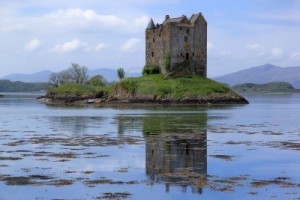
<div id="attachment_6326" class="wp-caption aligncenter" style="width: 310px"><a href="/wp-content/uploads/2013/08/screen2.jpg" data-lightboxplus="lightbox[5270]" title="That's a Wrap! Scotland on Screen"><img class="size-full wp-image-6326" alt="Castle Stalker - Monty Python and the Holy Grail, Highlander: Endgame" src="/wp-content/uploads/2013/08/screen2.jpg" width="300" height="200" /></a><p class="wp-caption-text">Castle Stalker &#8211; Monty Python and the Holy Grail, Highlander: Endgame</p></div>
<p style="text-align: center;"><strong>Castle Stalker -</strong><em><strong> Monty Python and the Holy Grail, Highlander: Endgame</strong></em></p>
<p>This wee gem of a castle located in Argyll is most well-known from the final scene of <em>Monty Python and the Holy Grail</em>. Castle Stalker is known in the film as &#8220;The Castle of Aaaaarrrrrrggghhh&#8221;, where John Cleese taunts Arthur from its battlements before launching an attack. It also appeared briefly in the film <em>Highlander: Endgame</em>. Castle Stalker was built as a small fort by <a href="http://www.scotclans.com/scottish_clans/clan_macdougall/">Clan MacDougall</a> around 1320, with it&#8217;s present form dating from around 1440. Stalker is said to have been lost by the MacDougalls to <a href="http://www.scotclans.com/scottish_clans/clan_campbell/">Clan Campbell</a> in a drunken bet in 1620, with the castle changing hands between the two clans until 1820 when Clan Campbell abandoned the castle for good when it lost its roof. You can view the Python scene in all its glory by <a href="https://www.youtube.com/watch?v=9V7zbWNznbs">clicking here.</a></p>
<p>&nbsp;</p>
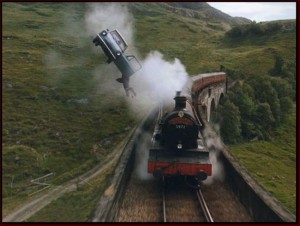
<div id="attachment_6327" class="wp-caption aligncenter" style="width: 310px"><a href="/wp-content/uploads/2013/08/screen3.jpg" data-lightboxplus="lightbox[5270]" title="That's a Wrap! Scotland on Screen"><img class="size-full wp-image-6327" alt="Glenfinnan Viaduct - Harry Potter Series" src="/wp-content/uploads/2013/08/screen3.jpg" width="300" height="226" /></a><p class="wp-caption-text">Glenfinnan Viaduct &#8211; Harry Potter Series</p></div>
<p style="text-align: center;"><strong>Glenfinnan Viaduct &#8211; <em>Harry Potter Series</em></strong></p>
<p>Perhaps one of the most magical landscapes featured in the <em>Harry Potter</em> series, the Glenfinnan Railway Viaduct is passed over by Harry and his pals en route to Hogwarts at the beginning of each school year/film. The 21-arch single track viaduct was one of the largest concrete engineering feats undertaken when construction began in 1897. Today the route acts as a part of the West Highland tourist trail, with the steam engine operating along the line called &#8216;The Jacobite&#8217;. The engine had a starring role in the Harry Potter films, playing the role of the Hogwart&#8217;s Express, which you can <a href="https://www.youtube.com/watch?v=U_vO5ja-gj8" target="_blank">view here</a>.</p>
<p>&nbsp;</p>
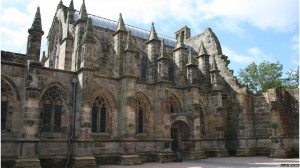
<div id="attachment_6328" class="wp-caption aligncenter" style="width: 310px"><a href="/wp-content/uploads/2013/08/screen4.jpg" data-lightboxplus="lightbox[5270]" title="That's a Wrap! Scotland on Screen"><img class="size-full wp-image-6328" alt="Rosslyn Chapel - The Da Vinci Code" src="/wp-content/uploads/2013/08/screen4.jpg" width="300" height="168" /></a><p class="wp-caption-text">Rosslyn Chapel &#8211; The Da Vinci Code</p></div>
<p style="text-align: center;"><strong>Rosslyn Chapel -</strong><strong> </strong><em><strong>The Da Vinci Code</strong></em></p>
<p>Rosslyn Chapel was founded as a Catholic church by William Sinclair, 1st Earl of Caithness of the <a href="http://www.scotclans.com/scottish_clans/clans/sinclair/" target="_blank">Sinclair Family </a>in the mid-15th Century. According to some accounts, the descendents of Jesus Christ and members of the Knights Templar existed within the Sinclair family. Dan Brown used this theory in his 2003 novel <em>The Da Vinci Code</em>, with the chapel being used as a location in the film version which was released three years later. <span style="font-size: small;">Despite being dismissed by historians and the Catholic Church, the novel has sold over 80 million copies worldwide.</span></p>
<p>&nbsp;</p>
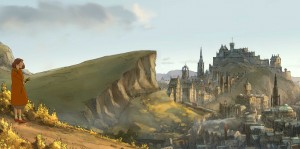
<div id="attachment_6329" class="wp-caption aligncenter" style="width: 310px"><a href="/wp-content/uploads/2013/08/screen5.jpg" data-lightboxplus="lightbox[5270]" title="That's a Wrap! Scotland on Screen"><img class="size-full wp-image-6329" alt="City of Edinburgh - The Illusionist" src="/wp-content/uploads/2013/08/screen5.jpg" width="300" height="149" /></a><p class="wp-caption-text">City of Edinburgh &#8211; The Illusionist</p></div>
<p style="text-align: center;"><strong>City of Edinburgh -</strong><strong> </strong><em><strong>The</strong><strong> Illusionist</strong><strong><br />
</strong></em></p>
<p>This hand-drawn animated French film is perhaps one of the most beautiful filmic depictions of Edinburgh, and one of the reasons I fell head over heels for this magnificent city. The film brings to life locations such as Arthur&#8217;s Seat, Princes Street, Jenners Department Store, The Cameo Theatre, Waverley Station and the glorious cobbled streets, presenting them as they were in the late 1950s. Jonathan Meville of <em>The Scotsman</em> wrote: &#8220;Edinburgh&#8217;s skyline has never looked so good, and if the city didn&#8217;t exist it would be hard to believe somewhere so beautiful was real: if locals aren&#8217;t inspired to take a walk up North Bridge or down Victoria Street after this, they never will be. You can view a clip featuring Edinburgh as depicted in the film <a href="https://www.youtube.com/watch?v=hSgNZ6R5Rbg" target="_blank">here.</a></p>
<p>The post <a rel="nofollow" href="http://109.74.200.198/thats-a-wrap-scotland-on-screen/">That&#8217;s a Wrap! Scotland on Screen</a> appeared first on <a rel="nofollow" href="http://109.74.200.198">ScotClans | Scottish Clans</a>.</p>
]]></content:encoded>
			<wfw:commentRss>http://109.74.200.198/thats-a-wrap-scotland-on-screen/feed/</wfw:commentRss>
		<slash:comments>2</slash:comments>
		</item>
		<item>
		<title>The Real Treasure of Rosslyn Chapel</title>
		<link>http://109.74.200.198/the-real-treasure-of-rosslyn-chapel/</link>
		<comments>http://109.74.200.198/the-real-treasure-of-rosslyn-chapel/#comments</comments>
		<pubDate>Wed, 13 Mar 2013 16:47:01 +0000</pubDate>
		<dc:creator>Amanda Moffet</dc:creator>
				<category><![CDATA[Scottish History]]></category>
		<category><![CDATA[Scottish Mystery]]></category>
		<category><![CDATA[Rosslyn Chapel]]></category>

		<guid isPermaLink="false">http://www.bletherskite.net/?p=4601</guid>
		<description><![CDATA[<p>Rosslyn Chapel is famous for appearing in Hollywood blockbuster The Da Vinci Code, as the last resting place of the Holy Grail. The chapel has always been shrouded in legend, mainly concerning hidden treasure hidden within it&#8217;s grounds, clues within the ornate carvings, just waiting to be deciphered. A new book just published claims to [&#8230;]</p>
<p>The post <a rel="nofollow" href="http://109.74.200.198/the-real-treasure-of-rosslyn-chapel/">The Real Treasure of Rosslyn Chapel</a> appeared first on <a rel="nofollow" href="http://109.74.200.198">ScotClans | Scottish Clans</a>.</p>
]]></description>
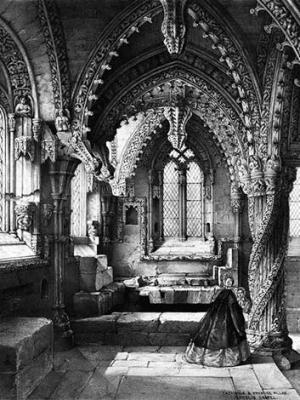
				<content:encoded><![CDATA[<p><a href="/wp-content/uploads/2013/03/Rosslyn1.jpg" data-lightboxplus="lightbox[4601]" title="The Real Treasure of Rosslyn Chapel"><img class="aligncenter size-full wp-image-39129" alt="Rosslyn1" src="/wp-content/uploads/2013/03/Rosslyn1.jpg" width="300" height="400" /></a>Rosslyn Chapel is famous for appearing in Hollywood blockbuster The Da Vinci Code, as the last resting place of the Holy Grail. The chapel has always been shrouded in legend, mainly concerning hidden treasure hidden within it&#8217;s grounds, clues within the ornate carvings, just waiting to be deciphered.</p>
<p>A new book just published claims to have found the real purpose of the 15th Century building. Following years of research the authors Alan Butler and John Ritchie came to conclusion that the chapel was built as a shrine &#8211; for the safe keeping for the skull of St Mathew. The skull had been smuggled from France for safe keeping. Religious artefacts were much sought-after, especially those with a direct link to Jesus.</p>
<div id="attachment_39127" class="wp-caption alignleft" style="width: 310px"><a href="/wp-content/uploads/2013/03/Rosslyn2.jpg" data-lightboxplus="lightbox[4601]" title="The Real Treasure of Rosslyn Chapel"><img class="size-full wp-image-39127" alt="The Apprentice Pillar" src="/wp-content/uploads/2013/03/Rosslyn2.jpg" width="300" height="400" /></a><p class="wp-caption-text">The Apprentice Pillar</p></div>
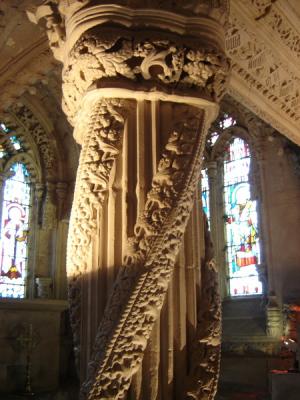
<p>The chapel is covered in amazing carvings, within these are clues to the chapel being a safe house for the skull of St Mathew. There is a beautiful ornate pillar known as The Apprentice Pillar, it has the representation of a miraculous honey laden tree that is associated with St Mathew.</p>
<p>In fact the whole building is designed so that honey from beehives hidden in the buttress roof dripped down onto the altar.  Builders working on the Chapel had been shocked to find a 600-year-old bee hive built into the stones. &#8220;There has been so much written about Rosslyn Chapel and what the carvings mean,&#8221; says Butler. &#8220;But it does not stretch credibility that the chapel represents this story about St Mathew. Every single detail fits. &#8220;What we are saying is what is the most likely explanation. The chapel was built as a giant reliquary for the skull of St Mathew.&#8221;</p>
<p>The post <a rel="nofollow" href="http://109.74.200.198/the-real-treasure-of-rosslyn-chapel/">The Real Treasure of Rosslyn Chapel</a> appeared first on <a rel="nofollow" href="http://109.74.200.198">ScotClans | Scottish Clans</a>.</p>
]]></content:encoded>
			<wfw:commentRss>http://109.74.200.198/the-real-treasure-of-rosslyn-chapel/feed/</wfw:commentRss>
		<slash:comments>0</slash:comments>
		</item>
		<item>
		<title>Rossyln Chapel&#8217;s new roof revealed after 14 years</title>
		<link>http://109.74.200.198/rossyln-chapels-new-roof-revealed-after-14-years/</link>
		<comments>http://109.74.200.198/rossyln-chapels-new-roof-revealed-after-14-years/#comments</comments>
		<pubDate>Mon, 16 Aug 2010 15:26:14 +0000</pubDate>
		<dc:creator>donald</dc:creator>
				<category><![CDATA[Scottish News]]></category>
		<category><![CDATA[Rosslyn Chapel]]></category>

		<guid isPermaLink="false">http://www.scotclans.com/bletherskite/?p=2078</guid>
		<description><![CDATA[<p>After 14 years of work, the canopy has finally been removed from the roof of Rosslyn Chapel. The canopy was put up while major work was done to the roof of the chapel which, for hundreds of years, had been letting in rain water leading to structural decay. It took six weeks to carefully remove [&#8230;]</p>
<p>The post <a rel="nofollow" href="http://109.74.200.198/rossyln-chapels-new-roof-revealed-after-14-years/">Rossyln Chapel&#8217;s new roof revealed after 14 years</a> appeared first on <a rel="nofollow" href="http://109.74.200.198">ScotClans | Scottish Clans</a>.</p>
]]></description>
				<content:encoded><![CDATA[<div id="attachment_39432" class="wp-caption aligncenter" style="width: 651px"><a href="/wp-content/uploads/2010/08/rosslyn1.png" data-lightboxplus="lightbox[2078]" title="Rossyln Chapel's new roof revealed after 14 years"><img class="size-full wp-image-39432" alt="Rosslyn Chapel with its covering" src="/wp-content/uploads/2010/08/rosslyn1.png" width="641" height="482" /></a><p class="wp-caption-text">Rosslyn Chapel with its covering</p></div>
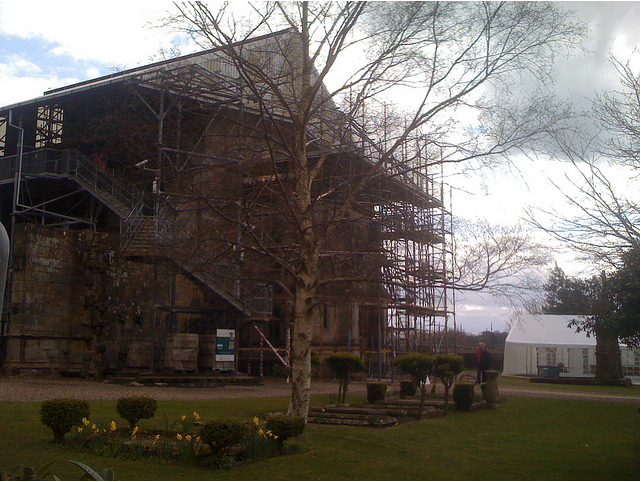
<p>After 14 years of work, the canopy has finally been removed from the roof of Rosslyn Chapel.</p>
<p>The canopy was put up while major work was done to the roof of the chapel which, for hundreds of years, had been letting in rain water leading to structural decay.</p>
<p>It took six weeks to carefully remove the huge steel covering, and now the chapel is back to its former glory.</p>
<p>The post <a rel="nofollow" href="http://109.74.200.198/rossyln-chapels-new-roof-revealed-after-14-years/">Rossyln Chapel&#8217;s new roof revealed after 14 years</a> appeared first on <a rel="nofollow" href="http://109.74.200.198">ScotClans | Scottish Clans</a>.</p>
]]></content:encoded>
			<wfw:commentRss>http://109.74.200.198/rossyln-chapels-new-roof-revealed-after-14-years/feed/</wfw:commentRss>
		<slash:comments>1</slash:comments>
		</item>
		<item>
		<title>The Westford Knight</title>
		<link>http://109.74.200.198/the-westford-knight/</link>
		<comments>http://109.74.200.198/the-westford-knight/#comments</comments>
		<pubDate>Fri, 09 Apr 2010 11:57:44 +0000</pubDate>
		<dc:creator>donald</dc:creator>
				<category><![CDATA[Gunn]]></category>
		<category><![CDATA[Scottish Myths]]></category>
		<category><![CDATA[Sinclair]]></category>
		<category><![CDATA[Earl of Orkney]]></category>
		<category><![CDATA[Orkney]]></category>
		<category><![CDATA[Roslin Castle]]></category>
		<category><![CDATA[Rosslyn Chapel]]></category>
		<category><![CDATA[Westford Knight]]></category>

		<guid isPermaLink="false">http://www.scotclans.com/bletherskite/?p=1863</guid>
		<description><![CDATA[<p>What is claimed as a carving on a glacial boulder in the town of Westford, in Massachusetts, USA, is argued to be proof that an expedition, led by Henry Sinclair, Earl of Orkney, landed on the North American continent almost 100 years before Christopher Columbus. The &#8216;carving&#8217; is subject to much speculation over its authenticity, [&#8230;]</p>
<p>The post <a rel="nofollow" href="http://109.74.200.198/the-westford-knight/">The Westford Knight</a> appeared first on <a rel="nofollow" href="http://109.74.200.198">ScotClans | Scottish Clans</a>.</p>
]]></description>
				<content:encoded><![CDATA[<div id="attachment_39131" class="wp-caption alignleft" style="width: 399px"><a href="/wp-content/uploads/2010/04/westfordknight1.gif" data-lightboxplus="lightbox[1863]" title="The Westford Knight"><img class="size-full wp-image-39131" alt="The Westford Knight engraving, with the Gunn arms on the shield" src="/wp-content/uploads/2010/04/westfordknight1.gif" width="389" height="850" /></a><p class="wp-caption-text">The Westford Knight engraving, with the Gunn arms on the shield</p></div>
<p>What is claimed as a carving on a glacial boulder in the town of Westford, in Massachusetts, USA, is argued to be proof that an expedition, led by Henry <a href="http://www.scotclans.com/scottish-clans/clan-sinclair/" target="_blank">Sinclair</a>, Earl of Orkney, landed on the North American continent almost 100 years before Christopher Columbus.</p>
<p>The &#8216;carving&#8217; is subject to much speculation over its authenticity, but it is said to depict a Medieval knight with sword and shield who was a fallen member of Sinclair&#8217;s party who travelled to the &#8216;New World&#8217; in 1398.</p>
<p>The story goes that in early April 1398 Henry Sinclair set sail, heading west with a fleet of 13 small vessels; two of which were driven by oars. They made it across to North America by the start of June; sailing into Chedabucto Bay, and dropping anchor in what is modern-day Guysborough Harbour, Nova Scotia in Canada. The explorers interacted peacefully with the natives, and with one tribe in particular, the Míkmaq (or Micmac). Sinclair managed to persuade the Míkmaqs to act as a guide so his party could travel and explore around the area safely.</p>
<p>They stayed in Nova Scotia until the following spring when the explorers are said to have sailed south, landing in Massachusetts, just north of where the city of Boston now sits. It has been claimed that Sinclair and his party made such a positive impression on the Míkmaq of Nova Scotia, and that after they left, the tribe chose to remember the travellers by telling stories about them, passing them down through many generations, and that the legendary figure of <em>Glooscap</em> is, in fact, meant to represent Henry Sinclair.</p>
<p>In Massachusetts the group stayed with the natives, also getting along with them peacefully, before Sinclair took 100 of his men and headed west. Among the men was a knight, and loyal friend of Henry, called Sir James <a href="http://www.scotclans.com/scottish-clans/clan-gunn/" target="_blank">Gunn</a>. Gunn was later to become known as the Westford Knight. Unfortunately for Sir James the name came about due to his death on the expedition and he was buried, with a large rock covering his grave, where the modern-day town of Westford now is. On the stone an effigy of the Scottish knight was carved. It depicts Gunn with his sword and shield, and on the shield the Gunn family arms. After over 600 years the engraving is still said to be there on the stone, but is now very faint, and your imagination is needed to visualise it for the most part.</p>
<p>The tale of the Westford Knight is very much a part of Westford folklore, but the story itself is widely considered to be apocryphal. The &#8216;facts&#8217; of the story are widely disputed by mainstream professional archaeologists and historians, who are under the general belief that the voyage never happened, and the carving is either much more recent than the 14th century or simply just a natural feature on the stone. Other reasons why the claim that Henry Sinclair reached the North American continent 94 years before Christopher Columbus is doubted include the lack of any physical evidence of the voyage and the new land, which Columbus did provide, plus there is no contemporary record of it at all. Also, it is stated that the rock, onto which the effigy of Sir James Gunn is carved, would most likely have been under almost a metre of earth at the time of the supposed visit, making it more than unlikely for it to have been used as a memorial.</p>
<p>Whatever the facts, it is not likely that anyone will know for absolute certainty whether or not Henry <a href="http://www.scotclans.com/scottish-clans/clan-sinclair/" target="_blank">Sinclair</a> made it to North America, and if the stone at Westford is actually a memorial to Sir James <a href="http://www.scotclans.com/scottish-clans/clan-gunn/" target="_blank">Gunn</a>.</p>
<p>The post <a rel="nofollow" href="http://109.74.200.198/the-westford-knight/">The Westford Knight</a> appeared first on <a rel="nofollow" href="http://109.74.200.198">ScotClans | Scottish Clans</a>.</p>
]]></content:encoded>
			<wfw:commentRss>http://109.74.200.198/the-westford-knight/feed/</wfw:commentRss>
		<slash:comments>0</slash:comments>
		</item>
	</channel>
</rss>