The post Tartan Day Celebrated Around the World appeared first on ScotClans | Scottish Clans.
]]>As well playing a significant role in shaping Scottish history, the declaration’s confirmation of kingship, independence and the rights of the people is said to have formed the basis of the American Declaration of Independence. Today the day is celebrated with a variety of different events hosted by various clan and Scots heritage societies. Here’s a quick round up of snaps from this years celebrations:

Super Selfie from New York Tartan Day Parade
Simon Fraser University (B.C.) Pipe Band drum major Jason Paguio led the Tunes of Glory band at Saturday’s New York Tartan Day Parade and decided to snap a photo as the parade wound its way through Manhattan. “I was hoping I wouldn’t get into trouble,” Paguio said with a chuckle. You can view a news report form the New York festivities here.

McGregors, McAlisters and McIntyres in attendance in WA
About 75 people gathered on the steps of the Legislative Building in Olympia, Washington State on Sunday. The event featured bagpipe music, a reading of a National Tartan Day resolution and a group performance of “Scotland the Brave”.

Thousands celebrate Celtic heritage at Tartan Day South
The fourth annual Tartan Day South Highland Games was held at the Celtic Festival in Cayce, Columbia on Saturday. Thousands flowed in for this year’s event, part of the four-day Tartan Day festivities that also featured a movie night Thursday and concert Friday at West Columbia’s Riverwalk Amphitheater. The festivities concluded Sunday with the Kirkin of the Tartans, a worship service.

Weekend of events in Arbroath kick off Tartan Day Scotland Festival
A weekend of special events marking the heritage and culture of Angus attracted crowds of people to Arbroath. A re-enactment of the signing of the Declaration of Arbroath by the medieval nobles of Scotland took place within the walls of Arbroath Abbey for the first time in several years. You can view a video here.

Minneapolis Mayor Hodges honored for Scottish roots
Minneapolis Mayor Betsy Hodges was Guest of Honor Saturday at Saturday’s Tartan Day event, which recognizes Scottish history and culture. She wore a sash of her clan’s Modern Red Morrison tartan for the event, held at the state Capitol. In a Facebook post, Hodges said she has lots of Scottish blood:
I was so touched to be the honored guest at Minnesota Tartan Day. I have Scottish heritage from both sides of my family, Clan Morrison on my father Morrison Hodges’ side and Clan Nicholson on my mother Aj Hodges’ side. I think I first knew I was Scottish when the bagpipers played Amazing Grace at my grandfather’s funeral. The second time was when I went to Scotland and for the first time in my Minnesota-raised life I was around a bunch of people who kinda sorta looked like me.
The post Tartan Day Celebrated Around the World appeared first on ScotClans | Scottish Clans.
]]>The post This Week in History: Isabel MacDuff and Robert the Bruce appeared first on ScotClans | Scottish Clans.
]]>
Bruce is crowned for the second time in two days by Isabel MacDuff, Countess of Buchan. Colour litho by Williams, Morris Meredith (1881-1973).
With attention focused on the approaching 700th anniversary of the Battle of Bannockburn, it’s worth taking a look at the events and figures instrumental in the lead-up to the momentous battle. Strangely absent from the legends surrounding Bannockburn is the role played by women, even though one largely looked-over heroine enabled Robert the Bruce’s claim to the Scottish throne on this day 708 years ago.
Like a lot of periods in Scottish history, the early 14th century was a rather tumultuous time. Fresh of the back of the the 13th century’s succession disputes, and William Wallace’s failed uprising, Scotland was then ruled as a province of England by Edward I. Bruce had become a guardian of Scotland, alongside his biggest rival for the Scottish throne, John III Comyn, Lord of Badenoch. In 1306, Bruce quarreled with Comyn and stabbed him to death at Greyfriars Kirk in Dumfries, cementing a deep hatred between the Bruce and Comyn families.

The killing of John Comyn in the Greyfriars church in Dumfries, as seen by Felix Philippoteaux, a 19th-century illustrator.
Isabel MacDuff, second cousin to Robert the Bruce, had the great misfortune of being married a few years earlier to Comyn’s cousin, John Comyn, Earl of Buchan. Some historians and authors believe she may also have been one of Bruce’s lovers. Following the murder at Greyfriars, it’s safe to say times were tough for Isabel. She took the contrary view to her husband, instead supporting the Bruce by taking the Scottish side in the Scottish Wars of Independence.
Bruce, knowing he would be excommunicated for killing a man on holy ground, and knowing an excommunicated man could not be crowned king, did the only thing he could in order to claim the Scottish throne as his own: he dashed for Scone, traditional crowning place of the Scottish kings, in a race against the messengers flying to the Pope with news of the Greyfriarsmurder and the messengers speeding back equally hastily with news of his excommunication.
Robert’s coronation took place on either March 25 or 26 1306 in Scone, however tradition at the time stated all Kings must be crowned near the stone of destiny and/or anointed by the Kirk. Unfortunately the stone had been removed by Edward I a few years earlier, and the Kirk would have been hardly willing to crown Bruce following his actions at Greyfriars. Another tradition was sought to cement the claim, and it just so happened that the MacDuff clan held a hereditary right to crown Kings of Scotland.

Robert the Bruce and Isabel MacDuff immortalised in stone at Edinburgh Castle
Meanwhile, Isabel’s husband John was in England at this time so, on hearing the news of the impending coronation of the new king, she took her husbands horses and rode to Scone, unfortunately arriving a day late. However, because so many traditional elements of the crowning were absent from the first crowning, a second crowing with Isabel representing the MacDuff family tradition on either the 26th or 27th of March solidified Bruce’s right to the kingship of Scotland, thus effectively cutting off Isabel’s ties to her Comyn family.
Isabel stayed on with Bruce, but was betrayed and captured shortly after Bruce’s defeat at the Battle of Methven in June 1306. Edward I of England ordered her sent to Berwick-upon-Tweed with these instructions:
“Let her be closely confined in an abode of stone and iron made in the shape of a cross, and let her be hung up out of doors in the open air at Berwick, that both in life and after her death, she may be a spectacle and eternal reproach to travellers.”
She was imprisoned in this cage for four years, then moved to the Carmelite friary at Berwick. This was not necessarily a humanitarian move; it is suggested that by this stage Bruce was gaining support, his female relatives were potentially valuable hostages, and the English did not want them to die of ill-treatment. The last clear mention of her is being transferred again in 1313, one year before the Battle of Bannockburn, with her eventual fate uncertain.
The post This Week in History: Isabel MacDuff and Robert the Bruce appeared first on ScotClans | Scottish Clans.
]]>The post Bannockburn Visitor Centre Ready for Battle appeared first on ScotClans | Scottish Clans.
]]>
A 3D Robert the Bruce visits his troops at the new Bannockburn Visitor Centre
We’re just back from a quick trip up the road to just outside Stirling to check out the new Bannockburn Visitor Centre, set to open to the public next weekend. Coming in (on time, and on budget) with a price tag of £9.1 million, the centre uses state-of-the-art motion capture techniques and fight choreography to immerse visitors in a realistic and historically accurate 3D Battle of Bannockburn. (View a gallery from our visit here.)
A thoroughly impressive experience, the visitors centre is the first tourist attraction in the world to use this kind of technology, providing a very 21st century view of the battle in this the year of its 700th anniversary. You’ll find no objects in glass boxes here – there are no surviving artefacts from the battle anyway. The centre appeals to the ‘modernologist’, moving away from passive ‘museum’ viewing, and instead offering visitors the chance to interact with history.
Interpretation designers Bright White Ltd worked with an Academic Advisory Panel of some of the UK’s top historians and leading 3D modellers at the Centre for Digital Documentation and Visualisation (a partnership between the Digital Design Studio of the Glasgow School of Art and Historic Scotland) to bring the battle to life for 21st century audiences.
Revered as the most famous Scots victory – the Battle of Bannockburn marked a pivotal moment in Scotland’s history, paving the way for the signing of the momentous Declaration of Arbroath. Our tour began with a 3D puppet-show prologue by two of the battle’s well-known figures – Sir James Douglas representing the Scots, and Isabella of France, wife of Edward II of England.
We then moved through to the next room to ‘Prepare for Battle’. Robert the Bruce and King Edward II feature as life-size 3D projections, witnessing the two sides preparing for battle. If you’ve ever wondered what it feels like to be a fly on the wall in the Scots or English camp the night before Bannockburn, this is about as close as you’re going to get. Eerily lifelike (and lifesize) Scots soldiers were practicing hand-to-hand combat metres from where I stood, while English soldiers fired arrows at targets on the other side of the room.
Iconic moments from the battle also dramatically play out, including when Bruce encounters Sir Henry De Bohun with his axe on the first day of the battle. I also had a very interesting briefing from Sir James Douglas in the digital character section, who presented me with his reasons for supporting the Bruce.

Let the battle begin!
From there we moved through to the jewel in the centre’s crown, the battle simulation room. Upon entry you are given a number from a battlemaster which determines where abouts around the interactive battle map you stand, and more importantly, which side you’re on. I was placed on the English side, and given control of a division of longbows and heavy infantry.
During the first day of battle my divisions moved about near the rear of the action, warily trying to get into a good strategic position. But once I sent forward my first longbow attack, I’m rather ashamed to admit I had the taste for it, and went on a little bit of a rampage, sending cavalry and longbows hurtling after Robert the Bruce (who was cowering somewhere behind Stirling Castle). By the end of the second day it looked as though we were going to take the castle, but just at the last minute we were foiled by traps set by the Scots.

Tense times! The final moments of the battle
Our battlemaster David Weinczok, 24 from Nova Scotia, controlled the game and was on hand to flesh out historical details, and throw in tips and advice before declaring the successful side, summarising the results of the action with an overview of how the battle played out in 1314, and revealing the 21st-century version of the landscape and locations of conflict. The only thing I’m a bit confused by was his costume – looking more like a sci-fi knight sent from the future than a 14th century soldier.

Battlemaster David Weinczok provides an overview of the real 1314 battle.
After the battle we entered the epilogue room, where another 3D puppetry styled video was shown in which Sir James presented the aftermath and consequences from the battle, most importantly Scotland’s assertion as an independent kingdom. Topical stuff, in this the year of the referendum. We finished our visit outside the centre at the recently restored Bruce monument and flagpole. After being immersed in so much state of the art technology, we finished our day by walking twenty metres through a field to stand in the place where these events of Bannockburn exactly 700 years ago.
View our gallery from this mornings event here! The centre is open from 1/3/2014.
The post Bannockburn Visitor Centre Ready for Battle appeared first on ScotClans | Scottish Clans.
]]>The post The Clans of Ireland appeared first on ScotClans | Scottish Clans.
]]>
Clan Map of Ireland, 1485
This time tomorrow I’ll be jet-setting across the ditch to Ireland for a quick break with my wee brother who is currently visiting me in Edinburgh. We’ll be spending some time in Dublin and Galway, before heading up to Northern Ireland, then back home to Scotland. I’m looking forward to connecting some ancestral puzzle pieces, as well as enjoying the obligatory first pint of ‘real’ Guinness in the famed stout’s homeland.
I have to admit that even though my ancestry is Irish rather than Scottish, I’m a complete newbie when it comes to Irish clans. The extent of my knowledge is that for hundreds of years there’s been an awful lot of to-ing and fro-ing between the clans, as many Scottish and Irish clans claim ancestry from each other. Clan MacLachlan, Clan Lamont, Clan Ewen of Otter and Clan MacNeil of Barra all claim descent from Ánrothán Ua Néill, an Irish prince of the O’Neill dynasty who left Ireland for Kintyre in the 11th century. Clan Munro also emigrated to Scotland from Ireland – The 11th century chief Donald Munro was granted lands in the Highlands for services rendered to Malcolm II of Scotland in defeating the Danish Viking invasion.
Similarly the Irish Clan Sweeney is Scottish in origin – in the early 14th century, Clan Sweeney were in cahoots with the MacDougalls – bitter enemies of Robert the Bruce. In 1310 when Bruce had most of Argyll and the North Channel in his favour, Clan Sweeney attempted to reclaim their lands at Knapdale. However they failed miserably, and were forced to reestablish themselves as Gallowglass mercenary soldiers in Donegal. The Gallowglass are an interesting story in themselves – following the Scottish Wars of Independence in the late 13th and early 14th century, many Scottish clans of Norse-Gaelic origin were dispossessed of their lands for choosing the wrong side in the war. These clans ended up in Ireland, settled by Irish nobles in return for providing services as a class of elite soldiers, famed as a heavily armoured, trained aristocratic infantry to be relied upon as a strong defence for holding a position.
So you see, there really is so much clan history overlapping between Scotland and Ireland. And I haven’t even mentioned the language yet – I’m told Scottish Gaelic is an older, more conservative form of Irish Gaelic (although that’s probably a topic for another day). The clan systems in both countries have their differences, however surprisingly the modern day versions of the ancient clans seem to have organised themselves in very similar ways.
The clan system formed the basis of society in Ireland up until the 17th century. From ancient times, Irish society was organised around traditional kinship or groups, which can trace their origins to larger pre-surname population groupings such as Uí Briúin in Connacht, Eóghanachta and Dál gCais in Munster, Uí Neill in Ulster, and Fir Domnann in Leinster. Underneath each larger grouping were various septs, who through war and politics became more powerful than others and were accorded the status of royalty in Gaelic Ireland. The largely symbolic role of High King of Ireland rotated amongst the leaders of these royal clans. Like the Scottish clans, the chief of each Irish clan was responsible for maintaining and protecting their clan and the property, and the clan was composed of those who were related by blood as well as those who were adopted or fostered into the clan.

Siege of Kinsale Battle Map
The early 17th century marked a huge turning point in clan history in Ireland. The Siege of Kinsale was a three month battle ending on 3rd January 1602 that is kind of like Ireland’s version of Culloden. Kinsale was the ultimate battle in Tudor England’s conquest of Ireland, campaigned by Aodh Mór Ó Néill, Aodh Rua Ó Dónaill and other Irish clan leaders against English rule. Just like the Jacobites at Culloden, the Irish were defeated, and the clan system was effectively and decisively stamped out. The Tudor re-conquest marked the destruction of Gaelic aristocracy, and when the senior Gaelic Chiefs of Ulster left Ireland in 1607 to unsuccessfully recruit support in continental Europe, the English authorities in Dublin were able to establish real control over Ireland for the first time.
Despite this almost eradication of the clans, followed by the subsequent loss of ancestral lands and forced and willing emigration, today the clans of Scotland and Ireland still employ a huge part of each countries’ culture. In the 1940s Edward MacLysaght, the first Chief Herald of Ireland, drew up a list of 243 Irish clans and began to publish a number of works on the history and background of Irish families. Modern Irish clans were reformed in the latter half of the twentieth century and in 1991 sixteen of the nineteen bloodline chiefs were received by the President of Ireland, Dr. Mary Robinson. This was the first time in modern history that the bloodline chieftains of Ireland had gathered to form a new Council of Irish chiefs, established by the President to bring together the Chiefs of the Gaelic nobility of Ireland as recognised by the Chief Herald. The only other recorded meeting of the Irish chiefs was before the Siege of Kinsale.
In January 2013 the Standing Council of Irish Chiefs and Chieftains signed a Memorandum of Understanding with Finte na hÉireann – an authentication and registration body for the Clans of Ireland. This historic event took place at a meeting of the board on 26 January 2013 at Christ Church Cathedral in Dublin. The MOU was signed for Clans of Ireland by Dr. Michael J.S. Egan, Cathaoirleach and for the Standing Council by Sir Malcolm MacGregor of MacGregor. As part of the agreement both organisations agree to recognise each other’s authority over clans and to support each other’s respective goals, working together well into the 21st century just as the clans of each country had (allbeit in a less bloody way) for hundreds of years before.
The post The Clans of Ireland appeared first on ScotClans | Scottish Clans.
]]>The post Poem Marks Bannockburn Anniversary appeared first on ScotClans | Scottish Clans.
]]>
Rotunda Monument at the Bannockburn Battleground
A new poem has been unveiled to mark the upcoming 700th anniversary of the Battle of Bannockburn. The specially commissioned poem appears on a new timber ring crowning on the Rotunda Monument at the historic battle site.
The designer behind the original monument, Sir Robert Matthew, planned for it to bear an inscription however nothing had been inscribed since the monument was installed half a century ago. Expert carver Richard Douglas from Andrew Miller Architectural Joinery, based in Stirling, began the inscription works back in June.
Poet Kathleen Jamie, a professor of Creative Writing at Stirling University, said the poem was inspired by Scotland’s landscape and deep literary traditions. She said: “As Bannockburn is so important in Scottish history, it seemed proper to acknowledge our cultural traditions, especially poetry and song about landscape. From the start I wanted this piece of work to make a nod to the Scottish literary tradition and the Scottish landscape, to evoke the deep love of a country that makes one community out of many people.”
David McAllister, director of the Battle of Bannockburn project, said: “The Rotunda is the central place for commemoration of the Battle of Bannockburn and our intent is to continue that tradition of memorial and contemplation.”
“Kathleen’s poem encapsulates the essence of the Battle of Bannockburn project – introducing a contemporary take on the battle and the landscape while paying respect to the memory of this important moment in Scottish history.”
The inscription is part of a series of site-transformations happening at the battlefield in preparation for 2014′s anniversary commemorations. A weather-beaten statue of Robert the Bruce has already been restored and a state-of-the-art visitor centre is set to open in 2014.
The poem:
Here lies our land: every airt
Beneath swift clouds, glad glints of sun,
Belonging to none but itself.
We are mere transients, who sing
Its westlin’ winds and fernie braes,
Northern lights and siller tides,
Small folk playing our part.
‘Come all ye’, the country says
You win me, who take me most to heart.
The post Poem Marks Bannockburn Anniversary appeared first on ScotClans | Scottish Clans.
]]>The post Clan Donnachaidh (Robertson) Estate up for Sale appeared first on ScotClans | Scottish Clans.
]]>
Dall House, surrounded by Dall Estate
An excessively magnificent and utterly luxurious highland estate with clan links has been placed on the market, boasting an equally impressive price tag. Once home to Clan Robertson, the sprawling Dall Estate is located on the south shore of Loch Rannoch in Perthshire with the estate agent currently accepting offers of over £2.3 million. The lands of the estate are also steeped in history, directly linking to historical-titans such as Robert the Bruce and King James I.

One of the many bedrooms inside Dall House
The estate is home to Dall House, which has 80+ rooms including 38 bedrooms, a cinema, library, chapel, sports hall and gun room. The grounds are even more impressive; hosting multiple bungalows and cottages, tennis courts, a boat house on the shore of the loch, an assault course and a fire engine that the estate agent states is “handy for cleaning the windows that come with the estate”.
In 2010 the current laird Malcolm James came under fire for his ambitious plan to turn the property into an exclusive billionaires resort. He announced that the minimum liquid net worth of clients using the estate would be set at 100 million, with membership fees of 2m and annual dues of 500,000. The plans received a great deal of opposition from local community and conservation groups who claimed the development would threaten one of Scotland’s most picturesque and unspoilt landscapes.

Inside Dall House
Members of Perth and Kinross Council voted 21-3 to reject the development of Dall, which was set to include a 104-room luxury hotel, two 18-hole golf courses and clubhouse, a state-of-the-art health spa, a concert hall, a “body-enhancement clinic” with surgery facilities, a retail arcade and a shore-side restaurant based on the design of a crannog. The plans were met with a storm of local and national protest, with local politicians calling the development inappropriate and damaging to the environment and ecology of Loch Rannoch.
The origin of the estate can be traced back to beginning of the 14th Century during the First War of the Scottish Wars of Independence. At this time Clan Robertson were known by their original name ‘Clan Donnachaidh’ – named after chief Duncan the Stout. In 1314 Duncan led his clan to battle at Bannockburn in staunch support of his friend, King Robert the Bruce. The lands of Dall were later gifted to the clan in 1347 for their support in this battle and the final years of the war.
100 years later chief Robert Riach (the Grizzled), known for his intense loyalty to the Stewarts, was responsible for capturing the murderers of King James I in 1437. In return the Crown granted him the feudal barony of the lands at Struan, with the chief then on known as Robertson (from Robert of Struan).
Struan became the clan seat until the aftermath of the Battle of Culloden (1746), in which the clan had their lands forfeited by the Government. The lands were returned (along with old debts) in 1784 however the clan found it increasingly difficult to make a living and break free of the debt. In 1853 Struan was sold, leaving only the lands at Dall remaining. Dall House was built in 1855, becoming the seat of the clan until 1926.
The house was commissioned by clan chief George Duncan Robertson and built by the renowned architect Thomas Mackenzie, who was responsible for the present Ballindalloch castle (1847) and Aldourie Castle (1853). Dall House was the only house he ever designed and built himself in Scots Baronial style, which is known for its 16th Century features including turrets. In 1926 the estate was sold, and Dall House became offices of the Forestry Commission before being established as an independent boarding school in 1959. The school’s remote location forced its closure in 2002.
You can view the property listing for Dall Estate by clicking here.
The post Clan Donnachaidh (Robertson) Estate up for Sale appeared first on ScotClans | Scottish Clans.
]]>The post The Battle of Dalrigh and the Lost Sword of Robert the Bruce. appeared first on ScotClans | Scottish Clans.
]]>
Robert the Bruce
One famous battle immediately springs to mind when you think about Robert the Bruce; The Battle of Bannockburn. A great victory for the Scots led by Bruce over the English foe. But before this Bruce’s path had been a hard one and he suffered many humiliations on the route to victory.
It all started with a bitter rivalry. While Edward I of England strutted around north of the border, demanding that nobles swear allegiance to him two men came before him who hated each other far more than Edward. Robert the Bruce and John Comyn, The ‘Red Comyn’.
Comyn and Bruce were supposed to be working together as guardians of Scotland under the watchful eye of Edward but this was an impossible situation and it came to a head in 1306 when Bruce stabbed Comyn to death at the altar of Greyfriars church in Dumfries. This event and Bruce’s subsequent crowning at Scone palace was a signal of intent to Edward, ‘come and have a go if you think you’re hard enough’!
Edward responded with fury, he authorised the raising of the ‘Dragon Banner’ a sign that no quarter would be given to Bruce or his followers. Back in Scotland Bruce was still trying to convince his fellow Scots that he was the man for the job. Many still supported Comyn and he would have a hard time uniting Scotland. With Edward’s knights marching north this was not a good time for the newly crowned king.
By the summer of 1306 Edwards army had made camp in Perthshire and had linked up with Comyn’s supporters north of the border, it was a formidable force and not one to be taken on lightly. Nevertheless Bruce set off to engage them and suffered a great defeat at the Battle of Methven. The English army was led by Aymer de Valence, Comyn’s brother-in-law. According to accounts of the battle Bruce arrived at the appointed place but then retired with his army to camp for the night. Under the feudal rules of engagement Valence would not attack however under cover of darkness he did just that and routed Bruce and his forces.
This was a sign for Bruce that his enemies were not intending to ‘play fair’ remembering the campaign of his predecessor Wallace he resorted to more guerilla tactics.
As we already know Bruce had made a few enemies when he stabbed Comyn. By far the biggest of these north of the Border were the MacDougalls a powerful clan who held the lands around Argyll. This clan was descended from Somerled a great Hebridean king and it’s testament to their power that they had inflicted heavy defeats on both the MacDonald and Campbell clans. They had been great Scottish patriots, unfortunately for Bruce though Comyn was related to the MacDougalls and so they had come out in support of Balliol and the English. With Bruce and his surviving army fleeing westward they ran out of the frying pan and smack into the fire where a large force of MacDougalls were sharpening their swords in anticipation.
When Bruce reached Strathfillan, just to the south of Tyndrum around a thousand MacDougalls were there to meet him, led by the son of Alexander the chief John of Lorne (also known as ‘John the Lame). Bruce was trapped! With Valence pursuing him and the MacDougalls blocking his path he was forced to fight. Bruce and his men were not prepared for battle and the result was a foregone conclusion. What few horses Bruce still had were cut down by the MacDougall axemen and many of his most valued allies such as Sir James Douglas and Gilbert Hey were wounded during the engagement. This rather fanciful poem gives account of the battle:
They thereupon withdrew. In this
There was no mark of cowardice.
They kept together; and the king
Was ever busy rescuing
The rearmost of his company.
With skill and valour there wrought he,
And safely all his men withdrew.
He daunted those that would pursue
So none durst leave their cloe array,
For he was never far away.
The fighting was desperate for Bruce, at one point cut off from his allies he was fighting alone against a small lochan. A MacDougall man attempted to pull Bruce from his horse by grabbing his cloak. Bruce killed him but lost his cloak in so doing. The dead MacDougall was found later still grasping the cloak with Bruce’s brooch still attached. This brooch is still in the possession of the clan to his day.
Bruce and a handful of men escaped with their lives. His army was now non-existent and he fled to the caves and into the history books!
He hadn’t finished with the MacDougalls though and in 1308 at the Pass of Brander Bruce took bloody revenge against the MacDougalls. Once again with the Black Douglas by his side he completely destroyed the MacDougall’s and finally put an end to Scottish resistance to his claim to the throne.

The Lochan of the Lost Sword
The place where Bruce’s darkest moment had come was named ‘Dail Righ’ or ‘The Kings Field’. Bruce had escaped by a hairs breadth (of maybe a brooch pin’s width). As Bruce had escaped he and many of his men threw any unwieldy heavy arms they had into a small lochan. Local legend has it that the king’s sword still lies beneath the surface. Whether its guarded by a ‘lady of the lake’ would be mere speculation.
The post The Battle of Dalrigh and the Lost Sword of Robert the Bruce. appeared first on ScotClans | Scottish Clans.
]]>The post The Wizard laird of Skene’s dance with the devil appeared first on ScotClans | Scottish Clans.
]]>
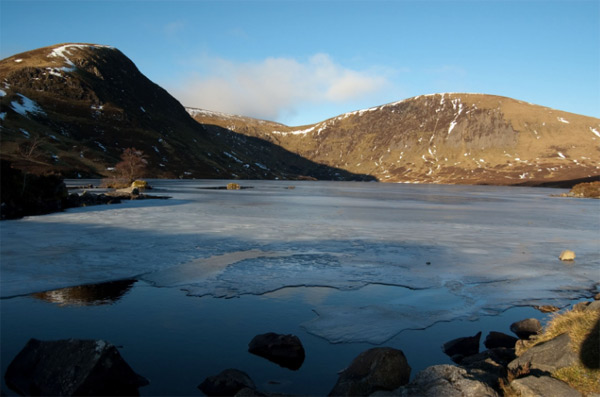
Loch Skene
Skene Loch is an eerie and forbidding place, particularly on cold evenings in the dead of winter – when the waters on the loch can freeze over. If you were to brave the icy conditions and venture down to the lochside and look across the frozen loch you might see what seems like a mysterious set of curved tracks embedded in the ice. Tracks which look newly made by a coach or carriage.
Frozen Loch
So the tracks on the ice? are they a lasting reminder of the day Auld Nick himself paid a visit to his devil-worshipping friend the Wizard Laird of Skene.

Did Auld Nick pay a visit to the Wizard Laird of Skene?
Alexander Skene, the 16th Laird, was the man the devil had come to Aberdeenshire to see. It was said the laird never cast a shadow, was followed everywhere by magpies or crows and had the power to reest, or glue, his enemies to the spot where they stood. On at least one occasion Skene was kept awake by neighbours enjoying a ceilidh. His reaction was to cast a spell on the revellers which made them unable to stop dancing – until their feet bled and they cried in agony.
His mastery of the black arts had been learned while he was a young student at the University of Padua in northern Italy. One of the most famous seats of learning in Europe, Padua was noted for the views some of its members held on the then-controversial subjects of astronomy and necromancy. Many returned with “peculiar ideas” about the heavens and the black arts. The Wizard Laird went one step further and formed a pact with the devil.
The wizard’s coachman was named Kilgour and was well used to his master’s eccentricities – but nothing could have prepared him for the night the devil came calling.
Kilgour was ordered to prepare the coach and horses at midnight to transport his special guest from Skene House, the family mansion. But the laird made Kilgour promise that on no account was he to turn round and look at the stranger.
As the coach and horses sped through the dark countryside, the laird told Kilgour to take the more direct route across the Loch of Skene. There had only been one night’s frost and the coachman said such a journey would be impossible – but the wizard told him not to worry, the ice was strong enough.
The night would have passed without incident had Kilgour’s curiosity not got the better of him. As they were approaching the other side of the loch he did what his master had told him not to do – he turned round. What he saw terrified him. For there sat the unmistakable horned, cloven-footed figure of the devil himself – Auld Nick.
As soon as Kilgour turned to look the ice cracked, the devil turned into a raven and flew off and the coach and horses sank to the bottom of the loch. Whether the laird and his coachman escaped depends on which variation of the tale you hear.
Sheena Blackhall, a poet and historian in north-east Scotland, spent part of her childhood in Skene and remembers local children saying that if they ran 100 times round the Wizard Laird’s gravestone he would rise from the dead.
Despite his supposed deal with the devil, the laird is buried in the churchyard in the village of Kirkton of Skene. The wizard lived from around 1680 until 1724 but his activities had such an impact on the superstitious local people that, even last century, fires were lit at Halloween to keep him at bay. The author William Somerset Maugham heard the story while recovering from tuberculosis at Glen O’Dee Hospital in Banchory, Kincardineshire, and used it as inspiration for his novel, The Magician, in which evil deeds take place at Skene House.
The Skene family are said to have been a sept of the Clan Robertson. According to tradition one young clan member saved the life of King Malcolm III (Canmore) by killing a wolf with his sgian, or knife. The king then granted him as much land as could be covered by a hawk’s flight and the family received a charter in 1318 from Robert the Bruce. The line died out in the 19th century with the 20th laird, who was deaf. The reputedly cursed Skene House is now in a sad state of repair.

skene house
If you think stories of warlocks, curses and visitations by the devil are fanciful nonsense then consider the words of Stanley Robertson, a former gypsy traveller who lived in the Skene area and claims to possess psychic powers.
“The travellers say that if there is something demonic about a place, the frisson will rise up your back instead of down. That is why the hackles rise at the back of your head. And that is exactly the feeling I got when I once visited Skene House, my hackles rose and I had the feeling something very evil had taken place there.”
The post The Wizard laird of Skene’s dance with the devil appeared first on ScotClans | Scottish Clans.
]]>The post ‘Birth certificate of Scotland’ unearthed by archaeologists appeared first on ScotClans | Scottish Clans.
]]>
Oliver O’Grady with Suzanne Urquhart of Scone Abbey
The ancient mound known as the Moot Hill in the ground of Scone Palace was once the site of the “lost” abbey of Scone, founded in 1114 by Alexander I, where Scottish kings are believed to have assumed the mantle of power on the Stone of Destiny.
It was revealed yesterday that archaeologists studying the historic site have been able to use radiocarbon dating to push back the origins of the ancient seat of ecclesiastical and royal power to at least 1,000 years ago, in a remarkable breakthrough that has been hailed as uncovering the “birth certificate of Scotland”.
The critical dating evidence came from scientific analysis of carbon samples retrieved during excavations of a massive ditch that once surrounded the Moot Hill.
Dr Oliver O’Grady, the archaeologist who has been leading the excavations at Scone for the past five years, said: “The radiocarbon dates confirm Moot Hill as one of Europe’s extraordinary survivals, unique in Britain and the first assembly-mound in Scotland to be scientifically dated.
“The lab results are in a sense nothing less than a birth certificate for Scotland.”
Dr O’Grady said the radiocarbon dating, carried out by the Scottish Universities Environmental Research Centre laboratories in East Kilbride, had proven beyond doubt the genuine antiquity of Scotland’s ancient inauguration mound.
He said the findings had put paid to the legend that the hill was created by the soil brought to Scone in the shoes of nobility who came to pay homage to Robert the Bruce at his crowning in 1306.
The radiocarbon dating had been based on the samples of burned wood recovered from the base of ditch which surrounds the mound. Dr O’Grady said: “The analysis shows that Moot Hill likely dates to some point between the late ninth century and early 11th century.”
Significantly, the new dating evidence also matches the earliest historical accounts of royal ceremonies being held at Scone contained in a tenth-century chronicle, dating from the reign of King Constantine II, which began in 900.
Dr O’Grady said: “It will probably be debated amongst archaeologists for time to come as to when the hill was first used for a crowning ceremony.
ut it is very striking that the date that we’ve got is so close to the first genuine historical record of Scone in the chronicles of the kings of Alba.
“From a point of probability, until I have other evidence, it seems entirely plausible to me to suggest that King Constantine II, or at least one of his successors, was responsible for the creation of this mound.
“And that should be seen as a very significant moment in Scotland’s history because they are no longer identifying themselves as Picts and they are gathering, as its says in the text ‘in the manner of the Gaels’ and they are holding their most important royal ceremonies on that mound.”
Moot Hill that was centre of power for centuries:
c 700-900 – Scone established as power centre of the Pictish province of Gowrie.
906 – Meeting of Constantine II at Scone with Bishop Cellach of St Andrews.
1114 – Founding of new monastery, with building works continuing over many decades.
1249 – Alexander III inaugurated on Stone of Destiny in abbey cemetery.
1296 – Stone of Destiny (along with other treasures and documents) are removed to Westminster by Edward I.
1298 – Abbey attacked.
1306 – Robert Bruce crowned King of Scots at Scone.
1360s – Abbey in poor state, young canons instructed not to frequent taverns.
1371/1390 – Robert II and Robert III both hold parliaments on Montem (Moot Hill) of Scone.
1400s – Pilgrims attracted to shrine of St Fergus in the abbey church.
1437 – James I assassinated at Blackfriars in Perth.
1551 – Major church repairs.
1559 – Abbey sacked by Protestant reformers.
1606 – Abbey lands granted to David Murray, Lord Stormont.
1618 – Parish church built on Moot Hill.
1631 – 1st Lord Stormont dies, buried in mausoleum on Moot Hill.
1651 – Charles II last king crowned on Moot Hill
The post ‘Birth certificate of Scotland’ unearthed by archaeologists appeared first on ScotClans | Scottish Clans.
]]>The post Robert Burns – Greatest Scot of all time…? appeared first on ScotClans | Scottish Clans.
]]>
Scotland’s Greatest?
As part of the Homecoming Scotland celebrations, a poll was held by STV to see who the public believes the greatest ever Scot is. Thousands of people were said to have voted from the list of 35 nominees, with Robert Burns, perhaps aptly, generating the most popularity.
Homecoming Scotland 2009 has Burns as its focus, celebrating the 250th anniversary of his birth, so it is maybe no surprise that the national bard was at the forefront of most peoples minds when it came to this vote.
The list of nominees was split up into six different categories (Arts and Entertainment, Invetors and Entrepreneurs, Leaders and Thinkers, People’s Choice, Scientists and Engineers, and Sport), making sure that Scots from all walks of life were covered.
The top 10 greatest Scots as voted by the public is as follows:
1 ) Robert Burns
4 ) Jock Stein
5 ) David Tennant
6 ) Robert the Bruce
7 ) Andrew Carnegie
8 ) Sir William Alexander Smith
9 ) Billy Connolly
10 ) Alex Harvey
However, for many, not only the actual outcome of the top-10 is considered as controversial, but also of the list of nominees, and some of the notable Scots omitted from it, such as nurse Mary Seacole, medical missionary Dr. David Livingstone as well as missonary Mary Slessor, leader of the Protestant Reformation John Knox, and even writer Sir Walter Scott.
What do you think?
The post Robert Burns – Greatest Scot of all time…? appeared first on ScotClans | Scottish Clans.
]]>