The post The Sword of Donald Robertson of Woodsheal appeared first on ScotClans | Scottish Clans.
]]>Further to presenting a talk at Culloden House in April of this year on the topic of Scottish Swords of Legend, I was advised that the Clan Donnachaidh Museum housed a sword with Culloden provenance.
As this was on the return route to Edinburgh, stopping in to study the sword was a natural choice. Upon viewing the sword, I was struck by certain manufactured form and detail that I found of great interest and was inspired to subsequently make some fascinating historic connections.
My work involves hand-crafting historically accurate European edged weaponry of all forms from Bronze Age to present day. Over the years, Scottish basket hilted swords have been one area of personal interest that has become more prominent in my armoury studies. Every basket hilted sword has particular identifying form and characteristics as unique as a fingerprint and every one provides a fascinating insight into historical craftsmanship, functional form and martial swordsmanship.
The sword of Donald Robertson revealed remarkable similarities to another sword and one currently in my custodianship, that of Rob Roy MacGregor. The Macgregor sword was passed from him to his landlord (a MacLaren) on his deathbed and remained in this family line until a couple of generations ago, when it was bought by a family from my own homeland in Moidart.
My first visit to study the Robertson sword only sparked further burning questions and closer study was necessary. The museum was extremely helpful when upon my second visit I was granted access to examine the sword closely and also directly alongside that of MacGregor for direct comparison.

Sword of Donald Robertson of Woodsheal (Targe by Graeme Biggerstaff at Alba Targes)
It may be simpler to first account for the differences in both swords. The grip material and form is different, with MacGregor’s having a wooden grip (Caledonian pine) filed deeply to originally secure wire over a leather or shark-skin grip covering (now lost to expose only wooden grip). Robertson’s sword unusually bears a grip made from stag antler (red deer).
This is an unusual grip material choice but the form feels remarkably comfortable in the hand. It is always possible that the antler has been a later addition to possibly replace a badly cracked or perished wooden grip, but the top of the pommel shows no signs of re-working in recent years.
Robertson’s sword also carries a pommel somewhat smaller and squatter than MacGregor’s. This is not too surprising as MacGregor’s blade is slightly broader. This results in a slightly heavier blade overall, which requires balancing out with a larger pommel.
Both swords bear distinctly broad double edged blades of excellent temper. The origin of blades without specific marks of makers or country of origin might always be debatable, but we might assess something as much from what markings they do not carry.
Jacobite swordsmen often privately purchased their side-arms, and they certainly knew the value of a good quality blade. Examples of Jacobite swords for example invariably carry blades of far higher quality than the standard “munition quality” swords issued to British Government troops of the day.
The best quality sword blades manufactured in great numbers were from Solingen and Passau in Germany, and these were often imported to Scotland throughout the late C17th – mid C18th to be mounted by local makers as basket hilted swords. The “running wolf” mark was common to German blade-smiths and can often be found on quality Jacobite swords.

Running Wolf maker’s mark on a Solingen manufactured sword blade.
Neither MacGregor’s or Robertson’s blades display a running wolf mark. Both blades are double edged and centrally fullered. The fullers or grooved channels running down the length of a blade serve a simple purpose and that is to reduce weight where possible without compromising blade strength or flexibility. They are not “blood grooves” as popular gory myth might imply.
Robertson’s blade appears to have some lettering inside the fullering, which could not be easily discerned in the low light conditions. Further dedicated study may here reveal greater detail. The blade of MacGregor’s is stamped with the legend ANDRIA FARARA.
Andrea Fararra was an Italian swordsmith working in Belluno between 1550 – 1583. It is believed he also lived and worked in Scotland for a number of years. He was renowned for the exceptional quality of his steel and blades, so much so that his name continued to be stamped in various spellings on blades far beyond his death throughout the C17th and C18th.

Andria Farara blade stamping on MacGregor’s sword blade fullers.
The hilt forms of both swords are similar in form and detail. Both have been constructed according to the same pattern, one which could date from as early as 1680 – 1690. One particular construction consistency between both swords is the section and dimensions of connecting bars.
These are noticeably square in section, which is unusual as most Highland basket hilt connecting bars are round in section. More-so, these connecting bars are incised their length on the outside faces with a shallow central channel. The side panels are near identical in form and detail, featuring exactly the same pattern of filed channels and positions of pierced holes and hearts. The same bears true for the forward-most panel or knucklebow, which reflects the pattern and detail of the side panels.
The main difference in the hilts lies in the square “Saltire panels”. Each sword has two of these square panels, which provide a significant part of the basket hilt protection for hand and knuckles. MacGregor’s sword features a repeating pattern of pierced circular holes and rectangular slots. Robertson’s features four hearts on each panel, filed in the same form as the forward and side panel detail.

MacGregor and Robertson swords hilts side view comparison

MacGregor and Robertson sword hilts front view comparison
Such similar form and details are indicative of being crafted by the same hand, or at very least the same armoury. So where could these swords of provenance have originated?
Earlier this year I was directed on a path of research after reading about a legendary Highland armoury. This was the armoury at Innerwick, Glen Lyon, which was operated by no less than 14 generations of the MacFarlane Clan.
The MacFarlanes were renowned for their skill in making quality arms and certainly were in production here through the C17th and C18th. This clan also had close ties with the MacGregors of Roro and provided them with arms for many years.
Tying the clan association together with geography (Rob Roy was usually living approximately 20 miles South West of Innerwick and Robertson approximately 20 miles to the East), the armourers of Glen Lyon would appears to be the likely candidates for the manufacture of these unique swords of provenance.
I recently visited the location of the Innerwick armoury. The building is now gone, but its original place is known and lies directly beside a small burn still known today as Muileann nam Biodag or the Mill of the Dirks.
It was a special visit to rediscover this ancient site where once sparks and hammers flew daily to craft some of the best quality blades and arms in the Highlands. Clansmen would have revered these, carried them with pride, swore by them and staked their very Honour and Lives upon them.

The author with Rob Roy MacGregor’s Sword by the Mill of the Dirks at Innerwick, Glen Lyon
Further research is now currently being conducted in order to determine the characteristics of Glen Lyon patterns of basket hilted swords. Such studies have only been made possible by the original connections made between two swords of distinct legend, that of Donald Robertson of Woodsheal and that of Rob Roy MacGregor.
Every original sword is unique and bears its own character, much like those of the original makers and owners. These old seasoned veterans talk to us yet and we need only listen closely and ask the right questions to see more clearly into the mists of time.
And like any great historic adventure, the more questions that are answered, the more are raised. Let us see what further discoveries and paths of research might yet arise from these initial findings by the sword.
Paul Macdonald is originally from Moidart and has long held a fascination in Scottish martial archaeology. He is a professional custom sword and knife maker and historical fencing master and runs Macdonald Armouries (www.macdonaldarms.com/armoury) and the Macdonald Academy of Arms (www.macdonaldarms.com) based in Edinburgh.
The post The Sword of Donald Robertson of Woodsheal appeared first on ScotClans | Scottish Clans.
]]>The post A Northward Meandering – Walking the West Highland Way – Part One. appeared first on ScotClans | Scottish Clans.
]]>
Making Plans
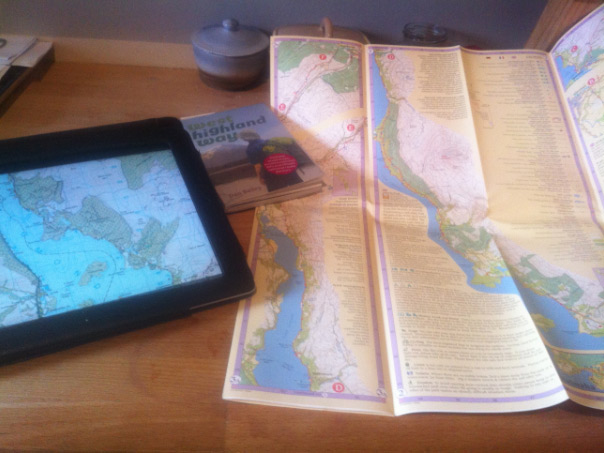
For several years I’ve been planning to walk the West Highland Way, one of Scotland’s best known long distance walks that runs for 96 miles from Milgavie just north of Glasgow all the way to Fort William in the North West Highlands. I have just returned from finally managing to complete this incredible and iconic route, a little bruised a little worn but a lot richer for the experience. During my travels I kept a journal of each day, here along with some of the photos taken along the route is my account of ‘walking the way’.
Prologue: Getting to the starting line.
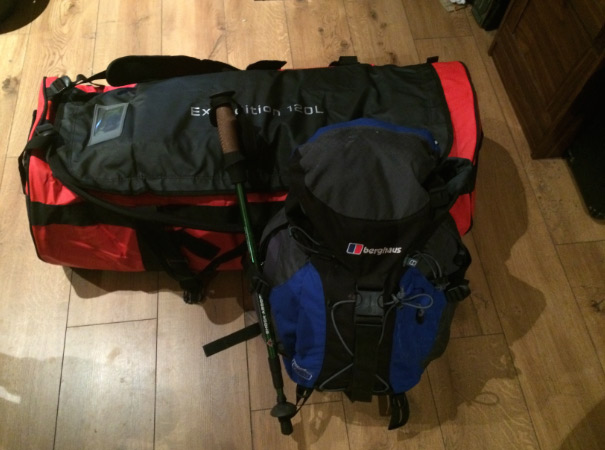
All packed and ready to go
For most people the start of the West Highland Way starts with a train journey. for me it was boarding a train from Edinburgh to Milngavie. For what should be a short hop from east to west central Scotland this is one of those surprisingly long journeys on a train that stops at places even I’m not familiar with despite spending most of my life in the central belt. As the train trundled through Scotland’s former industrial centres I sat with my outrageously large holdall and rucksack and wondered how this week was going to go. Finally as we got into the late afternoon the train came to a halt at the and of the line – Milngavie.

Milngavie
Milngavie (pronounced ‘Mull Guy’) was a once small village that grew rapidly in the industrial revolution, being close to a good water supply this allowed the development of paper mills etc, now it has more or less been swallowed up by the expansion of Greater Glasgow and these days serves as a commuter town. Since the first day was going to be a long one I had decided to get through the day before and stay overnight giving me a chance for an early start the next day. Having hauled my huge bag and myself off the train I afforded myself the luxury of a taxi to the hotel.
My home for the night was a local branch of a budget hotel chain, the size of the hotel in such a small town is testament to just how popular this walk is. In fact its hard to go anywhere in Milngavie without being reminded of it, certainly a boost for the local economy. A small industry has indeed grown up around servicing the 85,000 people who use this route every year (though just a little over 1 in 3 walk the whole way). One of the most welcome of these is the baggage transfer companies who for a modest fee will take your bags to the end of each stage and pick them up the next day allowing you to walk with just what you need for the journey. One of these called ‘ Travel Lite would be custodian if my very large holdall for the week (lucky them).
Unfortunately my last night of luxury was not the best, my excitement about the day ahead leaving me a bit like a kid at Christmas, unable to sleep properly. I found myself up and about at a fairly crazy hour (for me) so ventured down for an early breakfast. once filled with the standard Scots fair of cholesterol I did my final packing, dropped my bag at reception and began the walk to the town centre and beyond…
Day One: Milngavie to Drymen
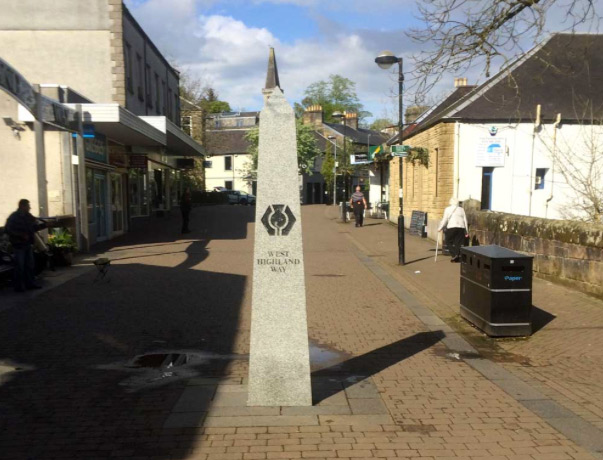
The start of the way
A modest stone obelisk in the town centre marks the start of the way, this is conveniently beside an arch which walkers pass through, leading down to the path by the river and some convenient signs. It was a beautiful spring morning with puffy clouds and little but the sound of birdsong and the hoof beats of joggers out for an early sunday morning workout. The early stages of the way are surprisingly pleasant as it meanders along the Allander water, very quickly you feel that you are leaving the town behind and the adventure is beginning.
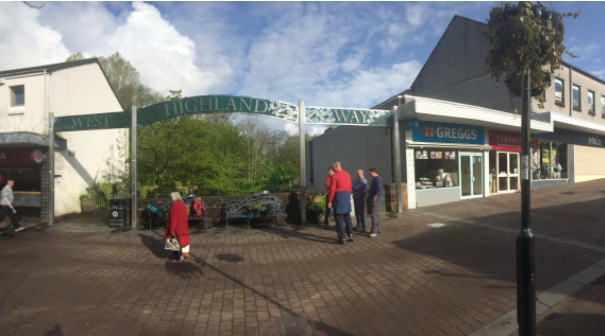
The West Highland Way arch
After a short stroll up river I came to a large ‘diversion’ sign, accompanied with other signs, maps etc explaining that a large section of the way was temporarily closed for work on power lines and a diversion was in place. This diversion sign pointed up what looked like a rather steep hill. Fortunately it was still early and this didn’t feel like too much of an inconvenience. A few minutes later I was beginning to question this decision as I puffed up a relentless incline through the forest. My efforts were rewarded though since this diversion came out right next to Mugdock Castle.
This small but impressive Castle was a Graham stronghold from the mid 13th Century. Mugdock is possibly the birthplace of the most famous of the Grahams – the Marquis of Montrose. The castle has had mixed fortunes (partly down the association with Montrose and partly down to the clans eventual abandonment for the larger Buchanan Old House. The ruin has since been stabilised and now makes a very attractive landmark.
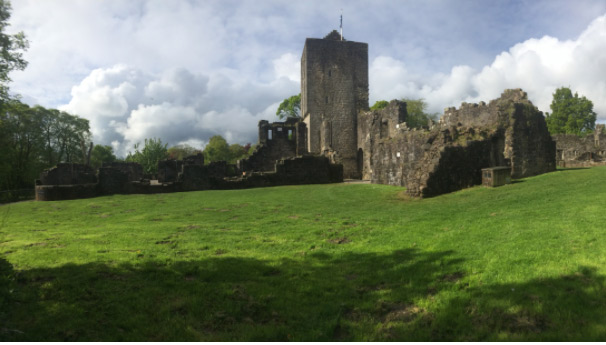
Mugdock Castle
From Mugdock the diversion took me rather appropriately along a fairly well rutted bridle path and an early test for the footwear. This muddy track finally found its way downhill at a place called Carbeth with views across to the famous Carbeth Huts. It would be easy to wander past this little area of painted wooden lodges without giving them a second thought but the Carbeth Huts (and the Hutters who own them) are part of local lore. This area near to the Campsie fells has often been a popular spot for people looking to escape the pollution of the big city (in this case Glasgow) Scout groups, climbers and walkers would all use this area to camp. After the First World War the landowner allowed ex servicemen to build small wooden huts on the land and a community grew up around them. The huts were used as shelters during the great depression and also from the bombs during the Clydebank Blitz. Still the existence of the huts were dependant on the whim of the landowner but in 2010 an agreement was reached and the hutters bought the land in a community buy out.

The Carbeth Huts
Onwards and more or less northwards I went, the small path crossed a minor road and up a little hill. Cresting the hill is quite a surprise as its your first glimpse of what really lies ahead. far in the distance the mountains around loch Lomond form a backdrop to rolling moorland with the Campsie fells flanking to the East. This is the first of many changes of landscape you experience on the way. From here a disused railway line is your guide for a large part of your remaining day. The railway though disused for carrying passengers does have another cargo however; water. Beside the line and partially buried a massive pipe carries the water supply from Loch Lomond all the way to the homes of the people of Glasgow.
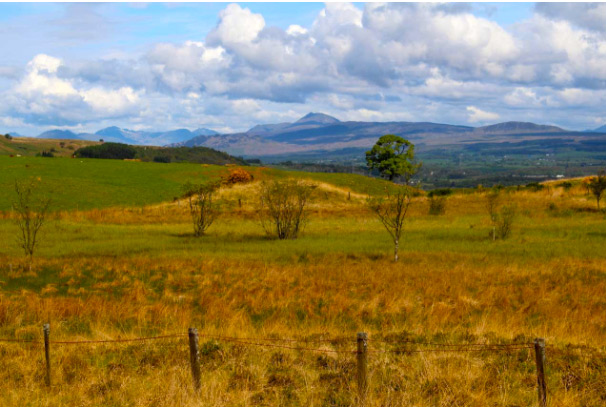
The Highlands ahead!
The monotony of this stage was broken by the view of the Glengoyne Distillery. This pretty distillery sits directly on the ‘highland Line’ and so is unique in that the whisky there is officially distilled in the highlands but matured in sheds on the other side of the road which are classified as being in the lowlands. Glengoyne may look small but produces a million litres of spirit a year, an impressive figure. Tempting though a visit to the distillery was the sight of the Beech Tree Inn right next to the road a few yards further on drew me in. This lovely little pub with an impressive beer garden was the first chance to take the pack off and sit down with a soft drink (it was still Sunday morning after all) and chat to other walkers who had started the journey that day. This is the great thing about the West Highland Way, the camaraderie that builds up as the week progresses, the same familiar faces that pop up as you complete each stage or take a break can sometimes lead to great friendships. Much of the early chat of course is all about how far are you going and what stops you are doing, there is an air of excitement and expectation.
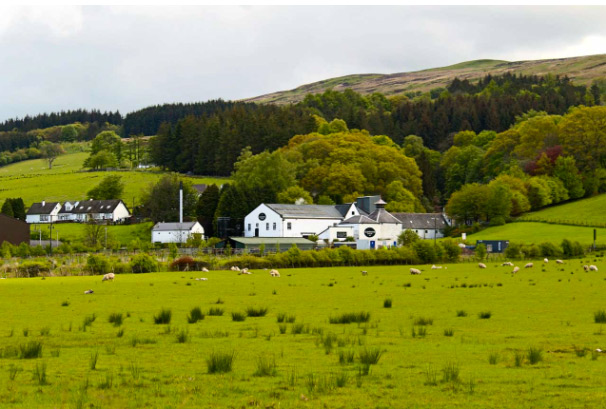
Glengoyne Distillery
From here it was just a few miles to the end of the road for day one. The small town of Drymen and for me the campsite of Easter Drumquassle Farm a mile or so to the south of the town. It was at this point I discovered a phenomena of long distance walking; the attack of the ‘Nearly Theres’. this is a peculiar malaise that effects the feet and leg joints and sometimes the entire body which appears to have made up its mind that the journey is over despite the fact that there are miles to go. the last hour or so then became a slow trudge along country lanes till eventually the campsite came into view.
This farm is a popular first stage for those wishing to camp on the route. Having poured over any research available beforehand I was somewhat concerned as the online reports for this place were not great. Reports of badly sloping pitches and temperamental owners were playing on my mind but all seem to be unfounded. The site was damp but understandable considering the rain we had previously, however the spot I found up by the fence was quite level and the young owner who bounced over to me as I was picking up my bag from the shed acting as a drop off point for the baggage service was charming. Having hauled my pack up to my chosen spot I then began to erect my tent. The tent we have was one Amanda bought for her trip to St Kilda a few years ago, its quite large for hiking and at first is rather complicated to put up. Fortunately despite my slow pace I was the first to arrive so could get on with it in peace. To my surprise the tent went up with very little stress to me or the aluminium poles and was soon sorting out my little home for the night. Fortunate timing too as the rain came thundering down moments later so I amused myself listening to the pounding of the rain and peering from the small flap I’d allowed to stay open with a view over to the Horses in the next paddock. Eventually the rain eased off and boredom set in so despite the miles undertaken I decided to take a walk into the town of Drymen.
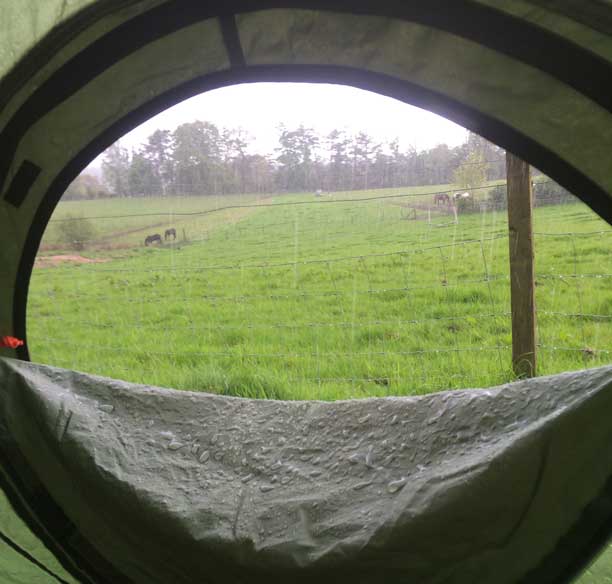
Watching the rain
Drymen is a quaint little village, the name comes from the Gaelic word Druiminn which also happens to be where the family name Drummond comes from. Not only the West Highland Way but the Rob Roy Way passes through here and the village pub the Clachan (which claims to be the oldest in Scotland) was reputed to have connections with the family of the famous outlaw. I decided to pay a visit to the famous Clachan pub, purely for research you understand. and after a short rest stop hobbled back to camp for the night. Tomorrow was going to be a long day with Rowardrennan by Loch Lomondside as my destination…
The post A Northward Meandering – Walking the West Highland Way – Part One. appeared first on ScotClans | Scottish Clans.
]]>The post DNA used to try and solve the name game for outlawed MacGregors appeared first on ScotClans | Scottish Clans.
]]> The MacGregors were once the most feared and persecuted clansmen in Scotland – forced to renounce their ancient ancestry or face execution.
Clan Gregor was effectively erased from existence after King James VI decreed the name MacGregor should be abolished following the murder of the King’s Forester, killed for hanging some clansmen for poaching.
For two centuries the MacGregors, including the legendary Rob Roy, lived as outlaws.
MacGregor clansmen, caught after refusing to renounce their name, were killed while the women were stripped, branded, and whipped through the streets before they and their children were sold into slavery in Britain’s new American colonies.
Others legally changed their surnames to escape persecution as the clan was dispersed to the four winds.
But now, 233 years after the persecution of the MacGregors finally ended, the latest advances in DNA technology are being used for the first time by the Clan Gregor Society to welcome “lost” clansmen back into their fold.
The DNA profile of a known descendent of the chief’s line – the MacGregors of Glencarnoch – is being used as the benchmark for the vital tests. He is known simply by the codename Kit 2124.
And the council of the Clan Gregor Society has announced that it will admit to full membership of the society anyone who can prove they share 31 out of the 37 DNA markers in common with the main MacGregor bloodline profiler – irrespective of their surname.
Professor Richard McGregor, the chairman of the Clan Gregor Society of Scotland, said:
“The council has taken this decision in recognition of the fact that, as a result of Clan Gregor’s past turbulent history, individuals were required to assume names which were totally divorced from their actual clan, and although such name changes were often documented at the time, others were not.
“The council recognises the ancestors of some MacGregors chose not to return to the original clan name for a variety of reasons, and that advances in DNA testing now allows descendants of such individuals to be identified as belonging to the clan.”
• THE persecution of the Clan Gregor began in 1603 when King James VI issued an edict proclaiming that the name MacGregor should be “altogidder abolished” and ruling that those of the “wicked and unhappie race of the Clan Gregour” who bore the name must renounce it or suffer death.
The gentry were encouraged to hunt down Gregors who refused to change their surnames and a price of 1,000 merks – a fortune – was put on the heads of clan leaders, with 100 merks for other clan members.
The persecution finally ended in 1774, when the Act of Proscription against the clan was repealed.
To find out more please see the new MacGregor DNA blog.
Surnames that were looked at or this project are:
Agor, Bennett, Black, Campbell, Card/Cart, Clark, Dougall, Dowie, Drummond, Foxton, Greer/Grier/Grierson, Gregor, Gregory, Gregson, Grieg/Gregg, Grieve, Grigsby, Gruer, Hardy, King, Lackey/Leckie, Lawrie, MacDougall, MacFarlane, MacGregor, MacGregor-Skinner, MacPherson, MacWhannell/McIlchonnell, Magruder/McGruder, Malloch, Mathews, McAdam, McAdams, McGee/Magee, McGregor, McGrew/McGreer, McLaughlin/Gilmore/Stranahan, MacNab, McNee, McWhannell, Megehee, Mitchell, Moore, Mustard, Nevins, Nichols, Offutt, Orr, Peterson, Pyatt, Ree/McLergan/McLean, Reese, Reid, Rodgers, Shanahan/Strannigan, Shankland, Shipperlee, Skerratt, Skinner, Smith, Snow, Stallings, Stirling, Thorn, Turk, Warner, Welcker, West, Westran, Whyte/White
The post DNA used to try and solve the name game for outlawed MacGregors appeared first on ScotClans | Scottish Clans.
]]>