The post Watching Scotland: Scottish Political Basics for Americanos appeared first on ScotClans | Scottish Clans.
]]> Scotland has been locked in union with England and Wales since 1707. In contrast, Scotia’s Gaelic neighbor Ireland arrived and departed the union in the span of little more than 100 years. The Irish episode left behind too many dead and ruined lives and Ireland’s northern six counties united with the nations of Great Britain. Scotland itself is relentless in its discussion of wiggling free of its union with England, Wales and Northern Ireland and talk of a second Scottish independence referendum continues to enliven the news. If you want to learn about politics and governance in the British world it helps to understand political unions. British people, including their offspring in America, love political unions and over the course of the centuries they have formed, layered, adjusted and rejected all kinds. Historically strong constitutional dynamism on the British Isles continues to this day.
Note that these “unions” have not always been the product of entirely informed and voluntary choice on both sides In the case of the very early melding of Wales into England the word “annexation” tells the tale with more truth while still maintaining politeness. In 1776 many people in the 13 British colonies in North America actually decided to reject one political union – the one formed in 1707 and called the United Kingdom (see below) – and attempted to “form a more perfect” one. We in America are now on our second try getting at that perfect union; the Articles of Confederation being the first and the long beleaguered Constitution the second.
Meanwhile, the Scottish have been doing the political union thing since about 843AD.
 Scotland’s First Union: Picts and Gaels

The idea of a unified Scottish nation first began to solidify in the 9th century with the union of the two then resident societies north of the English border, the Picts and the Gaels. A famous fellow named Cinaed mac Ailpin (anglicized as Kenneth MacAlpin), a son and scion of both the Pictish and the Gaelic worlds, apparently gained power over it all round about 843AD and established right then and there a more or less unbroken and continuing line of Scottish royal coat tail riders. The Pict/Gael union was formed in the midst of the strange disappearance of the Pictish world into the Gaelic. And of course, almost immediately, feudal political and cultural pressure began pushing up from south of the Scottish-Anglo “border”, eventually infecting all of Scotland but first and most completely, altering the borders and lowlands.
The Second Scottish Union: Gaelic Highland and Anglo Lowland
Throughout the 9th – 15th centuries, Anglo and Norman influence expanded northward crashing Caledonia’s Gaelic party. Deep distinctions began to separate the primarily Gaelic highlands and islands from the quickly anglicizing Scottish urban centers, borders and lowlands. Meanwhile, what appears to have been an extraordinary and artistic culture was flourishing in the Gaidhealtachd. The great MacDonald Lordship of the Isles was based at Loch Finlaggan on the island of Islay and it held together a Gaelic world that was politically and culturally distinct from the Scottish kingdom based in Edinburgh with its strings to London.
Unfortunately for the indigenous Gaelic culture, conformity struck a hard blow at the close of the 15th century when political union was once again imposed on Scotland. Having had enough Gaelic cultural diversity for a lifetime, King James IV acted to forfeit the Lordship of the Isles in 1493AD and then deployed culture crushing tools such as the 1507 Statutes of Iona to depress all things Gaelic. For good or ill, Scotland was now on its way to becoming one nation, often under three gods, Gaelic, Catholic and Protestant. Not a match made in heaven.
Union of the Crowns: Two Kingdoms, One King
About a century into James IV’s war of extermination and cultural domination against the Gaels, Big Elizabeth I died down in London and her Protestant nephew James VI of Scotland became James I of England as well. Thus began one of the most enduring – and from the Scots perspective practically troublesome – of the British unions. While both nations maintained their independent parliaments following James’ second coronation in 1603, under the Union of the Crowns of Scotland and England, England and Scotland thereafter shared the same Monarch and royal family. This arrangement proved an overall disadvantage for Scotland as the Scottish/English kings were much more impressed with England than with what they considered to be a quarrelsome and backward Scotland. Most royal favor remained with the King in England while consternation and impatience flowed north to Scotia.

Burning Question: What happens to the Queen and wee George if Scotland leaves the United Kingdom?
Many people outside of the United Kingdom take an interest in the British Royal Family, especially now that there are young beautiful heirs and fresh babies being wheeled about in royal prams. A good deal of negative reaction to the Scottish independence movement over here is based on the American royal watchers’ fear that were Scotland to become an independent nation it would lose or forfeit its tie to the British royal family and that just could not come at a more photogenic time.
Face it – what Americans understand about Monarchy fits in a thimble. For the moment, there is only one thing we need to understand. Who wants to lose their claim to two year old Prince George and his tiny sister Charlotte? No one that’s who. Not to fear, as Scotland shares equally in the Windsor royal blood, independence would not of itself strip the royals from Scotland. Do note however, that Scotland harbors a “republican” movement interested in ditching the monarchy and replacing it with a form of democratic republic traveling in Ireland’s path. The movement is small and at present inconsequential. We can still look forward to adorable pictures of wee George in his first handkerchief sized kilt sitting atop the royal pony.
The United Kingdom of Great Britain: A Union of Nations
Finally, in 1707, ironically a tidy 200 years after James IV issued the culturally brutal Statutes of Iona, Scotland dissolved its own Scottish parliament, packed all the quills and parchment in wagons and trucked it down south to England’s house. The new union with England was called the United Kingdom of Great Britain. This is the one that 45% of Scottish voters wanted out of as of last September 18th.That number is undoubtedly higher today. We’ll be exploring why in future blogs.
It is important to note that Scotland’s unique systems of law, church and education were allowed to remain intact and purely Scottish even after formation of the United Kingdom and dissolution of the Scottish parliament at the dawn of the 18th century. These three carve outs were spared the sword of union as nods toward political expediency. They demonstrate some of what it took to pass the Act of Union in Scotland. Union was not immediately popular in Scotland.
I’ve always found it curious and perhaps telling that the name of this famous and powerful union of nations is not the United “Kingdoms” of Great Britain – plural – two kingdoms. Imagine if the United States had been called just the United State. Quite the different connotation there, eh? Not very scholarly but it just makes me itch.
Anyway, from 1707 until 1999, Scotland had no Scottish parliament and the Scottish people were ruled, except as to their legal, religious and education systems, directly by the parliamentary governmental structure of the United Kingdom sitting at Westminster in London, England.
Low and behold, after fussing about with it for decades, in 1997-1998 a UK Labour government and the Scottish people voted to allow the formation of a new Scottish parliament to exercise new “devolved” authority over certain limited areas of governance. In consequence of this “devolution”, since 1999 Scotland has convened its own parliament in Edinburgh while continuing to truck Scottish representatives down to the United Kingdom’s House of Commons at Westminster.
More on the Scottish Parliament and Scottish politics in Scotland in Part Two of this blog post. It’s a story unto itself. For now, here are some of the basic nuts and bolts about how things work at Westminster, which, at least for the moment, continues to have great impact on Scotland.
Westminster Parliament

Westminster in London
The UK Parliament sports an “upper” and a “lower” legislative chamber both of which are active in considering and enacting bills and over seeing the executive function which implements the laws of the national government. The UK Parliament considers and passes legislation in a process that is generally recognizable to anyone familiar with how the US Congress and Senate (are supposed to) accomplish the same work. Any piece of legislation must be processed through the lower house, the House of Commons and the upper house, the House of Lords. Amendments of one house must be reconciled with the other house version prior to final passage. Once all amendments are reconciled, the legislation is placed before the King or Queen for Royal Assent. One does not veto.
 The House of Lords, an unelected mixed life-appointed and hereditary body, had long held a veto over bills passed by the House of Commons. Since the middle of the 20th century, Parliament has been attempting to reform the manner in which the House of Lords functions. Reforms are still in the works, but most of the Lords who are eligible to participate in the work of the House of Lords are now life peers instead of hereditary peers which is better but still isn’t reeking of democracy.
In further reforms, the House of Lords has been stripped of its ability to amend finance and tax bills originating in the House of Commons. Finally, if the House of Lords cannot agree upon a bill that has passed the House of Commons the bill falls. Pursuant to the reforms of the Parliament Act of 1949, the House of Commons can pass that bill without the concurrence of the House of Lords in the next parliamentary session, thus stripping Lords of their traditional veto power over the House of Commons, an elected and more democratically designed chamber.
Her Majesty’s Government and Her Majesty’s Official Opposition
The UK “Government” (similar to the United States’ executive branch) is formed by the party in the majority in the House of Commons and led by that party’s leader. Presently, the majority party is the Conservative Party (Tory) and David Cameron MP is the Conservative Party leader and the UK Prime Minister – leader of the executive function of the United Kingdom. His role as Prime Minister finds him doing many “presidential” sorts of things but he is just an MP and can actually be sacked by his own party. Just a thought.
Her Majesty’s official opposition is the second most numerous party in Commons. Currently that is the traditional British and Scottish powerhouse, the Labour party. However, in the same election that brought the Conservatives a humble but clear majority, the British Labour party and its cousin the Liberal Democratic party were both electorally devastated. The final election numbers saw the number of Labour MPs fall from 256 to 232. The Liberal Democrats lost 49 of their previous 57 House of Commons seats and a share of a coalition government as well. Forty of those lost seats went to SNP candidates in Scotland. While Labour is busily looking for a new leader and a new life (to be chosen in September 2015 – more on that later) Labour remains Her Majesty’s official opposition party in the House of Commons but has been heavily criticized for offering little or no opposition to major Conservative legislation. This is a story we will be watching.
The SNP 56
Meanwhile, Scotland’s presence at Westminster has improved significantly since last May’s UK General Election. A new UK Parliament is elected every 5 years unless things go very badly and they just can’t wait that long. In May 2015 this year, to begin the 55th UK Parliament, Scotland sent 56 Scottish National Party MPs to Westminster. The SNP is the party of Scottish independence. Doesn’t take a rocket scientist to see that things may be shaken up in London because of this. The shaking is already underway.

Mhairi Black, (SNP) MP
The SNP 56 will be at Parliament until 2020 when the next Parliament will be elected. So 56 SNP Ministers of Parliament is 50 more SNP MPs than were elected by Scotland for the prior Parliament and only 3 shy of the entire Scottish contingent to the UK House of Commons. The SNP 56 represent the victorious flip side of the collapse of Labour and the Liberal Democrats as it plays out in Scotland and it is a fascinating story. Despite not being Her Majesty’s official opposition, the SNP have in fact been doing most of the opposing in this Parliament. To prove it, the SNP have a special section on the UK Parliament’s website which details a full slate of SNP “shadow” ministers of state and parliamentary officials.
Scotland’s 56 SNP MPs are enthusiastically participating in the British people’s business as they were elected to. A few new celebrities have emerged, including 20 year old university student (now graduate) Mhairi Black, the Union’s youngest ever Minister of Parliament who is proving to be a caring, articulate and inspiring public servant. Scotland’s national profile within the United Kingdom is higher than it has ever been due to 56 Scottish Nationalists showing up and doing their jobs.

Scottish first minister Nicola Sturgeon and the new SNP MPs pose in front of the Forth
* * *
Next edition of Watching Scotland brings a view to Scotland’s Parliament and national government and explanation of a raucous and changing political Scottish scene. Look out for Part Two of Scottish Politics and Government for Americanos 101!
Some Helpful Info
The United Kingdom of Great Britain* and Northern Ireland
The United Kingdom of Great Britain* and Northern Ireland
England, Wales, Scotland & Northern Ireland
Chronology
Wales: Wales was combined with England in 1284 via the Statute of Rhuddlan which was followed by an Act of Union in 1536.
Scotland: The Scottish and English crowns were united in the person and line of King James VI of Scotland and I of England in 1603; the Act of Union uniting Scotland and England legislatively passed in 1707 and Scotland became part of The United Kingdom of Great Britain.
Ireland: The legislative union between Great Britain and Ireland became effective in 1801 and the name was changed to The United Kingdom of Great Britain and Ireland.
Ireland Checks Out: Ireland rejected its union with Great Britain in 1921 becoming an independent republic. By treaty with the residual UK, the six northern Irish counties remained in union with Great Britain and the name is once again adjusted to The United Kingdom of Great Britain and Northern Ireland as it is today.
*Great Britain is a geographic term (coined by King James VI & I in 1603) that refers to the largest island in the island group called the British Isles. The island of Great Britain contains the mainland of the Scottish kingdom, the English kingdom and the Welsh
The United Kingdom's Parliament at Westminster
The United Kingdom’s Parliament at Westminster
House of Commons
Elected from home constituencies
Members of Parliament: 650
England: 533
Scotland: 59
Wales: 40
N. Ireland: 18
Parties
Conservative: 330
Labour: 232
SNP: 56
Liberal Democrats: 8
Democratic Unionist Party: 8
Plaid Cymru: 3
Sinn Fein: 4
Social Democratic & Labour: 3
Ulster Unionist Party: 2
Green Party: 1
Independent: 1
UK Independence Party: 1
Speaker: 1
House of Lords
Appointed by the Queen upon advice of Prime Minister.
Lords & Bishops: 750+/-
Appointed for Life: 600+/-
Hereditary Peers: 92
Bishops in The Church of England: 26
Largest Party In Lords: Conservative (226)
Parties
Conservative: 226
Crossbench (no party affiliation): 179
Labour: 212
Liberal Democrats: 101
Democratic Unionist 4
UKIP: 3
Plaid Cymru: 2
Ulster Unionist: 2
Green: 1
Sinn Fein: 0
SNP: 0
Non Affiliated: 21
Other: 5
How Does Scotland Stack Up?
The United Kingdom: How Does Scotland Stack Up?
Geography
UK: 94,060 sq mi Scotland: 30,414 sq mi Wales: 8,023 sq mi Northern Ireland: 5,456 sq mi England: 50,346 sq mi Population
UK: 64.5 Million Scotland: 5.3+ Million Wales: 3.0+ Million Northern Ireland: 1.8+ Million England: 53.0+ Million Economy (Approx. Total GDP)
UK: $2.945 trillion Scotland: $245 billion incl. oil Wales: $80 billion Northern Ireland: $48 billion England: $2.68 trillion Number of Nuclear Submarine Stations
UK: 1 Scotland: 1 Wales: 0 Northern Ireland: 0 England: 0 Density (people per sq mi)
UK: 661/sq mi Scotland: 174/sq mi Wales: 381/sq mi Northern Ireland: 346/sq mi England: 1,054/sq mi
The post Watching Scotland: Scottish Political Basics for Americanos appeared first on ScotClans | Scottish Clans.
]]>The post What Now Scotland? appeared first on ScotClans | Scottish Clans.
]]>
Saltires being carried up Arthur’s Seat
Last Thursday evening I set my alarm for 2am and took to bed early, the fridge was stocked with snacks and beer and a bottle of wine sat in the kitchen, champagne seemed too much like tempting fate.
I checked my phone just before 2.00 to find a message from a friend, Clackmannanshire had declared for no and it was already not looking good. My heart sank. Nevertheless I got out of bed and tuned into the BBC coverage. It was relentless and despairing, as each declaration came in the inevitable result became clearer and clearer. For some reason my mind drifted back to the awful night my father passed away, the family were together through the night by his hospital bed and looked at each other as he slowly drifted away over the course of the night and into the next morning. We were helpless and powerless and as I watched him I thought about all those memories and experiences that were about to be extinguished forever. That same feeling washed over me as I watched the dreams of so many Scots being slowly strangled by fear.
Around 7am I crept into my sons bedroom and sat beside him on the bed, he woke and sat up, looking at me through sleepy eyes, ‘I’m sorry, it’s a no’ was all I could say. He lay back down and pulled the covers over his head, I heard him struggle to hold in his emotions. Back in the living room I returned to the TV coverage but I could now hear the sobs coming from his room.
I opened my laptop and began to remove myself from numerous pro independence Facebook groups, to ‘unlike’ all those many pages that had for months tried to spread a positive message of hope. Slowly my social media feed began to return to normal.
And that was it… The dream of a better Scotland was just that, a dream and I’d woken up on a grey September morning to contemplate a bleak future. However in all of this I’d forgotten one simple and unforgettable truth…
This is Scotland and we are the Scots.
As Friday wore on my mood began to lift. As my friends across our wide social networks began to react to the result I saw each find their own way of dealing with it. Some changed their Facebook profile pure black or white in mourning. Others returned their images to how they had been before. Collectively we were going through the stages of grief.
And then it stopped.
In the end Scotland had voted against independence by 55% to 45%. That 45% represented over 1.6 Million Scots, far more people than the entire turn out for most elections. 1.6 million people had said that they would not be frightened by the scare stories in the media, that they did not believe the establishment’s promises of extra powers. 1.6 million of us chose hope over fear. And that was quite an achievement.
Around lunchtime on Friday some inventive person started up a little Facebook community, they borrowed a slogan from the ‘occupy’ movement and called it ‘we are the 45%’. What happened over the next few hours was quite incredible; within minutes several hundred had joined the community, within hours it was in the thousands, by the early evening it was tens of thousands. As I write this over 175,000 people have joined this online gathering. A beacon had been lit and the shell-shocked troops of the yes campaign had seen it and they were regrouping. Suddenly it became clear that we were not dead, this was not over, and this fight was really just beginning.
But then the news started filtering in from George Square in Glasgow and reality bit hard again. For weeks the Yes movement had more or less occupied the square, a multi cultural festival of singing and dancing and speeches had shown the world what was great about Scotland. For the next few hours we were about to see the other side, the darker side, the Janus face of Scotland. Like a scene from some zombie horror movie the square began to fill with union flag wearing bully boys, throwing flares, making nazi salutes and attacking anyone wearing a Yes badge or holding a saltire flag. Within minutes the square, which had focus of peace and hope became an ugly scene of threat and intimidation. And these were the so-called ‘winners’?
The next morning I left a grey overcast Edinburgh behind and headed up into the highlands with some old friends to climb in Glencoe. It was as spectacular a day as you could imagine, a perfect day to clear the head, blow away the blackness of the last few days. We even managed to joke about the spectacular views of ‘North Britain’ from the top of Buchaille Etive Beag. That evening we settled down for a night of drinking and entertainment in the famous Clachaig Bar; A Saturday night at the Clachaig is always a bit special and fairly rowdy but in all my years I’ve never seen it like this. The bar was packed and people sang along to the band and danced on the tables even though the low ceiling forced them to be bent near double. A divided nation? Not here it wasn’t.
 Online though the immediate aftermath of the result had some strange effects on people. In all of this it’s been very easy to ignore how those who actually voted no have reacted to the result; The vast majority have gone back to business as usual but for others the fact that the ‘45’ have refused to just go away has caused frustration and anger. I probably lost more friends in the days immediately after the vote than I lost in the weeks leading up to it. Strangely many who had been deafeningly silent for weeks found a voice and the internet was charged with negative particles mostly, unremarkably, finding Facebook and Twitter as an outlet.
But the 45 were not going to be silenced. A grass roots movement this big was never going to disappear overnight. What none of us expected however was the overwhelming reaction in the week that followed; Within a few days the membership of the SNP (Scottish National Party) more than doubled making it the third largest political party in the UK ahead of the UK wide Liberal Democrats, other ‘pro’ parties such as the Scottish Greens also saw a growth spurt so great that over the week they were actually one of the fastest growing political parties in the whole of Europe. Even the fairly modest Scottish Socialist Party were overwhelmed by applications for membership. It was clear that this huge political movement were ready to send out a message to the rest of the UK establishment. “we are still here, and we are watching”.
And just as well too, for it took less that a few hours before the promises made to us to secure a no vote were beginning to unravel. Within a few days news reports of huge oil discoveries in the North Sea magically began to surface in the media and a little over a week since the referendum we are about to go to war in the Middle East again! The last week has been nothing short of Orwellian.
We are watching, and we are no going to be quiet.
So on Saturday, 10 days after the referendum day thousands gathered at the Holyrood parliament building in Edinburgh. The event was not organised by the SNP or Yes Scotland or any other political group, it was organised instead by a mum who wanted to show the rest of Scotland that the fight was not over. Under a tree in one corner at the far end of the parliament square hundreds of shopping bags were being deposited, all donations for food banks. As I stood in wonder I watched a severely crippled man struggle over the last few yards, a Sainsbury’s bag swinging from his crooked arm, he stopped and carefully added his contribution to the sea of goodwill. And that was when the wave hit me full in the face. I could not hold back the tears and had to find a quiet spot to let it out.

Food Bank Donations
For the next few hours the crowds of saltires grew and people listened patiently as speakers got up to say how they felt. Some were professionals such as SNP MSP Marco Biaggi but others had just found their way to the microphone to vent their anger, their frustration, their defiance and their testimony. Somehow my son who a week ago had been devastated by the result managed with his friend to get himself behind the speakers and he stood holding his end of a saltire flag aloft to provide a backdrop. I don’t think I’ve ever been so proud in all my life. Every speaker had one common message – this is not over.

Rally at Holyrood, Edinburgh
The fat lady is not for singing.
So what have we learned over this week? I think the overriding lesson has been that what lost the referendum was not the argument it was our lack of control of the message that was being fed to the public. The fact that many more older people voted no was almost certainly because they were the demographic that the online media was not reaching. Forced to rely on the press and TV they were never given a chance to make a balanced decision.
When the campaign begins again (and begin it will) we need to have better control of traditional media. The move to ensure that begins now; already plans are underway for the foundation of a new red top newspaper for Scotland. Plans to enter into the broadcast arena are being formed too, all coming together thanks to crowd funding. The grass roots basis of the yes campaign once again proving its resilience by ensuring that within days many of the initial crowd funding projects designed to work on simple feasibility studies had already met their targets.
And then there was Labour. Their red hand had been all over the No campaign, from its leader right down to its show of strength in the last days before the vote and Gordon Browns maniacal speeches. In less than a year we will have a general election and its already clear that this political monster that has been created will work as one unit to ensure the utter destruction of Labour in Scotland. It may be almost unrecoverable for them across the UK too, The Conservative led government have collectively taken one pace backwards and Labour in their utter idiocy have been set up.
And it’s exactly what they deserve.
Because here’s the thing. If next years general election result is a complete rout of Labour and we can assume by that same token the Conservative’s and Lib Dems will continue with their pathetic showing north of the border then the Scottish part of the UK will return a huge SNP representation, and if that is large enough it would constitutionally permit Scotland to declare UDI; a Unilateral Declaration of Independence, this was the route that led both the Republic of Ireland AND the USA to declare Independence and it might yet be our route too. No referendum, no conspiracies of recounts, no media interference. Job done.
The 2014 referendum was not the end of the fight. It was a bloody nose but that’s all and Scotland is not out. We are back off the ropes and now we know our opponents best moves we can counter the punches and fight back.
“Wha’s like us? 1.6 million and were nae deid”
Rodger Moffet
The post What Now Scotland? appeared first on ScotClans | Scottish Clans.
]]>The post The View From the Ground in Aberdeen appeared first on ScotClans | Scottish Clans.
]]>
The view from my window in Aberdeen
It could be any other lazy, late summer afternoon today in Aberdeen. Sunlight is attempting to squeeze its way through the clouds, seagulls are circling in droves, and ship horns are belching at the city’s bulging harbour. Right on cue, the haar has begun to roll in off the North Sea, making the crowd of the oil industry’s supply ships anchored off the coast look spectacularly ghostly.
But there’s something peculiar in the air today. The view from my window looks out on to one of Aberdeen’s relics from the not-so-distant past – a magnificent 1950s council tower block, that’s today dotted with saltires and simple one-worded banners. I kid you not, I can also hear the sound of someone playing Flower of Scotland on the bagpipes somewhere down the street. Today the atmosphere in Aberdeen, and indeed all over Scotland, is a mash of anxious-electric-hope as we all sit on the very edge of history.
I’m roughly 17,800 kilometers from my hometown of Rotorua, New Zealand. Sitting here today in the North East of Scotland, I somehow have landed myself right at the crossroads of what is one of the most important moments in this country’s already exceptional history. And thanks to my London-born father I’m one of those lucky buggers with dual-citizenship, which alongside my Scottish address gives me the right to vote in Thursday’s Independence Referendum.
New Zealand’s path to independence from the UK is, I’m rather embarrassed to admit, one of national confusion. We don’t even have an Independence Day, because no one can agree on when it actually happened. However we’re still part of the Commonwealth – which to me means that a well-to-do woman from London graces us with her presence on our coins and banknotes.

The Signing of the Treaty of Waitangi by Marcus King
Our independence came about after well over 150 years worth of baby steps, beginning with the signing of the ‘Treaty of Waitangi’ in 1840. The Treaty is a hotly contested topic at home to this day, and depending on who you speak to, it’s either the official date that we became a Crown Colony of Britain, or, when Maori chiefs gained sovereignty over the Crown. See why we’re so confused?
Over the next century, following our own war, then two world wars, our relationship with Old Blighty eroded as we slowly found our own feet in the world. We established and gained more and more degrees of self-rule, until finally, one day in 1986 the last remaining shreds of apron strings that stretched to the other side of the globe were cut. We developed our own constitution, removing the residual power of the UK to legislate.
A few weeks before I moved to Scotland almost two years ago, I watched from the other corner of the globe as Mr Cameron and Mr Salmond signed the Edinburgh Agreement. I remember thinking that Cameron seemed a little too calm in his post-signatory interview, and wondered why the prospect of the break-up of perhaps the mightiest Union in history didn’t seem to bother him. I thought perhaps the campaign for independence was too small and wasn’t perceived as a serious matter by Downing Street.
It’s now two years later, and let me tell you that this matter is so very far from small. Never mind what the people in suits have said – whichever side of the campaign ordinary folk are on, the sheer engagement and engrossment by every man, woman and child in the future of this land has been unprecedented. It’s been a truly electrifying and galvanising experience that I will cherish with all my heart for the rest of my days.
And so here I sit in my adopted home, right in the thick of it, poised and ready with poll card in hand.
I look around me at the gigantic gap between the rich and the poor in this city and wonder how the outcome on Thursday will affect the people who are visibly struggling to make ends meet. I look at the single mother and her daughter who walk past my door on the way to school each morning and wonder if my vote will affect that girl’s education prospects. And the wee old man who gives me a wave from his window every afternoon on my way home from work, how will this affect his pension scraps?
On Thursday morning I will place a tick beside the box marked Yes. Because I believe that there is a real genuine hunger in this country for something better. And I believe that the alternative is something that we will all be better off without. How incredibly fortunate we all are, that we have the right to choose.
As we say in my home – Kia kaha, Scotland. It means stay strong. If little old New Zealand can do it, then you sure as hell can too. Grab your independence by the baws and aim for the stars.
The post The View From the Ground in Aberdeen appeared first on ScotClans | Scottish Clans.
]]>The post The World Is Watching – A View From the USA appeared first on ScotClans | Scottish Clans.
]]> The world is watching Scotland this week. This is nothing new to those of us who know and hold our Alban ancestors in great respect. We have been keeping an affectionate eye on Scotland for hundreds of years. Like tens of millions of others across the globe, I am descended from those of Scotland’s children that left Scotland and started families across the seas – the Scottish ancestral diaspora.
We have grown in the tens of millions and developed differently than we would have in Scotland. We know of course that only Scotland is Scotland – the weather, the landscape, the Scots. There is no Scot like a Scot from Scotland. Yet, likewise, there is no Scot like a Scot from America or Australia or Singapore. Scotland owns us all, as Robert Louis Stevenson and others have noted, to the twentieth generation and beyond.
With its mind lately on independence, Scotland may not have noticed that as the Scottish nation has recently become ascendant in the eyes of the world, so has its diaspora. More people are aware and proud of their Scottish ancestry and heritage today than at any other moment in history. Scotland today has a very big and very supportive global family and that is no small thing.
The matter of Scottish independence is now burning brightly on the world’s screen. The transformation of ‘the Scottish question’ into a question of global importance via the unpredicted success of the YES campaign means that the world is now closely engaged with what had previously been portrayed as an internal if not somewhat trivial British matter.
Despite sharp prodding of journalists, most of the leaders of Scottish diaspora organizations have remained silent on the question of Scottish independence while the debate remained almost entirely a Scottish matter. As the President of The Council of Scottish Clans & Associations I have been one of those who have withheld opinions. However, as the President of the United States has now officially opened the ‘butting – in’ season in America and the rest of the world has followed course, I will add my individual Scottish American voice to the din.
Of course I cannot and do not speak for the Council of Scottish Clans & Associations on this matter as COSCA has not taken an official position on the Scottish referendum. However, as the debate over Scottish independence widens to the world, the voice of the Scottish diaspora ought to be heard. So count my voice simply as one of those who care.
It’s the Union Stupid.
My own view toward Scottish independence has only recently been solidified. It has been determined more by the demeaning, warlike and punitive nature of the NO campaign itself than by the whizzing shrapnel pieces of economic, social or political substance that I have managed to catch while following the heated battles. It isn’t that all of the facts and figures and ‘what if’s’ are unimportant. Of course they are important – those that aren’t simply fantastical scaremongering. Yet there is something much more fundamental that seems to be motivating the heart of this young, energetic, upbeat & spirited YES campaign. Something that must be settled even before you can get to the economics.
As Henry McLeish insightfully predicted as early as 2012, the rock solid refusal of Westminster to honestly accept Scotland as an equal partner within the British Union will eventually result in a sovereign and independent Scotland outside of the Union. Britain’s relentlessly negative drum beat has finally led me to place one of those snappy wee YES twibbons on my social media profile and I suspect it has moved more Scots in a similar direction than almost anything else in the campaign. The manner in which London has approached and conducted this campaign is the best evidence that many at Westminster prefer to dominate Scotland instead of deal with her as an equal sovereign partner sharing an influential but very small set of islands. That is no good foundation for a political union.
In the wake of a YES vote the need for England to live next to Scotland on a friendly, cooperative, commercially active and healthy basis will of course remain as important as it has always been. If a new union of interests as to certain areas of life appears to be in the best interests of both nations in the future, logically, there is no reason both Scotland and England as friendly neighbors would not pursue that or some other mutually beneficial path. Certainly it is hard to believe that the people of Scotland, England, Wales and Northern Ireland would want anything other than a decrease in the present level of conflict. That is what the rest of the world will want.
Yet until the very recent fear and panic set it, Westminster’s NO campaign statements sounded as though September 19th following a YES vote would initiate a period of intentionally destructive economic and social warfare levied against the people and institutions of Scotland. While not at all an unprecedented reaction by England, it doesn’t really predict the sort of temperament that you might want to cuddle up to in a 21st century political union. Point of the YES team made. The British Union was improperly founded and has matured in a way that disallows Scotland’s people the opportunities to freely and completely pursue their national vision for the future.
I Am Unanimous In That
In a way, the original referendum campaign is over. The YES campaign has already won victory: Scotland is, by now, fairly united that fundamental constitutional adjustment must come and come now. All that is left is for Scotland to determine what the relative positions of the two nations will be in the negotiations that will follow the vote. Will Scotland choose to enter those discussions unified as a free and independent member of the nations of the world or as a questionable sub region of a marginally and temporarily repentant overlord? That question remains critically important.
Scotland has gained the high ground. A NO vote now surrenders the nation. The time to back down and hope for the best deal – if ever there was such a time – is past. Scotland seems to be growing more united behind major constitutional change but London is clearly not. Achieving a true commitment to a different fundamental relationship between Scotland and England south of the border is not a thing that can happen in a day and it won’t occur without a strong hand. Success will require unity and clarity of purpose in the people of Scotland so the leaders can be held to no less. If Scotland believes that it is every nation’s equal in the 21st century it should begin 2015 having made a clear and unavoidable declaration of that belief on September 18, 2014.
Can The Torch of Liberty Be Loaned?
I am a great fan of the American independence movement – the old one back in 1776. The primary point of the American Revolution was to break old bonds that no longer made sense and create something better and more just than anything mankind had attempted before. Historical scholarship is now firmly united in the view that we got our ideas about freedom, liberty and justice more from 17th and 18th century Scottish enlightenment thinkers than anyone or anywhere else. Aye, and the development of America was largely engineered by the pioneer Scots who flowed across the country and Arthur Hermann has sold an awful lot of books entitled “How [the Scots] Invented The Modern World (And Everything In It)”. For good and for ill this isn’t the first time Scots have been at the heart of major political change in the western world.
Our modern world could use some peaceful reinvention and no one may be more keenly aware of that than Scotland’s Yes voter. Certainly no one in western civilization is presently more willing or better equipped to take the first difficult step along that path with courage, commitment, selfless virtue and goodness of heart than the people of Scotland and those around the world who support that nation. After all, these are the people who, over the course of decades of work and commitment, have come to the brink of engineering a major political revolution crafted with ideas and dogged human communication instead of bullies and bullets. Perhaps it is now time for America to lend the torch of liberty back to the people of Scotland so that they may advance the cause of human freedom, equality and justice a little further on down the line.
The post The World Is Watching – A View From the USA appeared first on ScotClans | Scottish Clans.
]]>The post PM Cites Clan Cameron Heritage in Referendum Speech appeared first on ScotClans | Scottish Clans.
]]>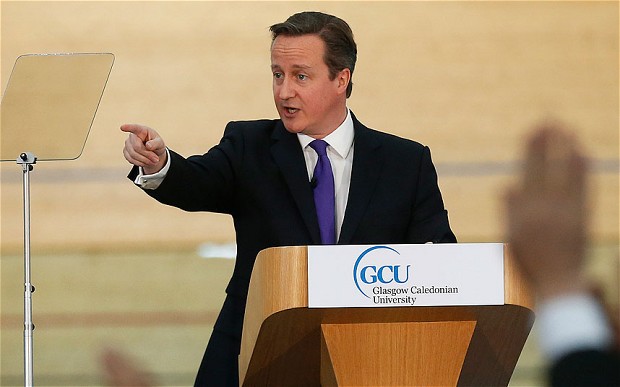
David Cameron answers questions from the media in East London after his speech on the importance of Scotland to the UK.
UK Prime Minister David Cameron has referenced his clan heritage in an appeal to keep Scotland part of the United Kingdom. In a speech given in East London last Friday, Cameron urged Scots and Britons to defend their shared history and heritage by voting against the upcoming referendum on Scottish Independence.
With only seven months to go before the big vote, Cameron spoke of his pride in his own Scottish roots in a major speech on the issue. Referencing his West Highland ancestry, Cameron said: “The name Cameron might mean ‘crooked nose’ but the clan motto is “Let us unite” – and that’s exactly what we in these islands have done.”
Cameron’s emotional defence of the Union also praised Scotland’s role in Britain’s military achievements, from the rich history of ship building on the Clyde to the bagpipes of Lord Lovat’s regiment which roused troops during the D-Day landings. He also stated Scotland had helped to make Britain “the most extraordinary country in history”, then used the success of Team GB at the 2012 Olympic Games to urge voters to keep together “the winning team in world history.”
While the speech made a great deal of importance of Cameron’s clan heritage, it conveniently left out Clan Cameron of Lochiel’s long history of battling the English. Described as ‘fiercer than fierceness itself’, Clan Cameron’s reputation can be summed up with their war cry: “Chlanna nan con thigibh a so’s gheibh sibh feoil!” (Sons of the hound come here and get flesh!).
Legend states that a Cameron contingent fought alongside Robert the Bruce against the English king Edward II at the Battle of Bannockburn in 1314, the decisive clash of the Wars of Scottish Independence. Members of the clan also fought in the front line of the Jacobite Army during the disastrous battle of Culloden in 1745. Following the defeat of Bonnie Prince Charlie, the Cameron estates were forfeited by the Government because of the support the chief had given to the Jacobite cause.
Cameron’s speech also did not mention that he has for many years enjoyed family holidays on the Tarbert estate on the Scottish island of Jura. The estate, owned by his wife Samantha’s stepfather, Viscount Astor, has 6,000 deer, which the Prime Minister has joined stag shooting parties to hunt.
Responding to the Speech, Scotland’s First Minister Alex Salmond called it “flimsy” and attacked Cameron as a member of the “out–of–touch Westminster elite”, stating: “This speech was a threadbare defence of the case for Westminster Tories retaining their undemocratic control over Scotland, which betrays the utter weakness of the Prime Minister’s case.”
Mr Cameron admitted people had advised him to stay quiet on independence – previously he has admitted his “Tory toff” image is an impediment – but on Friday he said “frankly, I care far too much to stay out”.
The post PM Cites Clan Cameron Heritage in Referendum Speech appeared first on ScotClans | Scottish Clans.
]]>The post Holyrood Perplexities – A Beginners Guide to Scottish Parliament appeared first on ScotClans | Scottish Clans.
]]> It’s an exciting time to be able to vote in Scotland – in September 2014 the country will go to the polls to decide on the Scottish Independence Referendum. This morning I received a delightful letter in the post from my local MP informing me that I am now registered to vote in the UK. Much to the annoyance of my fellow antipodean travelers, I’m incredibly fortunate that I have UK citizenship through my father who was born in London, thus enabling me to vote, live and work here visa-free.
I wanted to find out a little bit about the political system in Scotland, especially when tasked with having a say in the country’s future on such a contentious issue. Feeling a little confused as to how the Scottish Parliament works alongside Westminster, I took a trip to the Scottish Parliament last week to find out more.
The Scottish Parliament is situated in the shadow of Arthur’s Seat at the bottom of the Royal Mile in Edinburgh. On the day I visited a meeting of the Parliament was being held in the debating chamber, where SNP cabinet members for the Environment and Justice were questioned by other parties about their portfolios. This included questions and debates on reducing carbon emissions in Glasgow, amendments to the crofting reform act, assisting farmers affected by the recent cold weather and whether the Government is planning to reduce the number of Police Officers in order to meet budget cuts. An interesting question was also put forward regarding safeguarding the bee population of Scotland, to which much to my delight many bee-puns were given in response, (e.g. “I knew you would sting me with that question…”). The experience was entirely different to my visit to Westminster in November – The House of Commons is about five times smaller than the Scottish debating chamber, with UK MPs decidedly more ruckus.
The Scotland Act of 1998 established the first Parliament in Scotland since 1707. This passed power from Westminster to Holyrood on a range of devolved matters including health, education, housing, justice, the environment, agriculture and the arts. However Westminster still retained powers to make laws for Scotland on certain issues. These issues generally have a UK-wide or international impact and are known as reserved matters. They include things like benefits, immigration, defence, foreign policy, employment, broadcasting, nuclear energy and the Constitution.
The Scottish Parliament is made up of 129 elected representatives, who are known as Members of Scottish Parliament (MSPs). The voting system used is a type of proportional representation known as the Additional Member System, which gives each voter two votes in an election. The first vote is the constituency vote, with the candidate winning the largest number of votes gaining the seat. The second vote is for a political party within a larger electoral area called a Scottish Parliament region. In each of the eight regions, parties are allocated seats depending on the number of votes they receive in the regional ballot, and taking into account the number of constituency seats they win in a region. Of the 129 MSPs, 73 are constituency representatives, while 56 represent the eight parliamentary regions. In the last election in 2011, the Scottish National Party won 69 seats – making it a majority government. Previous governments were a minority government or coalition.
Bills passed by the Scottish Parliament don’t have to be approved by the UK Parliament, however royal assent by The Queen must be given before they can come into force. In contrast the UK Parliament can pass laws that affect Scotland on devolved matters. By convention the UK Parliament would normally do this by seeking the consent of the Scottish Parliament through a legislative consent motion proposed by a MSP. It is possible for MSPs to become Members of the UK Parliament simultaneously (called a dual mandate), however the roles are entirely separate. There are 650 MPs in the House of Commons, 59 hailing from Scotland and representing Scotland on reserved matters.
During my afternoon in the debating chamber there was only one mention of the most hotly contested issue in Scotland at the moment – independence. The mention of this word by a SNP cabinet member made the debating chamber erupt into a fully fledged House-Of-Commons style debate, with MSPs from all parties crying out and waving papers and arms in the air when they disagreed. Scotland’s Parliament surely does have an interesting year and a half ahead if the little snippet on independence I saw is anything to go by.
The post Holyrood Perplexities – A Beginners Guide to Scottish Parliament appeared first on ScotClans | Scottish Clans.
]]>The post Mohamed Al-Fayed – President of Scotland? appeared first on ScotClans | Scottish Clans.
]]>
Mohamed Al-Fayed
Egyptian businessman and Harrods owner, Mohamed Al-Fayed has said that he wants to be president of an independent Scotland.
Al-Fayed, who owns a 65,000 acre Highland estate, is hoping that Scotland will go to a referendum and vote for independence, and he has urged his ‘fellow Scots’ to denounce the monarchy and become an independent, self governing nation.
But the Egyptian is not a big fan of Scotland’s current leader, Alex Salmond. He was quoted saying,
“When you Scots have your independence, I’m ready to be your president.
“You have been living in a coma for too long.
“Whatever help is needed for Scotland to regain its independence, I will provide it. I have lived in England for 40 years but now the home that I want is Scotland.”
“It is time for you to wake up and detach yourself from the English and their terrible politicians. But I don’t want this Alex Salmond. I asked to meet him but he refused. Salmond would be better off fishing for salmon than being a politician. He is a dickhead.”
A spokesperson for the SNP leader did admit that Mr. Al-Fayed requested a meeting with Alex Salmond to talk about a potential donation, but the request was declined, adding that “no disrespect was intended”.
 If Scotland did leave the United Kingdom, then Al-Fayed said that he plans to buy Balmoral Castle and turn it into a museum. But, for now, it is now the businessmans intention to erect a statue in honour of Scota, an Egyptian princess who is said to have founded Scotland some 3,600 years ago.
Al-Fayed said, “You Scots are originally Egyptians. Like Scota, I travelled north and I found the Balnagown estate. I will erect a statue of her to honour the links between Scotland and Egypt.”
However, unfortunately for Mohamed Al-Fayed, historian Richard Oram, from the University of Stirling, has said that the myth connecting the two countries was “rubbish”.
The post Mohamed Al-Fayed – President of Scotland? appeared first on ScotClans | Scottish Clans.
]]>