The post An Ode to Scotland – Meeting a Modern-Day Scots Poet appeared first on ScotClans | Scottish Clans.
]]>Intertwined and impenetrably linked to Scottish culture, poetry has a long and distinguished history in Scotland. And it’s a history that’s continuing to this day – Edinburgh was recently named the world’s first UNESCO City of Literature, the publishing industry is thriving, the country has more literature festivals per capita than any other, and there’s at least a dozen spoken word monthly nights in Glasgow and Edinburgh alone which are frequented by a plethora of experienced and budding poets.
This new generation of Scottish poetry is certainly alive and well, carrying on rich literary traditions of old. However these days you’re more likely to find these modern-day versifiers using hashtags and laptops rather than quills and parchment.

Harry Giles performs in Edinburgh, January 2013. Photo by Chris Scott via The STANZA Blog.
Meet Harry Giles, 27, an Edinburgh-based poet, producer and performance artist. He’s the proud author of two poetry publications, performs regularly in England and Scotland, and is something of a luminary in the Scottish poetry slam scene – winning the UK Student Slam in 2008 followed by the BBC Slam in 2009. I first encountered him at the BBC Slam during last years Fringe festival, where his ranted, passionate ode to Scottishness entitled Brave grabbed me by the ears and demanded my attention.
I sing
o
a Scotland
whit
wadna ken workin class authenticity gin hit cam reelin aff an ile rig douned six pints o Tennent’s n glasst hit in the pus,
whit it wadna
by the way;
o google Scotland,
o laptop Scotland,
o a Scotland sae dowf on bit-torrentit HBO drama series n DLC packs fer paistapocalyptic RPGs that hit disna ken hits gowk fae hits gadjie;
- Excerpt from Brave.
Harry is one of only a handful of young poets writing and performing in Scots – one of three native languages spoken in Scotland; predominantly in the lowlands, Shetland and Orkney. He grew up immersed in a mixture of Orcadian Scots and English on the tiny island of Westray, part of the Orkney Islands, just off the northern-most tip of the Scottish mainland.
If you, like me, assumed that Orkney was Gaelic speaking, you’re not alone – it’s an assumption that is something of a hot issue amongst Orcadians. Gaelic never had a significant impact on Orkney. Instead a form of Norse introduced by the vikings, called Norn, became the spoken language before Orcadian Scots. You can still see bits of the language around to this day – Westray and many others of Orkney’s islands end in the suffix ‘ay‘, which is Norse for ‘island’.
With Celtic culture so prevalent in defining the image of Scotland both here and abroad, this different kind of Scotland, where things are more Norse than Celt is a theme that pops up in Harry’s poetry. “Scandinavian culture is very influential in Orkney. The place names, peoples names, even the architecture. It kind of feels half Scottish, half Scandinavian. And it’s even more so on Shetland.”
Along with identifying with this different type of Scottishness, Harry was born in London, but his family moved to Orkney when he was two. At that time in Westray, the Giles family were one of the only ‘incomer’ families, the Orkney term for outsiders who have adopted the isles as their home. “I have no feelings of home towards England, I’ve only had feelings of home towards Scotland. So I’ve always had this doubleness where Orkney is my only home but I don’t quite belong either.”

Visa Wedding by Harry Giles
This mash of English/Orcadian/Scottish identity makes good fodder for poetry, with Harry’s 2012 publication of Visa Wedding acting as a kind of therapy, addressing and resolving these questions about himself:
Listen, hit’s semple:
in Orkney I’m English;
in England I’m Scottish;
in Scotland, Orcadian–
this glib-gabbit, mony-littit tongue
snacks at identity as tho hit wis
a gollach piecie sappit wi
the sweet-n-soor o BELONG.
- Excerpt from Visa Wedding #1.
His love of Scots came from the sounds and rhythms, and the way it feels to speak. “When I’m writing in Scots, I’m often digging out words from my memory that have fallen off my tongue as I’ve lived in St. Andrews, London and Edinburgh. They’re words from Orkney that I knew in my childhood and used in my childhood but never identified with enough to keep using and have lost over the years. So I’m recovering a lot of those words, and recovering a part of my own identity which is Scottish and not Scottish at the same time.”
“Even as a written language, you can’t get away from how Scots sounds. It’s impossible to write without thinking about the speaking of it possibly because of the tradition of Scots literature which is so connected to speaking. So I really like that aspect of it. Something that people say to me now is that they look at my Scots poem on the page, and they have no idea what it says, and then I’ll speak it and it becomes immediately intelligible. And that’s really interesting to me.”
The status of Scots as a language is a hotly contested topic, with some claiming it’s merely a dialect, or ancient variety of English; or at the other end of the scale a completely distinct language from English, in much the same way that Norwegian is closely linked yet vastly different to Danish. Harry’s view is that what matters is where people can be understood by each other.
“If somebody in Glasgow can’t be understood by somebody in the East End of London, talking the way they would in those places, then I think it’s pretty sensible to say that they’re separate languages.”
In the 2011 Scottish census, 1.54 million Scots (30%) indicated they were able to speak Scots, however an earlier study of the language by the Scottish Government found that 64% of respondents “don’t really think of Scots as a language”. This may be because of Scots reputation as slang, as for many years the language was discouraged by officialdom and schools. Today Scots is promoted and fostered, but it’s nowhere near as threatened and in decline as Scotland’s other traditional language, Gaelic, with only 58,000 respondents in the 2011 census indicating they could speak fluently.

A leading light of the Scots Renaissance, Hugh MacDiarmid.
“There are also different type of Scots, not just regional variants, but what I would call vernacular Scots, which is the way that people actually speak. So if you go into a pub in Leith you will actually hear people speaking in what I call the (Leith Scots) vernacular. There’s also a sort of literary Scots which is not necessarily how people speak.” Harry explained that during the 50s there was an active reclamation known as the Scots Renaissance by people like Hugh MacDiarmid and Hamish Henderson who were deliberately working to preserve and recreate the language.
“Folk like MacDiarmid would read ancient Scots dictionaries and travel around and collect words from people, and then construct what he called a ‘syncretic’, as in synthesised Scots from that, taking the words the people spoke and making a literary language out of them.”
“And most poets writing in English are writing in a kind of English that’s nothing like people speak, ya know. So I’m writing mostly in literary Scots, in a sort of constructed Scots, rather than the Scots that people speak.”
While Harry agrees that cultural dominance can threaten and water down traditional language, he’s skeptical of some of the recent efforts employed to promote Scots. “It’s a very optimistic utopian project to imagine that we might have a complete body of work that’s written only in Scots. There’s too many different types and regional variants of Scots, and I’m really resistant to the idea of there being a monolithic Scots that has one form of spelling and one form of words. I’m much more interested in people writing new work and working in new ways in Scots than I am in reading a translation of Asterix in Scots.”
Harry is currently writing about 50% of his work in Scots, and said he can usually tell straight away when writing a poem if it will be in English or Scots. However sometimes he bounces a poem between the two languages, or if the poem is about Scotland, then it’s almost always in Scots. Cue what is fast becoming known as his signature piece, Brave, which was written in 2011, just as the Independence debate was starting to heat up.
cadna hink o a grander wey tae end a nite as wi a poke o chips n curry sauce,
whit chacks the date o Bannockburn on Wikipaedia,
whit draws chairts on the backs o beermats tae lear ye aboot rifts n glaciation
n when hit dis hit feels this oorie dunk,
this undesairvt wairmth
o inexplicable luve;
- Excerpt from Brave.
“I was thinking a lot about my past, and how I felt about Scotland and was reading a lot of Scots poetry. I wanted to get across something of the contradictions and complexities of Scottish-ness. I wanted to react against the tartan tat vision of Scotland. And even though Orkney is the only home I know I am still an incomer. I wanted to claim Scotland for myself in some way, and also talk about how it is and isn’t mine at the same time.”
“And I like being funny, and I like being angry, and I like being ranty, so I just wrote the longest rant that I could in Scots, about what Scotland meant to me. And what pissed me off and what I liked about Scotland. It’s kind of like my state of the nation poem; as if a wee scrote like me could write a state of the nation!”
The poem has gone on to have a life of its own, being featured on podcasts, websites, and in the Scottish literary journal New Writing Scotland. He thinks the poem gained significance as it came out just at the right time, when all across the land people are questioning their identity, just before the looming independence referendum this September.
“Literature and poetry in particular are quite central to Scotland’s self understanding. Poetry and folk music are our art forms. There are poems carved on the walls of Scottish parliament, so it definitely has a place in our political discourse. So I do feel like artists are central to the way Scotland constructs and presents itself.”

Oam by Harry Giles
Post-Brave and Visa Wedding, Harry says his writing has moved on, and he’s not writing as much about Scotland as a whole these days. His second publication Oam was the result of a five month residency at Govanhill Baths in Glasgow, with proceeds from the sale helping the project reopen as a community swimming pool and well-being centre. The poems are all written in contemporary Scots and describe the baths and their incredible history.
“(Writing Oam) was quite nice because I was writing in Scots intensely, but I wasn’t writing about Scotland. I was just writing about this one place. So I’m less interested in the big questions of Scotland at the moment, in poetry, and more interested in local stuff.”
As his body of work moves and evolves, Harry says the reason he talks so much about Orkney now is because he has an urge to go back to discover more of that part of himself. “The Scots that I write is influenced by the Scots that’s spoken in the lowlands, it’s very influenced by urban Scots, partly because that’s what i’m living in now, and partly because that has dominated the Scots literary tradition. I have an ambition to spend much longer in Orkney digging to try and get more of the Orcadian Scots into my own writing, and that would involve investigating Norn a bit more. I’m also interested in the Viking forms of poetry and how this has influenced Scots poetry. But that’s more of a long term ambition.”
As Harry’s work expands and evolves, he’s the latest in a long line of innovative writers who have been inspired and shaped by Scotland and Scottishness. As the country considers its future, Harry’s body of work mashes literary traditions of old and new, providing a pertinent and contemporary review of Scotland’s identity.
—–
You can read more about Harry here, and listen to a recording of Brave here.
The post An Ode to Scotland – Meeting a Modern-Day Scots Poet appeared first on ScotClans | Scottish Clans.
]]>The post Poem Marks Bannockburn Anniversary appeared first on ScotClans | Scottish Clans.
]]>
Rotunda Monument at the Bannockburn Battleground
A new poem has been unveiled to mark the upcoming 700th anniversary of the Battle of Bannockburn. The specially commissioned poem appears on a new timber ring crowning on the Rotunda Monument at the historic battle site.
The designer behind the original monument, Sir Robert Matthew, planned for it to bear an inscription however nothing had been inscribed since the monument was installed half a century ago. Expert carver Richard Douglas from Andrew Miller Architectural Joinery, based in Stirling, began the inscription works back in June.
Poet Kathleen Jamie, a professor of Creative Writing at Stirling University, said the poem was inspired by Scotland’s landscape and deep literary traditions. She said: “As Bannockburn is so important in Scottish history, it seemed proper to acknowledge our cultural traditions, especially poetry and song about landscape. From the start I wanted this piece of work to make a nod to the Scottish literary tradition and the Scottish landscape, to evoke the deep love of a country that makes one community out of many people.”
David McAllister, director of the Battle of Bannockburn project, said: “The Rotunda is the central place for commemoration of the Battle of Bannockburn and our intent is to continue that tradition of memorial and contemplation.”
“Kathleen’s poem encapsulates the essence of the Battle of Bannockburn project – introducing a contemporary take on the battle and the landscape while paying respect to the memory of this important moment in Scottish history.”
The inscription is part of a series of site-transformations happening at the battlefield in preparation for 2014′s anniversary commemorations. A weather-beaten statue of Robert the Bruce has already been restored and a state-of-the-art visitor centre is set to open in 2014.
The poem:
Here lies our land: every airt
Beneath swift clouds, glad glints of sun,
Belonging to none but itself.
We are mere transients, who sing
Its westlin’ winds and fernie braes,
Northern lights and siller tides,
Small folk playing our part.
‘Come all ye’, the country says
You win me, who take me most to heart.
The post Poem Marks Bannockburn Anniversary appeared first on ScotClans | Scottish Clans.
]]>The post Òrain Gàidhlig – Scottish Gaelic Song appeared first on ScotClans | Scottish Clans.
]]>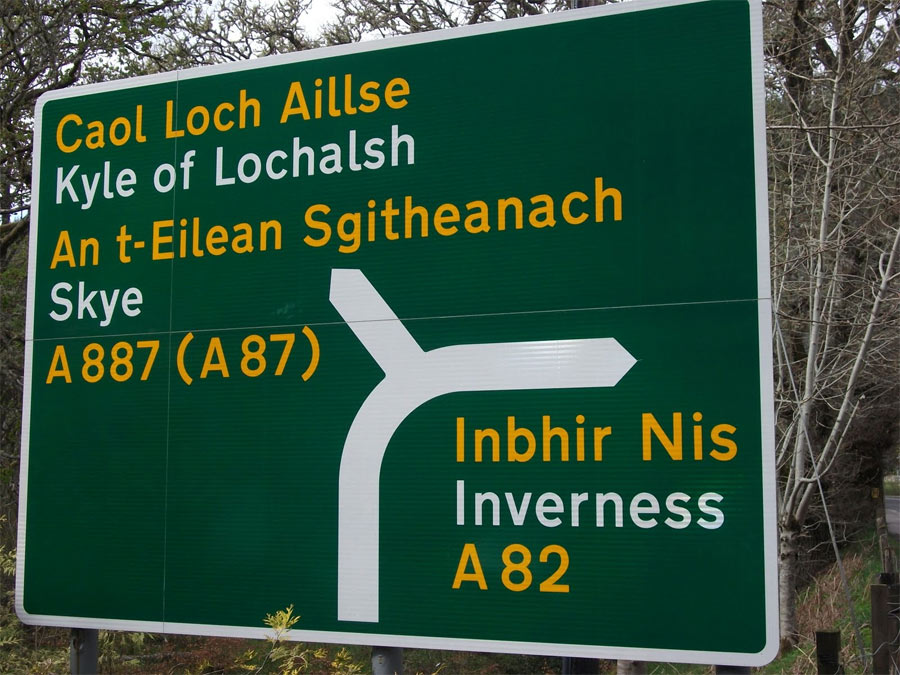
Bilingual Scottish Road Sign
One of the experiences that stood out the most on my Highland adventure a few months back was the amount of Scottish Gaelic I encountered. From road and railway station signs, to the greeting displayed on the entrance to McDonalds in Inverness, this was my first encounter with Scotland’s oldest surviving spoken language. It’s something you don’t really come across in Edinburgh, either because the language is spoken by less than 2% of the Scottish population, or because Lowland Scots has been the traditional form of speech in the south.
Sadly Scottish Gaelic has been in steady decline for quite some time. 100 years ago the amount of bilingual Scots numbered 183,998. At the time of the last census in 2001, only 58,652 people were registered as bilingual in Gaelic. Nevertheless, the language is in the midst of a government supported revival. BBC’s Gaelic television station Alba reportedly gets on average 530,000 viewers per week, and Edinburgh’s Gaelic primary school is currently at full capacity, prompting a relocation to a larger campus later in the year.
Apart from place names, I had never spoken a word of Gaelic in my life until last Friday when I attended a Gaelic harmony singing workshop. Held at the Scottish Storytelling Centre on Edinburgh’s Royal Mile, I arrived a little early and sat trying to figure out how to pronounce the lyrics on the handout I’d received. I have never encountered a language quite like it before – the words are pronounced entirely differently to how you would expect them to sound. This makes reading Gaelic when beginning to learn a little bit perplexing. I found it much easier to watch and listen to how it looks and sounds, mimicking rather than trying to read.
The workshop was lead by well-known Gaelic singer Gillie Mackenzie. Gillie grew up in Lewis but now lives in the Lothians, and has been singing ever since she can remember. Family ceilidhs instilled an early understanding of vocal harmony and she fondly told us how her and her sisters would sing and harmonise together in Gaelic while doing the dishes at home. Gillie currently teaches Gaelic song and conducts the Gaelic choir at Bunsgoil Crois na Cìse (the Gaelic medium unit at Edinburgh’s Tollcross Primary School), and recently began a Gaelic choir at James Gillespie’s High School. She released her first solo album entitled Griais in 2012 and is currently touring with her band.
We began by singing two traditional songs (Tobair Tobair Siolaidh and ‘S Toigh Leam Fhin Buntat ‘s ìm); first as a group, then combined with different vocal harmonies, and finally in round. It sounded absolutely glorious and I wondered if the tourists just outside the window walking up and down the high street could hear us singing in ancient Scottish tongue. The first few times we went through the song I felt completely lost with the language, but as we repeated the song my mouth was slowly becoming accustomed to this new way of speaking. We then learnt a beautiful song called Gleanna Gollaidh by Robert Donn (1714-78). Donn was a well-known bard hailing from Sutherland (Mackay country), with this particular song praising a glen in his district:
Gleann-a-Gallaidh, Gleann-a-Gallaidh, (Glen Gollaidh, Glen Gollaidh)
Gleann-a-Gallaidh nan craobh, (Glen Gollaidh of our trees)
Cò a chì e nach mol e, (Who can see it without praising it?)
Gleann-a-Gallaidh nan craobh. (Glen Gollaidh of our trees)Ri faicinn crìoch àrdain (Seeing the abutment of its elevation)
Ga mo bhreugadh gu taobh, (Drew me aside)
‘S ann a smuainich mi fanadh (Indeed I thought of staying in)
An Gleann-a-Gallaidh nan craobh. (Glen Gollaidh of the trees)Chan àill leam bhur n-airgead (I don’t desire your money)
‘S ri bhur n-arm cha bhi mi, (And I’ll never join your army)
Cha diùlt mi bhur drama (I won’t refuse your dram)
Ach ri tuilleadh cha bhì. (But I’ll do no more than that)Ged a gheibhinn gu m’ àilgheas (Though I might get to my desire)
Ceann-t-sàile MhicAoidh, (Mackay’s Kintail)
‘S mòr a b’ annsa leam fanadh (More I fancy staying)
An Gleann-a-Gallaidh nan craobh. (In Glen Gollaidh of the trees)Fonn diasach, ‘s mòr a b’ fhiach e (Bountiful land, much of its value)
Gu fiadhach ‘s gu nì, (For stalking and cattle)
Aite sìobhalt ri doineann (An agreeable place in time of storm)
Is nach criothnaich a’ ghaoth. (In which the wind will not shudder).
Coincidentally, Donn was writing poetry around the same time as the 1745 Jacobite Rising. An ardent Jacobite supporter, Dunn upset the Hanoverian chief of Clan Mackay by writing this poem about the rising:
Now, young Charles StewartEvery clan places its hope in youThat sought to crown youAnd set the country alight;They’re like hidden snakesWhich cast their skins last yearBut are making ready their fangs
To arise on the day of your coming

Waulking in Iochdar, South Uist, June 1970
We finished the workshop with an Isle of Lewis waulking song called Bodachan Cha Phòs mi. These songs were traditionally sung by women waulking cloth and were an institution in female Gaelic society. This practice involved a group of women beating newly woven tweed rhythmically against a table or similar surface to soften it. As the singers worked the cloth, they gradually shifted it to the left so as to work it thoroughly. Typically one person would sing the verse, while the others joined in the chorus. A night at a waulking was a tremendous social outlet for women. The songs have a strong element of gossip in them, of exchanging secrets, of comments on men, good and bad. Although some songs were light-hearted and trivial, many were intimate, frank, intensely vivid, and expressive statements of women’s experiences.
A week since the workshop, I’m suprised at how well I have remembered the melody and the language I learnt. I have quite often found myself humming the songs, especially the beautiful Gleanna Gollaidh. Sadly the only statistics I can find online regarding Scotland’s Gaelic speakers date from 2001, but I would love to know if efforts since have increased the number of speakers of this fascinating language.
——-
You can listen to Gleanna Golaidh by visiting the BBC’s Year of Song website here, and they also have a great ‘teach yourself Gaelic’ website for absolute beginners called Beag air Bheag.
Another great resource for Scottish oral recordings is Tobar an Dualchais where you can hear many Gaelic recordings.
The post Òrain Gàidhlig – Scottish Gaelic Song appeared first on ScotClans | Scottish Clans.
]]>The post ‘World’s Worst Poet’ Has Last Laugh appeared first on ScotClans | Scottish Clans.
]]>
Scottish Poet William McGonagall dubbed ‘world’s worst’
A handwritten, unpublished work by a Scottish music hall performer known as the world’s worst poet is set to fetch thousands of pounds at auction. Edinburgh-born William McGonagall, won notoriety in the 19th century as an extremely bad poet, and to this day is regarded as the worst in English literature.
His works were so detested he was pelted with rotten fish, with critics stating that he was deaf to poetic metaphor and employed inappropriate rhythms that resulted in unintentionally amusing poetry. The manuscript belongs to Roy Davids, a collector who is selling his entire hoard of poetry. It is expected to fetch £3,000 at Bonham’s in London in May.
Born in 1825, McGonagall claimed he was inspired to write poetry when he felt a strange feeling steal over him, which lasted for approximately five minutes. He realised if he were to succeed as a poet he needed a patron, and wrote to Queen Victoria to request the honour. Inspired by the “thanks, but no thanks” letter from one of Victoria’s functionaries, McGonagall set off to Balmoral to proove himself in person. In July 1878, he walked from Dundee to Balmoral, a distance of about 60 miles over mountainous terrain and through a violent thunderstorm to perform for the Queen. When he arrived, he announced himself as “The Queen’s Poet”. The guards informed him “You’re not the Queen’s poet! Tennyson is the Queen’s poet!” McGonagall presented the letter but was refused entry and had to return home.
McGonagall struggled with money throughout his life, but found lucrative work performing his poems at a local circus. While he read his poems, the audience was permitted to pelt him with eggs, flour, herrings, potatoes and stale bread. He seemed happy with this arrangement which he received 15 shillings s night for, however the events became so raucous that city magistrates were forced to put a ban on them. Throughout his life he seemed oblivious to opinions on his poems, with some suggesting he was a lot shrewder than he is given credit for, playing to the audience’s perception of him.
In 1895 McGonagall and his wife moved to Edinburgh, where he met shortlived success as a ‘cult figure’. However he died penniless in 1902 and was buried in an unmarked grave in Greyfriars Kirkyard. A grave-slab to his memory was unveiled in 1999.
The Tay Bridge Disaster
Beautiful Railway Bridge of the Silv’ry Tay!
Alas! I am very sorry to say
That ninety lives have been taken away
On the last Sabbath day of 1879,
Which will be remember’d for a very long time.
To The Rev George Gilfillan
He is a liberal gentleman
To the poor while in distress,
And for his kindness unto them
The Lord will surely bless.
Robert Burns
Immortal Robert Burns of Ayr,
There’s but few poets can with you compare;
Some of your poems and songs are very fine:
To “Mary in Heaven” is most sublime;
And then again in your “Cottar’s Saturday Night”,
Your genius there does shine most bright,
As pure as the dewdrops of the night.
Jottings of New York
Oh mighty City of New York! you are wonderful to behold,
Your buildings are magnificent, the truth be it told,
They were the only things that seemed to arrest my eye,
Because many of them are thirteen storeys high.
The post ‘World’s Worst Poet’ Has Last Laugh appeared first on ScotClans | Scottish Clans.
]]>