The post Could Lost Kingdom of Rheged have been found in Galloway? appeared first on ScotClans | Scottish Clans.
]]>
The site near Gatehouse of Fleet could have been at the heart of the kingdom
Archealogists think they have discovered a ‘lost dark age kingdom in Dumfries and Galloway. The sixth century Kingdom of Rheged has always been a mystery, now they believe they have found the Royal Pictish Seat of this Kingdom.

Archaeologists believe the royal seat of Rheged may have been in Galloway
The location of Rheged had previously been thought by many historians to be in Cumbria.
Pictish carvings found in this area made them look closer.

The Pictish carvings at the site which sparked a deeper investigation of the area.
Dr Christopher Bowles, co-director of the excavation work in Dumfries and Galloway, said:
“The new archaeological evidence from Trusty’s Hill enhances our perception of power, politics, economy and culture at a time when the foundations for the kingdoms of Scotland, England and Wales were being laid,” he said.
“The 2012 excavations show that Trusty’s Hill was likely the royal seat of Rheged, a kingdom that had Galloway as its heartland.
“This was a place of religious, cultural and political innovation whose contribution to culture in Scotland has perhaps not been given due recognition.”
Dr Bowles said the influence of the kingdom had “rippled through the history and literature of Scotland and beyond”.
Mr Toolis added that they had not been looking for Rheged when they started the excavations.

The excavation found evidence the area had been a royal stronghold
“What drew us to Trusty’s Hill were Pictish symbols carved on to bedrock here, which are unique in this region and far to the south of where Pictish carvings are normally found,” said Mr Toolis.
“The Galloway Picts Project was launched in 2012 to recover evidence for the archaeological context of these carvings.
“But far from validating the existence of Galloway Picts, the archaeological context revealed by our excavation instead indicates the carvings relate to a royal stronghold and place of inauguration for the local Britons of Galloway around AD 600.
“The new archaeological evidence suggests that Galloway may have been the heart of the lost Dark Age kingdom of Rheged, a kingdom that was in the late sixth century pre-eminent amongst the kingdoms of the north.”
The post Could Lost Kingdom of Rheged have been found in Galloway? appeared first on ScotClans | Scottish Clans.
]]>The post The Treasure of Norries Law. appeared first on ScotClans | Scottish Clans.
]]>
Lower Largo
On The Fife coast sits the pretty village of Lower Largo. The village was the Birthplace of Alexander Selkirk, the inspiration behind the story of Robinson Crusoe and a sign in the village points to the Juan Fernandez Islands, some 7,500 miles away where Selkirk was a castaway. The history of the area goes back much much further though to a time before Scotland as we know even existed.
Outside the village sits Largo Law and around a mile to the North, Norrie’s Law, ancient burial mounds that indicate the great antiquity of the occupation of this area.
It was common among the children of the village to play a game that had a connection to Norrie’s Law. One child would stand before the others and recite a verse; “I’ll tell you a story, Aboot Tammie o Norrie, If ye dinna speak in the middle o’ it, Will ye no?” The object of the game was to lure another child into saving “No” at which point all the others would shout, “The spell is broken, ye hae spoken, Yell never hear the story o’ lang Tarn o Norrie.” Like so many other children games this has a story behind it – a story of the ghost of Norrie’s Law.
In a time long past Largo Law was reputed to be haunted by an earthbound spirit; a ghost sentenced to wander the earth until a spell was broken to release it. To break the spell the ghost had to give up his secret; the hiding place of a hoard of treasure, buried somewhere on Largo Law.
On the nearby farm of Balmain there was a fairly unscrupulous shepherd. Having heard the story he had spent many nights wandering the area around the Law in hope of discovering the treasure. Finally one evening as he walked around the Northern shoulder of the hill he was confronted by a shimmering cloud of smoke. Many others had met this apparition but all had fled in terror. Taken aback at first he gathered all his courage to approached it and asked what it was that kept it bound to this realm. The ghost fixed him with a stare and said:”If Auchendowie cock disnae craw, An the herd o Balmain disnae blaw, I’ll tell ye whar the gold is on Largo Law.” The ghost then quickly ran through the small print of his offer which also included the cut off time of 8 o’clock the following evening.
The shepherd was only concerned about getting his hand on the treasure and cared little of who he had to inconvenience to achieve his ends. He thought of the first part of the ghosts request and scurried off the Auchedowie farm. The next morning the farmer and his wife slept in, never awoken by the crowing of the cockerel. When they went off to investigate they found the cockerel strangled and tossed into a heap of straw by the barn. Phase one complete.
Now for the Herdsman of Balmain. The herdsman was called Tammie O’ Norrie and it was safe to say there was little love lost between him and the shepherd. As Tammie set off to take his cows to pasture the shepherd was waiting. He blocked his path and shouted to Tammie ‘Hey you, Tammie O Norrie, I want a word wae ye”. As Tammie approached the shepherd let his coat slip open to reveal a long knife tucked into his belt. “You had better no blaw yer horn to summon in yon cows the nicht or it will be the worse fur ye”. Tammie was confused; “How no! How will I caw the cows in with nae horn?” The shepherd gripped the handle of his knife; “Ye can use the dugs to round them up – now mind what a said or it will be the worse for ye”. At that he glowered at the herdsman and furtively took off.

Part of the Silver Hoard
With all the plans in place the shepherd made his way back to the north slope of the hill, just before 8:00 the spectre appeared again. As the shepherd approached the ghost the sound of Tam’s horn was heard in the distance. The ghost flew into a rage; “Woe to the man that blew that horn, For out of that spot he shall never be borne.” At that he vanished. The shepherd ran for all he was worth, determined to have it out with the herdsman but when he reached the spot he was met with an awful sight. There in the field stood Tam O Norrie, the horn horn still pressed to his lips but he had turned to stone – petrified literally by the wandering spirit.
The shepherd told no one of his involvement in the events and when the local people discovered what had befell Tam they tried to move him – but some sinister force prevented all attempts, finally they gave up and heaped the earth around him creating another small hill; this came to be known as ‘Norries Law’.
The shepherd never got his prize but many years later a hoard of silver (not gold) was unearthed nearby. It is one of the best silver hoards to be discovered in Scotland. a variation in this tale had been that the law was the burial sight of a viking called Norroway who had been buried on his horse in full armour. However investigation of the find discovered that the pieces were of Pictish rather than Norse origin. Sadly some of the hoard never made it to the protection of the museum, some coins and other pieces were reputed to have been sold off and melted down – we may never know just how extensive this treasure find really was.
‘Will we no’.
The post The Treasure of Norries Law. appeared first on ScotClans | Scottish Clans.
]]>The post What did the Picts really wear? appeared first on ScotClans | Scottish Clans.
]]>
A late-16th century, fanciful Giclee print of a Pictish warrior with spear and shield. (clearly based on Herodian’s description of the “barbarians” of Caledonia) by John White.
We see these depictions all the time, of naked blue people adorned with tattoos and maybe a severed head or two. But evidence shows us they looked was quite the opposite. It’s an incomplete jigsaw puzzle as not much is known, but what we do know is they didn’t look like this, well not all the time.
So Why Blue?
The overall blue tinting of the body is inspired by a remark made by Julius Caesar, who had spent a few weeks in the south-eastern corner of Britain in 55BC and 54BC: “All the Britons, without exception, stain themselves with woad, which produces a blueish tint; and this gives them a wild look in battle.”. Julius Caesar never spent any time here and certainly never travelled up to the North (Pictland).
Who were the Picts?
The origins of the name Pict has been much debated. . What they called themselves is not known – the Picts left no literature – but the Latin word Picti would appear to mean ‘painted people’ (pictus = ‘painted’, hence the English word ‘picture’). It was the Romans that termed the various tribes people of Britain ‘Picts’. In 208, Septimius Severus arrived in Britain to campaign against the tribes of Caledonia (the Maeatae and the Caledonians). Herodian, a contemporary of Severus, writes:
“Most of the regions of [northern] Britain are marshy, since they are flooded continually by the tides of the ocean; the barbarians are accustomed to swimming or wading through these waist-deep marsh pools; since they go about naked, they are unconcerned about muddying their bodies. Strangers to clothing, they wear ornaments of iron at their waists and throats; considering iron a symbol of wealth, they value this metal as other barbarians value gold. They tattoo their bodies with coloured designs and drawings of all kinds of animals; for this reason they do not wear clothes, which would conceal the decorations on their bodies. Extremely savage and warlike, they are armed only with a spear and a narrow shield, plus a sword that hangs suspended by a belt from their otherwise naked bodies. They do not use breastplates or helmets, considering them encumbrances in crossing the marshes.”
Herodian ‘History of the Empire after Marcus’ Book III Chapter 14
Almost a century after Severus, the name Pict appeared (297). Another century later, in 400, the poet Claudian talked of Britain (in female personification) being:
“… clothed in the skin of some Caledonian beast, her cheeks tattooed, and an azure cloak, rivalling the swell of Ocean, sweeping to her feet …”
Claudian ‘De Consulatu Stilichonis’ (On the Consulship of Stilicho) Book II
And, in 402, of:
“… the strange devices tattooed on dying Picts.”
Claudian ‘De Bello Gothico’ (On the Gothic War)
And he had, in 396, referred to:
“… the well-named Picts …”
Claudian ‘Panegyricus de Tertio Consulatu Honorii’ (Panegyric on the Third Consulship of Honorius)
Possibly, then, it was their tendency to decorate themselves with extravagant body-art that caused the Romans to nickname them Picti: ‘painted people’. On the other hand, maybe the association of tattooing with British “barbarians” was based not on reality, but on a stereotyped notion of those distant savages. In other words, perhaps it was a myth that the Picts tattooed their bodies. The British cleric Gildas, writing in about 545(?), who refers to the Picts and the Scots as “dark swarms of worms”, and says of them:
“Differing partly in their habits, yet alike in one and the same thirst for bloodshed – in a preference also for covering their villainous faces with hair rather than their nakedness of body with decent clothing …”
Gildas ‘De Excidio Britanniae’ Chapter 19
Gildas most definitely been disparaging when describing these ‘barbarians’. Nevertheless, in the early-600s, the Spanish bishop and encyclopaedist, Isidore of Seville wrote:
“It is not simply in clothing but in physical appearance also that some groups of people lay claim to features peculiar to themselves as marks to distinguish them, so that we see the curls [perhaps topknot] of the Germans, the mustaches and goatees of the Goths, the tattoos of the Britons. The Jews circumcise the foreskin, the Arabs pierce their ears, the Getae with their uncovered heads are blond, the Albanians shine with their white hair. The Moors have bodies black as night, while the skin of the Gauls is white. Without their horses, the Alans are idle. Nor should we omit the Picts, whose name is taken from their bodies, because an artisan, with the tiny point of a pin and the juice squeezed from a native plant, tricks them out with scars to serve as identifying marks, and their nobility are distinguished by their tattooed limbs.”
sidore of Seville ‘Etymologiae’ (or ‘Origines’) Book XIX Part 23 No. 7
The image of the highly decorate Pict seems to have stuck in the public’s imagination. Their defining feature to the point they are depicted naked and covered in tattoos.
So what ‘evidence’ do we really have about Pictish Dress
While it is nearly impossible to say anything absolutely conclusive about Pictish dress, this need to carefully piece together the information that does exist makes for very interesting research.
Pictish Dress shown on Stone Carvings

Picture Rhynie Man Pictish Standing Stone

St Viegans stone
From stone carvings we can tell they would have worn tunics and been very covered up, especially the women who are all depicted as wearing ankle length tunics. Men were a bit more daring and wore varied lengths.


Pictish Hilton of Cadboll stone
The Orkney Hood

The Orkney Hood – real evidence
This is the most complete clothing found from Pictish times. Is incredible it’s survived.
It’s from St Andrew’s Parish, Orkney. The Orkney Hood is dates to about 200-615AD and so may be earlier than the Pictish period, but evidence is so sparse. The entire hood is made of wool and the body of the hood is a 2/2 herringbone twill while the bands are tablet woven with two or four hole tablets. The fringe is woven as part of one of the two tablet woven bands and is as long as 11-12 inches. The primary construction stitches are running stitches, hem stitches, and overcast or whip stitches. Based on the wear on the fibers and that the fringed tablet weaving does not seem to be quite long enough, it seems that the fibers may be recycled from other garments.
Other Archaeological Evidence


Here’s a great pdf showing the evidence in archaeology and in stone carvings about what the Picts would have worn:
http://eithni.com/referencedesk/TheWell-DressedPict.pdf
So Picts maybe weren’t straight out of Avatar.
The post What did the Picts really wear? appeared first on ScotClans | Scottish Clans.
]]>The post Asterix Weighs in on Independence Debate appeared first on ScotClans | Scottish Clans.
]]>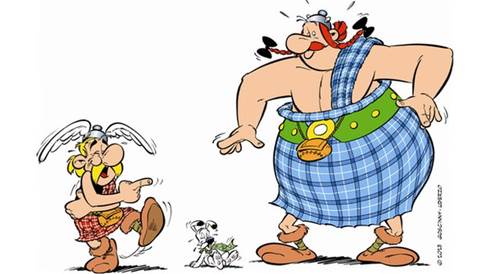 Inspired by the Scottish independence debate, the latest Asterix adventure sees the comic book hero travel to Iron Age Scotland where he meets the Picts. Author Jean Yves-Ferri explained that the story called Asterix and the Pechts includes a political slant, alluding to the looming 2014 referendum.
Yves-Ferri is the first person other than the original Asterix creators to script an episode which shows the Pictish clans united and divided. The story follows Asterix and his erstwhile sidekick Obelix as they travel from Ancient Gaul to Scotland. Yves-Ferri added the landscapes of the Highlands also inspired the story, which includes quintessential Scottish stereotypes including whisky, bagpipes and the Loch Ness Monster.
Speaking to BBC Radio Scotland he said: “Politics are the background. But the story – the principle story – is a kind of love story between a Pict character and a girl. And Asterix and Obelix went to Scotland to help him. And it’s a symbol, for Scotland united and free… I love the landscapes of Scotland, especially at the north, up in the highlands. And it’s the landscape for a story of Asterix – an ideal landscape.”
The pro-independence Yes Scotland campaign welcomed the allusion. They said: “We are animated by an endorsement from such a prestigious character, but, as ever, we would have to check that he is registered to vote.”
The comic book, published in October, will be available in Scots and Scottish Gaelic for the first time. It is the first Asterix story written and illustrated by anyone other than the original creators, Albert Uderzo and Rene Goscinny. Goscinny died in 1977 but illustrator Uderzo took on the writing duties and produced a further 11 comic books.
The post Asterix Weighs in on Independence Debate appeared first on ScotClans | Scottish Clans.
]]>The post The Pharaoh’s daughter and Scotland appeared first on ScotClans | Scottish Clans.
]]>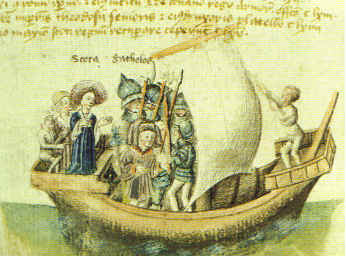
Scota (left) with Goídel Glas voyaging from Egypt, as depicted in a 15th century manuscript of the Scotichronicon of Walter Bower; in this version Scota and Goídel Glas (Latinized as Gaythelos) are wife and husband.
Tradition has it that the legend starts back in ancient Egypt, where a pharaoh’s daughter, called Scota, and two Greek princes formed a group which was very troublesome and they were banished because traditionally, Scota and her group had a reputation everywhere they went of being very troublesome and antagonistic.
According to legend the pharaoh’s daughter and her group, who became known as the Scots, ended up in Iberia, now modern day Spain, where they settled, consolidated, and built themselves up. However, in Iberia things were no different, and it is said that they frequently fought with the Moorish Spanish over possession of the land, and these battles would end in bloodshed. Scota’s group got together and eventually decided that it would be for the best that they left Iberia and look for new lands to live in. They had heard of this land which was very fertile, and had some very clever farmers and people. So Scota and her family headed north and landed in Ireland.
Back then the people of this island were quite mild, and were brilliant farmers. However, the Scots reputation of being so troublesome, so mischievous, and so disruptive preceded them, and they were banned from Ireland. So they headed east to the west coast of Scotland where they made a nuisance of themselves amongst the Picts, the natives of Scotland, but they still settled there, and it is said that from this settling group known as the Scots is where the country of Scotland got it’s name from.
However, this story is pure legend.
The post The Pharaoh’s daughter and Scotland appeared first on ScotClans | Scottish Clans.
]]>