The post Photographs Reveal Croft Memories appeared first on ScotClans | Scottish Clans.
]]>
3:44am, Isle of Harris (John Maher)
A new photographic exhibition is set to open that will shine a light on abandoned crofts throughout the Western Isles of Scotland. Entitled Leaving Home: An Alternative View of the Outer Hebrides, selected photographs will be accompanied by memoirs from those who grew up in the houses, which reveal what life was like in the second half of the 20th century in an outer Hebridean croft.
John Maher and Ian Paterson, the pair behind the exhibition, said their interest lay in exploring the domestic landscape and social histories of the people who once made a living in the Outer Hebrides. The area is known for its stunning landscapes featuring white sandy beaches and endless machair, rather than its crofting history. This is the first time many of the crofts have been photographed and exhibited, offering a unique and fresh insight into the almost forgotten history of the area.

George’s House, Eriskay II, 2012 (Ian Paterson)
One croft featured in the exhibition was once home to a man named Seoras (George) Skillanders, who was a young boy when he was bought to Erskay as a ‘homer’ or ‘boarded-out child’. During Victorian times, young children from homeless or very poor families were relocated to the Highlands to cope with Scotland’s central belt sprawl. This practice carried on for at least 100 years, with reports suggesting that checks of the suitability of surrogates were largely inadequate. According to accounts form the 1950s and 60s, staff members would set off north with a vanload of children, stopping at villages along the way and asking if anyone needed a child. This practice would continue until the van was empty. Seoras was almost certainly from a Polish family, and possibly came from Greenock. He was a fluent Gaelic speaker and was left the croft when the family who took him in died. He died in the 1980s and the croft has remained vacant ever since.

Domestic Decay, Isle of Harris, 2013 (Ian Paterson)
Another croft in the exhibition is located in the Bays of Harris, and was once the childhood home to Morag Morrison. Morag’s grandfather built the house, and she recalled fondly the men who would sit around the Rayburn stove in the kitchen, telling stories and smoking Black Twist tobacco. There was no road near the home when it was built, as the main method of transport being boat in and out of the bays. Morag has returned to live in the Bay of Harris, living only yards from her childhood home. Today the only inhabitants of the croft are the sheep, who gather there to escape the cold.
An message by an ex-crofter published on the exhibition’s website also provides an account as to why the houses were simply abandoned as they were. The photographers received an e-mail from Flora MacDonald in Australia, who came from a family of nine from Harris. In 1957 the family left Harris for Glasgow, and from there went to Australia, as at the time it was not permitted to emigrate directly from Harris to Australia. Almost all of their possessions were left behind, as they were only allowed to bring one suitcase. Ms MacDonald said she identified strongly with the homes in the photographs, saying: “We just closed the door behind us and left.”
Ian and John are both self-taught photographers who became aware of each others work through social media, including Flickr and Facebook. They kept in touch mostly via e-mail and by following each others postings on various websites. Collaboration and the subsequent development of an exhibition came about when they realised that between them they had amassed a considerable body of work on a subject they were equally as fascinated by. John said he was repeatedly drawn to the crofts, saying: “The people may have left long ago, but it’s the things they left behind with only the passage of time and the elements to disturb them that make these places so special.” John lives on Harris and was once the drummer for the legendary and influential punk band The Buzzcocks. Ian lives in Fife and has spent the last 25 years working as a veterinary surgeon.
The exhibition is set to open from 9th November until 31st December at An Lanntair in Stornoway on the Isle of Lewis. The pair are currently running a KickStarter campaign (which you can donate to here) to cover the costs of printing, mounting and framing the photographs. As additional funds become available they plan to increase the body of work and to assemble a traveling exhibition that will enable the stories and images of the crofts to live on.
The post Photographs Reveal Croft Memories appeared first on ScotClans | Scottish Clans.
]]>The post Hill and Adamson appeared first on ScotClans | Scottish Clans.
]]>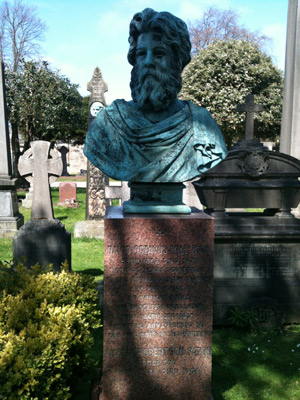
Grave of David Octavius Hill in Dean Cemetery. The bust of him was sculpted by his wife.
Buried in the beautiful Victorian Dean Cemetery in Edinburgh is David Octavius Hill, a painter who, along with Robert Adamson, pioneered in Scottish and aesthetic photography. They founded the Hill & Adamson Studio in 1843, Scotland’s first photographic studio, when the medium of photography was still very much in its infancy. And from this partnership, the pair produced perhaps the first ever collection of photographs that were purposefully taken in an artistic style.
David Hill was witness to the Disruption Assembly in the May of 1843 - a schism in the Church of Scotland, which led to the founding of the Free Church of Scotland when 474 ministers walked out because they were extremely unhappy with the Church’s relationship with the State – and Hill, with the encouragement of friend and other witness Lord Henry Cockburn, wanted to paint the historic event. Hill admired the ministers’ great personal risk they were taking, and so wanted to sketch a likeness of each one to put into his painting. Another witness to the Disruption was the eminent physicist Sir David Brewster, and when he realised Hill’s desire to sketch nearly 500 ministers before they headed back to their respective homes across Scotland he suggested that Hill might like to use the services of Robert Adamson to create photographic images of the men instead. Initially Hill was quite reluctant to use this new art form, but after he first met Adamson and discussed the logistics of it all he was quickly won over to the idea and within weeks the two had formed a close working partnership. Hill and Adamson took photos of the setting of the Disruption as well of those who had been there. Hill had a great eye for composition and lighting from his skill as a painter, and positioned each sitter how he envisioned them to be in the finished painting, whereas Robert Adamson, the photography enthusiast, had considerable dexterity when it came to handling the camera, as well as being very genial in nature, which put the sitters at ease and allowed them to act naturally in front of the camera.
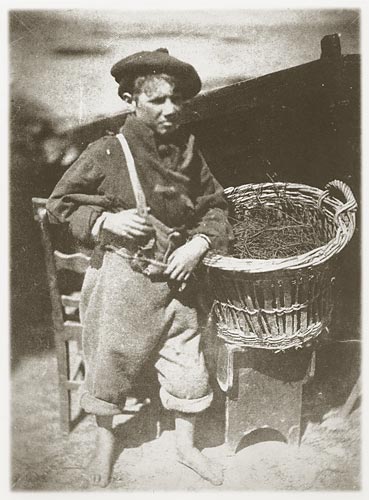
A Hill & Adamson picture titled ‘His Faither’s Breeks’
Their collaboration proved to have been very successful and they went on to produce portraits of well-known Scots of the time, both outdoors and in their studio at “Rock House” on Calton Hill. They would quite often use the grand tombs in the kirkyard at Greyfriars in their portraits. But it wasn’t only the famous or well-to-do that Hill and Adamson photographed; they also took landscape pictures locally and around Fife to the north, as well as photos of normal working people, most notably fishermen and women around Newhaven village and harbour.
However, David Octavius Hill’s partnership with Robert Adamson was to last only four and half years. Adamson fell ill in late 1847 and died, at the age of just 26, in the January of 1848. Together the pair produced thousands of groundbreaking portraits and landscapes as well as worked on improving the technology of photography.
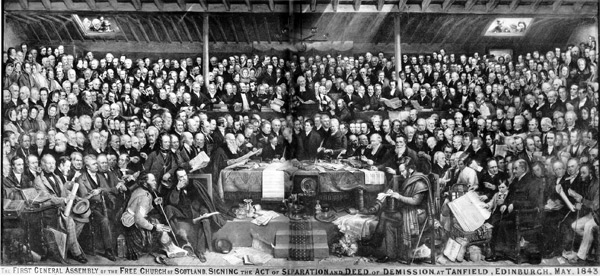
Hill’s Disruption of 1843 painting
After Adamson’s death the studio became less and less active, and Hill eventually returned solely to painting, selling prints of his photographs as a way to earn a living. He finally finished his painting of the Disruption Assembly nearly two decades later in 1866 to much acclaim.
The post Hill and Adamson appeared first on ScotClans | Scottish Clans.
]]>