The post Scotland’s World Heritage Sites! appeared first on ScotClans | Scottish Clans.
]]>If you were not aware UNESCO is the United Nations Educational, Scientific and Cultural Organization and they are in charge of running the World Heritage Programme. The programme catalogues, names, and conserves sites of outstanding cultural or natural importance to the common heritage of humanity. There are currently 1008 sites listed across 161 countries including such wonders as the Great Wall of China, Angkor Wat in Cambodia, Canadian Rocky Mountain Parks, Statue of Liberty in the USA, Uluru in Australia and many, many more.
Now let’s take a look at what Scotland has to offer, starting with the most recent addition…

Forth Bridge
The Forth Bridge is one of 3 crossings over the Firth of Forth beginning just west of Edinburgh over to Queensferry. Alongside it are the Forth Road Bridge and the yet to be completed Queensferry Crossing. It is a fantastic example of single cantilever bridge and was the longest such bridge in the world until 1917 when the Quebec Bridge in Canada was completed but it continues to be world’s second-longest single cantilever span. It is 8,094 feet in length, and the double track is elevated 150 feet above the water level at high tide. The weight of the bridge superstructure was 50,513 long tons, including the 6.5 million rivets used. The bridge also used 640,000 cubic feet of granite.
Prior to the construction of the bridge the only way across the Forth was by ferry. In 1806 it was proposed that a tunnel was dug under the Forth to provide a crossing route and in 1818 James Anderson produced a design for a three-span suspension bridge close to the site of the present one but that proved to not move forward any further than a design. Thomas Bouch became involved in 1871 and designed a suspension bridge that would have crossed the Forth at almost the same point as the present bridge, and after careful verification, work started in 1878 on a pier at Inchgarvie. However following the Tay Bridge disaster in 1879, all confidence in Bouch quickly evaporated. The public inquiry into the disaster found the Tay Bridge to be “badly designed, badly constructed and badly maintained,” with Bouch being “mainly to blame” for the defects in construction and maintenance and “entirely responsible” for the defects in design. Bouch’s design was formally abandoned on 13 January 1881, and Sir John Fowler, W. H. Barlow and T. E. Harrison, consulting engineers to the project, were invited to give proposals for a bridge. It was two of these men, the English engineers, Sir John Fowler and Sir Benjamin Baker, that designed the bridge we know and love today.

In April 1883, construction of a landing stage at Inchgarvie commenced. Extensive preparations took place to prepare the are for the bridge and included removal of an old coastguard station at the Fife end to make way for the north-east pier, a steep hillside had to be terraced on the Queensferry end and wooden huts and shops for the workmen were put up in the area, a cable was laid across the Forth to allow telephone communication between the centres at Queensferry, Inchgarvie, and Fife. Near the shore a sawmill and cement store were erected, and a substantial jetty around 2,100 feet long was started early in 1883 and sidings were built to bring railway vehicles among the shops, and cranes set up to allow the loading and movement of material delivered by rail. On Inchgarvie extant buildings, including fortifications built in the 15th century, were roofed over to increase the available space, and the rock at the west of the island was cut down to a level 7 feet above high water, and a seawall was built to protect against large waves.
At its peak, approximately 4,600 workers were employed in its construction, it used 55,000 tonnes of steel and 140,000 cubic yards of masonry including Aberdeen granite, Arbroath rubble, sand and timber the marvel of engineering was completed after 6 hard years in December 1889. The first complete crossing took place on 24 February, when a train consisting of two carriages carrying the chairmen of the various railway companies involved made several crossings. The bridge was officially opened on 4 March 1890 by the Prince of Wales, later King Edward VII, who drove home the last rivet, which was gold plated and suitably inscribed. The key for the official opening was made by Edinburgh silversmith John Finlayson Bain, commemorated in a plaque on the bridge.

Something interesting happened between competing railway operators following the opening of the bridge. Previously a trip from London to Aberdeen would have taken around 13 hours up the west coast lines(from Euston and using the London and North Western Railway and Caledonian Railway on a west coast route), with the opening of the east coast lines(starting from King’s Cross up to the Great Northern, North Eastern and North British railways east line) the two different routes began to unofficially race reducing the journey time to about 8½ hours on the overnight runs. When the public interest in these ‘races’ began to subside the journey pulled back to an average time of around 10 hours, still a big improvement.
In the First World War British sailors would time their departures or returns to the base at Rosyth by asking when they would pass under the bridge. This practice continued at least up to the 1990s.
The first German air attack on Britain in the Second World War took place over the Forth Bridge, six weeks into the war, on 16 October 1939. Although known as the “Forth Bridge Raid”, the bridge was not the target and not damaged. The target of the attack was shipping from the Rosyth naval base in the Forth, close to the bridge.
Network Rail plans to add a visitor centre to the bridge, which would include a viewing platform on top of the North Queensferry side, or a bridge climbing experience to the South Queensferry side.

St Kilda
St Kilda is an isolated archipelago 64 kilometres west-northwest of North Uist in the North Atlantic Ocean. It contains the westernmost islands of the Outer Hebrides of Scotland. The largest island is Hirta, whose sea cliffs are the highest in the United Kingdom; three other islands (Dùn, Soay and Boreray) were also used for grazing and seabird hunting.
St Kilda may have been permanently inhabited for at least two millennia, the population probably never exceeding 180 but the entire remaining population was evacuated from Hirta (the only inhabited island) in 1930. It became one of Scotland’s six World Heritage Sites in 1986 and is one of the few in the world to hold joint status for its natural and cultural qualities, an honour the islands share with internationally important sites such as Machu Picchu in Peru, Mount Athos in Greece and the Ukhahlamba/Drakensberg Park in South Africa.. Parties of volunteers work on the islands in the summer to restore the many ruined buildings that the native St Kildans left behind. They share the island with a small military base established in 1957.
One of the primary themes of life on St Kilda for the natives was that of isolation. Separated by distance and weather, the natives knew little of mainland and international politics. After the Battle of Culloden in 1746, it was rumoured that Bonnie Prince Charlie and some of his senior Jacobite aides had escaped to St Kilda. An expedition was launched, and in due course British soldiers were ferried ashore to Hirta. They found a deserted village, as the St Kildans, fearing pirates, had fled to caves to the west. When the St Kildans were persuaded to come down, the soldiers discovered that the isolated natives knew nothing of the prince and had never heard of King George II either.
Even in the late 19th century, the islanders could only communicate with the rest of the world by either lighting a bonfire on the summit of Conachair and hoping a passing ship might see it, or by using the “St Kilda mailboat”. This was the invention of John Sands, who visited in 1877. During his stay, a shipwreck left nine Austrian sailors marooned there, and by February supplies were running low. Sands attached a message to a lifebuoy salvaged from the Peti Dubrovacki and threw it into the sea. Nine days later it was picked up in Birsay, Orkney, and a rescue was arranged. The St Kildans, building on this idea, would fashion a piece of wood into the shape of a boat, attach it to a bladder made of sheepskin, and place in it a small bottle or tin containing a message. Launched when the wind came from the north-west, two-thirds of the messages were later found on the west coast of Scotland or, less conveniently, in Norway.
Above and beyond the isolation the life of a St Kildan was very different for several other reasons. Their diet was heavily restricted by what could be farmed or hunted on the island. The islanders kept sheep and a few cattle and were able to grow a limited amount of food crops such as barley and potatoes and they generally shied away from the fishing that you would expect from such an area due to the unpredictable nature of the seas around the island. Instead the mainstay of their diet was the profusion of island birds, especially gannet and fulmar. They harvested the eggs and young birds and ate both fresh and cured. Adult puffins were also caught by the use of fowling rods. These fowling activities involved considerable skills in climbing, especially on the precipitous sea stacks. An important island tradition involved the ‘Mistress Stone’, a door-shaped opening in the rocks north-west of Ruival over-hanging a gully. Young men of the island had to undertake a ritual there to prove themselves on the crags and worthy of taking a wife.

Another important aspect of St Kildan life was the daily ‘Parliament’. This was a meeting held in the street every morning and attended by all the adult males during the course of which they would decide upon the day’s activities. No one led the meeting, and all men had the right to speak.
On 29 August 1930, the residents of the island were removed to Morvern on the Scottish mainland at their own request. Numerous factors led to the evacuation of St Kilda. The islands’ inhabitants had existed for centuries in relative isolation until tourism and the presence of the military in World War I disconnected the islanders from the way of life that had allowed their forebears to survive in this unique environment. After World War I most of the young men left the island, and the population fell from 73 in 1920 to 37 in 1928. After the death of four men from influenza in 1926 there was a succession of crop failures in the 1920s. Investigations by Aberdeen University into the soil where crops had been grown have shown that there had been contamination by lead and other pollutants, caused by the use of sea bird carcasses and peat ash in the manure used on the village fields. The dwindling population and the isolation from medical care led to the islanders eventually abandoning St Kilda.
In 1931 St Kilda was sold to the Marquess of Bute, a keen ornithologist. He bequeathed them to The National Trust for Scotland in 1957.

New Lanark
New Lanark is a village on the River Clyde, just over a mile from Lanark, in Lanarkshire, and some 24 miles from Glasgow. It was founded in 1786 by David Dale, who built cotton mills and housing for the mill workers. Dale built the mills there in a brief partnership with the English inventor and entrepreneur Richard Arkwright to take advantage of the water power provided by the only waterfalls on the River Clyde. Under the ownership of a partnership that included Dale’s son-in-law, Robert Owen, a Welsh philanthropist and social reformer, New Lanark became a successful business and an epitome of utopian socialism as well as an early example of a planned settlement and so an important milestone in the historical development of urban planning.
The New Lanark cotton mills were founded in 1786 by David Dale although he sold the mills, lands and village in the early 19th century for £60,000, payable over 20 years, to a partnership that included his son-in-law Robert Owen. Owen, who became mill manager in 1800, was an industrialist who carried on his father-in-law’s philanthropic approach to industrial working and who subsequently became an influential social reformer. In Owen’s time some 2,500 people lived at New Lanark, many from the poorhouses of Glasgow and Edinburgh. Although not the grimmest of mills by far, Owen found the conditions unsatisfactory and resolved to improve the workers’ lot. He paid particular attention to the needs of the 500 or so children living in the village and working at the mills, and opened the first infants’ school in Britain in 1817.
The mills thrived commercially, but Owen’s partners were unhappy at the extra expense incurred by his welfare programmes. Unwilling to allow the mills to revert to the old ways of operating, Owen bought out his partners. In 1813 the Board forced an auction, hoping to obtain the town and mills at a low price but Owen and a new board, that was sympathetic to his reforming ideas, won out.
New Lanark became celebrated throughout Europe, with many leading royals, statesmen and reformers visiting the mills. They were astonished to find a clean, healthy industrial environment with a content, vibrant workforce and a prosperous, viable business venture all rolled into one. Owen’s philosophy was contrary to contemporary thinking, but he was able to demonstrate that it was not necessary for an industrial enterprise to treat its workers badly to be profitable. Owen was able to show visitors the village’s excellent housing and amenities, and the accounts showing the profitability of the mills.

In 1825, control of New Lanark passed to the Walker family when Owen left Britain to start settlement of New Harmony in the US. The Walkers managed the village until 1881, when it was sold to Birkmyre and Sommerville and the Gourock Ropeworks. They and their successor companies remained in control until the mills closed in 1968. The town and the industrial activity had been in decline before then, but after the mills closed migration away from the village accelerated, and the buildings began to deteriorate. In 1970 the mills, other industrial buildings and the houses used by Dale and Owen were sold to Metal Extractions Limited, a scrap metal company. In 1974 the NLCT (now the NLT) was founded to prevent demolition of the village. A compulsory purchase order was used in 1983 to recover the mills and other buildings from Metal Extractions after a repairs notice had been served in 1979. This was because of the state of repair of the buildings despite their listing as historic buildings that required their legal preservation in 1971. By 2005 most of the buildings had been restored and the village has become a major tourist attraction.
It has been estimated that over 400,000 people visit the village each year and about 200 people currently live in New Lanark. Considerable attention has been given to maintaining the historical authenticity of the village. No television aerials or satellite dishes are allowed in the village, and services such as telephone, television and electricity are delivered though buried cables. To provide a consistent appearance all external woodwork is painted white, and doors and windows follow a consistent design. Householders used to be banned from owning dogs, but this rule is no longer enforced.

Edinburgh’s Old & New Town
The Old Town is he name given to the oldest part of Scotland’s capital, and is an area that has retained much of the medieval street plan and many of the reformation era buildings. The New Town is the name given to the are just north of the Old Town, built between 1767 and around 1850, which retains much of the original neo-classical and Georgian period architecture and is considered a masterpiece of city planning. Together these two areas of the city form one World Heritage Site.
The Old Town makes up the heart of Edinburgh and has done since the beginnings of the city of Edinburgh. The Royal Mile is at the heart of the area and makes up it’s main artery, running from Edinburgh Castle all the way down to Holyrood Palace. Narrow closes (alleyways), often no more than a few feet wide, lead steeply downhill to both north and south of the main spine which runs west to east.n addition to the Royal Mile, the Old Town may be divided into various areas, namely from west to east: West Port, the old route out of Edinburgh to the west, Grassmarket, the area to the south-west, Edinburgh Castle, The Cowgate, the lower southern section of the town, Canongate, a name correctly applied to the whole eastern district, Holyrood, the area containing Holyrood Palace and Holyrood Abbey, Croft-An-Righ, a group of buildings north-east of Holyrood. Notable buildings in the Old Town include St. Giles’ Cathedral, the General Assembly Hall of the Church of Scotland, the National Museum of Scotland, the Old College of the University of Edinburgh and the Scottish Parliament Building.
Due to the space restrictions imposed by the narrowness of the “tail” the Old Town became home to some of the earliest “high rise” residential buildings. Multi-story dwellings were the norm from the 16th century onwards. A census 0f 1792 put the Old Town and Canongate population at around 30,000 residents. As the population was for a long time reluctant to build outside the defensive wall, the need for housing grew and hence the buildings became higher and higher. Many of these buildings were destroyed in the Great Fire of Edinburgh (1824); the rebuilding of these on the original foundations led to changes in the ground level and the creation of many passages and vaults under the Old Town. The construction of new streets including North Bridge and South Bridge in the 18th century also created underground spaces, such as the Edinburgh Vaults below the latter. Traditionally buildings were less dense in the eastern, Canongate, section. This area underwent major slum clearance and reconstruction in the 1950s, thereafter becoming an area largely of Council housing. Further Council housing was built on the southern fringe of the Canongate in the 1960s and 1970s in an area generally called Dumbiedykes. From 1990 to 2010 major new housing schemes appeared throughout the Canongate. These were built to a much higher scale than the traditional buildings and have greatly increased the population of the area.

The idea of a New Town was first suggested in the late 17th century when the Duke of Albany and York (later King James VII and II), when resident Royal Commissioner at Holyrood, encouraged the idea of having an extended regality to the north of the city and a North Bridge. The decision to construct a New Town was taken by the city fathers, after overcrowding inside the Old Town city walls reached breaking point and to prevent an exodus of wealthy citizens from the city to London.[2] The Age of Enlightenment had arrived in Edinburgh, and the outdated city fabric did not suit the professional and merchant classes who lived there. Lord Provost George Drummond succeeded in extending the boundary of the Royal Burgh to encompass the fields to the north of the Nor Loch, the heavily polluted body of water which occupied the valley immediately north of the city. A scheme to drain the Loch was put into action, although the process was not fully completed until 1817. Crossing points were built to access the new land; the North Bridge in 1772, and the Earthen Mound, which began as a tip for material excavated during construction of the New Town. The Mound, as it is known today, reached its present proportions in the 1830s.
As the successive stages of the New Town were developed, the rich moved northwards from cramped tenements in narrow closes into grand Georgian homes on wide roads. However, the poor remained in the Old Town.
The street names applied to the New Town are something of interest when investigated. The principal street was named George Street, after the king at the time, George III. Queen Street was to be located to the north, named after his wife, and St. Giles Street to the south, after the city’s patron saint. St. Andrew’s Square and St. George’s Square, located at either end of George Street, were the names chosen to represent the union of Scotland and England. The idea was continued with the smaller Thistle Street (for Scotland’s national emblem) between George Street and Queen Street, and Rose Street (for England’s emblem) between George Street and Princes Street.
King George rejected the name St. Giles Street as St Giles was known as the patron saint of lepers and the name was also connected with a slum area on the edge of the City of London. It was therefore renamed Princes Street after his sons. The name of St. George’s Square was changed to Charlotte Square, after the Queen, to avoid confusion with the existing George Square on the South Side of the Old Town. The westernmost blocks of Thistle Street were renamed Hill Street and Young Street, making Thistle Street half the length of Rose Street. The three streets completing the grid, Castle, Frederick and Hanover Streets, were named for the view of the castle, King George’s father Frederick, and the name of the royal family respectively.
The New Town was envisaged as a purely residential suburb but it did not take long for the commercial potential of the site to be realised. Shops were soon opened on Princes Street, and during the 19th century the majority of the townhouses on that street were replaced with larger commercial buildings.
Occasional piecemeal redevelopment continues to this day, though most of Queen Street and Thistle Street, and large sections of George Street, Hanover, Frederick and Castle Streets, are still lined with their original late 18th century buildings. Very large sections of the Second New Town, built from the early 19th century are also still exactly as built.

The Antonine Wall
The lesser known brother to England’s Hadrians Wall, the Antonine Wall is a stone and turf fortification built by the Romans across what is now the Central Belt of Scotland, between the Firth of Forth and the Firth of Clyde. It spanned approximately 39 miles and was about 3 metres high and 5 metres wide.
The Antonine wall was built from turf on a stone foundation, and the stone foundations and wing walls of the original forts demonstrate that the original plan was to build a stone wall similar to Hadrian’s Wall, but this plan was at sometime abandoned. The Romans initially planned to build forts every 6 miles, but this was soon revised to every 2 miles, resulting in a total of nineteen forts along the wall. The best preserved but also one of the smallest forts is Rough Castle Fort. In addition to the forts, there are at least 9 smaller fortlets, very likely on Roman mile spacings, which formed part of the original scheme, some of which were later replaced by forts.
Roman Emperor Antoninus Pius ordered the construction of the Antonine Wall around 142 and took around 12 years to complete. The wall was intended as a replacement for Hadrians Wall, 99 miles south, and to extend the borders and dominance of the Roman Empire becoming the new frontier of Britannia.
The wall was abandoned only eight years after completion, when the Roman legions withdrew to Hadrian’s Wall in 162, and over time reached an accommodation with the Brythonic tribes of the area whom they fostered as the buffer states which would later become “The Old North”. After a series of attacks in 197, Emperor Septimius Severus arrived in 208 to secure the frontier, and oversee repairs to the wall. Although this re-occupation only lasted a few years, the wall is sometimes referred to by later Roman historians as the Severan Wall.
Today the remains of the wall and several of the forts can still be seen along it’s original route, and due to it travelling across such a vast area it’s fairly easy to visit and view sections, although it may take a awhile to take in the whole monument.

The Heart of Neolithic Orkney
The Heart of Neolithic Orkney refers to a group of Neolithic monuments found on the Mainland, one of the islands of Orkney, and the name was adopted by UNESCO when it proclaimed these sites as a World Heritage Site in 1999.
The grouping currently consists of four important sites found in and around this are; Maeshowe, Standing Stones of Stenness, Ring of Brodgar and Skara Brae.

Maeshowe is a Neolithic chambered cairn and passage grave that was likely built around 2800 BCE.
The mound encasing the tomb is 35m in diameter and rises to a height of 7.3m. Surrounding the mound, at a distance of 15m to 21m is a ditch up to 14m wide. The grass mound hides a complex of passages and chambers built of carefully crafted slabs of flagstone weighing up to 30 tons. It is aligned so that the rear wall of its central chamber held up by a bracketed wall,is illuminated on the winter solstice.
Maeshowe is the largest burial cairn of it’s class and gives it’s name to other such chambered cairns, which are limited to Orkney. It is believed a monument such as this, built at the time it was, would have taken a considerable amount of effort to build. Estimates put it somewhere in the area of 100,000 man-hours. It represents a significant example of Neolithic craftsmanship.

The Standing Stones of Stenness, another Neolithic monument, are found 5 miles northeast of Stromness on the mainland of Orkney and may be the oldest henge site in the British Isles.
The monument is made up of thin slabs, approximately 300 mm (12 in) thick with sharply angled tops. Four, up to about 5m high, were originally elements of a stone circle of up to 12 stones, laid out in an ellipse about 32m diameter on a levelled platform of 44m diameter, surrounded by a ditch. Based on radiocarbon dating, it is thought that work on the site had begun by 3100 BC.
Traditions involving the stones survived for centuries, right up to the 18th century. One tradition involved a particular stone, known as the “Odin Stone” which stood in the field to the north of the henge,was pierced with a circular hole, and was used by local couples for plighting engagements by holding hands through the gap.
Unfortunately this stone was destroyed in late 1814. Captain W. Mackay, a recent immigrant to Orkney who owned farmland in the vicinity of the stones, decided to remove them on the grounds that local people were trespassing and disturbing his land by using the stones in rituals. He started by smashing the Odin Stone. This caused outrage in the locals and they managed to stop him causing any more damage, but only after he had destroyed one other stone and toppled another. The toppled stone was re-erected in 1906 along with some inaccurate reconstruction inside the circle.

The Ring of Brodgar (or Brogar, or Ring o’ Brodgar) is another Neolithic henge and stone circle found about 6 miles north-east of Stromness and is the northern most example of a henge found in Britain.
Brodgar is a striking exception of a henge containing a stone circle, ranking with Avebury (and to a lesser extent Stonehenge) among the greatest of such sites. The site has resisted attempts at scientific dating and the monument’s age remains uncertain. It is generally thought to have been erected between 2500 BC and 2000 BC, and was, therefore, the last of the great Neolithic monuments built on the Ness.

Skara Brae is a stone-built Neolithic settlement, located on the Bay of Skaill on the west coast of Mainland which was occupied from roughly 3180 BCE–2500 BCE. It makes up Europe’s most complete Neolithic village older than both Stonehenge and the Great Pyramids, and is often called the “Scottish Pompeii” because of its excellent preservation.
In the winter of 1850, a severe storm hit Scotland, causing widespread damage and over 200 deaths. In the Bay of Skaill, the storm stripped the earth from a large irregular knoll known as “Skerrabra”. When the storm cleared, local villagers found the outline of a village, consisting of a number of small houses without roofs.
William Watt of Skaill, the local laird, began an amateur excavation of the site, but after four houses were uncovered, but the work was abandoned in 1868. The site remained undisturbed until 1913, when during a single weekend the site was plundered by a party with shovels who took away an unknown quantity of artifacts. In 1924, another storm swept away part of one of the houses and it was determined the site should be made secure and more seriously investigated. The job was given to University of Edinburgh’s Professor Vere Gordon Childe.
The houses used earth sheltering, being sunk into the ground. It is believed they were sunk into mounds of pre-existing prehistoric domestic waste known as middens. The midden provided the houses with a small degree of stability and also acted as insulation against Orkney’s harsh winter climate. On average, the houses measure 40 square metres in size with a large square room containing a stone hearth used for heating and cooking. Given the number of homes, it seems likely that no more than fifty people lived in Skara Brae at any given time.
The dwellings contain a number of stone-built pieces of furniture, including cupboards, dressers, seats, and storage boxes and each dwelling even included a primitive form of a toilet.
The Grooved Ware People, a distinctive form of pottery found around all the sites in the Neolithic Heart of Orkney, who built Skara Brae were primarily pastoralists who raised cattle and sheep. It was originally believed that the inhabitants did not practice agriculture, but excavations in 1972 unearthed seed grains from a midden suggesting that barley was cultivated.
This pastoral lifestyle is in sharp contrast to some of the more exotic interpretations of the culture of the Skara Brae people. Euan MacKie, a British archaeologist and anthropologist, suggested that Skara Brae might be the home of a privileged theocratic class of wise men who engaged in astronomical and magical ceremonies at nearby Ring of Brodgar and the Standing Stones of Stenness. Doubt has been cast on this interpretation as there is no archaeological evidence to back it up.
The post Scotland’s World Heritage Sites! appeared first on ScotClans | Scottish Clans.
]]>The post WW1 letter reveals a brutal day at Scapa Flow appeared first on ScotClans | Scottish Clans.
]]>
Scapa Flow in Orkney is a historic wreck site. You can see shipwrecks littered all around.
Scapa Flow is one of Britain’s most important historic stretches of water, located within the Orkney Islands, off the northeast coast of Scotland. It’s a natural harbour which has been used over many centuries, from the Viking fleet of King Haokon in the 13th Century, to the present day. It formed an important northern base for the British fleets in both world wars.
Shipwrecks can still be seen everywhere, an incredible insight into the past, a natural museum. The stories of some these rusty carcasses has started to be heard through some newly discovered letters. Astonishingly these letters show that in WW1 these ships were scuttled by their own sailors on 21 June 1919 in this natural bay on Orkney. On this fateful day they had the single greatest loss of warships in history, and the sailors killed that day were the last fatalities of World War One.
One young British officer not only witnessed the astonishing events, but recorded his own dramatic involvement in an account which has remained unpublished until now.

Edward Hugh Markham David – Hugh, or “Ti” (short for “Tiny”) to his family – was 18 years old in 1919, but had already been in the Royal Navy for two years.
By June he was a sub-lieutenant aboard the battleship HMS Revenge, flagship of Admiral Sir Sydney Fremantle.
Fremantle was the man charged with guarding the interned ships of the German High Seas Fleet in the Orkney anchorage of Scapa Flow.
On the morning of Sunday 21 June, the British fleet steamed out on exercise. Hundreds of miles away, in Paris, the wrangles over the peace treaty to officially end the Great War were reaching a climax. The fate of the magnificent German warships was due to be decided.
The German commander, Admiral Ludwig von Reuter, believed that his ships were about to be seized as spoils of war and divided up between the victorious Allies. He felt duty-bound not to let that happen.

A total of 52 ships sank to the seafloor
At 10:30 von Reuter’s flagship, Emden, sent out the seemingly innocuous message – “Paragraph Eleven; confirm”. It was a code ordering his men to scuttle their own ships.
Beneath decks, German sailors immediately began to open seacocks – valves that allow water in – and smash pipes.
There have been many accounts of the drama that followed, but Hugh David’s version of events has never been published.

David wrote the very next day to his mother from HMS Revenge, as the battleship steamed south to Cromarty, loaded with German sailors, now prisoners-of-war.
Even after nearly a century, the words are clear. So too are the feelings of the young man. In the emotion of telling his story, David got the date of his letter wrong – recording it as 26 June instead of 22 June.
HMS Revenge received a message at around 12:45 on 21 June that its captive German ships were sinking. The fleet turned back at full speed. It was too late.
“The sight that met our gaze as we rounded the Island of Flotta is absolutely indescribable,” wrote David.
“A good half of the German fleet had already disappeared, the water was one mass of wreckage of every description, boats, carley floats, chairs, tables and human beings, and the ‘Bayern’ the largest German battleship, her bow reared vertically out of the water was in the act of crashing finally bottomwards, which she did a few seconds later, in a cloud of smoke bursting her boilers as she went.”

Location of German Ships
The Germans took to small boats to escape their sinking ships. From one of them Admiral von Reuter was taken aboard HMS Revenge.
“About the most dramatic moment of the whole day was the meeting of the English and German Admirals,” wrote David. “The two men were about the same height, both fine looking and tall.”

Although von Reuter later recalled this conversation in his memoirs, David’s record appears to be the only contemporaneous one:
“At first there was a pause, the German standing at the salute then the following conversation -
Fremantle: I presume you have come to surrender?
Von Reuter: I have come to surrender my men and myself (with a sweeping gesture towards the fast sinking ships) I have nudding else.
Pause
Von Reuter: I take upon myself the whole responsibility of this, it is nothing to do with my officers and men – they were acting under my orders.
Fremantle: I suppose you realise that by this act of treachery [hissing voice] by this act of base treachery you are no longer an interned enemy but my prisoner of war and as such will be treated.
Von Reuter: I understand perfectly.
Fremantle: I request you remain on the upper deck until I can dispose of you.
Von Reuter: May my Flag Lieutenant accompany me?
Fremantle: Yes, I grant you that.
The drama recorded by David took place at about 16:00 that Midsummer Day. It seems David was then ordered to join a boarding party to try to save the few German ships still afloat.
“I strapped a revolver round my waist grabbed some ammunition and leapt into the drifter with an armed guard and took off to save the Hindenburg,” wrote David.
The Hindenburg was the biggest German battlecruiser. She sank as Hugh’s small boat drew alongside but before he climbed on board “very nearly taking us with her.”

By 1700 BST, as the last ship, the Hindenberg, went under, the surface of Scapa Flow was covered in oil and debris
David’s launch turned instead for the giant battleship Baden, sister of the Bayern. She was the only German battleship the Royal Navy succeeded in saving.
“We then got alongside ‘Baden’ who was going down fast and hurried below to see what we could do to save her – we closed watertight doors which kept her up temporarily but she eventually had to be towed ashore,” explained David.
“We found one little German sub-lieut (sic) below who was dragged onto the upper deck.”

The German said that he didn’t mind if he was shot straight away. David, however, doesn’t record whether the unfortunate man was shot, but there’s no doubt that others were. They were the final casualties of World War One – the Treaty of Versailles was signed a week later on 28 June 1919.
“The terrible part of the whole show, to my mind, was that the Huns hadn’t got a weapon between them and it was our bounden duty to fire on them to get them back to close their valves,” wrote David. He describes the British as being in an “awful position”.

Andrew Choong, Curator of Ships, Plans and Historic Photographs at the National Maritime Museum in Greenwich, has read a transcript of David’s letter.
“I think it’s an absolutely fascinating account. Our knowledge and analysis of this event are based on the recollections of the great and the good, like von Reuter and official reports. I haven’t ever seen an account of a similar experience. Here’s a mid-level officer placed right in the middle of it all.”
Choong was struck by David’s feelings. “Here is a man who comes across first as a human being and is obviously very uncomfortable about the whole thing,” he says.
“I think it’s very moving because there is no relish in what he’s doing and he finds time to mark the acts of German bravery. It’s a remarkable document.”
After his eventual return to Germany, von Reuter helped to put together a government report on “British breaches of international law” against the German sailors, charges consistently denied by Britain.
Choong says the British would have had justification to fire in some cases. “The rules of engagement were that if you saw a German opening a seacock or giving orders to others to do so you could order him to stop – and if he refused, you could shoot him,” he says.
However, there’s evidence, including in David’s letter and a subsequent one he wrote a few days later to his Uncle Walter, to suggest some British sailors went further, firing on Germans who were trying to escape from their sinking ships.
“Today you would say there’s probably no excuse, but that’s to impose a modern view of the situation which then was very unclear and very uncertain,” says Choong. “In one or two places in the letter it makes it sound like a bit of a massacre but in fact only nine men were killed and 16 wounded out of hundreds and hundreds.”
The tumultuous events of that day clearly had their effect on Hugh David.

He died in 1957. His letter to his mother eventually passed to his daughter, Hilary Chiswell Jones. It was her decision to make it public, after 96 years.
“I probably didn’t read it until I was 25 or so,” explains Hilary. “I remember being impressed by the way he portrayed the event and also by his awareness of how awful it was for the Germans.
“He obviously had compassion for them and I admired him for it – I was pleased he showed it, especially at 18, when you tend to be perhaps a bit cocky. I thought that showed his humanity.”
Does she think her father did fire on the German sailors?
“I think he would have told his Uncle Walter in his letter to him had he shot anyone, so I don’t think so.”
Within months of the scuttling, David had left the Royal Navy. He joined the fledgling RAF, where he served with distinction until 1950, rising to the rank of Group Captain.
But it seems unlikely he ever forgot the extraordinary things he witnessed at Scapa Flow.
The post WW1 letter reveals a brutal day at Scapa Flow appeared first on ScotClans | Scottish Clans.
]]>The post An Ode to Scotland – Meeting a Modern-Day Scots Poet appeared first on ScotClans | Scottish Clans.
]]>Intertwined and impenetrably linked to Scottish culture, poetry has a long and distinguished history in Scotland. And it’s a history that’s continuing to this day – Edinburgh was recently named the world’s first UNESCO City of Literature, the publishing industry is thriving, the country has more literature festivals per capita than any other, and there’s at least a dozen spoken word monthly nights in Glasgow and Edinburgh alone which are frequented by a plethora of experienced and budding poets.
This new generation of Scottish poetry is certainly alive and well, carrying on rich literary traditions of old. However these days you’re more likely to find these modern-day versifiers using hashtags and laptops rather than quills and parchment.

Harry Giles performs in Edinburgh, January 2013. Photo by Chris Scott via The STANZA Blog.
Meet Harry Giles, 27, an Edinburgh-based poet, producer and performance artist. He’s the proud author of two poetry publications, performs regularly in England and Scotland, and is something of a luminary in the Scottish poetry slam scene – winning the UK Student Slam in 2008 followed by the BBC Slam in 2009. I first encountered him at the BBC Slam during last years Fringe festival, where his ranted, passionate ode to Scottishness entitled Brave grabbed me by the ears and demanded my attention.
I sing
o
a Scotland
whit
wadna ken workin class authenticity gin hit cam reelin aff an ile rig douned six pints o Tennent’s n glasst hit in the pus,
whit it wadna
by the way;
o google Scotland,
o laptop Scotland,
o a Scotland sae dowf on bit-torrentit HBO drama series n DLC packs fer paistapocalyptic RPGs that hit disna ken hits gowk fae hits gadjie;
- Excerpt from Brave.
Harry is one of only a handful of young poets writing and performing in Scots – one of three native languages spoken in Scotland; predominantly in the lowlands, Shetland and Orkney. He grew up immersed in a mixture of Orcadian Scots and English on the tiny island of Westray, part of the Orkney Islands, just off the northern-most tip of the Scottish mainland.
If you, like me, assumed that Orkney was Gaelic speaking, you’re not alone – it’s an assumption that is something of a hot issue amongst Orcadians. Gaelic never had a significant impact on Orkney. Instead a form of Norse introduced by the vikings, called Norn, became the spoken language before Orcadian Scots. You can still see bits of the language around to this day – Westray and many others of Orkney’s islands end in the suffix ‘ay‘, which is Norse for ‘island’.
With Celtic culture so prevalent in defining the image of Scotland both here and abroad, this different kind of Scotland, where things are more Norse than Celt is a theme that pops up in Harry’s poetry. “Scandinavian culture is very influential in Orkney. The place names, peoples names, even the architecture. It kind of feels half Scottish, half Scandinavian. And it’s even more so on Shetland.”
Along with identifying with this different type of Scottishness, Harry was born in London, but his family moved to Orkney when he was two. At that time in Westray, the Giles family were one of the only ‘incomer’ families, the Orkney term for outsiders who have adopted the isles as their home. “I have no feelings of home towards England, I’ve only had feelings of home towards Scotland. So I’ve always had this doubleness where Orkney is my only home but I don’t quite belong either.”

Visa Wedding by Harry Giles
This mash of English/Orcadian/Scottish identity makes good fodder for poetry, with Harry’s 2012 publication of Visa Wedding acting as a kind of therapy, addressing and resolving these questions about himself:
Listen, hit’s semple:
in Orkney I’m English;
in England I’m Scottish;
in Scotland, Orcadian–
this glib-gabbit, mony-littit tongue
snacks at identity as tho hit wis
a gollach piecie sappit wi
the sweet-n-soor o BELONG.
- Excerpt from Visa Wedding #1.
His love of Scots came from the sounds and rhythms, and the way it feels to speak. “When I’m writing in Scots, I’m often digging out words from my memory that have fallen off my tongue as I’ve lived in St. Andrews, London and Edinburgh. They’re words from Orkney that I knew in my childhood and used in my childhood but never identified with enough to keep using and have lost over the years. So I’m recovering a lot of those words, and recovering a part of my own identity which is Scottish and not Scottish at the same time.”
“Even as a written language, you can’t get away from how Scots sounds. It’s impossible to write without thinking about the speaking of it possibly because of the tradition of Scots literature which is so connected to speaking. So I really like that aspect of it. Something that people say to me now is that they look at my Scots poem on the page, and they have no idea what it says, and then I’ll speak it and it becomes immediately intelligible. And that’s really interesting to me.”
The status of Scots as a language is a hotly contested topic, with some claiming it’s merely a dialect, or ancient variety of English; or at the other end of the scale a completely distinct language from English, in much the same way that Norwegian is closely linked yet vastly different to Danish. Harry’s view is that what matters is where people can be understood by each other.
“If somebody in Glasgow can’t be understood by somebody in the East End of London, talking the way they would in those places, then I think it’s pretty sensible to say that they’re separate languages.”
In the 2011 Scottish census, 1.54 million Scots (30%) indicated they were able to speak Scots, however an earlier study of the language by the Scottish Government found that 64% of respondents “don’t really think of Scots as a language”. This may be because of Scots reputation as slang, as for many years the language was discouraged by officialdom and schools. Today Scots is promoted and fostered, but it’s nowhere near as threatened and in decline as Scotland’s other traditional language, Gaelic, with only 58,000 respondents in the 2011 census indicating they could speak fluently.

A leading light of the Scots Renaissance, Hugh MacDiarmid.
“There are also different type of Scots, not just regional variants, but what I would call vernacular Scots, which is the way that people actually speak. So if you go into a pub in Leith you will actually hear people speaking in what I call the (Leith Scots) vernacular. There’s also a sort of literary Scots which is not necessarily how people speak.” Harry explained that during the 50s there was an active reclamation known as the Scots Renaissance by people like Hugh MacDiarmid and Hamish Henderson who were deliberately working to preserve and recreate the language.
“Folk like MacDiarmid would read ancient Scots dictionaries and travel around and collect words from people, and then construct what he called a ‘syncretic’, as in synthesised Scots from that, taking the words the people spoke and making a literary language out of them.”
“And most poets writing in English are writing in a kind of English that’s nothing like people speak, ya know. So I’m writing mostly in literary Scots, in a sort of constructed Scots, rather than the Scots that people speak.”
While Harry agrees that cultural dominance can threaten and water down traditional language, he’s skeptical of some of the recent efforts employed to promote Scots. “It’s a very optimistic utopian project to imagine that we might have a complete body of work that’s written only in Scots. There’s too many different types and regional variants of Scots, and I’m really resistant to the idea of there being a monolithic Scots that has one form of spelling and one form of words. I’m much more interested in people writing new work and working in new ways in Scots than I am in reading a translation of Asterix in Scots.”
Harry is currently writing about 50% of his work in Scots, and said he can usually tell straight away when writing a poem if it will be in English or Scots. However sometimes he bounces a poem between the two languages, or if the poem is about Scotland, then it’s almost always in Scots. Cue what is fast becoming known as his signature piece, Brave, which was written in 2011, just as the Independence debate was starting to heat up.
cadna hink o a grander wey tae end a nite as wi a poke o chips n curry sauce,
whit chacks the date o Bannockburn on Wikipaedia,
whit draws chairts on the backs o beermats tae lear ye aboot rifts n glaciation
n when hit dis hit feels this oorie dunk,
this undesairvt wairmth
o inexplicable luve;
- Excerpt from Brave.
“I was thinking a lot about my past, and how I felt about Scotland and was reading a lot of Scots poetry. I wanted to get across something of the contradictions and complexities of Scottish-ness. I wanted to react against the tartan tat vision of Scotland. And even though Orkney is the only home I know I am still an incomer. I wanted to claim Scotland for myself in some way, and also talk about how it is and isn’t mine at the same time.”
“And I like being funny, and I like being angry, and I like being ranty, so I just wrote the longest rant that I could in Scots, about what Scotland meant to me. And what pissed me off and what I liked about Scotland. It’s kind of like my state of the nation poem; as if a wee scrote like me could write a state of the nation!”
The poem has gone on to have a life of its own, being featured on podcasts, websites, and in the Scottish literary journal New Writing Scotland. He thinks the poem gained significance as it came out just at the right time, when all across the land people are questioning their identity, just before the looming independence referendum this September.
“Literature and poetry in particular are quite central to Scotland’s self understanding. Poetry and folk music are our art forms. There are poems carved on the walls of Scottish parliament, so it definitely has a place in our political discourse. So I do feel like artists are central to the way Scotland constructs and presents itself.”

Oam by Harry Giles
Post-Brave and Visa Wedding, Harry says his writing has moved on, and he’s not writing as much about Scotland as a whole these days. His second publication Oam was the result of a five month residency at Govanhill Baths in Glasgow, with proceeds from the sale helping the project reopen as a community swimming pool and well-being centre. The poems are all written in contemporary Scots and describe the baths and their incredible history.
“(Writing Oam) was quite nice because I was writing in Scots intensely, but I wasn’t writing about Scotland. I was just writing about this one place. So I’m less interested in the big questions of Scotland at the moment, in poetry, and more interested in local stuff.”
As his body of work moves and evolves, Harry says the reason he talks so much about Orkney now is because he has an urge to go back to discover more of that part of himself. “The Scots that I write is influenced by the Scots that’s spoken in the lowlands, it’s very influenced by urban Scots, partly because that’s what i’m living in now, and partly because that has dominated the Scots literary tradition. I have an ambition to spend much longer in Orkney digging to try and get more of the Orcadian Scots into my own writing, and that would involve investigating Norn a bit more. I’m also interested in the Viking forms of poetry and how this has influenced Scots poetry. But that’s more of a long term ambition.”
As Harry’s work expands and evolves, he’s the latest in a long line of innovative writers who have been inspired and shaped by Scotland and Scottishness. As the country considers its future, Harry’s body of work mashes literary traditions of old and new, providing a pertinent and contemporary review of Scotland’s identity.
—–
You can read more about Harry here, and listen to a recording of Brave here.
The post An Ode to Scotland – Meeting a Modern-Day Scots Poet appeared first on ScotClans | Scottish Clans.
]]>The post Learn to Speak Norn For Only £120 appeared first on ScotClans | Scottish Clans.
]]> A dictionary of an extinct language spoken only in the remote Scottish Highlands has been uncovered in an English charity shop. The two-volume Norn Dictionary was anonymously donated to the Willow Burn bookshop in County Durham, and with a price tag of £120 is the most valuable item to date handed into the shop.
Originally influenced by the Old Norse spoken by Norwegian settlers in the 8th Century, Norn gradually developed in the Northern Isles into its own distinctive language. The sheer scale of Norse settlement obliterated the Pictish language previously spoken in the Northern Isles, with Norn becoming the dominant language over the coming centuries. Interestingly Gaelic was never spoken in the islands, unless the language of Orkney’s Pictish inhabitants – the predecessors of the Norsemen – was variant, or precursor, to Gaelic.
Scots gradually began to replace Norn after control of Shetland and Orkney passed from Denmark to Scotland in the 15th century. From 1400 many people also moved to the islands from the Scottish mainland and as Scots became the official language, Norn became marginalised as the language of poor crofters and fishermen and thus was never written down. Although official documents do exist from this period, they were generally written in Norwegian.
When the Reformation reached Scotland in 1560, new Scots-medium schools were set up in the islands, along with Scots-speaking clergy. From 1740 an English version of the Bible was being taught in schools, and negative attitudes to Norn were becoming common. By the 19th century the shift from Norn to Scots was more or less complete, except on the more isolated islands such as Foula, Unst, Yell and Fetlar, where some people knew fragments of the language, such as songs and poems until the 1890s. The last native speaker of Norn is cited as Walter Sutherland from Skaw in Unst, who died in 1850.
Before the discovery of the dictionary, very few texts and no recordings of Norn were known to exist, making details of Norn pronounciation uncertain. Attempts have been made to reconstruct and revive Norn, including the Nynorn Project which aims to re-create Norn as a usable language.
The Lord’s Prayer* in Orkney Norn:
Favor i ir i chimrie,
Helleur ir i nam thite,
gilla cosdum thite cumma,
veya thine mota vara gort
o yurn sinna gort i chimrie,
ga vus da on da dalight brow vora
Firgive vus sinna vora
sin vee Firgive sindara mutha vus, lyv vus ye i tumtation,
min delivera vus fro olt ilt,
Amen.
_______
*Recorded in the late 1690′s by James Wallace and first published in his An Account of the Islands of Orkney.
The post Learn to Speak Norn For Only £120 appeared first on ScotClans | Scottish Clans.
]]>The post The Westford Knight appeared first on ScotClans | Scottish Clans.
]]>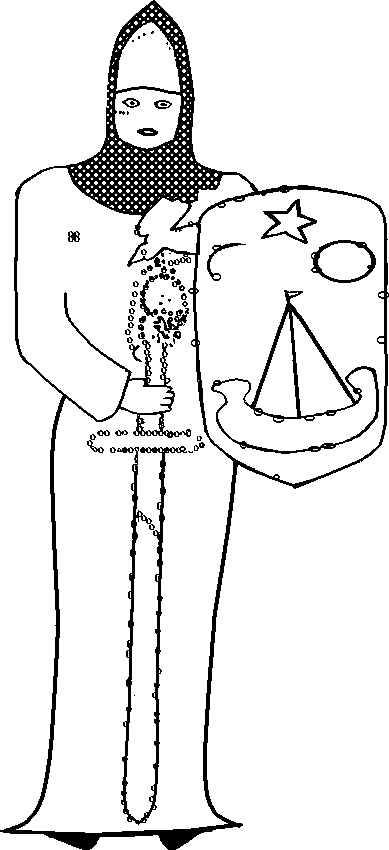
The Westford Knight engraving, with the Gunn arms on the shield
What is claimed as a carving on a glacial boulder in the town of Westford, in Massachusetts, USA, is argued to be proof that an expedition, led by Henry Sinclair, Earl of Orkney, landed on the North American continent almost 100 years before Christopher Columbus.
The ‘carving’ is subject to much speculation over its authenticity, but it is said to depict a Medieval knight with sword and shield who was a fallen member of Sinclair’s party who travelled to the ‘New World’ in 1398.
The story goes that in early April 1398 Henry Sinclair set sail, heading west with a fleet of 13 small vessels; two of which were driven by oars. They made it across to North America by the start of June; sailing into Chedabucto Bay, and dropping anchor in what is modern-day Guysborough Harbour, Nova Scotia in Canada. The explorers interacted peacefully with the natives, and with one tribe in particular, the Míkmaq (or Micmac). Sinclair managed to persuade the Míkmaqs to act as a guide so his party could travel and explore around the area safely.
They stayed in Nova Scotia until the following spring when the explorers are said to have sailed south, landing in Massachusetts, just north of where the city of Boston now sits. It has been claimed that Sinclair and his party made such a positive impression on the Míkmaq of Nova Scotia, and that after they left, the tribe chose to remember the travellers by telling stories about them, passing them down through many generations, and that the legendary figure of Glooscap is, in fact, meant to represent Henry Sinclair.
In Massachusetts the group stayed with the natives, also getting along with them peacefully, before Sinclair took 100 of his men and headed west. Among the men was a knight, and loyal friend of Henry, called Sir James Gunn. Gunn was later to become known as the Westford Knight. Unfortunately for Sir James the name came about due to his death on the expedition and he was buried, with a large rock covering his grave, where the modern-day town of Westford now is. On the stone an effigy of the Scottish knight was carved. It depicts Gunn with his sword and shield, and on the shield the Gunn family arms. After over 600 years the engraving is still said to be there on the stone, but is now very faint, and your imagination is needed to visualise it for the most part.
The tale of the Westford Knight is very much a part of Westford folklore, but the story itself is widely considered to be apocryphal. The ‘facts’ of the story are widely disputed by mainstream professional archaeologists and historians, who are under the general belief that the voyage never happened, and the carving is either much more recent than the 14th century or simply just a natural feature on the stone. Other reasons why the claim that Henry Sinclair reached the North American continent 94 years before Christopher Columbus is doubted include the lack of any physical evidence of the voyage and the new land, which Columbus did provide, plus there is no contemporary record of it at all. Also, it is stated that the rock, onto which the effigy of Sir James Gunn is carved, would most likely have been under almost a metre of earth at the time of the supposed visit, making it more than unlikely for it to have been used as a memorial.
Whatever the facts, it is not likely that anyone will know for absolute certainty whether or not Henry Sinclair made it to North America, and if the stone at Westford is actually a memorial to Sir James Gunn.
The post The Westford Knight appeared first on ScotClans | Scottish Clans.
]]>