The post Scottish Heraldry 101: The Court of Lord Lyon appeared first on ScotClans | Scottish Clans.
]]>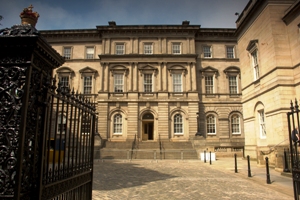
HM New Register House, Edinburgh
Just off Edinburgh’s bustling Princes Street sits a grand old building that houses hundreds of years worth of Scotland’s records. HM New Register House is well known as home to the General Register Office for Scotland but also houses the Court of Lord Lyon – Scotland’s centuries-old heraldic authority that can be traced back to at least 1388. The court regulates and has jurisdiction over matters relating to Scottish heraldry, which includes establishing and issuing Coats of Arms and maintaining the Public Register of All Arms and Bearings and the Public Register of Genealogies and Birthbrieves in Scotland.
Inside the first-floor office, bookshelves stacked full of leather-bound publications line the corridor that is also decorated with heraldic antiquities including tabards and carved coats of arms of past knights of the Order of the Thistle. Central to the Lyon Court is the Lord Lyon King of Arms and the Lyon Clerk and Keeper of Records, the latter from whom I’ve come to receive an introduction on all things heraldry. While the Lord Lyon is the judge responsible for determining and granting new arms, the Lyon Clerk puts the Lord Lyon’s instructions into operation and makes sure they are properly adhered to. The Lyon Clerk is also specifically responsible for the maintenance of the registers and records within the office.
The position of Lyon Clerk is currently held by Elizabeth Roads LVO, whose other quite separate hats include assistant secretary to the Order of the Thistle and Snawdoun Herald of Arms. Mrs. Roads started off as the then Lord Lyon’s assistant in 1975 on return to Edinburgh from overseas travel. She came from a fine arts background, and had no particular knowledge of heraldry other than how it related to art and decoration. “I’ve been here for nearly 39 years, which the then Lord Lyon is probably laughing at, bless his heart. I told him I didn’t think it was likely I would stay here more than five years.”
In 1986 Mrs. Roads was appointed Lyon Clerk, the first woman to be so, and said that the job hadn’t changed an awful lot during her 26 year tenure in the post. “The office has existed in its current form since at least the late 17th century. So 40 years isn’t a very long time in the court’s existence. I would like to think that if Colonel Lawson (Lyon Clerk 1929-1966) walked in now, he would be able to sit down at this desk and do exactly the same job as he did in 1929.” One thing that has changed is the amount of correspondence received from all over the world, as a result of the enormous quantity of genealogical information available online. Thus a large number of the court’s records have been digitised and archived online, available to view and download at £10 per record.
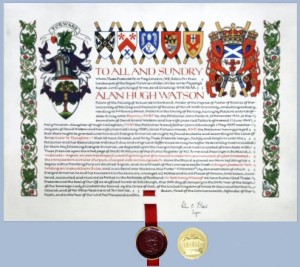
Grant of Arms issued by The Lyon Court
In order to apply for a new Coat of Arms, or marticulate older arms, Lyon Clerk recommends doing as much research as possible into heraldry beforehand. “Very often [applicants will] come and have a chat with us first about the process. It’s a formal process so you have to lodge a petition and give us such documentary evidence as is necessary for your particular case.” Information about applying is available on the court’s website, with petitioners increasingly using this avenue to begin their heraldic journey. In terms of designing a Coat of Arms, very often petitioners will come with only the broadest of ideas, in which case the Lord Lyon or Lyon Clerk will work out something that is simple, clear and appropriate. “For private individuals our starting point would always be their surname. If it’s an established Scottish surname then we’ll look at what the underlying arms of the chief are and use that as the basis.”
Perhaps the most common misconception among applicants is who a Coat of Arms belongs to. “A Coat of Arms belongs to a person, not a family. It’s a piece of personal property that will pass down an individual’s senior line. A family Coat of Arms just doesn’t exist”. Lyon Clerk likens it to saying that you have a family passport, or a family driver’s licence.
The application involves fees which go to the Exchequer and the heraldic artists and calligraphers who hand-paint the arms on vellum paper. The Exchequer’s fees are paid as protection so that if somebody misuses your arms, the Crown will take action at no cost to you. “Normally it doesn’t get as far as prosecution. In fact in my time only once has someone insisted on using arms to which they were not entitled, which resulted in prosecution. If arms are being used unlawfully then the Procurator Fiscal to the Court of the Lord Lyon will write to them saying they shouldn’t be doing so. They’ll then provide advice as to what they should do if they want their own Coat of Arms.”
Along with arms enquiries, the court also receives many queries from people asking about clans, with questions ranging from what their clan or family is, who their chief is and what tartan to wear. “We get a lot of these sorts of general queries very often because they don’t know where else to go. This office is sort of thought of as being the office that knows everything. Sometimes we do know the answer and can help and sometimes we merely direct them towards the answer.” In fact, the only relationship the court has with the clans is when a chief comes to record their coat of arms. “We’re only concerned with the heraldry of the clan chief. Lyon doesn’t recognise a clan chief as such. What he does is vest that person in what are called the Undifferenced Arms of the Name, showing they are the principle person of their name and the clan chief.” The Standing Council of Scottish Chiefs, the organisation that represents chiefs of clans and families in Scotland, will only invite chiefs to be members if they have been granted the Undifferenced Arms of the Name by Lord Lyon.
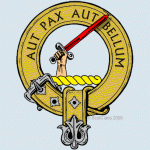
Clan Gunn Badge – Aut pax aut bellum (Either peace or war)
The majority of clans have a fairly clear succession down the senior line so the question of who is the rightful chief is usually straightforward. However, when the line has been lost it presents huge problems and a large amount of research must be undertaken. In order to assign a new chief, concrete evidence must be shown by the petitioner that the line has died out completely. “A particular instance would be Clan Gunn where we know what the principle line was. What we don’t know is what happened to [the many] descendents of that line. They undoubtedly will still be there, it’s just a matter of who they are and where they are now.” When a chief is missing, a commander can be appointed. The current commander of the Clan Gunn is Iain Gunn of Banniskirk who has been the clan’s leader for a very long time. Lyon Clerk added he is an efficient and effective commander. But there are an enormous amount of Gunn descendents and the search continues in determining exactly who is the senior descendent.
Commanders can go on to become chiefs, as in the case of Clan MacArthur, where the principle line was lost around 1820. “It took a lot of research but it was possible to show that actually those people all died without issue.” The resulting research showed that the commander was in fact the senior line of the surviving genealogical descendants. The Lyon Court is a court of law, therefore they are unable to undertake the successional research which then comes before them to be examined. Clan and family societies are very often the bodies who drive chieftainship petitions, with Lyon Clerk stating that it’s not their role to decide who should become chief, but rather to present research to the court.
One of the most enjoyable parts of Lyon Clerk’s job is providing genealogical records to those who are tracing their roots. “There is absolutely no classic person you can say is going to take an interest in heraldry or genealogy. People come from all sorts of backgrounds and there’s no rhyme or reason why people take an interest in it, so I get to meet an enormously interesting cross section of people.” For budding genealogists, Lyon Clerk says it’s easy to get back to the middle of the nineteenth century with no difficulty because birth, marriage and death records were statutory. Prior to that it helps if you’re tracing an unusual surname. She also adds to remember: “if you can’t find records, it doesn’t mean they don’t exist”. Genealogical websites have different records so it’s important to check out a few. Names were also sometimes spelt phonetically, so you won’t necessarily get the spelling you’re looking for. Lyon Clerk’s own genealogical journey has revealed such esteemed ancestors as Robert the Bruce and a 17th century Lord Lyon. “As one of my predecessors said, no individual has a longer genealogy than anyone else, they just happen to know more. I warn you now, it’s a complete drug. You always think – I wonder if I can just find that little bit more.”
The post Scottish Heraldry 101: The Court of Lord Lyon appeared first on ScotClans | Scottish Clans.
]]>The post Queen Marks Anniversary in Scottish Style appeared first on ScotClans | Scottish Clans.
]]> Beside a bubbling brook in a remote part of the highlands isn’t usually where you would expect to come across a modern-day monarch. But a new portrait of Queen Elizabeth II has done just that – picturing her against the sprawling backdrop of Balmoral Estate and kitted out in a velvet green mantle and a plethora of jewels. The photograph is one of 100 published in a new book Keepers, which was released this week to mark the 60th anniversary of the Queen’s coronation.
Inspired by Sir Henry Raeburn’s series of portraits of clan chiefs, photographer Julian Calder said he wanted the portrait to highlight some of the Queen’s traditional if less prominent roles. “We wanted to photograph the Queen as the Queen of Scots and I wanted to do it as a Raeburn painting. He did paintings of Scottish clan chiefs and I thought they were very romantic… We wanted to have her looking at the massed clans on the distant hills.”
The Queen is dressed in the mantle of the Most Ancient and Most Noble Order of the Thistle, the Scottish counterpart to England’s Order of the Garter. From her shoulders, held by white satin ties, hangs the Collar of the Order made of golden thistles and rue sprigs, from which hangs a tiny St Andrew and his saltire cross. The photographer had initially hoped that the Queen would wear Scotland’s Crown Jewels, known as the Honours Three. However tradition dictates that they can only be removed from Edinburgh by the Duke of Hamilton, who was unavailable. Instead the Crown Jewel cabinet in London was raided, with the Queen opting to wear the emerald-covered Vladimir Tiara. It was once owned by the Grand Duchess Vladimir, aunt of the last Russian Tsar Nicholas II, and was smuggled out of Russia during the Revolution

The MacNab – one of a series of portraits of clan leaders that inspired Julian Calder’s picture of the Queen
The portrait also enforces the Scottish connections to the monarchy – Elizabeth II is a direct descendant of Mary Stuart, Queen of Scots, not of England’s Virgin Queen, Elizabeth I, who reluctantly signed Mary’s death warrant. The Queen’s great‑great‑grandmother, Queen Victoria, who bought and loved the Balmoral Estate, said she could never forgive Elizabeth I’s treatment of “my ancestor, poor Mary”. A favoured summer holiday spot for the royals since Victoria, the Queen is popularly supposed to be happier at Balmoral than anywhere else.
Calder and the book’s author Alastair Bruce spent the day beforehand scouting for locations finally opting for a remote stream called Gelder Burn, which runs into the River Dee. “It’s remote, you can seen the heather was out and everything was right about it. Creatively, the curve of the stream could mirror the curve of the cape. The dark green of the trees and the heather all worked as a composition. It had all the ingredients” Calder said.
On the day of the photo shoot, Bruce said rain threatened to disrupt plans which had been weeks in the making. “As the allotted hour approached, the skies cleared and the Queen not only agreed to go outside but also to be photographed at a spot I had picked 25 minutes away. So we drove up to Gelder Burn and passed a family out for a walk who were just astonished to see the Queen passing by in all this regalia. There was no time to set up the shot but it was this magical moment – hardly a breath of wind and no midges.”

Say cheese – On set with the Queen
Keepers celebrates the bewildering range of official titles and appointments that have evolved over more than a thousand years. Those photographed range from the Monarch and the Master of the Rolls to a vicar’s son who is the hereditary Lord High Admiral of the Wash and the Royal Falconer. The portrait is the latest in a series of recent representations of the Queen. The Welsh Rugby Union unveiled a matronly expressionist portrait by Dan Llywelyn Hall earlier this year, and HRH received rave reviews for her role alongside Daniel Craig in the London Olympics Opening Ceremony in 2012.
The post Queen Marks Anniversary in Scottish Style appeared first on ScotClans | Scottish Clans.
]]>The post The Order of the Thistle appeared first on ScotClans | Scottish Clans.
]]>Like many ‘ancient’ Scottish traditions, the origins of the order are actually relatively new; albeit not modern. It is a function of monarchy to be seen to be regal and full of pomp and circumstance – part of the pageantry that makes the institution so appealing. This was not lost on kings going back into the mists of time, but many of the outfits, ceremony, customs and ritual surrounding the British Crown can be traced back only a couple of hundred years in many instances; and some are 20th century in their design – but, meant to hearken back to an age when kings ruled as well as reigned.

HM The Queen and Duke of Edinburgh in Thistle Robes
The Order of the Thistle in it current guise (which may be its only ever incarnation) was established by King James VII (James II of England) on the 29th of May 1687. As an absentee monarch who actually enjoyed a fair amount of support in Scotland he, like now, was keen to foster a close relationship with his northern subjects; and he turned to two of the most important ministers of state to come up with a innovative idea that combined regal authority, ceremony, exclusivity and importance. Two brothers, John Drummond, Earl of Melfort and Secretary of State for Scotland and James Drummond, Earl of Perth and Lord Chancellor then went about ‘resurrecting’ the Order. In truth they essentially invented it.
Legend has it that a Scottish/Pictish king granted the order to the great emperor Charlemagne in 809; which may have some plausibility to it as he was known to have used Scottish mercenaries in his bodyguard and in the van of his armies. But, if it ever happened it was probably some token or gift exchanged between two rulers. Historians also point to James III (1451 – 1488), who is said to have made a presentation to King Francis I of France of an “Order of the Burr or Thissil’. Again, probably a personal inter-sovereign gift; but there may have been such an order. If late medieval and renaissance knightly orders did exist in Scotland, they may have sprung up sporadically, lasted for a few years and then disappeared again. Certainly nothing substantial or lasting; and certainly nothing akin to the modern order developed.
The Drummond’s order looked also to be short-lived as James VII was deposed from the throne of England in 1688 and then Scotland in 1689 and his successors William and Mary did not maintain it. However, in 1703 Queen Anne, the last Stewart monarch resurrected it and it remains pretty much in the same format and ceremonial as it was then. However, in 1987 the present Queen allowed for the membership of women as Ladies of the Thistle. As our parliamentary customs and practices developed to be more constitutional throughout the 18th and 19th centuries with real power shifting from the monarch to Prime Minister, virtually all honours gifted by the sovereign are done so on the advice of the Government. George VI (the queen’s father), felt that the Orders of the Garter and Thistle were being overused as devices for patronage, and in agreement with his Prime Minister, knighthood in both these orders became the personal gift of the monarch with no government interference – it is this which makes being a Knight of the Thistle so unique.
Equally unique are the small number that can be knights at any given time: There are only ever sixteen ordinary knights, a handful of officials and a few ‘extra’ knights, who are mainly members of the Royal Family. Members of the Order are addressed as Sir (or Lady) and can use the letters KT (or LT) after their names. It outranks all other orders with the exception of the Garter.
The Chapel of the Knights is in St Giles Cathedral, Edinburgh and the order meet on an annual basis and to confirm new members (such as Prince William). Whenever they so meet they are fully kitted out in their ceremonial robes, which are a beautiful deep green, with white trim; they wear the star and other emblematic accessories and a feathered cap. It can look somewhat anachronistic, but it serves to bind the functions of the state at a deeply symbolic level; and the ordinary members are chosen for their lifetime commitment to serving their country and for working toward the welfare of the people of Scotland.

Star of the Order of the Thistle
The motto of the order is: Nemo me Impune Lacessit, which means ‘no-one provokes me with impunity’ or who dares meddle with me. It is considerd the motto of Scotland and of the Royal Regiment of Scotland.
Chivalry is an unpopular word in a world that is too reliant on popularism; ceremony and duty underrated in an age of consumer commercialism and sycophantic celebrity. But, our institutions and such quirky roles are the glue that binds the fabric of our multi-patched nation; and it is a good thing to see the Earl of Strathearn maintaining that link and function.
The post The Order of the Thistle appeared first on ScotClans | Scottish Clans.
]]>