The post Drumnacoub – A Bloody Battle in the Far North appeared first on ScotClans | Scottish Clans.
]]>
The Kyle of Tongue
This battle was an internal feud among the men of Clan MacKay but also involved some Sutherland men. A disastrous battle, it led to the loss of many senior members of the clan and most of the belligerents on both sides.
The origins of the battle begin with an ongoing feud between the MacKays and their neighbours the Sutherland Clan. In 1370 the MacKay chief had been murdered by the Sutherlands in Dingwall. This had led to considerable acrimony between both clans as you can imagine and finally in 1426 Angus Du MacKay and his son Neil marched into Sutherland lands to take revenge. They met the Sutherland clan at Harpisdale.
The battle was more or less fought to a stalemate with no clear winner and considerable slaughter on either side. News of the conflict reached James I in Edinburgh. James wasn’t exactly having the easiest of times and frustrated by yet another inter-clan war he rode north to Inverness and demanded that the clan leaders submit to him. Angus duly complied and volunteered his son as a hostage to guarantee his clan’s good behaviour. Neil was taken to the Bass rock. an island prison in the outer Firth of Forth. During his imprisonment he was given the nickname ‘Vass’ a phonetic spelling of ‘Bass’
While this was going on three cousins of Angus Du: the brothers Thomas Mackay, Morgan Mackay, and Neil Neilson Mackay had a dispute with the Laird of Freswick – a man by the name of Mowat. Thomas pursued him to the chapel of St Duffus in the town of Tain. Mowat claimed sanctuary at the chapel but Thomas killed him anyway and burned down the chapel for good measure. As anyone who has followed the fortunes of Robert the Bruce will know murdering someone in a house of worship was a serious breach of etiquette and burning it down was even worse, so once again James I was forced to intervene so he denounced and outlawed Thomas, promising his land and possessions as a reward for his capture dead or alive.
Angus Moray (of Clan Sutherland) apprehended Thomas and handed him over to the law, however there was clear suspicion that Thomas’ own brothers; Morgan and Neil Neilson had assisted Angus Murray for a share of the spoils. Thomas was carted off to Inverness and executed and this apparent betrayal within the clan (made even worse by conspiring with a Sutherland) split the clan.
The Earl of Sutherland – seeing a good opportunity to break the power of the MacKay clan further supported Morgan and Neil Neilson by offering his own daughters in marriage (though they had already married Moray’s daughters). As well as helping them make a bid for the MacKay lands.
Back in Caithness Angus Du and his illegitimate son John Aberach Mackay were in a tight spot. Angus was by now an old man and had no will to fight, preferring to make some sort of settlement with his cousins. He offered all his land apart from Strathnaver but they refused the deal, intending to take all of MacKay lands for themselves. At this point Angus’ illegitimate second son John Aberach Mackay stepped in to advise the elderly chief and offered to defend the MacKay lands or die trying.
Some time between 1427 and 1433 (exact dates are unclear) the two sides met at Drumnacoub (Druim na coub, Drum-ne-coub) a few miles from the coastal village of Tongue on the North East coast.
The battle was a long and terrible one with both sides suffering heavy losses, by the end of the day Neil Mackay, Morgan Mackay and Angus Moray were all dead, John Aberach Mackay was severely wounded (possibly loosing an arm) and lay critical on the battlefield and very few from around 3,000 men (around 1,500 on either side by some estimates) were left standing.
Angus Du in despair asked to be carried to the battlefield to search for his son John but an opportunistic Sutherland archer spotted him and killed him with a well aimed arrow.
Shortly after the battle the remaining MacKay clan had to consider who would succeed as chief. Many supported John despite his illegitimacy but as fortune would have it Neil ‘Vass’ MacKay escaped from imprisonment at the Bass rock and made his way back north (it turned out the governor was married to a MacKay and she possibly helped him break out). John deferred to the legitimate heir and Neil was made chief. John was given lands around Lochnaver.
Neil pursued the Sutherlands who had supported the potential usurpers and a year later took revenge at the Battle of Sandside Chase. The widow of Neil Neilson and his son were given fairly rough treatment at the hands of those loyal to Angus Du’s side and for their own safety the moved to Olrig in Caithness. John dropped the name MacKay and became known as John Bain, progenitor of the Bain Family.
The post Drumnacoub – A Bloody Battle in the Far North appeared first on ScotClans | Scottish Clans.
]]>The post Òrain Gàidhlig – Scottish Gaelic Song appeared first on ScotClans | Scottish Clans.
]]>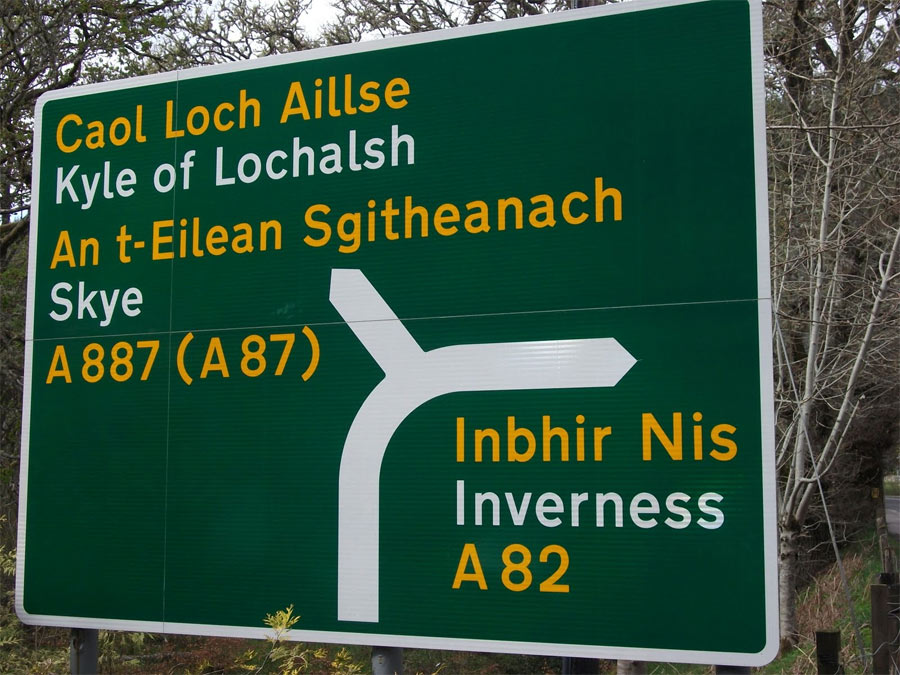
Bilingual Scottish Road Sign
One of the experiences that stood out the most on my Highland adventure a few months back was the amount of Scottish Gaelic I encountered. From road and railway station signs, to the greeting displayed on the entrance to McDonalds in Inverness, this was my first encounter with Scotland’s oldest surviving spoken language. It’s something you don’t really come across in Edinburgh, either because the language is spoken by less than 2% of the Scottish population, or because Lowland Scots has been the traditional form of speech in the south.
Sadly Scottish Gaelic has been in steady decline for quite some time. 100 years ago the amount of bilingual Scots numbered 183,998. At the time of the last census in 2001, only 58,652 people were registered as bilingual in Gaelic. Nevertheless, the language is in the midst of a government supported revival. BBC’s Gaelic television station Alba reportedly gets on average 530,000 viewers per week, and Edinburgh’s Gaelic primary school is currently at full capacity, prompting a relocation to a larger campus later in the year.
Apart from place names, I had never spoken a word of Gaelic in my life until last Friday when I attended a Gaelic harmony singing workshop. Held at the Scottish Storytelling Centre on Edinburgh’s Royal Mile, I arrived a little early and sat trying to figure out how to pronounce the lyrics on the handout I’d received. I have never encountered a language quite like it before – the words are pronounced entirely differently to how you would expect them to sound. This makes reading Gaelic when beginning to learn a little bit perplexing. I found it much easier to watch and listen to how it looks and sounds, mimicking rather than trying to read.
The workshop was lead by well-known Gaelic singer Gillie Mackenzie. Gillie grew up in Lewis but now lives in the Lothians, and has been singing ever since she can remember. Family ceilidhs instilled an early understanding of vocal harmony and she fondly told us how her and her sisters would sing and harmonise together in Gaelic while doing the dishes at home. Gillie currently teaches Gaelic song and conducts the Gaelic choir at Bunsgoil Crois na Cìse (the Gaelic medium unit at Edinburgh’s Tollcross Primary School), and recently began a Gaelic choir at James Gillespie’s High School. She released her first solo album entitled Griais in 2012 and is currently touring with her band.
We began by singing two traditional songs (Tobair Tobair Siolaidh and ‘S Toigh Leam Fhin Buntat ‘s ìm); first as a group, then combined with different vocal harmonies, and finally in round. It sounded absolutely glorious and I wondered if the tourists just outside the window walking up and down the high street could hear us singing in ancient Scottish tongue. The first few times we went through the song I felt completely lost with the language, but as we repeated the song my mouth was slowly becoming accustomed to this new way of speaking. We then learnt a beautiful song called Gleanna Gollaidh by Robert Donn (1714-78). Donn was a well-known bard hailing from Sutherland (Mackay country), with this particular song praising a glen in his district:
Gleann-a-Gallaidh, Gleann-a-Gallaidh, (Glen Gollaidh, Glen Gollaidh)
Gleann-a-Gallaidh nan craobh, (Glen Gollaidh of our trees)
Cò a chì e nach mol e, (Who can see it without praising it?)
Gleann-a-Gallaidh nan craobh. (Glen Gollaidh of our trees)Ri faicinn crìoch àrdain (Seeing the abutment of its elevation)
Ga mo bhreugadh gu taobh, (Drew me aside)
‘S ann a smuainich mi fanadh (Indeed I thought of staying in)
An Gleann-a-Gallaidh nan craobh. (Glen Gollaidh of the trees)Chan àill leam bhur n-airgead (I don’t desire your money)
‘S ri bhur n-arm cha bhi mi, (And I’ll never join your army)
Cha diùlt mi bhur drama (I won’t refuse your dram)
Ach ri tuilleadh cha bhì. (But I’ll do no more than that)Ged a gheibhinn gu m’ àilgheas (Though I might get to my desire)
Ceann-t-sàile MhicAoidh, (Mackay’s Kintail)
‘S mòr a b’ annsa leam fanadh (More I fancy staying)
An Gleann-a-Gallaidh nan craobh. (In Glen Gollaidh of the trees)Fonn diasach, ‘s mòr a b’ fhiach e (Bountiful land, much of its value)
Gu fiadhach ‘s gu nì, (For stalking and cattle)
Aite sìobhalt ri doineann (An agreeable place in time of storm)
Is nach criothnaich a’ ghaoth. (In which the wind will not shudder).
Coincidentally, Donn was writing poetry around the same time as the 1745 Jacobite Rising. An ardent Jacobite supporter, Dunn upset the Hanoverian chief of Clan Mackay by writing this poem about the rising:
Now, young Charles StewartEvery clan places its hope in youThat sought to crown youAnd set the country alight;They’re like hidden snakesWhich cast their skins last yearBut are making ready their fangs
To arise on the day of your coming

Waulking in Iochdar, South Uist, June 1970
We finished the workshop with an Isle of Lewis waulking song called Bodachan Cha Phòs mi. These songs were traditionally sung by women waulking cloth and were an institution in female Gaelic society. This practice involved a group of women beating newly woven tweed rhythmically against a table or similar surface to soften it. As the singers worked the cloth, they gradually shifted it to the left so as to work it thoroughly. Typically one person would sing the verse, while the others joined in the chorus. A night at a waulking was a tremendous social outlet for women. The songs have a strong element of gossip in them, of exchanging secrets, of comments on men, good and bad. Although some songs were light-hearted and trivial, many were intimate, frank, intensely vivid, and expressive statements of women’s experiences.
A week since the workshop, I’m suprised at how well I have remembered the melody and the language I learnt. I have quite often found myself humming the songs, especially the beautiful Gleanna Gollaidh. Sadly the only statistics I can find online regarding Scotland’s Gaelic speakers date from 2001, but I would love to know if efforts since have increased the number of speakers of this fascinating language.
——-
You can listen to Gleanna Golaidh by visiting the BBC’s Year of Song website here, and they also have a great ‘teach yourself Gaelic’ website for absolute beginners called Beag air Bheag.
Another great resource for Scottish oral recordings is Tobar an Dualchais where you can hear many Gaelic recordings.
The post Òrain Gàidhlig – Scottish Gaelic Song appeared first on ScotClans | Scottish Clans.
]]>The post Hugh William Mackay, Chief of Clan Mackay Dies appeared first on ScotClans | Scottish Clans.
]]>
Lord Reay 1937-2013
Clan Mackay. A distinguished parliamentarian, Mackay served in the House of Lords, held office for a short time in the Thatcher government and later sat for six years in the European Parliament. Mackay died in London on May 10 2013 aged 75 following a short illness. One of two Scottish elected hereditary peers who survived Blair’s Parliamentary reforms of 1999, Mackay’s death has triggered a rare by-election to appoint his successor in the House of Lords.
Born on July 19 1937 in Edinburgh, Mackay was the only son of Aeneas Alexander Mackay, 13th Lord Reay, and his wife Charlotte (née Younger). Mackay was educated at Eton College and Christ Church in Oxford where his sharp dress sense was first noted. He was living in Holland when his father died in 1963, inheriting the titles of Lord, Chief, Baronet of Farm (a Nova Scotia title originally bestowed on an ancestor by James VI) and the Barony of Ophemert and Zennewijnen (created in 1822 by King William I of Netherlands). With this latter title came the picturesque 16th-century manor house, Ophemert Castle in the Netherlands.

The Chief and his lady Victoria at the Gathering in 2009
Lady Elizabeth Fairbairn, Hugh’s sister and president of the Clan Mackay Society, said her brother spoke with authority on a number of subjects related to the north of Scotland – especially the Highland Clearances. Mackay attended the Clan Gathering in Edinburgh 2009, walking the Royal Mile parade in Mackay tartan, and later spoke enthusiastically at the Mackay tent of the work being done at the Clan Mackay Room at the Strathnaer Museum in Sutherland. He also spoke of his love for Edinburgh, saying: “I have always had a soft spot for Edinburgh, the place of my birth and still managing to hold its place as, in my opinion, the most beautiful city in the United Kingdom. I feel honoured to be amongst you. Clansmen, Clanswomen. I ask you to raise your glasses to Clan Mackay.”
Mackay entered the House of Lords as a cross-bencher and played a prominent role in the abolition of capital punishment in 1965, joining the Liberals soon afterwards. However, disapproving of the party’s standing as a genuinely ‘national’ party he returned to the cross-benchers before joining the Conservatives in 1971. Upon the UK’s entry to the Common Market in 1973, Mackay was one of eight peers nominated to serve in the European Parliament. After the Parliament’s first public election in 1979, he was nominated to the Council of Europe which he served in until 1986. During this time his increasingly hawkish attitude on defence issues attracted the attention of Margaret Thatcher who appointed him as a Lord-in-Waiting or junior whip. Thatcher’s successor John Major appointed Mackay as Parliamentary Under Secretary of State to the Department of Trade and Industry (DTI), however he decided to leave Parliament less than a year later. He joined the Select Committee on the European Communities, also chairing its food and agriculture subcommittee, until 1999. Mackay stayed a member of the House of Lords until 2013.
During his political career Mackay’s support of environmental issues was mixed – On behalf of the Department of the Environment he had to oppose pressure for the phasing out of CFC gases, however one of his first announcements at the DTI was a package of grants for recycling. As recently as May 2012 Mackay sponsored legislation to define minimum distances between wind turbines and residential premises, however during a debate on renewable energy he dismissed wind power as a pointless gesture towards an economically crippling green ideology. Mackay was also strongly against further EU integration, gay marriage and caused controversy when he suggested that Britain recognised the Dalai Lama as a spiritual (rather than a political) leader only.
Mackay married Annabel Therese Fraser in 1964, youngest daughter of the 17th Lord of Lovat, and had two sons and daughters. They divorced in 1978, and in 1980 Mackay married Victoria Warrender, daughter of the 1st Lord of Bruntsfield, having two daughters. His elder son, Aeneas Simon Mackay – Master of Reay, born in 1965, succeeds the titles including the chieftainship of Clan Mackay. The funeral is likely to be on the 23rd of May in Lancashire with a Memorial Service in London to be held at a later date.
The post Hugh William Mackay, Chief of Clan Mackay Dies appeared first on ScotClans | Scottish Clans.
]]>