The post A Cannonball, a Sheepskin and a Loch Village appeared first on ScotClans | Scottish Clans.
]]>
The Mingary Castle cannonball
What – Cannonball
Era – Most likely 1644
Found – Wedged in the wall of Mingary Castle, Lochaber, West Highlands.
Fired almost 350 years ago, this cannonball was found during restoration work currently taking place at Mingary Castle. The cannonball was found sitting in an 18 inch hole in one of the castle’s sea facing walls, embedded a foot into the wall. A ship was lost in the attack on the castle during tensions between clans and Covenanters.
The remains of the ship were discovered in 1999 and relate to the siege of Mingary Castle by by Archibald Campbell, 8th Earl of Argyll, the castle’s former owner, recorded in a diary written by John Weir in 1644. Weir was a Puritan imprisoned in Mingary Castle by Major-General Alasdair MacDonald.
Originally built for the Clan MacDonald of Ardnamurchan (also known as MacIain of Ardnamurchan), the castle has had many different occupants over the years including Clan MacDonald of Lochalsh, Clan Campbell, Clan MacLean and King James IV of Scotland who used it as a stronghold for fighting off Clan Donald in the late 15th century.

Archaeologists at the burial excavation site in Sutherland
What – Burial cist with sheepskin and human remains
Era – Bronze Age
Found – A back garden near the village of Spinningdale, Sutherland, North Highlands.
Discovered by accident when a septic tank was being installed in a back garden, the sheepskin and human remains are said to be at least 4000 years old. The sheepskin was found wrapped around the left arm bone of the skeleton of the middle aged female whose crouched body was contained within the burial cist.
It is believed to be the first known example of sheepskin from the Bronze Age found in Britain.
A spokesman for the archaeology company said: “A radiocarbon date of 2051-1911 BC and 2151-2018 BC was obtained from bone and charcoal fragments, placing the cist in the early Bronze Age period. The radiocarbon dating of the cist corresponds with the date of the food vessel urn buried with the body. The vessel contained carbonised material of non-botanical origin, unidentified cremated bone and a fragment of a small ring. These were probably placed there to assist the individual’s journey into the next world and indicate belief in the afterlife, which appears to have been a concept only adopted in Scotland.”
“The preservation of organic material, such as sheepskin or wool, also supports the view of a elaborate burial rites being carried out in the vicinity of the Dornoch Firth during the early Bronze Age.”
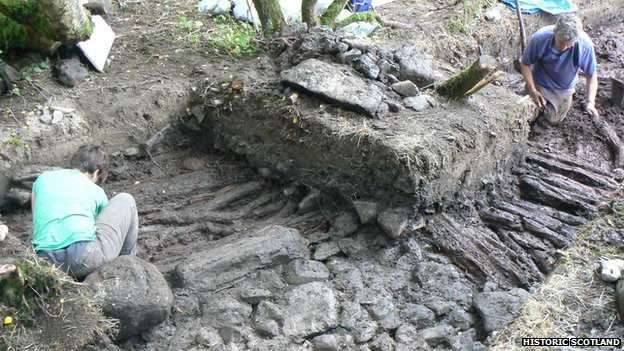
The loch village revealed
What – Loch Village
Era – Iron Age
Found – Wigtownshire, Dumfries and Galloway
Experts are calling this remarkable find ‘Scotland’s Glastonbury’, in reference to Somerset’s famous lake village after discovering the first loch village in Scotland. What originally began as a small scale excavation of a crannog (a singular loch dwelling) turned into a fully fledged dig when archaeologists found evidence of multiple structures on the site. The site is one of 55 archaeology projects to receive more than £1m in funding from Historic Scotland for 2013/14.
What initially appeared to be one of a small group of mounds before excavation was revealed to be a massive stone hearth complex at the centre of a roundhouse. The timber structure of the house has been preserved, with beams radiating out from the hearth forming the foundation, while the outer wall consists of a double-circuit of stakes. The most surprising discovery was that the house was not built on top of an artificial foundation, but directly over the fen peat which had gradually filled in the loch.
Graeme Cavers, of AOC Archaeology, who is the co-director of the site, said that because the land was abandoned after the Iron Age, the buildings were well preserved.
“Waterlogged wood also offers the opportunity to date the structure very accurately using dendrochronology – or tree-ring counting – to give a date accurate to within a few years or even months, rather than the decades or centuries usually provided by radiocarbon dating,” he added.
The post A Cannonball, a Sheepskin and a Loch Village appeared first on ScotClans | Scottish Clans.
]]>The post Morag of Loch Morar Sightings Discovered appeared first on ScotClans | Scottish Clans.
]]>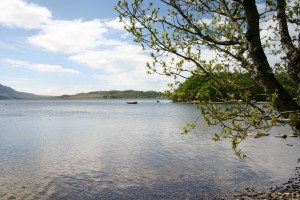
Loch Morar, Lochaber.
Researchers at the University of Edinburgh have discovered accounts dating back more than one hundred years of Morag of Loch Morar. The descriptions paint a conflicting view of the monster, who is reputed to inhabit the Loch in the remote Lochaber area of the Highlands.
One account describes her as a mermaid-like creature with flowing hair, while the other describes her as a grim reaper whose sighting was a precursor to death. The accounts were documented by Alexander Carmichael in 1902, who was a prolific gatherer of folklore and later became a figurehead in the celtic artistic movement. He wrote the descriptions in Gaelic and is thought to only have spent a few days in the area interviewing locals, not getting a glimpse of the elusive Morag himself.
In the first text, Carmichael states: “Morag is always seen before a death and before a drowning.”
A second text reads: “There is a creature in Loch Morar and she is called Morag. She is never seen save when one of the hereditary people of the place dies. The last time she was seen was when Aeneas Macdonnell died in 1898. The Morag is peculiar to Loch Morar. She is seen in broad daylight and by many persons, including church persons. She appears in a black heap or ball slowing and deliberately rising in the water and moving along like a boat waterlogged.”
A final description, penned by Mr Carmichael at a later date, retains Morag’s association with death, but sees her take on more human characteristics. He wrote: “Like the other water deities, she is half-human half-fish. The lower portions of her body are in the form of a grilse and the upper in the form of a small woman of highly developed breasts with long flowing yellow hair falling down her snow-white back and breast. She is represented as being fair, beautiful and very timid and never seen, save when one of the Morar family dies or when the clan falls in battle. The Morag has often brought out of their houses at night the people living along the shores of the lake … causing much anxiety to the men and much sore weeping to the women.”
Dr Donald Stewart, a senior researcher on the project, discovered the texts while leafing through a “mad mixture” of folklore collected by Carmichael over 50 years. “People make sense of it in different ways, depending on who sees it, what they’re feeling at the time and how the story comes down from tradition afterwards,” he said.
“I think the texts are pretty exciting. They give us a window back to how people saw this monster well over 100 years ago. They’re the first reported sightings that we have.”
In other monster-related news, the hunt for the Loch Ness Monster is about to celebrate its 80th anniversary. Said to have been spotted in 1933 by Aldie Mackay, the sighting of the monster put Loch Ness on the map and created a global media and tourism phenomenon that continues to this day. The tiny lochside village of Drumnadrochit receives around 300,000 visitors each year, with visitor numbers spiking following reported sightings. Loch Ness Monster tourism is estimated to be worth around £30 million – spent on hotels and B&Bs, boat trips, food and monster-branded merchandise.
_______
You can read our information pages about Morag, the Loch Ness Monster and other Scottish monsters here.
The post Morag of Loch Morar Sightings Discovered appeared first on ScotClans | Scottish Clans.
]]>