<br />
<b>Deprecated</b>:  mysql_connect(): The mysql extension is deprecated and will be removed in the future: use mysqli or PDO instead in <b>/var/www/apps/scotclans_wp/wp-includes/wp-db.php</b> on line <b>1142</b><br />
<?xml version="1.0" encoding="UTF-8"?>
<rss version="2.0"
	xmlns:content="http://purl.org/rss/1.0/modules/content/"
	xmlns:wfw="http://wellformedweb.org/CommentAPI/"
	xmlns:dc="http://purl.org/dc/elements/1.1/"
	xmlns:atom="http://www.w3.org/2005/Atom"
	xmlns:sy="http://purl.org/rss/1.0/modules/syndication/"
	xmlns:slash="http://purl.org/rss/1.0/modules/slash/"
	>

<channel>
	<title>ScotClans &#124; Scottish Clans &#187; Johnstone</title>
	<atom:link href="http://109.74.200.198/tag/johnstone/feed/" rel="self" type="application/rss+xml" />
	<link>http://109.74.200.198</link>
	<description></description>
	<lastBuildDate>Fri, 20 Jan 2017 08:08:09 +0000</lastBuildDate>
	<language>en-US</language>
	<sy:updatePeriod>hourly</sy:updatePeriod>
	<sy:updateFrequency>1</sy:updateFrequency>
	<generator>http://wordpress.org/?v=3.6.1</generator>
		<item>
		<title>The Fyrish Monument</title>
		<link>http://109.74.200.198/the-fyrish-monument/</link>
		<comments>http://109.74.200.198/the-fyrish-monument/#comments</comments>
		<pubDate>Tue, 21 Jun 2011 12:55:35 +0000</pubDate>
		<dc:creator>donald</dc:creator>
				<category><![CDATA[Abernethy]]></category>
		<category><![CDATA[Munro]]></category>
		<category><![CDATA[Anderson]]></category>
		<category><![CDATA[Fyrish Monument]]></category>
		<category><![CDATA[Johnstone]]></category>
		<category><![CDATA[Keith]]></category>
		<category><![CDATA[Primrose]]></category>

		<guid isPermaLink="false">http://www.scotclans.com/bletherskite/?p=2901</guid>
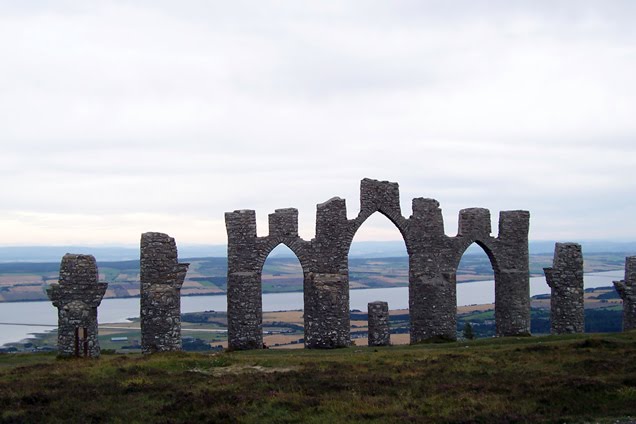
		<description><![CDATA[<p>On a hill overlooking the Cromarty Firth is a striking, most un-highland monument. It is a replica of the gates of Negapatam, a port in Madras (now Chennai) in South East India. Negapatam was originally a Dutch colony, but it was won by the British in 1781. Responsible for this success was Sir Hector Munro, [&#8230;]</p>
<p>The post <a rel="nofollow" href="http://109.74.200.198/the-fyrish-monument/">The Fyrish Monument</a> appeared first on <a rel="nofollow" href="http://109.74.200.198">ScotClans | Scottish Clans</a>.</p>
]]></description>
				<content:encoded><![CDATA[<div id="attachment_39153" class="wp-caption aligncenter" style="width: 646px"><a href="/wp-content/uploads/2011/06/fyrish.jpg" data-lightboxplus="lightbox[2901]" title="The Fyrish Monument"><img class="size-full wp-image-39153" alt="The Fyrish Monument" src="/wp-content/uploads/2011/06/fyrish.jpg" width="636" height="424" /></a><p class="wp-caption-text">The Fyrish Monument</p></div>
<p>On a hill overlooking the Cromarty Firth is a striking, most un-highland monument. It is a replica of the gates of Negapatam, a port in Madras (now Chennai) in South East India. Negapatam was originally a Dutch colony, but it was won by the British in 1781.</p>
<p>Responsible for this success was Sir Hector <a href="/scottish-clans/clan-munro/" target="_blank">Munro</a>, 8th of Novar (1726 &#8211; 1805) who won fame and fortune as a British Army Officer in India. When he retired to Scotland in 1782 he found that in the midst of the Highland Clearances many Munros and others in the area were unemployed and hungry, so he paid them all to carry stones to the top of Cnoc Fyrish (land the Munros obtained from the <a href="http://www.scotclans.com/scottish-clans/clan-keith/" target="_blank">Keiths</a> in 1589) where the monument to celebrate his triumph was erected. There is a myth that Sir Hector, desperate to be able to provide more work for these people, that he took all the stones back down the hill in order to be able to pay the men to do the job again.</p>
<p>Tragically, Sir Hector&#8217;s two sons were both killed in India, one by a tiger and one by a shark in the Bay of Bengal and the estate passed to his daughter whose descendants still own it.</p>
<p>Sir Hector&#8217;s nephew, Hugh <a href="http://www.scotclans.com/scottish-clans/clan-anderson/" target="_blank">Anderson</a> <a href="http://www.scotclans.com/scottish-clans/clan-johnstone/" target="_blank">Johnstone</a> Munro of Novar was one of the most notable art collectors of his day and a close friend of the English artist J. M. W. Turner. Munro eventually owned fifteen oil paintings by Turner and one hundred and nine of his water colours. One of his favourites, &#8216;Modern Rome &#8211; Campo Vaccino&#8217; was sold by Munro&#8217;s heirs in 1878 to Archibald <a href="http://www.scotclans.com/scottish-clans/clan-primrose/" target="_blank">Primrose</a>, 5th Earl of Roseberry (and future Prime Minister) for the astonishing price (at that time) of 4,450 guineas. It later went under the hammer recently for the second time in a Sotheby&#8217;s sale in London with an estimate of £12-18 million.</p>
<p>The post <a rel="nofollow" href="http://109.74.200.198/the-fyrish-monument/">The Fyrish Monument</a> appeared first on <a rel="nofollow" href="http://109.74.200.198">ScotClans | Scottish Clans</a>.</p>
]]></content:encoded>
			<wfw:commentRss>http://109.74.200.198/the-fyrish-monument/feed/</wfw:commentRss>
		<slash:comments>2</slash:comments>
		</item>
		<item>
		<title>The Maxwell Johnstone Feud-The Theft of Ane Black Horse and the Aftermath</title>
		<link>http://109.74.200.198/the-maxwell-johnstone-feud-the-theft-of-ane-black-horse-and-the-aftermath/</link>
		<comments>http://109.74.200.198/the-maxwell-johnstone-feud-the-theft-of-ane-black-horse-and-the-aftermath/#comments</comments>
		<pubDate>Wed, 30 Dec 2009 10:03:31 +0000</pubDate>
		<dc:creator>tommoss</dc:creator>
				<category><![CDATA[CLANS - Big List of Scottish Clans]]></category>
		<category><![CDATA[James VI]]></category>
		<category><![CDATA[Johnstone]]></category>
		<category><![CDATA[Maxwell]]></category>
		<category><![CDATA[Annandale]]></category>
		<category><![CDATA[Border Reivers]]></category>
		<category><![CDATA[Langholm]]></category>
		<category><![CDATA[Lochwood Tower]]></category>

		<guid isPermaLink="false">http://www.scotclans.com/bletherskite/?p=1606</guid>
		<description><![CDATA[<p>By 1593 the feud that had existed between the Maxwells and the Johnstones, the two most powerful families in south-west Scotland, was to reach its zenith. The feud was long-standing as it had existed for over a century. Whilst the culmination of the feud would result in the Battle of Dryfe Sands which has already [&#8230;]</p>
<p>The post <a rel="nofollow" href="http://109.74.200.198/the-maxwell-johnstone-feud-the-theft-of-ane-black-horse-and-the-aftermath/">The Maxwell Johnstone Feud-The Theft of Ane Black Horse and the Aftermath</a> appeared first on <a rel="nofollow" href="http://109.74.200.198">ScotClans | Scottish Clans</a>.</p>
]]></description>
				<content:encoded><![CDATA[<p>By 1593 the feud that had existed between the <a href="/scottish-clans/clan-maxwell/">Maxwells</a> and the <a href="http://www.scotclans.com/scottish-clans/clan-johnstone/">Johnstones</a>, the two most powerful families in south-west Scotland, was to reach its zenith. The feud was long-standing as it had existed for over a century.</p>
<p>Whilst the culmination of the feud would result in the Battle of Dryfe Sands which has already been well recorded in these articles, it is more than interesting to consider the events which would lead up to the battle, the biggest family &#8216;set to&#8217; in British history.</p>
<div id="attachment_1607" class="wp-caption alignnone" style="width: 310px"><a href="http://www.letsbuyscottish.com/wp-content/uploads/2009/12/lockwood-tower1.jpg" data-lightboxplus="lightbox[1606]" title="The Maxwell Johnstone Feud-The Theft of Ane Black Horse and the Aftermath"><img class="size-medium wp-image-1607" alt="THE FORLORN REMAINS OF LOCHWOOD TOWER. HOME OF THE JOHNSTONES." src="http://www.letsbuyscottish.com/wp-content/uploads/2009/12/lockwood-tower1-300x212.jpg" width="300" height="212" /></a><p class="wp-caption-text">THE FORLORN REMAINS OF LOCHWOOD TOWER. HOME OF THE JOHNSTONES.</p></div>
<p>The most powerful position in the Border Country during the turbulent times of the <a href="http://www.reivershistory.co.uk">Border Reiver </a>was that of March <a href="http://www.scotclans.com/the-wardens-of-the-marches/">Warden</a>. In the Scottish south-west it was a post which brought a spurious legality to the nefarious activities of the Maxwells and Johstones who vied with each other for decades to rule supreme in the Scottish West March.</p>
<p>The role of Warden was consigned on a too frequent basis from one to the other of the great Border warlords, Maxwell and Johnstone with the result that the Scottish south-west experienced nothing but upheaval, death and mayhem.</p>
<p>At one time, when <a href="/scotland/kings-queens/1567-james6/">the King</a> appointed a Johnstone, the Maxwell Laird told his clan and followers to ignore the dictates of the new Warden. At another a Johnstone laird died, it is said, heartbroken that yet again Maxwell was to take the role.</p>
<p>There are thus many recorded instances of the hatred that existed between the two families during the sixteenth century but none would compare with the events that unfolded from the stealing of &#8216;ane black horse&#8217;.</p>
<p>In 1593 a small party of Johnstones, five in all, made their way to the head of Nithsdale in the twilight of a July evening, to the <a href="/scottish-clans/clan-crichton/">Crichton</a> stronghold there, and stole a black mare from the stables. The theft was witnessed by Lord Crichton and his followers who immediately pursued the Johnstone raiders.</p>
<p>Whilst four of the five Johnstones easily evaded pursuit, their trustworthy nags more than a match for the uneven and rocky ground which confronted them in their descent down the valley, one, known as the &#8216;Galliard&#8217;, not content with stealing the black mare, had determined to ride it home to Wamphrey in Annandale. He little knew that the fine looking beast was partially blind and that it would stumble and fret and be unsure of its footing as he spurred it into action to distance himself from the chase.</p>
<p>He was soon ridden down, bound to his horse, and conveyed to the nearest tree where he was hanged without any ceremony.</p>
<p>The other four Johnstones, hiding nearby, witness to the summary justice and now led by Willie of Kirkhill, vowed vengeance for the death of one of their own.</p>
<p>Within a short time, without informing their leader, James Johnstone of Dunskellie, they had raided Crichton lands, burned farms and villages, stolen insight (household and farming gear) and murdered fifteen of the Crichton clansmen. The offenders then went into hiding, miles from their homelands of Wamphrey.</p>
<p>Lord Crichton, well aware of both the advantages and limitations of the Border Law, sought redress through advances to his March Warden John, Lord Maxwell.</p>
<p>Sir James Johnstone, holder of a special commission from the King for exacting justice among his own clan, vowed to try his recalcitrant kinsmen himself. He refused to hand them over to the Maxwells.</p>
<p>Though Maxwell had previously been keen to see an end to the Johnstones of Annandale, he was reluctant to act without due consideration of the amity that now existed between the two clans. Before the present trouble it seemed that their differences would be resolved thus he called for time to seriously consider the matter.</p>
<p>Crichton was infuriated at the dalliance and journeyed to Edinburgh to petition the King, James VI. He well knew of James&#8217; penchant for prevarication, and seizing the issue with both hands, he advertised the crimes of the Johnstone clan in a novel way to the common folk of Edinburgh.</p>
<p>He spoke loudly and vehemently at the Mercat Cross, inviting the populace to listen to his plea for justice. Moreover, within his followers from Sanquar, were the wives and girl friends of the fifteen men who had been murdered in the Johnstone raids on his lands in reprisal for the hanging of the &#8216;Galliard&#8217;. They brought out the blood-stained sarks (shirts) of the dead ones and paraded them up to the castle and back to Holyrood House. By the time they arrived there, many of the Edinburgh folk had joined the throng. All bayed for justice.</p>
<p>James VI was now quick to act and a proclamation at the Mercat Cross seemed to seal the fate of Sir James Johnstone. The King demanded that Johnstone hand himself over to Maxwell before trial in Edinburgh. Should he refuse to be taken then Maxwell was given a free hand to use what force he saw fit.</p>
<p>Matters took a new turn when the Lairds of Closeburn, Lag, Drumlanrig and the Crichtons offered to be bonded to Maxwell in &#8216;manrent&#8217; , in effect become his vassals. They were prepared to do this because, whilst outwardly throwing their force behind Maxwell and thus adding to his already almost omnipotent hold on the south-west of Scotland , they, themselves, wished to see an end to all the <a href="http://www.scotclans.com/scottish-clans/clan-johnstone/">Johnstones</a> of Annandale.</p>
<p><a href="/scottish-clans/clan-maxwell/">Maxwell</a> signed the deeds of manrent yet was not happy with his decision.</p>
<div id="attachment_1608" class="wp-caption alignnone" style="width: 310px"><a href="http://www.letsbuyscottish.com/wp-content/uploads/2009/12/cavelock-castle1.jpg" data-lightboxplus="lightbox[1606]" title="The Maxwell Johnstone Feud-The Theft of Ane Black Horse and the Aftermath"><img class="size-medium wp-image-1608" alt="CAERLAVEROCK CASTLE. STRONGHOLD OF THE MAXWELLS." src="http://www.letsbuyscottish.com/wp-content/uploads/2009/12/cavelock-castle1-300x225.jpg" width="300" height="225" /></a><p class="wp-caption-text">CAERLAVEROCK CASTLE. STRONGHOLD OF THE MAXWELLS.</p></div>
<p>It was all to come to a head and lead to the Battle of Dryfe Sands when the parchment detailing the agreement between Maxwell and the scheming Lairds was found by a kitchen maid. She could not read but was entranced by the flowery writing and the magnificent colours used. Rather than burn it she took it to her uncle who recognised the name Johnstone on the parchment. Very soon it was in Sir James&#8217; hands.</p>
<p>The die was cast. The result &#8211; the humiliation of the Maxwells at the ensuing battle. The story was not to end with Dryfe Sands in 1593.</p>
<p>Fifteen years later in 1608, the son of the John, Lord Maxwell, who was to die at Dryfe Sands held out the hand of friendship to Sir James Johnstone, still at that time, head of the clan, and requested that the latter meet him to resolve their differences.</p>
<p>There were only four men present; Maxwell, Johnstone and a servant of each. The servants drew aside whilst Maxwell and Johnstone talked of how to overcome the animosity which presided over the two clans.</p>
<p>All of a sudden the two servants started to argue and Johnstone walked towards them to intervene in their differences. As he moved he had his back to Maxwell who pulled a pistol from beneath his cloak and shot Johnstone twice in the back. He fell dead.</p>
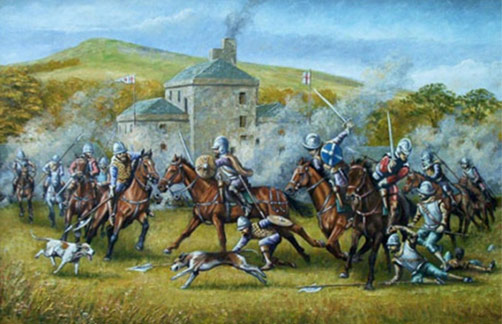
<div id="attachment_38943" class="wp-caption aligncenter" style="width: 512px"><a href="/wp-content/uploads/2009/12/border-reivers11.jpg" data-lightboxplus="lightbox[1606]" title="The Maxwell Johnstone Feud-The Theft of Ane Black Horse and the Aftermath"><img class="size-full wp-image-38943" alt="BORDER REIVERS AT LANGHOLM CASTLE. (Painting courtesy of Bill Ewart of Langholm.)" src="/wp-content/uploads/2009/12/border-reivers11.jpg" width="502" height="324" /></a><p class="wp-caption-text">BORDER REIVERS AT LANGHOLM CASTLE. (Painting courtesy of Bill Ewart of Langholm.)</p></div>
<p>Maxwell fled abroad. His crime was that of treason as the meeting had been convened under terms which ensured the safety of all present. In 1612 he made his way back to the north of Scotland but was recognised and reported by a near relative. He was beheaded in Edinburgh. Thus in the short space of twenty-five years, between 1587 and 1612, four of the clan leaders of the <a href="/scottish-clans/clan-maxwell/">Maxwells</a> and <a href="http://www.scotclans.com/scottish-clans/clan-johnstone/">Johnstones</a> were to die because of a clan feud which took a century to resolve.</p>
<p>The post <a rel="nofollow" href="http://109.74.200.198/the-maxwell-johnstone-feud-the-theft-of-ane-black-horse-and-the-aftermath/">The Maxwell Johnstone Feud-The Theft of Ane Black Horse and the Aftermath</a> appeared first on <a rel="nofollow" href="http://109.74.200.198">ScotClans | Scottish Clans</a>.</p>
]]></content:encoded>
			<wfw:commentRss>http://109.74.200.198/the-maxwell-johnstone-feud-the-theft-of-ane-black-horse-and-the-aftermath/feed/</wfw:commentRss>
		<slash:comments>5</slash:comments>
		</item>
		<item>
		<title>The Wardens of the Marches</title>
		<link>http://109.74.200.198/the-wardens-of-the-marches/</link>
		<comments>http://109.74.200.198/the-wardens-of-the-marches/#comments</comments>
		<pubDate>Wed, 23 Sep 2009 10:26:41 +0000</pubDate>
		<dc:creator>donald</dc:creator>
				<category><![CDATA[Bell]]></category>
		<category><![CDATA[Dixon]]></category>
		<category><![CDATA[House of Stewart]]></category>
		<category><![CDATA[Hume]]></category>
		<category><![CDATA[Irvine]]></category>
		<category><![CDATA[James VI]]></category>
		<category><![CDATA[Johnstone]]></category>
		<category><![CDATA[Kerr]]></category>
		<category><![CDATA[Scott]]></category>
		<category><![CDATA[The Borders]]></category>
		<category><![CDATA[Trotter]]></category>
		<category><![CDATA[Turnbull]]></category>
		<category><![CDATA[Border Reivers]]></category>
		<category><![CDATA[Marches]]></category>
		<category><![CDATA[Scottish Borders]]></category>

		<guid isPermaLink="false">http://www.scotclans.com/bletherskite/?p=967</guid>
		<description><![CDATA[<p>The relationship between Scotland and England wasn&#8217;t always as amicable as it is today.  From the late 13th century to the 16th century, Scotland and England were constantly at war with each other.  This created a lawless environment where crime soared, people from both sides of the border would live more like outlaws, taking advantage [&#8230;]</p>
<p>The post <a rel="nofollow" href="http://109.74.200.198/the-wardens-of-the-marches/">The Wardens of the Marches</a> appeared first on <a rel="nofollow" href="http://109.74.200.198">ScotClans | Scottish Clans</a>.</p>
]]></description>
				<content:encoded><![CDATA[<p class="MsoNormal">The relationship between Scotland and England wasn&#8217;t always as amicable as it is today.  From the late 13<sup>th</sup> century to the 16<sup>th</sup> century, Scotland and England were constantly at war with each other.  This created a lawless environment where crime soared, people from both sides of the border would live more like outlaws, taking advantage of the constant fighting.</p>
<p class="MsoNormal">In 1249 in an attempt to deal with crime an agreement was signed between both nations, a system began called the &#8216;Laws of the Marches&#8217; this was to be carried out by the &#8216;Wardens of the Marches&#8217; who were appointed by their respective monarchs.</p>
<div id="attachment_982" class="wp-caption alignnone" style="width: 408px"><a href="http://www.letsbuyscottish.com/wp-content/uploads/2009/09/marches21.jpg" data-lightboxplus="lightbox[967]" title="Borders area showing the different marches"><img class="size-full wp-image-982" title="Borders area showing the different marches" alt="Borders area showing the different marches" src="http://www.letsbuyscottish.com/wp-content/uploads/2009/09/marches21.jpg" width="398" height="302" /></a><p class="wp-caption-text">Borders area showing the different marches</p></div>
<div id="attachment_984" class="wp-caption alignleft" style="width: 130px"><a href="http://www.letsbuyscottish.com/wp-content/uploads/2009/09/robert_carey1.jpg" data-lightboxplus="lightbox[967]" title="Sir Robert Carey,  Lord Warden of the Marches"><img class="size-full wp-image-984" title="Sir Robert Carey,  Lord Warden of the Marches" alt="Sir Robert Carey,  Lord Warden of the Marches, and a contemporary of Elizabeth I and James VI." src="http://www.letsbuyscottish.com/wp-content/uploads/2009/09/robert_carey1.jpg" width="120" height="185" /></a><p class="wp-caption-text">Sir Robert Carey, Lord Warden of the Marches</p></div>
<p class="MsoNormal">The border lands on each side divided into three marches: an east, middle, and west march.  Each march had its own warden, who was responsible for the security of the area and its people Each Waarden answered to the Lord Warden. The Scottish wardens were familiar with their territories, and knew the people from the marches, and this gave them the opportunity to get involved in questionable dealings in order to further their position. However, the English wardens were not as familiar with the area and the ways of the Borderers, and often went about creating more problems than they solved when trying to administer any justice.</p>
<p class="MsoNormal">Examples of some of the families you would traditionally find on the Scottish side are: <a href="http://www.scotclans.com/scottish-clans/clan-home/">Hume</a>, <a href="http://www.scotclans.com/scottish-clans/clan-trotter/">Trotter</a>, Dixon in East March; <a href="http://www.scotclans.com/scottish-clans/clan-kerr/">Kerr</a>, <a href="http://www.scotclans.com/scottish-clans/clan-scott/">Scott</a>, <a href="http://www.scotclans.com/scottish-clans/clan-turnbull/">Turnbull</a> in Middle March; and <a href="http://www.scotclans.com/scottish-clans/clan-bell/">Bell</a>, <a href="http://www.scotclans.com/scottish-clans/clan-irvine/">Irvine</a>, <a href="http://www.scotclans.com/scottish-clans/clan-johnstone/">Johnstone</a> in West March.</p>
<div id="attachment_38936" class="wp-caption aligncenter" style="width: 524px"><a href="/wp-content/uploads/2009/09/marches13.jpg" data-lightboxplus="lightbox[967]" title="The Wardens of the Marches"><img class="size-full wp-image-38936" alt="Wardens of The March" src="/wp-content/uploads/2009/09/marches13.jpg" width="514" height="334" /></a><p class="wp-caption-text">Wardens of The March</p></div>
<p class="MsoNormal">Wardens from both sides of the border would meet monthly in peace on the day of truce. They would assess the complaints from either side, and administer the appropriate justice. The Wardens had to bear in mind that both countries valued things differently, and this created many difficulties when trying to solve these grievances. Many of the crimes would range from cattle rustling to murder.</p>
<p class="MsoNormal">To explain about how the Wardens of the Marches worked; if for example you were English, and went north of the border to Scotland and stole some cattle, it used to be quite normal to get a a pat on the back back in England, because you had committed a crime in the opposite realm.  You would go unpunished.  The purpose of the Wardens was to prevent this from happening. The Wardens were expected to talk to their foreign counterpart. So if someone went across the border to steal something, then the warden whose land was plundered would tell his counterpart, and the issue would be resolved on the day of truce. The task of solving each person&#8217;s grievance was a taxing and thankless task, which usually provided solutions that left no-one happy.</p>
<p class="MsoNormal">Those who were accused of a crime were supposedly tried by six honest Scotsmen and six honest Englishmen. However it has been said that this could never have happened because you would not have been able to find any honest men from either side of the border.</p>
<p class="MsoNormal">The &#8216;Calendar of Border Papers&#8217; has recorded a large number of complaints that were made to the Wardens of the Marches. They go into some detail as how many of these people were wronged by raiders both sides of the border. The papers are still available to read to this day.</p>
<p class="MsoNormal">By 1603 the role of Warden of the Marches became unnecessary, after the <a href="http://www.scotclans.com/scotland/scottish-history/scottish-unification/1603-union/">union of the crowns</a> when <a href="/scotland/kings-queens/1567-james6/">James VI &amp; I</a>, in his attempt to permanently put an end to the Border Reiver clans, got rid of the name &#8220;Borders&#8221; to represent that area, and renamed it the &#8220;Middle Shires&#8221;. Over the following 100 years you saw a gradual change of the borderers putting down the sword and picking up the plough.</p>
<p>The post <a rel="nofollow" href="http://109.74.200.198/the-wardens-of-the-marches/">The Wardens of the Marches</a> appeared first on <a rel="nofollow" href="http://109.74.200.198">ScotClans | Scottish Clans</a>.</p>
]]></content:encoded>
			<wfw:commentRss>http://109.74.200.198/the-wardens-of-the-marches/feed/</wfw:commentRss>
		<slash:comments>4</slash:comments>
		</item>
	</channel>
</rss>