The post St. Patrick’s Scottish Heritage appeared first on ScotClans | Scottish Clans.
]]>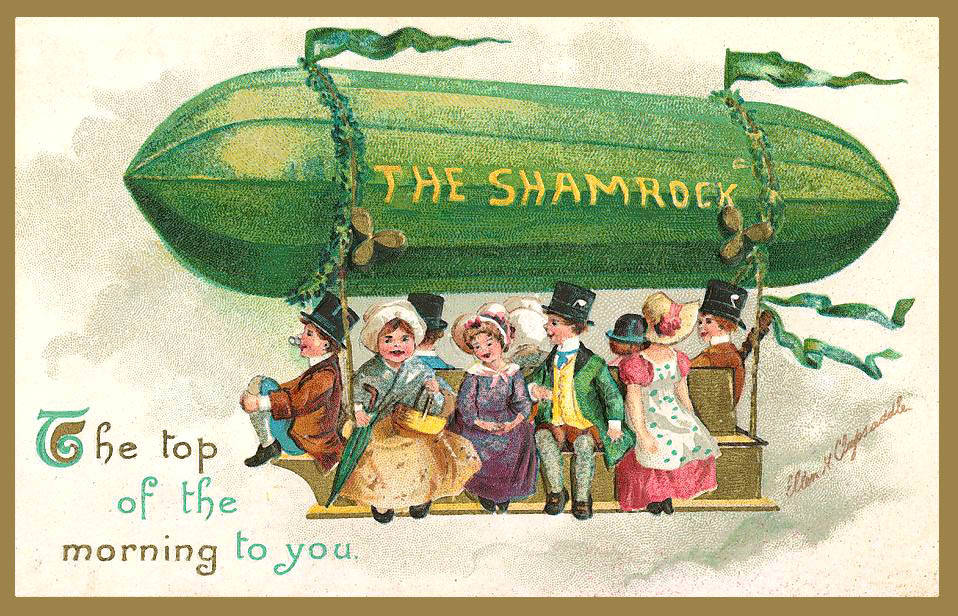 It’s the most Irish day of the year, so what better time to brush up on the history of Ireland’s well-known patron saint. As Saint Patrick’s Day is celebrated today by Irish communities in all corners of the globe, it may come as a suprise to most to learn that Saint Patrick most likely hailed from none other than Scotland.
While March 17 is the accepted date when this famous saint died, no-one actually knows the exact date Patrick was born. Much speculation leads to the year of 387 AD, during the reign of Roman Emperor Theodocius I (r.379 to 395), who, after his own conversion, converted the entirety of Roman Britian to Christianity in 380. The most accepted place of birth amongst historians is along the western coast of Britannia somewhere between the border of present day Scotland and Hadrian’s Wall.
St. Patrick was born to Calpurnius and Conchessa, a Roman couple who gave their child an appropriate Roman name: “Patricius” which means “noble of the patrician class,” referring to the class that had ruled Rome since the early Republic. His father was a Decurion, or a cavalry officer, in command of Roman soldiers, who had been originally sent to the northern area of Britannia to keep order on the outskirts of a Roman Empire in decline. The Decurion’s troops would have had to deal with the Picts of Scotland and the Celts in Ireland, who had remained unconquered by the Romans.
At the age of 14, Patrick was captured by Celtic raiders and taken to Ireland where he spent six years in slavery as a shepherd. It’s generally believed he was located throughout this time in what is now known as County Antrim, where Belfast is located. Ireland at this time was a land of Celtics and pagans, and even though he learned the Celtic way of life, he was increasingly turning to God and prayer.
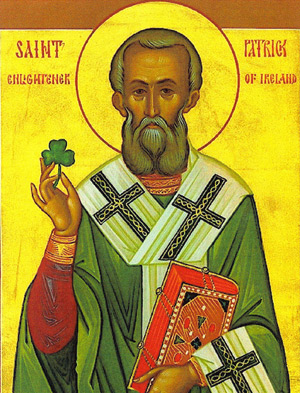
Saint Patrick
Patrick’s captivity lasted until he was twenty, when he escaped after having a dream from God in which he was told to leave Ireland by going to the coast. There he found some sailors who took him back to Scotland, where he reunited with his family. But he had another dream in which he heard the people of Ireland calling out to him, so he commenced his studies for the Priesthood and was ordained by St. Germanus, the Bishop of Auxerre, whom he had studied under for years.
Later, Patrick was ordained a bishop, and was sent to take the Gospel to Ireland. He arrived in Ireland March 25, 433, at Slane. One legend says that he met a chieftain of one of the tribes, who tried to kill Patrick. Patrick converted Dichu (the chieftain) after he was unable to move his arm until he became friendly to Patrick.
Patrick preached and converted all over Ireland for 40 years. Perhaps his most well-known legacy is the shamrock which he used to explain the Holy Trinity. After years of living in poverty, traveling and enduring much suffering he died March 17, 461, at Saul where his first Church was built. Today Saint Patrick’s Day is a national holiday in Ireland, and on the island of Montserrat in the Caribbean, which was founded by Irish refugees.
The post St. Patrick’s Scottish Heritage appeared first on ScotClans | Scottish Clans.
]]>The post The Clans of Ireland appeared first on ScotClans | Scottish Clans.
]]>
Clan Map of Ireland, 1485
This time tomorrow I’ll be jet-setting across the ditch to Ireland for a quick break with my wee brother who is currently visiting me in Edinburgh. We’ll be spending some time in Dublin and Galway, before heading up to Northern Ireland, then back home to Scotland. I’m looking forward to connecting some ancestral puzzle pieces, as well as enjoying the obligatory first pint of ‘real’ Guinness in the famed stout’s homeland.
I have to admit that even though my ancestry is Irish rather than Scottish, I’m a complete newbie when it comes to Irish clans. The extent of my knowledge is that for hundreds of years there’s been an awful lot of to-ing and fro-ing between the clans, as many Scottish and Irish clans claim ancestry from each other. Clan MacLachlan, Clan Lamont, Clan Ewen of Otter and Clan MacNeil of Barra all claim descent from Ánrothán Ua Néill, an Irish prince of the O’Neill dynasty who left Ireland for Kintyre in the 11th century. Clan Munro also emigrated to Scotland from Ireland – The 11th century chief Donald Munro was granted lands in the Highlands for services rendered to Malcolm II of Scotland in defeating the Danish Viking invasion.
Similarly the Irish Clan Sweeney is Scottish in origin – in the early 14th century, Clan Sweeney were in cahoots with the MacDougalls – bitter enemies of Robert the Bruce. In 1310 when Bruce had most of Argyll and the North Channel in his favour, Clan Sweeney attempted to reclaim their lands at Knapdale. However they failed miserably, and were forced to reestablish themselves as Gallowglass mercenary soldiers in Donegal. The Gallowglass are an interesting story in themselves – following the Scottish Wars of Independence in the late 13th and early 14th century, many Scottish clans of Norse-Gaelic origin were dispossessed of their lands for choosing the wrong side in the war. These clans ended up in Ireland, settled by Irish nobles in return for providing services as a class of elite soldiers, famed as a heavily armoured, trained aristocratic infantry to be relied upon as a strong defence for holding a position.
So you see, there really is so much clan history overlapping between Scotland and Ireland. And I haven’t even mentioned the language yet – I’m told Scottish Gaelic is an older, more conservative form of Irish Gaelic (although that’s probably a topic for another day). The clan systems in both countries have their differences, however surprisingly the modern day versions of the ancient clans seem to have organised themselves in very similar ways.
The clan system formed the basis of society in Ireland up until the 17th century. From ancient times, Irish society was organised around traditional kinship or groups, which can trace their origins to larger pre-surname population groupings such as Uí Briúin in Connacht, Eóghanachta and Dál gCais in Munster, Uí Neill in Ulster, and Fir Domnann in Leinster. Underneath each larger grouping were various septs, who through war and politics became more powerful than others and were accorded the status of royalty in Gaelic Ireland. The largely symbolic role of High King of Ireland rotated amongst the leaders of these royal clans. Like the Scottish clans, the chief of each Irish clan was responsible for maintaining and protecting their clan and the property, and the clan was composed of those who were related by blood as well as those who were adopted or fostered into the clan.

Siege of Kinsale Battle Map
The early 17th century marked a huge turning point in clan history in Ireland. The Siege of Kinsale was a three month battle ending on 3rd January 1602 that is kind of like Ireland’s version of Culloden. Kinsale was the ultimate battle in Tudor England’s conquest of Ireland, campaigned by Aodh Mór Ó Néill, Aodh Rua Ó Dónaill and other Irish clan leaders against English rule. Just like the Jacobites at Culloden, the Irish were defeated, and the clan system was effectively and decisively stamped out. The Tudor re-conquest marked the destruction of Gaelic aristocracy, and when the senior Gaelic Chiefs of Ulster left Ireland in 1607 to unsuccessfully recruit support in continental Europe, the English authorities in Dublin were able to establish real control over Ireland for the first time.
Despite this almost eradication of the clans, followed by the subsequent loss of ancestral lands and forced and willing emigration, today the clans of Scotland and Ireland still employ a huge part of each countries’ culture. In the 1940s Edward MacLysaght, the first Chief Herald of Ireland, drew up a list of 243 Irish clans and began to publish a number of works on the history and background of Irish families. Modern Irish clans were reformed in the latter half of the twentieth century and in 1991 sixteen of the nineteen bloodline chiefs were received by the President of Ireland, Dr. Mary Robinson. This was the first time in modern history that the bloodline chieftains of Ireland had gathered to form a new Council of Irish chiefs, established by the President to bring together the Chiefs of the Gaelic nobility of Ireland as recognised by the Chief Herald. The only other recorded meeting of the Irish chiefs was before the Siege of Kinsale.
In January 2013 the Standing Council of Irish Chiefs and Chieftains signed a Memorandum of Understanding with Finte na hÉireann – an authentication and registration body for the Clans of Ireland. This historic event took place at a meeting of the board on 26 January 2013 at Christ Church Cathedral in Dublin. The MOU was signed for Clans of Ireland by Dr. Michael J.S. Egan, Cathaoirleach and for the Standing Council by Sir Malcolm MacGregor of MacGregor. As part of the agreement both organisations agree to recognise each other’s authority over clans and to support each other’s respective goals, working together well into the 21st century just as the clans of each country had (allbeit in a less bloody way) for hundreds of years before.
The post The Clans of Ireland appeared first on ScotClans | Scottish Clans.
]]>