The post Airline Reveals Tartan-Clad Plane appeared first on ScotClans | Scottish Clans.
]]>
Cabin crew sport tartan scarves in front of easyJet’s new tartan-clad plane
A distinctive orange and black tartan-clad aircraft has been unveiled to mark a new early morning flight from Inverness to London Gatwick. Budget airline EasyJet launched the tartan today entitled “Highland aircraft” on its Airbus A319 aircraft, alongside a kilt and scarf sported by cabin crew on its inaugural 6:40am service.
However the kilt is not set to become part of regular cabin crew uniforms, and will only be used for special occasions. The design is the first tartan to be officially registered by the Scottish Register of Tartans since records began six years ago.
Reaction to the tartan has been mixed, with some design experts calling the launch an appropriate way for the airline to mark its commitment to Scotland. Design expert Susanna Freedman, head of brand at design firm Emperor said: “Tartan is such an iconic textile, and employed with consideration – as part of an overall design scheme – can add real impact and authenticity.
“I hope we see a ‘less is more’ approach – or innovative execution in its use – that fits with easyJet’s brand positioning, rather than it appearing as a superficial ‘bolt on’ to current easyJet apparel.”
Richard Havers, a former British Caledonian general manager for Europe, admires easyJet’s idea but not its design. Tartan-clad cabin crew is most famously associated with now-defunct British Caledonian and its predecessor Caledonia Airways. Staff wore a range of tartans from the 1960s until its takeover by British Airways in 1988.
He said: “It’s quite a clever idea, but a bit of a dubious tartan. Making up a tartan is a cheap trick. Sir Adam Thomson [British Caledonian’s founder and chairman] would be turning in his grave.
“British Caledonian used about 30 tartans, but none were designed for the airline, that would have been against its ethos. It would have felt it was not the right thing to do.”
Mr Havers said both cabin crew and check-in staff had chosen which tartan to wear.
He added: “Most based their choice on their hair colour, with blondes picking green tartans and those with dark hair going for red ones.”
The former airline executive said tartan had been part of British Caledonian’s brand image, which was the “total antithesis” to easyJet’s. He said: “It was an era when flying was more glamorous – passengers wore jackets and ties.”
Mr Havers said it was a “pity” easyJet appeared to be using the tartan as a publicity stunt.
The post Airline Reveals Tartan-Clad Plane appeared first on ScotClans | Scottish Clans.
]]>The post Talking Folk with The Elephant Sessions appeared first on ScotClans | Scottish Clans.
]]>
The Elephant Sessions performing at Northern Roots 2013. Photo by Roddy Mackenzie.
Hailing from Inverness, The Elephant Sessions are an upcoming act set to make waves on the traditional Scottish music scene this summer. I caught them last year at a gig in Edinburgh, where they blasted through a set of the grooviest folk music I’ve ever heard. They’re currently recording their debut album off the back of a successful online fundraising campaign, so I recently caught up with guitarist Mark Bruce to find out more:
Describe the members of the Elephant Sessions and the instruments you play:
The Elephant Sessions are:
- Euan Smillie – Fiddle
- Greg Barry – Drums
- Alasdair Taylor – Mandolin
- Seth Tinsley – Double bass
- Mark Bruce – Guitars.
Where are you from and how did you guys meet?
We met through a mutual love of traditional music and the fact we have similar ideas of how the folk/traditional genre can be pushed by adding influences from other genres. Four of us hail from the Highlands of Scotland, and Seth is from Northumberland.
You’re all excellent musicians – I was wondering how long you’ve been playing and how you got into this type of music?
We have all been playing traditional music for many years, we all got into it through things such as the Feisan movement and through traditional music groups in school. We are very lucky in the Highlands of Scotland that we are so immersed in traditional melodies and culture.
The thing that struck me the most about your band is the way you combine traditional folk music with contemporary genres such as funk – what makes your music so unique, and what kinds of things is the band influenced by?
I think what may potentially make our music a bit different is the fact the we self write all our melodies and we aren’t afraid to try and push the boundaries of where we can take it – I think not being afraid to fail is very important when you’re trying to do something a bit unique. We take influences from a wide range of music, everything from Gaelic singer Julie Fowlis to the Red Hot Chili Peppers.
I saw you perform last year in Edinburgh, and you definitely got the crowd moving for a subdued Wednesday night! Is this what usually happens at an Elephant Sessions gig?
Yeah, we usually try and noise the crowd up a bit. Basically, whether its an 11am or an 11pm festival slot we will try and give it all we have and hopefully we get everyone dancing
What’s been your standout gig so far?
I think our highlight so far has probably been opening up for the Peatbog Faeries at The 02 Academy in Newcastle. They have been a band we have all looked up to from early on in our musical lives and it was an honour to get the chance to do that.
I’m a complete newbie to traditional folk music – can you explain to me what it’s called when a song suddenly changes halfway through? Is this a round? Set? Jig? Help!
Erm, the best way to maybe explain this is usually a ‘set’ comprises of more than one tune. We try and arrange the tunes so there is a tempo change, it can be fast or slow depending on where we are trying to take the listener. A classic traditional music change would be something like a Strathspey into a reel, effectively this doubles the beat. The difference between a jig and a reel is, in a jig the notes are grouped in 3 and in a reel notes are grouped in 4. We hope this makes a little bit of sense.

The Elephant Sessions
You’ve just finished a successful Kickstarter campaign for the funding of your debut album – how did it go?
Kickstarter is a company that allows you to set up a page where the public can donate money to help fund a project. We plan to record our debut album with the money we raise from it, we are very excited!
Comparing the music that you’re currently performing with the music available on your EP, do you think it’s different at all? Where do you hope to take the band?
I think we ‘grew up’ a bit from what we were playing on the EP to what we are playing now, we have become more confident in our ideas and we think we are writing better material. We hope!
What’s the most exciting thing happening in Scottish folk at the moment?
We all really love Adam Holmes’ debut album ‘Heirs and Graces’. He is writing some beautiful songs and he has an amazing band. Definitely worth checking out.
Finally, what are your plans for 2014?
To release our album and hopefully do some festivals in the summer and tour Britain in October.
You can hear more by the Elephant Sessions at www.elephantsessions.com or check them out on Facebook.
The post Talking Folk with The Elephant Sessions appeared first on ScotClans | Scottish Clans.
]]>The post Map Reveals Scots Modern-Day Surnames appeared first on ScotClans | Scottish Clans.
]]>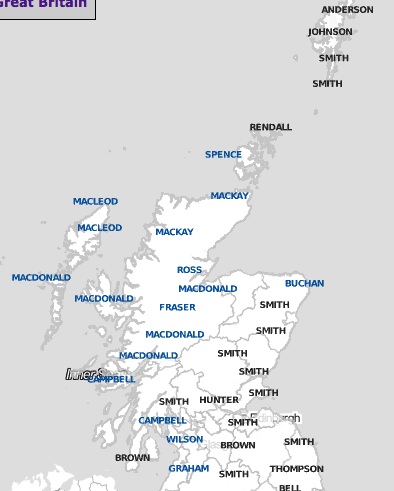
The Uncertainty of Identity project maps Great Britain’s most popular surnames by area.
A map of Great Britain’s most popular surnames shows the dominance that clan areas still hold in Scotland, while other areas show the effects of modern-day immigration. Created by experts from three English Universities, Uncertainty of Identity uses surnames listed on the electoral roll to find the three most popular names in each electoral ward.
Mackay and Sutherland are the most popular names in the North Highlands, echoing the ancient territories and stronghold of the clans. Mackenzie, Fraser and Ross are the most popular in the area North of Inverness, while MacLeod and MacDonald dominate the Western Isles – data that directly corresponds with clan territory maps.
In the Northern Isles Halcrow, Drever and Flett survive as the third most common surnames, while Shetland still boasts a diverse mix of Spences, Rendalls and Sinclairs. Carole Hough, professor of onomastics – the study of name origins – at Glasgow University, said the surnames of Orkney and Shetland differ from much of mainland Scotland due to naming traditions.
“Shetland and Orkney are unique in that they have a much higher proportion of surnames from local place names, which makes them quite distinctive. Place names tend to cluster around their origin, which is surprising given how mobile people are,” she added
The English derived surname Smith is the most dominant across the whole of Great Britain with a considerable stronghold in the lowlands and east of Scotland. Modern-day immigration shows in areas such a Glasgow’s Pollokshield’s East, with Ahmed, Ali and Singh popular surnames. Jones, Davies and Williams dominate in Wales.
Looking to the future, a resurgence in the popularity of traditional Scottish forenames in recent years is likely to combat Anglicisation, said Hough.
“Far more Gaelic and Celtic-derived personal names are being chosen by parents in Scotland, which can be a way of affirming national identity,” she says. “Gaelic-derived forenames that are in the top 100 names in Scotland at the moment include Aiden, Callum and Finlay. Cameron is originally a clan name, and Lewis, Evan and Isla are all place names.”
You can view a map of Scotland’s most popular surnames at Tartan Footprint.
The post Map Reveals Scots Modern-Day Surnames appeared first on ScotClans | Scottish Clans.
]]>The post The Battle of Clachnaharry appeared first on ScotClans | Scottish Clans.
]]>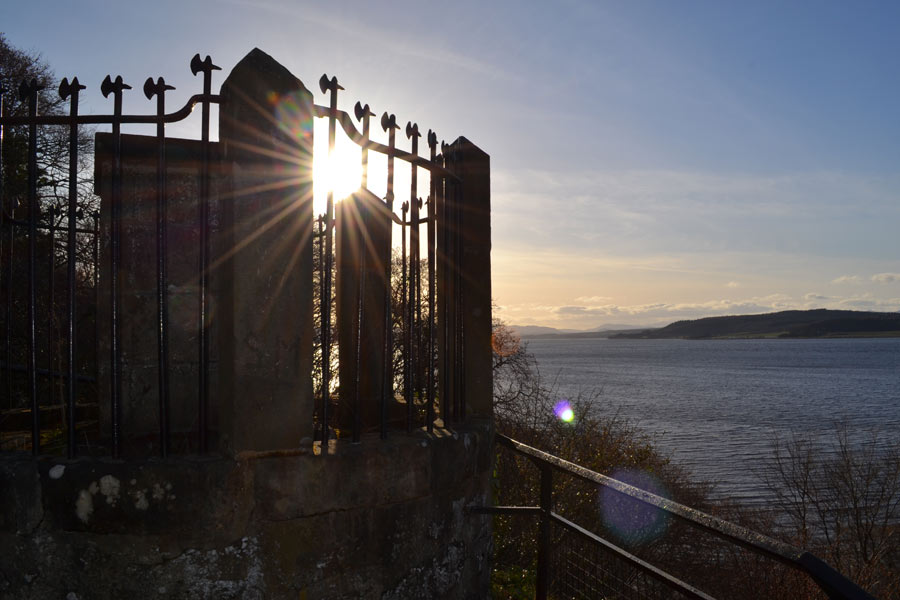
Clachnaharry Monument overlooking the Beauly Firth
Perched atop a hill overlooking the Beauly Firth in Inverness, the Clachnaharry Monument commemorates a particularly fierce battle between Clan Munro and Clan Chattan that occurred in 1454. After a day of sunbathing (in April) in the Highlands, I decided to take advantage of the unusually warm evening and take a walk out to the monument.
Clachnaharry is situated about 2 miles from Inverness and was once a bustling fishing village. The village takes its name from the Gaelic Clach na h-Aire (Stone of the Watch), referring to an irregular stone at the top of the hill used as a look out post to spot approaching unfriendly clans from the north. Just past the high street a little path leads through some woods and up a hill to where the monument is located, also providing a spectacular view of the Beauly Firth, the bottom of the Black Isle and Ben Wyvis.
Largely thought to have occurred in 1454, the battle came about when the Munros were returning home to Easter Ross through Chattan territory following a cattle raid in Perthshire. The Munros were led by John Munro Tutor of Foulis who refused to pay the customary tax on their plunder. This safe passage fee, or ‘road collop’ was often paid in the form of a number of cattle. A dispute broke out over the amount and when no agreement could be reached the Chattans gravely insulted the Munros by cutting the tails off of their horses. The Munros left to travel north, having sent their spoils ahead, but the Chattans caught up and ambushed them at Clachnaharry.
In the fight which followed many died including the chief of Clan Chattan. John Munro was left for dead on the battlefield, but was found by an old woman of the Fraser clan who nursed him back to health. Lord Lovat, chief of the Frasers, returned John to Foulis, however his hand was mutilated in the battle. He became known as Iain Bac-lambach (John the Lame-Handed). This act signaled the start of an enduring friendship between the Munro and Fraser clans.

The monument in better days
The monument was built in 1821 by Major Hugh Robert Duff of Muirtown and originally included a figure on top of a 8m column. Unfortunately the figure fell off in a gale in 1934 and the column was blown down during a severe storm in 1954, leaving only the stump that remains today. Each side of the monument reads the two clan names, facing their respective territories. The Latin inscription is thought to read “Between these high, red rocks their bones are collected”. In recent years the monument was refurbished after it was vandalised and overgrown with foliage.
The monument is also conveniently located across the road from the Clachnaharry Inn, which provided the perfect cure (in cool, refreshing pint form) to the sunburn I received earlier in the day. You can click any of the pictures below to enlarge.


The post The Battle of Clachnaharry appeared first on ScotClans | Scottish Clans.
]]>The post Terrorising Owl at Large in Inverness appeared first on ScotClans | Scottish Clans.
]]>
Feathered Foe Remains on the Loose
Here’s a strange case of life imitating art from Inverness, with news just in that rivals Hitchcock’s 1963 horror The Birds:
A giant Eagle Owl is to blame for attacks on pedestrians over the last week on Castle Street. Police have warned residents to keep clear of the giant bird of prey, who has taken up residences upon the roof of a kilt shop and in the backyard of a local pub.
Two men have reported attacks to the police, after being attacked within minutes of each other on January 19. John Mackay of North Kessick was knocked out and left lying in a pool of blood after the 2-ft high bird swooped on him and left him with a 3-inch cut in his head. “I thought I had been hit on the back of my head by a brick. I didn’t hear a thing, not even the flap of a wing. It was only when I stumbled back on to my feet and I saw the owl perched on top of a van that I then knew what had happened. I couldn’t believe how much blood there was. People were asking for more towels. I went into shock straight away. It’s not the kind of thing you expect to happen on a Saturday night.”
Moments earlier, in efforts to fend off the feathered foe, Noel Hill of Inverness engaged in a fist fight with the bird. “It hit me from behind. I never heard it coming and it hit me in the head. It flew up to the Redcliffe Hotel and then flew down at me again. I saw it coming at me for the second time and I had to beat it off with my fists.”
It is believed the owl, with a wingspan of 6-ft, has escaped from an aviary or been released into the wild by an owner not willing to pay for its expensive upkeep. Despite warnings crowds are converging on Castle Street, with eager bird spotters hoping to catch a glimpse of the winged terror.
We’ll keep you updated on any further developments in this case.
The post Terrorising Owl at Large in Inverness appeared first on ScotClans | Scottish Clans.
]]>The post Prophecy – Scottish Second Sight appeared first on ScotClans | Scottish Clans.
]]>
Easily the best known and most popular of Highland prophets is Kenneth Mackenzie, The Brahan Seer; who may (or may not) have lived around 400 years ago to the north and west of Inverness. The story goes that his mother cut a deal with the spirit of a Danish princess, and in return for letting the wraith return to her grave the power of second sight would be gifted upon her child. In the morning Kenneth awoke to find a stone with a hole cut through the middle next to his bed. On looking through the stone he was engulfed with visions, good and bad, of a future yet to come. In time he would learn to control this gift and make numerous predictions for his own people and for the Highlands as a whole.

The Brahan Seer
Although he is most famous for predicting the downfall of his own clan, the Mackenzies of Seaforth, with a dramatic vision of deaf chiefs, white-hooded lassies and tragedy; he also foresaw the destinies of many other clans as well, for example – “When the big-thumbed sheriff officer and the blind man of the twenty-four fingers shall meet, then MacNeil of Barra shall prepare for a flitting“. It is known that this prophecy came true in 1838 when the last of the MacNeils of Barra left Kisimul Castle behind bankrupt (a ‘flitting’ in Scotland is to move house). Most of his predictions follow this vein, with many being very specific. Many of the prophecies are about battles or hardship ahead, and often a little macabre: “The day will come when the raven will drink its three fills of the blood of Clan Donald on top of the Hills of Minaraidh in Lewis“; ravens drinking the blood is a recurring theme. He would also foresee the changes that ravaged the Highlands during the Clearances of the 18th and 19th century that began in Ross-shire.
“The day will come when there will be a road through the hills of Ross-shire from sea to sea, and a bridge on every stream. Then the people of the land will degenerate and grow weak as their country improves . . . and the clansmen will flee from their native country before an army of sheep” Anyone who knows something of the history of the Highlands will know just how much that sadly came to pass, with sheep replacing men, and whole glens emptied of their people by a brutal aristocracy and their agents. Still, the seer goes on in another vision: “the people will emigrate to islands now unknown in the boundless oceans, after which the deer and other wild animals shall be exterminated by horrid Black Rains. The people will then return and take undisturbed possession of the lands of their ancestors.” This is a reference to the mass emigration from Scotland in the 19th century; but we still await the horrid black rain, and this is one of the most feared predictions in the Highlands still to be fulfilled.
The Brahan Seer wasn’t the only prophet to foretell the Clearances, and considering the social and personal upheavals it caused it’s no wonder. In the 1640s on the shores of Loch Tay in Highland Perthshire lived a seer known as the ‘Lady of Lawers’. It is likely she was Mary Campbell who married John Stewart of Appin, and lived at the big house in the now deserted village of Lawers. She too saw the coming of the sheep and the evicting of the people: “The land will first be sifted and then riddled of its people, and the jaw of the sheep will drive the plough from the ground. The homes on Loch Tay shall become so scarce that a cock crowing will not be heard from one to the other.” Today, the once heavily cultivated slopes of Loch Tay are now almost exclusively put over to sheep grazing.
The landlord was the Marquess of Breadalbane, who’s estate in the 19th century was nearly half a million acres; and he was instrumental in evicting at least 3000 people from Lochtayside during the worst excesses of the Clearances. Not that his family would be spared from the foresight of the Lady of Lawers either: “The day will come when the Campbells of Breadalbane will have a thousand rents, then one rent, then no rents at all; what was put together in hides shall be rent asunder in laces. The last laird will pass over Glenogle with a grey pony leaving nothing behind.” In the 1920s the estate fell into a sharp decline with mounting debts and by the 30s it was bust. Countess Breadalbane sold the last of the estate in 1948 and left the area in a trap pulled by a grey pony.

Breadalbane – Hard hit by the Clearances
Sometimes landowners made the mistake of evicting seers as well, and one such soothsayer forcibly removed from Jura in the early 1700s left her Campbell landlord with an ominous prediction: “The last Campbell laird of Jura will be blind in one eye, and will leave the island with all of his belongings tied to a cart pulled by a lone white horse.” This was well known to the islanders, and finally came true in 1938 when Charles Campbell, who’d been blinded in the First World War fell on hard times, sold up and left the island behind with nothing but a cart and horse. Today, the Isle of Jura distillery produces a whisky commemorating the story, called “Prophecy”
Not all prophecies are doom and gloom; some have a more positive aspect. For example it is well known to the Clan Cameron that “As long as there’s snow on Ben Nevis the Camerons will command Locheil“. At 4409ft, Ben Nevis is the highest mountain in the British isles and looms high and large over the Cameron estates of Locheil; being so high the snow has only melted six times in the last 120 years, only to remain the next year. The Camerons I think are safe. But, eventually we may all be doomed by the famous words of the Border prophet known as ‘Thomas the Rhymer’: “When the Cows of Gowrie come to land, the Judgement Day is near at hand.” The Cows of Gowrie are two boulders sitting in the sands of the Firth of Tay near Dundee, and it is said they move landward at about an inch a year.
The legend goes that Thomas the Rhymer, who lived in the 13th century in the village of Earlston near Melrose, was enchanted by a fairy queen dwelling deep within the Eildon Hills. He was allowed to return to the mortal world for a short time, and was granted the gift of second sight; before eventually spending eternity in the world of the fairies. The story is similar in theme to the ‘gifting’ of the power to the Brahan Seer; and the sidhe, or fairy people play a large part in old superstitions and legends in Scotland. It may be a folk-memory of an older, lost culture that had certain shamanic ritual, and thus lots of prophecies. Many people across the globe, through their own natural shrewdness and perhaps with the help of hallucinogens have been venerated in their culture as being able to divine the future. The seers are our version of this, and many people have claimed the gift, or curse, right down to the present day – it may well have its origins in our very ancient past. It certainly makes for great storytelling.
This article was written by David McNicoll, who runs Vacation Scotland – a travel company specialising in tours and vacation packages to Scotland. For more info – www.vacationscotland.biz
The post Prophecy – Scottish Second Sight appeared first on ScotClans | Scottish Clans.
]]>The post The Gaelic Gasp & The Glottal Stop appeared first on ScotClans | Scottish Clans.
]]>
From Ayrshire, the land of Robert Burns, across the Central Belt – through Glasgow, Edinburgh and Fife to Dundee – accents are variations on the Lowlands Scots Dialect. There are those who will argue that Scots is a language of its own, separate from English; and while I see this, to me it simply a tongue that developed from the same root and a variation on a theme. Even those who claim to speak it this is not what was taught to them at school. Scotland has her own independent educational system, which is broad-based, and the national curriculum imposes Maths and English as compulsory subjects to the age of 16. The English taught is that of Received Pronunciation or ‘Proper English’ (whatever that might be). Thus, ‘English’ is the written language of Scotland, despite its distinct vernacular.
Lowland Scots has several distinct features both in dialect and accent – the rolling of the Rs, and the famous Glottal Stop: “Scawe-land” rather than Scot-land, “Buh-ur” rather than but-er, and so on. The ‘helpful vowel’ or Svarabhakti is often employed – wur-um and wur-uld for worm and world. These and a large range of words unused elsewhere in the English speaking world (e.g. – ken for know; thrawn for stubborn; drouthy for thirsty; etc.) make the accent instantly recognisable – and account for the stereotype. Outwith the Central Belt, the diversity of the accent becomes even more pronounced, with striking differences in both diction and enunciation.
Perhaps the most striking of Scottish accents is that of the Doric, spoken essentially in Aberdeenshire. The term ‘Doric’ is a reference to the rough speech of the Spartan people (to Athenian ears), and came to mean ‘rustic’ or ‘rural’. One of the most noticeable differences from Lowland Scots is the use of ‘f’ instead of ‘whi’ in words like what, who (pronounced fit and fa’ respectively). Doric speakers share most of the dialectal words used further south, but have plenty others of their own – ‘louns’ for boys, and ‘queans’ for girls being well known examples.
The small village of Auldearn near Nairn is one of Scotland’s linguistic boundaries, where the Doric of the east switches to the lilt and nasal accent of the Inverness area – itself an extension of the Highland dialects of Strathspey, the Great Glen and Easter Ross. The change is not just in phonology, but in grammar and structure. In many ways the language constructs of Highland English mirror that of the Southeast of England, and the Oxbridge world. This is due to the language being first introduced and then forced upon Gaelic speakers over the course of the last 200 years, and more importantly since the Education Act (Scotland) 1872. When a new language enters an area and is systematically taught one generation on another from textbooks, then the formula tends to stick – this is the reason why Inverness is often quoted as having the ‘Best Spoken English in the World’.
As you continue west towards the Hebrides (but also in pockets like Perthshire), where Gaelic is still spoken or was until relatively recently then the English begins to adopt idiosyncrasies from the mother language; which, as a Celtic tongue is arranged in a very different way. As well as more aspiration in the speech, and grammatical constructions which mimic Gaelic, such as “I am after buying a newspaper”, there is the strange phenomenon of the ‘Gaelic Gasp’.
The ‘gasp’ is a sharp intake of breath signifying agreement, often accompanied by an ‘aye’, or a nodding of the head. This breathy acquiescence isn’t restricted to the Highlands, but can be found across the North Atlantic including the Faeroes, Iceland and Norway – which suggests a Viking origin to this linguistic oddity. It also gives us insight to the varieties of English spoken across Scotland: from the sing-song lilt of the islands to the barking gruff of the Lothians. A thousand years ago an Anglo-Saxon (or early English) language was spoken in southeast; Welsh languages dominated both the southwest and central Scotland (Briton and Pictish were part of this family); in the west, beyond the mountains the Picts of Argyll spoke Gaelic; and, in the far north Norse was spoken. Each would contribute to accents and dialects that would emerge in their areas – but why English?
In 1070 King Malcolm III married Margaret Ætheling, an Anglo-Saxon Princess fleeing the conquest of England by William of Normandy. She was a dominant woman, thorough in her religious convictions: establishing abbeys and influencing the Scottish court. She made sure that ‘English’ became the ‘natural’ language of diplomacy. Her son, David I, introduced the feudal system into Scotland – including Royal Burghs (towns with specific trading rights). The linga-franca of these new towns was English: David’s first language. The nobility followed, and by the necessity of trade, so ultimately did the farmers. Formed from a more antiquated Anglo-Saxon, this version of English would evolve into Scots. Words such as ‘kirk’ for a church, or ‘gate’ for a street hint at the older Germanic root; now lost in modern English. This accounts for the origins of the Scots dialect; where the accent differs depends on the level of Celtic/Norse influence beyond adoption.
A second revolution saw the assimilation of ‘Proper English’ – the Reformation of 1560. While a truly Scottish event, the influence of the English Reformation played a part. There, bibles were already printed in English, and while there were significant vocabulary differences, most Scots could read and understand them. The Church of Scotland decided not to bother printing bibles in the vernacular, and so from then on English became the ‘written’ expression of the language. This was cemented in 1603 when James VI of Scotland became the king of England.
In the Highlands, the bible was actually translated into Gaelic, but inroads are long in the making. The decline of Gaelic is well documented and the reasons legion; and the effect on the language remains to this day. The Gaidhealtachd, the Gaelic speaking areas of Scotland, have for a thousand years been receding against the never-ending tsunami of English. There are milestones along the way, and we should be thankful that the language exists far less thrives, in the Hebrides. The Highland line still provides a major boundary, such as Auldearn, or Dunkeld – where the age-old usage of English meets the recently taught variety in the traditional Gaelic lands. Yet, whatever the origin, whatever the accent, the Scottish dialect is vibrant and truly fascinating.
This blog was written by David McNicoll, owner of Highland Experience USA – which specialises in Vacation Packages and Tours of Scotland
Link – www.highlandexperience-usa.com
The post The Gaelic Gasp & The Glottal Stop appeared first on ScotClans | Scottish Clans.
]]>