The post Ice Age Scotland appeared first on ScotClans | Scottish Clans.
]]>The Ice Age was more than just a never ending cold, or ice building up and flowing across the landscape; it carved that very landscape, obliterating what went before and providing a new canvass for nature to re-conquer once the glaciers finally melted. The geology of Scotland in places is billions of years old, and for the most part hundreds of millions of years old; but it has been sculpted over the last two million by repeated glacial episodes, the last of which began around 30,000 years ago and finally ended 10,000 years ago. But, what causes these events and what legacy have they left us?
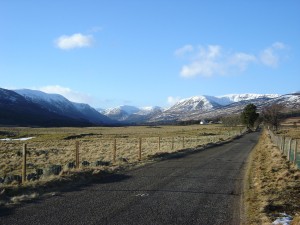
Glen Doll in Angus – A landscape carved by Ice
The principal reasons that the earth experiences enhanced ice age events periodically are astronomical; and collectively termed the Milankovitch Cycles (named after the Serbian scientist, Milutin Milanković, who first made the connection). We assume that the planet meanders through the vastness of space in a uniform manner, fixed in place: but not so. Over time periods we cannot comprehend the earth wobbles about and shifts its patterns of orbit and rotation; and does so cyclically, repeating the pattern across the ages.
Each cycle has its extremes, and can individually trigger enhanced ice growth; but they peak at differing time intervals, and so it’s only when they click together that the results can be truly spectacular. They’re not the only factors involved, others include the strength or non-existence of the Gulf Stream, plate tectonics and mountain building, and many more – and to be honest we really don’t know how it all connects together. Still, 30,000 years ago, the Milankovitch cogwheels clicked into place and the Gulf Stream turned off; resulting in the rapid build up of ice at the poles and the southward advance of the polar front: the summer limit of pack-ice.
Initially as the polar front moved southward, Scotland experienced extremely cold winters, somewhat like Canada today; resulting in glacier ice forming in the Northwest Highlands, the Nevis Range, the Cairngorms and Lochnagar; plus winter sea ice probably reached as far as the Shetland Islands. This is colder than we’ve experienced in the last 10,000 years, but there was no respite and the mercury continued to drop. Ice ages don’t happen because of cold winters, they happen because of cold summers, where the ice and snow from the previous season doesn’t melt and it builds up, layer upon layer, until it starts flowing under its own weight towards the sea via a path of least resistance. The glaciers then pool in lower ground.
It would only take a couple of thousand years to go from small glaciers in the mountains to ice caps forming in places like Rannoch Moor, Royal Deeside and the Great Glen. Around 25,000 years ago large glaciers, the like we’d associate with Alaska today would be flowing steadily down our main valleys, to perhaps a thickness of 2000ft in the upland areas. By now there is glacier ice in the Southern Uplands, the Lake District, Yorkshire and Snowdonia; and large ice flows streaming through the Central Belt mainly towards the North Sea via Strathmore and the Forth Valley.
The glacial maximum came around 18,000 years ago, when the polar front which today is to the north of Iceland reached to Portugal. Scotland was now buried under an ice-sheet over 4000ft thick in places: akin to Greenland today; and it was small in comparison. The whole of Scandinavia was buried under a much thicker dome centered over the Baltic Sea, and North America groaned under the vast weight of the Laurentide Ice Sheet, which may have been 10,000ft thick, and was over half as big again as the Antarctic sheet today. The result of all this water locked away as ice was a severe drop in sea levels: over 400ft lower than today. The North Sea didn’t was a meadowland, grazed by mammoths and other lost fauna during the short summer season. It is possible that people followed the game on to the plains; but we also know that the population of Europe was very low, and forced into cluster ‘refuges’.
From around 18,000 years ago the earth slowly warmed again and the cogs came out of sync; and by 13,000 years ago the British ice sheet, which had stretched to the English Midlands, and covered most of Ireland had gone. The ice itself had carved out a new landscape, digging deep into the rock as it ground its way to the sea. The picturesque fjord landscape of the west coast, deep valleys like Glencoe and Glen Muick, the rounded hills of the Southern Uplands and the sharp ridges of the Cuillin of Skye: all sculpted out of the bedrock by the sheer power of the glaciers. The melting of that ice had no less a dramatic effect either.
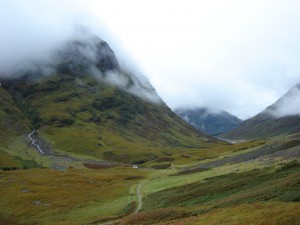
Glencoe – A typical U-Shaped valley
Most of the Highland valleys and all of the Lowlands are blanketed in debris either left directly by retreating ice, or washed out by meltwaters. Torrential flooding and reworking of sediment created terraces, gravel fans and deep, sandy deposits; in other places the retreating ice can be mapped by way of the unique landforms left behind, like the horseshoe shaped moraines dumped at the front of the glacier. Only the far northwest, where the landscape was heavily scoured, saw little deposition – giving us a glimpse of the immediate post glacial world of Scotland 13,000 years ago. But everywhere you look you will find evidence of Scotland’s Ice Age: from Edinburgh’s Royal Mile to the deep lochs of the Great Glen; and from the macro to the micro.
Global temperatures dropped again around 11,500 years ago, and there was further ice growth in the Highlands, but by 10,000 years ago the last of the glaciers had melted; and thus it has remained. A new world emerged from the grip of the big freeze, great rivers now flow where ice once ruled, and soon forests and grasslands came to dominate. The sea also rose, rapidly and to levels higher than today. This is thanks to a phenomenon where the land, having been compressed by the sheer weight of the ice, rebounds, but at a slower rate than the sea. So, relative to one another the sea reaches a certain height, and then the land slowly rises out of it. And all around our coast are archaic cliffs and raised beaches: testament to an older shoreline when sea levels were over 100ft higher. Scotland continues to rise.
For 10,000 years humankind has basked in the warmth of the current inter-glacial and flourished like never before in our history. But, eventually the Milankovitch cogwheels will click once more, and Scotland along with half the globe will be plunged again into the abyss of an Ice Age.
This article was written by David McNicoll, the owner of Vacation Scotland; a travel company specialising in tours and vacation packages to Scotland. If you are interested in exploring Scotland’s landscapes, please contact them by clicking their website – www.vacationscotland.biz
The post Ice Age Scotland appeared first on ScotClans | Scottish Clans.
]]>The post The Parallel Roads of Glen Roy appeared first on ScotClans | Scottish Clans.
]]>
Glen Roy is a narrow, steep-sided valley branching off from the wider Glen Spean about 15 miles north of Fort William and the high peaks of the Ben Nevis Range. Glen Spean in turn opens into the broad, straight and imposing Glen Mòr, or Great Glen. This geographical arrangement would have a significant bearing on the story. Curiously, Glen Roy has a ring of terraces or ‘roads’ running the entire length of the valley on one side which is then mirrored at the exact same altitude on the other. They look man-made, but are so precise in keeping their height and remain parallel to each other that some other-worldly influence seems present in the formation. There are three distinct terraces ringing the valley, one at 850ft, the next at 1066ft and the highest at 1150ft above sea-level. This uniformity and curious nature of their existence in this one valley spawned countless myths and stories.
Legend had it, they were built by the Romans to race their chariots; or perhaps by our Pictish ancestors as a running track to prove one’s manliness. Others suggested they were constructed by the legendary Fionn MacCuimhaill as an aid to hunting some mysterious beast in the mountains of Lochaber. The fairies built them as part of their ancient magic, or the Gods for us to worship; and, religion would be a major player when the real investigation started.
The Scottish Highlands are littered with large mounds; boulders in the wrong places, knows as erratics; and high terraces lining many of the straths and glens. There didn’t seem to be any natural reason or cause for this, or indeed why the landscape should be the shape it is. Until the middle of the 19th century the only plausible explanation was Noah’s Flood – and that these phenomena were thus created by the receding waters; and, this simplistic biblical mindset was stubbornly resistant. However, in-roads and alternatives were being espoused. Scottish geologists James Hutton and Charles Lyell had begun to explain the processes of how the earth was formed over huge eons of time, and that these processes are on-going. This was of course a direct challenge to the 7 Day Creation story, and it took a lot of persuading for it to become mainstream.
Thus, they said, geological action over vast periods of time, and weathering could account for many of the features found in the Highlands; but, the Parallel Roads of Glen Roy had them stumped. These were clearly not river terraces, nor laid down in geological sequence. Lyell, and even Charles Darwin looked to explain the mystery. In the 1830s both men became convinced that what they were looking at were ancient coastlines, beaches formed when the sea was much higher (or the land much lower) than today. This kind of correlated with the Flood proposal, and many stuck to the older theory. They would all be proved wrong; and when the answer finally came, it would revolutionise the story of the planet, and rock the scientific world to its core.
During the 1830s the revolutionary Swiss geologist Louis Agassiz proposed that his Alpine homeland had once been covered by a massive ice sheet similar to that of Greenland, rather than the network of sinuous glaciers snaking down from peaks as now. This had been brought about by detailed work examining rocks, terraces and deposits; and, in 1837 he published the idea that the world had once been subject to an enhanced glacial episode. So, armed with the know-how he came to Scotland in 1840. Here, where no glaciers existed, Agassiz and his colleague William Buckland showed substantial and evidential proof that the mountains and glens had been in the past subjected to intense glaciation – the same mounds, deposits, scratches (known as striations) and erratics found in the Alps were all over the Highland landscape. It was empirical confirmation that Scotland too had once been under the action of an ice sheet and multiple glaciers. But, what of Glen Roy and those pesky roads?
In a moment of clarity, Agassiz, who dedicated much of his research in this area concluded that the terraces were shorelines formed by fresh-water lakes dammed by ice in the main valley. In 1863 Thomas Jamieson published a paper on the ice-age origins of the parallel roads: his conclusions settled the debate once and for all.
Towards the end of the last Ice Age, around 11,000 years ago, ice once again thickened and spread to fill the wide basin of the Great Glen in Lochaber; which as it grew spilled into Glen Spean. This then blocked off the potential for meltwater in Glen Roy (and also in Glen Gloy) to escape to the sea. So, what are known as ‘ice-dammed lakes’ formed, leaving the tell-tale shorelines. As the ice continued to thicken, the lake level rose: marked out by the three terraces. Eventually, the water level reached the point where it exceeded the altitude of the watershed at the head of the glen, and over-spilled into the River Spey catchment and flowed to the North Sea.
Around 10,000 years ago the climate warmed dramatically and the ice melted quickly away; and, with the blockage gone the lake could drain down into the Atlantic – it may have been quite an explosive event, and the valley all the way to Fort William is littered with gravels from the disgorging of the lake. Understanding the processes involved in the formation of the parallel roads completely re-wrote our understanding of the earth’s glacial past; revolutionised the study of ancient landform creation (evidence of enormous ice-dammed lakes would be found in North America for example); and, without the mystery of the Parallel Roads of Glen Roy those discoveries may have been decades in the finding. Figuring out this enduring mystery was the Eureka moment in the study of the world’s landscape history; and aught not to be forgotten.
This blog was written by David McNicoll, owner of Highland Experience USA; who specialise in Scottish Travel Packages. Tours to explore Scotland’s incredible geography and scenery can be arranged.
Link – www.highlandexperience-usa.com
The post The Parallel Roads of Glen Roy appeared first on ScotClans | Scottish Clans.
]]>