The post Doing Something Good For Gaelic: The Scottish Gaelic Foundation of the U.S.A. is underway! appeared first on ScotClans | Scottish Clans.
]]> Scottish Gaelic in the United States truly is a marginalized language and culture, and it has been largely subsumed and reinvented on a very different Anglo-Scottish model. Thus, much of the discussion necessary to set the stage for expanded efforts at Gaelic culture and language recovery and revitalization tends to be a bit dark and more than a little uncomfortable. Such has been the case for a few of the Not Your Fathers’ Gaelic posts over the last few months.
The good news is that there is an uplifting side to the rather somber “State of Gaelic in America” type reports. Many of the comments that have come in on recent Gaelic culture and language posts have identified the need to do something helpful and have pondered about what that might be. The need is fairly inescapable. After a great deal of group discussion and individual cogitation, an impressive and excited group of Scottish Gaelic scholars, artists and activists have come together to support the creation of a new organization called The Scottish Gaelic Foundation of the U.S.A., or simply Gaelic USA.
 Creation of a national Gaelic support organization like Gaelic USA can achieve many very positive changes within the Gaelic community on behalf of Gaelic culture itself as well as outside the Gaelic community, within the larger mainstream Scottish American heritage community. There is little question that the mainstream Scottish American heritage community could be representing the diversity of Scottish heritage much better. Gaelic is certainly not the only valid heritage experience that should be better acknowledged, understood and expressed. Perhaps the long overdue recognition and development of the living Gaelic culture and heritage will highlight the potential for increased awareness of Scots language heritage and other cultural expressions that have grown from what we today call Scotland.
Another popular discussion thread seeks alternative, truly Gaelic ways to celebrate Gaelic heritage; ways to supplant or to complement those mainstream expressions of Scottish heritage that do not portray Gaelic culture and heritage with accuracy, integrity and equity. Among other initiatives, Gaelic USA will support and complement the outstanding Scottish Gaelic cultural groups already engaged in these kinds of activities on local and regional scales, such as the awesome work and energy of Slighe nan Gaidheal operating in the Seattle, Washington area.
So please hop over to the new Gaelic USA website. It is a new and developing site, but you will find a great deal of outstanding information already there. Most importantly, as Gaelic USA is still on its journey of creation, we would love to hear your ideas and reactions. You will find plenty of substance to discuss and consider and opportunity to comment.
So check it out and discover who is already backing the Mission and Scope of Work for this new, inclusive Gaelic ethnic organization. Add your name to a growing list of supporters and begin to follow along as Gaelic culture and heritage enters a new era in recovery and revitalization in the United States.
Click here to visit Gaelic USA and don’t forget to leave your thoughts and ideas! Happy exploring!
The post Doing Something Good For Gaelic: The Scottish Gaelic Foundation of the U.S.A. is underway! appeared first on ScotClans | Scottish Clans.
]]>The post A Commitment to Kisimul – Statement from Macneil of Barra appeared first on ScotClans | Scottish Clans.
]]>The Macniel’s flag flying high today at Kisimul Castle
Friday’s ceremony to celebrate finalising the Lease of Kisimul Castle to Historic Scotland is a milestone in Kisimul’s long history. It will enable my father’s dream of securing a viable future for Kisimul to be realised. Supported by my mother, his vision and determination through five years of negotiation of the lease with Historic Scotland, followed by a decade of persistance to ensure that Historic Scotland presented a viable Conservation Plan, laid the foundation for the finalisation of the Lease being celebrated today.
Many other people have contributed to the growing relationship between the MacNeils of Barra, Historic Scotland, the people of Barra and MacNeils around the world that had brought us to where we are today, at the dawn of a bright new future for Kisimul. At the head of the list is Ruth Parsons, former Chief Executive of Historic Scotland, who courageously re-engaged with my family, admitting mistakes that had been made in the past, and inspiring the team at Historic Scotland to provide the devoted and professional support that has been so much in evidence for the past five years.
Ian Walford, the current Chief Executive of Historic Scotland, has continued on the path Ruth set out, quickly came to grips with the unique challenges support and care of Kisimul presents, and is demonstrating his ongoing personal commitment to Kisimul by, among other things, organising and attending today’s ceremony.
Many people at Historic Scotland are involved in providing one form of support or another to Kisimul. Lucy Vaughan and Jamie MacPherson, who lead the team, are both highly skilled and committed professionals. The fantastic work they do at Kisimul itself and in Barra is open for all to see; they have been equally effective in working within Historic Scotland to explain Kisimul and the challenges it presents and act as advocates for it. I am sure I can speak for both Historic Scotland and the community in saying that we are very fortunate indeed to have Lucy and Jamie so actively involved in managing Kisimul.
Donald, Anne-Marie, Maggie and Gerry have proved worthy counterparts to the ‘offshore’ Historic Scotland team. Their commitment and good humoured professionalism, notwithstanding the weather(!), has been instrumental in Historic Scotland’s growing involvement in the Castle over the past five years. Without the local knowledge they bring to the day to day management and operation of Kisimul its management would literally be impossible. With Annag Bheag’s support, the participation of the children from the school in the outreach activities Jamie has initiated has been an inspiration to more people that you might think, both within and beyond Historic Scotland.
I would specially to thank Alasdair Allan. Alasdair intervened not once but twice to build a bridge to Historic Scotland during a period when it appeared very likely that no Conservation Plan would be forthcoming. It was the second of these interventions, a meeting with Ruth Parsons, that set stage for the progress made over the past five years and the promise of much more to come in the years ahead.
Last but not least, a timely reminder of the fact that Kisimul is important not just to the local community but to MacNeils and other Barraich around the world comes from the happy fact that the finalisation of the Lease enables my family to make available to Historic Scotland the 100,000 in the Kisimul Castle Restoration Fund for use in the conservation projects now planned for the next three years.
Warm thanks are also due to the many donors, small and large, who contributed to that fund over the years.
Rory Macneil of Barra

You can read the full press release from Historic Scotland regarding Kisimul Castle by clicking here.
The post A Commitment to Kisimul – Statement from Macneil of Barra appeared first on ScotClans | Scottish Clans.
]]>The post Conservation Work Begins on Drum Castle appeared first on ScotClans | Scottish Clans.
]]>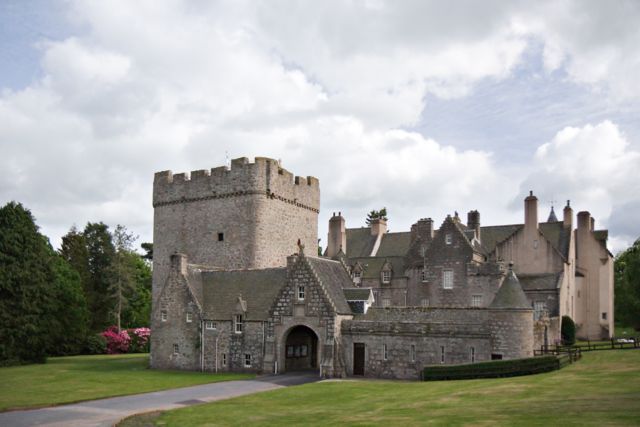
Drum Castle, Aberdeenshire
Drum Castle, ancient seat of Clan Irvine, has received a £700,000 conservation grant from Historic Scotland. The 700-year old castle boasts the oldest keep in Scotland and is the oldest intact building under the care of the trust.
The castle is to undergo specialist works to remove cement pointing, replacing it with traditional, breathable lime mortar to aid in preservation. Scaffolding is currently being erected around the keep in order to begin the painstaking task of chipping away the cement.
Located near Drumoak in Aberdeenshire, the castle’s name is derived from the gaelic druim meaning ridge. The keep is said to be the work of medieval architect Richard Cementarius who held the title of King’s Master Mason to King Alexander III of Scotland. In a show of neighbourly love, Robert the Bruce gifted the lands and castle of Drum to his neighbour and armour bearer William de Irwyn (Irvine) in 1323. De Irwyn was appointed by Bruce as the Baron of Drum and charged with overseeing the Royal Forest, parts of which remain standing today. According to legend, the holly on the Irvine badge were awarded after de Irwyn guarded the King while he slept under a holly bush.
During the Covenenting Rebellion of the 17th century Drum was twice attacked and four times captured by hostile troops. Despite backing the Jacobites during the two uprisings of the 18th Century, the Irvines bounced back and we able to hold and develop Drum further throughout the 19th Century. The Castle has been in the care of Historic Scotland since 1975. In 2012 the castle played host to the first ever ‘Ginger Snap’ – a flash mob of ginger haired folk.
The project is being funded by The National Trust for Scotland Foundation USA, Historic Scotland and an anonymous donor. Work is expected to continue until the end of the year.
The post Conservation Work Begins on Drum Castle appeared first on ScotClans | Scottish Clans.
]]>The post An Expedition to Munro Country appeared first on ScotClans | Scottish Clans.
]]>
Hector Munro outside Foulis Castle
Following unseasonable snowy conditions a week earlier, Hector had been working around the clock to get his Spring barley crop in the ground while the weather was cooperating. “I am really just a land manager who happens for historic reasons to be the head of an enlarged family group known as a Clan. I work for my living like anyone else – that living happens to be farming.” The majority of the Munro farm at Foulis is made up of malting barley, which when harvested goes to a cooperative shared by farmers in the area. The barley is sorted, batched and sold to maltsters to the order of local whisky distilleries including Glen Ord, Glenmorangie, Highland Park and The Macallan.
Perched among the sown-fields of Foulis sits the striking Foulis Castle, seat of Clan Munro for at least 800 years. “We don’t know the very early history of the castle because there was a terrible family row in the mid-1800s and a lot of documents were burnt and destroyed. As far as we can make out a Munro chief acquired Foulis in about 1350 by swapping some land that he already had on the Black Isle. So we know the land has been in the family since then, possibly longer.” Keyhole gun ports were recently discovered in the base of what seems to have been a corner tower on a defensive outer wall of the castle. “They can be positively dated to between 1450 and 1550, so we know there’s been a castle here since at least then.”
The castle suffered a plundering by Jacobites during the 1745 Rising, as the Munros were ardent Presbyterians and Whigs by political persuasion. “One of my fore-bearers attended the Reformation Parliament in Edinburgh in 1560, voting for reformation. The last thing the Munros wanted was a Catholic King on the throne, so we were staunchly anti-Jacobite.” When the rebellion broke out, 200 Munros marched straight to Inverness to provide aid to the besieged General Sir John Cope, later escorting him to Aberdeen and acting as his scouts. The Munros attempted to hold the North for the Government, but in the end were forced to retreat into Sutherland leaving Foulis open for plundering. The chief at the time, Sir Robert Munro, died commanding an English battalion at the Battle of Falkirk, alongside his brother Dr Duncan Munro who was also killed. At the end of the Rising, Robert’s son returned to Foulis to find it a ruin. “Eventually the Government paid compensation, eight years after Culloden, which allowed him to restore the castle. And by that time I think he realised there was no longer the need for a defensive tower so he incorporated the old parts of the castle into what’s really a modern Georgian mansion. So that’s why today it looks more like a mansion then a castle. The sad thing is that no pictures of the castle (before the mid 1800s) survive, as they were destroyed during the family row over succession.”

Foulis Castle in the distance, surrounded by farmland.
Once an estate of 36,000 acres, the lands today have been reduced to 2,500 and is a mixture of let grazing, barley and forestry. “Sadly there’s very, very few clan chiefs who still are lucky enough to have their original property. And I think it’s the fact that very few areas of the highlands are actually economically viable. Tax, death duties and service to the country has bought about the demise of most of the clan seats, so yes I consider myself very lucky that we’re still at Foulis.”
Clan Munro has a very close affiliation with the Seaforth Highlanders, with ties that go back almost two hundred years. During the Second World War, Hector’s father and uncle were captured at St Valery in 1940 while providing cover for the British Expeditionary Force to escape. “I think it was probably 10,000 men from the Highlands who were captured there in one go. They spent the next four years and 11 months in a POW camp, in which time Foulis became thoroughly run down. The Highland soldiers were always considered the crack troops of the British Army, and as a result they tended to be pushed to the front lines to deal with the trouble spots. I think the Scots probably lost more per head of population than any other allied force in the Second World War.”
Hector began running Foulis in 1974, and became chief in 1995 following the death of his father, Captain Patrick Munro. “I don’t think the role of chief twigged properly until much later, I just took it for granted when I was younger. The fact that my Granny lived in a castle that leaked like a sieve; it didn’t really occur to me that there was any significance. The family have always been in the military so there were lots of swords and spears from great uncle so-and-so who brought them back from Africa. Granny used to allow us to play with these swords as kids, and how we never cut each others heads off, I don’t know, but it was great fun. When my father returned from the war first and foremost he had to work the farm, and secondly try and preserve the castle. In 1958 we got a grant from the Historic Buildings Council for Scotland (now Historic Scotland) and they helped with a grant to put a new roof on the castle.”

Foulis Castle as it stands today
Clan Munro gatherings are held at Foulis every 5-10 years, with the next happening in 2014 to coincide with the 700th anniversary of Bannockburn and Homecoming 2014. “There will be all sorts of activities going on, including some for younger people who will be able to climb Ben Wyvis which is the Munro* out the back here.” The last gathering in 2007 was attended by Munros from America, Canada, Australia, England and even a band of French descendents who came from a Munro who escaped the Battle of Worcester in 1651. “At the head of the French branch of the family is a man called Donald Munro. He can’t speak a word of English yet he’s got a Scottish name – 350 years since his fore-bearers left Scotland. The French Munros were all wearing kilts and wearing their Highland bonnets a bit like a beret – so the tradition carries on.”
Hector would like to see the clans used as a tool to promote the Highlands. “Really the clans are about the Highlands, not Edinburgh. People will go to Edinburgh anyway when they come to visit Scotland, but they won’t necessarily go to the Highlands to look for the clans.” Foulis Castle receives around 6-700 visitors per year from all over the world – appointments can be made by getting in touch through the Clan Munro website. “It’s such a unique selling point for Scotland – where else in the world, just by knowing your surname, can you go to a place and know your fore-bearers came from that spot. Clan territories are very distinct like that.”
Hector’s role as clan chief involves chairing Clan Munro Association meetings, upholding the clans history and traditions, meeting with visiting Munros and dealing with inquiries from all over the world. Outside of being a chief three grandchildren occupy his time when he’s not working on the farm (he says his wife would call him a workaholic). “I suppose the role of clan chief is secondary to being a farmer. I think people tend to have this romantic image of the clans for which Sir Walter Scott probably has much to answer for. The truth is however no less interesting and if we can educate people to take excessive tartantry and dreamt up ceremonials with a pinch of salt, and search out the actual historical facts, then that is far healthier.”
Upon leaving Foulis I walked down the hill towards the clan museum at the old Munro Storehouse. Along the way I passed many relics of the clan’s past, including an ancient burial cairn and disused bridge emblazoned with an eagle – the Munro clan badge. How amazing that for over 800 years the Munro family have worked, fought and lived on the same land, carrying on histories and traditions to this very day.

The Munro Bridge near Foulis Castle

Eagle badge on the bridge
___
* = A Munro is a mountain in Scotland with a height over 3,000 ft (914.4 m). Munros are named after Sir Hugh Munro of Clan Munro (1856–1919), who produced the first list of such hills, known as Munros Tables, in 1891.
The post An Expedition to Munro Country appeared first on ScotClans | Scottish Clans.
]]>The post Scottish Battlefield Sites Protected appeared first on ScotClans | Scottish Clans.
]]>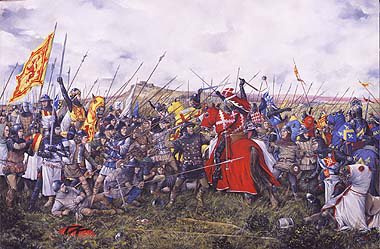
The Battle of Bannockburn by Brian Palmer
The British architect Graeme Shankland once said:
“A country without a past has the emptiness of a barren continent, and a city without old buildings is like a man without a memory.”
Historic sites serve as a reminder of our past, help us to understand our culture and give clues as to where we may be heading. In 2008 Historic Scotland launched a public consultation to include a battlefield inventory in the Scottish Historic Environmental Policy. The consultation generated more public responses than any other at that time, highlighting the tremendous amount of fascination and relevance that these sites still provide.
The inventory, which was completed today, officially recognises and protects 39 historic and iconic battle sites across Scotland. This means that local authorities must take the site’s significance into consideration when making planning decisions that might affect the battlefield.
Dr Iain Banks from The Centre for Battlefield Archeology who carried out the research, said this was the first time historical battle sites have been given any protection. “These sites preserve the last traces of historical events that shaped the nation of Scotland through history, and there is no substitute for visiting the battlefields for understanding what happened in each battle.”
50 sites were researched and consulted for inclusion in the inventory, with the Centre for Battlefield Archeology in touch with some groups whose battlefields were not included in the final list. A major battle missing from the inventory is Mons Grapus (AD 83 or 84), where Rome’s 9th Hispana, its cohorts and Roman cavalry defeated 30,000 Caledonians. The exact location of where the battle happened has been lost to time, however suggested sites include Dunning in Perthshire, Carpow in Fife, Bennachie in Aberdeenshire and Culloden.
The 39 battlefields protected are:
- Alford (1645)
- Ancrum Moor (1545)
- Auldearn (1645)
- Bannockburn (1314)
- Bothwell Bridge (1679)
- Culloden (1746)
- Dunbar II (1650)
- Dupplin Moor (1332)
- Falkirk II (1746)
- Glenshiel (1719)
- Harlaw (1411)
- Killiecrankie (1689)
- Kilsyth (1645)
- Philiphaugh (1645)
- Pinkie (1547)
- Prestonpans (1745)
- Sheriffmuir (1715)
- Barra (1308)
- Carbisdale (1650)
- Cromdale (1690)
- Drumclog (1679)
- Fyvie (1645)
- Inverkeithing II (1651)
- Inverlochy II (1645)
- Linlithgow Bridge (1526)
- Mulroy (1688)
- Rullion Green (1666)
- Stirling Bridge (1297)
- Blar-na-Leine (1544)
- Dunbar I (1296)
- Dunkeld (1689)
- Glen Livet (1594)
- Inverlochy I (1431)
- Langside (1568)
- Loudoun Hill (1307)
- Roslin (1303)
- Sauchieburn (1488)
- Skirmish Hill (1526)
- Tippermuir (1644)
More information on the inventory can be found at Historic Scotland’s website: http://www.historic-scotland.gov.uk/index/heritage/battlefields.htm
The post Scottish Battlefield Sites Protected appeared first on ScotClans | Scottish Clans.
]]>The post New Battlefield Sites to be Protected for Future Generations appeared first on ScotClans | Scottish Clans.
]]>
Monument to the Battle of Langside in Glasgow
Historic Scotland has recently opened a consultation with the public as it moves to increase the number of recognised historic battlefield sites around Scotland. Under plans drawn up areas such as the site of the battle of Loudon Hill, One of Robert the Bruce’s early victories, Mary Queen of Scots defeat at Langside and the ‘Battle of the Shirts’ a famous skirmish between Clan Donald and Clan Fraser will all be protected as sites of historical significance.
Historic Scotland already looks after well knows sites such as Culloden and Bannockburn. Culloden already has a magnificent and award winning visitor centre and plans are underway for a new centre at Bannockburn. During this ‘Year of Creative Scotland’ in 2012 the sites chosen will be properly investigated for any physical remains or significant archeology and also deeper consideration will be given to any potential planning applications which may impact on these areas.
To be added to Historic Scotland’s current list of 28 battle sites the new ones will have to demonstrate that they are of extreme historical and cultural significance. The consultation will go online for public comment on Friday May 18th until June 30th, at www.historic-scotland.gov.uk/battlefieldconsultation .
The successful candidates for the Inventory will be announced later this year.
The battlefields under consideration in the consultation are:
- East Ayrshire
Loudoun Hill (1307)
- East Lothian
Dunbar I (1296)
- Glasgow City / East Renfrewshire
Langside (1568)
The battle of Langside includes a small area of East Renfrewshire, although the majority is in
Glasgow City.
- Highland
Blar na Léine (1544)
Glenlivet (1594)
Inverlochy I (1431)
- Midlothian
Roslin (1303)
- Perth and Kinross
Dunkeld (1689)
Tippermuir (1644)
- Scottish Borders
Melrose (1526)
- Stirling
Sauchieburn (1488)
The post New Battlefield Sites to be Protected for Future Generations appeared first on ScotClans | Scottish Clans.
]]>