The post The Voyage of the Hector appeared first on ScotClans | Scottish Clans.
]]> It was only 28 years after the infamous Battle of Culloden, in 1773, when the Hector was moored within Loch Broom taking onboard a group of people from the Highlands. 189 passengers joined the Hector that day, 25 single men, 33 families, a piper and their agent, all of which had one thing in common. They had a fire in their hearts to find a better life and a new land. A land where they were free to speak their own language, Gaelic, to play the music of their ancestors and to wear their beloved tartan without fear of repercussions. This hefty and dangerous journey was to take three months, but would represent the first significant migration of Scottish settlers to Canada.
The Hector was a fully rigged fluyt built in the Netherlands sometime before 1750. She was employed in the local trade off the coasts of Great Britain but was also involved in the immigrant trade to North America. Whilst she had already made a trip carrying Scottish emigrants to Boston, Massachusetts in 1770, she had never before made a voyage to Canada. By the time of this voyage the Hector was an old ship and had definitely seen better days.

This famous voyage began with her departure from Loch Broom in the second week of July, 1773. Mr. John Pagan, the ships owner, had purchased three shares of land near Pictou, Nova Scotia, along with Dr. John Witherspoon, a presbyterian minister who is most famous for being one of the Founding Fathers of the United States. John Ross was hired by Pagan and Witherspoon to act as a recruiting agent for settlers willing to emigrate to Nova Scotia and was given authority to offer free passage, one years worth of free provisions and a farm as an incentive. John Ross recruited those that went from Greenock and Lochbroom in Rossshire, with the majority coming from Lochbroom. Most of those that boarded the Hector were poor crofters and artisans who only spoke Gaelic. There was a school teacher onboard, William McKenzie, who was one of only a few passengers who spoke both English and Gaelic.
The arduous journey was a long one and was not without troubles. The journey was delayed by 14 days due to increasingly bad weather. Dysentry and smallpox spread throughout the passengers and claimed the lives of 18 passengers. But spirits were not dampened, and in fact, were raised with the birth of a child not far fro the Canadian coast. A long 11 weeks after it left Scotland the Hector finally reached Pictou harbour. On the 15th September 1773 she made her landing at Browns Point, immediately west of the present day town of Pictou, just as the harsh winter weather was setting in.
Unfortunately the provisions they had been promised never materialised and the settlers had to hurry to build shelter without them before the harsh weather set in and starved them. This was a hard task, but the hardy Scottish settlers managed and proceeded to tame a small part of this wild new continent, naming it Nova Scotia in honour of their roots.

The town of Pictou holds great significance within the history of the Scots spreading throughout Canada. It is known as the ‘Birthplace of New Scotland’. Whilst there was already a great number of Scots settled in other areas of Nova Scotia by the time of the towns founding, it was the first settlement that was primarily made up of Scottish immigrants and was a receiving point for many Scottish immigrants moving to a new home in northern Nova Scotia and Cape Breton Island following the Highland Clearances.
During the early 90′s, officials in Nova Scotia sought to commemorate the Hector‘s contribution to Pictou’s, and Nova Scotiain, history. The Ship Hector Foundation was formed in 1992 as a result. Consisting of volunteers from Pictou county, the group began to raise funds in order for a replica of the Hector to be built. After several years of fundraising and construction, the replica Hector was launched with great fanfare and media coverage on September 17, 2000 and can still be visited today.
The post The Voyage of the Hector appeared first on ScotClans | Scottish Clans.
]]>The post The Fair Lady of Strathglass – Heroine of The Clearances appeared first on ScotClans | Scottish Clans.
]]>
The Clan system was soon to end. The defeat of the Jacobite cause at Culloden in 1746 heralded the beginning of the end for the Clan system that had sustained the old way of life across the highlands. Retribution for supporting Bonnie Prince Charlie was swift. Raiding parties were sent into the straths and the glens throughout the highlands seeking out those who had supported the Prince. Strathglass suffered from a number of bloody incursions by Cumberland’s troops. The people who lived in this area were known to be Catholic and possible Jacobites. Now the British crown had control.
So families in the Strathglass area had survived Catholic persecution, then the hunting down of Jacobites but nothing prepared them for what was to happen next. In the latter half of the 18th century the infamous Highland Clearances saw people cleared from the land, often by their own kinfolk, to provide grazing for sheep. These were gaelic people who expected to live and die on the same land their ancestors had.

Tenants were forcibly evicted
The population of Strathglass and the surrounding glens were decimated as they were forced to leave their homeland forever, many starting a new life in the new world. This was a harsh desperate time where human lives counted for nothing and land owners just wanted money from having sheep on their land. But in the midst of all this inhumanity were real heroes – in this case heroines - landowners fought against the Clearances.
The Chief of the Chisholms (Known as the “fair-haired Chisholm”) at this time was Chief Alexander XXIII with the support of Elizabeth and their only daughter Mary, he resisted the temptation to put the clansmen out of their homes and lease the Chisholm lands to southern sheep farmers. In doing so defied the orders and pressure coming from London.
When the chief Alexander died in 1793, he left his widow, Elisabeth the rental of a number of crofting settlements – ‘townships’ as they were called.

Elizabeth Wilson (1760-1826), the wife of Chief Alexander XXIII
The chiefship of Clan Chisholm had gone to Alexander’s brother William. The widow Elizabeth and her only child, Mary, kept the tenantry intact for 33 years, never turning anyone off their land. Once, soon after Alexander’s death, the new chief came over to see Elizabeth at Comar together with many Southern men to try and intimidate her and arrange a deal for the best parts of the Glen to be turned over to sheep. Mary, a teenager, objected, and was sent to bed in disgrace. She crept down to the kitchen and told the servants what was afoot. By early next morning about a 1,000 men had gathered outside Comar House, and the southerners avoided trouble by slipping out of the back. When they looked back they saw the chief, carried on the shoulders of his clansmen being piped back from Comar to Invercannich House.

Comar Lodge

While Elizabeth and her daughter, Mary, did everything they could to stop the evictions of their tenants the chief William, the 24th Chisholm, began the clearances in Strathglass in 1801.
“By and bye, I will tell you how the tenantry were treated by the young Chief and his advisers. But I feel bound to tell you first, that repeated efforts were made by some of those who were acting for the Chief to get hold of the land still in possession of the widow. However, the great good sense of this noble- minded Edinburgh lady, and the sincere attachment of her daughter, Mrs Gooden, to her father’s tenantry stood firm against all the advances made to deprive her of the faithful Highland tenantry entrusted to her care.
For the long space of thirty-three years she kept her tenantry intact, never turned one of them out of a farm, nor did she ever deprive any man of an acre of land. As The Chisholm, her husband, left them at the time of his death in 1793, so they were left by his beloved widow at the time of her death in 1826. This excellent lady was well known and distinguished in the Highlands by the endearing term of “A Bhantigheama-Bhan”—the English equivalent of which is “the fair lady.”(From ‘From the Transactions of the Gaelic Society of Inverness’)
Many who rented on the Chief’s land were forcibly removed to make way for the sheep farming. Many of the evicted families fled across the Atlantic and settled principally in Nova Scotia and Cape Breton Island.
“They gave the names of some Strathglass farms to their freehold lands in their adopted country. In the Island there is even the county ot Inverness.” (From ‘From the Transactions of the Gaelic Society of Inverness’).
They sailed from Fort William to Pictou in Nova Scotia on the Sarah. During the passage, some fifty persons died of smallpox, the disease having been spread by a family called Robertson.
The first Chisholm families at Long Point, Judique would appear to have been those of Colin, William, Alexander, John and Alexander Ban. They too came to Pictou from Strathglass in 1801. They crossed over to Long Point a year later where they built grist and saw mills and, as soon as possible, established a school. Soon after, Alexander Chisholm was killed by a falling tree. He was the first person to be buried in the Long Point graveyard. Over his remains was mournfully sprinkled consecrated earth brought by the emigrants from Strathglass.
In Cape Breton Donald Chisholm, who left Strathglass for Nova Scotia in 1803 at 68 settled near Antigonish, in mainland Nova Scotia wrote a poem called ’When I was young in Strathglass’ (‘Bah mi ogam a Strathglais’) in it he expresses his sorrow at having to leave home in old age and his anger at the clan chiefs for betraying the old social order.
When I was young in Strathglass
I had no thought of leaving,
Now that the gallant men have gone, I too, shall leave
The coward who now rules us
Evicted his own, few remain
He prefers sheep in the hills to a kilted retinue.
(From The Last of the Celts by Marcus Tanner)
William, the chief, was always in delicate health, and the management of the estates fell largely into the hands of his wife, whom the natives of Strathglass to this day blame for having cleared the whole clan out of their native glen. In the period of one year, half of the clan were evicted.
After William’s death, his son was still a minor; but his wife Elizabeth continued with the evictions for one sole purpose – to pay for her son’s (the future 25th Chisholm) education at Cambridge.
Bishop Chisholm had pleaded with her to end the evictions:
“Oh! Madam, you would really feel if you only heard the pangs and saw the oozing tears by which I am surrounded in this once happy but now devastated valley of Strathglass, looking out all anxiously for a home without forsaking their dear valley; but it will not do, they must emigrate!”
She promised the tenants, who had gone to her for help, to come up with a solution. But she never did. Two sheep farmers, Thomas Gillespie and William MacKenzie, had convinced her that she should continue with the “improvements” to her land.
The evictions continued with the Cambridge educated son, Alexander. He followed in his parents’ footsteps and totally depopulated Strathglass. It was said that only one Chisholm remained. Bard and poet in the old Gael tradition, Donald Chisholm, wrote these words:
“Our chief is losing his kin! He prefers sheep in the glens, and his young men away in the camp of the army!”
A man of the time described Alexander as wanting nothing so much as to replace all his people, “his family from the beginning of time,” with sheep. And, unfortunately, it was true.
One house belonging to a man called William Chisholm was especially singled out. Chisholm was a tinker, and probably a squatter, but this does not condone the act. In the house was the mother of Chisholm’s wife, a bed-ridden woman of over ninety. When Sellar was told that she was too ill to be removed, he replied: “Damn her, the old witch; she has lived too long. Let her burn!”’
The house was set on fire and by the time she was pulled out, the blankets she was covered with were also burning. She was set down in an adjoining shed, which only with great trouble they were prevented from burning also. The old woman died within the week.
The news of this, and other acts, began to ripple through the country. Sellar was taken into custody and a trial began on 23 April 1816. The jury consisted of 15 men; eight were local landed proprietors, two merchants, two tacksmen, and one a lawyer. Most were magistrates and Justices of the Peace. Sellar was charged with culpable homicide.
When Lord Pitmilly came to sum up, he instructed the jury to bear in mind the character of the tinker, Chisholm, versus the character of the accused. The jury were quite clear what he meant and returned a verdict of not guilty in fifteen minutes.
Sellar’s work as a factor for Stafford would be remembered as Bliadhna an Losgaidh, the year of the burnings.

Joe K. Chisholm’s farm at Harbour Centre, Antigonish. Joe’s great grandparents came from Strathglass to Nova Scotia in 1801 on the Nora.
Sadly Elizabeth passed away in 1826. Her nephew, The Chisholm, Alexander William, having succeeded his father in 1817, succumbed immediately, and Round 2 of the Chisholm clearances commenced.
The post The Fair Lady of Strathglass – Heroine of The Clearances appeared first on ScotClans | Scottish Clans.
]]>The post Martin Fowler’s Graphic History of Scotland appeared first on ScotClans | Scottish Clans.
]]>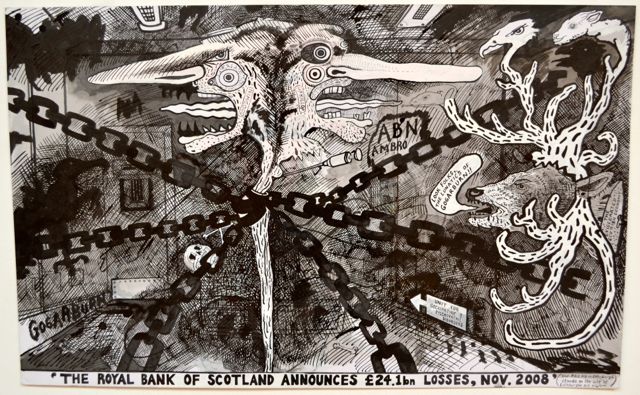
The Royal Bank of Scotland – Martin Fowler
Compiling 500 years of Scottish history is by no means an easy feat. Countless pages of history books burst at the seams with tales of battles, inventions, kings and queens, acts of law, migration, song – it’s hard enough to even pick where to begin. However, Scottish artist Martin Fowler has done just that, compiling his picks from the last 500 years in an astute new exhibition that serves as a catalyst to examine Scottish identity through history. Entitled Scotland the Brave – A Graphic History of Scotland 1513-2013, the exhibition features ink drawings that document the ‘warts and all’ side of Scotland’s story.
Works in the exhibition currently on show at the Scottish Storytelling Centre in Edinburgh range from monumental events such as the battles of Culloden, Bannockburn and Flodden, to more recent events such as the near collapse of the Royal Bank of Scotland, the Housing Act of 1980, Edinburgh’s tram debacle and the opening of the Scottish Parliament in 1998. The Relegation of Rangers FC and the comical disaster of the 1978 World Cup campaign also make an appearance – after all, it wouldn’t be a history of Scotland without the mention of football. The series also explores darker and often overlooked issues such as the arrival of the AIDS epidemic in Edinburgh in the 80s, Scottish self-hatred (a term coined by writer Irvine Welsh) and issues within the prison system where Fowler once worked with prisoners as an art teacher.

A Concise History of North Sea Oil – Martin Fowler
The exhibition serves as an aide-mémoire to Fowler, who said the drawings act as a way to understand and remember events from history. Fowler comes from a generation of Scottish children who were taught a distinctly English history at school, rather than the history of the country in which they were born and raised, saying: “At school there were no references to the Scottish Enlightenment, even though I grew up and went to school in Edinburgh where it happened. I didn’t even have an opinion on it.” Cynicism and satire are employed within some works as a way to critique the madness, as seen in A Concise History of North Sea Oil. Fowler said this piece attempts to address the lies and falsehoods surrounding the use of Scotland’s oil reserves, especially during the Thatcher years.
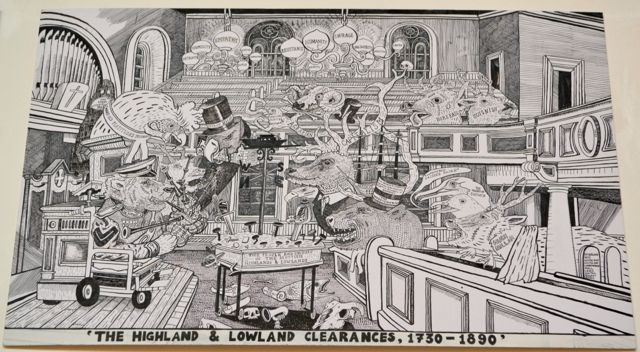
The Highland and Lowland Clearances – Martin Fowler
Fowler chose events based on those he had emotional engagement with, providing an alternative history and another way of looking at events that have often had a prescribed ‘John Prebble’ treatment. In his piece on the Highland Clearances, Fowler references the often overlooked role that women played in resisting landowners moves to clear land. This often resulted in heavy handed police brutality, riots and even deaths. He told me a story about the women of Coigach, where in 1853 attempts were made to clear families from the lands around Coigach in Wester Ross. The women defied orders to leave, and proceeded to strip the Sherrif in command of his clothes, destroying the summons he came bearing. He was then put into a boat, returning to Coigach absolutely nude and humiliated. Martin said the events surrounding the clearances are one of the events in the exhibition that have had the most impact on national identity, saying a sense of loss still exists in the Highlands to this day – something that is vitally important to Scotland’s sense of self.
Another piece in the exhibition looks at the Darien Venture in which Scotland unsuccessfully attempted to become a world trading nation by establishing the colony of Caledonia in Panama around 1690. Fowler said he didn’t know anything about the venture before he began this project, discovering the resulting economic and social situation in Scotland lead to one of the most important parliamentary acts being passed. The venture sucked half of the wealth out of Scotland, weakening the country’s resistance to the Act of the Union which was passed in 1707.
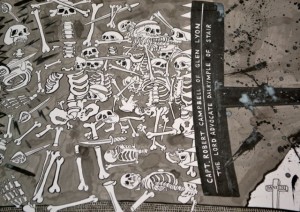
Detail – The Massacre of the MacDonalds of Glencoe
Fowler’s style has similarities with that of comic-book journalist Joe Sacco, saying he was influenced by the political and social satires of English caricaturist James Gillray. Fowler is currently living in Carlisle where he is a Senior Lecturer in Drawing and Fine Art at the University of Cumbria.
As Scotland looks towards the future in 2014, perhaps it’s useful to look back in time to see how Scotland’s identity has been shaped by the past. Not only has Fowler created an accessible collection of work but also one that shows a comprehensive appreciation of Scotland’s deep and rich history of the last 500 years.
You can see Scotland the Brave at the Scottish Storytelling Centre on the Royal Mile until the 28th of July 2013. Fowler will also be giving a talk about the exhibition on Saturday 20th July at 1pm where he will discuss how the collection came about and offer an insight into the practical and technical aspects of his work. All pieces in the exhibition are for sale and you can view more of his work here.
The post Martin Fowler’s Graphic History of Scotland appeared first on ScotClans | Scottish Clans.
]]>The post Highland Clearances Influence Composer appeared first on ScotClans | Scottish Clans.
]]>
Robert Aitken’s new soundtrack ‘Kildonan’
A new soundtrack by a Scottish composer has been influenced by the infamous Highland Clearances of the 18th and 19th Centuries. Kildonan, the latest work by Sutherland based composer Robert Aitken, draws on traditional, contemporary and classical styles to create an album that evokes the forced eviction of people from their lands.
During the industrial revolution, landowners in Scotland sought to make more capital by shipping people out and making way for shooting estates and large industrialised deer and sheep farms. Tracks on the soundtrack include Last Footsteps of Home which tells the story of a young girl on her way to an emigrant ship that lies in wait, and Red River Rant, a tribute to a piper on board an emigrant ship bound for Canada.
Aitken, who was born and brought up in Brora in Sutherland, said: “My aim is to drop the listener into a particular point in time and experience the life-story of a situation. I want the music to be felt rather than just heard. With Kildonan it was also important to examine the big themes of life, then and now – to connect the past with our present in what I do not see as time immemorial, but the ever moving cycle of life as time orbital.”
The soundtrack has received praise from Emmy-winning documentary producer Guy Perotta who called Kildonan a breath of fresh air. “Kildonan is very different from what is found in some works involving Scottish history, which sometimes resorts to what seems like a stereotypical take on what the music ought to sound like.”
Songs from the soundtrack feature on an app released in 2012 to mark the 200th anniversary of clearances in the Strath of Kildonan. Musuems Without Walls: Scotland’s Clearances Trail App uses GPS navigation, archival information and new media to guide users around important clearance sites, bringing the area’s history alive.
Several of the evicted Kildonan families sailed to Hudson Bay, in north east Canada, where they were forced to build their own shelters to protect themselves against severe winter conditions. The following spring, they set off on foot for the Red River Settlement around Lake Winnipeg in Canada where Scottish aristocrat, the Earl of Selkirk, had promised them land. Many made the 100 mile (161km) journey in handmade snowshoes.
Among the travelers was Catherine McPherson, who nursed the sick after typhoid broke out aboard ship on the journey from Scotland to Canada. She also survived a severe flood that carried away her log-built home. Her story is told in the app.
The soundtrack is available for purchase on Spotify, iTunes and Amazon.
The post Highland Clearances Influence Composer appeared first on ScotClans | Scottish Clans.
]]>The post Life On The Edge appeared first on ScotClans | Scottish Clans.
]]>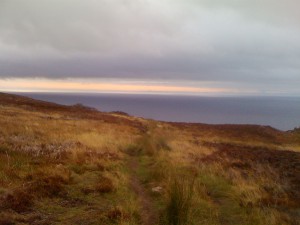
View from Badbea out to the North Sea
On the Caithness east coast, five miles north of the town of Helmsdale, you will see the ruinous remains of the once inhabited village of Badbea which saw its last resident leave at the start of the 20th century.
The Highland Clearances affected thousands of Highland families who were made to move from their homes. Some were persuaded through finacial means, such as having their fare to North America or Australia or New Zealand paid for, whilst the more unfortunate were forced out through violence and intimidation, where it wouldn’t be uncommon to see landlords have crofts burnt down. The people of the Highlands who fled ended up settling all over the place; with families moving to the lowlands or cities of Scotland and northern England looking for work in textile or shipping industries; or they emigrated to foreign countries; or some relocated to nearby coastal areas which were deemed unhabitable for the money-making sheep which replaced them.
Badbea was one of these coastal areas that some families were moved to. It was a cliff-top village established in 1793 when a number of tenant crofters were evicted from their homes to make way for the much more profitable sheep. The families were displaced on a steep, rough, small area of land. They were forced onto the tight area between the high Berriedale cliffs facing the North Sea and a large drystone wall built to protect the sheep.
Sir John Sinclair of Ulbster was the landowner who forced out many of the families from the nearby town of Ousdale, destroying their crofts to create room for the sheep. Sinclair was a politician, and also a writer on finance and agriculture who was a strong advocate for the protection and improvement of British wool.

The Badbea Monuement
Badbea was a tough place to live in; the conditions were horrendous with the land being barely fertile enough for the crofters to live on. Many of the families living there were from Ousdale, though there some from Auchencraig and Kildonan.
Each family who arrived was given their own plot of land to live on and farm. However there were no buildings actually present, and the families would have to clear their area and hack away at the difficult terrain and then build the houses from the stones they found. Each plot had enough space for a longhouse with a shed at the end, a couple of outbuildings and a kailyard. The rest of their land was then used for some cattle, a pig, and a few chickens. It was kind of primitive living for the most part as the whole village only had one horse, and so had no plough. Instead the fields were ploughed manually with the men using a spade-like instrument called a chaib. The harrow needed to be pulled by the men instead, and the manure was carried by the women on their backs in creels.
The families were industrious and frugal, with each household having a spinning wheel in the home where the young women would learn spinning and carding.
With the land provided it was impossible to be able to make a living from farming. The area wasn’t incredibly fertile, with the land being quite rocky. Also being right on the coast like they were the winds coming in from the North Sea were so violent that it would have been practically impossible to grow anything substantial there anyway. In fact, the winds were so strong that when the adults were working any children or livestock outdoors had to be tethered to rocks or posts to stop them being blown over the precipice.
Herring fishing was the the main source of income. The men would go to sea, and the women would gut what was caught. Fishing was a very dangerous occupation, especially in the North Sea. Before the Clearances most of these people lived in the sheltered inlands of the straths and the glens, and so were not accostumed to being out at the sea. However, at its height there were 13 fishing boats in use, and the herring fishing provided a lot of food for all families, including for the widows who had children to support children.
By 1814 the Laird’s Estate had been sold to James Horne. At this point the population of Badbea was 80 people within 12 different families. Though for the families in Badbea, this would turn out to have unfortunate consequences.
Donald Horne, James’ nephew, put a stop to the herring fishing, favouring to fish salmon instead. This put a stop to the community’s main form of employment, meaning that the people had to survive on much less, and the widowed families having to occasionally do without. However there were other means of income. Some of the women would weave baskets, or make flails of birch for threshing corn corps and then sell them at Dunbeath Market in November.

Inscription on Badbea Monument
On the landlord’s estate there would sometimes be some menial jobs to be done by people from Badbea, but the rate of pay would be very low, and in no way appropriate. This would encourage some of the men to look for work on other estates or elsewhere. However, if they were caught doing this by their landlord, as punishment the men and their familied could face being evicted from Badbea.
A notable resident of Badbea was John “Badbea” Sutherland. John was a very popular and respected member of the community. He lived most of his life in Badbea where he was preacher and doctor to all. John was thought of as a man of great piety and worth, and it is said that he possessed the only watch in the village. John died in his house at the age of 76 on the 31st August, 1864 and was burried in the burial ground at Berriedale.
The village of Badbea was occupied for over 100 years, with the last resident leaving in the early 1900s. In 1911 a memorial was errected in honour of the families who lived in Badbea and suffered during the Highland Clearances. The man who commissioned the monument was David Sutherland who visited Badbea in 1901 when only two tenants were left. Born in New Zealand, David was the son of Alexander Robert Sutherland who was born in Badbea and brought up by John “Badbea” Sutherland. Alexander emigrated to New Zealand in his 30s in 1839 and although he prospered in his new country, he never forgot Scotland. The memorial was built using the stones from the croft that was lived in by John “Badbea”.
The post Life On The Edge appeared first on ScotClans | Scottish Clans.
]]>