The post Culloden Moor Housing Development and our Ancestral Heritage. appeared first on ScotClans | Scottish Clans.
]]>
Old Leanach Cottage on Culloden Moor
As dusk fell over Culloden Moor on the 16th April 1746 the last major land battle to be fought on British soil had drawn to a conclusion. With close to 2,000 dead and wounded Jacobites the campaign to restore the Stewart monarchy to the throne had been dealt a decisive final blow. In the days and weeks that followed the dead were buried and the site of the battle was gradually reclaimed by nature, with the exception of a minor road, which ran by the site Culloden has remained untouched to this day.
Now the site is a magnet for those who wish to immerse themselves in the dream of Scotland, in the romantic stories of Bonnie Prince Charlie and Flora MacDonald, in the Jacobite cause that has been the inspiration of so many folk songs and tales. And so the cause of an Italian-born noble to recapture the throne of the United Kingdom from an incumbent German-born monarch became a story that has somehow come to define Scotland.
Two centuries and more have passed and now the site of this battle like many others around Scotland have been taken under the wing of the National Trust for Scotland and the site has been the subject of in-depth research by Historic Scotland and the Royal Commission for Ancient and Historical Monuments for Scotland (RCAHMS). In recent weeks however another battle has been played out over the moor. Not this time though does it feature blue-bonneted highlanders charging over moorland towards red-coated Hanoverians, this battle is taking place on the Internet, in the offices of planning departments and around Scotland’s parliament.
A collection of disused farm buildings which lie around 400m to the north of the battlefield have been the centre of a planning row. Developers who wish to tear down these buildings and erect 16 houses have appealed a local authority decision to refuse planning permission and despite objections from the National Trust for Scotland the Government reporter has overturned the refusal. For those who see Culloden as a symbol of their Scottish identity the very idea of this development is abhorrent and yet taken on its individual merit there is very little in this proposal that would appear to deserving of such a reaction; the footprint and profile of the proposed development extends very little beyond the brown field site that the farm buildings occupy, the increase in noise and traffic that 16 houses contribute to the landscape is paltry compared to the constant flow of tour busses and cars to and from the visitor centre itself and the site is screened from the battlefield by a stand of trees and on the other side of a minor road that has a surprisingly high traffic flow given its rural location.
Taken in isolation it is very hard to see why so many have been worked up into a frenzy over this, even claims that this development will somehow lead to a ‘creeping urbanisation’ of the Culloden area has very little evidence to support it
So there’s no problem and we should just let it go ahead then, right?
Wrong, very very wrong.
You see this issue is not about Culloden. It is about our stewardship of historical sites in every corner of Scotland and it is about the process of managing how developments in areas surrounding sites of historical importance are controlled.
As a race we have in the last century woken up to the responsibilities of managing our environment, not just our natural environment but our historical one too. Nowadays we find it incredible that so many sites, of major importance to our race, have been treated with disregard by our ancestors. Temples and tombs that have been robbed and razed to the ground. Ancient wonders where the stones have been removed to be used for local buildings. We have a lot to thank the Victorians for. It was their curiosity that led to the halt in the demise of our historical environment. People like John Clayton for example, who we have to thank for the fact that anything survives of the magnificent Hadrian’s wall.
Now this does not mean that every corner of our landscape that has a tale to tell must be trapped in amber, the creeping ‘disneyfication’ of Scotland is no better than a creeping urbanisation. People live in and work the landscapes that their ancestors fought and died on and they should be allowed to continue. Take for example the site of the battle Flodden, an event that was arguably more significant in the history of our nation but an event that is marked by a simple monument surrounded by the fields of a working farm, every season the land that saw one of the biggest massacres in Scottish history is ploughed over and grazed upon, life continues as it did before that date in 1513. And that is as it should be
What is required is a sensible approach to the management of our historical environment, it has to be taken into consideration that this environment is not just part of our history but the history of Scotland’s diaspora and their thoughts and views should be listened to. Any inventoried site in Scotland should have a level of protection that means that one civil servant cannot write it off with a flourish of his pen. We have a trust body in Scotland for a reason and their opinions must be considered with the highest regard. Only when all parties agree that a proposed change to a site of significance is right and proper should it be allowed to go ahead.
Viewhill development at Culloden is a fairly innocent piece of planning in itself. 16 family homes out of sight of the moor will have virtually no impact on the quiet contemplation of the landscape, however what Viewhill demonstrates is a lack of joined up thinking across government departments, local councils and trust bodies. The same lack of joined up thinking that has at times hindered the development of a solid approach to ancestral tourism. There is an awful lot of talk but not a lot of listening; in this homecoming year it is time we did just that.
The post Culloden Moor Housing Development and our Ancestral Heritage. appeared first on ScotClans | Scottish Clans.
]]>The post The Great Wood of Caledon appeared first on ScotClans | Scottish Clans.
]]>
As well as the Black Wood, substantial sections of the old forest are also to be found in Glen Affric, the Cairngorms, in upper Deeside and in small patches across the Highlands. Collectively the expanse today of this unique environment is restricted to around 40,000 acres, about 1% of the forest’s original scope. These last remnants form the western fringe of the Eurasian Boreal Forest: dense woodlands that cover much of Scandinavia and northern Russia; and, have remained more or less intact since the end of the last Ice Age

The Eurasian Boreal Forest
In the centuries that followed the final melting of the ice 10,000 years ago, the British Isles became covered in a great forest, known in our folk memory as the Wild Wood. This was the landscape of fairytales: full of big, bad wolves, witches and green men; a place to be feared, respected and tamed. Reflecting Britain’s north-south climate and relative altitude displacement the Wild Wood morphed from oak, lime and elm in the south to the ubiquitous pines and birches in the north. As well as the trees, juniper bushes and heathers, intermixed with grasslands and marsh, this arboreal realm was home to a host of animals now long since vanished from these shores – bears, wolves, lynx and elk. There are of course animals and birds that have survived, and who now find the Caledonian Pineforest their last stronghold – wildcats, capercaillie, pine martens, red squirrels and golden eagles. The first major inroads into the forest came around 6000 years ago, and the arrival of Neolithic farming practices.
Starting with the great oak forests of southern England our Neolithic ancestors, having adopted the new fangled notion of farming from their European cousins began a systematic destruction of the Wild Wood to make way for cultivation. In Scotland these farmers settled mainly in the lowlands between the Clyde and the Forth, and up the east coast towards Aberdeen; as well as up the fertile valleys of the Tay, Tweed, Spey and Great Glen. Initially the process of forest clearing in preparation for cereal production and animal husbandry was slow, and often the woodlands were able to recover if sites were abandoned. This process however gathered apace throughout the Bronze Age and on into the Iron Age (c. 500BC), by which time the huge deciduous forests of Strathclyde, Fife and Strathmore had been all but eradicated. Climate deterioration 2500 years ago also had an affect, and the cooler conditions saw a substantial lowering of the tree-line, turning great woodlands such as Rannoch Moor into vast peat-bogs, and reducing still further the amount of forested land.
Yet, despite nearly 4000 years of encroachment, by the time the Romans arrived into Scotland, most of the land north of the Tay was still forested – indeed the name ‘Caledonian’ itself maybe reflective of the thick forests of the Highlands that posed such an impenetrable barrier to Argricola’s forces in 84AD. Although the Roman legions had little direct impact on the Highlands, they did cut down vast amounts of trees in Lowland Scotland to build their forts and roads. It would also appear that the native Celtic tribes protected their Highland homelands by maintaining thick woodlands at the entrances of all the valleys exiting the mountains – Birnam Wood near Dunkeld could be one such forest that existed into historical times.
The next thousand years would see further incursions into the ever-diminishing Wild Wood including deliberate burnings by Norse invaders in the west. However, it was the three centuries following the 1066 conquest of England by William the conqueror and the adoption of the Feudal System in Scotland by David I that saw the end of the mighty oak forests of England and Lowland Scotland. Rapacious warfare between the English and the Scots during the period exacerbated by ‘scorched-earth’ tactics brought to an end the forests of the borderlands. By 1400 wood had to be imported into the Lowlands, as it had simply run out of trees (in 1503 it was reported officially that the forests of the Lowlands had been destroyed completely). The Great Wood of Caledon, protected by the high peaks and deep inaccessible glens of the Highlands remained considerable, with huge swathes of pine and birch in many areas. Southern eyes turned to the north.
From around 1600 the pine woods of the Highlands came under increasing pressure from various angles. Some came north to exploit the forest for charcoal – essential for iron forging, others to build boats, some to take the wood to build the houses of the growing towns and cities, and some with far more sinister motives. As technology improved so extraction problems were overcome: log floating, reminiscent of Canadian timber was a common site on Scottish rivers. Yet for all that, some parts of the forest were either so remote or owned by more progressive lairds that the destruction of the Highland forest was a initially apiece-meal process, leaving much of the heartland intact.
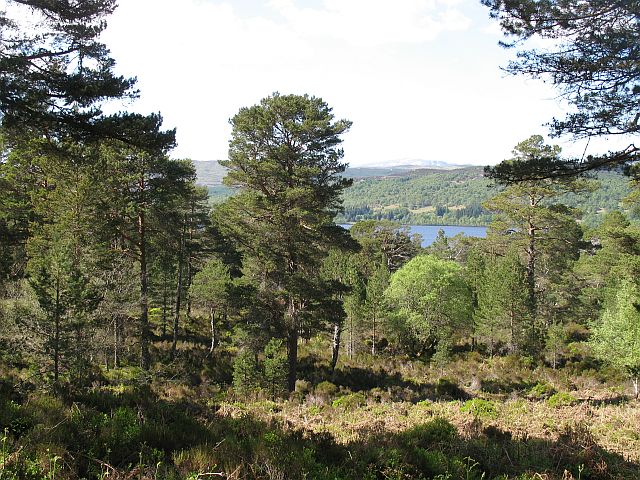
The Caledonian Pine Forest – Black Wood of Rannoch
As well as the rapacious need by the industrial cities of the south for wood, the Highlands underwent a cataclysmic social reorganisation in the years following the Battle of Culloden in 1746. Known as the Highland Clearances, from around 1780 there was a systematic removal of people from their native glens at the hands of a brutal and unsympathetic aristocracy. The driving force was enrichment, and many thousands emigrated or moved to the industrial cities. In their wake came sheep. The wholesale introduction of sheep also had a devastating effect on what remained of the ancient forest. Over-grazing prevented regeneration, and the promotion of the heather moorlands, that now dominate the Highland landscape, to provide a habitat for grouse and deer during the heyday of the Victorian shooting estates put paid to the last significant areas of Britain’s remaining virgin forest. The writing was on the wall.
By 1917, and the dark days of the First World War, Britain had run out of trees, and was now relying on imports from Canada the time had come to fell the last pine stands in the Highlands; regardless of how remote. Thankfully, by November 1918 the war was over and the condemned pines were saved. Following the war the Government established the Forestry Commission, a state owned body that would oversee a massive reforestation project. Most of the trees planted were non-native (Sitka Spruce), but the FC would also take into state ownership most of the remaining sections of the Caledonian Pineforest – saving them for future generations. In addition over the next 200 years the plan is to extend, perhaps even treble the acreage covered: an ambitious project, but worthwhile.
Today, the remaining parts of the Great Wood of Caledon are very much protected. They are living cathedrals, drawing us home to a past we so very nearly lost; and one that allows us to appreciate the landscape and world of our forefathers.
This article was written by David McNicoll
Owner of Vacation Scotland – www.vacationscotland.biz which specialises in vacation packages and tailor-made tours of Scotland.
The post The Great Wood of Caledon appeared first on ScotClans | Scottish Clans.
]]>The post A song from the heart appeared first on ScotClans | Scottish Clans.
]]>
After the ubiquitous ‘Happy Birthday’, the great New Year anthem Auld Lang Syne is the next most sung song on earth; bellowed out from graduations in Thailand to weddings across the globe. The funny thing is that many of the jovial partakers have no idea about the lyrics themselves.
Should auld acquaintance be forgot
And never brought to mind?
Should auld acquaintance be forgot
and Auld Lang Syne.
So, what on earth is an ‘auld lang syne’ anyway? Well, in the old Scots vernacular it simply means ‘long since hence’; and in the spirit of the song, essentially the days of long ago. This pithy three word phrase encapsulates beautifully the sense of remembering the great days of the past, and allows us a chance to wistfully reminisce with rose-tinted spectacles the fun days of our youth. It is about friendship, old friendships that as the years pass drift, perhaps even sour; but now in the twilight we can look back and never forget those long summer days long ago. This is what Burns was driving at, and we as we shed the old year for the new should think on this and remember the good stuff and the importance of love and friendship.

The song was first published by Burns in 1788, and became hugely popular in Scotland. As Scots emigrated around the world they took it with them to create a global phenomenon. However, Burns was not the first to use the phrase ‘auld lang syne’ in a song, both Ayton and Ramsay had earlier, and the bard himself admitted that he had simply ‘re-written’ an old folk song. The tune wasn’t his either, nor the one he planned to use, but was added later. Whatever the origins, I’m sure that master playboy Burns would appreciate the gusto with which his lyrics are still appreciated by millions across the world.
Not all of Scotland’s songs are quite so cheery; over half of the ones I can think of tend to be about battles and cruel fate, usually at the hands of the English. Perhaps it is because Scotland was dealt the wildest of cards, and mixed with our natural Celtic melancholy we have so many lilting laments and heartfelt songs. Top of that list, must surely be the ‘Flowers of the Forest’.
I’ve heard the lilting, at the yowe-milking
Lassies a-lilting before the dawn of day
But now they are moaning on ilka green loaning
“the flowers of the forest are all wede away”
Written by Jean Elliot and again based on an earlier folk song, this mournful, yet intoxicating ballad expresses the anguish and sheer loss felt by those left at home when men go to war and don’t come back. It was written in the aftermath of Scotland’s darkest day on the bloody Field of Flodden: a scene of utter carnage and the loss of a national soul still yet to be recovered fully.
In early 1513 King Henry VIII of England invaded France as part of the Catholic League, and using Calais as his base he won a string of spectacular victories. As part of a more protracted conflict the Pope had become concerned at the growing power of Louis XII of France, and constructed an alliance including England to combat this threat. Scotland was allied to the French and the king, James VI, was the embodiment of the Renaissance and chivalrous to his core. He decided the only honourable course was to aid his ally and invade England in order to distract Henry and buy a little breathing space for Louis. He assembled an army of over 30,000 – the largest ever commanded by a Scottish king, and crossed the border at the end of August 1513.

King James IV
Henry had left the defence of England in the hands of his wife, Catherine of Aragon and the Earl of Norfolk. They dispatched a much smaller army north to meet the Scottish invasion. After a short stand-off the two armies clashed on the 9th of September at Flodden, and while the Scots held the advantage the geography conspired against them and they were annihilated. The king was killed and hacked to pieces, and along with him Scotland would lose, 12 Earls, 13 Barons, the Archbishop of St Andrews and nearly 10,000 men. It was said not one noble family was spared, and every village in Scotland mourned a loss. The youth of the nation was torn apart, its nobility wrecked: these were the flowers of the forest, and now they were all wede (gone) away, leaving behind only empty fields, moaning and pain.
Today, the lament is usually heard played as a pipe tune at funerals or memorial services; sung only at the most heartfelt of times: but, played globally. It has an incredible weightiness about it; one that draws you back to that time and every war since, and the senseless misery of it all.
But, for every Flodden there is a Bannockburn – where the gods of fortune smile down on Scotland for once and deliver victory; oh, and how we celebrate. The Scots are a funny people, a concoction of doom and gloom and a rich, vibrant joie de vivre, and our music mirrors this. Flodden was a hammer blow to the Scottish psyche, and from then on we’ve had this inferiority complex, a chip on our shoulder often aimed south of the border. It’s hard to shake, but as a people our contribution to the world has been immense, and the Scots have much to crow about. Perhaps we are at last climbing out of the pit of self-indulgent grief. We do live in a Scotland transformed in the last 50 years, and although it looks back 700 years to Bruce and Wallace the song most played as a ‘National Anthem’ for Scotland reflects the re-birth in our own national identity.
Oh, flower of Scotland,
when will we see your likes again?
That fought and died for
Your wee bit hill and glen.
Drawing from the emotions of the lost flowers, Roy Williamson’s song, written in 1965, plays upon the fall then rise of a country. It implores us to look back to our ancestors and feel their sense of national pride and deliver forth a new vibrant and healthy Scotland. Flower of Scotland is a simple tune, with an even simpler message – rise up and be a nation again, the perfect ingredient for a national anthem: one that lauds the country, asks more from her people and can be sung by 60,000 on the slopes of Hampden Park. I don’t think you need to be a Scottish Nationalist or a believer in independence to feel national empowerment with this song.

Scottish Pride at Hampden Park
Each of these songs has it’s time and place; each reflects part of the emotional journey it means to be Scottish. Robert Louis Stevenson once said that the Scots carry the past around with them in a way that few others could understand; and perhaps, like the Welsh and the Irish, with our Celtic fire burning brightly that emotion is best expressed in song and music.
This article was written by David McNicoll, who runs Vacation Scotland – a travel company specialising in tours and vacation packages to Scotland. For more info – www.vacationscotland.biz
The post A song from the heart appeared first on ScotClans | Scottish Clans.
]]>