The post Worldwide Call for 24 Hour Ceilidh appeared first on ScotClans | Scottish Clans.
]]>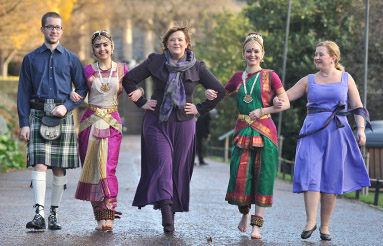
Fiona Hyslop, Cabinet Secretary for Culture and External Affairs gets ready to dance. Photo: Rob McDougall
People from across the world have been invited to join in a global ceilidh held over 24 hours next summer, as part of Glasgow 2014 Commonwealth Games celebrations.
The Royal Scottish Country Dance Society (RSCDS), which has been commissioned by Get Scotland Dancing to create the Commonwealth Ceilidh, will work with dance organisations in Edinburgh, Glasgow and Aberdeen to create new ‘fusion’ dances which will be performed along with existing dances in a worldwide event on Saturday 21 June 2014.
The Commonwealth Ceilidh will begin with events in New Zealand at 7.30pm local time; the next events will begin two hours later in Australia, then in Japan and onwards, with the dancing beginning at 7.30pm in Scotland, 12 hours after the Ceilidh started.
Along with Commonwealth Ceilidhs in Aberdeen, Glasgow and Edinburgh it is hoped that Commonwealth Ceilidhs will take place in hundreds of locations across Scotland and the UK. The Commonwealth Ceilidh then continues over to the Americas and organisers are aiming for the final event to take place in Hawaii 24 hours after the first ceilidh call was made.
Each Commonwealth Ceilidh will be unique to its location, with an interval in every event giving the chance for groups to showcase their national or local dance style. Organisers are especially interested at present in hearing from people who would like to organise a Ceilidh in their own community.
Culture Secretary Fiona Hyslop said:
“The Commonwealth Ceilidh is set to be the biggest celebration of Scottish Country Dancing the world has ever seen – It will be a fantastic way to celebrate, share and showcase our culture during 2014.
“As well as being celebrated throughout the Commonwealth, participants in Scotland will get the opportunity to go to a taster class in their community in the weeks following the Ceilidh. The fact is – Scottish Country Dancing is fun, social and good for our health. I expect that from John O’Groats to Jedburgh – Achiltibuie to Auchmithie – many participants across Scotland will keep dancing through the rest of 2014 and into the years beyond.”
Eileen Gallagher, Independent Director on the Glasgow 2014 Board and Chair of the Ceremonies, Culture and Queen’s Baton Relay Committee, said:
“The Commonwealth Ceilidh will be a vibrant celebration of Scottish culture which everyone can get involved in no matter where they are across the world. The chance to learn the three specially created new dances as part of the Glasgow 2014 Cultural Programme will make the Commonwealth Ceilidh a unique and exciting opportunity for so many people who love Scottish country dancing.”
Event planning information will be available in January 2014 and the programme of dances, music and training resources will be available in March 2014. You can register your interest at the Get Scotland Dancing website.
The post Worldwide Call for 24 Hour Ceilidh appeared first on ScotClans | Scottish Clans.
]]>The post Why is Scotland so… Google Reveals All appeared first on ScotClans | Scottish Clans.
]]>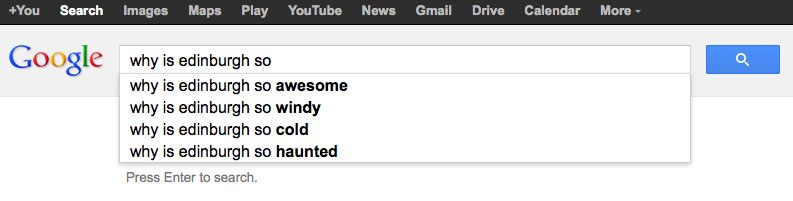 Internet search giant Google has revealed questions the world wants to know about Scotland, unfortunately showing rather unflattering results. The auto-complete feature imbedded in the search engine suggests common search terms when certain information is entered, revealing what internet users really want to know.
When asking Google the question ‘Why is Scotland so…’, auto-complete suggests words to finish the sentence that include ‘boring’, ‘windy’, ‘violent’, and ‘cold’. When asking the same question of Glasgow, Google suggests words such as ‘dirty’, ‘violent’ and ‘poor’, while Edinburgh’s suggestions include ‘awesome’, ‘windy’, ‘cold’ and ‘haunted’. Further north, Internet users want to know why Aberdeen is so expensive, and why Dundee is so popular.
The search engine can also reveal what questions are being asked about Scottish people, with top results including ‘Why are Scottish people so… pale, rude, and tough’. In contrast with my home, the internet wants to know why New Zealanders are so ‘good at rugby’, ‘nice’, ‘boring’ and ‘big’.
Auto-complete results show how internet users research information to gather a rounded view of a subject. Dr Jason Turner, lecturer in marketing at the University of Abertay, said people are increasingly consulting Google as a first resource. “”If they haven’t visited Scotland before, it’s likely they will be asking negative questions rather than positive ones, in order to get a balanced view and learn more about things they’ve heard. People want to reassure themselves, so if they’ve heard Glasgow is dangerous, they might well ask Google about it in order to find out.”
Contrary to Google’s suggestions, Scotland has recently received many travel accolades including CNN naming the country as the number one travel destination in 2013. A VisitScotland spokesman said: “We’re not going to pay too much attention to the automatic answers on Google, when putting in the same question about England, Ireland or Wales, the responses are very similar and therefore aren’t a true representation.
John Donnelly, chief executive of Marketing Edinburgh, said the auto-complete results are not a true representation of Edinburgh. “The true representation of visitor experience in Edinburgh is hugely positive, as is proven through the likes of TripAdvisor reviews, blogger articles and press coverage the world over, which almost universally agree that Edinburgh is one of the most iconic, inspiring places on Earth.”
Google uses algorithms based on popularity and location to come up with auto-complete suggestions, and has said that it cannot be held responsible for what search terms are entered by users. In a recent legal case Bettina Wulff, the wife of the former German president Christian Wulff, attempted to sue Google because the search engine added words to her name that referred to a red-light district and escort services. The American company said it was “incomprehensible” it could be held liable for what people chose to search for online. The case is still pending in a Hamburg court.
The post Why is Scotland so… Google Reveals All appeared first on ScotClans | Scottish Clans.
]]>The post Map Reveals Scots Modern-Day Surnames appeared first on ScotClans | Scottish Clans.
]]>
The Uncertainty of Identity project maps Great Britain’s most popular surnames by area.
A map of Great Britain’s most popular surnames shows the dominance that clan areas still hold in Scotland, while other areas show the effects of modern-day immigration. Created by experts from three English Universities, Uncertainty of Identity uses surnames listed on the electoral roll to find the three most popular names in each electoral ward.
Mackay and Sutherland are the most popular names in the North Highlands, echoing the ancient territories and stronghold of the clans. Mackenzie, Fraser and Ross are the most popular in the area North of Inverness, while MacLeod and MacDonald dominate the Western Isles – data that directly corresponds with clan territory maps.
In the Northern Isles Halcrow, Drever and Flett survive as the third most common surnames, while Shetland still boasts a diverse mix of Spences, Rendalls and Sinclairs. Carole Hough, professor of onomastics – the study of name origins – at Glasgow University, said the surnames of Orkney and Shetland differ from much of mainland Scotland due to naming traditions.
“Shetland and Orkney are unique in that they have a much higher proportion of surnames from local place names, which makes them quite distinctive. Place names tend to cluster around their origin, which is surprising given how mobile people are,” she added
The English derived surname Smith is the most dominant across the whole of Great Britain with a considerable stronghold in the lowlands and east of Scotland. Modern-day immigration shows in areas such a Glasgow’s Pollokshield’s East, with Ahmed, Ali and Singh popular surnames. Jones, Davies and Williams dominate in Wales.
Looking to the future, a resurgence in the popularity of traditional Scottish forenames in recent years is likely to combat Anglicisation, said Hough.
“Far more Gaelic and Celtic-derived personal names are being chosen by parents in Scotland, which can be a way of affirming national identity,” she says. “Gaelic-derived forenames that are in the top 100 names in Scotland at the moment include Aiden, Callum and Finlay. Cameron is originally a clan name, and Lewis, Evan and Isla are all place names.”
You can view a map of Scotland’s most popular surnames at Tartan Footprint.
The post Map Reveals Scots Modern-Day Surnames appeared first on ScotClans | Scottish Clans.
]]>The post Edinburgh and Glasgow’s Rivarly Began Over Bread appeared first on ScotClans | Scottish Clans.
]]> It has been recently suggested that the centuries-long rivalry between Scotland’s capital and Scotland’s largest city all started over bread.
It seems to have begun in 1656 when the Glasgow town council spoke of their worries about the low quality of bread its local bakeries were producing, and two bakers from neighbouring Edinburgh cheekily offered to supply the city with their bread, claiming that it was made to a considerably greater standard. This irritated the Glaswegians and things became quite heated between the two cities.
University of St Andrews Professor and author of On Glasgow and Edinburgh, Robert Crawford, said: “The gloves were off and the jousting between Edinburgh and Glasgow had now begun.” Professor Crawford says that it is not uncommon for two of a country’s main cities to develop a rivalry, though there is something unique about the one between the east and west coast cities.
“In the English-speaking world, the rivalry between Edinburgh and Glasgow is foundational in that it precedes, and to some extent prefigures all other fully developed, long-standing urban rivalries – those between New York and Boston, Sydney and Melbourne, Toronto and Vancouver come later,” Crawford added.
Though fortunately, nowadays, any rivalry between Scotland’s two largest cities seems to be purely good-hearted, or even just a thing of the past.
The post Edinburgh and Glasgow’s Rivarly Began Over Bread appeared first on ScotClans | Scottish Clans.
]]>The post Glasgow’s New Church Is Going To Be Rubbish appeared first on ScotClans | Scottish Clans.
]]>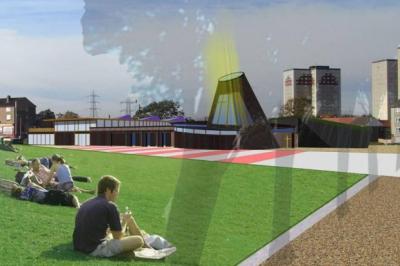
An artist’s impression of what the new community centre in Milton will look like
A new church is set to be built in Glasgow made out of recycled items ranging from empty beer cans to bales of straw. The church, theatre, and community centre will be situated in Milton, north Glasgow. It has been described as one of the country’s most ambitious recycling projects, and it has had the backing from the Scottish Government, Glasgow City Council, and the National Lottery in the form of financial grants. The locals are doing their bit too: over two tonnes of aluminimum cans have been collected already, with the hope to collect another two. Many of the cans are going to be used to build walls and furniture, and the rest are to be sold to help raise funds for the project. The minister of Colston Milton Parish Church, Reverend Christopher Rowe says that the local community love the concept of a church being built with the help of old lager cans. “I think they find something ironic and rather amusing about it.”
Work on an “energy hub” and community centre – the project’s phase 1 – is already underway, and after that they intend to build the church, a cafe, offices, a gallery, and a theatre, all set within a landscaped garden. It is hoped that the project will be completed by April 2014.
Rev. Christopher Rowe said, “We are creating our new building ourselves – one can, one tyre, one straw bale at a time. The people of Milton will be building out of material commonly regarded as rubbish, things that people throw away but which in reality could be given another life in all sorts of ways.” Rowe adds that the recycling will help cut landfill pollution. “Our aim is to create a building with as many recycled materials as possible to use less energy and create fewer emissions.” The construction will recycle 12 shipping containers, over 500 old car tyres, and 300 timber pallets, amongst other things. The project’s co-ordinator and architect, Lee Ivett said, “We plan to transform the tyres into foundations, cans into walls and shipping containers into a sustainable community space. In turn we are saving raw materials and money. It will demonstrate the value of recycling in a building project that will ultimately be a much-needed resource for the people of Milton. A hands-on approach is the most appropriate way of demonstrating the benefits of a sustainable lifestyle that has recycling and re-use as a key component. Our projects provide a means of empowering the community in a manner that is economic, resourceful, sustainable and enriching.”
The post Glasgow’s New Church Is Going To Be Rubbish appeared first on ScotClans | Scottish Clans.
]]>The post A Hidden Gem – New Lanark appeared first on ScotClans | Scottish Clans.
]]>
The Scottish Reformation of the 17th century was at times brutal, destructive and reactionary; and yet, for the most part it was liberating and enlightening. The new church, the Kirk, established poorhouses in every parish, engaged the local population in clerical affairs and brought the Bible and Sermon down to serve the people. The Church of Scotland has a Calvinist doctrine, and at the heart of this theology is the belief that faith is a personal covenant with the Almighty and an understanding of the gospels and laws of the Old Testament. Thus, education stood as a central pillar of the Kirk. It would have unforeseen consequences.

John Knox – Father of the Scottish Reformation
It was a key principal of the new regime that everyone could read the Bible, and so a school was established in virtually every parish in Scotland. As a result, children in Scotland would throughout the 18th and 19th centuries receive a full education until the age of 14; something that was completely unheard off across Europe at that time. By 1800 over 75% of all Scots were literate, the highest rate on earth. What the Church hadn’t taken into account was that people would read books other than the Bible; they did, and they ate up literature, mathematics, philosophy, classical texts and humanities with a voracious appetite. Our unique universal education policy laid the foundation for the Scottish Enlightenment.
It took more than education to change Scotland though, it took money as well. Scotland was historically one of the poorest nations in Europe; a problem compounded by an unfavourable climate, and a dearth of good agricultural land. Yet, the Scots are hard working, and following the Treaty of Union with England in 1707 new agricultural techniques arrived into the country, and Lowland Scotland went through a rapid agrarian revolution. Like the Highland Clearances that followed a century later, there was a large population shift, as farming became less labour intensive and smaller units were merged into larger ones. But, for the farmers and the markets they served, it was boom time; and a new middle class began to emerge.
The money being generated, and the wealth flowing across the border also helped to finance new innovation and entrepreneurship. Opportunities in England’s overseas colonies was also breeding a burgeoning merchant class; slowly at first, but then like a hare out of the trap Scotland’s economy blossomed like the heathland being converted to farms across the nation. However, many of these farmers, especially in Ayrshire, around Glasgow and in Fife never realised the untapped wealth their fields covered – a new revolution was coming and like the Reformation before it, it would change the country forever.
The City of Glasgow was well placed on the Clyde to trade with the colonies of North America; and by the mid 1700s was the key tobacco and sugar port in the British Isles. This made the mercantile class very rich indeed, but more was to come. As well as trading with the world, it would be here on the Clyde the world’s shipping would be built. In addition huge coal reserves and iron deposits were discovered across the Central Belt. Forges, steelworks, factories, mills and all sorts of industries sprung up and thrived from Ayr in the south to Dundee in the east. By 1850 Scotland had become the Engine Room of the British Empire. It was a remarkable transformation.
The cities also provided a home for the many in the countryside who couldn’t find work at home, but conditions were grim. Places like the Gorbals in Glasgow or the Hilltown area of Dundee were among the worst slums in Europe – the Gorbals would be forever etched in the national psyche as the epitome of horrific housing and poverty. Still, they poured in, fuelling the Industrial Revolution as much as the coal, steel, ships or jute they were working with. Edinburgh too had its slums and industrial heart, but nothing like Glasgow; and the Scottish capital has long since drawn its wealth and employment opportunities from the service industry.
It was here that the new finance available was sown into something very different, and the ‘Athens of the North’ would become the fulcrum of the Enlightenment. Throughout the late 18th and all of the 19th centuries, it would be greatest intellectual seat in Europe; and as the money poured in on the back of all the philosophical advancements so a strong banking sector developed. It was here that Scotland’s special education system perhaps shone the brightest. Yet, across the nation, that great gift of learning was paying dividends: from Watt’s steam engine, and Adam Smith’s economic theories; from the poems of Robert Burns to the medical advancements pioneered by the likes of Joseph Lister. These were gifts that Scotland would export around the world as the British Empire grew to cover a quarter of the globe.
The River Clyde crashes over the Bonnington and Corra Linn waterfalls with an incredible force, a power that industrialists had long coveted. In 1786, one of them, David Dale and his son-in-law Robert Owen took the strength of the river and built a set of new mills in the valley bellow the old medieval town of Lanark. Unlike the slave drivers in Glasgow, these two had a more utopian vision of how a workforce should be treated. New Lanark was, from the very beginning, meant to be something different and more socially enlightened. Owen was the real driving force in this project, a man of real philanthropic ideals. He would take hundreds of families from the slums and bring them to the leafy Clyde valley, and give them a proper life, and from that good, hard workers. It was, and is a fantastic concept. The craziest part is that it worked. Owen even bought out his less enlightened partners to pursue his welfare programmes.

The Mills and Houses of New Lanark
It became a model village, and enterprise; and the great and good from rags to royalty came to see it in action. It was more often than not an eye-opening experience. When the Mills finally shut in 1968, a number of ventures worked to keep the essence of the site intact; and today both the village and the falls are among Scotland’s best kept secret attractions. It remains a fantastic testament to our nation’s industrial spirit and enlightened zeal.
Written by David McNicoll, owner of Highland Experience USA – and for anyone interested in our heritage. www.highlandexperience-usa.com
The post A Hidden Gem – New Lanark appeared first on ScotClans | Scottish Clans.
]]>The post The Gaelic Gasp & The Glottal Stop appeared first on ScotClans | Scottish Clans.
]]>
From Ayrshire, the land of Robert Burns, across the Central Belt – through Glasgow, Edinburgh and Fife to Dundee – accents are variations on the Lowlands Scots Dialect. There are those who will argue that Scots is a language of its own, separate from English; and while I see this, to me it simply a tongue that developed from the same root and a variation on a theme. Even those who claim to speak it this is not what was taught to them at school. Scotland has her own independent educational system, which is broad-based, and the national curriculum imposes Maths and English as compulsory subjects to the age of 16. The English taught is that of Received Pronunciation or ‘Proper English’ (whatever that might be). Thus, ‘English’ is the written language of Scotland, despite its distinct vernacular.
Lowland Scots has several distinct features both in dialect and accent – the rolling of the Rs, and the famous Glottal Stop: “Scawe-land” rather than Scot-land, “Buh-ur” rather than but-er, and so on. The ‘helpful vowel’ or Svarabhakti is often employed – wur-um and wur-uld for worm and world. These and a large range of words unused elsewhere in the English speaking world (e.g. – ken for know; thrawn for stubborn; drouthy for thirsty; etc.) make the accent instantly recognisable – and account for the stereotype. Outwith the Central Belt, the diversity of the accent becomes even more pronounced, with striking differences in both diction and enunciation.
Perhaps the most striking of Scottish accents is that of the Doric, spoken essentially in Aberdeenshire. The term ‘Doric’ is a reference to the rough speech of the Spartan people (to Athenian ears), and came to mean ‘rustic’ or ‘rural’. One of the most noticeable differences from Lowland Scots is the use of ‘f’ instead of ‘whi’ in words like what, who (pronounced fit and fa’ respectively). Doric speakers share most of the dialectal words used further south, but have plenty others of their own – ‘louns’ for boys, and ‘queans’ for girls being well known examples.
The small village of Auldearn near Nairn is one of Scotland’s linguistic boundaries, where the Doric of the east switches to the lilt and nasal accent of the Inverness area – itself an extension of the Highland dialects of Strathspey, the Great Glen and Easter Ross. The change is not just in phonology, but in grammar and structure. In many ways the language constructs of Highland English mirror that of the Southeast of England, and the Oxbridge world. This is due to the language being first introduced and then forced upon Gaelic speakers over the course of the last 200 years, and more importantly since the Education Act (Scotland) 1872. When a new language enters an area and is systematically taught one generation on another from textbooks, then the formula tends to stick – this is the reason why Inverness is often quoted as having the ‘Best Spoken English in the World’.
As you continue west towards the Hebrides (but also in pockets like Perthshire), where Gaelic is still spoken or was until relatively recently then the English begins to adopt idiosyncrasies from the mother language; which, as a Celtic tongue is arranged in a very different way. As well as more aspiration in the speech, and grammatical constructions which mimic Gaelic, such as “I am after buying a newspaper”, there is the strange phenomenon of the ‘Gaelic Gasp’.
The ‘gasp’ is a sharp intake of breath signifying agreement, often accompanied by an ‘aye’, or a nodding of the head. This breathy acquiescence isn’t restricted to the Highlands, but can be found across the North Atlantic including the Faeroes, Iceland and Norway – which suggests a Viking origin to this linguistic oddity. It also gives us insight to the varieties of English spoken across Scotland: from the sing-song lilt of the islands to the barking gruff of the Lothians. A thousand years ago an Anglo-Saxon (or early English) language was spoken in southeast; Welsh languages dominated both the southwest and central Scotland (Briton and Pictish were part of this family); in the west, beyond the mountains the Picts of Argyll spoke Gaelic; and, in the far north Norse was spoken. Each would contribute to accents and dialects that would emerge in their areas – but why English?
In 1070 King Malcolm III married Margaret Ætheling, an Anglo-Saxon Princess fleeing the conquest of England by William of Normandy. She was a dominant woman, thorough in her religious convictions: establishing abbeys and influencing the Scottish court. She made sure that ‘English’ became the ‘natural’ language of diplomacy. Her son, David I, introduced the feudal system into Scotland – including Royal Burghs (towns with specific trading rights). The linga-franca of these new towns was English: David’s first language. The nobility followed, and by the necessity of trade, so ultimately did the farmers. Formed from a more antiquated Anglo-Saxon, this version of English would evolve into Scots. Words such as ‘kirk’ for a church, or ‘gate’ for a street hint at the older Germanic root; now lost in modern English. This accounts for the origins of the Scots dialect; where the accent differs depends on the level of Celtic/Norse influence beyond adoption.
A second revolution saw the assimilation of ‘Proper English’ – the Reformation of 1560. While a truly Scottish event, the influence of the English Reformation played a part. There, bibles were already printed in English, and while there were significant vocabulary differences, most Scots could read and understand them. The Church of Scotland decided not to bother printing bibles in the vernacular, and so from then on English became the ‘written’ expression of the language. This was cemented in 1603 when James VI of Scotland became the king of England.
In the Highlands, the bible was actually translated into Gaelic, but inroads are long in the making. The decline of Gaelic is well documented and the reasons legion; and the effect on the language remains to this day. The Gaidhealtachd, the Gaelic speaking areas of Scotland, have for a thousand years been receding against the never-ending tsunami of English. There are milestones along the way, and we should be thankful that the language exists far less thrives, in the Hebrides. The Highland line still provides a major boundary, such as Auldearn, or Dunkeld – where the age-old usage of English meets the recently taught variety in the traditional Gaelic lands. Yet, whatever the origin, whatever the accent, the Scottish dialect is vibrant and truly fascinating.
This blog was written by David McNicoll, owner of Highland Experience USA – which specialises in Vacation Packages and Tours of Scotland
Link – www.highlandexperience-usa.com
The post The Gaelic Gasp & The Glottal Stop appeared first on ScotClans | Scottish Clans.
]]>