The post Gaelic Map of Scotland and Gaelic Place Names appeared first on ScotClans | Scottish Clans.
]]>
Scotland/Alba
Aberdeenshire and Aberdeen City
| English | Scottish Gaelic | Meaning or Notes |
|---|---|---|
| Aberchirder | Obar Chiardair | “The mouth of Chirder Burn” |
| Aberdeen | Obar Dheathain | “The mouth of the Don” |
| Aberdeenshire | Siorrachd Obar Dheathain | |
| Aboyne | Abèidh | |
| Alford | Athfort | “The Fjord”, Norse. |
| Auchenblae | Achadh nam Blàth | “field of flowers” |
| Badenyon | Bad an Eòin | “knoll of the birds” |
| Ballater | Bealadair | |
| Balmedie | Baile Mheadhain | |
| Banchory | Beannchar | |
| Banff | Banbh | |
| Braemar | Bràigh Mhàrr | “upland of Mar” |
| Corgarff | Corr Garaidh | |
| Crathie | Craichidh | |
| Crimond | Crith MhonadhCrioch Mhonadh | |
| Cruden Bay | Inbhir Chruidein | Traditionally, the name was derived from the Gaelic Croch Dain (Slaughter of Danes). |
| Dinnet | Dùnaidh | “Fort/Castle/Fortification belonging to Aidh/Aed” |
| Drumoak | Druim M’Aodhaig | “the ridge of St Aodhag” |
| Ellon | Eilean | |
| Fetterangus | Fothair Aonghais | “Field belonging to Angus”, or “Field of Angus Cattle” |
| Fettercairn | Fothair Chàrdain | “Shelving or terraced slope at the copse” |
| Findon | Fionndan | |
| Formartine | Fearann Mhàrtainn | “Martin’s land” |
| Fraserburgh | A’ Bhruaich | |
| Huntlyformerly Strathbogie | Hunndaidhformerly Srath Bhalgaidh | |
| Insch | An Innis | The name of the village may have come from the Scottish Gaelic innis, meaning an island,or, as in this context, a piece of terra firma in a marsh. |
| Inverallochy and Cairnbulg | Inbhir Aileachaidh agus Càrn Builg | “At the mouth of the river/burn Allochy” and “Memorial to Builg/Bulg” |
| Inverbervie | Inbhir Biorbhaidh | “Mouth of the River Bervie” |
| Inverurie | Inbhir Ùraidh | “At the mouth of the river Urie” |
| Inverurie | Inbhir Uraidh | “Mouth of the Ury” |
| Kemnay | Ceann a’ Mhuigh | |
| Kildrummy | Cionn Droma | |
| Kintore | Ceann Tòrr | “head of a hill” |
| Laurencekirk | Coinmheadh | “an obligation to provide free food and board to passing troops” |
| Lumphanan | Lann Fhìonain | |
| Macduff | An Dùn | “hill fort” |
| Marrformerly Mar | Màrr | |
| Maud | Am Mòd | |
| New Deer | Achadh Reite | |
| Oldmeldrum | Meall Druim | |
| Peterhead | Ceann PhàdraigInbhir Ùigidh | |
| Portlethen | Port Leathain | |
| Portsoy | Port Saoidh | The original name of the town was Port Soaidh, which translates as ‘The wooded place of the warriors (or heroes)’. |
| Rattray | Raitear | |
| Rosehearty | Ros Abhartaich | |
| Rothienorman | Ràth Thormoid) | |
| St Cyrus | Eaglais Chiric | |
| St Fergus | Peit Fhearghais | |
| Stonehaven | Cala na CreigeSron na h-Aibhne | |
| Strathdee | Srath Dhè | “Deeside” |
| Strathdon | Srath Dheathain | |
| Tarland | Turlann | |
| Tarves | Tarbhais | |
| Torphins | Tòrr Fionn | |
| Turriff | Baile ThurraTorraibh |
Angus and Dundee City
| English | Scottish Gaelic | Meaning or Notes |
|---|---|---|
| Aberlemno | Obar Leamhnach | |
| Angus | Aonghas | |
| Arbirlot | Obar Eilid | |
| Arbroath | Obar Bhrothaig | |
| Brechin | Breichinn | |
| Carmyllie | Càrn Mhoillidh | |
| Carnoustie | Càrn fheusta | “cairn of the feast” |
| Dundee | Dùn Dè | “Fort/Castle/Fortification belonging to Daigh/Dee” |
| Dunnichen | Dùn Neachdain | |
| EdzellOriginally called Slateford | Eigill | |
| Forfar | Baile Fharfair | |
| Inverkeilor | Inbhir Chìollair | |
| Kirriemuir | Cearan Mhoire | |
| Monifieth | Monadh Feith | “Hill of the deer” |
| Montrose | Monadh Rois | “moor peninsula or promontory” |
| Tarfside | Bruach Tarbha |
Argyll and Bute
| English | Scottish Gaelic | Meaning or Notes |
|---|---|---|
| Acha, Coll | An t-Achadh | |
| Achahoish | Achadh a’ Chòis | |
| Achnamara | Achadh na Mara | |
| Aird of Kinloch | An Àird | |
| Annat | An Annaid | |
| Appin | An Apainn | |
| Ardalanish | Àird Dealanais | |
| Ardanaiseig | Àird an Aiseig | |
| Ardbeg | Àirde Beaga | |
| Ardentinny | Àird an t-SionnaichÀird an Teine | “the hill of fire” |
| Ardfern | Aird Fheàrna | “the head-land of alder-trees” |
| Ardlui | Àird Laoigh | |
| Ardrishaig | Rubha Àird Driseig | |
| Ardtun | Àird Tunna | |
| Arduaine | An Àird Uaine | |
| Argyll and Bute | Earra-Ghaidheal agus Bòd | |
| Arinagour | Àirigh nan Gobhar | |
| Arrochar | An t-ÀrarAn Tairbeart Iar | |
| Barcaldine | Am Barra Calltainn | |
| Bellochantuy | Bealach an t-Suidhe | |
| Benderloch | Meadarloch | |
| Bonawe | Bun Abha | |
| Bowmore | Bogh Mòr | |
| Bunessan | Bun Easain | |
| Cairnbaan | An Càrn Bàn | “the white hill” |
| Cairndow | An Càrn Dubh | “the black hill” |
| Calgary, Mull | Calgarraidh | |
| Campbeltown | Ceann Loch Chille ChiarainCeann Locha | “head of the loch by the church of Ciarán” |
| Cara Island | Cara | |
| Cardross | Càrdainn Ros | |
| Carradale | Càrradal | |
| Cladich | An Cladach | |
| Colintraive | Caol an t-Snàimh | “swimming strait”"swimming narrows” |
| Coll | Cola | |
| Colonsay | Colbhasa | |
| Connel | A’ Chonghail | |
| Coulport | An Cùl Phort | |
| Cowal | Còmhghall | |
| Craigendoran | Creag an Dòbhrain | |
| Craighouse | Taigh na Creige | |
| Craignish | Creiginis | |
| Craignure | Creag an Iubhair | |
| Crinan | An Crìonan | |
| Dalavich | Dail Abhaich | “meadows/valley of the River Avich” |
| Dalmally | Clachan an DìseirtDail Mhàilidh | |
| Drumlemble | Druim Leamhan | |
| Dubh Artach | Dubh Artach | |
| Dunbegformerly known as Dunstaffnage | An Dùn BeagDùn Stafhainis | “the small fort” |
| Dunstaffnage | Dùn Stafhainis | |
| Dunoon | Dùn Omhain | |
| Erraid | Eilean Earraid | |
| Fingal’s Cave | An Uaimh Bhinn | “the melodious cave” |
| Fionnphort | Fionnphort | |
| Fishnish | Finnsinis | |
| Ford | Àth na Crà | |
| Furnaceformerly Inverleacainn | An FhùirneisInbhir Leacainn | “the mouth of the River Leacainn” |
| Garelochhead | Ceann a’ Gheàrr-loch | “head of Geàrr-loch” |
| Gigha | Giogha | |
| Glen Fruin | Gleann Freòin | |
| Glenbarr | Am Bàrr | |
| Glendaruel | Gleann Dà Ruadhail | |
| Gometra | Gòmastra | |
| Gulf of Corryvreckan | Coire Bhreacain | “cauldron of the speckled seas”"cauldron of the plaid” |
| Gunna | Gunnaigh | |
| Hebrides | Innse Gall | |
| Helensburgh | Baile Eilidh | |
| Holy Loch | An Loch SiantaAn Loch Seunta | |
| Inch Kenneth | Innis Choinnich | |
| Inchmarnock | Innis Mheàrnaig | |
| Inner Hebrides | Na h-Eileanan a-staigh | “the inner isles” |
| Inveraray | Inbhir Aora | |
| Inveruglas Isle | Innis Inbhir Dhughlais | “island at the mouth of the black stream” |
| Iona | ÌÌ Chaluim ChilleEilean Idhe | |
| Islay | Ìle | |
| Isle of MullMull | Muile | |
| Isle of JuraJura | Diùra | |
| Kames | Camas nam Muclach | |
| Kerrera | Cearrara | |
| Kilberry | Cill Bheiridh | |
| Kilmartin | Cille Mhàrtainn | |
| Kilmelford | Cill Mheallaird | |
| Kilmun | Cill Mhunna | |
| Kilninver | Cill an InbhirCill Fhionnbhair | “appears to mean ‘church by the river mouth’, although an older form of Cill Fhionnbhair, ‘Finbar’s church’ appears.” |
| Kintyre | Cinn Tìre | |
| Knapdale | Cnapadal | |
| Knockan | An Cnocan | |
| Kyles of Bute | Na Caoil Bhòdach | |
| Lagavulin | Lag a’ Mhuilinn | “hollow by the mill” |
| Lismore | Lios Mòr | |
| Little Colonsay | Colbhasa Beag | |
| Loch AweLochawe | Loch Obha | |
| Loch Eck | Loch Eich | |
| Loch Etive | Loch Eite | |
| Loch Fyne | Loch Fìne | “loch of the vine or wine” |
| Loch Gilp | Loch Gilb | |
| Loch Goil | Loch Goill | |
| Loch Linnhe | An Linne Dhubh (upstream of Corran);An Linne Sheileach (downstream of Corran) | “the black pool”"the salty pool” |
| Loch Lomond | Loch Laomainn | |
| Loch Long | Loch Long | “Ship Lake” |
| Lochbuie, Mull | Locha Buidhe | “yellow loch” |
| Lochgair | An Loch Geàrr | |
| Lochgilphead | Ceann Loch Gilb | |
| Lochgoilhead | Ceann Loch Goibhle | |
| Luing | Luinn | |
| Luss | Lus | “herb” |
| Machrihanish | Machaire Shanais | |
| Muasdale | Muasdal | |
| Mull of Kintyre | Maol Chinn Tìre | |
| Oban | an t-Òban | |
| Ormsary | Ormsaraidh | |
| Otter Ferry | An Oitir | |
| Port Askaig | Port Asgaig | |
| Port Bannatyne | Port MhicEamailinn | |
| Port Charlotte, Islay | Port Sgioba | |
| Port Ellen | Port Ìlein | |
| Portavadie | Port a’ Mhadaidh | |
| Portnahaven | Port na h-Abhainne | “river port” |
| Rhu | An Rubha | |
| Rhubodach | Rubha a’ BhodaichAn Rubha Bhódaich | “old man’s point (or promontory)”"the Bute headland” |
| River Orchy | UrchaidhAbhainn Urchaidh | |
| Rosneath | Ros Neimhidh | |
| Ross of Mull | An Ros Mhuileach | |
| Rothesay | Baile Bhòid | |
| Saddell | Saghadal | |
| Salen, Ardnamurchan | An t-Sàilean | |
| Salen, Mull | An t-Sàilean | |
| Sanda Island | Sandaigh | |
| Sandbank | An OitirTaigh a’ Chladaich | |
| Scarba | Sgarba | The island’s name is from the Norse and may mean “sharp, stony, hilly terrain” or “cormorant island”. |
| Seil | Saoil | |
| Shuna, Slate Islands | Siuna | |
| Skerryvore | Sgeir Mhòr | “”The Great Skerry” A skerry is a small rocky island, usually defined to be too small for habitation. |
| Skipness | Sgibinis | |
| Southend | Ceann mu Dheas | |
| Staffa | Stafa | from the Old Norse for stave or pillar island |
| Stewarton | Baile nan Stiùbhartach | |
| Strachur | Srath Chura | |
| Strathlachlan | Srath Lachlainn | |
| Strone | An t-Sròn | “the nose” |
| Succoth | An Socach | |
| Tarbert | An Tairbeart | |
| Tarbet | An Tairbeart | |
| Tayinloan | Taigh an Lòin | |
| Taynuilt | Taigh an Uillt | “house by the stream” |
| Tayvallich | Taigh a’ Bhealaich | “house of the pass” |
| Texa | Teacsa | |
| Tighnabruaich | Taigh na Bruaich | |
| Tiree | Tiriodh | |
| Tobermory, Mull | Tobar Mhoire | |
| Torinturk | Tòrr an Tuirc | |
| Toward | Tollard | |
| Uisken | Uisgean | |
| Ulva Ferry | Aiseag Ulbha | |
| Ulva | Ulbha | |
| West Highland Line | Rathad Iarainn nan Eilean | |
| West Highland Way | Slighe na Gàidhealtachd an Iar | |
| Whitehouse | An Taigh Bàn |
Ayrshire
| English | Scottish Gaelic | Meaning or Notes |
|---|---|---|
| Ardrossan | Aird Rosain | “headland of the little promontory” |
| Auchinleck | Achadh nan Leac | “field of the flagstones” |
| Ayr | Inbhir Àir | “mouth of the River Ayr” |
| Cumnock | Cumnag | |
| Hurlfordformer names include Whirlford and Hurdleford. | Àth Cliath | “the ford of the hurdles” |
| Kilmarnock | Cille Mhèarnaig | |
| Largs | An Leargaidh GalldaAn Leargaidh | “the slopes” |
| Lochranza | Loch Raonasa | |
| Muirkirk | Eaglais an t-Sléibh | |
| Prestwick | Preastabhaig | |
| Polnessan | Poll an Easain | “pool (or stream) of the little waterfall” |
Clackmannanshire
| English | Scottish Gaelic | Meaning or Notes |
|---|---|---|
| Alloa | AlamhaghAllmhagh Mor | |
| Alva | Allmhagh Beag | |
| Tillicoultry | Tulach Cultraidh | “the mount or hill at the back of the country” |
Dumfries and Galloway
| English | Scottish Gaelic | Meaning or Notes |
|---|---|---|
| Annan | Inbhir Anainn | |
| Dumfries | Dùn Phris | |
| Gatehouse of Fleet | Taigh an Rathaid | “House on the Road” |
| Gretna | Greatna | Gretna means “(place at the) gravelly hill”, from Old English greot “grit” (in the dative form greoten) and hoh “hill-spur”. |
| Kirkcudbright | Cille Chuithbeirt | “the church of St Cuthbert” |
| Langholm | Langaim | Also known colloquially as the “Muckle Toon”. From Norse – long field by the river |
| Lockerbie | Locarbaidh | The name means Lockard’s Farm in Old Norse. |
| Sanquhar | An t-Seann Chathair | “the old seat” |
| Stranraer | An t-Sròn Reamhar | The name is believed to come from the Scottish Gaelic An t-Sròn Reamhar: literally “the fat nose”, it means “the broad headland”. |
| Whithorn | Taigh Mhàrtainn |
Dunbartonshire
| English | Scottish Gaelic | Meaning or Notes |
|---|---|---|
| Alexandria | Am Magh LeamhnaCathair Alastair | “plain of the Lennox” |
| Balloch | Bealach | “the pass” |
| Bearsden | Cille Phàdraig Ùr | |
| Bishopbriggs | Coille Dobhair | the name of the old parish of Cadder |
| Clydebank | Bruach Chluaidh | |
| Dumbarton | Dùn BreatannDùn Breatainn | “fort of the Britons” |
| Duntocher | ”Dùn TòchairDruim Tòchair | |
| Kirkintilloch | Cathair Cheann TulaichCair Ceann Tulaich | “fort at the end of the hillock” |
Falkirk
| English | Scottish Gaelic | Meaning or Notes |
|---|---|---|
| Bo’ness | Ceann Fhàil | |
| Falkirk | An Eaglais Bhreac | |
| Grangemouth | Inbhir Ghrainnse | |
| Larbert | Lèirbert | |
| Polmont | Poll-Mhonadh |
Fife
| English | Scottish Gaelic | Meaning or Notes |
|---|---|---|
| Aberdour | Obar Dobhair | |
| Cowdenbeath | Coilltean Beithe | |
| Cupar | Cupar | |
| Dunfermline | Dùn Phàrlain | |
| Glenrothes | Gleann Ràthais | |
| Inverkeithing | Inbhir Chèitein | |
| Kirkcaldy | Cair Chaladain | |
| Rosyth | Ros SaidheRos SaoitheRos Fhìobha | |
| St Andrews | Cill Rìmhinn |
Glasgow
| English | Scottish Gaelic | Meaning or Notes |
|---|---|---|
| Glasgow | Glaschu | |
| Govan | Baile a’ Ghobhainn | |
| Partick | PàrtaigPearraig |
Highland Region
| English | Scottish Gaelic | Meaning or Notes |
|---|---|---|
| Aberarder | Obar Àrdair | |
| Aberchalder | Obar Chaladair | |
| Abriachan | Obar Itheachan | |
| Achachork | Achadh a’ Choirce | |
| Achanalt | Achadh nan Allt | |
| Achandunie | Achadh an Dùnaidh | |
| Acharacle | Àth Tharracail | |
| Achaphubuil | Achadh a’ Phùbaill | |
| Achateny | Achadh an Teine | |
| Achentoul | Achadh an t-Sabhail | |
| Achgarve | An t-Achadh Garbh | |
| Achinahuagh | Achadh na h-Uamha | |
| Achintee | Achadh an t-Suidhe | |
| Achintraid | Achadh na Tràghad | |
| Achindrean | Achadh an Dreaghainn | |
| Achininver | Achadh an Inbhir | |
| Achinduich | Achadh an Dabhaich | |
| Achnacarry | Achadh na Cairidh | |
| Achnaha | Achadh na h-Àtha | |
| Achnahanat | Achadh na h-Annaid | |
| Achnagarron | Achadh nan Gearran | |
| Achnasaul | Achadh nan Sabhal | |
| Achnasheen | Achadh na Sìne | |
| Achnashellach | Achadh nan Seileach | |
| Achriesgill | Achadh Rìdhisgil | |
| Achosnich | Achadh Osnaich | |
| Achvarasdal | Achadh Bhàrrasdail | |
| Achvaich | Achadh a’ Bhàthaich | |
| Alness | Alanais | |
| Inveralligin | Inbhir Àiliginn | |
| Altnaharra | Allt na h-Eirbhe | |
| Alvie | Albhaidh | |
| Kensaleyre | Ceann Sàil Eighre | |
| Ardachu | Àrd Achadh | |
| Ardcharnich | Àird Cheatharnaich | |
| Ardclach | Àird Chlach | |
| Aviemore | an Aghaidh Mhòr | |
| Ballachulish | Baile a’ Chaolais | |
| Beauly | A’ Mhanachainn | |
| Broadford | An t-Àth Leathann | |
| Castlebay | Bàgh a’ Chaisteil | |
| Craignure | Creag an Iubhair | |
| Cromarty | Cromba | |
| Culloden | Cùil Lodair | |
| Dingwall | Inbhir Pheofharain | |
| Dornoch | Dòrnach | |
| Fort Augustus | Cille Chuimein | |
| Fort William | An Gearasdan | |
| Fortrose | A’ Chananaich | |
| Glencoe | Gleann Comhann | |
| Inverness | Inbhir Nis | |
| John o’ Groats | Taigh Iain Ghròt | |
| Kingussie | Ceann a’ Ghiuthsaich | |
| Kyle of Lochalsh | Caol Loch Aillse | |
| Mallaig | Malaig | |
| Nairn | Inbhir Narann | |
| Portree | Port Rìgh | |
| Rosemarkie | Ros Maircnidh | |
| Strathpeffer | Srath Pheofhair | |
| Thurso | Inbhir Theòrsa | |
| Tongue | Tunga or Cinn Tàile | |
| Ullapool | Ulapul | |
| Wick | Inbhir Ùige |
Inverclyde
| English | Scottish Gaelic | Meaning or Notes |
|---|---|---|
| Gourock | Guireag | |
| Greenock | Grianaig | |
| Port Glasgow | Port Ghlaschu | |
| Wemyss Bay | Bàgh nan Uaimhean |
Lanarkshire
| English | Scottish Gaelic | Meaning or Notes |
|---|---|---|
| Airdrie | An t-Àrd Ruigh | |
| Coatbridge | Drochaid a’ Chòta | |
| Cumbernauld | Comar nan Allt | |
| East Kilbride | Cille Bhrìghde an Ear | |
| Hamilton | Hamaltan | |
| Kilsyth | Cill Saidhe | |
| Lanark | Lannraig | |
| Motherwell | Tobar na Màthar | |
| Rutherglen | An Ruadh Ghleann |
Lothian and Edinburgh
| English | Scottish Gaelic | Meaning or Notes |
|---|---|---|
| Dalkeith | Dail Chè | |
| Dunbar | Dùn Bàrr | |
| Edinburgh | Dùn Èideann | |
| Haddington | Baile Adainn | |
| Leith | Lìte | |
| Livingston | Baile Dhùnlèibhe | |
| Linlithgow | Gleann Iucha |
Moray
| English | Scottish Gaelic | Meaning or Notes |
|---|---|---|
| Aberlour | Obar Lobhair | |
| Alves | An Àbhais, An Àbhas | |
| Buckie | Bucaidh | |
| Cullen | Inbhir Cuilinn | |
| Dallas | Dalais | |
| Dufftown | Baile Bhainidh | |
| Elgin | Eilginn | |
| Forres | Farrais | |
| Keith | Baile Chè | |
| Lossiemouth | Inbhir Losaidh | mouth/estuary of the Lossie |
| Tomintoul | Tom an t-Sabhail | “Hillock of the Barn” |
Orkney
| English | Scottish Gaelic | Meaning or Notes |
|---|---|---|
| Kirkwall | Baile na h-Eaglais |
Outer Hebrides
| English | Scottish Gaelic | Meaning or Notes |
|---|---|---|
| Balallan | Baile Ailein | |
| Stornoway | Steòrnabhagh | |
| Tarbert | An Tairbeart |
Perth and Kinross
| English | Scottish Gaelic | Meaning or Notes |
|---|---|---|
| Aberfeldy | Obar Pheallaidh | |
| Blair Atholl | Blàr Athaill | |
| Callander | Calasraid | |
| Crieff | Craoibh | |
| Comrie | Cuimridh | |
| Dunkeld | Dùn Chailleann | |
| Gleneagles | Gleann Eagas | |
| Perth | Peairt | |
| Pitlochry | Baile Chloichridh | |
| Scone | Sgàin |
Renfrewshire
| English | Scottish Gaelic | Meaning or Notes |
|---|---|---|
| Erskine | Arasgain | |
| Paisley | Pàislig | |
| Renfrew | Rinn Friù |
Scottish Borders
| English | Scottish Gaelic | Meaning or Notes |
|---|---|---|
| Eyemouth | Inbhir Eighe | |
| Galashiels | An Geal Àth | |
| Hawick | Hamhaig | |
| Jedburgh | Deadard | |
| Kelso | Cealsaidh | |
| Melrose | Am Maol Ros | |
| Newcastleton | Baile a’ Caisteal Nuadh | |
| Peebles | Na Pùballan | “The Tents” – the English probably in fact from the British: compare Welsh “Pebyll”. |
| Selkirk | Salcraig |
Stirling
| English | Scottish Gaelic | Meaning or Notes |
|---|---|---|
| Aberfoyle | Obar Phuill | |
| Arnprior | Earrann a’ Phriair | |
| Bannockburn | Allt a’ Bhonnaich | |
| Cowie | Collaidh | |
| Crianlarich | A’ Chrìon-Làraich | |
| Dunblane | Dùn Bhlàthain | |
| Killearn | Cill Earnain | |
| Kippen | An Ceapan | |
| Stirling | Sruighlea | |
| Tyndrum | Taigh an Droma |
Scottish glens
| English | Scottish Gaelic | Meaning or Notes |
|---|---|---|
| Glen Tilt | Gleann Teilt | |
| Glendaruel | Gleann Dà Ruadhail |
Scottish hills and mountains
| English | Scottish Gaelic | Meaning or Notes |
|---|---|---|
| Beinn a’ Ghlò | Beinn a’ Ghlò | |
| Beinn an Lochain | Beinn an Lochain | |
| Beinn Bheula | Beinn Bheula | |
| Beinn Bhuidhe (Glen Fyne) | A’ Bheinn Bhuidhe | |
| Beinn Dorain | Beinn Dòbhrain | “hill of the streamlet”"hill of the otters” |
| Beinn Lochain | Beinn Lochain | |
| Beinn Luibhean | Beinn Luibhean | |
| Ben Narnain | Beinn Narnain | |
| Beinn Reithe | Beinn Reithe | |
| Beinn Ìme | Beinn Ìme | |
| Ben Arthur | Beinn Artair | |
| Ben Avon | Beinn Athfhinn | |
| Ben Donich | Beinn Dòmhnaich | |
| Ben Ledi | Beinn Leitir | “Mountain of the slope” |
| Ben Lomond | Beinn Laomainn | |
| Ben Lui | Beinn Laoigh | |
| Ben Macdui | Beinn Mac Duibh | |
| Ben More (Mull) | Beinn Mhòr | “great mountain” |
| Ben Nevis | Beinn Nibheis | |
| Ben Vane | Beinn Mheadhain | |
| Ben Vorlich (Loch Lomond) | Beinn Mhùrlaig | |
| Bennachie | Beinn na Cìche | “hill of the breast” |
| Binnein an Fhidhleir | Binnein an Fhidhleir | |
| Braeriach | Bràigh RiabhachAm Bràigh Riabhach | |
| Cairn Gorm | An Càrn Gorm | “blue or green hill” |
| Cairn Toul | Càrn an t-Sabhail | “hill of the barn” |
| Cairngorms | Am Monadh Ruadh | |
| Clach Bheinn (Lochgoilhead) | Clach Bheinn (Lochgoilhead) | |
| Cnoc Coinnich | Cnoc Coinnich | |
| Cruach nam Miseag | Cruach nam Miseag | |
| Cruach nam Mult | Cruach nam Mult | |
| Cruach nan Capull | Cruach nan Capull | |
| Cuillin | An Cuiltheann | |
| Carn Glas | Càrn Glas | |
| Grampian Mountains | Am Monadh | |
| Lochnagar | Beinn Chìochan | “mountain of breasts” |
| Monadhliath Mountains | Monadh Liath | “grey mountains” |
| Mount Keen | Monadh Caoin | |
| Mounth | Monadh | |
| Mullach Coire a’ Chuir | Mullach Coire a’ Chuir | |
| Schiehallion | Sìdh Chailleann | |
| Stob an Eas | Stob an Eas | |
| Stob na Boine Druim-fhinn | Stob na Boine Druim-fhinn | |
| The Cobbler | Beinn Artair | |
| The Devil’s Point | Bod an Deamhain | |
| Tom Molach | Tom Molach | |
| Tom nan Gamhna | Tom nan Gamhna |
Scottish passes
| English | Scottish Gaelic | Meaning or Notes |
|---|---|---|
| Cairnwell Pass | Càrn a’ Bhailg | |
| Footdee | Bun Dè | |
| Lairig Ghru | Làirig Dhrù | “pass of Dhru or Druie” |
Scottish rivers
| English | Scottish Gaelic | Meaning or Notes |
|---|---|---|
| Alladale River | Abhainn Alladail | |
| Abhainn a’ Ghlinne Mhòir | Abhainn a’ Ghlinne Mhòir | |
| Bervie Water | Uisge Bhiorbhaigh | |
| Carron Water, Aberdeenshire | Carrann | “the shrimps” |
| Carron Water, Dumfriesshire | Carrann | “the shrimps” |
| Cowie Water | Uisge Chollaidh | |
| River Add | Abhainn Àd | |
| River Carron (Forth) | Abhainn Carrann | “the shrimps” |
| River Carron, Sutherland | Carrann | “the shrimps” |
| River Carron, Wester Ross | Carrann | “the shrimps” |
| River Clyde | Abhainn Chluaidh | |
| River Dee, Aberdeenshire | Uisge Dhè | |
| River Dee, Galloway | DèUisge Dhè | |
| River Don | Deathan | |
| River Forth | Uisge For or Abhainn Dubh | “The black river” |
| River Garry, Inverness-shire | GaradhAbhainn Gharadh | |
| River Garry, Perthshire | GarAbhainn Ghar | |
| River North Esk | Easg Thuath | |
| River Spey | Abhainn Spè | |
| River Tay | Abhainn Tatha | |
| River Teith | Uisge Theamhich | “The pleasant water” |
| River Tweed | Abhainn Tuaidh | |
| River UryRiver Urie | UaraidhÙraidh | |
| Water of Aven | an t-Uisge Bàn |
Scottish lochs
| English | Scottish Gaelic | Meaning or Notes |
|---|---|---|
| Campbeltown Loch | Loch Chille Chiarain | |
| Gare Loch | An Gearr Loch | |
| Holy Loch | An Loch SiantaAn Loch Seunta’ | |
| Loch Affric | Loch Afraig | |
| Loch Ard | Loch na h-Àirde | |
| Loch Arkaig | Loch Airceig | |
| Loch Assynt | Loch Asaint | |
| Loch Awe | Loch Obha | |
| Loch Cluanie | Loch Cluanaidh | |
| Loch Doon | Loch Dhùin | |
| Loch Drunkie | Loch Drongaidh | |
| Loch Earn | Loch Éireann | |
| Loch Eck | Loch Eich | |
| Loch Ericht | Loch Eireachd | |
| Loch Etive | Loch Eite | |
| Loch Fyne | Loch Fìne | |
| Loch Garry | Loch Garraidh | |
| Loch Goil | Loch Goill | |
| Loch Katrine | Loch CeiteireinLoch Ceathairne | |
| Loch Lochy | Loch Lochaidh | |
| Loch Lomond | Loch Laomainn | |
| Loch Long | Loch Long | “Ship Lake” |
| Loch Lyon | Loch Lìomhann | “Ship Lake” |
| Loch Maree | Loch Ma-ruibhe | |
| Loch Morar | Loch Mhòrair | |
| Loch Ness | Loch Nis | |
| Loch Ossian | Loch Oisein | |
| Loch Quoich | Loch Chuaich | |
| Loch Rannoch | Loch Raineach | |
| Loch Riddon | Loch Ruel | |
| Loch Shiel | Loch Seile | |
| Loch Shin | Loch Sìn | |
| Loch Tay | Loch Tatha |
Scottish firths
| English | Scottish Gaelic | Meaning or Notes |
|---|---|---|
| Firth of Lorn | An Linne Latharnach |
Scottish Islands
| English | Scottish Gaelic | Meaning or Notes |
|---|---|---|
| Ailsa Craig | Creag Ealasaid | |
| Baleshare | Baile Sear | |
| Barra HeadBerneray | Beàrnaraigh | |
| Barra | Barraigh, Eilean Bharraigh | |
| Benbecula | Beinn nam Fadhla | |
| Berneray, North Uist | Beàrnaraigh (na Hearadh) | |
| BerneraGreat Bernera | Beàrnaraigh (Ùig)Beàrnaraigh Mòr | |
| Burnt Islands | Eilean MòrEilean FraoichEilean Buidhe | “Large Island”"Heather Island”"Yellow Island” |
| Canna | Canaigh | |
| Coll | Cola | |
| Colonsay | Colbhasa | |
| Davaar IslandIsland Davaar | Eilean Dà Bhàrr | |
| Easdale | Eilean Èisdeal | |
| Eigg | Eige | |
| Eilean Dubh Mòr | Eilean Dubh Mòr | “big black island” |
| Eilean DubhGlen Caladh Island | Eilean Dubh | “Black Island” |
| Ellenabeich | Eilean nam Beitheach | “island of the birchwoods” |
| Eriskay | Èirisgeigh | |
| Fair Isle | Eilean nan Geansaidh | |
| Flodaigh | Flodaigh | |
| Fraoch-eilean | Fraoch-eilean | |
| Gigha | Giogha | |
| Grimsay, South East Benbecula | Griomasaigh | |
| Grimsay (north) | Griomasaigh | |
| Harris | Na Hearadh | |
| Inner Hebrides | Na h-Eileanan a-staigh | |
| Iona | ÌÌ Chaluim Chille | |
| Islay | Ìle | |
| Isle of ArranArran | Arainn | |
| Isle of ButeBute | Eilean BhòidEilean BhòdachBòd | |
| Isle of JuraJura | Diùra | |
| Isle of MullMull | Muile | |
| Lewis and Harris | Leòdhas agus na Hearadh | |
| Lewis | Leòdhas | |
| Lismore | Liosmòr | |
| Muck | Eilean nam Muc | |
| North Uist | Uibhist a Tuath | |
| Orkney | Arcaibh | |
| Outer Hebrides | Na h-Eileanan Siar | |
| Raasay | Ratharsair | Sometimes, Ratharsaigh, but this is incorrect |
| Rum | Rùm | |
| Scalpay, Inner Hebrides | Sgalpaigh | |
| Scalpay, Outer Hebrides | Sgalpaigh (na Hearadh) | |
| Shetland | Sealtainn | |
| Skye | An t-Eilean Sgitheanach | |
| South Uist | Uibhist a Deas | |
| St Kilda | Hiort | The same name is used for the main island of the group. |
| The Black Isle | An t-Eilean Dubh | |
| Tiree | Tioridh | |
| Vatersay | Bhatarsaigh |
Other islands
| English | Scottish Gaelic | Meaning or Notes |
|---|---|---|
| Channel Islands | Eileanan a’ Chaolais | |
| Isle of Man | Eilean Mhanainn | |
| Rathlin | ReachlainnReachra |
Scottish regions
| English | Scottish Gaelic | Meaning or Notes |
|---|---|---|
| Borders | Crìochan na h-Alba | |
| Central Region | Roinn Meadhanach | |
| Dumfries and Galloway | Dùn Phrìs is Gall-Ghaidhealaibh | |
| Grampian | Roinn a’ Mhonaidh | |
| Fife | Fìobha | |
| Highland | A’ Ghàidhealtachd | |
| Lothian | Lodainn | |
| Orkney | Arcaibh | |
| Tayside | Taobh Tatha | |
| The Outer Hebrides | Na h-Eileanan Siar | |
| Shetland | Sealtainn | |
| Strathclyde | Srath Chluaidh |
Pre-1975 counties
| English | Scottish Gaelic | Meaning or Notes |
|---|---|---|
| Aberdeenshire | Siorrachd Obar Dheathain | |
| Angus(Forfarshire until 1928) | Siorrachd Aonghais | |
| Argyll | Earra-Ghàidheal | |
| Ayrshire | Siorrachd Inbhir Àir | |
| Banffshire | Siorrachd Bhanbh | |
| Berwickshire | Siorrachd Bhearaig | |
| Caithness | Gallaibh | |
| Clackmannanshire | Siorrachd Chlach Mhanainn | |
| County of Bute | Siorrachd Bhòid | |
| Dumfriesshire | Siorrachd Dhùn Phris | |
| Dunbartonshire | Siorrachd Dhùn Breatainn | |
| East Lothian(Haddingtonshire until 1921) | Lodainn/Labhdaidh an Ear | |
| Fife | Fìobha | |
| Inverness-shire | Siorrachd Inbhir Nis | |
| Kincardineshire | Siorrachd Chinn Chàrdainn | |
| Kinross-shire | Siorrachd Chinn Rois | |
| Kirkcudbrightshire | Siorrachd Chill Chuithbeirt | |
| Lanarkshire | Siorrachd Lannraig | |
| Midlothian(County of Edinburgh until 1890) | Meadhan Lodainn/Labhdaidh | |
| County of Moray(also known as Elginshire until 1918) | Moireibh | |
| Nairnshire | Siorrachd Inbhir Narann | |
| Orkney | Arcaibh | |
| Peeblesshire | Siorrachd nam Puballan | |
| Perthshire | Siorrachd Pheairt | |
| Renfrewshire | Siorrachd Rinn Friù | |
| Ross and Cromarty | Ros is Cromba | |
| Roxburghshire | Siorrachd Rosbruig | |
| Selkirkshire | Siorrachd Shailcirc | |
| Zetland(Shetland) | Sealtainn | |
| Stirlingshire | Siorrachd Shruighlea | |
| Sutherland | Cataibh | |
| West Lothian(Linlithgowshire until 1924) | Lodain/Labhdaidh an Iar | |
| Wigtownshire | Siorrachd Bhaile na h-Ùige |
The post Gaelic Map of Scotland and Gaelic Place Names appeared first on ScotClans | Scottish Clans.
]]>The post Looking at Scottish land with an indigenous Gaelic eye appeared first on ScotClans | Scottish Clans.
]]> I am of the opinion that there is value in pre-colonial indigenous ideas about how to get on in this world and so they are worth exploring. I live in the midst of recognized indigenous cultures in every direction, as far as the eye can see. Some of these cultures are still alive; others just remnants disclosed in relics like the paintings and etchings in rocks.
Scottish Gaelic culture is an indigenous culture as well, but unlike the natives with whom I share our North American landscape, Gaels are not so well recognized for their indigenousness and do not universally recognize themselves as one of the world’s remaining indigenous people.
The label “indigenous” is not deeply understood by most and there is not popular agreement as to the word’s meaning. Merriam – Webster Dictionary provides this definition: “produced, living, or existing naturally in a particular region or environment.” Clearly, that works better with plants than humans. Coincidentally though, the Merriam – Webster online dictionary also provides the following example of the proper use of the word indigenous:
“Viking invaders quickly subdued the indigenous population, known as the Picts.” —Jared M. Diamond, Collapse, 2005
As far as official definitions go, the global indigenous community has been rightfully reluctant to subscribe to a universal definition of indigenousness, understanding that no single definition could capture the vast diversity of indigenous peoples across the planet. The U.N. has not adopted a specific definition and does not maintain a list of who is and who is not indigenous. Indeed, the United Nations Declaration on the Rights of Indigenous People (“UNDRIP”) mandates that self-determination of indigenousness is a human right, an approach that itself prohibits any “official” listing.
There is, however, some widely supported scholarly guidance and this working definition is worth quoting in its entirety, especially since we are wasting no trees in doing so, here at ScotClans.com:
Working definition of indigenous peoples by Jose R. Martinez Cobo
Indigenous communities, peoples and nations are those which, having a historical continuity with pre-invasion and pre-colonial societies that developed on their territories, consider themselves distinct from other sectors of the societies now prevailing on those territories, or parts of them. They form at present non-dominant sectors of society and are determined to preserve, develop and transmit to future generations their ancestral territories, and their ethnic identity, as the basis of their continued existence as peoples, in accordance with their own cultural patterns, social institutions and legal system.
This historical continuity may consist of the continuation, for an extended period reaching into the present of one or more of the following factors:
- Occupation of ancestral lands, or at least of part of them
- Common ancestry with the original occupants of these lands
- Culture in general, or in specific manifestations (such as religion, living under a tribal system, membership of an indigenous community, dress, means of livelihood, lifestyle, etc.)
- Language (whether used as the only language, as mother-tongue, as the habitual means of communication at home or in the family, or as the main, preferred, habitual, general or normal language)
- Residence in certain parts of the country, or in certain regions of the world
- Other relevant factors.
On an individual basis, an indigenous person is one who belongs to these indigenous populations through self-identification as indigenous (group consciousness) and is recognized and accepted by these populations as one of its members (acceptance by the group). This preserves for these communities the sovereign right and power to decide who belongs to them, without external interference.
UNDRIP also recognizes the paramount importance of self-determination:
Article 33 of the United Nations Declaration on the Rights of Indigenous Peoples
1. Indigenous peoples have the right to determine their own identity or membership in accordance with their customs and traditions. This does not impair the right of indigenous individuals to obtain citizenship of the States in which they live.
2. Indigenous peoples have the right to determine the structures and to select the membership of their institutions in accordance with their own procedures.
People like to argue about technical details of which culture is indigenous to a place and which is not. As we’ve already seen, dictionary definitions do not provide much direction. Without rehashing the facts, how about this: Scottish Gaelic is classified as an indigenous language under the European Charter for Regional or Minority Languages. Works for me. Scottish Gaelic is an indigenous culture, but how did it get to be something separate and apart from the rest of Scotland and what have been the consequences of marginalization?
A national divorce. The Scottish kingdom was a Gaelic kingdom before it was Scottish. Of course Scottish and Gaelic are very different things in this and other contexts. By the opening of the 10th century, the Dal Riata Gaels and the still mysterious Picts were united under an Alban flag and there began the kingdom of Alba. From a significant original land base the PictoGaelic realm expanded into almost all of what we know as Scotland today. Gaelic place names are found everywhere in North Britain. At its zenith Gaelic influence was ubiquitous and easily distinguished from English society to the south.
Eventually however, following several centuries of waging hot and cold war against invasive Anglo-Norman influence, the Gaelic kingdom of Alba had succumbed to a new Scottishness and the sphere of continuing Gaelic influence had retreated to the Highlands and Islands. Outside of the remote Gaelic heartland, Scottish Gaelic culture and institutions were largely replaced with Anglo-Norman norms. One of the most unfortunate aspects of this separation was the prejudicial animosity and acrimony that accompanied this divorce of Scotland’s Gaelic and non-Gaelic (highland-lowland) pathways. This is where Gaelic became indigenous and Scottish became something new.
Unfortunately for cultural diversity, even within the Highlands and Islands, traditional Gaelic communities joined their lowland neighbors in having to deal with fundamental changes in the Gaelic socio-economic building blocks. Among other things, Anglicization has been highly erosive of the primary markers of Gaelic indigenousness. By the 14th century, Lowland Scots and English commenters began to interpret and label Gaelic identity as “savage”, “barbaric” and “uncivilized” and the popular Scottish policy was, by hook or crook, to civilize the Erse savages. Today we recognize that same identity as a native or indigenous culture persistently existing within Scottish political boundaries.
One of the things that changed the most was the relationship between Gaels and the land upon which they and their ancestors lived. A society’s approach to and behavior in the natural world - including land - is a good marker of indigenous perspective. Indigenous people often tend to enjoy a more direct connection and interaction with the natural world, placing themselves squarely within nature as an interconnected part of it, as opposed to separate from, and dominant over, the natural world. According to those who are beginning to study the subject, Gaelic culture did a good bit of that. Erosion of that cultural marker turns an affectionate cohabitation with natural landscape into fear and a drive to dominate and improve the bleakness and danger of an undeveloped wilderness. Hello Scottish “civilization,” good bye indigeneity.
Historian Jim Hunter spends a bit of time contrasting a traditional Gaelic outlook toward nature and a typical Anglo-Norman outlook as part of his book On The Other Side Of Sorrow: Nature and People in the Scottish Highlands. Hunter’s aim in the book, which was re-released just last year, is to support the characterization of Gaelic society as what we would today call “green”. He presents a convincing case. Other works, including Alastair McIntosh’s Soil and Soul: People versus Corporate Power, have begun to explore the Gaelic relationship to land, resources and place in a more systematic and focused and modern way. I will take a closer look at these new interpretations, as well as the North American perspective coming from scholars Michael Newton and Colin Calloway in a future post. For now, lets just try to deal with the reality of how much Gaelicness was actually lost to modern Scotland.
Almost all of the land. We are fortunate to have Andy Wightman’s excellent reminder of the What, How, When and Why of the great Gaelic land loss. In his definitive book The Poor Had No Lawyers: Who owns Scotland and how they got it Wightman catalogues a massive legal and cultural conversion of land use and control that is as complete as if it had followed a violent conquest. As it turns out the Anglo-Norman tinged Scottish conversion of Gaelic land law and custom into its own feudal law and practice is manifested today with plenty of legal cover. Nevertheless, Wightman clearly demonstrates the varied ways in which the decision to hit the reset button on the Gaelic world was made by a small handful of powerful non-Gaelic elite.
In Wightman’s own words, his book follows on from prior scholarship focusing on “the legal and political mechanisms that enabled vast areas of Scotland to be appropriated by private interests.” Additionally, appropriation of land from the commons and conveyance into new private ownership was not just a highland occurrence. Wightman continues, “Equally, whilst for good historical reasons land issues have become associated with the Highlands and Islands almost to the exclusion of the rest of the country, the historic struggle for land rights took place across the whole country.”
The acquisitive processes and outcomes described in The Poor Had No Lawyers were more than just a rearrangement of who owns land. They were part of a larger cultural conversion from a Gaelic kingdom to a Scottish kingdom, one that was influenced largely by Anglo-Norman law and institutions and less by old Gaelic versions.
Today Scottish land law bears little resemblance to the Gaelic system it replaced and a tiny number of people continue to own and control the vast majority of Scottish land. For many reasons, it is important to try to understand what was lost as that process developed through history. Andrew Wightman notes that this is at least part of his intent in The Poor Had No Lawyers:
“But what I want to convey is how the theft of Scotland’s commons has robbed us not only of extensive communal interests in land but of a sense of connection with place which is leading to all sorts of social and economic problems.”
That’s plenty for this Sunday. There is more to the story of Gaelic relationships to land and natural resources in Scotland and in diaspora countries. Stay tuned and Get Your Gaelic On!
The post Looking at Scottish land with an indigenous Gaelic eye appeared first on ScotClans | Scottish Clans.
]]>The post Doing Something Good For Gaelic: The Scottish Gaelic Foundation of the U.S.A. is underway! appeared first on ScotClans | Scottish Clans.
]]>Scottish Gaelic in the United States truly is a marginalized language and culture, and it has been largely subsumed and reinvented on a very different Anglo-Scottish model. Thus, much of the discussion necessary to set the stage for expanded efforts at Gaelic culture and language recovery and revitalization tends to be a bit dark and more than a little uncomfortable. Such has been the case for a few of the Not Your Fathers’ Gaelic posts over the last few months.
The good news is that there is an uplifting side to the rather somber “State of Gaelic in America” type reports. Many of the comments that have come in on recent Gaelic culture and language posts have identified the need to do something helpful and have pondered about what that might be. The need is fairly inescapable. After a great deal of group discussion and individual cogitation, an impressive and excited group of Scottish Gaelic scholars, artists and activists have come together to support the creation of a new organization called The Scottish Gaelic Foundation of the U.S.A., or simply Gaelic USA.
 Creation of a national Gaelic support organization like Gaelic USA can achieve many very positive changes within the Gaelic community on behalf of Gaelic culture itself as well as outside the Gaelic community, within the larger mainstream Scottish American heritage community. There is little question that the mainstream Scottish American heritage community could be representing the diversity of Scottish heritage much better. Gaelic is certainly not the only valid heritage experience that should be better acknowledged, understood and expressed. Perhaps the long overdue recognition and development of the living Gaelic culture and heritage will highlight the potential for increased awareness of Scots language heritage and other cultural expressions that have grown from what we today call Scotland.
Another popular discussion thread seeks alternative, truly Gaelic ways to celebrate Gaelic heritage; ways to supplant or to complement those mainstream expressions of Scottish heritage that do not portray Gaelic culture and heritage with accuracy, integrity and equity. Among other initiatives, Gaelic USA will support and complement the outstanding Scottish Gaelic cultural groups already engaged in these kinds of activities on local and regional scales, such as the awesome work and energy of Slighe nan Gaidheal operating in the Seattle, Washington area.
So please hop over to the new Gaelic USA website. It is a new and developing site, but you will find a great deal of outstanding information already there. Most importantly, as Gaelic USA is still on its journey of creation, we would love to hear your ideas and reactions. You will find plenty of substance to discuss and consider and opportunity to comment.
So check it out and discover who is already backing the Mission and Scope of Work for this new, inclusive Gaelic ethnic organization. Add your name to a growing list of supporters and begin to follow along as Gaelic culture and heritage enters a new era in recovery and revitalization in the United States.
Click here to visit Gaelic USA and don’t forget to leave your thoughts and ideas! Happy exploring!
The post Doing Something Good For Gaelic: The Scottish Gaelic Foundation of the U.S.A. is underway! appeared first on ScotClans | Scottish Clans.
]]>The post “Our children are bred for emigration” appeared first on ScotClans | Scottish Clans.
]]>Yesterday was the birthday of a great Gael. One of the greatest in fact. Poet, story teller and Gaelic cultural warrior Somhairle MacGill-Eain (Sorely MacLean) was born on Raasay on October 26th in 1911.
Somhairle died in 1996. Had the Gaelic people, culture and kingdom not been overtaken and marginalized (i.e. stolen) by Anglo aggression, ethnic cleansing and forced assimilation, October 26th would likely be a national Gaelic holiday. Somhairle Mac Gill-Eain was a living, breathing 20th century Gaelic hero. He was relevant and influential. But he is largely forgotten by the Gaelic diaspora.
 Here is how the Sorley MacLean Trust describes Mac Gill-Eain’s work:
“His poetry is characterised by its innovation and boldness, both in its approach and subject matter. In his seminal work Dàin do Eimhir, his poetry speaks of love, choice, suffering and injustice, and simultaneously considers the seismic political events that were to shake Europe to its foundations in the 1930s and 1940s. Events such as the Spanish Civil War and the rise of Fascism were welded together with his own intense personal feelings to produce poetry that has attracted national and international acclaim.”
Instead of national celebration, Scotland and the Scottish diaspora – including the highlands and islands Gaelic diaspora – allow October 26th to pass by each year in sad, defeated silence. After all, Burns Nights are not that far away. Now there’s something to celebrate, right? Pull on that philabeag (wi’ hope it still fits) and dust off the Prince Charlie and piper’s hose and claim your Scottish highland heritage at your local Burns Supper. Even though Robert Burns was no Gael. Not even close.
Why does the Gaelic diaspora celebrate other people’s heroes at the expense of our own? It is done because that is what we have learned to do from those who have crushed our own Gaelic language and heritage and supplanted it with theirs. It is time for that craziness to stop. Fondly remember Robert Burns if you like. But if you are a Gael, it is time to discover your own heroes. Celebrate them.
You can read Somhairle’s words today and you should. The Sorley MacLean Trust website is a fantastic place to begin (don’t worry, you can read it all in English!). But you can listen to his thoughts as well. Do not allow this day to pass without hearing Somhairle Mac Gill-Eain’s own voice:
This is a fantastic recording backed by a haunting musical soundtrack. Great work. Did you hear what the great man said directly to you? He does not allow the Gaelic diaspora off the hook in terms of the root causes of the forced Gaelic march toward extinction.
“Our culture is vitiated by the sentimentality of those who have gone away,” he says. Mac Gill-Eain’s word “vitiate” means to spoil, destroy and ignore the validity of a thing.
 Yep. That’s us celebrating Robert Burns. That’s us teaching our children to dress up in Victorian costumes and dance the Anglo created knock off called “Highland” dancing and telling them it’s Gaelic. That’s us utterly failing to pass-on our Gaelic language and culture to the next generation of Gaelic Americans and instead filling our children’s wee heads with Anglo baloney and celebrating non-Gaels who actively marginalized Gaelic culture. The kids aren’t buying it by the way.
That’s us helping to murder our own culture and heritage, year in and year out. Do you think Gaelic revitalization is something that only people in Scotland need to think about? Do you think we Gaelic Americans have no part in it?
Think again.
The post “Our children are bred for emigration” appeared first on ScotClans | Scottish Clans.
]]>The post Gaelic, Not Gaelic: Two Scotlands two Diasporas appeared first on ScotClans | Scottish Clans.
]]>If one looks at Scotland from a certain perspective, it is completely possible to identify two distinct worlds co-existing under one Alban sky. A close reading of north Britain human history reveals about 1,300 post-Roman years of a multi-cultural, multi-lingual, dynamic melting pot of Gaelic, Pict, Norse, Briton and finally Anglo Saxons and Normans. Rich, diverse, cultural intersection. So long as your village wasn’t burned, but even then … every century has one or two of its own challenges.
Eventually, however, history runs into an 18th century nation that has been steadily reduced to a bi-cultural, bi-lingual majority/minority society that even today hosts a societal element that prefers to reduce cultural diversity even further. An onlooker can see a Scotland that has been assimilated and strained of its former native cultural richness in such a way as to yield only two distinct products. Gaelic. Not Gaelic.
Sadly, Gaelic is the only non-Anglo culture that heavily influenced Scotland throughout history that actually persists as a vibrant human community in Scotland, natively speaking it’s own language. That is a tremendous achievement. Today’s Gaelic community in Scotland is remarkable for its tenacity in the face of an astoundingly backward opposition to Gaelic language speakers’ rights.
Now, hop across the pond. In the United States we find the Scottish diaspora suffering the same unbalanced and troublesome cultural pattern. Today’s Scottish American heritage tradition developed in the 19th and 20th centuries largely without contribution from scholarly Gaelic study and increasingly outside of native Gaelic culture including language.
In the United States, genuine understanding of Gaelic immigrant history and culture simply does not exist as the history is almost entirely yet to be written. What an awful – but real – state of affairs: Scottish Americans do not yet have access to resources necessary to understand and appreciate the reality of our distinct Gaelic heritage and identity. And we have largely lost our language, despite the thousands of Gaels who emigrated here living and speaking Gaelic when they arrived. What we can see of the culture is awesomeness. There is so much more yet to reveal.
In light of the lack of Gaelic influence, it isn’t surprising that it has been effectively argued that the Scottish diaspora is the world’s leading brand ambassador for the classic Scottish image of romanticized Tartanry and military Highlandism. That is not the sin. This is the sin: Contrary Gaelic intrusions into the popular story lines are usually discouraged as being political or, boring, or quaint, or worse yet, absolutely useless and of no interest, as Gaelic is often misunderstood to be a dead end that was properly deposited in the unrecoverable past ages ago.
My Gaelic immigrant ancestor came to America in 1776 from Inverness. He was almost certainly bilingual, speaking at least Scottish Gaelic and English, possibly Scots and likely other languages as well. Many like him came here as Gaels with Gaelic families that were left behind in Scotia. Once in North America, Gaelic immigrants spawned families each of which now number in the multi-hundreds, if not thousands in some cases. Sadly, we descendants have largely been reduced to blandly monolingual Scottish Americans, speaking English only – because that is what Americans are supposed to do.
So how should I approach today’s tartan clad, country dancing, claymore swinging Scottish heritage tradition that is so unlike my own actual Gaelic heritage? Simply stated, the Scottish heritage celebrated today is not a celebration of my culture. In many ways, it is a celebration of the marginalization of my culture.
The trend is this: studies have found that those who have become deeply interested in their real Gaelic heritage simply do not mix, by and large, with the highland games and Burns Supper crowd which is where so many people go to learn about and celebrate a Scottish heritage that is new to them. Two Scotlands; two Diasporas.
Today’s active mainstream Scottish Americans understand and celebrate a snapshot of Scotland. A slice only, and too much of it just simply made up or terribly misinformed but understood to be real and perpetuated. The Scottish American community could easily be moving to change, adapt, innovate and update to integrate new scholarship and to support new research as well as to aggressively support and encourage Gaelic language learners. A strong Gaelic American movement could help that to happen.
The truth is, the mainstream stuff is not selling very well to most Scottish Americans, especially the very savvy younger ones. On the other hand, the Outlander stuff is attractive, not in small part because it portrays Gaelic language and culture in a primary, accurate and unromanticized form. And Jamie Fraser.
The active and interested Scottish American heritage community is aging and by all indications it is not growing. As a leader in that community I used to be quite concerned about the internally acknowledged fact that younger people aren’t buying it as much as they need to. Young folks are staying away from what can often be a rigid unwelcoming sometimes nonsensical Scottish American world in droves. Oh the hand wringing.
The good news is, I no longer care so much about that part of the Scottish American world that is rigid, unwelcoming, and nonsensical, because there is an awesome true Gaelic heritage scurrying about in the wings and ready to explode with new awareness and youthful vitality. This is where Gaels’ work should focus. It is not antithetical to the Scottish clan heritage but it is not satisfied with Anglo-centrism or fantasy.
Today’s Anglo-Scottish tradition may be a valid cultural and heritage expression. It is a tradition of fairly recent birth. It doesn’t celebrate my Scottish heritage; it shuns or is indifferent to Gaelic heritage. Accepting it is like asking someone of Lakota Sioux ancestry to be satisfied describing themselves as an “early American”. It simply is not in my DNA.
For today’s Gael, congeniality with the dominant Scottish tradition is one thing; celebration of it is yet another. Everyone is free to choose. But continuing to allow today’s form of Scottish heritage to overshadow and prevent further understanding of Gaelic heritage is a third thing altogether and comes with very negative consequences for Scottish cultural celebration. The solution is more focus and initiative on Gaelic culture and language – Gaelic heritage.
Here is what is in my DNA: Gaelic history and heritage. Despite it being overshadowed and largely forgotten for so long, Gaelic culture in America is not gone. Further, the historical and cultural resources necessary to recover and reclaim Gaelic American history, culture and language are available and bursting with new information – much of it written in Gaelic. We can do this.
It is critical to understand that for my family and many others, the loss of Gaelic culture happened on our side of the Atlantic. People came to British North America and then the United States as Gaels but the culture failed to make it past the first two or three generations here. It is completely appropriate that I be interested in – not to mention a bit disturbed by – the loss of our family’s Gaelic culture particularly because it happened here, and not so very long ago.
Now as much as ever, Americans who have Gaelic ancestry should be delighted to understand themselves as Gaelic Americans. We should see and hear that term more and more often. In addition to or exclusive of Scottish American identity. And it’s not a bad idea for me and other Gaelic-Americans to spend time and interest in reconnecting with our Gaelic past. And supporting Gaelic language and culture revitalization initiatives that will help us give those young cousins who come after us a better understanding of their Gaelic heritage and identity.
Get Your Gaelic On!
The post Gaelic, Not Gaelic: Two Scotlands two Diasporas appeared first on ScotClans | Scottish Clans.
]]>The post You might be a Gael if … appeared first on ScotClans | Scottish Clans.
]]>I wrote a Not Your Father’s Gaelic blog post a few weeks ago wherein I expressed how nice it would be to have neighbors who are aware of and interested in their Scottish Gaelic heritage. Perhaps even neighbors with whom I could joke around in Gaelic! As it is, even my own (Italian American) mother’s eyes glaze over when I begin to get Gaelic-y.
Of course there are loads of people with Scottish Gaelic heritage just about everywhere in America. The problem is, they have no clue of the incredible heritage that they – and their children and grandchildren – are missing. Lets face the facts: precious few Scottish Americans are actually aware that they enjoy Scottish heritage and somewhat less than a micron of that number understand their Scottish Gaelic roots. Suffice it to say that one would not likely hike through the hyper-cultural polyglot of New York City and expect to happen upon a “little Gaidhealtachd” or a corner vendor selling haggis on a stick. Not gonna happen.
Why not? Gaelic immigration to America has been significant relative to other immigrant cultures. And this is important: people came here as Gaels – these were not people who considered themselves Scottish with a side dish of Gaelic ancestry. They spoke Gaelic – many spoke it exclusively – and they engaged in Gaelic tradition and lifeways in America. It is not a difficult task to unmask at least one or three folk of Gaelic heritage in almost any office or workplace in America today. What happened to Gaelic culture in America?
I have explored a little of the “why” side of America’s Gaelic loss in prior NYFG posts and that story can be fairly depressing. You can read some of those posts here.
This particular post is not nearly as depressing and with hope it will provide a few moments of light-hearted enlightenment about what a Gael has been and is today. After all, the first job of a Gaelic activist in America is to introduce other people of Gaelic ancestry to an awesome lost heritage and in doing so, further enrich American lives.
So, in the spirit of our Ulster Scot brothers and sisters who dot the hills and hollows of Appalachia, please enjoy the inaugural edition of–
“You might be a Gael …”
You might be a Gael if you think you’re a “highlander”. Evidence of the presence and influence of Scottish Gaelic culture and language can be found throughout Scotland in clues such as Gaelic local place names. However, the Scottish highlands and islands have for centuries been the Gaelic heartland of Scotland. Gaels would not originally have referred to themselves as “highlanders” but might have used the Scottish Gaelic term “Gaidheal” or “braigheach”. Such a mountaineer would be living not in “the highlands” but in “a’ Ghaidhealtachd”. Generally accepted scholarship indicates that the modern Scottish split personality between “highland” and “lowland” – Gaelic and non-Gaelic – was not firmly in place until the 14th century. From there it only deepened and widened.
 You might be a Gael if you like Outlander. Author Diana Gabaldon is one of the first popular fiction authors to take Gaelic culture seriously – the other being author of the outstanding ”Bone Rattler” series, Eliot Pattison. Happily, Gabaldon’s pro-Gaelic approach has been taken up by the creators and crew of the StarzTV Outlander television series.
Not only is Scottish Gaelic correctly and appropriately spoken in the series but the actors and crew themselves have become outstanding ambassadors on behalf of the Scottish Gaelic culture. The three gods of Outlander Gaelic, Gillebride MacMillan, Adhamh O Broin and Gary Lewis are pictured above as part of Gary’s launch of a great online Gaelic learning site. Read about the real life Colum Mackenzie’s favorite online Scottish Gaelic language learning website LearnGaelic.scot.
You might be a Gael if you have never really got used to using the letters J, K, Q, V, X, Y and Z. That’s because the Scottish Gaelic alphabet does not use those letters. What does that sound like you ask? Try this: The website An Sgeulachd Ghoirid (the short story) is a wonderful site where you can hear Scottish short stories spoken by real people. It is a great site if you speak Gaelic but if you don’t it is absolutely fascinating. Check out the site and listen to a few stories to get an idea of what your ancestral language actually sounds like. And its nothing like English!
 You might be a Gael if every time the massed regimental pipe bands begin to march at your local highland games you drop your scotch eggs and run for the hills. Don’t feel bad, it’s a Gaelic thing. That is exactly what your Gaelic ancestors might have felt like every time one of the Royal Independent Highland Companies darkened the door of a wee Gaelic cottage. More often than not the visit was not in a friendly spirit as these precursors to the famous Black Watch regiment were hired by the Crown to keep the peace and enforce the King’s law in the Gaelic highlands.
Worse, although plenty of Gaels filled out the ranks of many brave and glorious Scottish regiments, Gaelic military service on behalf of the British crown was not always voluntary.
Indeed, it was a known practice for 18th and 19th century clan chiefs to require the military service of their clansfolk’s Gaelic sons in British foreign wars in order for clan families to be allowed to remain on clan land and continue to live and farm in the manner that their ancestors had done for hundreds of years. It was an ugly trade in sons for land. Introduction of Anglo-Norman feudal land tenure transformed clan lands into the exclusive property of the clan chief through royal grant. By adopting a feudal title, the chief became a landlord and ceased to be a clan leader. Of course the clan chief pocketed the enlistment bounties paid by the British government and thereby added another personal income stream that could help to subsidize an increasingly expensive “chiefly” lifestyle.
 You might be a Gael if you get a strange, exhilarating, warm and fuzzy feeling when you glimpse viking longships on the horizon. Yes, there was tension, battle and blood between Gaels and Vikings. Beginning in the late 8th century and continuing for six hundred years hence, the Gaelic western coast and northern islands were heavily influenced by Norsemen. But there was also trade, intermarriage, children and a blending of the Norse and the Gaelic cultures that is part of what made a Scottish Gael a unique and wonderful animal. Are you an e-book reader? If so, get a screamin’ good deal on George Henderson’s pre-1910 book The Norse Influence on Celtic Scotland. Download the Kindle edition now on Amazon for $1.59. True story. What do you have to lose?
 You might be a Gael if you secretly think that the kind of kilt that guys wear today is just wrong. It is. Well, sort of. At least from the traditional Scottish Gaelic perspective. The original Gaelic form of the kilt was developed in the 16th century and is called the “feileadh mhor” or great kilt. It is a single large wrap that is gathered around the body and fixed at the waist with a belt while the lower half of the garment is draped around the upper part of the legs to the knee. The upper part of the great kilt can be worn as a cloak over the shoulder or even over the head in bad weather. The great kilt fit the work and lifestyle of the Gael very well for centuries. Watch Outlander’s Jamie Fraser show you how to put such a thing on. If you don’t know who Jamie Fraser is, watch the clip. Then watch the Starz production of Diana Gabaldon’s Outlander.
The garment that has become so ubiquitous at Scottish highland games and other celebrations is a highly stylized version of an 18th century modification of the traditional Gaelic great kilt. It was likely developed to accommodate different sorts of work and industry and a different lifestyle that was being introduced to the highlands in the wake of the first Jacobite rising in 1715 in order to civilize Gaelic society and make it more productive for the larger United Kingdom.
By the time the small kilt or “feileadh beag” became popular among the Scottish diaspora in the late 19th and 20th centuries, it had undergone further modifications to suit kilted British military regiments. Fashion overtook function though, on the hips of romantic Victorian gentlemen who got a kick out of dressing up as a stylized version of the very same Gaels that had only recently been utterly defeated and subjugated and who would soon be physically removed from much of their Gaelic homeland altogether.
Not that there is anything wrong with your military style Victorian gentlemen’s “small kilt” – plenty a Gael wore something like it just prior to the 1746 ”Dress Act” prohibiting the wearing of any type of highland dress except in service of the Crown in Scottish military regiments. And plenty of Gaels wore the small kilt into battle as part of a kilted British regiment. But for those of Gaelic ancestry today, there is an option that is more respectful of Gaelic heritage and, frankly guys, looks a great deal better on the bod! Next time you empty your sporran and trade a son to buy a new kilt – make it a great kilt and …
Get Your Gaelic On!
The post You might be a Gael if … appeared first on ScotClans | Scottish Clans.
]]>The post Introducing Susan McIntosh – Our latest member of team ScotClans! appeared first on ScotClans | Scottish Clans.
]]>Hàlo! Is mise Siusaidh Nic An Toisich!

Susan McIntosh
In case you didn’t quite recognize that it is Scots Gaelic for “Hello! I am Susan McIntosh” – and I am honored and excited to begin blogging for the great team at ScotClans. A few folks may already know me as the immediate past president of the Council of Scottish Clans & Associations (COSCA). I stepped down as COSCA President in March of this year so that I could slow down a bit and try my hand at a few new tricks. Some of you might also have run across nearly three years of my column on the back page of Scots Heritage Magazine called “McLetter From America”. While all of that was great fun, I am chuffed to say that I have consolidated my efforts into the most active, inquisitive and engaging Scottish heritage presence on the web and on the field – ScotClans. Whether we are old friends or new I can’t wait to begin to interact with you here on Bletherskite.
I will be writing about the two Scots loves of my life. No, not Sean Connery and Sam Heughan, although I would not shrink from that duty. I will be reporting on Scots Gaelic culture and history and on Scottish contemporary affairs with an eye to making both easily accessible, intelligible and fun for folks of the global Scottish diaspora. Here’s a bit more about what’s in store.
Not your father’s Gaidhlig
Not everyone with a Scottish heritage sports Gaelic ancestry or interest but many do. Even if yours is a family of Scottish Normans, who somehow never made the Bruce mistake of marrying into those wild eyed Gaels, a better knowledge of the Scots Gaelic culture will enrich the larger brotherhood of Scots. Plus its just plain fascinating stuff.
I will be looking at our Gaelic ancestors using a different lens, using resources that focus with and on Gaelic eyes and words free of non Gaelic interests and bias. This will be a story that has gone untold and is largely forgotten in the Scottish diaspora world. Resources with which to learn about Gaeldom from the Gaelic perspective based upon resources written in Gaelic by Gaels are tragically few and largely inaccessible to the Scots Diaspora.
The good news is, over the last few decades, more scholars and institutions are locating and digging into these true primary Gaelic resources and they are providing insight from a native perspective. The less good news is that most of these resources and scholarly interpretations are widely dispersed and hard to find, often written fully or partially in the Gaelic language, and not easily available and organized for those who have the greatest hunger for the information and the least time to spend hunting for it – the Gaelic Diaspora.
Americans learn virtually nothing about our Scots Gaelic past in school and those of us with an interest must take it upon ourselves to go find answers. Yet when we discover what has been written about our ancient indigenous roots we too often find that it fails to satisfy. We learn about Gaelic culture through the filter of words such as “savage”, “barbaric”, “primitive”, “outlaw”, “backward” and “anxious to be improved by British civilization.” We have been fast forwarded to a history told from the perspective of a growing, Anglicized, urban-centered, industrializing and outward looking 19th Century British Scotland. As you might guess we aren’t getting the whole story. Or necessarily the correct story all the time. We want to know as much about our ancestors’ worlds as possible. Consequently, we want to know their world through their own eyes.
But what is that story? It’ll be my job to begin to chase that down and bring it to Bletherskite. I am not a Gaelic scholar and my own knowledge of the language is steadily approaching rudimentary. I will be picking the brains of the best scholars out there today to begin to paint the picture of what it means to be a Gael – from our own perspective.
And lest we forget, Gaelic culture is a living thing. So don’t be surprised to find some chatter about the contemporary arts side of our Gaelic world to complement and give context to the ancient roots. I look forward to an exciting and enlightening journey to recover and learn about a great Gaelic civilization and I hope you join in!
Watching Scotland: The world is watching Scotland – maybe we should find out what all the buzz is about.
While most of us in the Scottish Diaspora can extemporaneously provide a rousing and mostly accurate recount of the Jacobite rebellion of 1745, few of us can do the same for 2014′s version of “the 45” or “the 56” for that matter. My second job at Bletherskite is to begin to change that for anyone that is interested.
Both “the 45” and “the 56” are new monikers, freshly minted in the exciting and turbulent world of contemporary Scottish politics. Scotland boasts an extremely engaged, creative and energetic society today and Scottish independence from the United Kingdom is only one area that has garnered huge worldwide attention.
Scotland is currently in the midst of fundamental land reform discussions the outcome of which could have profound consequences for the Scottish diaspora, including our built and environmental heritage. In other news, the very backbone of Scottish politics and government, the Labour party, has recently imploded while a record 56 Scottish National Party (SNP) MPs were sent to Westminster recently, one of whom is the youngest Minister of Parliament in the history of the Union at 20 and she has a colleague who is 23. Scotland is folding 16 and 17 year olds into the electoral process as the nation recognizes the importance of youthful views and judgment for the future. Scotland is an exceptionally exciting place to live – and watch – right now!
No one outwith Scotia is more interested in Scotland than the Scottish Diaspora but geez-Louise it is difficult to find trustworthy straightforward reporting on the subject. America is a particularly difficult market as we are not of the Commonwealth and thus one more step removed from news of the United Kingdom.
Then there is the challenge of understanding it all. From the American perspective just about everything about Scottish and United Kingdom politics and government are, well, foreign. Who can tell a Labour or a Tory MSP from a hole in a pine tree over here? Ta da! I can and I’m going to help you make some sense of it all too.
Specifically, I will abandon the comfort of good ol’ American news sources and daringly sift through actual British and Scottish news and opinion and blog about the stuff that matters most to the Diaspora:
• Scottish independence (or not)
• Scottish natural environment
• Scottish heritage
You’ll see a few interviews with key Scottish leaders here as well. As we go along, Rodger, Amanda and I will be providing some keen resources to help folks in the Diaspora interpret what is going on in your ancestral homeland today. Look for my first Watching Scotland post here on Bletherskite for a wee glossary of terms necessary for understanding what the heck is going on over there.
So that’s it! If you have any thoughts or suggestions or comments or gripes, fire them over. We are interested in your ideas. I can’t wait to get started and I hope to see and hear from everyone in the ScotClans extended family!
The post Introducing Susan McIntosh – Our latest member of team ScotClans! appeared first on ScotClans | Scottish Clans.
]]>The post Gaelic Music Needs Your Help! appeared first on ScotClans | Scottish Clans.
]]>
Just as the descendents of Scottish emigrants can be found in every corner of the globe, so too can their language. Scottish Gaelic is the focus of a new musical project celebrating the languages spread throughout the world, highlighting the importance of indigenous language to the concept of home and belonging. Now the team behind the idea are after your help to finish the project.
Struileag (Shore to Shore) is an ambitious musical project now two years in the making headed by well-known Scottish composer Jim Sutherland. A team of 50 of Scotland’s most celebrated musicians, singers, writers, composers and dancers are currently collaborating to produce a show to coincide with the Glasgow Commonwealth Games and the 2014 Year of the Homecoming. Struileag will then culminate in an international touring show which will form a significant highlight of Scotland’s Homecoming year.
A Kickstarter campaign is currently underway to raise funds for a recording of an album of songs from the show. 20 critically-acclaimed Gaelic poets are currently busy writing new material to be recorded for the project. Composer Jim Sutherland has been commissioned to create 75 minutes of contemporary music score in response to the commissioned poetry and text produced. Funds raised will go towards studio and equipment hire, artist accommodation, travel costs and catering.
Drawing on the rich histories and tradition of Scottish Gaelic, the writing will provide a new interpretation of what it means to be part of the Gaelic diaspora. Some pieces will be delivered as spoken word, underscored by music and others will be developed into original song. Mr. Sutherland said he’s proud to be connected to such pioneering people: “It is amazing where we find people and I love to hear their stories… The poetry and text that we have been receiving from a team of 20 writers is inspiring and I am really enjoying the process of turning it into a show that can be relevant and exciting.”
Headed by author Kevin MacNeil, this team of writers includes renowned poets and songwriters such as Aonghas Dubh MacNeacail and Anna Frater, to the exciting emerging talents of Babs NicGriogair and Mona NicLeòid. Their work will cover a broad spectrum, from the avant-garde to the more traditional luminaries, emerging writers and traditional Gaelic singers. One commissioned piece takes the form of a secular psalm to the sea. Another piece has been commissioned as a rap, focusing on the abandonment of culture and heritage, and those who have been deceived in search of a promised better life.
Mr Sutherland said he has had a huge involvement with Gaelic music throughout his career: “I have worked with Gaelic musicians and singers most of my working life in various guises and figured out it was time to put something back. I’m a Highlander myself. but I’m actually from Thurso on the North sea coast which isn’t really a very Gaelic area these days. The Gaels have traveled the world and the spread of their descendants is amazing. They have done everything from becoming slaves to masters of industry. 2014 is a year of homecoming in Scotland and I thought that this would be a great time to celebrate this amazing spread of people that we call the Gaelic diaspora.”
The post Gaelic Music Needs Your Help! appeared first on ScotClans | Scottish Clans.
]]>The post Move Over Breaking Bad, Here Comes Bannan appeared first on ScotClans | Scottish Clans.
]]>
Scotland’s Gaelic TV channel BBC Alba is hoping Bannan will appeal to a wider audience.
Here’s some great news for my fellow small-screen junkies – a new Scottish series will soon be hitting our screens, filmed entirely in Gaelic and influenced by cult-hit Breaking Bad. Filming of Bannan (trans. The Ties That Bind) has recently begun on the Isle of Skye, with three pilot episodes commissioned by BBC Alba.
Bannan follows the story of Mairi Macdonald, who returns to the island for a funeral having left eight years earlier, and rediscovers the emotional ties that bind her there. The series will be directed by River City actor Tony Kearney and if successful up to 20 episodes per year could be produced. The latest annual report for BBC Alba identified original drama as something that was lacking on the channel.
Chris Young, who produced E4 comedy The Inbetweeners, is working with screenwriter Chrisella Ross and Kearney on the series, and said the soap will be made on a low budget. Mr Young, a Gaelic speaker who lives on Skye, said he wanted Bannan to have the feel and structure of the Danish political drama Borgen or the US crime series Breaking Bad.
“We’re keen to do something contemporary and I think we want to bring a drama in Gaelic to a firmly 21st century audience,” he said. “We want to talk about 21st century Gaels, who are of course living in 21st century Scotland.”
He added that the drama departed from any previous Gaelic productions by being immersed in the language from start to finish. “We originated the script in Gaelic, and I think the big step forward with this is director Tony Kearney directed his actors in Gaelic. And we have a crew that is Gaelic. I think that is revolutionary.”
In other Scottish language news, the latest results from the 2011 Census have revealed the decline in Gaelic speakers in Scotland has slowed. The 2001 Census results recorded an 11% drop in speakers, while the new figures suggest a 1.2% fall from 59,000 to 58,000. The results also showed a 0.1% increase in the number of Gaelic speakers aged under 20.
The Scottish Government called the results ‘encouraging’ and said their investment in the language was paying off. Alasdair Allan, minister for Scotland’s languages, said: “While the census shows a slight fall overall, we can take real encouragement from the growth in Gaelic speakers under the age of 20… Our efforts to support Gaelic and create more learning opportunities for all ages has also significantly slowed down the decline in the overall numbers of speakers, many of whom tend to be in older age groups.”
The Census also revealed that 1.5 million people regularly speak Scots at home. Michael Hance, director of the Scots Language Centre, said Scots had suffered from “centuries of neglect”.
He said: “It is good to see figures being produced for the first time on the number of those speaking Scots and now that we have these figures we are calling on the Scottish government to draw up a Charter for Scots outlining how the language and its dialects can be supported more effectively… The data gathered during the 2011 census means that we can now begin to plan how to support communities of Scots speakers and to encourage those communities to value their language and pass it on to future generations.”
The post Move Over Breaking Bad, Here Comes Bannan appeared first on ScotClans | Scottish Clans.
]]>The post Òrain Gàidhlig – Scottish Gaelic Song appeared first on ScotClans | Scottish Clans.
]]>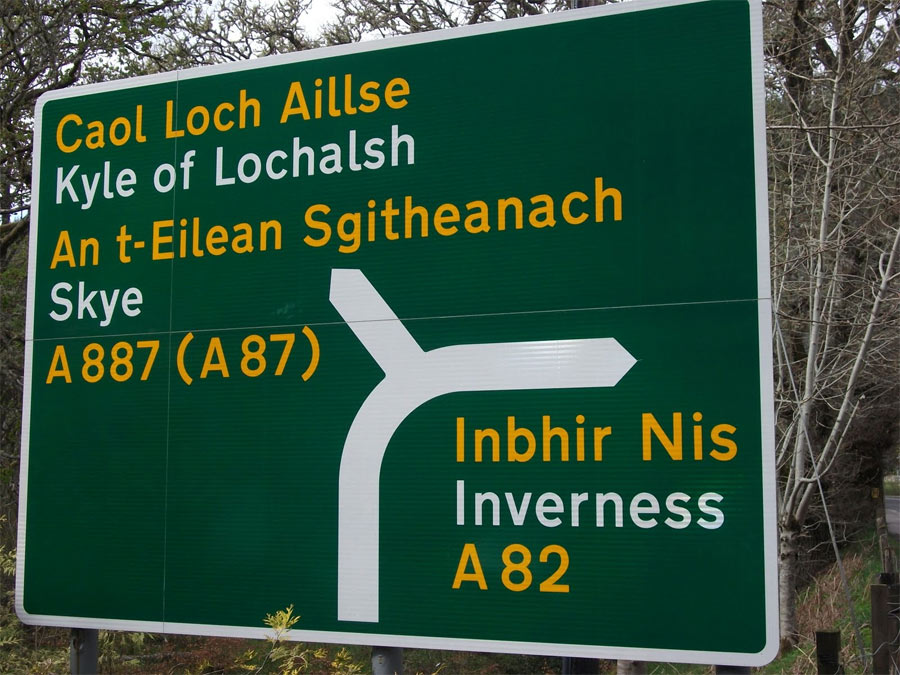
Bilingual Scottish Road Sign
One of the experiences that stood out the most on my Highland adventure a few months back was the amount of Scottish Gaelic I encountered. From road and railway station signs, to the greeting displayed on the entrance to McDonalds in Inverness, this was my first encounter with Scotland’s oldest surviving spoken language. It’s something you don’t really come across in Edinburgh, either because the language is spoken by less than 2% of the Scottish population, or because Lowland Scots has been the traditional form of speech in the south.
Sadly Scottish Gaelic has been in steady decline for quite some time. 100 years ago the amount of bilingual Scots numbered 183,998. At the time of the last census in 2001, only 58,652 people were registered as bilingual in Gaelic. Nevertheless, the language is in the midst of a government supported revival. BBC’s Gaelic television station Alba reportedly gets on average 530,000 viewers per week, and Edinburgh’s Gaelic primary school is currently at full capacity, prompting a relocation to a larger campus later in the year.
Apart from place names, I had never spoken a word of Gaelic in my life until last Friday when I attended a Gaelic harmony singing workshop. Held at the Scottish Storytelling Centre on Edinburgh’s Royal Mile, I arrived a little early and sat trying to figure out how to pronounce the lyrics on the handout I’d received. I have never encountered a language quite like it before – the words are pronounced entirely differently to how you would expect them to sound. This makes reading Gaelic when beginning to learn a little bit perplexing. I found it much easier to watch and listen to how it looks and sounds, mimicking rather than trying to read.
The workshop was lead by well-known Gaelic singer Gillie Mackenzie. Gillie grew up in Lewis but now lives in the Lothians, and has been singing ever since she can remember. Family ceilidhs instilled an early understanding of vocal harmony and she fondly told us how her and her sisters would sing and harmonise together in Gaelic while doing the dishes at home. Gillie currently teaches Gaelic song and conducts the Gaelic choir at Bunsgoil Crois na Cìse (the Gaelic medium unit at Edinburgh’s Tollcross Primary School), and recently began a Gaelic choir at James Gillespie’s High School. She released her first solo album entitled Griais in 2012 and is currently touring with her band.
We began by singing two traditional songs (Tobair Tobair Siolaidh and ‘S Toigh Leam Fhin Buntat ‘s ìm); first as a group, then combined with different vocal harmonies, and finally in round. It sounded absolutely glorious and I wondered if the tourists just outside the window walking up and down the high street could hear us singing in ancient Scottish tongue. The first few times we went through the song I felt completely lost with the language, but as we repeated the song my mouth was slowly becoming accustomed to this new way of speaking. We then learnt a beautiful song called Gleanna Gollaidh by Robert Donn (1714-78). Donn was a well-known bard hailing from Sutherland (Mackay country), with this particular song praising a glen in his district:
Gleann-a-Gallaidh, Gleann-a-Gallaidh, (Glen Gollaidh, Glen Gollaidh)
Gleann-a-Gallaidh nan craobh, (Glen Gollaidh of our trees)
Cò a chì e nach mol e, (Who can see it without praising it?)
Gleann-a-Gallaidh nan craobh. (Glen Gollaidh of our trees)Ri faicinn crìoch àrdain (Seeing the abutment of its elevation)
Ga mo bhreugadh gu taobh, (Drew me aside)
‘S ann a smuainich mi fanadh (Indeed I thought of staying in)
An Gleann-a-Gallaidh nan craobh. (Glen Gollaidh of the trees)Chan àill leam bhur n-airgead (I don’t desire your money)
‘S ri bhur n-arm cha bhi mi, (And I’ll never join your army)
Cha diùlt mi bhur drama (I won’t refuse your dram)
Ach ri tuilleadh cha bhì. (But I’ll do no more than that)Ged a gheibhinn gu m’ àilgheas (Though I might get to my desire)
Ceann-t-sàile MhicAoidh, (Mackay’s Kintail)
‘S mòr a b’ annsa leam fanadh (More I fancy staying)
An Gleann-a-Gallaidh nan craobh. (In Glen Gollaidh of the trees)Fonn diasach, ‘s mòr a b’ fhiach e (Bountiful land, much of its value)
Gu fiadhach ‘s gu nì, (For stalking and cattle)
Aite sìobhalt ri doineann (An agreeable place in time of storm)
Is nach criothnaich a’ ghaoth. (In which the wind will not shudder).
Coincidentally, Donn was writing poetry around the same time as the 1745 Jacobite Rising. An ardent Jacobite supporter, Dunn upset the Hanoverian chief of Clan Mackay by writing this poem about the rising:
Now, young Charles StewartEvery clan places its hope in youThat sought to crown youAnd set the country alight;They’re like hidden snakesWhich cast their skins last yearBut are making ready their fangs
To arise on the day of your coming

Waulking in Iochdar, South Uist, June 1970
We finished the workshop with an Isle of Lewis waulking song called Bodachan Cha Phòs mi. These songs were traditionally sung by women waulking cloth and were an institution in female Gaelic society. This practice involved a group of women beating newly woven tweed rhythmically against a table or similar surface to soften it. As the singers worked the cloth, they gradually shifted it to the left so as to work it thoroughly. Typically one person would sing the verse, while the others joined in the chorus. A night at a waulking was a tremendous social outlet for women. The songs have a strong element of gossip in them, of exchanging secrets, of comments on men, good and bad. Although some songs were light-hearted and trivial, many were intimate, frank, intensely vivid, and expressive statements of women’s experiences.
A week since the workshop, I’m suprised at how well I have remembered the melody and the language I learnt. I have quite often found myself humming the songs, especially the beautiful Gleanna Gollaidh. Sadly the only statistics I can find online regarding Scotland’s Gaelic speakers date from 2001, but I would love to know if efforts since have increased the number of speakers of this fascinating language.
——-
You can listen to Gleanna Golaidh by visiting the BBC’s Year of Song website here, and they also have a great ‘teach yourself Gaelic’ website for absolute beginners called Beag air Bheag.
Another great resource for Scottish oral recordings is Tobar an Dualchais where you can hear many Gaelic recordings.
The post Òrain Gàidhlig – Scottish Gaelic Song appeared first on ScotClans | Scottish Clans.
]]>