The post Home to Hume appeared first on ScotClans | Scottish Clans.
]]>
Clan Hume Gathering at Hume Castle, 08/09/2013
Earlier in September Amanda and I traveled to the Scottish Borders to spend an afternoon at Hume Castle, where part of this years Clan Hume/Home gathering was taking place. Held every five years, the gathering provides a way for clan members to connect in person with one another, while learning about their heritage and exploring the lands from which the clan once hailed. This years gathering was especially important as it coincided with the 500th anniversary of the Battle of Flodden – a 16th century battle between Scotland and England where various clans including Clan Home suffered many casualties.
The 2013 gathering was by far the largest international congregation of Homes on record, with almost 200 clan members attending from as far away as Australia, New Zealand, South Africa, Canada, the United States and Norway. Events at the four day meeting included genealogy workshops, ex-Home estate tours, the raising of the Home banner at Hume Castle and a visit to the Flodden memorial in Northumberland.
A well-known and respected Borders family, Clan Home were known as peacemakers, in contrast with another Borders family – Clan Douglas, whose reputation for harrying the English made them well-known as warriors. The name Home comes from the old English word for a hilly outcrop (Hôm), which is what Hume Castle sits upon. The name has also been spelt in many different ways over the centuries, but is always pronounced Hume.
We arrived in the Borders with a bit of time to spare, so stopped off at Floors Castle before making our way to the events at Hume Castle. Floors is the seat of the Duke of Roxburghe, and lies just outside Kelso on the banks of the River Tweed. The 5th Earl of Roxburghe (1680–1741) was instrumental in securing the union of England and Scotland in 1707, and was rewarded by being named the 1st Duke of Roxburghe. Floors was also once the home to the chief of Clan Innes, however when the twenty-fifth chief and 4th Duke died without a heir in 1805, the chiefly line ended. His successor who inherited the lands and peerage through the female line was obliged to take the double barreled surname of Innes-Ker, and hence was not recognised by the Court of Lord Lyon as chief of the name Innes. To this day Clan Innes is still without a chief.

Floors Castle, Scottish Borders
10 minutes down the road by car sits the remains of Hume Castle, the spiritual home of Clan Home. The lands were acquired by William de Hume in the early 13th century, who built the first stone fortifications on the site around this time. Hume was the only Borders castle not destroyed during Robert the Bruce’s scorched earth policy of 1313, and was also where King James II of Scotland was staying during the siege of Roxburgh (1460), when a canon he was firing exploded and killed him instantly. Today the preservation of the castle is maintained by the Clan Home Association, under the auspices of Historic Scotland.

Hume Castle, Scottish Borders

Chief of Clan Home/Hume
In the courtyard of the remnants of the castle, clan and association members and other special guests (including a whos-who of dignified Border families) gathered to hear stories about famous Homes including the philosopher David Hume (1711-1776). Hume started at Edinburgh University at the age of 12 and went on to become one of the leading lights of the Scottish Enlightenment. The gathering was then treated to a performance by Scottish folk singer Isla St Clair who spoke of her love for border ballads and the stories behind the songs. The afternoon was closed off by the 15th Earl of Home and current chief of Clan Home David Douglas-Home CVO CBE, who read from his father’s autobiography Where the Wind Blows. The chief is the only son of former Prime Minister Sir Alec Douglas-Home. Following the reading, I spoke to the chief briefly about this year’s gathering where he told me how clan members from at least 10 different countries were in attendance. He said the 2013 event was definitely the biggest gathering they’ve had, probably due to the event coinciding with the anniversary of Flodden.
With so many clan members hailing from overseas, I was interested in hearing how factions of Homes had ended up in each corner of the world. A South African contingent from Port Elizabeth told me how they descended from David Hume (born 1797 in Berweckshire) who arrived in South Africa in 1817. Hume was part of the settler party of 195 Scottish laborers and mechanics who bought out to South Africa by Captain Benjamin Moodie. He became and explorer and trader in South Africa, with one descendent telling me that Hume was in fact the first European to see Victoria Falls (not Scottish missionary and explorer David Livingstone). Hume’s South African descendents told me the reason they came to the gathering is because they feel their spiritual home is in Scotland. “The depth of history and heritage here is like nothing we have at home. It’s always important to know and understand your heritage and to be part of something bigger.”
The group from Norway traced their Home ancestry to a more recent time, when during the second World War a young Scottish woman named Frances Hume met a Norwegian man and emigrated there. This was their first time at a Home gathering, and they told me it was very important for them to know their story about where they came from, and to meet members of their Scottish family. Pam Hume and her husband were in attendance from Indiana – she said she didn’t know anything about the clans of Scotland or her Scottish ancestry until her cousin came across Hume Castle online. “I just thought the castle was four walls that happened to have our name.” Pam’s ancestry journey, as a result of her cousin’s discovery online, brought her to the gathering, where she discovered that there are a cluster of Humes living in Indiana less than 100 miles apart.

Interviewing the Norwegian Humes
William Cooley and Barbara Hume traveled from Vancouver for the gathering, and said they discovered the clan when organising a Hume family reunion in 2007. They sent a photo of the reunion to the association, who were very pleased to find out what had happened to the Canadian line of the Humes. Barbara told me the gathering was a great way to meet people and form new friendships with people across the world. The final overseas attendees I spoke to hailed from the Netherlands. Anegla Hume and her daughter Charlotte can trace their ancestry to an English faction of Clan Hume. Angela found the clan association through Wikipedia and decided to become involved as a mark of respect to her ancestors. “It’s important not to forget, as you learn more and more about the history it’s like they come back to life.”
With so many of the attendees using the internet to discover their roots and learn about their clan, it’s clear that this is the way forward for clans and their associated societies. The Clan Home gathering was a fantastic example of a well-organised clan who have used the internet to gather clan members from all across the world, bringing them back to their ancestral home.
You can view an album of photos from the event over at TartanFootprint.com
The post Home to Hume appeared first on ScotClans | Scottish Clans.
]]>The post Flodden Battlefield Grave Search Begins appeared first on ScotClans | Scottish Clans.
]]>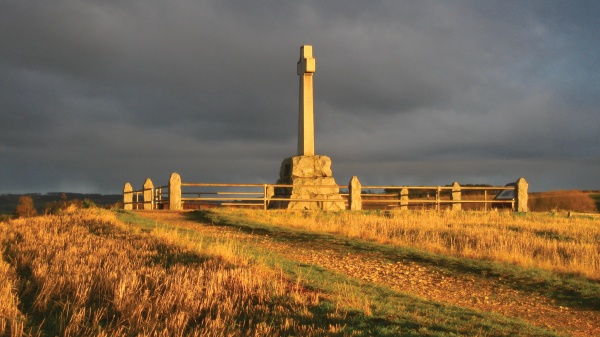
A memorial to the fallen at Flodden
Archaeologists and volunteers are set to begin the search for body pits from Scotland’s worst ever battlefield defeat. Beginning work in early September, archaeologists hope the successful location and excavation of the mass graves of the Battle of Flodden could lead to their official designation as war graves and thus granted protection under law as ancient monuments.
Located in Northumberland, around 10,000 Scottish troops were thought to have died in the 1513 battle, which ended a disastrous invasion of England. The Flodden 1513 Ecomuseum Project is seeking volunteers to help with the dig, saying bodies of fallen troops will be identified but not exhumed.
Christopher Burgess, the Flodden 1513 Project Archaeological Manger explains the background further: “We are acutely aware that these are war graves and will be treating any remains found with the utmost respect. There is an overriding aim to locate these body pits so that the last resting places of some of the dead of both nations who fell on Flodden Field 500 years ago can be protected.”
Alistair Bowden, a project manager at Flodden 1513, said Ordnance Survey mappers found four burial pits in the 19th century. He said: “There are four body pits in those early maps. But they’re not registered or protected.” New techniques could mean the team will unearth more body pits, and archaeologists are hopeful more resting places will be discovered.
The 9th of September 2013 marks the 500th anniversary of the battle, and to commemorate a large number of Clan Home/Hume members will visit the historic site on the exact day the battle was fought. The Homes fought under the then Lord Home against the English. Over 100 members are flying in from Australia, New Zealand, South Africa, the USA, Europe, Canada and the British Isles.
The post Flodden Battlefield Grave Search Begins appeared first on ScotClans | Scottish Clans.
]]>The post Flodden – The little known battle that changed history appeared first on ScotClans | Scottish Clans.
]]>In 1513 Henry was suprisingly – young, handsome and athletic, he was the renaissance prince. Henry VIII would not secure his throne until after the Battle of Flodden.
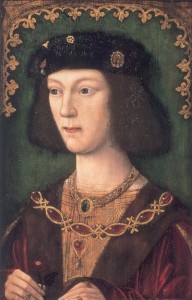
Young Henry VIII
Leading up to Flodden
It was turbulant times between England and Scotland as well as France ‘The Auld Aliance’. It was Henry’s marriage the Spanish princess, Catherine of Aragon, this linked up not just Spain, but Germany as well through her relatives and the Empires they ruled. If war was to come from France then with these new allies France would surely be crushed. Henry was trying to proove he was the rightful King of England, to do so he revived the ancient English claims to the throne of France. Catherine’s relatives happily agreed to support him. In 1511, Henry led an Anglo-Spanish invasion of Aquitaine, once an English possession. Thanks to the pope, Henry was recognised as King of France and the pope promised to crown him in Notre Dame if Louis was defeated. In 1512 the English held the port of Calais and defeated the French at the Battle of the Spurs, so called because the French knights spurred their horses in a desperate attempt to flee.
Here come the Scots!
Louis’ cause seemed lost but he had a trump card: the ‘Auld Alliance’ with Scotland. Louis sent ambassadors to Edinburgh who urged the Scottish King James IV to invade their mutual enemy from the north and force Henry to fight on two fronts. With Henry and the bulk of the English army fighting in France, James realised the opportunity to extend Scotland’s borders to the humber, or even Thames, was too good to miss.
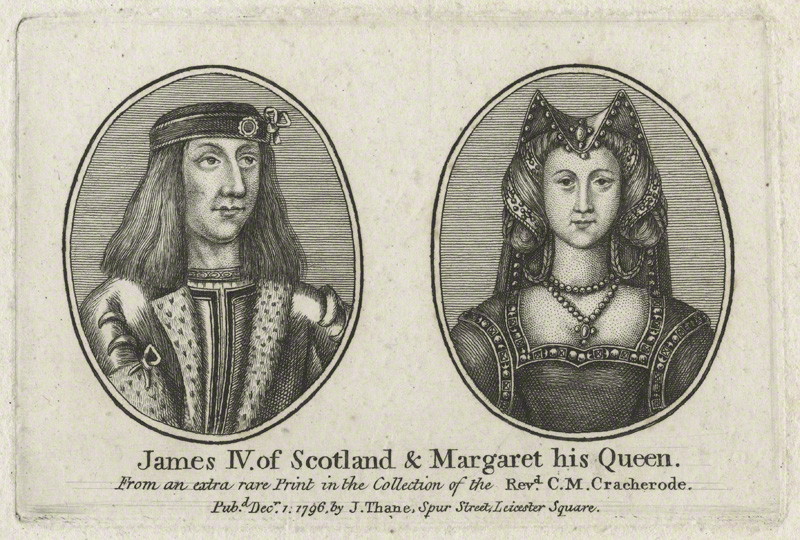 Ignoring the protests of his Tudor wife, James sent a letter to Henry, who was besieging the French town of Thérouanne, ordering the English king to raise the seige and return home to face war with Scotland. Henry angrily replied that James, as his brother-in-law, should join him in his war against France and warned that England’s northeren border was well defended. James ignored these threats and left Edinburgh on the 19th of August 1513 with an army of 30,000 men.
The Scots crossed the River Tweed on 24tg of August and besieged the English castles of Ford, Etal, Wark and Norham. James’ powerful train of artillery quickly pounded the English fortresses into submission but the heavy guns had to be dragged by teams of plodding oxen and this slowed the Scots’ progress. By the 19th of September, the Scots army had only just reached the village of Branxton, just five miles south of the Tweed, and were encamped on a low hill known as Flodden Edge. Meanwhile the commander of England’s northern armies, Thomas Howard Earl of Surrey, was marching towards the Northumbrian town of Wooler which he reached on the 7th of September. Here, as the laws of chivalry demanded, Surrey sent a message to the Scots’ King offering battle.
The Battle of Flodden
 James agreed to fight at noon on Friday the 9th of September. This delay allowed Surrey to position his army between the Scots’ camp at Flodden and the River Tweed, thus cutting off James’ line of retreat. James saw this manoeuvre but ordered his men not to open fire on the English because it was not yet the appointed time for the battle to begin!
The English drew up in a line below the Scots on the hilltop. Surrey’s hastily assemblrd army was armed with old-fashioned longbows and ‘bills’, a poleaxe eight feet long which combined a viscious, hooked, axe-blade with a spear point. By contrast, the Scots were armed with ‘modern’ weapons, namely arquebuses, an early form of musket, and pikes 18 feet long. The battle began with an exchange of artillery fire but the Scots guns on the top of the hill could not be depressed low enough and most of the Scottish culverin balls flew harmlessly over the English heads. Still thinking in terms of chivalry instead of tactics, James ordered his men to abandon their good defensive positions and advance towards the enemy. As the Scots marched down the slope, they were met by a storm of English arrows but, unlike at Crecy or Agincourt where the English bows had caused chaos in the French ranks, the Scots kept good order.
Battle was joined in the boggy ground at the bottom of the hill where the difference in English and Scottish weaponry became decisive. The unwieldy pikes, which kept the English cavalry at bay during the Battle if Bannockburn 200 years before, proved to be ineffective against English infantry carrying bills. The Englishmen simply chopped the tops off the Scottish pikes then disembowelled the defenceless pikemen.
 The battle became a slaughter. After just a few hours of butchert, between 10,000 and 12,000 Scotsmen, more than a third of James’ army lay dead on Flodden Field. Amongst the mangled corpses were the bodies of King James himself and scores of his nobles. The chronicler Robert Lindsay, writing 50 years later, lamented that every titled family in Scotland had lost at least one man at Flodden.
After Flodden
It is often said that the slaughter of the Scottish nobility at Flodden ended Scotland’s ability to function as an independent nation and thus paved the way for the uniting of the kingdoms of Scotland and England as Great Britain. Whilst this is undoubtedly true, it is only half the story. Though the Scots lost the battle of Flodden they did not lose the thousand years’ long Anglo-Scottish War and the seeds of Scotland’s ultimate victory were sown in the blood-soaked mud of Northumberland.
In 1603, ninety years after Flodden, the last Tudor monarch, the childless Elizabeth I, died an the English crown passed to James IV’s great-grandson also called James. Thus James VI of Scotland became Jamrs I of England. Though, in 1714, James’ direct descendants would lose the crown to their German cousins, the fact remains it was a Scottish King that finally ascended the English throne and not the other way around.
The Legacy of Flodden
The true significance of Flodden is that it delayed the almost inevitable unification of England and Scotland by almost a century and in that century the Protestant Reformation took root both North and South of the Border. If, instead of dying at Flodden, James IV had fulfilled his boast of ‘capturing York by Michaelmas’, then the French would have invaded England and restored the Yorkist pretender, Richard de la Pole, to the Engish throne. Indeed, in 1513 Richard, the last ‘White Rose’, was busy recruiting an army of 12,000 French mercenaries when the knock-on effects of Flodden forced him to pursepone his planned invasion.
If Henry VIII had been deposed, then there would have been no neef for a desperate search for a male heir to continue the Tudor dynasty. As a result there would have been no split with the Pope and no /church of England. Similarly, if James IV had lived, Scotland might have avoided the religious and political chaos that followed the disastrous reign of Mary Queen of Scots thirty years later.
 But, for good or ill, Protestantism did florish in Britain and it fuelled the next two centuries of civil strife in England and Scotland which ultimately ended the absolute power of the monachs in Britain. Later, the British would export their new-fangled ideas about democracy and political freedom, forged during these civil wars, to their colonies in America and around the world. It’s therefore no idle boast to say that without Henry VIII’s victory at Flodden, world history would have followed a very different path. Yet for all this importance Flodden remained largely forgotten … until now. As we approach this momentous battle’s quincentenary, there are plans to use a new concept in museums to restore Flodden’s rightful place in British, European and world history.
The post Flodden – The little known battle that changed history appeared first on ScotClans | Scottish Clans.
]]>The post Martin Fowler’s Graphic History of Scotland appeared first on ScotClans | Scottish Clans.
]]>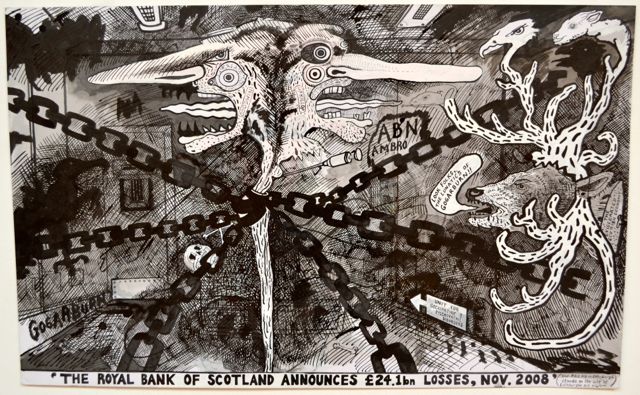
The Royal Bank of Scotland – Martin Fowler
Compiling 500 years of Scottish history is by no means an easy feat. Countless pages of history books burst at the seams with tales of battles, inventions, kings and queens, acts of law, migration, song – it’s hard enough to even pick where to begin. However, Scottish artist Martin Fowler has done just that, compiling his picks from the last 500 years in an astute new exhibition that serves as a catalyst to examine Scottish identity through history. Entitled Scotland the Brave – A Graphic History of Scotland 1513-2013, the exhibition features ink drawings that document the ‘warts and all’ side of Scotland’s story.
Works in the exhibition currently on show at the Scottish Storytelling Centre in Edinburgh range from monumental events such as the battles of Culloden, Bannockburn and Flodden, to more recent events such as the near collapse of the Royal Bank of Scotland, the Housing Act of 1980, Edinburgh’s tram debacle and the opening of the Scottish Parliament in 1998. The Relegation of Rangers FC and the comical disaster of the 1978 World Cup campaign also make an appearance – after all, it wouldn’t be a history of Scotland without the mention of football. The series also explores darker and often overlooked issues such as the arrival of the AIDS epidemic in Edinburgh in the 80s, Scottish self-hatred (a term coined by writer Irvine Welsh) and issues within the prison system where Fowler once worked with prisoners as an art teacher.

A Concise History of North Sea Oil – Martin Fowler
The exhibition serves as an aide-mémoire to Fowler, who said the drawings act as a way to understand and remember events from history. Fowler comes from a generation of Scottish children who were taught a distinctly English history at school, rather than the history of the country in which they were born and raised, saying: “At school there were no references to the Scottish Enlightenment, even though I grew up and went to school in Edinburgh where it happened. I didn’t even have an opinion on it.” Cynicism and satire are employed within some works as a way to critique the madness, as seen in A Concise History of North Sea Oil. Fowler said this piece attempts to address the lies and falsehoods surrounding the use of Scotland’s oil reserves, especially during the Thatcher years.
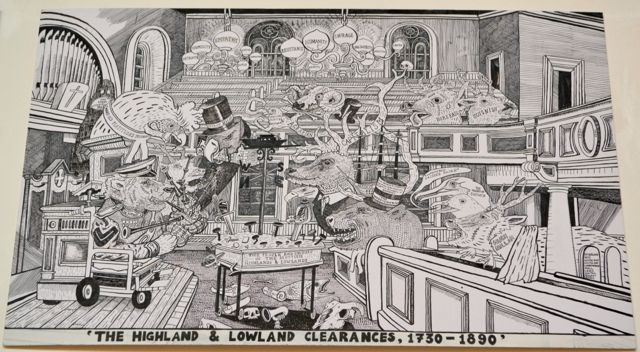
The Highland and Lowland Clearances – Martin Fowler
Fowler chose events based on those he had emotional engagement with, providing an alternative history and another way of looking at events that have often had a prescribed ‘John Prebble’ treatment. In his piece on the Highland Clearances, Fowler references the often overlooked role that women played in resisting landowners moves to clear land. This often resulted in heavy handed police brutality, riots and even deaths. He told me a story about the women of Coigach, where in 1853 attempts were made to clear families from the lands around Coigach in Wester Ross. The women defied orders to leave, and proceeded to strip the Sherrif in command of his clothes, destroying the summons he came bearing. He was then put into a boat, returning to Coigach absolutely nude and humiliated. Martin said the events surrounding the clearances are one of the events in the exhibition that have had the most impact on national identity, saying a sense of loss still exists in the Highlands to this day – something that is vitally important to Scotland’s sense of self.
Another piece in the exhibition looks at the Darien Venture in which Scotland unsuccessfully attempted to become a world trading nation by establishing the colony of Caledonia in Panama around 1690. Fowler said he didn’t know anything about the venture before he began this project, discovering the resulting economic and social situation in Scotland lead to one of the most important parliamentary acts being passed. The venture sucked half of the wealth out of Scotland, weakening the country’s resistance to the Act of the Union which was passed in 1707.
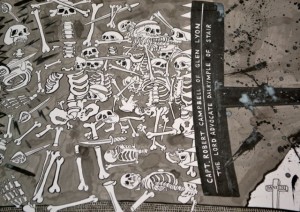
Detail – The Massacre of the MacDonalds of Glencoe
Fowler’s style has similarities with that of comic-book journalist Joe Sacco, saying he was influenced by the political and social satires of English caricaturist James Gillray. Fowler is currently living in Carlisle where he is a Senior Lecturer in Drawing and Fine Art at the University of Cumbria.
As Scotland looks towards the future in 2014, perhaps it’s useful to look back in time to see how Scotland’s identity has been shaped by the past. Not only has Fowler created an accessible collection of work but also one that shows a comprehensive appreciation of Scotland’s deep and rich history of the last 500 years.
You can see Scotland the Brave at the Scottish Storytelling Centre on the Royal Mile until the 28th of July 2013. Fowler will also be giving a talk about the exhibition on Saturday 20th July at 1pm where he will discuss how the collection came about and offer an insight into the practical and technical aspects of his work. All pieces in the exhibition are for sale and you can view more of his work here.
The post Martin Fowler’s Graphic History of Scotland appeared first on ScotClans | Scottish Clans.
]]>