The post BBC on the lookout for Canadian/American descendants of the Marloch & Metagama appeared first on ScotClans | Scottish Clans.
]]>Within two weeks in 1923, two ships carried approximately 600 people from the Outer Hebrides of Scotland to their new home in Canada.
At the time most Scottish emigrant ships were leaving from Glasgow, however the April 1923 voyages of the SS Marloch and SS Metagama embarked first from Glasgow, then stopped en-route to pick up passengers in Lochboisdale and Stornoway respectively.

The Marloch set sail for St John, New Brunswick from Lochboisdale on the 15th of April 1923. On board were at least 50 families from the southern outer islands of the Outer Hebrides, including Barra, Eriskay and North and South Uist. Over 300 men, women and children were on their way to the Clandonald colony in the Red Deer area of Alberta.
When the Metagama sailed for from Stornoway on the 23rd of April 1923, the ship contained 300 people mostly from Lewis with an average age of twenty two – all but twenty were young men. They were on their way to Montreal, Quebec.
The BBC is keen to hear any personal stories from any Canadians or Americans descendant from those who boarded either ship in Lochboisdale or Stornoway in 1923. Similarly, any stories from people descendant from those who stayed behind in the Scotland will be gratefully received.
You can contact researcher Nadine Lee by e-mail nadine.lee02@bbc.co.uk or by phone +44 1224 384 816.
The post BBC on the lookout for Canadian/American descendants of the Marloch & Metagama appeared first on ScotClans | Scottish Clans.
]]>Following the war, Sir Douglas Haig was promoted to the peerage as the Earl Haig; he was then instrumental in setting up the British Legion and the Poppy Appeal - two institutions with the purpose of raising funds and providing help and welfare for soldiers and their families, which is very much the legacy of this most controversial of Scotsmen.
The post The Earl Haig – A Study in Controversy appeared first on ScotClans | Scottish Clans.
]]>
Field Marshall Haig
Charlotte Square is the jewel in Edinburgh’s New Town, a wonderful expression of Georgian architecture and understated majesty. On the north side of the square facing the statue of Prince Albert is pseudo-palatial Bute House, the official residence of the First Minister of Scotland; in the southeast corner is the birthplace of Alexander Graham Bell, the inventor of the telephone, and it was here that Joseph Lister, the pioneer in anaesthetics lived and worked. It was here too in 1861 that one of Scotland’s most controversial figures was born: Field Marshal Sir Douglas Haig.
As we approach another Remembrance Sunday, when the Queen leads the nation in commemorating those who fought and died for king and country, we look back and reflect. The bloody First World War came to an end with an armistice truce that became effective at 11.00am, on the 11th day of the 11th month in 1918 – and since then, that moment has been remembered across the nation. In the lead up to the formal ceremonies and minutes of silence, Britons proudly wear their red poppies on their lapels, as mark of their respect and gratitude. It represents the vast poppy fields that bloomed across France and Belgium over the battlefields that claimed so many.
The poppy wearing tradition raises much needed funds which support veterans and their families. It began the early 1920s following the establishment of the British Legion in 1921. For the last 90 years the Legion has helped the old soldiers, provided a social club where they can meet, and generally been at the forefront of their welfare. One of the founders of, what is now the Royal British Legion was the Earl Haig, and in the years following the First World War he was instrumental in using his influence and importance in making sure that those returning from this and every conflict would be cared for and have a support structure. It is one of the greatest legacies of a man vilified in many quarters as the Butcher of the Somme.
By 1916 the war in the Western Front had disintegrated into a bloody war of attrition. Both the British and French on one side, and the Germans on the other were ensconced in mile upon muddy mile of trenches, stretching from the Alps to the North Sea. For most of the time it was a tedious existence for the millions of mainly volunteer soldiers; occasionally punctuated by a foray into No Mans Land, where almost inevitably the men were caught up in barbed wire or cut to ribbons by machine gun fire and artillery. It was a horrible existence. That spring the Germans launched a massive attack on the French position of Verdun. There was little strategic value to the old medieval city, but it was a symbolic site for the French. A position they would defend to the last man – and that was very much the German plan.
Earlier in the year the British supreme commander, Sir John French had been replaced by Sir Douglas Haig following a series of public disasters. Haig was a golden boy in certain circles and his promotion was encouraged by The Secretary of State for War, Lord Kitchener, and the king. He did have his detractors too, including David Lloyd George, which would cause issues as the war dragged on. He brought a sort of fresh outlook to the table, but his caution was a concern for the French High Command.
The French were getting pummelled at Verdun, and insisted their British allies launch a counter offensive in the early summer to relieve the pressure. Haig felt his army of volunteers weren’t ready, and preferred to hold off until August. In no uncertain terms the French commander, General Joffre told the British that unless a major operation was carried out as soon as possible, the “French army would cease to exist”. Pressure was put on Haig by the government at home, and he and his staff began preparations for an offensive in the Somme valley.
It was to be an attack on a truly awesome scale. In the week beforehand the German lines were bombarded with shellfire, so loud that it could be heard on the outskirts of London – it was the greatest deployment of artillery in the history of warfare to that point. The British believed that the enemy trenches would be so utterly destroyed that the soldiers would simply walk over no man’s land and take them. In reality, the huge bombardment had virtually no effect at all. Also, the barbed-wire that needed to be blown away by the guns as a necessity remained in many places pretty much intact.
The Battle of Somme began on the 1st of July 1916, when hundreds of thousands of British and allied soldiers left their trenches and went ‘over the top’. They were met with a hail of bullet and mortar fire from the German positions. It was a slaughter. On that first day there were 60,000 British casualties – the worst single day in British military history. And day, after day the Generals sent the men up and over, convinced that the breakthrough would come: it didn’t. There were several phases of the battle, and it saw the first introduction of the tank, but by the end in November the allies had only advanced 7 miles. The cost in lives and injured is mind-numbing – British and Commonwealth: 420,000; French: 204,000 and German: 465,000.
Much of the blame for this loss of life to success gained was placed on the shoulders of Haig and his generals; Lloyd George did much to expound this belief. However, modern scholars have revisited the battle and realised that it would have been hard to avoid these casualties in any event, and that it did have the effect of relieving Verdun and letting the French regroup. It also dealt a huge blow to the German army, which wobbled a bit. It is now considered by some that without the Somme offensive, the war may not have been won by the allies at all.
Haig was made a Field Marshal by the king, who thanked him in a personal note. Much as Prime Minister Lloyd George loathed the commander, he simply couldn’t get rid of him. So, he spent much of his time after the war discrediting him, and many of his memoirs form the basis of the British image of Haig. In 1917 Haig launched another offensive, known as the Battle of Passchendaele. The weather conspired against him as much as German resistance and again the high casualty figures for little gain seemed to highlight the incompetence of Haig and his command.
However, Haig’s fortunes turned and in 1918 he at last broke though what by then was a thoroughly demoralised German force. The German Empire was collapsing, and with the arrival of the Americans in 1917 allied victory was assured. Haig masterminded the final assaults and in November the Germans surrendered. The ‘Butcher’ had now won the war. Many said that it came at too high a price and that the campaigns were an unacceptable waste of men. However, through the looking glass we can see that these battles took so much out of the Germans, that their demise became inevitable. The cost was high, yes – but the war was won.
Begrudgingly, and probably at the king’s insistence, Haig was raised to a peerage, and created the Earl Haig. For the rest of his life he remained hugely popular with the veterans and soldiers; and his dedication to their welfare casts a very different light on the man. He died in 1928 in London; he then lay in state in Edinburgh before being buried at Dryburgh Abbey in Borders near his family’s ancestral home.
Whatever your opinion of Field Marshal Sir Douglas Haig, whether cold-hearted butcher or the man who won the bloodiest war fought in Western Europe; there is no doubt of his influence and contribution both to our psyche; and to the nation.
For more information on the Royal British Legion Poppy appeal – www.poppy.org.uk
This article was written by David McNicoll, owner of Vacations Scotland - a travel company specialising in Scottish vacation packages, including historical, family heritage and tailor-made tours – www.vacationscotland.biz
The post The Earl Haig – A Study in Controversy appeared first on ScotClans | Scottish Clans.
]]>The post History of Kilts Worn in Battle appeared first on ScotClans | Scottish Clans.
]]>All over Scotland and Ireland in ancient times people relied on a simple shirt over which they would wear a blanket for outdoor activities in cold weather. The shirt was a ‘Léine’ in Gaelic, or ‘Sark’ in Lallans. The blanket (or ‘Brat’) could be used also as a cover against the elements if sleeping outdoors, or while taking shelter from a storm. The weather-keeping qualities of wool are still known in modern Scottish knitwear.
The Leine worn by warriors is shown to be shorter than the ankle length tunic worn normally. A belt was used to make the tunic shorter giving the soldier the ability to move quickly and easily.
 One of the first references to a ‘Great Kilt’ worn as a military garment was in 1594.
in ‘The Life of Red Hugh O’Donnell’ in a description of a corps of Hebrideans who had come to The O’Donnell’s assistance:
“They were recognised among the Irish soldiers by the distinction of their arms and clothing, their habits and language, for their exterior dress was mottled cloaks of many colours with a fringe to their shins and calves, their belts were over their loins outside their cloaks.”
In the 1700′s there were two distinct societies in Scotland regarding what their soldiers wore. The Lowlanders wore uniform of English line infantry, while the Highlanders wore kilts. The only exceptions were: 71st, 72nd, 73rd, 74th, and 75th regiments, they didn’t were kilts. The 42nd is the oldest and the most famous of units of Scotland. The regimental motto is ‘Nemo me inpune lacessit’ (No one attacks me with impunity). The first companies of the Black Watch were raised as a militia in 1725 . The regiment’s name, Black watch, comes from the very dark tartan (a cloth having a crisscross design, tartan that they wear). ‘Black Watch’ was originally just a nickname for the 42nd (Royal Highland) but was used more and more so that in 1881 when the 42nd amalgamated with the 73rd the new regiment was named ‘The Black Watch (Royal Highlanders). During the First World War the kilted Highlanders were known as ‘The Ladies from Hell’.
The Kilt as we see today worn as the wrap around pleated garment was known as the ‘Small kilt’ or ‘Philabeg’. This evolved from the ‘Great Kilt’ , the need for a lighter version of the kilt was required, the Great Kilt was no longer practical, especially as a military uniform.
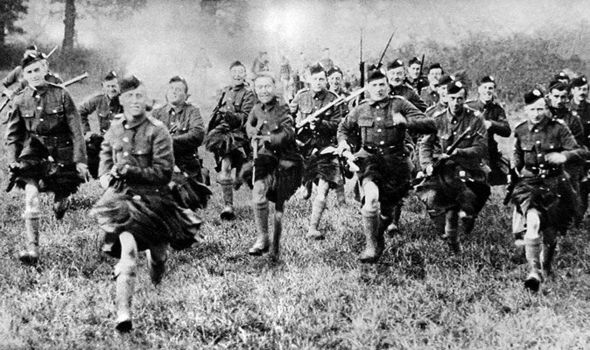
Scottish soldiers charging in their kilts during the First World War
The question of how the great kilt evolved into the or small kilt is a matter of some controversy (there are some that say it was even invented by an English man!) The other school of thought is that the small kilt had already been invented, there is evidence that highlanders attached to the Scottish Army had separated the kilt and the plaid worn over the shoulder wearing them as two separate articles making them easier to wear.
The “little” kilt was adopted for use by the military as soon as the expense and cumbersomeness of the “great” kilt was seen (i.e. by 1800). When the army dispensed with the great kilt and opted for the small kilt box-pleating was introduced to economise on the amount of material being used. When the pattern was matched, the style was to centre the same line on every pleat (“pleating to the line”).
Glengarry caps are a military invention of about the 1820′s, not adopted for regulation use until the 1850′s. Sgian Dubhs (or some such knife) were normally carried under the jacket until officers of the Black Watch started sticking them in their kilt hose in the 1840′s, then it caught on with everyone else.
 The reputation of the Highland regiments, especially during the Napoleonic Wars, lent a new prestige and glamour to the wearing of tartan. These battalions had been specifically exempted from the ban on Highland dress in the Disarming Act Of 1746 and thereafter the kilt came to be forever associated with the heroic deeds of the Scottish soldier. By the end of 1803, more than 52,000 Scots were serving in local and militia forces, in addition to the greater numbers enlisted in the regular army. The military tradition had long been an important part of the Scottish identity; now that was being decked out in Highland colours and the kilted battalions of MacKenzies under the Earl of Seaforth, Camerons under their Chieftains, Locheil and Erracht, were depicted as the direct descendants of the clans. Crucially, however, they now represented the martial spirit of the Scottish nation as a whole rather than a formerly despised part of it. And they fought for a Britain dominated by English needs as they forged an Empire worldwide.
 The Scottish infantry during the Great War were, arguably, the most distinctive of the British Expeditionary Force.
Scottish regimental uniform details can also be split into ‘highland’ and ‘lowland’ styles. The highland regiments were, perhaps, the most distinctive and instantly recognisable as they wore the kilt, for the most part, on active service. This was frequently worn with a protective khaki kilt apron, which had a pocket on the front to replace the sporran. Sometimes, as an alternative, the gas helmet haversack was worn at the front of the kilt instead. Despite its greatest drawback (namely extreme vulnerability to gas attacks), some suggest that in the damp conditions of trench warfare, the kilt became a useful piece of clothing. It saw widespread use and, although highland service dress was modified due to the practicalities of war, by and large, the kilt was worn in all weathers and campaigns. For example, the London Scottish served in their grey hodder kilts in Salonika, whilst the 1st Seaforths fought in theirs throughout Mesopotamia (modern-day Iraq).
Some lowland Territorial units adopted the kilt too, notably the 6th (City of Glasgow), the 9th (Glasgow Highland) H.L.I. and the ‘Dandy 9th’ or 9th (Highlanders) Royal Scots, who were raised in Edinburgh from highlanders who lived there. They wore Hunting Stewart kilts and were famed for their bravery at High Wood at Beaumont-Hamel during the Somme in 1916. However, the majority of lowland units wore standard British issue khaki uniform with the adoption of Scottish regimental headgear. Types of headgear were dependent on the regiment in question and changed between the Glengarry and Balmoral, or Tam O’Shanter, bonnet. In late 1915, the Glengarry was officially replaced by the less conspicuous khaki ‘Balmoral’, although it was still being worn long after this date. There seems to have also been an understandable practice in the trenches among troops to wear whatever type was available. During the winter of 1914-15, the 2nd Scots Fusiliers, at La Boutillerie, are shown wearing an assortment of both types. There is also much photographic evidence to suggest the wearing of woolly ‘cap-comforter’/balaclava types amongst both highland and lowland troops in the early winters of the war.
The post History of Kilts Worn in Battle appeared first on ScotClans | Scottish Clans.
]]>