The post Worldwide Call for 24 Hour Ceilidh appeared first on ScotClans | Scottish Clans.
]]>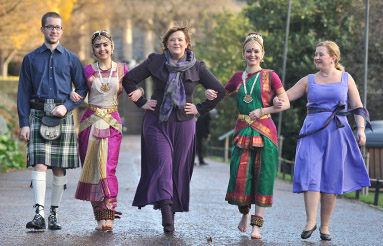
Fiona Hyslop, Cabinet Secretary for Culture and External Affairs gets ready to dance. Photo: Rob McDougall
People from across the world have been invited to join in a global ceilidh held over 24 hours next summer, as part of Glasgow 2014 Commonwealth Games celebrations.
The Royal Scottish Country Dance Society (RSCDS), which has been commissioned by Get Scotland Dancing to create the Commonwealth Ceilidh, will work with dance organisations in Edinburgh, Glasgow and Aberdeen to create new ‘fusion’ dances which will be performed along with existing dances in a worldwide event on Saturday 21 June 2014.
The Commonwealth Ceilidh will begin with events in New Zealand at 7.30pm local time; the next events will begin two hours later in Australia, then in Japan and onwards, with the dancing beginning at 7.30pm in Scotland, 12 hours after the Ceilidh started.
Along with Commonwealth Ceilidhs in Aberdeen, Glasgow and Edinburgh it is hoped that Commonwealth Ceilidhs will take place in hundreds of locations across Scotland and the UK. The Commonwealth Ceilidh then continues over to the Americas and organisers are aiming for the final event to take place in Hawaii 24 hours after the first ceilidh call was made.
Each Commonwealth Ceilidh will be unique to its location, with an interval in every event giving the chance for groups to showcase their national or local dance style. Organisers are especially interested at present in hearing from people who would like to organise a Ceilidh in their own community.
Culture Secretary Fiona Hyslop said:
“The Commonwealth Ceilidh is set to be the biggest celebration of Scottish Country Dancing the world has ever seen – It will be a fantastic way to celebrate, share and showcase our culture during 2014.
“As well as being celebrated throughout the Commonwealth, participants in Scotland will get the opportunity to go to a taster class in their community in the weeks following the Ceilidh. The fact is – Scottish Country Dancing is fun, social and good for our health. I expect that from John O’Groats to Jedburgh – Achiltibuie to Auchmithie – many participants across Scotland will keep dancing through the rest of 2014 and into the years beyond.”
Eileen Gallagher, Independent Director on the Glasgow 2014 Board and Chair of the Ceremonies, Culture and Queen’s Baton Relay Committee, said:
“The Commonwealth Ceilidh will be a vibrant celebration of Scottish culture which everyone can get involved in no matter where they are across the world. The chance to learn the three specially created new dances as part of the Glasgow 2014 Cultural Programme will make the Commonwealth Ceilidh a unique and exciting opportunity for so many people who love Scottish country dancing.”
Event planning information will be available in January 2014 and the programme of dances, music and training resources will be available in March 2014. You can register your interest at the Get Scotland Dancing website.
The post Worldwide Call for 24 Hour Ceilidh appeared first on ScotClans | Scottish Clans.
]]>The post Royal Storm hits over Gaelic College Name appeared first on ScotClans | Scottish Clans.
]]>
A Storm is Brewing at the Royal Cape Breton Gaelic College
A storm is erupting over the Royal designation given to a Canadian Gaelic College by Queen Elizabeth II. Colaisde na Gàidhlig – The Gaelic College in Cape Breton, Nova Scotia is to be styled immediately as The Royal Cape Breton Gaelic College, for its contribution to preserving Gaelic and Scottish culture in Canada.
The designation has caused a huge amount of controversy in the community, resulting in the chair of the college board of governors stepping down over the issue earlier today.
The Member of the Legislative Assembly for Inverness, Nova Scotia said the addition of the word ‘royal’ doesn’t sit well with people who have a strong understanding of the history of the Gaels. Allan MacMaster, who is also the conservative critic for Gaelic Affairs, delivered a speech in the House of Assembly last week following the colleges decision to change its name.
He said you have to look at the history that brought many people to Nova Scotia, and that at one time as much as 80 per cent of the province spoke Gaelic.
“If you look, after the Battle of Culloden (in the 1700s), there were efforts made in Scotland to destroy the clan system and some of that was to try to eliminate the speaking of Gaelic in Scotland,” MacMaster said.
In the 1600s, Scottish Highland clan chiefs were required to send their heirs to other parts of the country to be educated in a different language, he said.
“All of those things emanate from England and from the Crown,” MacMaster said. “To have the Gaelic College today be given the title of royal and connecting it to the Crown, for a lot of people, they find it offensive.”
Situated in the heart of Cape Breton’s earliest Scottish settlement, the institution is the only one of its kind in North America, and was founded in 1938 by Rev. A.W.R. MacKenzie devoted to the study and preservation of the Gaelic language and Celtic arts and culture. During the first half of the 19th century, Cape Breton experienced an influx of Highland Scots numbering approximately 50,000 as a result of the Highland Clearances. Today, the descendants of the Scots dominate Cape Breton Island’s culture, particularly in rural communities. Gaelic is still the first language of a number of elderly Cape Bretoners.
The acting chair of the College, Kirk McRae, says the honour is a welcome one. He said: “It creates more awareness and things with the college,
“It’s a designation that doesn’t come easy. It’s just an honour of name, it doesn’t take away what the goals are of the college and what the goals are of our instructors, students and staff, that is to grow the Gaelic culture.”
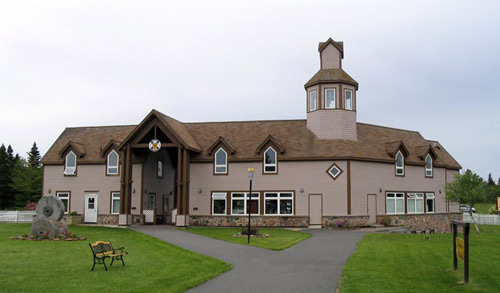
The Royal Cape Breton Gaelic College
Alex Morrision, a retired military officer, has stepped down as his voluntary role as board chair as a result of the controversy. According to the college’s Facebook page, while Morrison contacted the Queen’s offices without consulting the members of the board, the decision to change the college’s name was not his alone, with the board voting on and accepting the name change.
The response to the name change on the Facebook page has been largely negative, however others thought people were overreacting to the name change. One commenter said: “Good Lord what a tempest in a teapot. So if the Queen provides her coat of arms to HP sauce am I not to eat it?”
MacRae said he was somewhat surprised by the amount of feedback on the name change, but said the board doesn’t plan to reverse its decision.
“There’s going to be no change,” said MacRae. “It’s wonderful the passion people have and I understand their points of view, and I respect their points of view. We (were) bestowed this, and for the board, everyone I felt genuinely thought we were going forward and it was a good thing. The name doesn’t take away from the day-to-day activities of college, and that’s to grow the Gaelic culture and language.”
The post Royal Storm hits over Gaelic College Name appeared first on ScotClans | Scottish Clans.
]]>The post Home to Hume appeared first on ScotClans | Scottish Clans.
]]>
Clan Hume Gathering at Hume Castle, 08/09/2013
Earlier in September Amanda and I traveled to the Scottish Borders to spend an afternoon at Hume Castle, where part of this years Clan Hume/Home gathering was taking place. Held every five years, the gathering provides a way for clan members to connect in person with one another, while learning about their heritage and exploring the lands from which the clan once hailed. This years gathering was especially important as it coincided with the 500th anniversary of the Battle of Flodden – a 16th century battle between Scotland and England where various clans including Clan Home suffered many casualties.
The 2013 gathering was by far the largest international congregation of Homes on record, with almost 200 clan members attending from as far away as Australia, New Zealand, South Africa, Canada, the United States and Norway. Events at the four day meeting included genealogy workshops, ex-Home estate tours, the raising of the Home banner at Hume Castle and a visit to the Flodden memorial in Northumberland.
A well-known and respected Borders family, Clan Home were known as peacemakers, in contrast with another Borders family – Clan Douglas, whose reputation for harrying the English made them well-known as warriors. The name Home comes from the old English word for a hilly outcrop (Hôm), which is what Hume Castle sits upon. The name has also been spelt in many different ways over the centuries, but is always pronounced Hume.
We arrived in the Borders with a bit of time to spare, so stopped off at Floors Castle before making our way to the events at Hume Castle. Floors is the seat of the Duke of Roxburghe, and lies just outside Kelso on the banks of the River Tweed. The 5th Earl of Roxburghe (1680–1741) was instrumental in securing the union of England and Scotland in 1707, and was rewarded by being named the 1st Duke of Roxburghe. Floors was also once the home to the chief of Clan Innes, however when the twenty-fifth chief and 4th Duke died without a heir in 1805, the chiefly line ended. His successor who inherited the lands and peerage through the female line was obliged to take the double barreled surname of Innes-Ker, and hence was not recognised by the Court of Lord Lyon as chief of the name Innes. To this day Clan Innes is still without a chief.

Floors Castle, Scottish Borders
10 minutes down the road by car sits the remains of Hume Castle, the spiritual home of Clan Home. The lands were acquired by William de Hume in the early 13th century, who built the first stone fortifications on the site around this time. Hume was the only Borders castle not destroyed during Robert the Bruce’s scorched earth policy of 1313, and was also where King James II of Scotland was staying during the siege of Roxburgh (1460), when a canon he was firing exploded and killed him instantly. Today the preservation of the castle is maintained by the Clan Home Association, under the auspices of Historic Scotland.

Hume Castle, Scottish Borders

Chief of Clan Home/Hume
In the courtyard of the remnants of the castle, clan and association members and other special guests (including a whos-who of dignified Border families) gathered to hear stories about famous Homes including the philosopher David Hume (1711-1776). Hume started at Edinburgh University at the age of 12 and went on to become one of the leading lights of the Scottish Enlightenment. The gathering was then treated to a performance by Scottish folk singer Isla St Clair who spoke of her love for border ballads and the stories behind the songs. The afternoon was closed off by the 15th Earl of Home and current chief of Clan Home David Douglas-Home CVO CBE, who read from his father’s autobiography Where the Wind Blows. The chief is the only son of former Prime Minister Sir Alec Douglas-Home. Following the reading, I spoke to the chief briefly about this year’s gathering where he told me how clan members from at least 10 different countries were in attendance. He said the 2013 event was definitely the biggest gathering they’ve had, probably due to the event coinciding with the anniversary of Flodden.
With so many clan members hailing from overseas, I was interested in hearing how factions of Homes had ended up in each corner of the world. A South African contingent from Port Elizabeth told me how they descended from David Hume (born 1797 in Berweckshire) who arrived in South Africa in 1817. Hume was part of the settler party of 195 Scottish laborers and mechanics who bought out to South Africa by Captain Benjamin Moodie. He became and explorer and trader in South Africa, with one descendent telling me that Hume was in fact the first European to see Victoria Falls (not Scottish missionary and explorer David Livingstone). Hume’s South African descendents told me the reason they came to the gathering is because they feel their spiritual home is in Scotland. “The depth of history and heritage here is like nothing we have at home. It’s always important to know and understand your heritage and to be part of something bigger.”
The group from Norway traced their Home ancestry to a more recent time, when during the second World War a young Scottish woman named Frances Hume met a Norwegian man and emigrated there. This was their first time at a Home gathering, and they told me it was very important for them to know their story about where they came from, and to meet members of their Scottish family. Pam Hume and her husband were in attendance from Indiana – she said she didn’t know anything about the clans of Scotland or her Scottish ancestry until her cousin came across Hume Castle online. “I just thought the castle was four walls that happened to have our name.” Pam’s ancestry journey, as a result of her cousin’s discovery online, brought her to the gathering, where she discovered that there are a cluster of Humes living in Indiana less than 100 miles apart.

Interviewing the Norwegian Humes
William Cooley and Barbara Hume traveled from Vancouver for the gathering, and said they discovered the clan when organising a Hume family reunion in 2007. They sent a photo of the reunion to the association, who were very pleased to find out what had happened to the Canadian line of the Humes. Barbara told me the gathering was a great way to meet people and form new friendships with people across the world. The final overseas attendees I spoke to hailed from the Netherlands. Anegla Hume and her daughter Charlotte can trace their ancestry to an English faction of Clan Hume. Angela found the clan association through Wikipedia and decided to become involved as a mark of respect to her ancestors. “It’s important not to forget, as you learn more and more about the history it’s like they come back to life.”
With so many of the attendees using the internet to discover their roots and learn about their clan, it’s clear that this is the way forward for clans and their associated societies. The Clan Home gathering was a fantastic example of a well-organised clan who have used the internet to gather clan members from all across the world, bringing them back to their ancestral home.
You can view an album of photos from the event over at TartanFootprint.com
The post Home to Hume appeared first on ScotClans | Scottish Clans.
]]>