The post The Moffets track down the Danish Vikings appeared first on ScotClans | Scottish Clans.
]]>I know that Denmark ruled a massive area of England (called Danelaw) around the 9th century. The language spoken in England was affected by this clash of cultures with the emergence of Anglo-Norse dialects. What with this and being a big fan of The Killing, Borgen and The Bridge I thought I’d maybe have a head start in understanding Danish. This hasn’t proven to be true.
I have always been confused about which Vikings went where, Did the Danish Vikings just go to England and the Norwegian ones to Scotland and Ireland? or was it more mixed up than this? Have always found this a bit of a grey area.
Denmark
Denmark is made up of 406 islands, Scotland has around double this with nearly 800 islands - so we both have a lot of coast line. The largest of these Danish islands is called Jutland. I am currently in Copenhagan which is on the eastern island, Zealand. (Not the one New Zealand is named after, this is the Dutch province of Zeeland). Denmark has a population of around 5.6 million, a bit more than the population of Scotland’s 5.3 million.

Denmark isn’t that far away from Scotland – it was less than 1.5 hours flight. I’ve been told that by Viking boat it would take around 40 days.

Things I’ve noticed; Denmark is completely flat, rural Denmark is nearly all farm land, there are trees here but not vast forests, have been wondering if all the trees were made into ships. Also everywhere you look you see the Danish flag which I have just found out is risen at sunrise and taken down at sunset. My neighbours have been waking me up at 4 am when they do this. People in Denmark are very proud of their homes and have amazing furniture. They have a word that can’t really be translated called ‘Hugge’ it’s having cosy time, where they burn a lot of candles and enjoy good food and alcohol. This has probably come from having such extreme weather but has also added to their general content-ness and happiness they are famous for. They are completely trusting, babies are left outside in prams, bikes unlocked but are not overtly friendly, they don’t do chit chat which takes a bit of getting used to. Wonder how much of this goes back to their Viking past?

Moffet Hygge Time
Norse Settlers in Scotland
Between the periods of 8th to the 15th centuries Scotland saw a lot of Scandinavian settlement. The Vikings (Mostly Norwegian) colonised whole parts of Scotland. The height of their influence on Scotland was around the 11th Century. Some Clans proudly claim descent from Vikings; Clan MacLeod and Clan MacNeacail are two examples.
Our Trip to Roskilde
The end of last week, on a very sunny day we took a trip out to the Viking Ship Museum, Roskilde. It’s based around an exhibiton of 5 Viking ships that were discovered in 1962 nearby at Roskilde Fjord, near the village of Skuldelev. The ships had formed part of a barrier system to protect the Cathedral and Royal City of Roskilde.
The Excavation

How the five ships were found

The excavation of the Skuldelev ships in 1962.

Inside the museum – the five ships

Another original Viking Ship

Original boat
As well as seeing these original ships, which were really impressive especially seeing the size of the largest one the museum looked at all aspects of boat building, reconstructing full scale viking ships, using replica tools.
Making the Sails
Anna Nørgaard is the museum weaver. Flax has been used in Scandinavia since the Iron Age. It’s a massive process to go from the original grass to getting it into a state you can weave with.

Flax, being prepared for weaving

Weaving Flax

Making the Viking Ship’s Sails
Making Rope
This I found really interesting – did you know you can make rope from things like pig hide and sealskin? Most of the rope was from bark, here is someone making lime bast rope.

Making lime bast rope

All kinds of rope

I got beaten at a Viking game and my son dressed up as a Viking – no horned helmets here.
Ship reconstruction at the museum’ s boatyard
The workshop is an archaeological ship experiment this is ‘experimental archaeology’. By actually doing it – we constantly learn and get a fuller picture of the ships construction and it’s sailing characteristics. The boats they build here are used, lessons are learnt. It brings in the human element to archaeology and through this we can look at the interaction between Viking Age ships and society.

The ‘work shop’

Son having a go.

Making a wee viking boat
Jealously watching people departing on a 3 week Viking Voyage onboard the Sea Stallion of Glendalough, a recreation of a 9th Century Viking ship.
Just leaving while we were this is the largest reconstructed viking boat. Can seat up to 100 people and in it’s day, the original dwarfed the Mary Rose and terrorised Europe. This time they were embarking on a 3 week voyage around Denmark, stopping off at various Viking events. They have to eat as Vikings while on board, sleep onboard and who knows where the bathroom is.

Vikings Away!

We all waved and cheered it as it left, wonder if this is what happened back in Viking Times
Feel very privileged that we got to see this.

Shield and sword painted. Not quite sure how we’re going to get the shield back to Scotland.
So now the Danish Vikings are a peaceful bunch, trading in their longships for bicycles. By visiting Roskilde, it’s pretty impossible to see them as the hooligans they are quite often depicted at. This craftsmanship and teamwork can be seen today combined with strong customs – ‘The Danish Way’ as I keep hearing, it must all echo back to the past. Beginning to understand why they were such a strong influence on not just Scotland but the whole of Europe.
The post The Moffets track down the Danish Vikings appeared first on ScotClans | Scottish Clans.
]]>The post Ambassador Claims Vikings ‘Brought Sarcasm to Britain’ appeared first on ScotClans | Scottish Clans.
]]>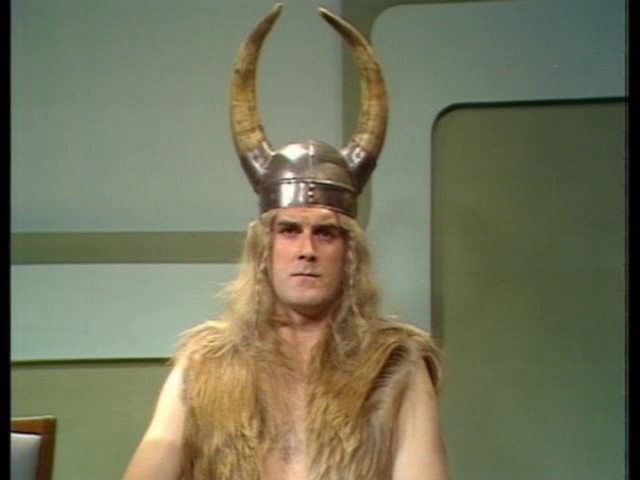
Monty Python have a lot to thank the Vikings for according to the Danish Ambassador
For over two centuries, Vikings colonised, traded and raided their way through much of Britain before disappearing form the pages of history completely. That’s not to say they didn’t leave behind a legacy that’s still able to be seen and heard to this day. Over one thousand years since the raiders from the north landed on these shores, place names still ring with the sounds of Norse, and archaeological artifacts left behind are still being found. Now sarcasm, understatement and irony can apparently be traced back to the Viking era too.
Earlier this month the story below which originally appeared in The Telegraph reported on comments by the Danish Ambassador to the UK, who said the similar sense of humour between the two countries originates from shared cultural heritage. Read on…
It may be the bedrock of British humour, but sarcasm was actually brought to the UK by the Vikings says the Danish Ambassador.
The British use of understatement and satire is thought to originate from the Vikings, typically noted for raping and pillaging throughout history, when they brought trade from across the world to British shores.
This led to exchanges with Britons, and the Vikings influencing them with the words and expressions they used. These eventually became part of everyday language, seen in some of the words and place names we use today, and ultimately in our caustic sense of humour.
Sarcasm, irony and understatement are part of the “common heritage” between Denmark and the UK says Claus Grube. He also claims there are traces in comic tales used in the later Old Norse sagas, such as Orkneyinga Saga where an Earl goes out disguised as a fisherman, to help a farmer.
These sagas, largely from the thirteenth century and known for their “laconic humour, detail examples of comedy in the face of adversity, and also contain the roots of some Danish and English words showing more similarities in how we communicate.
Sarcasm is very much inherent in British humour,” Mr Grube told the Telegraph.
He cites contemporary episodes, particularly the “extreme popularity” of Monty Python in Denmark as an example of the shared sense of comedy between the two countries which he says shows evidence of a common cultural heritage.
“It has always struck me that in the UK we have the same sense of humour as in Denmark,” he added.
“We use sarcasm and irony, and we also like understatement.
“I think this forms part of our common heritage, stemming from the Vikings and some of the legacy they have left.
“I think this legacy forms part of the way we express ourselves and the way we interact and the way you use language.”
Mr Grube cites a typical British use of sarcasm, describing something as “it could have been worse”, as humour particular to both countries that he believes could stem from expressions brought to the UK from the Vikings.
“It was not all about raping and pillaging, the Vikings were trading as well,” said Mr Grube, who has been in the UK for six months but said he has been struck by the similarities in British and Danish comedy.
“You have a more open attitude to the world around you if you are living from trade.”
Mr Grube said trading led to exchanges with the Vikings and the inheriting of expressions and body language, which influence comedy today.
He added: “Humour is actually an important part of the way you express yourself.
“The use of sarcasm and irony is quite distinct from other countries. For example if you use that in France and Germany it will often be taken literally, and the humour lost.”
Mr Grube said this difference adds to his belief that humour in the UK and Denmark dates back to our shared history.
He also cites Dane Law as an influence on words in Britain. He added: “Words were inherited, especially in the geographical sense under what you would call Dane Law. But it’s not only geography, this introduced a legal system as well.”
Dr Matthew Townsend, an expert in Old Norse from the University of York, said examples of influences on English humour can be seen from a range of periods in history, including in Old Norse sagas which were largely written in the thirteenth century – three centuries after the Viking settlement of England.
He said: “Anglo-Saxon texts also show a fondness for terse understatement, often of a humorous kind: so, for example, the poem Beowulf declares of the haunted mere where Grendel and his mother live, ‘that is not a pleasant place!’
“So one would be hard pressed to demonstrate that such understatement is a Viking import to England, rather than a common tradition.
“But it’s certainly true that the Old Norse sagas offer abundant examples of laconic humour, often in the face of adversity. My favourite comes in Grettir’s Saga : the hero’s brother, Atli, is stabbed fatally through the stomach, whereupon his dying words are (more or less) ‘I see that broad spears are in fashion this year’.”
Ivar Berg, a postdoctoral fellow at the Norwegian University of Science and Technology, said while there were close interactions between Scandanavians and the English, he did not believe the Ambassador’s statement. He said: “There are parallels, of course – sarcasm and understatements are well known and highly regarded also in Scandinavia, but to pinpoint a direction of influence seems futile.”
Dr Ragnhild Ljosland, a lecturer in Nordic Studies at the University of the Highlands and Islands, said rather than one source, it was likely English humour had been subject to a range of influences over the last 1,000 years. Dr Ljosland said: “I believe that the English have developed and refined their sense of humour through the ages and that it draws on a range of sources of cultural contact, as well as being their own, of course.
“Personally, as a Scandinavian living in the UK, I find the English understated and sarcastic sense of humour hard to understand. It often completely passes me by.”
In the chapter ‘Poetry and fishing’ in Orkneyinga saga, humour is used to describe how an Earl manages to hide his identity from villagers by pretending to be a fisherman. The Earl, dressed in a cowl, goes fishing with a farmer and gives all his haul away, before climbing a slope where “his feet shot from under him where the rain had made it slippery and he tumbled down to the bottom of the slope.”
The passage is followed by a comic verse recited by the Earl, where he reveals his identity:
“Wittily the woman
mocks my wear
but she laughs overlong,
and may not laugh last.
Early I sailed out,
eagerly, and all fully
furnished for fishing
Who’d figure me for an earl?”
The post Ambassador Claims Vikings ‘Brought Sarcasm to Britain’ appeared first on ScotClans | Scottish Clans.
]]>