The post Love for Culloden! appeared first on ScotClans | Scottish Clans.
]]>
We asked our many fans if they had ever been and if they could share their pictures in an effort to take a look at some different perspectives of the battlefield and surrounding areas. We couldn’t have been more shocked at the amazing response we had, especially on our Twitter page. Loads of amazing people shared some fantastic images alongside some of their thoughts about the site so we would like to take a little time to share them here and let everyone see how impactful such a site can be for generations to come. Take a look at a few of our favourites below and click on them to see the original post…


We would love to hear your thoughts on this historic site and if you’d like to share any images of your own feel free to email them to info@scotclans.com, and remember this is something we like to do every so often on Facebook and Twitter so make sure you like and follow us so you can keep an eye out and join in!
The post Love for Culloden! appeared first on ScotClans | Scottish Clans.
]]>The post The Sword of Donald Robertson of Woodsheal appeared first on ScotClans | Scottish Clans.
]]>Further to presenting a talk at Culloden House in April of this year on the topic of Scottish Swords of Legend, I was advised that the Clan Donnachaidh Museum housed a sword with Culloden provenance.
As this was on the return route to Edinburgh, stopping in to study the sword was a natural choice. Upon viewing the sword, I was struck by certain manufactured form and detail that I found of great interest and was inspired to subsequently make some fascinating historic connections.
My work involves hand-crafting historically accurate European edged weaponry of all forms from Bronze Age to present day. Over the years, Scottish basket hilted swords have been one area of personal interest that has become more prominent in my armoury studies. Every basket hilted sword has particular identifying form and characteristics as unique as a fingerprint and every one provides a fascinating insight into historical craftsmanship, functional form and martial swordsmanship.
The sword of Donald Robertson revealed remarkable similarities to another sword and one currently in my custodianship, that of Rob Roy MacGregor. The Macgregor sword was passed from him to his landlord (a MacLaren) on his deathbed and remained in this family line until a couple of generations ago, when it was bought by a family from my own homeland in Moidart.
My first visit to study the Robertson sword only sparked further burning questions and closer study was necessary. The museum was extremely helpful when upon my second visit I was granted access to examine the sword closely and also directly alongside that of MacGregor for direct comparison.

Sword of Donald Robertson of Woodsheal (Targe by Graeme Biggerstaff at Alba Targes)
It may be simpler to first account for the differences in both swords. The grip material and form is different, with MacGregor’s having a wooden grip (Caledonian pine) filed deeply to originally secure wire over a leather or shark-skin grip covering (now lost to expose only wooden grip). Robertson’s sword unusually bears a grip made from stag antler (red deer).
This is an unusual grip material choice but the form feels remarkably comfortable in the hand. It is always possible that the antler has been a later addition to possibly replace a badly cracked or perished wooden grip, but the top of the pommel shows no signs of re-working in recent years.
Robertson’s sword also carries a pommel somewhat smaller and squatter than MacGregor’s. This is not too surprising as MacGregor’s blade is slightly broader. This results in a slightly heavier blade overall, which requires balancing out with a larger pommel.
Both swords bear distinctly broad double edged blades of excellent temper. The origin of blades without specific marks of makers or country of origin might always be debatable, but we might assess something as much from what markings they do not carry.
Jacobite swordsmen often privately purchased their side-arms, and they certainly knew the value of a good quality blade. Examples of Jacobite swords for example invariably carry blades of far higher quality than the standard “munition quality” swords issued to British Government troops of the day.
The best quality sword blades manufactured in great numbers were from Solingen and Passau in Germany, and these were often imported to Scotland throughout the late C17th – mid C18th to be mounted by local makers as basket hilted swords. The “running wolf” mark was common to German blade-smiths and can often be found on quality Jacobite swords.

Running Wolf maker’s mark on a Solingen manufactured sword blade.
Neither MacGregor’s or Robertson’s blades display a running wolf mark. Both blades are double edged and centrally fullered. The fullers or grooved channels running down the length of a blade serve a simple purpose and that is to reduce weight where possible without compromising blade strength or flexibility. They are not “blood grooves” as popular gory myth might imply.
Robertson’s blade appears to have some lettering inside the fullering, which could not be easily discerned in the low light conditions. Further dedicated study may here reveal greater detail. The blade of MacGregor’s is stamped with the legend ANDRIA FARARA.
Andrea Fararra was an Italian swordsmith working in Belluno between 1550 – 1583. It is believed he also lived and worked in Scotland for a number of years. He was renowned for the exceptional quality of his steel and blades, so much so that his name continued to be stamped in various spellings on blades far beyond his death throughout the C17th and C18th.

Andria Farara blade stamping on MacGregor’s sword blade fullers.
The hilt forms of both swords are similar in form and detail. Both have been constructed according to the same pattern, one which could date from as early as 1680 – 1690. One particular construction consistency between both swords is the section and dimensions of connecting bars.
These are noticeably square in section, which is unusual as most Highland basket hilt connecting bars are round in section. More-so, these connecting bars are incised their length on the outside faces with a shallow central channel. The side panels are near identical in form and detail, featuring exactly the same pattern of filed channels and positions of pierced holes and hearts. The same bears true for the forward-most panel or knucklebow, which reflects the pattern and detail of the side panels.
The main difference in the hilts lies in the square “Saltire panels”. Each sword has two of these square panels, which provide a significant part of the basket hilt protection for hand and knuckles. MacGregor’s sword features a repeating pattern of pierced circular holes and rectangular slots. Robertson’s features four hearts on each panel, filed in the same form as the forward and side panel detail.

MacGregor and Robertson swords hilts side view comparison

MacGregor and Robertson sword hilts front view comparison
Such similar form and details are indicative of being crafted by the same hand, or at very least the same armoury. So where could these swords of provenance have originated?
Earlier this year I was directed on a path of research after reading about a legendary Highland armoury. This was the armoury at Innerwick, Glen Lyon, which was operated by no less than 14 generations of the MacFarlane Clan.
The MacFarlanes were renowned for their skill in making quality arms and certainly were in production here through the C17th and C18th. This clan also had close ties with the MacGregors of Roro and provided them with arms for many years.
Tying the clan association together with geography (Rob Roy was usually living approximately 20 miles South West of Innerwick and Robertson approximately 20 miles to the East), the armourers of Glen Lyon would appears to be the likely candidates for the manufacture of these unique swords of provenance.
I recently visited the location of the Innerwick armoury. The building is now gone, but its original place is known and lies directly beside a small burn still known today as Muileann nam Biodag or the Mill of the Dirks.
It was a special visit to rediscover this ancient site where once sparks and hammers flew daily to craft some of the best quality blades and arms in the Highlands. Clansmen would have revered these, carried them with pride, swore by them and staked their very Honour and Lives upon them.

The author with Rob Roy MacGregor’s Sword by the Mill of the Dirks at Innerwick, Glen Lyon
Further research is now currently being conducted in order to determine the characteristics of Glen Lyon patterns of basket hilted swords. Such studies have only been made possible by the original connections made between two swords of distinct legend, that of Donald Robertson of Woodsheal and that of Rob Roy MacGregor.
Every original sword is unique and bears its own character, much like those of the original makers and owners. These old seasoned veterans talk to us yet and we need only listen closely and ask the right questions to see more clearly into the mists of time.
And like any great historic adventure, the more questions that are answered, the more are raised. Let us see what further discoveries and paths of research might yet arise from these initial findings by the sword.
Paul Macdonald is originally from Moidart and has long held a fascination in Scottish martial archaeology. He is a professional custom sword and knife maker and historical fencing master and runs Macdonald Armouries (www.macdonaldarms.com/armoury) and the Macdonald Academy of Arms (www.macdonaldarms.com) based in Edinburgh.
The post The Sword of Donald Robertson of Woodsheal appeared first on ScotClans | Scottish Clans.
]]>The post A Walk Through Culloden appeared first on ScotClans | Scottish Clans.
]]>

John W. Patterson
This is a personal account on my trip to the Culloden Battle Field and visitor centre. I visited Culloden on August 12th of this year. For those who have never visited, it is a very solemn place.
Culloden is a historical site managed by the National Trust for Scotland. On 16 April 1746 a fierce and bloody battle took place on this spot near Inverness between the Jacobite army of Bonnie Prince Charlie and the Royal Troops of George II led by The Duke of Cumberland. This was the last stand of Charles Edward Stuart, commonly known as “Bonnie Prince Charlie” or “the Young Pretender”. Bonnie Prince Charlie and his sympathisers wanted the Stuarts on the throne rather than the Hanoverians.
There were 7,000 in the Jacobite army and 8,000 in the royal army. It is thought that around 1,500 to 2,000 Jacobites were killed or wounded in what was a terrible defeat for Bonnie Prince Charlie and his army which was made up of mostly highlanders who were volunteers rather than soldiers. Clans fought on both sides. On the Government side the losses and injuries were a lot lighter at around 300. The battle was over in less than an hour, it was a slaughter. This was the last pitched battle on British soil.
Leaving opinions aside and the circumstances that led up to the battle I would like to focus on my experience. When you arrive at the visitors centre and leave your car your experience begins as you start walking up a sidewalk adorned with Clan names, those that were involved in the battle, alongside their names are their clan crests. When you enter the visitor centre the cafe is to the left, which I found to be excellent and the gift shop. Walking straight ahead you begin the indoor portion of the tour.

Photo’s by John W. Patterson
Upon entering the tour you find large displays on both walls and many interactive displays. There are many exhibits of actual articles from the times with explanations of their significance. I found this to be a great addition to the experience and helps you connect with that awful day and the life the soldiers led. You are free to explore the exhibition in any way, and are not forced down one route, so the narrative is pieced together as you see fit. On one side of the exhibition is the Government side and the other for the Jacobite side. This is interesting as the exhibition does give you both sides of the story and it is up to you what you want to make of it. You start with the lead up to the battle, on one side the events of the Jacobites and the other the Loyalists. So you do end up seeing both sides, there isn’t a bias.
At the end of this part of the exhibition you enter a room with large screens on all four walls. It puts you in the middle of a re-enactment of the battle, you are charged at from one wall and muskets fire from another. The sound is amazing and really gives you the feel of being there. When you exit you see names of known Clansmen who fell during the battle. For me, I saw many Farquharson names and it really brought it home to me and gave me a personal connection to this event and an insight into my family and how brave they were. When you exit the hall you enter into another interactive room with a large animated map of the battle and many hands on displays.

The Walk outside
When you begin the outside portion of the tour you are given a headset with a GPS device. When you walk outside the GPS begins to give you information about the day. As you walk to points the GPS will chime and tell you about the point you are standing and gives you further information on specific people or a side note of the day by a touch on the screen. You immediately get the feeling of the day and as you walk the paths the battlefield the solemnity falls on you.
You can see blue flags that mark the Jacobite line and red flags the mark the Government side. Paths take you to each point and you pass various Clan Stones, these stones commemorate the members of the different branches of the Clan who fought and died on that fateful day in 1746. As well as specific Clan Stones there was also one labelled “Mixed Clans” for all those not listed. You walk by many markers of where certain Clans would have been lined or where certain people would have been standing that day.
In the end I want to say the National Trust for Scotland has done an amazing job with the centre. It should be noted that Culloden is a burial site for many who fell that day and the most respect should be given while walking the field. The feeling you get while walking the field is hard to describe, you are standing on the ground of a battle that had consequences for so many, some very harsh. History could have sent us in quite a different direction if Bonnie Prince Charlie had been successful in restoring the House of Stuart to the British throne.

John W. Patterson is the Editor of the Lion’s Face, Clan Farquharson UK
The post A Walk Through Culloden appeared first on ScotClans | Scottish Clans.
]]>The post Top 5: Whisky of the Clans appeared first on ScotClans | Scottish Clans.
]]>1. Dalmore

Dalmore 12 Year Old Whisky
In 1263, an ancestor of Clan Mackenzie saved King Alexander III of Scotland from being gored by a stag whilst out hunting. The grateful King granted the Mackenzies the right to bear a stag’s head, with twelve points to its antlers, signifying a ‘Royal’ in their coat of arms. Today every bottle of the Dalmore single malt is adorned with the clan’s proud emblem. The distillery is located on the northern shores of the Firth of Cromarty overlooking the Black Isle, and was originally established in 1839 by Alexander Matheson, a trader who made his fortune in opium imports. The Mackenzie family bought the distillery in 1866 and have recently begun to use the Mackenzie motto of Luceo Non Uro (I shine, not burn) as the company’s philosophy. The Dalmore Single Highland Malt Collection is matured in a wooden casks (both sherry wood and American white oak) which, along with the years and the climate, contributes to the flavour of each malt.
2. Clan MacGregor

Clan MacGregor Blended Whisky
Clan MacGregor blended whisky takes its name from the highland clan, honouring one the descendents of ancient Celtic royalty as proclaimed in the motto ‘Royal is my Race’. The blend is made from 15 malt and grain whiskies from the heart of Scotland, blended to create a delicate, sweet aroma and smooth, mellow taste. The bottles proudly carry the Clan MacGregor badge and motto, and with his kind permission, the personal crest of the 24th Clan Chief, Sir Malcolm MacGregor of MacGregor. The Clan badge, a crowned lion’s head on a wreath encircled with a belt and buckle, signifies the unity and loyalty of the clan who suffered two centuries worth of oppression. It is enjoyed in over 60 countries around the world, from the USA to Venezuela and the Middle East to Thailand.
3. Talisker

Talisker 10 Year Old
My personal favourite, this wee gem of single malt is produced at the Talisker distillery on the shores of Loch Harport on the Isle of Skye. It’s the only distillery on the isle, with the distillery’s seaside home giving it a deep peaty character followed by a hint of sweet. The distillery was built in 1831 by brothers Hugh and Kenneth MacAskil after they acquired the lease of Talisker House from the chief of Clan MacLeod. When a new lease for the distillery was negotiated with the chief in 1892 the annual payment was to be £23.12s and a ten-gallon cask of best-quality Talisker. Today the single malt continues to be the preferred dram of clan chiefs – the MacNeil of Barra leases their seat of Kisimul Castle to Historic Scotland at a cost of £1 per annum and a bottle of Talisker. In 2007 Talisker 18 year old won ‘Best Single Malt in the World’ at the World Whiskies Awards and was one of three whiskies described by poet Robert Louis Stevenson as “The king o’ drinks, as I conceive it” in his poem The Scotsman’s Return From Abroad.
4. Clan Campbell

Clan Campbell Blended Whisky
While the link between this blended whisky and the actual clan is unclear, the whisky takes it names from the clan who have 14 million descendents around the globe. Clan Campbell is one of the largest clans in Scotland and renowned for its bravery and influence over the country’s history since the 13th century. The whisky is distilled, blended and aged in the Highlands, combining Scotch grain and malt whiskies that have aged in oak casks for at least three years. The present clan chief, Torquhil Ian, combines his duties as Duke or Argyll, chief and landowner with a consultant role with Pernod Ricard, promoting Scotch Whiskies including Chivas Regal and Glenlivet.
5. Drambuie and Glayva

Drambuie Liqueur

Glayva Liqueur
Technically not a Whisky, Drambuie is a sweet golden coloured liqueur made from malt whisky, honey, herbs and spices. Produced in Broxburn, West Lothian, Drambuie derives its name from the Gaelic phrase an dram buidheach, (the drink that satisfies). After the Battle of Culloden in 1746, Prince Charles Edward Stuart fled to the isle of Skye. There, he was given sanctuary by Captain John MacKinnon of Clan MacKinnon. According to family legend, after staying with the captain, the prince rewarded him with this prized drink recipe. This version of events is disputed by historians who believe it to be a story concocted to boost sales of the drink. The MacKinnon family produce the liqueur to this day. A similar liqueur is Glayva, produced in Leith since 1947. It made from a blend of aged Scotch whiskies, herbs, anise, cloves, almonds, heather honey, and citrus fruits. Legend has it that when Bonnie Prince Charlie was served a whisky based liqueur, he looked at his host, held up the glass and spoke the Gaelic “Gle mhath!”(very good) thus giving the drink the name it carries to this day.
The post Top 5: Whisky of the Clans appeared first on ScotClans | Scottish Clans.
]]>The post PM Cites Clan Cameron Heritage in Referendum Speech appeared first on ScotClans | Scottish Clans.
]]>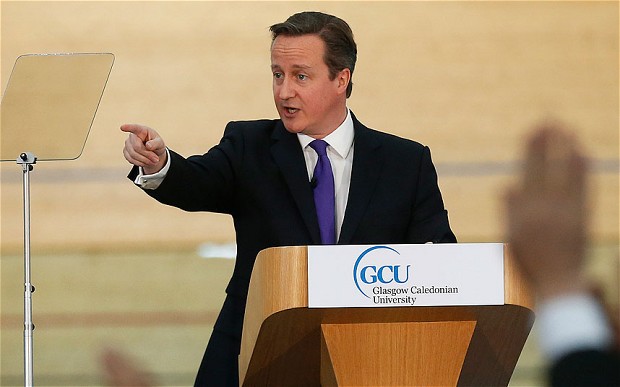
David Cameron answers questions from the media in East London after his speech on the importance of Scotland to the UK.
UK Prime Minister David Cameron has referenced his clan heritage in an appeal to keep Scotland part of the United Kingdom. In a speech given in East London last Friday, Cameron urged Scots and Britons to defend their shared history and heritage by voting against the upcoming referendum on Scottish Independence.
With only seven months to go before the big vote, Cameron spoke of his pride in his own Scottish roots in a major speech on the issue. Referencing his West Highland ancestry, Cameron said: “The name Cameron might mean ‘crooked nose’ but the clan motto is “Let us unite” – and that’s exactly what we in these islands have done.”
Cameron’s emotional defence of the Union also praised Scotland’s role in Britain’s military achievements, from the rich history of ship building on the Clyde to the bagpipes of Lord Lovat’s regiment which roused troops during the D-Day landings. He also stated Scotland had helped to make Britain “the most extraordinary country in history”, then used the success of Team GB at the 2012 Olympic Games to urge voters to keep together “the winning team in world history.”
While the speech made a great deal of importance of Cameron’s clan heritage, it conveniently left out Clan Cameron of Lochiel’s long history of battling the English. Described as ‘fiercer than fierceness itself’, Clan Cameron’s reputation can be summed up with their war cry: “Chlanna nan con thigibh a so’s gheibh sibh feoil!” (Sons of the hound come here and get flesh!).
Legend states that a Cameron contingent fought alongside Robert the Bruce against the English king Edward II at the Battle of Bannockburn in 1314, the decisive clash of the Wars of Scottish Independence. Members of the clan also fought in the front line of the Jacobite Army during the disastrous battle of Culloden in 1745. Following the defeat of Bonnie Prince Charlie, the Cameron estates were forfeited by the Government because of the support the chief had given to the Jacobite cause.
Cameron’s speech also did not mention that he has for many years enjoyed family holidays on the Tarbert estate on the Scottish island of Jura. The estate, owned by his wife Samantha’s stepfather, Viscount Astor, has 6,000 deer, which the Prime Minister has joined stag shooting parties to hunt.
Responding to the Speech, Scotland’s First Minister Alex Salmond called it “flimsy” and attacked Cameron as a member of the “out–of–touch Westminster elite”, stating: “This speech was a threadbare defence of the case for Westminster Tories retaining their undemocratic control over Scotland, which betrays the utter weakness of the Prime Minister’s case.”
Mr Cameron admitted people had advised him to stay quiet on independence – previously he has admitted his “Tory toff” image is an impediment – but on Friday he said “frankly, I care far too much to stay out”.
The post PM Cites Clan Cameron Heritage in Referendum Speech appeared first on ScotClans | Scottish Clans.
]]>The post Culloden Moor Housing Development and our Ancestral Heritage. appeared first on ScotClans | Scottish Clans.
]]>
Old Leanach Cottage on Culloden Moor
As dusk fell over Culloden Moor on the 16th April 1746 the last major land battle to be fought on British soil had drawn to a conclusion. With close to 2,000 dead and wounded Jacobites the campaign to restore the Stewart monarchy to the throne had been dealt a decisive final blow. In the days and weeks that followed the dead were buried and the site of the battle was gradually reclaimed by nature, with the exception of a minor road, which ran by the site Culloden has remained untouched to this day.
Now the site is a magnet for those who wish to immerse themselves in the dream of Scotland, in the romantic stories of Bonnie Prince Charlie and Flora MacDonald, in the Jacobite cause that has been the inspiration of so many folk songs and tales. And so the cause of an Italian-born noble to recapture the throne of the United Kingdom from an incumbent German-born monarch became a story that has somehow come to define Scotland.
Two centuries and more have passed and now the site of this battle like many others around Scotland have been taken under the wing of the National Trust for Scotland and the site has been the subject of in-depth research by Historic Scotland and the Royal Commission for Ancient and Historical Monuments for Scotland (RCAHMS). In recent weeks however another battle has been played out over the moor. Not this time though does it feature blue-bonneted highlanders charging over moorland towards red-coated Hanoverians, this battle is taking place on the Internet, in the offices of planning departments and around Scotland’s parliament.
A collection of disused farm buildings which lie around 400m to the north of the battlefield have been the centre of a planning row. Developers who wish to tear down these buildings and erect 16 houses have appealed a local authority decision to refuse planning permission and despite objections from the National Trust for Scotland the Government reporter has overturned the refusal. For those who see Culloden as a symbol of their Scottish identity the very idea of this development is abhorrent and yet taken on its individual merit there is very little in this proposal that would appear to deserving of such a reaction; the footprint and profile of the proposed development extends very little beyond the brown field site that the farm buildings occupy, the increase in noise and traffic that 16 houses contribute to the landscape is paltry compared to the constant flow of tour busses and cars to and from the visitor centre itself and the site is screened from the battlefield by a stand of trees and on the other side of a minor road that has a surprisingly high traffic flow given its rural location.
Taken in isolation it is very hard to see why so many have been worked up into a frenzy over this, even claims that this development will somehow lead to a ‘creeping urbanisation’ of the Culloden area has very little evidence to support it
So there’s no problem and we should just let it go ahead then, right?
Wrong, very very wrong.
You see this issue is not about Culloden. It is about our stewardship of historical sites in every corner of Scotland and it is about the process of managing how developments in areas surrounding sites of historical importance are controlled.
As a race we have in the last century woken up to the responsibilities of managing our environment, not just our natural environment but our historical one too. Nowadays we find it incredible that so many sites, of major importance to our race, have been treated with disregard by our ancestors. Temples and tombs that have been robbed and razed to the ground. Ancient wonders where the stones have been removed to be used for local buildings. We have a lot to thank the Victorians for. It was their curiosity that led to the halt in the demise of our historical environment. People like John Clayton for example, who we have to thank for the fact that anything survives of the magnificent Hadrian’s wall.
Now this does not mean that every corner of our landscape that has a tale to tell must be trapped in amber, the creeping ‘disneyfication’ of Scotland is no better than a creeping urbanisation. People live in and work the landscapes that their ancestors fought and died on and they should be allowed to continue. Take for example the site of the battle Flodden, an event that was arguably more significant in the history of our nation but an event that is marked by a simple monument surrounded by the fields of a working farm, every season the land that saw one of the biggest massacres in Scottish history is ploughed over and grazed upon, life continues as it did before that date in 1513. And that is as it should be
What is required is a sensible approach to the management of our historical environment, it has to be taken into consideration that this environment is not just part of our history but the history of Scotland’s diaspora and their thoughts and views should be listened to. Any inventoried site in Scotland should have a level of protection that means that one civil servant cannot write it off with a flourish of his pen. We have a trust body in Scotland for a reason and their opinions must be considered with the highest regard. Only when all parties agree that a proposed change to a site of significance is right and proper should it be allowed to go ahead.
Viewhill development at Culloden is a fairly innocent piece of planning in itself. 16 family homes out of sight of the moor will have virtually no impact on the quiet contemplation of the landscape, however what Viewhill demonstrates is a lack of joined up thinking across government departments, local councils and trust bodies. The same lack of joined up thinking that has at times hindered the development of a solid approach to ancestral tourism. There is an awful lot of talk but not a lot of listening; in this homecoming year it is time we did just that.
The post Culloden Moor Housing Development and our Ancestral Heritage. appeared first on ScotClans | Scottish Clans.
]]>The post Crowdfunding Appeal to Save Culloden Blunderbuss appeared first on ScotClans | Scottish Clans.
]]>
The National Trust for Scotland have launched an online crowdfunding appeal to save one of the few items removed from the historic battlefield at Culloden. The 343 year old blunderbuss, currently on display at the Culloden Battlefield Visitor Centre, is to be listed for sale in six months time, endangering it of being lost to an overseas buyer.
The historic weapon has been on loan to the National Trust and displayed at the visitor centre since 1996. However the private English owner, who wishes to remain anonymous, has indicated they wish to sell the blunderbuss, offering the trust ‘first refusal’ to purchase. If the trust is unable to secure funds within six months, the gun will be returned to the owner for sale. The trust have indicated that if this happens, the most likely scenario is that it will then be purchased by a collector overseas and removed from Scotland.
The blunderbuss was made in 1670 by John Finch, a leading London firearms maker, and is a rare survivor of its type – a muzzle-loading firearm with a flintlock mechanism and dog lock. It is connected to Culloden battlefield by its inscription ‘Taken at the battle of CULLODEN 16 April 1746 by Captain John Goodenough with 18 balls in it’. This particular blunderbuss would likely have made a good battle trophy for the captain, who is known to have fought with the Government forces at Culloden in Blakeney’s 27th Foot Regiment.
The trust launched their fundraising appeal last week, inviting local members of the trust to ‘The Secrets of Culloden’ event at the Culloden Battlefield Visitor Centre, where they were able to view the weapon first hand. Since then the appeal has gone viral online, helped by a post on Outlander author Diana Gabaldon’s Facebook page. The trust is hoping to raise £65,000 towards the purchase of the weapon, half coming from the appeal and the remainder from grant-funding bodies.
The National Trust for Scotland said the blunderbuss was an item of national interest and a key element of the collection at Culloden, providing a tangible link to the past. Individual Giving Manager Rebecca Amiel said: “The response to our call to arms last night was very positive. Our local members and supporters are unanimous in their agreement that Culloden is where the blunderbuss belongs and they left ready to champion the cause.
“As a conservation charity, we are so grateful for this support which we hope will help us to secure this important piece of Culloden’s history for the future.”
Donate via: www.justgiving.com/ntsculloden
If you’re in the UK, text BUSS14£5 to 70070 (to donate £5); you can also choose to donate £1, £2, £3, £4, £10 to the appeal by texting the word ‘BUSS14£(amount of donation) to 70070.
Via NTS website: www.nts.org.uk/Donations/
The post Crowdfunding Appeal to Save Culloden Blunderbuss appeared first on ScotClans | Scottish Clans.
]]>The post Clan Donnachaidh (Robertson) Estate up for Sale appeared first on ScotClans | Scottish Clans.
]]>
Dall House, surrounded by Dall Estate
An excessively magnificent and utterly luxurious highland estate with clan links has been placed on the market, boasting an equally impressive price tag. Once home to Clan Robertson, the sprawling Dall Estate is located on the south shore of Loch Rannoch in Perthshire with the estate agent currently accepting offers of over £2.3 million. The lands of the estate are also steeped in history, directly linking to historical-titans such as Robert the Bruce and King James I.

One of the many bedrooms inside Dall House
The estate is home to Dall House, which has 80+ rooms including 38 bedrooms, a cinema, library, chapel, sports hall and gun room. The grounds are even more impressive; hosting multiple bungalows and cottages, tennis courts, a boat house on the shore of the loch, an assault course and a fire engine that the estate agent states is “handy for cleaning the windows that come with the estate”.
In 2010 the current laird Malcolm James came under fire for his ambitious plan to turn the property into an exclusive billionaires resort. He announced that the minimum liquid net worth of clients using the estate would be set at 100 million, with membership fees of 2m and annual dues of 500,000. The plans received a great deal of opposition from local community and conservation groups who claimed the development would threaten one of Scotland’s most picturesque and unspoilt landscapes.

Inside Dall House
Members of Perth and Kinross Council voted 21-3 to reject the development of Dall, which was set to include a 104-room luxury hotel, two 18-hole golf courses and clubhouse, a state-of-the-art health spa, a concert hall, a “body-enhancement clinic” with surgery facilities, a retail arcade and a shore-side restaurant based on the design of a crannog. The plans were met with a storm of local and national protest, with local politicians calling the development inappropriate and damaging to the environment and ecology of Loch Rannoch.
The origin of the estate can be traced back to beginning of the 14th Century during the First War of the Scottish Wars of Independence. At this time Clan Robertson were known by their original name ‘Clan Donnachaidh’ – named after chief Duncan the Stout. In 1314 Duncan led his clan to battle at Bannockburn in staunch support of his friend, King Robert the Bruce. The lands of Dall were later gifted to the clan in 1347 for their support in this battle and the final years of the war.
100 years later chief Robert Riach (the Grizzled), known for his intense loyalty to the Stewarts, was responsible for capturing the murderers of King James I in 1437. In return the Crown granted him the feudal barony of the lands at Struan, with the chief then on known as Robertson (from Robert of Struan).
Struan became the clan seat until the aftermath of the Battle of Culloden (1746), in which the clan had their lands forfeited by the Government. The lands were returned (along with old debts) in 1784 however the clan found it increasingly difficult to make a living and break free of the debt. In 1853 Struan was sold, leaving only the lands at Dall remaining. Dall House was built in 1855, becoming the seat of the clan until 1926.
The house was commissioned by clan chief George Duncan Robertson and built by the renowned architect Thomas Mackenzie, who was responsible for the present Ballindalloch castle (1847) and Aldourie Castle (1853). Dall House was the only house he ever designed and built himself in Scots Baronial style, which is known for its 16th Century features including turrets. In 1926 the estate was sold, and Dall House became offices of the Forestry Commission before being established as an independent boarding school in 1959. The school’s remote location forced its closure in 2002.
You can view the property listing for Dall Estate by clicking here.
The post Clan Donnachaidh (Robertson) Estate up for Sale appeared first on ScotClans | Scottish Clans.
]]>The post Martin Fowler’s Graphic History of Scotland appeared first on ScotClans | Scottish Clans.
]]>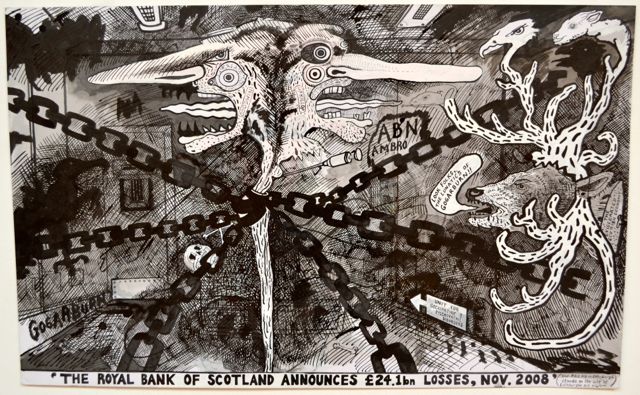
The Royal Bank of Scotland – Martin Fowler
Compiling 500 years of Scottish history is by no means an easy feat. Countless pages of history books burst at the seams with tales of battles, inventions, kings and queens, acts of law, migration, song – it’s hard enough to even pick where to begin. However, Scottish artist Martin Fowler has done just that, compiling his picks from the last 500 years in an astute new exhibition that serves as a catalyst to examine Scottish identity through history. Entitled Scotland the Brave – A Graphic History of Scotland 1513-2013, the exhibition features ink drawings that document the ‘warts and all’ side of Scotland’s story.
Works in the exhibition currently on show at the Scottish Storytelling Centre in Edinburgh range from monumental events such as the battles of Culloden, Bannockburn and Flodden, to more recent events such as the near collapse of the Royal Bank of Scotland, the Housing Act of 1980, Edinburgh’s tram debacle and the opening of the Scottish Parliament in 1998. The Relegation of Rangers FC and the comical disaster of the 1978 World Cup campaign also make an appearance – after all, it wouldn’t be a history of Scotland without the mention of football. The series also explores darker and often overlooked issues such as the arrival of the AIDS epidemic in Edinburgh in the 80s, Scottish self-hatred (a term coined by writer Irvine Welsh) and issues within the prison system where Fowler once worked with prisoners as an art teacher.

A Concise History of North Sea Oil – Martin Fowler
The exhibition serves as an aide-mémoire to Fowler, who said the drawings act as a way to understand and remember events from history. Fowler comes from a generation of Scottish children who were taught a distinctly English history at school, rather than the history of the country in which they were born and raised, saying: “At school there were no references to the Scottish Enlightenment, even though I grew up and went to school in Edinburgh where it happened. I didn’t even have an opinion on it.” Cynicism and satire are employed within some works as a way to critique the madness, as seen in A Concise History of North Sea Oil. Fowler said this piece attempts to address the lies and falsehoods surrounding the use of Scotland’s oil reserves, especially during the Thatcher years.
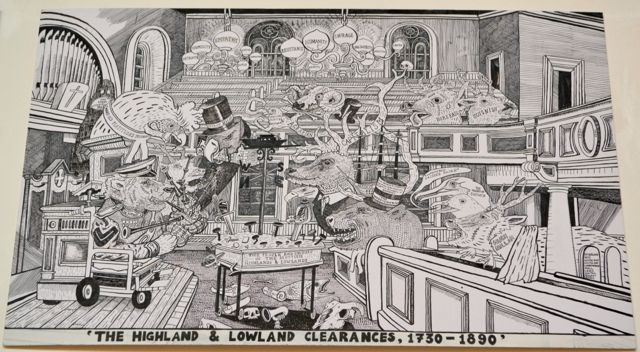
The Highland and Lowland Clearances – Martin Fowler
Fowler chose events based on those he had emotional engagement with, providing an alternative history and another way of looking at events that have often had a prescribed ‘John Prebble’ treatment. In his piece on the Highland Clearances, Fowler references the often overlooked role that women played in resisting landowners moves to clear land. This often resulted in heavy handed police brutality, riots and even deaths. He told me a story about the women of Coigach, where in 1853 attempts were made to clear families from the lands around Coigach in Wester Ross. The women defied orders to leave, and proceeded to strip the Sherrif in command of his clothes, destroying the summons he came bearing. He was then put into a boat, returning to Coigach absolutely nude and humiliated. Martin said the events surrounding the clearances are one of the events in the exhibition that have had the most impact on national identity, saying a sense of loss still exists in the Highlands to this day – something that is vitally important to Scotland’s sense of self.
Another piece in the exhibition looks at the Darien Venture in which Scotland unsuccessfully attempted to become a world trading nation by establishing the colony of Caledonia in Panama around 1690. Fowler said he didn’t know anything about the venture before he began this project, discovering the resulting economic and social situation in Scotland lead to one of the most important parliamentary acts being passed. The venture sucked half of the wealth out of Scotland, weakening the country’s resistance to the Act of the Union which was passed in 1707.
Detail – The Massacre of the MacDonalds of Glencoe
Fowler’s style has similarities with that of comic-book journalist Joe Sacco, saying he was influenced by the political and social satires of English caricaturist James Gillray. Fowler is currently living in Carlisle where he is a Senior Lecturer in Drawing and Fine Art at the University of Cumbria.
As Scotland looks towards the future in 2014, perhaps it’s useful to look back in time to see how Scotland’s identity has been shaped by the past. Not only has Fowler created an accessible collection of work but also one that shows a comprehensive appreciation of Scotland’s deep and rich history of the last 500 years.
You can see Scotland the Brave at the Scottish Storytelling Centre on the Royal Mile until the 28th of July 2013. Fowler will also be giving a talk about the exhibition on Saturday 20th July at 1pm where he will discuss how the collection came about and offer an insight into the practical and technical aspects of his work. All pieces in the exhibition are for sale and you can view more of his work here.
The post Martin Fowler’s Graphic History of Scotland appeared first on ScotClans | Scottish Clans.
]]>The post An Expedition to Munro Country appeared first on ScotClans | Scottish Clans.
]]>
Hector Munro outside Foulis Castle
Following unseasonable snowy conditions a week earlier, Hector had been working around the clock to get his Spring barley crop in the ground while the weather was cooperating. “I am really just a land manager who happens for historic reasons to be the head of an enlarged family group known as a Clan. I work for my living like anyone else – that living happens to be farming.” The majority of the Munro farm at Foulis is made up of malting barley, which when harvested goes to a cooperative shared by farmers in the area. The barley is sorted, batched and sold to maltsters to the order of local whisky distilleries including Glen Ord, Glenmorangie, Highland Park and The Macallan.
Perched among the sown-fields of Foulis sits the striking Foulis Castle, seat of Clan Munro for at least 800 years. “We don’t know the very early history of the castle because there was a terrible family row in the mid-1800s and a lot of documents were burnt and destroyed. As far as we can make out a Munro chief acquired Foulis in about 1350 by swapping some land that he already had on the Black Isle. So we know the land has been in the family since then, possibly longer.” Keyhole gun ports were recently discovered in the base of what seems to have been a corner tower on a defensive outer wall of the castle. “They can be positively dated to between 1450 and 1550, so we know there’s been a castle here since at least then.”
The castle suffered a plundering by Jacobites during the 1745 Rising, as the Munros were ardent Presbyterians and Whigs by political persuasion. “One of my fore-bearers attended the Reformation Parliament in Edinburgh in 1560, voting for reformation. The last thing the Munros wanted was a Catholic King on the throne, so we were staunchly anti-Jacobite.” When the rebellion broke out, 200 Munros marched straight to Inverness to provide aid to the besieged General Sir John Cope, later escorting him to Aberdeen and acting as his scouts. The Munros attempted to hold the North for the Government, but in the end were forced to retreat into Sutherland leaving Foulis open for plundering. The chief at the time, Sir Robert Munro, died commanding an English battalion at the Battle of Falkirk, alongside his brother Dr Duncan Munro who was also killed. At the end of the Rising, Robert’s son returned to Foulis to find it a ruin. “Eventually the Government paid compensation, eight years after Culloden, which allowed him to restore the castle. And by that time I think he realised there was no longer the need for a defensive tower so he incorporated the old parts of the castle into what’s really a modern Georgian mansion. So that’s why today it looks more like a mansion then a castle. The sad thing is that no pictures of the castle (before the mid 1800s) survive, as they were destroyed during the family row over succession.”

Foulis Castle in the distance, surrounded by farmland.
Once an estate of 36,000 acres, the lands today have been reduced to 2,500 and is a mixture of let grazing, barley and forestry. “Sadly there’s very, very few clan chiefs who still are lucky enough to have their original property. And I think it’s the fact that very few areas of the highlands are actually economically viable. Tax, death duties and service to the country has bought about the demise of most of the clan seats, so yes I consider myself very lucky that we’re still at Foulis.”
Clan Munro has a very close affiliation with the Seaforth Highlanders, with ties that go back almost two hundred years. During the Second World War, Hector’s father and uncle were captured at St Valery in 1940 while providing cover for the British Expeditionary Force to escape. “I think it was probably 10,000 men from the Highlands who were captured there in one go. They spent the next four years and 11 months in a POW camp, in which time Foulis became thoroughly run down. The Highland soldiers were always considered the crack troops of the British Army, and as a result they tended to be pushed to the front lines to deal with the trouble spots. I think the Scots probably lost more per head of population than any other allied force in the Second World War.”
Hector began running Foulis in 1974, and became chief in 1995 following the death of his father, Captain Patrick Munro. “I don’t think the role of chief twigged properly until much later, I just took it for granted when I was younger. The fact that my Granny lived in a castle that leaked like a sieve; it didn’t really occur to me that there was any significance. The family have always been in the military so there were lots of swords and spears from great uncle so-and-so who brought them back from Africa. Granny used to allow us to play with these swords as kids, and how we never cut each others heads off, I don’t know, but it was great fun. When my father returned from the war first and foremost he had to work the farm, and secondly try and preserve the castle. In 1958 we got a grant from the Historic Buildings Council for Scotland (now Historic Scotland) and they helped with a grant to put a new roof on the castle.”

Foulis Castle as it stands today
Clan Munro gatherings are held at Foulis every 5-10 years, with the next happening in 2014 to coincide with the 700th anniversary of Bannockburn and Homecoming 2014. “There will be all sorts of activities going on, including some for younger people who will be able to climb Ben Wyvis which is the Munro* out the back here.” The last gathering in 2007 was attended by Munros from America, Canada, Australia, England and even a band of French descendents who came from a Munro who escaped the Battle of Worcester in 1651. “At the head of the French branch of the family is a man called Donald Munro. He can’t speak a word of English yet he’s got a Scottish name – 350 years since his fore-bearers left Scotland. The French Munros were all wearing kilts and wearing their Highland bonnets a bit like a beret – so the tradition carries on.”
Hector would like to see the clans used as a tool to promote the Highlands. “Really the clans are about the Highlands, not Edinburgh. People will go to Edinburgh anyway when they come to visit Scotland, but they won’t necessarily go to the Highlands to look for the clans.” Foulis Castle receives around 6-700 visitors per year from all over the world – appointments can be made by getting in touch through the Clan Munro website. “It’s such a unique selling point for Scotland – where else in the world, just by knowing your surname, can you go to a place and know your fore-bearers came from that spot. Clan territories are very distinct like that.”
Hector’s role as clan chief involves chairing Clan Munro Association meetings, upholding the clans history and traditions, meeting with visiting Munros and dealing with inquiries from all over the world. Outside of being a chief three grandchildren occupy his time when he’s not working on the farm (he says his wife would call him a workaholic). “I suppose the role of clan chief is secondary to being a farmer. I think people tend to have this romantic image of the clans for which Sir Walter Scott probably has much to answer for. The truth is however no less interesting and if we can educate people to take excessive tartantry and dreamt up ceremonials with a pinch of salt, and search out the actual historical facts, then that is far healthier.”
Upon leaving Foulis I walked down the hill towards the clan museum at the old Munro Storehouse. Along the way I passed many relics of the clan’s past, including an ancient burial cairn and disused bridge emblazoned with an eagle – the Munro clan badge. How amazing that for over 800 years the Munro family have worked, fought and lived on the same land, carrying on histories and traditions to this very day.

The Munro Bridge near Foulis Castle

Eagle badge on the bridge
___
* = A Munro is a mountain in Scotland with a height over 3,000 ft (914.4 m). Munros are named after Sir Hugh Munro of Clan Munro (1856–1919), who produced the first list of such hills, known as Munros Tables, in 1891.
The post An Expedition to Munro Country appeared first on ScotClans | Scottish Clans.
]]>