The post Mingulay: 100 years of abandonement. appeared first on ScotClans | Scottish Clans.
]]>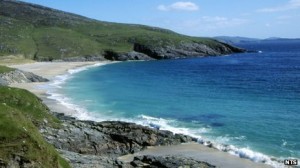 The island of Mingulay forms part of the Bishop Islands, a small collection of islands that lie off the south coast of Barra at the bottom of the Hebrides chain. Its an island of incredible drama; some of the tallest sea cliffs in Europe, sea stacks and arches, one tiny sheltered sandy bay and spectacular views across to its sister islands such as Pabbay and Berneray. Just at the end of the last ice age when the massive European ice sheets retreated from the Western Isles Mingulay would have been connected to the rest of the outer Hebrides, but as sea levels rose it was eventually cut off. There are traces of settlements dating back to the Iron Age and until that day in 1912 the island had been almost continually inhabited.
The sea around the island is dangerous and unpredictable, sailing out from Mingulay could be a one way trip and it was not uncommon for the island to be completely unreachable for months on end. One story that illustrates this concerns two friends who had left the island, one on a trip to Barra and the other who was heading to America to seek his fortune. The friends said their goodbyes at the quayside at Castlebay on Barra. Many months later the one who had made his way to America returned after deciding the new world was no for him. He was surprised to bump into his friend back in Castlebay. The poor man had been stuck on Barra all that time still unable to return home.
Up until the Mid 13th century the islands were under Norse control and indeed the name Mingulay is derived from the old Norse ‘Mikil -ay’ which means ‘big island’. When the Norse invaders finally gave up control of the western isles around 1266 the islands passed to the Lords of the Isles and then to the MacNeils of Barra, in fact it is the rocks of Builacraig on Mingulay that are featured on the crest of Clan MacNeil of Barra.
Although the islands had been long converted to christianity it was a version tempered with a mix of many other older beliefs. Islanders firmly believed in the faery folk and in many other supernatural creatures. Their belief could it times prove disastrous; one example occured during the early tenure of The MacNeils. The chief had grown concerned having not heard from the residents of Mingulay for many months. He sent a ship over to the island and one man called MacPhee was sent ashore. he searched the island and discovered all the inhabitants had died of disease. His crewmates fearing an outbreak of plague left him on the island where he was exiled for a year, climbing the hill every day to look out for rescue. When the boat finally returned to repopulate the island he was granted land there and the lookout hill was named MacPhee’s hill in his honour.
Alas MacNeil sold the island in 1840 along with the other Barra islands to Colonel John Gordon of Aberdeenshire. Gordon had little concern or charity for the islanders and proceeded to clear his new property to make way for sheep though oddly during the height of the clearances the population actually increased as many islanders from nearby Barra fled to the more remote Mingulay rather than make the perilous journey to Nova Scotia. around this time the island population peaked at around 150 inhabitants.

The Old School House on Mingulay
Gradually though the population began to decline, one theory was that it was sparked by a disaster that befell the residents of nearby Pabbay. A boat from the neighbouring island had sunk loosing all 5 hands on board. On such a small island as Pabbay this equated to half the male population. For the residents of Mingulay this brought home the fragility of their own existence and as knowledge of the world beyond their island began to improve many began to realise there were altogether safer and more prosperous ways to make a living away from this tiny outcrop.
From the start if the 1900s islanders began to abandon Migulay, some headed to nearby Vatersay and Sandray where they illegally occupied land there. in 1910 there were only six families living on the island and in 1912 the decision was reached to abandon the island for good.
Since 1912 the island has passed through a few owners who had used it for grazing land until it was finally taken over by the National Trust for Scotland in 2000. The island is now a home to an impressive seabird population.
This weekend the NTS will mark the centenary of the final abandonment of Mingulay with a series of events. A time to reflect on the fragile communities that have existed along the Hebridean chain.
The post Mingulay: 100 years of abandonement. appeared first on ScotClans | Scottish Clans.
]]>The post Prophecy – Scottish Second Sight appeared first on ScotClans | Scottish Clans.
]]>
Easily the best known and most popular of Highland prophets is Kenneth Mackenzie, The Brahan Seer; who may (or may not) have lived around 400 years ago to the north and west of Inverness. The story goes that his mother cut a deal with the spirit of a Danish princess, and in return for letting the wraith return to her grave the power of second sight would be gifted upon her child. In the morning Kenneth awoke to find a stone with a hole cut through the middle next to his bed. On looking through the stone he was engulfed with visions, good and bad, of a future yet to come. In time he would learn to control this gift and make numerous predictions for his own people and for the Highlands as a whole.

The Brahan Seer
Although he is most famous for predicting the downfall of his own clan, the Mackenzies of Seaforth, with a dramatic vision of deaf chiefs, white-hooded lassies and tragedy; he also foresaw the destinies of many other clans as well, for example – “When the big-thumbed sheriff officer and the blind man of the twenty-four fingers shall meet, then MacNeil of Barra shall prepare for a flitting“. It is known that this prophecy came true in 1838 when the last of the MacNeils of Barra left Kisimul Castle behind bankrupt (a ‘flitting’ in Scotland is to move house). Most of his predictions follow this vein, with many being very specific. Many of the prophecies are about battles or hardship ahead, and often a little macabre: “The day will come when the raven will drink its three fills of the blood of Clan Donald on top of the Hills of Minaraidh in Lewis“; ravens drinking the blood is a recurring theme. He would also foresee the changes that ravaged the Highlands during the Clearances of the 18th and 19th century that began in Ross-shire.
“The day will come when there will be a road through the hills of Ross-shire from sea to sea, and a bridge on every stream. Then the people of the land will degenerate and grow weak as their country improves . . . and the clansmen will flee from their native country before an army of sheep” Anyone who knows something of the history of the Highlands will know just how much that sadly came to pass, with sheep replacing men, and whole glens emptied of their people by a brutal aristocracy and their agents. Still, the seer goes on in another vision: “the people will emigrate to islands now unknown in the boundless oceans, after which the deer and other wild animals shall be exterminated by horrid Black Rains. The people will then return and take undisturbed possession of the lands of their ancestors.” This is a reference to the mass emigration from Scotland in the 19th century; but we still await the horrid black rain, and this is one of the most feared predictions in the Highlands still to be fulfilled.
The Brahan Seer wasn’t the only prophet to foretell the Clearances, and considering the social and personal upheavals it caused it’s no wonder. In the 1640s on the shores of Loch Tay in Highland Perthshire lived a seer known as the ‘Lady of Lawers’. It is likely she was Mary Campbell who married John Stewart of Appin, and lived at the big house in the now deserted village of Lawers. She too saw the coming of the sheep and the evicting of the people: “The land will first be sifted and then riddled of its people, and the jaw of the sheep will drive the plough from the ground. The homes on Loch Tay shall become so scarce that a cock crowing will not be heard from one to the other.” Today, the once heavily cultivated slopes of Loch Tay are now almost exclusively put over to sheep grazing.
The landlord was the Marquess of Breadalbane, who’s estate in the 19th century was nearly half a million acres; and he was instrumental in evicting at least 3000 people from Lochtayside during the worst excesses of the Clearances. Not that his family would be spared from the foresight of the Lady of Lawers either: “The day will come when the Campbells of Breadalbane will have a thousand rents, then one rent, then no rents at all; what was put together in hides shall be rent asunder in laces. The last laird will pass over Glenogle with a grey pony leaving nothing behind.” In the 1920s the estate fell into a sharp decline with mounting debts and by the 30s it was bust. Countess Breadalbane sold the last of the estate in 1948 and left the area in a trap pulled by a grey pony.

Breadalbane – Hard hit by the Clearances
Sometimes landowners made the mistake of evicting seers as well, and one such soothsayer forcibly removed from Jura in the early 1700s left her Campbell landlord with an ominous prediction: “The last Campbell laird of Jura will be blind in one eye, and will leave the island with all of his belongings tied to a cart pulled by a lone white horse.” This was well known to the islanders, and finally came true in 1938 when Charles Campbell, who’d been blinded in the First World War fell on hard times, sold up and left the island behind with nothing but a cart and horse. Today, the Isle of Jura distillery produces a whisky commemorating the story, called “Prophecy”
Not all prophecies are doom and gloom; some have a more positive aspect. For example it is well known to the Clan Cameron that “As long as there’s snow on Ben Nevis the Camerons will command Locheil“. At 4409ft, Ben Nevis is the highest mountain in the British isles and looms high and large over the Cameron estates of Locheil; being so high the snow has only melted six times in the last 120 years, only to remain the next year. The Camerons I think are safe. But, eventually we may all be doomed by the famous words of the Border prophet known as ‘Thomas the Rhymer’: “When the Cows of Gowrie come to land, the Judgement Day is near at hand.” The Cows of Gowrie are two boulders sitting in the sands of the Firth of Tay near Dundee, and it is said they move landward at about an inch a year.
The legend goes that Thomas the Rhymer, who lived in the 13th century in the village of Earlston near Melrose, was enchanted by a fairy queen dwelling deep within the Eildon Hills. He was allowed to return to the mortal world for a short time, and was granted the gift of second sight; before eventually spending eternity in the world of the fairies. The story is similar in theme to the ‘gifting’ of the power to the Brahan Seer; and the sidhe, or fairy people play a large part in old superstitions and legends in Scotland. It may be a folk-memory of an older, lost culture that had certain shamanic ritual, and thus lots of prophecies. Many people across the globe, through their own natural shrewdness and perhaps with the help of hallucinogens have been venerated in their culture as being able to divine the future. The seers are our version of this, and many people have claimed the gift, or curse, right down to the present day – it may well have its origins in our very ancient past. It certainly makes for great storytelling.
This article was written by David McNicoll, who runs Vacation Scotland – a travel company specialising in tours and vacation packages to Scotland. For more info – www.vacationscotland.biz
The post Prophecy – Scottish Second Sight appeared first on ScotClans | Scottish Clans.
]]>