The post Culloden Moor Housing Development and our Ancestral Heritage. appeared first on ScotClans | Scottish Clans.
]]>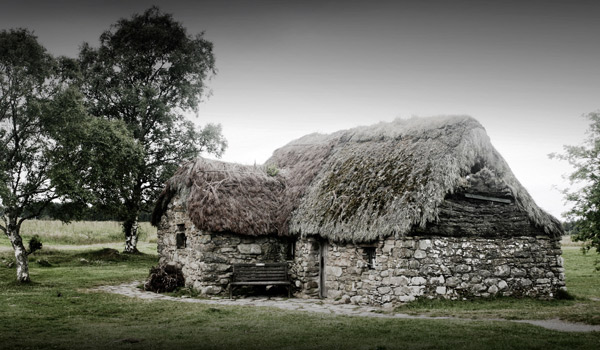
Old Leanach Cottage on Culloden Moor
As dusk fell over Culloden Moor on the 16th April 1746 the last major land battle to be fought on British soil had drawn to a conclusion. With close to 2,000 dead and wounded Jacobites the campaign to restore the Stewart monarchy to the throne had been dealt a decisive final blow. In the days and weeks that followed the dead were buried and the site of the battle was gradually reclaimed by nature, with the exception of a minor road, which ran by the site Culloden has remained untouched to this day.
Now the site is a magnet for those who wish to immerse themselves in the dream of Scotland, in the romantic stories of Bonnie Prince Charlie and Flora MacDonald, in the Jacobite cause that has been the inspiration of so many folk songs and tales. And so the cause of an Italian-born noble to recapture the throne of the United Kingdom from an incumbent German-born monarch became a story that has somehow come to define Scotland.
Two centuries and more have passed and now the site of this battle like many others around Scotland have been taken under the wing of the National Trust for Scotland and the site has been the subject of in-depth research by Historic Scotland and the Royal Commission for Ancient and Historical Monuments for Scotland (RCAHMS). In recent weeks however another battle has been played out over the moor. Not this time though does it feature blue-bonneted highlanders charging over moorland towards red-coated Hanoverians, this battle is taking place on the Internet, in the offices of planning departments and around Scotland’s parliament.
A collection of disused farm buildings which lie around 400m to the north of the battlefield have been the centre of a planning row. Developers who wish to tear down these buildings and erect 16 houses have appealed a local authority decision to refuse planning permission and despite objections from the National Trust for Scotland the Government reporter has overturned the refusal. For those who see Culloden as a symbol of their Scottish identity the very idea of this development is abhorrent and yet taken on its individual merit there is very little in this proposal that would appear to deserving of such a reaction; the footprint and profile of the proposed development extends very little beyond the brown field site that the farm buildings occupy, the increase in noise and traffic that 16 houses contribute to the landscape is paltry compared to the constant flow of tour busses and cars to and from the visitor centre itself and the site is screened from the battlefield by a stand of trees and on the other side of a minor road that has a surprisingly high traffic flow given its rural location.
Taken in isolation it is very hard to see why so many have been worked up into a frenzy over this, even claims that this development will somehow lead to a ‘creeping urbanisation’ of the Culloden area has very little evidence to support it
So there’s no problem and we should just let it go ahead then, right?
Wrong, very very wrong.
You see this issue is not about Culloden. It is about our stewardship of historical sites in every corner of Scotland and it is about the process of managing how developments in areas surrounding sites of historical importance are controlled.
As a race we have in the last century woken up to the responsibilities of managing our environment, not just our natural environment but our historical one too. Nowadays we find it incredible that so many sites, of major importance to our race, have been treated with disregard by our ancestors. Temples and tombs that have been robbed and razed to the ground. Ancient wonders where the stones have been removed to be used for local buildings. We have a lot to thank the Victorians for. It was their curiosity that led to the halt in the demise of our historical environment. People like John Clayton for example, who we have to thank for the fact that anything survives of the magnificent Hadrian’s wall.
Now this does not mean that every corner of our landscape that has a tale to tell must be trapped in amber, the creeping ‘disneyfication’ of Scotland is no better than a creeping urbanisation. People live in and work the landscapes that their ancestors fought and died on and they should be allowed to continue. Take for example the site of the battle Flodden, an event that was arguably more significant in the history of our nation but an event that is marked by a simple monument surrounded by the fields of a working farm, every season the land that saw one of the biggest massacres in Scottish history is ploughed over and grazed upon, life continues as it did before that date in 1513. And that is as it should be
What is required is a sensible approach to the management of our historical environment, it has to be taken into consideration that this environment is not just part of our history but the history of Scotland’s diaspora and their thoughts and views should be listened to. Any inventoried site in Scotland should have a level of protection that means that one civil servant cannot write it off with a flourish of his pen. We have a trust body in Scotland for a reason and their opinions must be considered with the highest regard. Only when all parties agree that a proposed change to a site of significance is right and proper should it be allowed to go ahead.
Viewhill development at Culloden is a fairly innocent piece of planning in itself. 16 family homes out of sight of the moor will have virtually no impact on the quiet contemplation of the landscape, however what Viewhill demonstrates is a lack of joined up thinking across government departments, local councils and trust bodies. The same lack of joined up thinking that has at times hindered the development of a solid approach to ancestral tourism. There is an awful lot of talk but not a lot of listening; in this homecoming year it is time we did just that.
The post Culloden Moor Housing Development and our Ancestral Heritage. appeared first on ScotClans | Scottish Clans.
]]>The post Hitting the Norman: Tracing Your Roots on Ancestry.com (in a hurry) appeared first on ScotClans | Scottish Clans.
]]>
Ouch!
A few years ago my sister contacted a genealogist to research my Mother’s family tree. After months of painstaking research she got back a large scroll with generations of our Robertson heritage. This scroll sat in its tube for some time until one day I got hold of it and decided it would be a good idea to incorporate this into some research I had been doing on our father’s side. This involved setting up an account with ancestry.com and starting to build my tree.
Talk about a can of worms!
First of all let me say I think ancestry is a great website. I have two issues with it though; first of all since they are not on great speaking terms with the records office in Scotland. Mainly down to the fact that the records office have their own ancestral research facility called ‘Scotland’s People‘ and it’s a paid for service so they are not hugely keen on handing over all their data to Ancestry for free so they can then charge for its use (you can sort of see their point). The second issue is that Ancestry builds some of its data from user’s trees. This means that it’s easy to let mistakes creep in. Of course if you are meticulous in your research and only allow ancestors onto your tree after they have been cross-referenced and quadruple checked then it’s not a problem.
If you are a bit lazy like me then you might get some surprises!
My attempts to go back on my father’s line (Moffet) did not take me very far, only a few generations. Part of the problem came down to spelling. Being descended from simple folk on that side (miners and farmers mostly) they were not terribly literate and so the spelling of our surname tended to vary from one generation to another and even in the one family birth certificate surname spelling among siblings was all over the place! Eventually I hit a total brick wall, my best guess is that I came across an illegitimate birth and the whole thing fell apart but who knows.
Now I had this Ancestry account for another 10 months and a bit of confusion what to do now. What’s that they say about idle hands?
Presented with a dead end on one line I started taking a few zig zags to see where they took me. Still following what they call the ‘pedigree’ line; parents, grandparent, great grandparents and so on. Now this is where the lazy bit comes in. looking for quick results I decided to use Ancestry’s ‘tree hints’. The website looks at the people you have added and searches other member trees, if it finds a match then it lets you know. You can then use their data to add members to your tree. Using this method you can build up a lot of relatives in a short time.
At first the results were interesting but each one would take me back a few generations and then run out. Nothing to see here, move along…. Census records only go back so far and before that you have parish records, which are pretty hard to read unless you are an expert so anyone doing amateur research tends to find it hard going after that.
Unless you hit a wee bit of blue blood that is.
The great thing about the upper classes, the landed elite is that with so much property they had to be sure of who they were handing the family jewels down to. Not so much of an issue of your inheritance was a wonky kitchen table and few bits of ‘manky’ crockery but if it’s a few hundred acres and a big ‘hoor’ of a castle that’s another matter! For this reason family records were kept meticulously. Also ancestors would turn up in charters and other documents so they are a lot easier to trace.
My bit of luck came while following a line back on my grannies side of the family, Granny always tended to think she was a bit above the rest of us (well she has been for a while now) Always centre stage in her fur coat! Well it turned out she had a point after all!
Her great Granny was called Margaret Eaton, going back another few generations the name changes to Aiton, go back another few generations and William Aiton strikes it lucky and marries Mary Campbell who it turns out is descended from the chiefs of Clan Campbell of Loudon
Bingo!
Now that I’ve tapped into a line of nobility there is frankly no turning back. My first impulse was to head off to Loudon Castle and set up the siege towers and claim my birth right, couple of problems with that; first of all we are talking 12 generations. Imagine each descendant had 5 children and each of them had 5 children (big families were more common then than now). Turns out there are a LOT of us! I guess maybe I could claim one brick of the ancestral home. Oops another problem, Loudon castle is the site of an abandoned theme park. Looks like I’m descended from a character in a Scooby Doo mystery (peels of mask to reveal the old caretaker)!

Black Agnes: ‘I fart in your general direction’
So off I went on my travel back trough time adding ancestor after ancestor, after ancestor, after…hang on! Just how many could I add? Turns out the answer was A LOT! Again the maths kicks in; 2 parents = 4 grandparents = 8 Great Grandparents = 16 Great Grandparents. After 10 generations you have over a thousand! Blimey. What became fascinating was that as I delved back further I began to uncover some gems from the past. People who I read about in the history books but people it now appeared I was descended from. For instance Black Agnes Dunbar: Agnes was one hell of a woman! Living in the 14th century she was the daughter of the Earl of Moray, a friend of Robert the Bruce. She held Dunbar castle while under siege by the English. According to legend, as the English fired volleys at the castle ramparts she would walk along with her handkerchief and flip the dust from them with nonchalance! She would stand and berate her English attackers without getting as much as a scratch! I’ve always thought Agnes was the inspiration behind the cheeky French knights in Monty Python and the Holy Grail.
Speaking of famous women another important one to turn up on the tree was Annabella Drummond. Annabella was consort to king Robert III and mother of King James I of Scotland. And of course if you have tapped into the Royal Stuart line then that line will of course take you back to Robert the Bruce or as we like to call him great, great, great, great, great, great, great, great, great, great, great, great, great, great, great, great, great, great, great, great, great, Grandad!
Now it’s a funny thing that! For years I’ve had emails at ScotClans from people saying ‘oh yes of course I’m descended from Robert the Bruce’, well by the looks of it most of us are! I remember hearing a few years ago about the descendents of Charlamagne. Emperor Charlamagne who was doing his ‘emperor thing’ around 700AD had an unbroken line of descent, every European royal family is descended from him and at least 14 US presidents have traced their line back there too. In fact research suggests that if you have white European ancestors then he’s your daddy, or rather your great, great, great, oh you get the idea!
So it was one evening while fooling around on the Ancestry site, adding relatives that I came up with the game called ‘Hit the Norman’ (remember the title of this blog, it seems like years ago now doesn’t it). How to play ‘Hit the Norman’
Take an ancestor on Ancestry.com and start heading back along one line, keep going till you can’t go back any further or until you find someone with a suspiciously French sounding name who’s birth place was somewhere in France some time before 1050! Well done you have found one of the Norman conquerors and you get 10 points and a cuddly toy!
Of course now I have a family tree with around 3,000 direct ancestors in it and I have NO IDEA how far back I’ve been able to go, some lines go way back to the 700s and beyond with names like Ethelwulf and Fulke LeStrange. Not names you hear being shouted up the street these days “haw Ethelwulf, come in yer tea’s oot!’ or ‘Fulke! Stop hitting yer wee sister (Grizel)’.
Of course this can all get quite obsessive, addictive even! Hours have been spent frantically adding relatives to the point where I’m seriously worried about how much of the internet I’m going to need for all this! Seriously they might have to give me a quiet bit all to myself where I can’t bother anyone. On the plus side it has made trips out more interesting; a day out to Roslyn castle becomes more interesting when you know you are descended from the St Clair’s who built it and the famous chapel nearby, mind you some places have a bloody cheek charging me to get in when I own the place!
So where do I go next? Clearly this is a task akin to emptying Loch Lomond with a teaspoon (with a hole in it). This could literally go on forever so maybe its time to look at a more defined area, maybe just limit myself to a few generations and see what detailed information I can find on them. This is in a way more interesting than knowing you are the 26th great grandson of King Whatshisname.
Tracing my Mother’s family who came from Wanlockhead in Dumfriesshire I discovered some amazing human stories, families of 13 children many of whom died in infancy, families who ended up in the local poor house and the story of James Robertson. James was born on Wanlockhead in 1803 but died in Inkerman Pennsylvania in 1869. John had immigrated to the USA taking his family with him. All but one that is. Of his 11 children one son John didn’t go, this was because at age 25 John was already dead leaving a wife and 4 children. For some reason his wife Isabella Milligan did not go with the others and stayed behind to suffer severe poverty as a widower in a small lead mining village, nevertheless her spirit survived and through her our family were descended.
So maybe that is the lesson after all. Not to celebrate the kings and queens and landed gentry but to recognise some of the incredible strong women, without whom none of us would be here!
Rodger Moffet (Rodger knows a fair bit about clans but clearly hasn’t much of a clue about genealogy as he readily admits)
The post Hitting the Norman: Tracing Your Roots on Ancestry.com (in a hurry) appeared first on ScotClans | Scottish Clans.
]]>