The post The Scottish Nobility appeared first on ScotClans | Scottish Clans.
]]>The times they have a changed. The Great Estates are still there, but are a shadow of their former glories; the castles now lie open to the public to raise enough revenue to heat the huge halls and ballrooms that once sat at the fulcrum of society; and the lords of the manor themselves reduced to living in former servants quarters to save on the electric bill. Political changes over the last 100 years have altered the role the nobility play in our legislative procedures, and no longer is the wealth concentrated in their hands. The Middle Class, political creatures and the Nuevo Riche have stolen a march on their erstwhile lords and masters. Still, the fire is not quite out. Having a noble title still infers a certain amount of wealth; a large degree of privilege and influence and will certainly open doors (there are plenty lords of the realm sitting on boardroom tables); and of course a residual amount of deference. To visitors from overseas our castles and titles, lords and ladies can be archaic if not downright incomprehensible. But, thousand year old ways are ingrained and hard to shift.

- Dunrobin Castle – Seat of the Countess Sutherland

Scotland was born out of warring factions and semi-kingdoms; a baptism of fire, and any king ruled only by the grace of his great lords. Traditionally, the nation was split into six provinces, each governed by a sub-king; such as Atholl, Moray and Fife. Our understanding of this social organisation comes from ancient, but not contemporary texts and may give an unclear, politically motivated or distorted view of Scotland1200 years ago. Indeed, like all Celtic-based societies of the time it is likely to have been far more complex, fluid and personal. The Church too played a big role and was a major landowner. The king had lots of juggling to do. By 1100, Scotland following on from the revolution in England after the Norman Conquest was introducing the Feudal System – a body politick that placed the king at the apex and then a screed of layered nobility below him ranked in order of precedence. At the bottom of course as always was the peasant who propped up the system.
The Feudal System involved reorganising trade, erecting towns and markets, streamlining authority and the wielding of real power. It was fully introduced into Lowland Scotland by 1200, but its adoption in the Highlands was far more haphazard, and in truth never fully implemented. Instead there was a two-tier system layering the aristocratic feudal structure against a traditional clan heritage. As authority became increasingly centralised around a powerful monarchy the royal house took control of lordships across the country as a tool in maintaining their authority, often displacing the native nobility: it was an omelette out of which our modern nobility was born.
From the early kinglets and a patchwork of lordships new titles emerge around 1000 – Mormaers, Thanes and Toisichs: the first two perhaps an interchangeable title that conveyed either noble rights or as placemen of the king and second only to him; the term toisich is Gaelic and probably equates to Chief, as would emerge in the developed clan system. The earliest mormaers are noted as far back as the 960s with the lords of Atholl; but by the middle of the 12th century the title had been merged with others, including thanages, to become Earl. This is an Anglo-Saxon title, similar to the Scandinavian Jarl and comparable to the continental title Count. The adoption of the English title is symptomatic of the changes in Scottish society and language away from a traditional Celtic one; and part of a wider reorganisation.
William the Conqueror had tried to supplant the title Earl with Count in England, but without success; however, the wife of an earl would be Countess, his son a Viscount and the land under his jurisdiction a County – all European terms. In England, as in the emerging feudal Scotland, the king had parcelled the land into Shires; counties were essentially the same thing and then as now the term is interchangeable. Women can hold the rank under their own right and pass it on to their children, but use the title Countess; for example the Countess of Sutherland (her son will be the next earl).
Some earls had greater responsibilities – perhaps their lands lay along important boundaries, or controlled valuable resources; and they were given a higher rank to donate this added role. From the old French Marchis meaning a border, the title of Marquess emerged. Today there are only four marquisettes in Scotland, the oldest and most senior being the Marquess of Huntly, who is the head of the Gordon family. Ranked even higher than a marquess is that of a Duke. From the Latin Dux, the title was originally a military one, given in Roman times to province commanders. In some countries Dukes or Archdukes are ruling monarchs; and in Scotland the title was originally reserved only for senior members of the royal family – the Duke of Rothesay for example is the official Scottish title for the heir to the throne (not Prince of Wales). Not until 1643 did a non-royal receive the title – the Duke of Hamilton. Today there are seven Scottish dukes, including the Duke of Buccleuch –Britain’s largest landowner – and the Duke of Montrose, who still sits in the House of Lords.

- Arms of the now extinct Earldom of Breadalbane
The wife of a duke is called a duchess, but a woman cannot hold the title on her own accord; even if she’s a queen. Thus a king is also Duke of Normandy (for the Channel Islands) and Duke of Lancaster; but the present Queen is not – although she holds the titles in privilege. She is the Duchess of Edinburgh however, as she is married to the Duke of Edinburgh. There are several Royal Dukes, Edinburgh being one, including the Duke of York (Prince Andrew) and Duke of Cambridge (Prince William) – dukes are addressed as ‘your grace’, but royal dukes as ‘your royal highness’.
Ranked lower than an earl are viscounts (often the courtesy title for the eldest son of an earl), such as the Viscount Falkland; and Lords of Parliament, such as Lord Lovat. There are no Barons in the peerage of Scotland as such, and Lord of Parliament is the equivalent. However, none were created after the Union of Parliaments in 1707 instead new hereditary Scottish lords were ennobled as United Kingdom barons.
By 1900 the aristocracy owned virtually every square inch of Scotland, with vast estates such as those held by the Dukes of Sutherland, Dukes of Atholl, Earls of Breadalbane, Dukes of Argyll, Dukes of Montrose, Earls of Angus and so on. Some titles are now extinct; two world wars and subsequent social upheaval changed the landscape forever. Many have found a new role, perhaps in business; others spending more time in their roles as clan chiefs, while others a quiet life on their estates. But, the age of the warrior aristocracy which has ruled Scotland for 2500 years is in its twilight and it will probably be gone by the end of the century.
The post The Scottish Nobility appeared first on ScotClans | Scottish Clans.
]]>The post Prophecy – Scottish Second Sight appeared first on ScotClans | Scottish Clans.
]]>
Easily the best known and most popular of Highland prophets is Kenneth Mackenzie, The Brahan Seer; who may (or may not) have lived around 400 years ago to the north and west of Inverness. The story goes that his mother cut a deal with the spirit of a Danish princess, and in return for letting the wraith return to her grave the power of second sight would be gifted upon her child. In the morning Kenneth awoke to find a stone with a hole cut through the middle next to his bed. On looking through the stone he was engulfed with visions, good and bad, of a future yet to come. In time he would learn to control this gift and make numerous predictions for his own people and for the Highlands as a whole.

The Brahan Seer
Although he is most famous for predicting the downfall of his own clan, the Mackenzies of Seaforth, with a dramatic vision of deaf chiefs, white-hooded lassies and tragedy; he also foresaw the destinies of many other clans as well, for example – “When the big-thumbed sheriff officer and the blind man of the twenty-four fingers shall meet, then MacNeil of Barra shall prepare for a flitting“. It is known that this prophecy came true in 1838 when the last of the MacNeils of Barra left Kisimul Castle behind bankrupt (a ‘flitting’ in Scotland is to move house). Most of his predictions follow this vein, with many being very specific. Many of the prophecies are about battles or hardship ahead, and often a little macabre: “The day will come when the raven will drink its three fills of the blood of Clan Donald on top of the Hills of Minaraidh in Lewis“; ravens drinking the blood is a recurring theme. He would also foresee the changes that ravaged the Highlands during the Clearances of the 18th and 19th century that began in Ross-shire.
“The day will come when there will be a road through the hills of Ross-shire from sea to sea, and a bridge on every stream. Then the people of the land will degenerate and grow weak as their country improves . . . and the clansmen will flee from their native country before an army of sheep” Anyone who knows something of the history of the Highlands will know just how much that sadly came to pass, with sheep replacing men, and whole glens emptied of their people by a brutal aristocracy and their agents. Still, the seer goes on in another vision: “the people will emigrate to islands now unknown in the boundless oceans, after which the deer and other wild animals shall be exterminated by horrid Black Rains. The people will then return and take undisturbed possession of the lands of their ancestors.” This is a reference to the mass emigration from Scotland in the 19th century; but we still await the horrid black rain, and this is one of the most feared predictions in the Highlands still to be fulfilled.
The Brahan Seer wasn’t the only prophet to foretell the Clearances, and considering the social and personal upheavals it caused it’s no wonder. In the 1640s on the shores of Loch Tay in Highland Perthshire lived a seer known as the ‘Lady of Lawers’. It is likely she was Mary Campbell who married John Stewart of Appin, and lived at the big house in the now deserted village of Lawers. She too saw the coming of the sheep and the evicting of the people: “The land will first be sifted and then riddled of its people, and the jaw of the sheep will drive the plough from the ground. The homes on Loch Tay shall become so scarce that a cock crowing will not be heard from one to the other.” Today, the once heavily cultivated slopes of Loch Tay are now almost exclusively put over to sheep grazing.
The landlord was the Marquess of Breadalbane, who’s estate in the 19th century was nearly half a million acres; and he was instrumental in evicting at least 3000 people from Lochtayside during the worst excesses of the Clearances. Not that his family would be spared from the foresight of the Lady of Lawers either: “The day will come when the Campbells of Breadalbane will have a thousand rents, then one rent, then no rents at all; what was put together in hides shall be rent asunder in laces. The last laird will pass over Glenogle with a grey pony leaving nothing behind.” In the 1920s the estate fell into a sharp decline with mounting debts and by the 30s it was bust. Countess Breadalbane sold the last of the estate in 1948 and left the area in a trap pulled by a grey pony.

Breadalbane – Hard hit by the Clearances
Sometimes landowners made the mistake of evicting seers as well, and one such soothsayer forcibly removed from Jura in the early 1700s left her Campbell landlord with an ominous prediction: “The last Campbell laird of Jura will be blind in one eye, and will leave the island with all of his belongings tied to a cart pulled by a lone white horse.” This was well known to the islanders, and finally came true in 1938 when Charles Campbell, who’d been blinded in the First World War fell on hard times, sold up and left the island behind with nothing but a cart and horse. Today, the Isle of Jura distillery produces a whisky commemorating the story, called “Prophecy”
Not all prophecies are doom and gloom; some have a more positive aspect. For example it is well known to the Clan Cameron that “As long as there’s snow on Ben Nevis the Camerons will command Locheil“. At 4409ft, Ben Nevis is the highest mountain in the British isles and looms high and large over the Cameron estates of Locheil; being so high the snow has only melted six times in the last 120 years, only to remain the next year. The Camerons I think are safe. But, eventually we may all be doomed by the famous words of the Border prophet known as ‘Thomas the Rhymer’: “When the Cows of Gowrie come to land, the Judgement Day is near at hand.” The Cows of Gowrie are two boulders sitting in the sands of the Firth of Tay near Dundee, and it is said they move landward at about an inch a year.
The legend goes that Thomas the Rhymer, who lived in the 13th century in the village of Earlston near Melrose, was enchanted by a fairy queen dwelling deep within the Eildon Hills. He was allowed to return to the mortal world for a short time, and was granted the gift of second sight; before eventually spending eternity in the world of the fairies. The story is similar in theme to the ‘gifting’ of the power to the Brahan Seer; and the sidhe, or fairy people play a large part in old superstitions and legends in Scotland. It may be a folk-memory of an older, lost culture that had certain shamanic ritual, and thus lots of prophecies. Many people across the globe, through their own natural shrewdness and perhaps with the help of hallucinogens have been venerated in their culture as being able to divine the future. The seers are our version of this, and many people have claimed the gift, or curse, right down to the present day – it may well have its origins in our very ancient past. It certainly makes for great storytelling.
This article was written by David McNicoll, who runs Vacation Scotland – a travel company specialising in tours and vacation packages to Scotland. For more info – www.vacationscotland.biz
The post Prophecy – Scottish Second Sight appeared first on ScotClans | Scottish Clans.
]]>The post The Battle of Altimarlach – Scotland’s last Clan Battle appeared first on ScotClans | Scottish Clans.
]]>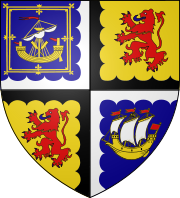
The Arms of the Earl of Caithness
The 13th of July, 1680 saw the last significant clan battle to be fought in Scotland, with the Sinclairs, under the command of George Sinclair of Keiss, taking on the Campbells led by Sir John Campbell of Glenorchy, fighting over the right to the Girnigoe Estates in Caithness.
In 1676, George Sinclair, the 6th Earl of Caithness died without an outright heir, and both Glenorchy and Keiss believed that they were entitled to inherit the estate.
During the latter half of the 17th century, economically, things were bad for many of the Highland clans, with some struggling to survive financially. The Earl of Caithness was one of those in desperate need for money with the Sinclair estate virtually bankrupt. It is alleged that he borrowed money from the Campbells for the purpose of shoring up the clan’s estates. On the death of the Earl, Sir John Campbell, being the main creditor to Sinclair, obtained the Girnigoe Estates as well as the Earldom in 1677 as repayment for his loan.
By 1678 he had married the late Earl’s widow, the Countess of Caithness. However, it is said that the only reason why Campbell married the countess was a financial one because it saved him having to pay her an annual 12,000 marks.
George Sinclair of Keiss was unhappy with Campbell’s accession to the Earldom, and disputed the claim. Keiss put forth his claim to the Earldom by stating that he was a direct relative of George Sinclair, and he went on to seize the Caithness estates, as well as occupying areas in and around the town of Wick.
The dispute continued and it saw Campbell gaining royal permission to invade Caithness and uphold his claim as the rightful Earl. Along with his own men, Campbell was provided with several companies of the king’s troops, and they marched north to Wick from Perth. They arrived on the 18th of May and camped at Braemore, near Morven. This was part of the Berriedale estate which Campbell laid claim to as Earl of Caithness.
The army, believed to be 800 strong, marched on on the 12th of July and reached the Hill of Yarrows, which was known for a long time as Torran nan Gael – the Highlanders Hill. From there Campbell and his men had a great view of the surrounding area. Whilst on the hill a thick mist descended, and Campbell decided to take this opportunity to advance on Wick. However, the mist lifted as he was heading down, and the alarm was promptly raised by the Sinclair forces in the town.
When Campbell and his men reached the bottom of the hill they headed for Stirkoke and Altimarlach where he split his army in two; deploying one lot on the haugh, and the rest were hidden in a gully. Sinclair moved his men, estimated to be around the same size as Campbells, out of the town and headed along Wick River to meet the enemy army. As they reached the haugh, just at the point where a burn met the river, the Campbells launched a surprise attack, followed shortly by an ambush by the men in the gully. The Sinclairs were in a tight position, pressed against the river bank. At this point the Wick River is rather deep, and as the Campbells pushed forward many of the Sinclairs fell into the water and drowned. For those who fell in to the flowing river, but managed to make it across to the opposite bank, on the Moss of Bronsie, awaiting for them there were reserves from Campbells army who summarily continued the fighting, killing many who made it across.
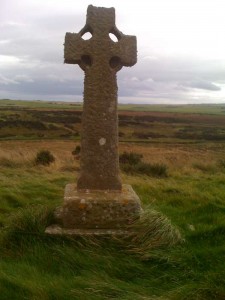
The monument to the battle of Altimarlach
The battle ended in a decisive victory for Sir John Campbell of Glenorchy, and it is generally viewed as a humiliating defeat for the Sinclairs. Legend claims that so many Sinclairs were killed or drowned in the river that the Campbells were able to cross without getting their feet wet. It is estimated that Sinclair lost around 300 men in the battle, whilst Campbell saw few from his side killed, and those that did die were buried where a commemorative cross now stands.
Peace was made however the following day when a truce was signed in the old Wick Town Hall, just east of present day Market Square.
Afterwards, Campbell split up part of his army around Caithness, where he levied the rents and taxes and ruled over the people in an oppressive manner.
It is said that on Campbell’s march to Caithness, to claim the estates, his piper, Finlay Ban MacIvor, composed two famous pipe tunes: Breadalbane Gathering and The Campbells are Coming. The former was said to have been played spontaneous in the middle of the battle, not long before the Sinclairs began to give way. Until relatively recently it was considered a gross insult to play either piece in Wick.
Campbell remained Earl of Caithness only until 1681. It is thought that George Sinclair had some influential and powerful friends, because he took his case to the Privy Council, and by act of parliament George was granted the Earldom, making him the 7th Earl, and putting the title back into the Sinclair family where it has remained ever since.
The post The Battle of Altimarlach – Scotland’s last Clan Battle appeared first on ScotClans | Scottish Clans.
]]>