<br />
<b>Deprecated</b>:  mysql_connect(): The mysql extension is deprecated and will be removed in the future: use mysqli or PDO instead in <b>/var/www/apps/scotclans_wp/wp-includes/wp-db.php</b> on line <b>1142</b><br />
<?xml version="1.0" encoding="UTF-8"?>
<rss version="2.0"
	xmlns:content="http://purl.org/rss/1.0/modules/content/"
	xmlns:wfw="http://wellformedweb.org/CommentAPI/"
	xmlns:dc="http://purl.org/dc/elements/1.1/"
	xmlns:atom="http://www.w3.org/2005/Atom"
	xmlns:sy="http://purl.org/rss/1.0/modules/syndication/"
	xmlns:slash="http://purl.org/rss/1.0/modules/slash/"
	>

<channel>
	<title>ScotClans &#124; Scottish Clans &#187; clan donald</title>
	<atom:link href="http://109.74.200.198/tag/clan-donald/feed/" rel="self" type="application/rss+xml" />
	<link>http://109.74.200.198</link>
	<description></description>
	<lastBuildDate>Fri, 20 Jan 2017 08:08:09 +0000</lastBuildDate>
	<language>en-US</language>
	<sy:updatePeriod>hourly</sy:updatePeriod>
	<sy:updateFrequency>1</sy:updateFrequency>
	<generator>http://wordpress.org/?v=3.6.1</generator>
		<item>
		<title>Work Begins on Clan Donald Village</title>
		<link>http://109.74.200.198/work-begins-on-clan-donald-village/</link>
		<comments>http://109.74.200.198/work-begins-on-clan-donald-village/#comments</comments>
		<pubDate>Wed, 05 Mar 2014 11:43:40 +0000</pubDate>
		<dc:creator>Nadine Lee</dc:creator>
				<category><![CDATA[CLANS - Big List of Scottish Clans]]></category>
		<category><![CDATA[Gaelic Heritage]]></category>
		<category><![CDATA[MacDonald]]></category>
		<category><![CDATA[Scottish News]]></category>
		<category><![CDATA[Alex Salmond]]></category>
		<category><![CDATA[clan donald]]></category>
		<category><![CDATA[Clan Donald of Sleat]]></category>
		<category><![CDATA[Kilbeg Village]]></category>
		<category><![CDATA[Nicola Sturgeon]]></category>
		<category><![CDATA[Sabhal Mòr Ostaig]]></category>
		<category><![CDATA[Skye]]></category>

		<guid isPermaLink="false">http://www.bletherskite.net/?p=5905</guid>
		<description><![CDATA[<p>Construction work began this week on the first planned village for over 100 years on the Isle of Skye. A project initiated by the Clan Donald Lands Trust, the 21st century Highland village known as Kilbeg is to be located on the Sleat Peninsula, and will be centered around the existing world-class Gaelic University Sabhal Mòr Ostaig. [&#8230;]</p>
<p>The post <a rel="nofollow" href="http://109.74.200.198/work-begins-on-clan-donald-village/">Work Begins on Clan Donald Village</a> appeared first on <a rel="nofollow" href="http://109.74.200.198">ScotClans | Scottish Clans</a>.</p>
]]></description>
				<content:encoded><![CDATA[<div id="attachment_5906" class="wp-caption aligncenter" style="width: 451px"><a href="http://www.bletherskite.net/wp-content/uploads/2014/03/KilbegUpdatedMasterPlan.jpg" data-lightboxplus="lightbox[38765]" title="Work Begins on Clan Donald Village"><img class="wp-image-5906" alt="Kilbeg VIllage Master Plan" src="http://www.bletherskite.net/wp-content/uploads/2014/03/KilbegUpdatedMasterPlan.jpg" width="441" height="311" /></a><p class="wp-caption-text">Kilbeg Village Master Plan</p></div>
<p>Construction work began this week on the first planned village for over 100 years on the Isle of Skye. A project initiated by the Clan Donald Lands Trust, the 21st century Highland village known as Kilbeg is to be located on the Sleat Peninsula, and will be centered around the existing world-class Gaelic University Sabhal Mòr Ostaig.</p>
<p>Kilbeg Village is a 40 acre site situated within the estate of Clan Donald Lands Trust on the southern end of the Isle of Skye, and incorporates a mix of housing, commercial, educational and leisure development. Community, energy sustainability and heritage components were a large factor in the planning stages, with the resulting master plan outlining a desire to create a village with a strong sense of place and local community.</p>
<p>The development will add to the hugely significant impact which Sabhal Mòr has had on the economic and social development of this formerly ‘fragile area’ which, against all trends, has seen its population double over recent years. In May 2013 Deputy First Minister Nicola Sturgeon announced £1.908m of capital funding was allocated to the project through the ERDF European Structural Funds Programme, completing the £6.7m Phase 1 funding stage.</p>
<p>Speaking on behalf of the Scottish Government which has strongly backed the initiative, First Minister, Alex Salmond MSP, said yesterday: “It’s fantastic that Sabhal Mòr Ostaig is now in a position to take this exciting step in what is a visionary project. Investment in projects like Kilbeg is absolutely key for stimulating economic growth throughout Scotland. It’s vital we support opportunities that help create new jobs and apprenticeships, places which, at the same time, support the development and improvement of our rural communities.&#8221;</p>
<p>&#8220;Sabhal Mòr Ostaig makes an important contribution to the area beyond its obvious tuition and promotion of Gaelic. Kilbeg will future-proof the university and, along with the local community, create the first new village to be built on the island in more than 100 years”.</p>
<p>“As many Gaels will attest, Gaelic is more than a language. It is an integral part of the identity and heritage of the Highlands and Islands, and thanks to Sabhal Mòr Ostaig, in this anniversary year, Gaelic is as current and relevant today as it was 40, even 400, years ago.”</p>
<div dir="ltr" data-angle="0" data-font-name="g_font_172_0" data-canvas-width="529.3261956443787">
<div id="attachment_5907" class="wp-caption aligncenter" style="width: 456px"><a href="http://www.bletherskite.net/wp-content/uploads/2014/03/Kilbeg-620x300.jpg" data-lightboxplus="lightbox[38765]" title="Work Begins on Clan Donald Village"><img class="wp-image-5907" alt="Work Begins at Kilbeg Village" src="http://www.bletherskite.net/wp-content/uploads/2014/03/Kilbeg-620x300.jpg" width="446" height="216" /></a><p class="wp-caption-text">Work Begins at Kilbeg Village. Photo courtesy of Island News and Advertiser.</p></div>
<p>Phase 1 will see the building of a new Academic, Research, Knowledge Transfer and Enterprise building to house key college staff. This will allow for the conservation and future redevelopment of the iconic and historic Steading Building, creating a new bespoke conferencing and events facility, a key part of the College’s own estate development strategy. Future phases of the wider Master plan over a 10-15 year time-frame provide for a range of housing, retail and enterprise units, a small hotel and sports and recreation facilities for Sabhal Mòr and the wider community.</p>
<p>Spearheaded by the Clan Donalds Land Trust, the registered charity aims to promote an understanding of the history and traditions of Clan Donald and the Lordship of the Isles. It operates Clan Donald Skye Visitor Centre situated within its 20,000 acre estate &#8211; a central feature of the Centre being the Museum of the Isles. The Trust also maintains the remains of Armadale Castle with its historic, landscaped Gardens, the Home Farm, ten Crofting Townships, and commercial and natural woodlands within the estate. In advancing its mission, the Trust also provides important economic benefits to the region as both a major employer and popular visitor attraction.</p>
</div>
<p>The post <a rel="nofollow" href="http://109.74.200.198/work-begins-on-clan-donald-village/">Work Begins on Clan Donald Village</a> appeared first on <a rel="nofollow" href="http://109.74.200.198">ScotClans | Scottish Clans</a>.</p>
]]></content:encoded>
			<wfw:commentRss>http://109.74.200.198/work-begins-on-clan-donald-village/feed/</wfw:commentRss>
		<slash:comments>0</slash:comments>
		</item>
		<item>
		<title>A Cannonball, a Sheepskin and a Loch Village</title>
		<link>http://109.74.200.198/a-cannonball-a-sheepskin-and-a-loch-village/</link>
		<comments>http://109.74.200.198/a-cannonball-a-sheepskin-and-a-loch-village/#comments</comments>
		<pubDate>Tue, 03 Sep 2013 14:00:57 +0000</pubDate>
		<dc:creator>Nadine Lee</dc:creator>
				<category><![CDATA[Campbell]]></category>
		<category><![CDATA[CLANS - Big List of Scottish Clans]]></category>
		<category><![CDATA[MacDonald]]></category>
		<category><![CDATA[MacLean]]></category>
		<category><![CDATA[Scottish History]]></category>
		<category><![CDATA[archaeology]]></category>
		<category><![CDATA[Bronze Age]]></category>
		<category><![CDATA[Cannonball]]></category>
		<category><![CDATA[Clan Campbell]]></category>
		<category><![CDATA[clan donald]]></category>
		<category><![CDATA[crannog]]></category>
		<category><![CDATA[Excavation]]></category>
		<category><![CDATA[Iron Age]]></category>
		<category><![CDATA[Loch VIllage]]></category>
		<category><![CDATA[Lochaber]]></category>
		<category><![CDATA[Mingary Castle]]></category>
		<category><![CDATA[sheepskin]]></category>

		<guid isPermaLink="false">http://www.bletherskite.net/?p=5356</guid>
		<description><![CDATA[<p>From a cannonball found lodged in the wall of a castle, to a Bronze Age body wrapped in a sheepskin &#8211; it&#8217;s been a thrilling week in the field of archaeology. Here&#8217;s the lowdown on the latest uncovered artifacts found in Scotland: What &#8211; Cannonball Era &#8211; Most likely 1644 Found &#8211; Wedged in the [&#8230;]</p>
<p>The post <a rel="nofollow" href="http://109.74.200.198/a-cannonball-a-sheepskin-and-a-loch-village/">A Cannonball, a Sheepskin and a Loch Village</a> appeared first on <a rel="nofollow" href="http://109.74.200.198">ScotClans | Scottish Clans</a>.</p>
]]></description>
				<content:encoded><![CDATA[<p>From a cannonball found lodged in the wall of a castle, to a Bronze Age body wrapped in a sheepskin &#8211; it&#8217;s been a thrilling week in the field of archaeology. Here&#8217;s the lowdown on the latest uncovered artifacts found in Scotland:</p>
<div id="attachment_5938" class="wp-caption aligncenter" style="width: 650px"><a href="/wp-content/uploads/2013/09/2-cannonball1.jpg" data-lightboxplus="lightbox[5356]" title="A Cannonball, a Sheepskin and a Loch Village"><img class="size-full wp-image-5938" alt="The Mingary Castle cannonball" src="/wp-content/uploads/2013/09/2-cannonball1.jpg" width="640" height="400" /></a><p class="wp-caption-text">The Mingary Castle cannonball</p></div>
<p><strong>What &#8211; Cannonball</strong><br />
<strong> Era &#8211; Most likely 1644</strong><br />
<strong> Found &#8211; Wedged in the wall of Mingary Castle, Lochaber, West Highlands.</strong></p>
<p>Fired almost 350 years ago, this cannonball was found during restoration work currently taking place at Mingary Castle. The cannonball was found sitting in an 18 inch hole in one of the castle&#8217;s sea facing walls, embedded a foot into the wall. A ship was lost in the attack on the castle during tensions between clans and Covenanters.</p>
<p>The remains of the ship were discovered in 1999 and relate to the siege of Mingary Castle by by Archibald Campbell, 8th Earl of Argyll, the castle&#8217;s former owner, recorded in a diary written by John Weir in 1644. Weir was a Puritan imprisoned in Mingary Castle by Major-General Alasdair MacDonald.</p>
<p>Originally built for the Clan MacDonald of Ardnamurchan (also known as MacIain of Ardnamurchan), the castle has had many different occupants over the years including Clan MacDonald of Lochalsh, Clan <a href="http://www.scotclans.com/scottish_clans/clan_campbell/" target="_blank">Campbell</a>, <a href="http://www.scotclans.com/scottish_clans/clan_maclean/" target="_blank">Clan MacLean</a> and King James IV of Scotland who used it as a stronghold for fighting off <a href="http://www.scotclans.com/scottish_clans/clan_macdonald/" target="_blank">Clan Donald</a> in the late 15th century.</p>
<p>&nbsp;</p>
<div id="attachment_5940" class="wp-caption aligncenter" style="width: 605px"><a href="/wp-content/uploads/2013/09/42225880871.jpg" data-lightboxplus="lightbox[5356]" title="A Cannonball, a Sheepskin and a Loch Village"><img class="size-full wp-image-5940" alt="Archaeologists at the burial excavation site in Sutherland" src="/wp-content/uploads/2013/09/42225880871.jpg" width="595" height="422" /></a><p class="wp-caption-text">Archaeologists at the burial excavation site in Sutherland</p></div>
<p><strong>What &#8211; Burial cist with sheepskin and human remains</strong><br />
<strong> Era &#8211; Bronze Age</strong><br />
<strong> Found &#8211; A back garden near the village of Spinningdale, Sutherland, North Highlands.</strong></p>
<p>Discovered by accident when a septic tank was being installed in a back garden, the sheepskin and human remains are said to be at least 4000 years old. The sheepskin was found wrapped around the left arm bone of the skeleton of the middle aged female whose crouched body was contained within the burial cist.<br />
It is believed to be the first known example of sheepskin from the Bronze Age found in Britain.</p>
<p>A spokesman for the archaeology company said: &#8220;A radiocarbon date of 2051-1911 BC and 2151-2018 BC was obtained from bone and charcoal fragments, placing the cist in the early Bronze Age period. The radiocarbon dating of the cist corresponds with the date of the food vessel urn buried with the body. The vessel contained carbonised material of non-botanical origin, unidentified cremated bone and a fragment of a small ring. These were probably placed there to assist the individual&#8217;s journey into the next world and indicate belief in the afterlife, which appears to have been a concept only adopted in Scotland.&#8221;</p>
<p>&#8220;The preservation of organic material, such as sheepskin or wool, also supports the view of a elaborate burial rites being carried out in the vicinity of the Dornoch Firth during the early Bronze Age.&#8221;</p>
<p>&nbsp;</p>
<div id="attachment_5943" class="wp-caption aligncenter" style="width: 634px"><a href="/wp-content/uploads/2013/09/69563001_img_2a1.jpg" data-lightboxplus="lightbox[5356]" title="A Cannonball, a Sheepskin and a Loch Village"><img class="size-full wp-image-5943" alt="The loch village revealed" src="/wp-content/uploads/2013/09/69563001_img_2a1.jpg" width="624" height="351" /></a><p class="wp-caption-text">The loch village revealed</p></div>
<p><strong>What &#8211; Loch Village </strong><br />
<strong>Era &#8211; Iron Age</strong><br />
<strong> Found &#8211; Wigtownshire, Dumfries and Galloway</strong></p>
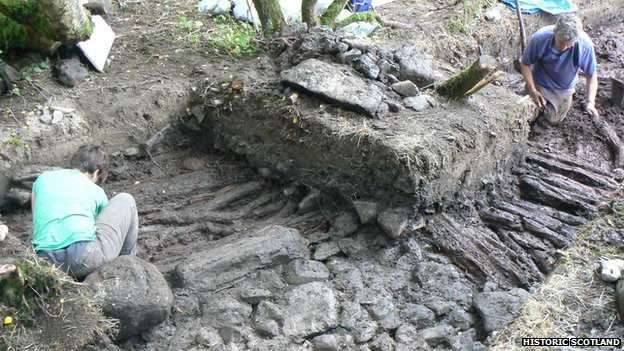
<p>Experts are calling this remarkable find &#8216;Scotland&#8217;s Glastonbury&#8217;, in reference to Somerset&#8217;s famous lake village after discovering the first loch village in Scotland. What originally began as a small scale excavation of a crannog (a singular loch dwelling) turned into a fully fledged dig when archaeologists found evidence of multiple structures on the site. The site is one of 55 archaeology projects to receive more than £1m in funding from Historic Scotland for 2013/14.</p>
<p>What initially appeared to be one of a small group of mounds before excavation was revealed to be a massive stone hearth complex at the centre of a roundhouse. The timber structure of the house has been preserved, with beams radiating out from the hearth forming the foundation, while the outer wall consists of a double-circuit of stakes. The most surprising discovery was that the house was not built on top of an artificial foundation, but directly over the fen peat which had gradually filled in the loch.</p>
<p>Graeme Cavers, of AOC Archaeology, who is the co-director of the site, said that because the land was abandoned after the Iron Age, the buildings were well preserved.</p>
<p>&#8220;Waterlogged wood also offers the opportunity to date the structure very accurately using dendrochronology – or tree-ring counting – to give a date accurate to within a few years or even months, rather than the decades or centuries usually provided by radiocarbon dating,&#8221; he added.</p>
<p>The post <a rel="nofollow" href="http://109.74.200.198/a-cannonball-a-sheepskin-and-a-loch-village/">A Cannonball, a Sheepskin and a Loch Village</a> appeared first on <a rel="nofollow" href="http://109.74.200.198">ScotClans | Scottish Clans</a>.</p>
]]></content:encoded>
			<wfw:commentRss>http://109.74.200.198/a-cannonball-a-sheepskin-and-a-loch-village/feed/</wfw:commentRss>
		<slash:comments>1</slash:comments>
		</item>
		<item>
		<title>Prophecy &#8211; Scottish Second Sight</title>
		<link>http://109.74.200.198/prophecy-scottish-second-sight/</link>
		<comments>http://109.74.200.198/prophecy-scottish-second-sight/#comments</comments>
		<pubDate>Thu, 02 Feb 2012 07:57:26 +0000</pubDate>
		<dc:creator>davemcnicoll</dc:creator>
				<category><![CDATA[Gaelic Heritage]]></category>
		<category><![CDATA[Scottish Mystery]]></category>
		<category><![CDATA[black rain]]></category>
		<category><![CDATA[brahan seer]]></category>
		<category><![CDATA[Cameron]]></category>
		<category><![CDATA[Campbell]]></category>
		<category><![CDATA[Clan]]></category>
		<category><![CDATA[clan donald]]></category>
		<category><![CDATA[clan heritage]]></category>
		<category><![CDATA[clearances]]></category>
		<category><![CDATA[highland]]></category>
		<category><![CDATA[highland clearnaces]]></category>
		<category><![CDATA[Inverness]]></category>
		<category><![CDATA[predictions]]></category>
		<category><![CDATA[prophecy]]></category>
		<category><![CDATA[prophets]]></category>
		<category><![CDATA[Scotland]]></category>
		<category><![CDATA[Scottish]]></category>
		<category><![CDATA[second sight]]></category>
		<category><![CDATA[seers]]></category>
		<category><![CDATA[sheep]]></category>
		<category><![CDATA[Thomas the Rhymer]]></category>

		<guid isPermaLink="false">http://www.scotclans.com/bletherskite/?p=3275</guid>
		<description><![CDATA[<p>The Scots are superstitious, and one of our most strongly held beliefs is that of the gift of second sight; the ability to predict events before they occur. Prophets, or seers, are well recorded in Scottish history and mythology from the Brahan Seer to Thomas the Rhymer; and this article looks at how their predictions cast a long shadow over the lives of people of Scotland</p>
<p>The post <a rel="nofollow" href="http://109.74.200.198/prophecy-scottish-second-sight/">Prophecy &#8211; Scottish Second Sight</a> appeared first on <a rel="nofollow" href="http://109.74.200.198">ScotClans | Scottish Clans</a>.</p>
]]></description>
				<content:encoded><![CDATA[<p class="MsoNormal" style="margin: 0cm 0cm 0pt;"><span style="font-family: Arial;"><span style="font-size: small;"><strong>The Scots are a superstitious people. We have a strong sense of the &#8216;otherworld&#8217; of portents, fairy people and tempting of fate: Scottish grannies are particularly good at spinning yarns of mysterious goings-on. One belief which has remained strong throughout the ages is that of Second Sight: the ability to see into the future and predict events ahead of time. The history of the Highlands is littered with prophets, or seers as they&#8217;re known; and very often their words foretold doom and disaster for one clan or another.</strong> </span></span></p>
<p class="MsoNormal" style="margin: 0cm 0cm 0pt;"><span style="font-family: Arial;"><span style="font-size: small;"> </span></span></p>
<p class="MsoNormal" style="margin: 0cm 0cm 0pt;"><span style="font-family: Arial;"><span style="font-size: small;">Easily the best known and most popular of Highland prophets is Kenneth Mackenzie, The Brahan Seer; who may (or may not) have lived around 400 years ago to the north and west of Inverness. The story goes that his mother cut a deal with the spirit of a Danish princess, and in return for letting the wraith return to her grave the power of second sight would be gifted upon her child. In the morning Kenneth awoke to find a stone with a hole cut through the middle next to his bed. On looking through the stone he was engulfed with visions, good and bad, of a future yet to come. In time he would learn to control this gift and make numerous predictions for his own people and for the Highlands as a whole.</span></span></p>
<div><span style="font-family: Arial;"><span style="font-size: small;"> </span></span></div>
<p><span style="font-family: Arial;"><span style="font-size: small;"> </span></span></p>
<p>&nbsp;</p>
<div id="attachment_5946" class="wp-caption aligncenter" style="width: 610px"><a href="/wp-content/uploads/2012/02/brahan-seer.jpg" data-lightboxplus="lightbox[5732]" title="Prophecy - Scottish Second Sight"><img class="size-full wp-image-5946" alt="The Brahan Seer" src="/wp-content/uploads/2012/02/brahan-seer.jpg" width="600" height="800" /></a><p class="wp-caption-text">The Brahan Seer</p></div>
<p class="MsoNormal" style="margin: 0cm 0cm 0pt;"><span style="font-family: Arial;"><span style="font-size: small;"> </span></span></p>
<p class="MsoNormal" style="margin: 0cm 0cm 0pt;"><span style="font-family: Arial;"><span style="font-size: small;">Although he is most famous for predicting the downfall of his own clan, the Mackenzies of Seaforth, with a dramatic vision of deaf chiefs, white-hooded lassies and tragedy; he also foresaw the destinies of many other clans as well, for example – &#8220;<em style="mso-bidi-font-style: normal;">When the big-thumbed sheriff officer and the blind man of the twenty-four fingers shall meet, then MacNeil of Barra shall prepare for a flitting</em>&#8220;. It is known that this prophecy came true in 1838 when the last of the MacNeils of Barra left Kisimul Castle behind bankrupt (a &#8216;flitting&#8217; in Scotland is to move house). Most of his predictions follow this vein, with many being very specific. Many of the prophecies are about battles or hardship ahead, and often a little macabre: &#8220;<em style="mso-bidi-font-style: normal;">The day will come when the raven will drink its three fills of the blood of Clan Donald on top of the Hills of Minaraidh in Lewis</em>&#8220;; ravens drinking the blood is a recurring theme. He would also foresee the changes that ravaged the Highlands during the Clearances of the 18<sup>th</sup> and 19<sup>th</sup> century that began in Ross-shire.</span></span></p>
<p class="MsoNormal" style="margin: 0cm 0cm 0pt;"><span style="font-family: Arial;"><span style="font-size: small;"> </span></span></p>
<p class="MsoNormal" style="margin: 0cm 0cm 0pt;"><span style="font-family: Arial;"><span style="font-size: small;">&#8220;<em style="mso-bidi-font-style: normal;">The day will come when there will be a road through the hills of Ross-shire from sea to sea, and a bridge on every stream. Then the people of the land will degenerate and grow weak as their country improves . . . and the clansmen will flee from their native country before an army of sheep</em>&#8221; Anyone who knows something of the history of the Highlands will know just how much that sadly came to pass, with sheep replacing men, and whole glens emptied of their people by a brutal aristocracy and their agents. Still, the seer goes on in another vision: <em style="mso-bidi-font-style: normal;">&#8220;the people will emigrate to islands now unknown in the boundless oceans, after which the deer and other wild animals shall be exterminated by horrid Black Rains. The people will then return and take undisturbed possession of the lands of their ancestors.</em>&#8221; This is a reference to the mass emigration from Scotland in the 19<sup>th</sup> century; but we still await the horrid black rain, and this is one of the most feared predictions in the Highlands still to be fulfilled. </span></span></p>
<p class="MsoNormal" style="margin: 0cm 0cm 0pt;"><span style="font-family: Arial;"><span style="font-size: small;"> </span></span></p>
<p class="MsoNormal" style="margin: 0cm 0cm 0pt;"><span style="font-family: Arial;"><span style="font-size: small;">The Brahan Seer wasn&#8217;t the only prophet to foretell the Clearances, and considering the social and personal upheavals it caused it&#8217;s no wonder. In the 1640s on the shores of Loch Tay in Highland Perthshire lived a seer known as the &#8216;Lady of Lawers&#8217;. It is likely she was Mary Campbell who married John Stewart of Appin, and lived at the big house in the now deserted village of Lawers. She too saw the coming of the sheep and the evicting of the people: &#8220;<em style="mso-bidi-font-style: normal;">The land will first be sifted and then riddled of its people, and the jaw of the sheep will drive the plough from the ground. The homes on Loch Tay shall become so scarce that a cock crowing will not be heard from one to the other.</em>&#8221; Today, the once heavily cultivated slopes of Loch Tay are now almost exclusively put over to sheep grazing. </span></span></p>
<p class="MsoNormal" style="margin: 0cm 0cm 0pt;"><span style="font-family: Arial;"><span style="font-size: small;"> </span></span></p>
<p class="MsoNormal" style="margin: 0cm 0cm 0pt;"><span style="font-family: Arial;"><span style="font-size: small;">The landlord was the Marquess of Breadalbane, who&#8217;s estate in the 19<sup>th</sup> century was nearly half a million acres; and he was instrumental in evicting at least 3000 people from Lochtayside during the worst excesses of the Clearances. Not that his family would be spared from the foresight of the Lady of Lawers either: &#8220;<em style="mso-bidi-font-style: normal;">The day will come when the Campbells of Breadalbane will have a thousand rents, then one rent, then no rents at all; what was put together in hides shall be rent asunder in laces. The last laird will pass over Glenogle with a grey pony leaving nothing behind.</em>&#8221; In the 1920s the estate fell into a sharp decline with mounting debts and by the 30s it was bust. Countess Breadalbane sold the last of the estate in 1948 and left the area in a trap pulled by a grey pony.</span></span></p>
<div></div>
<p>&nbsp;</p>
<div id="attachment_3283" class="wp-caption aligncenter" style="width: 494px"><img class="size-full wp-image-3283" title="Loch Tay" alt="Breadalbane - Hard hit by the Clearances" src="http://www.letsbuyscottish.com/wp-content/uploads/2012/02/loch-tayside.jpg" width="484" height="294" /><p class="wp-caption-text">Breadalbane &#8211; Hard hit by the Clearances</p></div>
<p>&nbsp;</p>
<p>&nbsp;</p>
<p class="MsoNormal" style="margin: 0cm 0cm 0pt;"><span style="font-family: Arial;"><span style="font-size: small;"> </span></span></p>
<p class="MsoNormal" style="margin: 0cm 0cm 0pt;"><span style="font-family: Arial;"><span style="font-size: small;">Sometimes landowners made the mistake of evicting seers as well, and one such soothsayer forcibly removed from Jura in the early 1700s left her Campbell landlord with an ominous prediction: &#8220;<em style="mso-bidi-font-style: normal;">The last Campbell laird of Jura will be blind in one eye, and will leave the island with all of his belongings tied to a cart pulled by a lone white horse</em>.&#8221; This was well known to the islanders, and finally came true in 1938 when Charles Campbell, who&#8217;d been blinded in the First World War fell on hard times, sold up and left the island behind with nothing but a cart and horse. Today, the Isle of Jura distillery produces a whisky commemorating the story, called &#8220;Prophecy&#8221;</span></span></p>
<p class="MsoNormal" style="margin: 0cm 0cm 0pt;"><span style="font-family: Arial;"><span style="font-size: small;"> </span></span></p>
<p class="MsoNormal" style="margin: 0cm 0cm 0pt;"><span style="font-family: Arial;"><span style="font-size: small;">Not all prophecies are doom and gloom; some have a more positive aspect. For example it is well known to the Clan Cameron that &#8220;<em style="mso-bidi-font-style: normal;">As long as there&#8217;s snow on Ben Nevis the Camerons will command Locheil</em>&#8220;. At 4409ft, Ben Nevis is the highest mountain in the British isles and looms high and large over the Cameron estates of Locheil; being so high the snow has only melted six times in the last 120 years, only to remain the next year. The Camerons I think are safe. But, eventually we may all be doomed by the famous words of the Border prophet known as &#8216;Thomas the Rhymer&#8217;: &#8220;<em style="mso-bidi-font-style: normal;">When the Cows of Gowrie come to land, the Judgement Day is near at hand.</em>&#8221; The Cows of Gowrie are two boulders sitting in the sands of the Firth of Tay near Dundee, and it is said they move landward at about an inch a year. </span></span></p>
<p class="MsoNormal" style="margin: 0cm 0cm 0pt;"><span style="font-family: Arial;"><span style="font-size: small;"> </span></span></p>
<p class="MsoNormal" style="margin: 0cm 0cm 0pt;"><span style="font-family: Arial;"><span style="font-size: small;">The legend goes that Thomas the Rhymer, who lived in the 13<sup>th</sup> century in the village of Earlston near Melrose, was enchanted by a fairy queen dwelling deep within the Eildon Hills. He was allowed to return to the mortal world for a short time, and was granted the gift of second sight; before eventually spending eternity in the world of the fairies. The story is similar in theme to the &#8216;gifting&#8217; of the power to the Brahan Seer; and the <em style="mso-bidi-font-style: normal;">sidhe</em>, or fairy people play a large part in old superstitions and legends in Scotland. It may be a folk-memory of an older, lost culture that had certain shamanic ritual, and thus lots of prophecies. Many people across the globe, through their own natural shrewdness and perhaps with the help of hallucinogens have been venerated in their culture as being able to divine the future. The seers are our version of this, and many people have claimed the gift, or curse, right down to the present day – it may well have its origins in our very ancient past. It certainly makes for great storytelling. </span></span></p>
<p class="MsoNormal" style="margin: 0cm 0cm 0pt;"><span style="font-family: Arial;"><span style="font-size: small;">This article was written by David McNicoll, who runs Vacation Scotland &#8211; a travel company specialising in tours and vacation packages to Scotland. For more info &#8211; <a title="Vacation Scotland" href="http://www.vacationscotland.biz" target="_blank">www.vacationscotland.biz</a> </span></span></p>
<p>The post <a rel="nofollow" href="http://109.74.200.198/prophecy-scottish-second-sight/">Prophecy &#8211; Scottish Second Sight</a> appeared first on <a rel="nofollow" href="http://109.74.200.198">ScotClans | Scottish Clans</a>.</p>
]]></content:encoded>
			<wfw:commentRss>http://109.74.200.198/prophecy-scottish-second-sight/feed/</wfw:commentRss>
		<slash:comments>2</slash:comments>
		</item>
	</channel>
</rss>