The post The Mystery of the Aberdeenshire’s Beaker people appeared first on ScotClans | Scottish Clans.
]]>
The Beaker Pots were decorated with impressions made with a cord.
These early people buried their dead with a beaker full of liquid to ease the journey to the next life (well this is one theory). There is evidence of beer and mead within some of these jars. Exactly why they used beakers is not fully understood.
The style of graves was also similar – all being round barrow graves. Unlike the Neolithic settlers, they buried their dead in individual graves, a practice which has remained ever since. This shift to individual burials shows a change in beliefs and social systems. Individual graves had personal belongings added – this was also new. Men and Women were mostly treated the same, interestingly the only difference was that men were buried tending to face the East, and women facing West. So one had sun rise and the other sun set.

Reconstruction of a Beaker burial, (National Archaeological Museum of Spain, Madrid)

the Upper Mains of Catterline cist
Pottery was only one small aspect of their ingenuity and craft, The Beaker People have been credited with introducing metalworking to Britain, being the first metal-smiths, working first in copper and gold, and later in the bronze which has given its name to this era. Also spreading the Indo-European language group and building Stonehenge and other stone circles. Some stone circles were earlier which suggests that the Beaker People and their descendants took over or adopted many of the beliefs and customs of the earlier Neolithic inhabitants. Historical studies found that the Beaker people appeared to be of a different physical type than those earlier populations in the same geographic areas. They were tall, and heavier boned compared to the earlier people.
The Beaker folk were farmers and archers, wearing stone wrist guards to protect their arms from the sting of the bowstring. They are said to have brought the plough, wheeled vehicles and even the woolly sheep and breeds of cattle. Populations grew on the richer farmable land.
Authors Neil Curtis, head of museums at the University of Aberdeen, and Neil Wilkin, curator of the British and European Bronze Age collections at the British Museum have been part of a new study ‘The Beakers and Bodies Project’, looking at The Beaker People in Scotland. They were particularly interested in the unusual clusters between Inverness and Aberdeen and down the East Coast.
New evidence was found that shows that the Beaker period was shorter in Scotland than that elsewhere in Europe. This poses new questions, tree rings have shown a dramatic temperature drop which lasted a year after a volcanic eruption in Iceland. There is evidence in England of abandoned homes at this time. Could this be one influence?
The team was able to get radiocarbon dates and stable isotope analyses from all surviving skeletons. This has shown that they didn’t move far in their lifetimes. This would mean a close and happy community who were able to find reliable sources of food. Interestingly their diet was also able to be studied and although close to the coast they didn’t eat much sea-food.
Surprisingly the Bronze studied in Scotland from this area was found to be produced earlier than in other areas of Britian:
‘We were also able to look at links with metalworking and monuments, discovering that the distinctive Recumbent Stone Circles were probably built at about the same time as Beakers were being made and the earliest bronze being made,’ Mr Curtis said.
‘It seems as though North-East Scotland was one of the first places to made bronze in Britain, drawing on skills from the Netherlands and beyond, copper from Ireland and tin from Cornwall.’
The study also shows that beakers found in many of the graves were decorated with a white powder made from ground up bones – something that appears to be unique to the North East. Whether animal or human is unknown.

Unlike other places the Beaker People in this area built new monuments, stone circles, and a lot of them. Aberdeenshire has an unusal large number of stone circles – around 30. None to the scale of Stonehenge but still fascinating. (see The Stone Circle Trail (pdf) >).
‘Much to people’s surprise, these megalithic monuments were not neolithic, but a younger and local development contemporary with the region’s Beaker burials,’ the authors said.
‘Elsewhere in Britain people spent great energy on building barrow mounds and funerary monuments, such as the Clava Cairns in the neighbouring Moray Firth region.
‘But in north-east Scotland, communities focused their collective and ceremonial attentions on recumbent stone circles.
‘Suddenly, there was an exciting new dimension to the puzzle of how and why north-east Scotland adopted new and international customs.’
So many new questions have been raised from this study; why were the Beaker burials in these areas of Scotland so popular and why so exclusive and separate from other traditions in this region? Why such a shorter time span? How did bronze come first to Scotland? Also why an apparently unique addition to their burial ceremony, animal or human ash on the beakers?
Examples of Beaker burials in Scotland include the case of ‘Ava’, the name given to a woman whose remains were discovered at Achavanich in Caithness in 1987 during road works. A young women between 18 and 22.
Artists reconstructed Ava:

Ava – This Bronze Age woman died more than 3,700 years ago
The post The Mystery of the Aberdeenshire’s Beaker people appeared first on ScotClans | Scottish Clans.
]]>The post St. Patrick’s Scottish Heritage appeared first on ScotClans | Scottish Clans.
]]>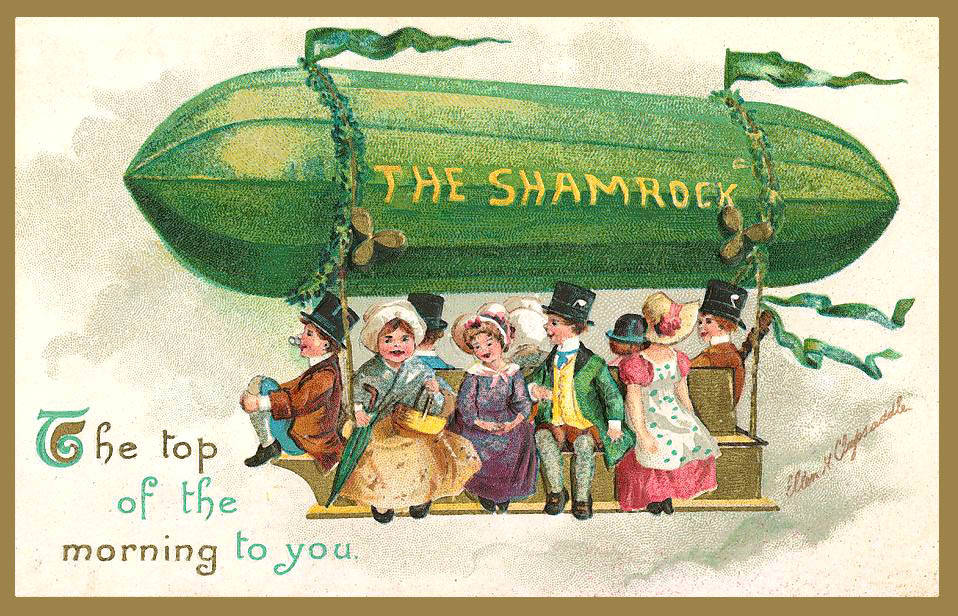 It’s the most Irish day of the year, so what better time to brush up on the history of Ireland’s well-known patron saint. As Saint Patrick’s Day is celebrated today by Irish communities in all corners of the globe, it may come as a suprise to most to learn that Saint Patrick most likely hailed from none other than Scotland.
While March 17 is the accepted date when this famous saint died, no-one actually knows the exact date Patrick was born. Much speculation leads to the year of 387 AD, during the reign of Roman Emperor Theodocius I (r.379 to 395), who, after his own conversion, converted the entirety of Roman Britian to Christianity in 380. The most accepted place of birth amongst historians is along the western coast of Britannia somewhere between the border of present day Scotland and Hadrian’s Wall.
St. Patrick was born to Calpurnius and Conchessa, a Roman couple who gave their child an appropriate Roman name: “Patricius” which means “noble of the patrician class,” referring to the class that had ruled Rome since the early Republic. His father was a Decurion, or a cavalry officer, in command of Roman soldiers, who had been originally sent to the northern area of Britannia to keep order on the outskirts of a Roman Empire in decline. The Decurion’s troops would have had to deal with the Picts of Scotland and the Celts in Ireland, who had remained unconquered by the Romans.
At the age of 14, Patrick was captured by Celtic raiders and taken to Ireland where he spent six years in slavery as a shepherd. It’s generally believed he was located throughout this time in what is now known as County Antrim, where Belfast is located. Ireland at this time was a land of Celtics and pagans, and even though he learned the Celtic way of life, he was increasingly turning to God and prayer.
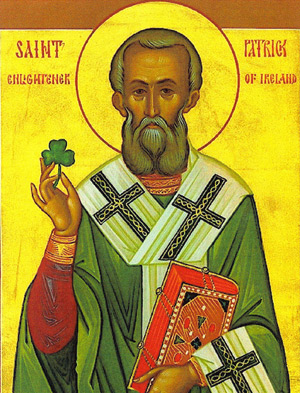
Saint Patrick
Patrick’s captivity lasted until he was twenty, when he escaped after having a dream from God in which he was told to leave Ireland by going to the coast. There he found some sailors who took him back to Scotland, where he reunited with his family. But he had another dream in which he heard the people of Ireland calling out to him, so he commenced his studies for the Priesthood and was ordained by St. Germanus, the Bishop of Auxerre, whom he had studied under for years.
Later, Patrick was ordained a bishop, and was sent to take the Gospel to Ireland. He arrived in Ireland March 25, 433, at Slane. One legend says that he met a chieftain of one of the tribes, who tried to kill Patrick. Patrick converted Dichu (the chieftain) after he was unable to move his arm until he became friendly to Patrick.
Patrick preached and converted all over Ireland for 40 years. Perhaps his most well-known legacy is the shamrock which he used to explain the Holy Trinity. After years of living in poverty, traveling and enduring much suffering he died March 17, 461, at Saul where his first Church was built. Today Saint Patrick’s Day is a national holiday in Ireland, and on the island of Montserrat in the Caribbean, which was founded by Irish refugees.
The post St. Patrick’s Scottish Heritage appeared first on ScotClans | Scottish Clans.
]]>