<br />
<b>Deprecated</b>:  mysql_connect(): The mysql extension is deprecated and will be removed in the future: use mysqli or PDO instead in <b>/var/www/apps/scotclans_wp/wp-includes/wp-db.php</b> on line <b>1142</b><br />
<?xml version="1.0" encoding="UTF-8"?>
<rss version="2.0"
	xmlns:content="http://purl.org/rss/1.0/modules/content/"
	xmlns:wfw="http://wellformedweb.org/CommentAPI/"
	xmlns:dc="http://purl.org/dc/elements/1.1/"
	xmlns:atom="http://www.w3.org/2005/Atom"
	xmlns:sy="http://purl.org/rss/1.0/modules/syndication/"
	xmlns:slash="http://purl.org/rss/1.0/modules/slash/"
	>

<channel>
	<title>ScotClans &#124; Scottish Clans &#187; bruce</title>
	<atom:link href="http://109.74.200.198/tag/bruce/feed/" rel="self" type="application/rss+xml" />
	<link>http://109.74.200.198</link>
	<description></description>
	<lastBuildDate>Fri, 20 Jan 2017 08:08:09 +0000</lastBuildDate>
	<language>en-US</language>
	<sy:updatePeriod>hourly</sy:updatePeriod>
	<sy:updateFrequency>1</sy:updateFrequency>
	<generator>http://wordpress.org/?v=3.6.1</generator>
		<item>
		<title>The Lion and the Clans</title>
		<link>http://109.74.200.198/the-lion-and-the-clans/</link>
		<comments>http://109.74.200.198/the-lion-and-the-clans/#comments</comments>
		<pubDate>Thu, 13 Sep 2012 14:33:09 +0000</pubDate>
		<dc:creator>rodger moffet</dc:creator>
				<category><![CDATA[Bruce]]></category>
		<category><![CDATA[CLANS - Big List of Scottish Clans]]></category>
		<category><![CDATA[Cumming]]></category>
		<category><![CDATA[Farquharson]]></category>
		<category><![CDATA[Gaelic Heritage]]></category>
		<category><![CDATA[Hume]]></category>
		<category><![CDATA[MacGregor]]></category>
		<category><![CDATA[MacLaren]]></category>
		<category><![CDATA[MacPhee]]></category>
		<category><![CDATA[Middleton]]></category>
		<category><![CDATA[Scottish History]]></category>
		<category><![CDATA[Stewart]]></category>
		<category><![CDATA[Baxter]]></category>
		<category><![CDATA[Broun]]></category>
		<category><![CDATA[bruce]]></category>
		<category><![CDATA[Chalmers]]></category>
		<category><![CDATA[Dundas]]></category>
		<category><![CDATA[Fairlie]]></category>
		<category><![CDATA[Heron]]></category>
		<category><![CDATA[Home]]></category>
		<category><![CDATA[Inglis]]></category>
		<category><![CDATA[Little]]></category>
		<category><![CDATA[Lundin]]></category>
		<category><![CDATA[MacDowall]]></category>
		<category><![CDATA[MacDuff]]></category>
		<category><![CDATA[Maitland]]></category>
		<category><![CDATA[Moncrieffe]]></category>
		<category><![CDATA[Moubray]]></category>
		<category><![CDATA[Newton]]></category>
		<category><![CDATA[Nicolson]]></category>
		<category><![CDATA[Pentland]]></category>
		<category><![CDATA[Primrose]]></category>
		<category><![CDATA[Stuart of Bute]]></category>
		<category><![CDATA[Vans]]></category>
		<category><![CDATA[Young]]></category>

		<guid isPermaLink="false">http://www.bletherskite.net/?p=4055</guid>
		<description><![CDATA[<p>Why is the image of a lion so prevalent in Scottish Clan heraldry? Why would a beast that was never native to Scotland feature so heavily? The image of the lion in art and culture dates back to pre history and cave paintings. Our ancient ancestors who&#8217;s story began in Africa would have admired these [&#8230;]</p>
<p>The post <a rel="nofollow" href="http://109.74.200.198/the-lion-and-the-clans/">The Lion and the Clans</a> appeared first on <a rel="nofollow" href="http://109.74.200.198">ScotClans | Scottish Clans</a>.</p>
]]></description>
				<content:encoded><![CDATA[<p><strong><em>Why is the image of a lion so prevalent in Scottish Clan heraldry? Why would a beast that was never native to Scotland feature so heavily?</em></strong></p>
<p><a href="/wp-content/uploads/2012/09/lion1.gif" data-lightboxplus="lightbox[4055]" title="The Lion and the Clans"><img class="alignleft size-full wp-image-6220" alt="lion1" src="/wp-content/uploads/2012/09/lion1.gif" width="300" height="296" /></a>The image of the lion in art and culture dates back to pre history and cave paintings. Our ancient ancestors who&#8217;s story began in Africa would have admired these powerful beasts and they would become symbols of noble savagery. As society advanced the symbolism became stronger; In ancient Egypt the lioness was merged with the human to create the sphinx.</p>
<p>In almost every other culture the lion was also present. Hittites, Assyrians, Babylonians, Persian and many early islamic cultures. Its not hard to understand, after all the lioness is a dedicated mother and ruthless hunter, the male lion a majestic animal that defends his pride with fury. a good role model for early civilisations.</p>
<p>The lion probably entered early Christian culture via a manuscript called the &#8216;Physiologus&#8217;. This document probably dates back to around the 2nd century AD and consists of a number of descriptions of animals and birds as characters in a series of moral tales. In the opening story a lioness gives birth to stillborn cubs but the lioness brings them to life by breathing upon them, this and other similar stories are a direct reference to the idea of Christ&#8217;s resurrection and the redemption of man. The Physiologicus also gives us the story of the Pelican wounding herself to feed her young, an image that can be seen on the <a title="Clan Stewart" href="http://www.scotclans.com/scottish-clans/clan-stewart/">Stewart</a> crest.</p>
<p>In the middle ages the manuscript was translated into latin and spread through central Europe and was adapted into several &#8216;Bestiaries&#8217; With such strong links to these moral tales such animals would naturally form the cornerstone of heraldic symbolism where they would become like &#8216;moral flash cards&#8217;.</p>
<p><a href="/wp-content/uploads/2012/09/lion2.gif" data-lightboxplus="lightbox[4055]" title="The Lion and the Clans"><img class="alignleft size-full wp-image-6222" alt="lion2" src="/wp-content/uploads/2012/09/lion2.gif" width="300" height="178" /></a>Such tales established the idea of the lion as the &#8216;king of the beasts&#8217; and so its understandable that heraldic art would take on this concept of using the lion as a symbol of the ruling elite. This symbol entered Scottish heraldry with King William I. Known as William the Lion this tag did not come from his appearance of character but simply from his adoption of the lion as part of his own standard. His successor Alexander II took the same red lion rampant on a yellow ground and made this the royal symbol that would become the well known Royal Standard of Scotland.</p>
<p>I have used the phrase &#8216;rampant&#8217; above. this refers to the attitude that the animal adopts, in this case raised up on hind legs and paws raised to strike (the lion can stand on either one or two legs depending on tradition although in British heraldry it tends to be one with the other also poised to strike). There are many other attitudes that animals such as lions, wildcats etc can assume; &#8216;Passant&#8217; is walking with one fore paw raised, &#8216;Statant&#8217; is standing with all paws on the ground, &#8216;Salient&#8217; is leaping, &#8216;Sejant&#8217; means in a sitting position and so on. Other phrases you may hear are &#8216;Guardant&#8217; or &#8216;Affrontee&#8217;, where the animal faces the viewer and &#8216;Regardant&#8217; where the animal looks to its rear.</p>
<p>With such strong links to Scottish royalty its no surprise that the Scots nobility would incorporate the lion into their own arms, some such as MacGregor make no secret of this with a lions head and the motto which translates as &#8216;Regal is my Race&#8217;. Here are the clans  and Scottish armigerous families we know of that use the lion symbol in their crests.</p>
<p><a title="Clan Baxter" href="http://www.scotclans.com/scottish-clans/clan-baxter/">Baxter</a> (A Lion Passant)</p>
<p><a title="Clan Broun" href="http://www.scotclans.com/scottish-clans/clan-broun/">Broun</a> (Rampant)</p>
<p><a title="Clan Bruce" href="http://www.scotclans.com/scottish-clans/clan-bruce/">Bruce</a> (Statant)</p>
<p><a title="Clan Chalmers" href="http://www.scotclans.com/scottish-clans/clan-chalmers/">Chalmers</a> (Head and Neck)</p>
<p><a title="Clan Cumming" href="http://www.scotclans.com/scottish-clans/clan-cumming/">Cumming</a> (Rampant)</p>
<p><a title="Clan Dundas" href="http://www.scotclans.com/scottish-clans/clan-dundas/">Dundas</a> (Head, Guardant)</p>
<p><a title="Clan Fairlie" href="http://www.scotclans.com/scottish-clans/clan-fairlie/">Fairlie</a> (Head Couped)</p>
<p><a title="Clan Farquharson" href="http://www.scotclans.com/scottish-clans/clan-farquharson/">Farquharson</a> (Rampant)</p>
<p><a title="Clan Heron" href="http://www.scotclans.com/scottish-clans/clan-heron/">Heron</a> (Demi Lion Rampant)</p>
<p><a title="Clan Home" href="http://www.scotclans.com/scottish-clans/clan-home/">Home / Hume</a> (Head)</p>
<p><a title="Clan Inglis" href="http://www.scotclans.com/scottish-clans/clan-inglis/">Inglis</a> (Demi Lion Rampant)</p>
<p><a href="http://www.scotclans.com/scottish-clans/clan-little/">Little</a> (Demi Lion Rampant)</p>
<p><a title="Clan Lundin" href="http://www.scotclans.com/scottish-clans/clan-lundin/">Lundin</a> (Demi Lion Rampant)</p>
<p><a title="Clan MAcDowall" href="http://www.scotclans.com/scottish-clans/clan-macdowall/">MacDowall</a> (Lion&#8217;s Paw)</p>
<p><a title="Clan MAcDuff" href="http://www.scotclans.com/scottish-clans/clan-macduff/">MacDuff</a> (Rampant)</p>
<p><a title="Clan MacGregor" href="http://www.scotclans.com/scottish-clans/clan-macgregor/">MacGregor</a> (Head)</p>
<p><a title="Clan MacLaren" href="http://www.scotclans.com/scottish-clans/clan-maclaren/">MacLaren</a> (Head)</p>
<p><a title="Clan MAcPhee" href="http://www.scotclans.com/scottish-clans/clan-macphee/">MacPhee</a> (Demi Lion Rampant)</p>
<p><a title="Clan MAitland" href="http://www.scotclans.com/scottish-clans/clan-maitland/">Maitland</a> (Sejant, Affrontee)</p>
<p><a title="Clan Middleon" href="http://www.scotclans.com/scottish-clans/clan-middleton/">Middleton</a> (Demi Lion Rampant)</p>
<p><a title="Clan Moncrieffe" href="http://www.scotclans.com/scottish-clans/clan-moncrieffe/">Moncrieffe</a> (Demi Lion Rampant)</p>
<p><a title="Clan Moubray" href="http://www.scotclans.com/scottish-clans/clan-moubray/">Moubray</a> (Demi Lion Rampant)</p>
<p><a title="Clan Newton" href="http://www.scotclans.com/scottish-clans/clan-newton/">Newton</a> (Demi Lion Rampant)</p>
<p><a title="Clan Nicholson" href="http://www.scotclans.com/scottish-clans/clan-nicholson/">Nicolson</a> (Demi Lion Rampant)</p>
<p><a title="Clan Pentland" href="http://www.scotclans.com/scottish-clans/clan-pentland/">Pentland</a> (Head)</p>
<p><a title="Clan Primrose" href="http://www.scotclans.com/scottish-clans/clan-primrose/">Primrose</a> (Demi Lion Rampant)</p>
<p><a title="Clan Stuart of Bute" href="http://www.scotclans.com/scottish-clans/clan-stuart-of-bute/">Stuart of Bute</a> (Demi Lion Rampant)</p>
<p><a title="Clan Vans" href="http://www.scotclans.com/scottish-clans/clan-vans/">Vans</a> (Rampant)</p>
<p><a title="Clan Young" href="http://www.scotclans.com/scottish-clans/clan-young/">Young</a> (Demi Lion Rampant)</p>
<p>Its easy to be confused about how an animal native to Africa could have such a profound symbolic influence in Europe, we should also remember that lions though not native or wild would have been brought over with invading Romans who would have kept the creatures for games or even as status symbols. Personally though I prefer to believe that it was not these poor caged beasts that influence the heralds of early mediaeval Europe but the lion tales of old that were seen as symbols of the ancient code of chivalry.</p>
<p>The post <a rel="nofollow" href="http://109.74.200.198/the-lion-and-the-clans/">The Lion and the Clans</a> appeared first on <a rel="nofollow" href="http://109.74.200.198">ScotClans | Scottish Clans</a>.</p>
]]></content:encoded>
			<wfw:commentRss>http://109.74.200.198/the-lion-and-the-clans/feed/</wfw:commentRss>
		<slash:comments>2</slash:comments>
		</item>
		<item>
		<title>Border Reivers &#8211; the &#8216;Great Cause&#8217;</title>
		<link>http://109.74.200.198/border-reivers-the-great-cause/</link>
		<comments>http://109.74.200.198/border-reivers-the-great-cause/#comments</comments>
		<pubDate>Sun, 05 Sep 2010 00:06:49 +0000</pubDate>
		<dc:creator>tommoss</dc:creator>
				<category><![CDATA[Bell]]></category>
		<category><![CDATA[CLANS - Big List of Scottish Clans]]></category>
		<category><![CDATA[Irving]]></category>
		<category><![CDATA[Border Reivers]]></category>
		<category><![CDATA[braveheart]]></category>
		<category><![CDATA[bruce]]></category>
		<category><![CDATA[Reivers]]></category>
		<category><![CDATA[scottish wars of independence]]></category>
		<category><![CDATA[wallace]]></category>

		<guid isPermaLink="false">http://www.scotclans.com/bletherskite/?p=2230</guid>
		<description><![CDATA[<p>The Scottish Wars of Idependence, nomonally over by 1328, would haunt the relationship between Scotland and England for another two centuries. They were kick-started by the unfortunate death of an innocent little girl.</p>
<p>The post <a rel="nofollow" href="http://109.74.200.198/border-reivers-the-great-cause/">Border Reivers &#8211; the &#8216;Great Cause&#8217;</a> appeared first on <a rel="nofollow" href="http://109.74.200.198">ScotClans | Scottish Clans</a>.</p>
]]></description>
				<content:encoded><![CDATA[<p>In 1286 <a href="/scotland/kings-queens/1249-alexander3/">Alexander lll</a> of Scotland died when his horse was blown over a cliff whilst on his way to Kinghorn in Fife on a stormy gale-strewn night. He was on his way to see his new wife, his second wife, Yolande de Dreux. So ended what is sometimes known as Scotland&#8217;s Golden Age: an age when peace reigned between Scotland and its southern neighbour England and the country prospered as a result.</p>
<p>Alexander had been a good king and, for the most part, was friendly with his English counterpart, Edward I. Indeed his first wife, who had died, was Edward&#8217;s sister.</p>
<p>Edward had often demanded fealty from Alexander. He viewed England as the superior race, but he declined forcing the Scottish king to bend to his will. Such was their friendship, cemented by the ties of marriage.</p>
<p>Unfortunately for Scotland, Alexander&#8217;s children, two sons and a daughter had predeceased him. One of his sons died at the age of nine, the other on his twentieth birthday. He left as his heir a granddaughter <a href="http://www.scotclans.com/scotland/kings-queens/1286-margaret/">Margaret, known to us as the Maid of Norway</a>. She was the child of the marriage of Alexander&#8217;s daughter, also Margaret and now dead, and the King of Norway.</p>
<p>The Community of the Realm which, following Alexander&#8217;s death, ruled Scotland through six guardians, was keen to safe-guard the minority of the Maid and thus ensure her succession to the Scottish Crown.</p>
<p>In negotiations with the English king the young girl, about six or seven years old, was promised in marriage to Edward&#8217;s infant son, the future Edward ll. To the Scots it was a move which sought to maintain the peace which the country had enjoyed during the lifetime of Alexander lll; to Edward l a means by which he would eventually achieve total domination of his northern neighbour. The agreement was ratified at the Treaty of Birgham.</p>
<p>However Margaret died in Orkney on her way to Scotland from Norway in 1290, some say of seasickness. Her death put an end to any alliance of the two countries by marriage and any consideration that Edward had for the Scots as an independent nation.</p>
<p>It is not known how Edward l became involved in the succession for the throne of Scotland but he was seen by the Scots to be a man who could be trusted to make the right decision. Why should they question his involvement? To that time he had always treated the Scots with fairness. More-over he was well respected. He had the authority, the reason, the power and persuasion. He was perceived as a man with a formidable legal mind, the best in Europe it is said. He would sort the wheat from the chaff and chose the rightful successor from the thirteen claimants, the &#8216;Competitors&#8217;, who now squared up to each other in their quest to become the king of Scotland.</p>
<p>Edward&#8217;s involvement would, however, come at a considerable cost. He demanded that the Scots accept that England was superior to Scotland and that he was its Overlord. Indeed before he would begin his deliberations on who should be king he had demanded fealty from the Scottish lords. Most had accepted his dictates, the Bruce included, and signed what are now known as the Ragman Rolls which still exist. One name missing from the Roll is that of Wallace, synonymous now with &#8216;Braveheart&#8217;, a name that would resound throughout the lands of Scotland within a few short years.</p>
<p>Edward, satisfied that he was about to gain more than a foothold for the Plantagenet dynasty in the lands north of the Border, gathered the thirteen claimants at Norham Castle.</p>
<div id="attachment_38934" class="wp-caption aligncenter" style="width: 610px"><a href="/wp-content/uploads/2010/09/norham21.jpg" data-lightboxplus="lightbox[2230]" title="Border Reivers - the 'Great Cause'"><img class="size-full wp-image-38934" alt="Norham Castle" src="/wp-content/uploads/2010/09/norham21.jpg" width="600" height="449" /></a><p class="wp-caption-text">Norham Castle</p></div>
<p>The deliberations on who should be king lasted nigh on two years. They would become known as the &#8216;Great Cause&#8217;.</p>
<p>Both countries would suffer as a result.</p>
<p>The two main &#8216;Competitors&#8217; for the throne of Scotland were the families of <a href="http://www.scotclans.com/scotland/kings-queens/the-house-of-bruce/">de Brus</a> and <a href="http://www.scotclans.com/scotland/kings-queens/the-house-of-balliol/">Balliol</a>. Eventually Edward chose <a href="http://www.scotclans.com/scotland/kings-queens/1292-balliol/">John Balliol</a> as the Scottish King. He would become a mere &#8216;puppet&#8217; in Edward&#8217;s hands and eventually rebel in late 1295. In that year Edward demanded fealty from Balliol; demanded that he join the English in their wars in France. It was a move to far for Balliol; As king of Scotland he would not be treated as an ordinary English Baron whose lands were held at the behest of the King. He made an alliance with the French and invaded northern England.</p>
<p>The English Border people were savaged by the Scottish attacks into their lands. Not suspecting any inroads from the north, their lands were devastated by the Scots; crops and houses burned, both people and animals butchered in the merciless acts of retribution from the humiliated Scottish king.</p>
<div id="attachment_2234" class="wp-caption alignnone" style="width: 235px"><a href="http://www.letsbuyscottish.com/wp-content/uploads/2010/09/edward-l-monument.jpg" data-lightboxplus="lightbox[2230]" title="Border Reivers - the 'Great Cause'"><img class="size-medium wp-image-2234" alt="Edward l Monument at Burgh by Sands, Cumbria" src="http://www.letsbuyscottish.com/wp-content/uploads/2010/09/edward-l-monument-225x300.jpg" width="225" height="300" /></a><p class="wp-caption-text">Edward l Monument at Burgh by Sands, Cumbria</p></div>
<p>Edward&#8217;s response was quick and savage. At Easter 1296 he invaded Berwick, then in Scottish hands, and put all to the sword it is said. Tytler, a historian, tells us that 17000 folk lost their lives in the English attack on Berwick. Men women and children, he said, were put to the sword. Whilst this is not true, the population of Berwick in 1296 would be little more than 500, it is an indictment of Edward l&#8217;s policy of Scottish domination, that he was utterly ruthless in his treatment of the people of Berwick: people who, for the most-part were not in a position to defend themselves.</p>
<div id="attachment_2232" class="wp-caption alignnone" style="width: 310px"><a href="http://www.letsbuyscottish.com/wp-content/uploads/2010/09/coldstream1d.jpg" data-lightboxplus="lightbox[2230]" title="Border Reivers - the 'Great Cause'"><img class="size-medium wp-image-2232" alt="River Tweed" src="http://www.letsbuyscottish.com/wp-content/uploads/2010/09/coldstream1d-300x224.jpg" width="300" height="224" /></a><p class="wp-caption-text">River Tweed</p></div>
<p>Thus began the Scottish Wars of Independence with the emergence of <a href="/scottish-clans/clan-wallace/wallace-people/">William Wallace</a> (Braveheart) and <a href="/scotland/kings-queens/1306-robert1/">Robert the Bruce</a>.</p>
<p>The Wars would last, off and on, for 250 years.</p>
<p>The people on both sides of the English Scottish Border would suffer untold loss for their birthright. They were in the wrong place at the wrong time. Vast armies of English or Scots would lay waste the lands that they inhabited; their houses, harvests and beasts were razed, burned or stolen to satisfy the hatred of the soldiers of a foreign nation or fill the bellies of an army on the move.</p>
<p>The<a href="http://www.reivershistory.co.uk"> Border folk </a>lost life, limb and loved one in the relentless surge for domination and were left destitute of the basic needs of life and living.</p>
<p>They were nothing if not hard and obdurate and they reacted in the only way left open to them in such dire circumstances. They stole where they could, be it from erstwhile friend on the same side of the Border Line or enemy on the other.</p>
<p>The Borderer became the Border Reiver. His dominance of the English-Scottish Border lands would last for centuries as feud, blood-feud, murder, death and extortion and blackmail would become the norm; a result of allegiance to the only people he could trust – his clan or family. It seemed, for centuries, that there was no answer to his disreputable activities.</p>
<p>In 1603, the <a href="http://www.scotclans.com/scotland/scottish-history/scottish-unification/1603-union/">Union of the two crowns of England and Scotland</a> would eventually bring a form of peace to a troubled land. The two nations would be united under one King, <a href="http://www.scotclans.com/scotland/kings-queens/1567-james6/">James VI of Scotland and l of England</a>. The Border Line from the Solway Firth in the west to the North Sea at Berwick in the east would still exist, indeed it still does to this day, but it would no longer divide two peoples.</p>
<p>The Border country became the Middle Shires of a new United Kingdom.</p>
<p>The <a href="http://www.suite101.com/content/border-reivers-pacification-of-the-borders-a134713">Border Reivers </a>were summarily executed, transported to the bogs of Roscommon in Ireland or conscripted to the protestant Low Countries in their fight against catholic Spain. They would slowly disappear from the landscape.</p>
<p>It would take another century but peace would eventually reign in the lands of the Scottish English Border.</p>
<div id="attachment_2237" class="wp-caption alignnone" style="width: 310px"><a href="http://www.letsbuyscottish.com/wp-content/uploads/2010/09/robert-the-bruce-bannockburn1.jpg" data-lightboxplus="lightbox[2230]" title="Border Reivers - the 'Great Cause'"><img class="size-medium wp-image-2237" alt="The Statue of Robet the Bruce at Bannockburn" src="http://www.letsbuyscottish.com/wp-content/uploads/2010/09/robert-the-bruce-bannockburn1-300x224.jpg" width="300" height="224" /></a><p class="wp-caption-text">The Statue of Robet the Bruce at Bannockburn</p></div>
<p>The post <a rel="nofollow" href="http://109.74.200.198/border-reivers-the-great-cause/">Border Reivers &#8211; the &#8216;Great Cause&#8217;</a> appeared first on <a rel="nofollow" href="http://109.74.200.198">ScotClans | Scottish Clans</a>.</p>
]]></content:encoded>
			<wfw:commentRss>http://109.74.200.198/border-reivers-the-great-cause/feed/</wfw:commentRss>
		<slash:comments>1</slash:comments>
		</item>
		<item>
		<title>Freedom and Chips Please!</title>
		<link>http://109.74.200.198/freedom-and-chips-please/</link>
		<comments>http://109.74.200.198/freedom-and-chips-please/#comments</comments>
		<pubDate>Fri, 20 Feb 2009 12:18:02 +0000</pubDate>
		<dc:creator>rodger moffet</dc:creator>
				<category><![CDATA[Arbroath]]></category>
		<category><![CDATA[Bruce]]></category>
		<category><![CDATA[Scottish Humour]]></category>
		<category><![CDATA[Scottish News]]></category>
		<category><![CDATA[bruce]]></category>
		<category><![CDATA[declaration of arbroath]]></category>
		<category><![CDATA[scottish history]]></category>

		<guid isPermaLink="false">http://www.scotclans.com/bletherskite/?p=285</guid>
		<description><![CDATA[<p>The Declaration of Arbroath is one of Scotland&#8217;s most famous documents. Scotland&#8217;s great cry of independence and freedom from the (then) yoke of the English. As with all great moments in history they do tend to appear on all manner of tourist souvenirs; there are Declaration of Arbroath fridge magnets, Declaration tea towels, probably even [&#8230;]</p>
<p>The post <a rel="nofollow" href="http://109.74.200.198/freedom-and-chips-please/">Freedom and Chips Please!</a> appeared first on <a rel="nofollow" href="http://109.74.200.198">ScotClans | Scottish Clans</a>.</p>
]]></description>
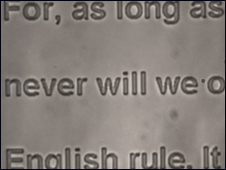
				<content:encoded><![CDATA[<div id="attachment_39676" class="wp-caption alignleft" style="width: 236px"><a href="/wp-content/uploads/2009/02/abroath_chip11.jpg" data-lightboxplus="lightbox[5643]" title="Freedom and Chips Please!"><img class="size-full wp-image-39676" alt="The Text on a chip" src="/wp-content/uploads/2009/02/abroath_chip11.jpg" width="226" height="170" /></a><p class="wp-caption-text">The Text on a chip</p></div>
<p>The <a href="http://www.scotclans.com/scotland/scottish-history/medieval-scotland/1320-arbroath">Declaration of Arbroath</a> is one of Scotland&#8217;s most famous documents. Scotland&#8217;s great cry of independence and freedom from the (then) yoke of the English. As with all great moments in history they do tend to appear on all manner of tourist souvenirs; there are Declaration of Arbroath fridge magnets, Declaration tea towels, probably even declaration loo paper (though I prefer the <a href="http://www.scotclans.com/scotland/scottish-history/scottish-unification/1707-union">Act of Union</a> loo paper myself!)</p>
<p>Now the words of <a href="http://www.scotclans.com/scottish-clans/clan-bruce/bruce-people">Bruce</a> and his followers have been immortalised in a small way &#8211; a very small way!</p>
<p>Andy Walker, a Blairgowrie boy made good and now running a successful business in Silicon Valley has managed to inscribe the whole declaration onto a silicon chip &#8211; in fact he had space left over so he did the  whole thing again in Latin.</p>
<p>Mr Walker, said: &#8220;I designed the chip myself and there&#8217;s usually at bit of space left on the chip to put some other stuff on.</p>
<p>&#8220;So I thought it would be nice to put on the Declaration of Arbroath, knowing that it would end up being the smallest ever version.</p>
<p>&#8220;It shows you how small things can get on silicon chips.</p>
<p>In Edinburgh we&#8217;re used to having something on our chips too &#8211; broon sauce!</p>
<p>The post <a rel="nofollow" href="http://109.74.200.198/freedom-and-chips-please/">Freedom and Chips Please!</a> appeared first on <a rel="nofollow" href="http://109.74.200.198">ScotClans | Scottish Clans</a>.</p>
]]></content:encoded>
			<wfw:commentRss>http://109.74.200.198/freedom-and-chips-please/feed/</wfw:commentRss>
		<slash:comments>0</slash:comments>
		</item>
	</channel>
</rss>