The post The Mystery of the Aberdeenshire’s Beaker people appeared first on ScotClans | Scottish Clans.
]]>
The Beaker Pots were decorated with impressions made with a cord.
These early people buried their dead with a beaker full of liquid to ease the journey to the next life (well this is one theory). There is evidence of beer and mead within some of these jars. Exactly why they used beakers is not fully understood.
The style of graves was also similar – all being round barrow graves. Unlike the Neolithic settlers, they buried their dead in individual graves, a practice which has remained ever since. This shift to individual burials shows a change in beliefs and social systems. Individual graves had personal belongings added – this was also new. Men and Women were mostly treated the same, interestingly the only difference was that men were buried tending to face the East, and women facing West. So one had sun rise and the other sun set.

Reconstruction of a Beaker burial, (National Archaeological Museum of Spain, Madrid)

the Upper Mains of Catterline cist
Pottery was only one small aspect of their ingenuity and craft, The Beaker People have been credited with introducing metalworking to Britain, being the first metal-smiths, working first in copper and gold, and later in the bronze which has given its name to this era. Also spreading the Indo-European language group and building Stonehenge and other stone circles. Some stone circles were earlier which suggests that the Beaker People and their descendants took over or adopted many of the beliefs and customs of the earlier Neolithic inhabitants. Historical studies found that the Beaker people appeared to be of a different physical type than those earlier populations in the same geographic areas. They were tall, and heavier boned compared to the earlier people.
The Beaker folk were farmers and archers, wearing stone wrist guards to protect their arms from the sting of the bowstring. They are said to have brought the plough, wheeled vehicles and even the woolly sheep and breeds of cattle. Populations grew on the richer farmable land.
Authors Neil Curtis, head of museums at the University of Aberdeen, and Neil Wilkin, curator of the British and European Bronze Age collections at the British Museum have been part of a new study ‘The Beakers and Bodies Project’, looking at The Beaker People in Scotland. They were particularly interested in the unusual clusters between Inverness and Aberdeen and down the East Coast.
New evidence was found that shows that the Beaker period was shorter in Scotland than that elsewhere in Europe. This poses new questions, tree rings have shown a dramatic temperature drop which lasted a year after a volcanic eruption in Iceland. There is evidence in England of abandoned homes at this time. Could this be one influence?
The team was able to get radiocarbon dates and stable isotope analyses from all surviving skeletons. This has shown that they didn’t move far in their lifetimes. This would mean a close and happy community who were able to find reliable sources of food. Interestingly their diet was also able to be studied and although close to the coast they didn’t eat much sea-food.
Surprisingly the Bronze studied in Scotland from this area was found to be produced earlier than in other areas of Britian:
‘We were also able to look at links with metalworking and monuments, discovering that the distinctive Recumbent Stone Circles were probably built at about the same time as Beakers were being made and the earliest bronze being made,’ Mr Curtis said.
‘It seems as though North-East Scotland was one of the first places to made bronze in Britain, drawing on skills from the Netherlands and beyond, copper from Ireland and tin from Cornwall.’
The study also shows that beakers found in many of the graves were decorated with a white powder made from ground up bones – something that appears to be unique to the North East. Whether animal or human is unknown.

Unlike other places the Beaker People in this area built new monuments, stone circles, and a lot of them. Aberdeenshire has an unusal large number of stone circles – around 30. None to the scale of Stonehenge but still fascinating. (see The Stone Circle Trail (pdf) >).
‘Much to people’s surprise, these megalithic monuments were not neolithic, but a younger and local development contemporary with the region’s Beaker burials,’ the authors said.
‘Elsewhere in Britain people spent great energy on building barrow mounds and funerary monuments, such as the Clava Cairns in the neighbouring Moray Firth region.
‘But in north-east Scotland, communities focused their collective and ceremonial attentions on recumbent stone circles.
‘Suddenly, there was an exciting new dimension to the puzzle of how and why north-east Scotland adopted new and international customs.’
So many new questions have been raised from this study; why were the Beaker burials in these areas of Scotland so popular and why so exclusive and separate from other traditions in this region? Why such a shorter time span? How did bronze come first to Scotland? Also why an apparently unique addition to their burial ceremony, animal or human ash on the beakers?
Examples of Beaker burials in Scotland include the case of ‘Ava’, the name given to a woman whose remains were discovered at Achavanich in Caithness in 1987 during road works. A young women between 18 and 22.
Artists reconstructed Ava:

Ava – This Bronze Age woman died more than 3,700 years ago
The post The Mystery of the Aberdeenshire’s Beaker people appeared first on ScotClans | Scottish Clans.
]]>The post A Cannonball, a Sheepskin and a Loch Village appeared first on ScotClans | Scottish Clans.
]]>
The Mingary Castle cannonball
What – Cannonball
Era – Most likely 1644
Found – Wedged in the wall of Mingary Castle, Lochaber, West Highlands.
Fired almost 350 years ago, this cannonball was found during restoration work currently taking place at Mingary Castle. The cannonball was found sitting in an 18 inch hole in one of the castle’s sea facing walls, embedded a foot into the wall. A ship was lost in the attack on the castle during tensions between clans and Covenanters.
The remains of the ship were discovered in 1999 and relate to the siege of Mingary Castle by by Archibald Campbell, 8th Earl of Argyll, the castle’s former owner, recorded in a diary written by John Weir in 1644. Weir was a Puritan imprisoned in Mingary Castle by Major-General Alasdair MacDonald.
Originally built for the Clan MacDonald of Ardnamurchan (also known as MacIain of Ardnamurchan), the castle has had many different occupants over the years including Clan MacDonald of Lochalsh, Clan Campbell, Clan MacLean and King James IV of Scotland who used it as a stronghold for fighting off Clan Donald in the late 15th century.

Archaeologists at the burial excavation site in Sutherland
What – Burial cist with sheepskin and human remains
Era – Bronze Age
Found – A back garden near the village of Spinningdale, Sutherland, North Highlands.
Discovered by accident when a septic tank was being installed in a back garden, the sheepskin and human remains are said to be at least 4000 years old. The sheepskin was found wrapped around the left arm bone of the skeleton of the middle aged female whose crouched body was contained within the burial cist.
It is believed to be the first known example of sheepskin from the Bronze Age found in Britain.
A spokesman for the archaeology company said: “A radiocarbon date of 2051-1911 BC and 2151-2018 BC was obtained from bone and charcoal fragments, placing the cist in the early Bronze Age period. The radiocarbon dating of the cist corresponds with the date of the food vessel urn buried with the body. The vessel contained carbonised material of non-botanical origin, unidentified cremated bone and a fragment of a small ring. These were probably placed there to assist the individual’s journey into the next world and indicate belief in the afterlife, which appears to have been a concept only adopted in Scotland.”
“The preservation of organic material, such as sheepskin or wool, also supports the view of a elaborate burial rites being carried out in the vicinity of the Dornoch Firth during the early Bronze Age.”
The loch village revealed
What – Loch Village
Era – Iron Age
Found – Wigtownshire, Dumfries and Galloway
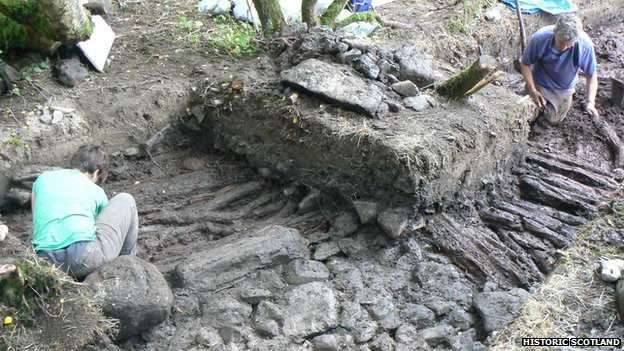
Experts are calling this remarkable find ‘Scotland’s Glastonbury’, in reference to Somerset’s famous lake village after discovering the first loch village in Scotland. What originally began as a small scale excavation of a crannog (a singular loch dwelling) turned into a fully fledged dig when archaeologists found evidence of multiple structures on the site. The site is one of 55 archaeology projects to receive more than £1m in funding from Historic Scotland for 2013/14.
What initially appeared to be one of a small group of mounds before excavation was revealed to be a massive stone hearth complex at the centre of a roundhouse. The timber structure of the house has been preserved, with beams radiating out from the hearth forming the foundation, while the outer wall consists of a double-circuit of stakes. The most surprising discovery was that the house was not built on top of an artificial foundation, but directly over the fen peat which had gradually filled in the loch.
Graeme Cavers, of AOC Archaeology, who is the co-director of the site, said that because the land was abandoned after the Iron Age, the buildings were well preserved.
“Waterlogged wood also offers the opportunity to date the structure very accurately using dendrochronology – or tree-ring counting – to give a date accurate to within a few years or even months, rather than the decades or centuries usually provided by radiocarbon dating,” he added.
The post A Cannonball, a Sheepskin and a Loch Village appeared first on ScotClans | Scottish Clans.
]]>