Following the war, Sir Douglas Haig was promoted to the peerage as the Earl Haig; he was then instrumental in setting up the British Legion and the Poppy Appeal - two institutions with the purpose of raising funds and providing help and welfare for soldiers and their families, which is very much the legacy of this most controversial of Scotsmen.
The post The Earl Haig – A Study in Controversy appeared first on ScotClans | Scottish Clans.
]]>
Field Marshall Haig
Charlotte Square is the jewel in Edinburgh’s New Town, a wonderful expression of Georgian architecture and understated majesty. On the north side of the square facing the statue of Prince Albert is pseudo-palatial Bute House, the official residence of the First Minister of Scotland; in the southeast corner is the birthplace of Alexander Graham Bell, the inventor of the telephone, and it was here that Joseph Lister, the pioneer in anaesthetics lived and worked. It was here too in 1861 that one of Scotland’s most controversial figures was born: Field Marshal Sir Douglas Haig.
As we approach another Remembrance Sunday, when the Queen leads the nation in commemorating those who fought and died for king and country, we look back and reflect. The bloody First World War came to an end with an armistice truce that became effective at 11.00am, on the 11th day of the 11th month in 1918 – and since then, that moment has been remembered across the nation. In the lead up to the formal ceremonies and minutes of silence, Britons proudly wear their red poppies on their lapels, as mark of their respect and gratitude. It represents the vast poppy fields that bloomed across France and Belgium over the battlefields that claimed so many.
The poppy wearing tradition raises much needed funds which support veterans and their families. It began the early 1920s following the establishment of the British Legion in 1921. For the last 90 years the Legion has helped the old soldiers, provided a social club where they can meet, and generally been at the forefront of their welfare. One of the founders of, what is now the Royal British Legion was the Earl Haig, and in the years following the First World War he was instrumental in using his influence and importance in making sure that those returning from this and every conflict would be cared for and have a support structure. It is one of the greatest legacies of a man vilified in many quarters as the Butcher of the Somme.
By 1916 the war in the Western Front had disintegrated into a bloody war of attrition. Both the British and French on one side, and the Germans on the other were ensconced in mile upon muddy mile of trenches, stretching from the Alps to the North Sea. For most of the time it was a tedious existence for the millions of mainly volunteer soldiers; occasionally punctuated by a foray into No Mans Land, where almost inevitably the men were caught up in barbed wire or cut to ribbons by machine gun fire and artillery. It was a horrible existence. That spring the Germans launched a massive attack on the French position of Verdun. There was little strategic value to the old medieval city, but it was a symbolic site for the French. A position they would defend to the last man – and that was very much the German plan.
Earlier in the year the British supreme commander, Sir John French had been replaced by Sir Douglas Haig following a series of public disasters. Haig was a golden boy in certain circles and his promotion was encouraged by The Secretary of State for War, Lord Kitchener, and the king. He did have his detractors too, including David Lloyd George, which would cause issues as the war dragged on. He brought a sort of fresh outlook to the table, but his caution was a concern for the French High Command.
The French were getting pummelled at Verdun, and insisted their British allies launch a counter offensive in the early summer to relieve the pressure. Haig felt his army of volunteers weren’t ready, and preferred to hold off until August. In no uncertain terms the French commander, General Joffre told the British that unless a major operation was carried out as soon as possible, the “French army would cease to exist”. Pressure was put on Haig by the government at home, and he and his staff began preparations for an offensive in the Somme valley.
It was to be an attack on a truly awesome scale. In the week beforehand the German lines were bombarded with shellfire, so loud that it could be heard on the outskirts of London – it was the greatest deployment of artillery in the history of warfare to that point. The British believed that the enemy trenches would be so utterly destroyed that the soldiers would simply walk over no man’s land and take them. In reality, the huge bombardment had virtually no effect at all. Also, the barbed-wire that needed to be blown away by the guns as a necessity remained in many places pretty much intact.
The Battle of Somme began on the 1st of July 1916, when hundreds of thousands of British and allied soldiers left their trenches and went ‘over the top’. They were met with a hail of bullet and mortar fire from the German positions. It was a slaughter. On that first day there were 60,000 British casualties – the worst single day in British military history. And day, after day the Generals sent the men up and over, convinced that the breakthrough would come: it didn’t. There were several phases of the battle, and it saw the first introduction of the tank, but by the end in November the allies had only advanced 7 miles. The cost in lives and injured is mind-numbing – British and Commonwealth: 420,000; French: 204,000 and German: 465,000.
Much of the blame for this loss of life to success gained was placed on the shoulders of Haig and his generals; Lloyd George did much to expound this belief. However, modern scholars have revisited the battle and realised that it would have been hard to avoid these casualties in any event, and that it did have the effect of relieving Verdun and letting the French regroup. It also dealt a huge blow to the German army, which wobbled a bit. It is now considered by some that without the Somme offensive, the war may not have been won by the allies at all.
Haig was made a Field Marshal by the king, who thanked him in a personal note. Much as Prime Minister Lloyd George loathed the commander, he simply couldn’t get rid of him. So, he spent much of his time after the war discrediting him, and many of his memoirs form the basis of the British image of Haig. In 1917 Haig launched another offensive, known as the Battle of Passchendaele. The weather conspired against him as much as German resistance and again the high casualty figures for little gain seemed to highlight the incompetence of Haig and his command.
However, Haig’s fortunes turned and in 1918 he at last broke though what by then was a thoroughly demoralised German force. The German Empire was collapsing, and with the arrival of the Americans in 1917 allied victory was assured. Haig masterminded the final assaults and in November the Germans surrendered. The ‘Butcher’ had now won the war. Many said that it came at too high a price and that the campaigns were an unacceptable waste of men. However, through the looking glass we can see that these battles took so much out of the Germans, that their demise became inevitable. The cost was high, yes – but the war was won.
Begrudgingly, and probably at the king’s insistence, Haig was raised to a peerage, and created the Earl Haig. For the rest of his life he remained hugely popular with the veterans and soldiers; and his dedication to their welfare casts a very different light on the man. He died in 1928 in London; he then lay in state in Edinburgh before being buried at Dryburgh Abbey in Borders near his family’s ancestral home.
Whatever your opinion of Field Marshal Sir Douglas Haig, whether cold-hearted butcher or the man who won the bloodiest war fought in Western Europe; there is no doubt of his influence and contribution both to our psyche; and to the nation.
For more information on the Royal British Legion Poppy appeal – www.poppy.org.uk
This article was written by David McNicoll, owner of Vacations Scotland - a travel company specialising in Scottish vacation packages, including historical, family heritage and tailor-made tours – www.vacationscotland.biz
The post The Earl Haig – A Study in Controversy appeared first on ScotClans | Scottish Clans.
]]>The post The Battle of Altimarlach – Scotland’s last Clan Battle appeared first on ScotClans | Scottish Clans.
]]>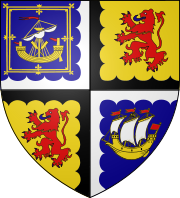
The Arms of the Earl of Caithness
The 13th of July, 1680 saw the last significant clan battle to be fought in Scotland, with the Sinclairs, under the command of George Sinclair of Keiss, taking on the Campbells led by Sir John Campbell of Glenorchy, fighting over the right to the Girnigoe Estates in Caithness.
In 1676, George Sinclair, the 6th Earl of Caithness died without an outright heir, and both Glenorchy and Keiss believed that they were entitled to inherit the estate.
During the latter half of the 17th century, economically, things were bad for many of the Highland clans, with some struggling to survive financially. The Earl of Caithness was one of those in desperate need for money with the Sinclair estate virtually bankrupt. It is alleged that he borrowed money from the Campbells for the purpose of shoring up the clan’s estates. On the death of the Earl, Sir John Campbell, being the main creditor to Sinclair, obtained the Girnigoe Estates as well as the Earldom in 1677 as repayment for his loan.
By 1678 he had married the late Earl’s widow, the Countess of Caithness. However, it is said that the only reason why Campbell married the countess was a financial one because it saved him having to pay her an annual 12,000 marks.
George Sinclair of Keiss was unhappy with Campbell’s accession to the Earldom, and disputed the claim. Keiss put forth his claim to the Earldom by stating that he was a direct relative of George Sinclair, and he went on to seize the Caithness estates, as well as occupying areas in and around the town of Wick.
The dispute continued and it saw Campbell gaining royal permission to invade Caithness and uphold his claim as the rightful Earl. Along with his own men, Campbell was provided with several companies of the king’s troops, and they marched north to Wick from Perth. They arrived on the 18th of May and camped at Braemore, near Morven. This was part of the Berriedale estate which Campbell laid claim to as Earl of Caithness.
The army, believed to be 800 strong, marched on on the 12th of July and reached the Hill of Yarrows, which was known for a long time as Torran nan Gael – the Highlanders Hill. From there Campbell and his men had a great view of the surrounding area. Whilst on the hill a thick mist descended, and Campbell decided to take this opportunity to advance on Wick. However, the mist lifted as he was heading down, and the alarm was promptly raised by the Sinclair forces in the town.
When Campbell and his men reached the bottom of the hill they headed for Stirkoke and Altimarlach where he split his army in two; deploying one lot on the haugh, and the rest were hidden in a gully. Sinclair moved his men, estimated to be around the same size as Campbells, out of the town and headed along Wick River to meet the enemy army. As they reached the haugh, just at the point where a burn met the river, the Campbells launched a surprise attack, followed shortly by an ambush by the men in the gully. The Sinclairs were in a tight position, pressed against the river bank. At this point the Wick River is rather deep, and as the Campbells pushed forward many of the Sinclairs fell into the water and drowned. For those who fell in to the flowing river, but managed to make it across to the opposite bank, on the Moss of Bronsie, awaiting for them there were reserves from Campbells army who summarily continued the fighting, killing many who made it across.
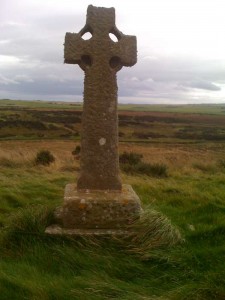
The monument to the battle of Altimarlach
The battle ended in a decisive victory for Sir John Campbell of Glenorchy, and it is generally viewed as a humiliating defeat for the Sinclairs. Legend claims that so many Sinclairs were killed or drowned in the river that the Campbells were able to cross without getting their feet wet. It is estimated that Sinclair lost around 300 men in the battle, whilst Campbell saw few from his side killed, and those that did die were buried where a commemorative cross now stands.
Peace was made however the following day when a truce was signed in the old Wick Town Hall, just east of present day Market Square.
Afterwards, Campbell split up part of his army around Caithness, where he levied the rents and taxes and ruled over the people in an oppressive manner.
It is said that on Campbell’s march to Caithness, to claim the estates, his piper, Finlay Ban MacIvor, composed two famous pipe tunes: Breadalbane Gathering and The Campbells are Coming. The former was said to have been played spontaneous in the middle of the battle, not long before the Sinclairs began to give way. Until relatively recently it was considered a gross insult to play either piece in Wick.
Campbell remained Earl of Caithness only until 1681. It is thought that George Sinclair had some influential and powerful friends, because he took his case to the Privy Council, and by act of parliament George was granted the Earldom, making him the 7th Earl, and putting the title back into the Sinclair family where it has remained ever since.
The post The Battle of Altimarlach – Scotland’s last Clan Battle appeared first on ScotClans | Scottish Clans.
]]>