The post Watching Scotland: Scottish Political Basics for Americanos appeared first on ScotClans | Scottish Clans.
]]> Scotland has been locked in union with England and Wales since 1707. In contrast, Scotia’s Gaelic neighbor Ireland arrived and departed the union in the span of little more than 100 years. The Irish episode left behind too many dead and ruined lives and Ireland’s northern six counties united with the nations of Great Britain. Scotland itself is relentless in its discussion of wiggling free of its union with England, Wales and Northern Ireland and talk of a second Scottish independence referendum continues to enliven the news. If you want to learn about politics and governance in the British world it helps to understand political unions. British people, including their offspring in America, love political unions and over the course of the centuries they have formed, layered, adjusted and rejected all kinds. Historically strong constitutional dynamism on the British Isles continues to this day.
Note that these “unions” have not always been the product of entirely informed and voluntary choice on both sides In the case of the very early melding of Wales into England the word “annexation” tells the tale with more truth while still maintaining politeness. In 1776 many people in the 13 British colonies in North America actually decided to reject one political union – the one formed in 1707 and called the United Kingdom (see below) – and attempted to “form a more perfect” one. We in America are now on our second try getting at that perfect union; the Articles of Confederation being the first and the long beleaguered Constitution the second.
Meanwhile, the Scottish have been doing the political union thing since about 843AD.
 Scotland’s First Union: Picts and Gaels

The idea of a unified Scottish nation first began to solidify in the 9th century with the union of the two then resident societies north of the English border, the Picts and the Gaels. A famous fellow named Cinaed mac Ailpin (anglicized as Kenneth MacAlpin), a son and scion of both the Pictish and the Gaelic worlds, apparently gained power over it all round about 843AD and established right then and there a more or less unbroken and continuing line of Scottish royal coat tail riders. The Pict/Gael union was formed in the midst of the strange disappearance of the Pictish world into the Gaelic. And of course, almost immediately, feudal political and cultural pressure began pushing up from south of the Scottish-Anglo “border”, eventually infecting all of Scotland but first and most completely, altering the borders and lowlands.
The Second Scottish Union: Gaelic Highland and Anglo Lowland
Throughout the 9th – 15th centuries, Anglo and Norman influence expanded northward crashing Caledonia’s Gaelic party. Deep distinctions began to separate the primarily Gaelic highlands and islands from the quickly anglicizing Scottish urban centers, borders and lowlands. Meanwhile, what appears to have been an extraordinary and artistic culture was flourishing in the Gaidhealtachd. The great MacDonald Lordship of the Isles was based at Loch Finlaggan on the island of Islay and it held together a Gaelic world that was politically and culturally distinct from the Scottish kingdom based in Edinburgh with its strings to London.
Unfortunately for the indigenous Gaelic culture, conformity struck a hard blow at the close of the 15th century when political union was once again imposed on Scotland. Having had enough Gaelic cultural diversity for a lifetime, King James IV acted to forfeit the Lordship of the Isles in 1493AD and then deployed culture crushing tools such as the 1507 Statutes of Iona to depress all things Gaelic. For good or ill, Scotland was now on its way to becoming one nation, often under three gods, Gaelic, Catholic and Protestant. Not a match made in heaven.
Union of the Crowns: Two Kingdoms, One King
About a century into James IV’s war of extermination and cultural domination against the Gaels, Big Elizabeth I died down in London and her Protestant nephew James VI of Scotland became James I of England as well. Thus began one of the most enduring – and from the Scots perspective practically troublesome – of the British unions. While both nations maintained their independent parliaments following James’ second coronation in 1603, under the Union of the Crowns of Scotland and England, England and Scotland thereafter shared the same Monarch and royal family. This arrangement proved an overall disadvantage for Scotland as the Scottish/English kings were much more impressed with England than with what they considered to be a quarrelsome and backward Scotland. Most royal favor remained with the King in England while consternation and impatience flowed north to Scotia.

Burning Question: What happens to the Queen and wee George if Scotland leaves the United Kingdom?
Many people outside of the United Kingdom take an interest in the British Royal Family, especially now that there are young beautiful heirs and fresh babies being wheeled about in royal prams. A good deal of negative reaction to the Scottish independence movement over here is based on the American royal watchers’ fear that were Scotland to become an independent nation it would lose or forfeit its tie to the British royal family and that just could not come at a more photogenic time.
Face it – what Americans understand about Monarchy fits in a thimble. For the moment, there is only one thing we need to understand. Who wants to lose their claim to two year old Prince George and his tiny sister Charlotte? No one that’s who. Not to fear, as Scotland shares equally in the Windsor royal blood, independence would not of itself strip the royals from Scotland. Do note however, that Scotland harbors a “republican” movement interested in ditching the monarchy and replacing it with a form of democratic republic traveling in Ireland’s path. The movement is small and at present inconsequential. We can still look forward to adorable pictures of wee George in his first handkerchief sized kilt sitting atop the royal pony.
The United Kingdom of Great Britain: A Union of Nations
Finally, in 1707, ironically a tidy 200 years after James IV issued the culturally brutal Statutes of Iona, Scotland dissolved its own Scottish parliament, packed all the quills and parchment in wagons and trucked it down south to England’s house. The new union with England was called the United Kingdom of Great Britain. This is the one that 45% of Scottish voters wanted out of as of last September 18th.That number is undoubtedly higher today. We’ll be exploring why in future blogs.
It is important to note that Scotland’s unique systems of law, church and education were allowed to remain intact and purely Scottish even after formation of the United Kingdom and dissolution of the Scottish parliament at the dawn of the 18th century. These three carve outs were spared the sword of union as nods toward political expediency. They demonstrate some of what it took to pass the Act of Union in Scotland. Union was not immediately popular in Scotland.
I’ve always found it curious and perhaps telling that the name of this famous and powerful union of nations is not the United “Kingdoms” of Great Britain – plural – two kingdoms. Imagine if the United States had been called just the United State. Quite the different connotation there, eh? Not very scholarly but it just makes me itch.
Anyway, from 1707 until 1999, Scotland had no Scottish parliament and the Scottish people were ruled, except as to their legal, religious and education systems, directly by the parliamentary governmental structure of the United Kingdom sitting at Westminster in London, England.
Low and behold, after fussing about with it for decades, in 1997-1998 a UK Labour government and the Scottish people voted to allow the formation of a new Scottish parliament to exercise new “devolved” authority over certain limited areas of governance. In consequence of this “devolution”, since 1999 Scotland has convened its own parliament in Edinburgh while continuing to truck Scottish representatives down to the United Kingdom’s House of Commons at Westminster.
More on the Scottish Parliament and Scottish politics in Scotland in Part Two of this blog post. It’s a story unto itself. For now, here are some of the basic nuts and bolts about how things work at Westminster, which, at least for the moment, continues to have great impact on Scotland.
Westminster Parliament

Westminster in London
The UK Parliament sports an “upper” and a “lower” legislative chamber both of which are active in considering and enacting bills and over seeing the executive function which implements the laws of the national government. The UK Parliament considers and passes legislation in a process that is generally recognizable to anyone familiar with how the US Congress and Senate (are supposed to) accomplish the same work. Any piece of legislation must be processed through the lower house, the House of Commons and the upper house, the House of Lords. Amendments of one house must be reconciled with the other house version prior to final passage. Once all amendments are reconciled, the legislation is placed before the King or Queen for Royal Assent. One does not veto.
 The House of Lords, an unelected mixed life-appointed and hereditary body, had long held a veto over bills passed by the House of Commons. Since the middle of the 20th century, Parliament has been attempting to reform the manner in which the House of Lords functions. Reforms are still in the works, but most of the Lords who are eligible to participate in the work of the House of Lords are now life peers instead of hereditary peers which is better but still isn’t reeking of democracy.
In further reforms, the House of Lords has been stripped of its ability to amend finance and tax bills originating in the House of Commons. Finally, if the House of Lords cannot agree upon a bill that has passed the House of Commons the bill falls. Pursuant to the reforms of the Parliament Act of 1949, the House of Commons can pass that bill without the concurrence of the House of Lords in the next parliamentary session, thus stripping Lords of their traditional veto power over the House of Commons, an elected and more democratically designed chamber.
Her Majesty’s Government and Her Majesty’s Official Opposition
The UK “Government” (similar to the United States’ executive branch) is formed by the party in the majority in the House of Commons and led by that party’s leader. Presently, the majority party is the Conservative Party (Tory) and David Cameron MP is the Conservative Party leader and the UK Prime Minister – leader of the executive function of the United Kingdom. His role as Prime Minister finds him doing many “presidential” sorts of things but he is just an MP and can actually be sacked by his own party. Just a thought.
Her Majesty’s official opposition is the second most numerous party in Commons. Currently that is the traditional British and Scottish powerhouse, the Labour party. However, in the same election that brought the Conservatives a humble but clear majority, the British Labour party and its cousin the Liberal Democratic party were both electorally devastated. The final election numbers saw the number of Labour MPs fall from 256 to 232. The Liberal Democrats lost 49 of their previous 57 House of Commons seats and a share of a coalition government as well. Forty of those lost seats went to SNP candidates in Scotland. While Labour is busily looking for a new leader and a new life (to be chosen in September 2015 – more on that later) Labour remains Her Majesty’s official opposition party in the House of Commons but has been heavily criticized for offering little or no opposition to major Conservative legislation. This is a story we will be watching.
The SNP 56
Meanwhile, Scotland’s presence at Westminster has improved significantly since last May’s UK General Election. A new UK Parliament is elected every 5 years unless things go very badly and they just can’t wait that long. In May 2015 this year, to begin the 55th UK Parliament, Scotland sent 56 Scottish National Party MPs to Westminster. The SNP is the party of Scottish independence. Doesn’t take a rocket scientist to see that things may be shaken up in London because of this. The shaking is already underway.

Mhairi Black, (SNP) MP
The SNP 56 will be at Parliament until 2020 when the next Parliament will be elected. So 56 SNP Ministers of Parliament is 50 more SNP MPs than were elected by Scotland for the prior Parliament and only 3 shy of the entire Scottish contingent to the UK House of Commons. The SNP 56 represent the victorious flip side of the collapse of Labour and the Liberal Democrats as it plays out in Scotland and it is a fascinating story. Despite not being Her Majesty’s official opposition, the SNP have in fact been doing most of the opposing in this Parliament. To prove it, the SNP have a special section on the UK Parliament’s website which details a full slate of SNP “shadow” ministers of state and parliamentary officials.
Scotland’s 56 SNP MPs are enthusiastically participating in the British people’s business as they were elected to. A few new celebrities have emerged, including 20 year old university student (now graduate) Mhairi Black, the Union’s youngest ever Minister of Parliament who is proving to be a caring, articulate and inspiring public servant. Scotland’s national profile within the United Kingdom is higher than it has ever been due to 56 Scottish Nationalists showing up and doing their jobs.

Scottish first minister Nicola Sturgeon and the new SNP MPs pose in front of the Forth
* * *
Next edition of Watching Scotland brings a view to Scotland’s Parliament and national government and explanation of a raucous and changing political Scottish scene. Look out for Part Two of Scottish Politics and Government for Americanos 101!
Some Helpful Info
The United Kingdom of Great Britain* and Northern Ireland
The United Kingdom of Great Britain* and Northern Ireland
England, Wales, Scotland & Northern Ireland
Chronology
Wales: Wales was combined with England in 1284 via the Statute of Rhuddlan which was followed by an Act of Union in 1536.
Scotland: The Scottish and English crowns were united in the person and line of King James VI of Scotland and I of England in 1603; the Act of Union uniting Scotland and England legislatively passed in 1707 and Scotland became part of The United Kingdom of Great Britain.
Ireland: The legislative union between Great Britain and Ireland became effective in 1801 and the name was changed to The United Kingdom of Great Britain and Ireland.
Ireland Checks Out: Ireland rejected its union with Great Britain in 1921 becoming an independent republic. By treaty with the residual UK, the six northern Irish counties remained in union with Great Britain and the name is once again adjusted to The United Kingdom of Great Britain and Northern Ireland as it is today.
*Great Britain is a geographic term (coined by King James VI & I in 1603) that refers to the largest island in the island group called the British Isles. The island of Great Britain contains the mainland of the Scottish kingdom, the English kingdom and the Welsh
The United Kingdom's Parliament at Westminster
The United Kingdom’s Parliament at Westminster
House of Commons
Elected from home constituencies
Members of Parliament: 650
England: 533
Scotland: 59
Wales: 40
N. Ireland: 18
Parties
Conservative: 330
Labour: 232
SNP: 56
Liberal Democrats: 8
Democratic Unionist Party: 8
Plaid Cymru: 3
Sinn Fein: 4
Social Democratic & Labour: 3
Ulster Unionist Party: 2
Green Party: 1
Independent: 1
UK Independence Party: 1
Speaker: 1
House of Lords
Appointed by the Queen upon advice of Prime Minister.
Lords & Bishops: 750+/-
Appointed for Life: 600+/-
Hereditary Peers: 92
Bishops in The Church of England: 26
Largest Party In Lords: Conservative (226)
Parties
Conservative: 226
Crossbench (no party affiliation): 179
Labour: 212
Liberal Democrats: 101
Democratic Unionist 4
UKIP: 3
Plaid Cymru: 2
Ulster Unionist: 2
Green: 1
Sinn Fein: 0
SNP: 0
Non Affiliated: 21
Other: 5
How Does Scotland Stack Up?
The United Kingdom: How Does Scotland Stack Up?
Geography
UK: 94,060 sq mi Scotland: 30,414 sq mi Wales: 8,023 sq mi Northern Ireland: 5,456 sq mi England: 50,346 sq mi Population
UK: 64.5 Million Scotland: 5.3+ Million Wales: 3.0+ Million Northern Ireland: 1.8+ Million England: 53.0+ Million Economy (Approx. Total GDP)
UK: $2.945 trillion Scotland: $245 billion incl. oil Wales: $80 billion Northern Ireland: $48 billion England: $2.68 trillion Number of Nuclear Submarine Stations
UK: 1 Scotland: 1 Wales: 0 Northern Ireland: 0 England: 0 Density (people per sq mi)
UK: 661/sq mi Scotland: 174/sq mi Wales: 381/sq mi Northern Ireland: 346/sq mi England: 1,054/sq mi
The post Watching Scotland: Scottish Political Basics for Americanos appeared first on ScotClans | Scottish Clans.
]]>The post Martin Fowler’s Graphic History of Scotland appeared first on ScotClans | Scottish Clans.
]]>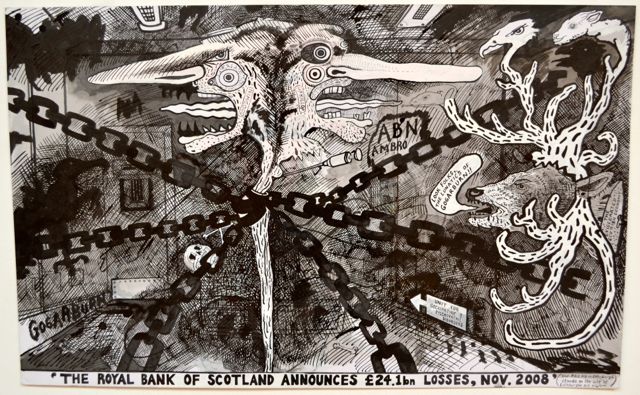
The Royal Bank of Scotland – Martin Fowler
Compiling 500 years of Scottish history is by no means an easy feat. Countless pages of history books burst at the seams with tales of battles, inventions, kings and queens, acts of law, migration, song – it’s hard enough to even pick where to begin. However, Scottish artist Martin Fowler has done just that, compiling his picks from the last 500 years in an astute new exhibition that serves as a catalyst to examine Scottish identity through history. Entitled Scotland the Brave – A Graphic History of Scotland 1513-2013, the exhibition features ink drawings that document the ‘warts and all’ side of Scotland’s story.
Works in the exhibition currently on show at the Scottish Storytelling Centre in Edinburgh range from monumental events such as the battles of Culloden, Bannockburn and Flodden, to more recent events such as the near collapse of the Royal Bank of Scotland, the Housing Act of 1980, Edinburgh’s tram debacle and the opening of the Scottish Parliament in 1998. The Relegation of Rangers FC and the comical disaster of the 1978 World Cup campaign also make an appearance – after all, it wouldn’t be a history of Scotland without the mention of football. The series also explores darker and often overlooked issues such as the arrival of the AIDS epidemic in Edinburgh in the 80s, Scottish self-hatred (a term coined by writer Irvine Welsh) and issues within the prison system where Fowler once worked with prisoners as an art teacher.

A Concise History of North Sea Oil – Martin Fowler
The exhibition serves as an aide-mémoire to Fowler, who said the drawings act as a way to understand and remember events from history. Fowler comes from a generation of Scottish children who were taught a distinctly English history at school, rather than the history of the country in which they were born and raised, saying: “At school there were no references to the Scottish Enlightenment, even though I grew up and went to school in Edinburgh where it happened. I didn’t even have an opinion on it.” Cynicism and satire are employed within some works as a way to critique the madness, as seen in A Concise History of North Sea Oil. Fowler said this piece attempts to address the lies and falsehoods surrounding the use of Scotland’s oil reserves, especially during the Thatcher years.
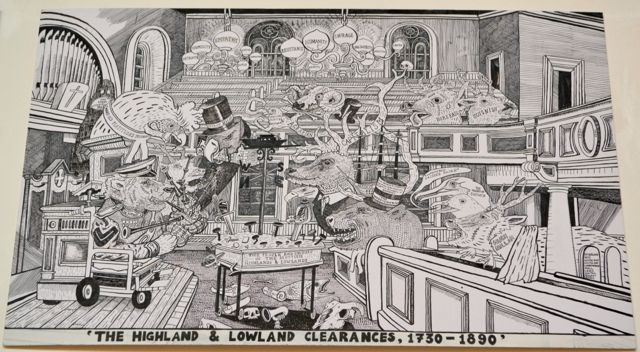
The Highland and Lowland Clearances – Martin Fowler
Fowler chose events based on those he had emotional engagement with, providing an alternative history and another way of looking at events that have often had a prescribed ‘John Prebble’ treatment. In his piece on the Highland Clearances, Fowler references the often overlooked role that women played in resisting landowners moves to clear land. This often resulted in heavy handed police brutality, riots and even deaths. He told me a story about the women of Coigach, where in 1853 attempts were made to clear families from the lands around Coigach in Wester Ross. The women defied orders to leave, and proceeded to strip the Sherrif in command of his clothes, destroying the summons he came bearing. He was then put into a boat, returning to Coigach absolutely nude and humiliated. Martin said the events surrounding the clearances are one of the events in the exhibition that have had the most impact on national identity, saying a sense of loss still exists in the Highlands to this day – something that is vitally important to Scotland’s sense of self.
Another piece in the exhibition looks at the Darien Venture in which Scotland unsuccessfully attempted to become a world trading nation by establishing the colony of Caledonia in Panama around 1690. Fowler said he didn’t know anything about the venture before he began this project, discovering the resulting economic and social situation in Scotland lead to one of the most important parliamentary acts being passed. The venture sucked half of the wealth out of Scotland, weakening the country’s resistance to the Act of the Union which was passed in 1707.
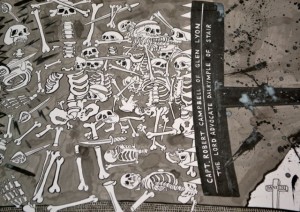
Detail – The Massacre of the MacDonalds of Glencoe
Fowler’s style has similarities with that of comic-book journalist Joe Sacco, saying he was influenced by the political and social satires of English caricaturist James Gillray. Fowler is currently living in Carlisle where he is a Senior Lecturer in Drawing and Fine Art at the University of Cumbria.
As Scotland looks towards the future in 2014, perhaps it’s useful to look back in time to see how Scotland’s identity has been shaped by the past. Not only has Fowler created an accessible collection of work but also one that shows a comprehensive appreciation of Scotland’s deep and rich history of the last 500 years.
You can see Scotland the Brave at the Scottish Storytelling Centre on the Royal Mile until the 28th of July 2013. Fowler will also be giving a talk about the exhibition on Saturday 20th July at 1pm where he will discuss how the collection came about and offer an insight into the practical and technical aspects of his work. All pieces in the exhibition are for sale and you can view more of his work here.
The post Martin Fowler’s Graphic History of Scotland appeared first on ScotClans | Scottish Clans.
]]>