<br />
<b>Deprecated</b>:  mysql_connect(): The mysql extension is deprecated and will be removed in the future: use mysqli or PDO instead in <b>/var/www/apps/scotclans_wp/wp-includes/wp-db.php</b> on line <b>1142</b><br />
<?xml version="1.0" encoding="UTF-8"?>
<rss version="2.0"
	xmlns:content="http://purl.org/rss/1.0/modules/content/"
	xmlns:wfw="http://wellformedweb.org/CommentAPI/"
	xmlns:dc="http://purl.org/dc/elements/1.1/"
	xmlns:atom="http://www.w3.org/2005/Atom"
	xmlns:sy="http://purl.org/rss/1.0/modules/syndication/"
	xmlns:slash="http://purl.org/rss/1.0/modules/slash/"
	>

<channel>
	<title>ScotClans &#124; Scottish Clans &#187; Aberdeen</title>
	<atom:link href="http://109.74.200.198/tag/aberdeen/feed/" rel="self" type="application/rss+xml" />
	<link>http://109.74.200.198</link>
	<description></description>
	<lastBuildDate>Fri, 20 Jan 2017 08:08:09 +0000</lastBuildDate>
	<language>en-US</language>
	<sy:updatePeriod>hourly</sy:updatePeriod>
	<sy:updateFrequency>1</sy:updateFrequency>
	<generator>http://wordpress.org/?v=3.6.1</generator>
		<item>
		<title>World&#8217;s oldest lunar calendar discovered in Scottish field</title>
		<link>http://109.74.200.198/worlds-oldest-lunar-calendar-discovered-in-scottish-field/</link>
		<comments>http://109.74.200.198/worlds-oldest-lunar-calendar-discovered-in-scottish-field/#comments</comments>
		<pubDate>Thu, 05 Jan 2017 16:23:03 +0000</pubDate>
		<dc:creator>Amanda Moffet</dc:creator>
				<category><![CDATA[‎The First Hunter Gatherers]]></category>
		<category><![CDATA[Aberdeen]]></category>
		<category><![CDATA[Aberdeenshire]]></category>
		<category><![CDATA[Crathes Castle]]></category>

		<guid isPermaLink="false">http://www.scotclans.com/?p=61760</guid>
		<description><![CDATA[<p>Archaeologists excavating Warren Field, an area next to Crathes Castle in Aberdeenshire from 2004-06 uncovered 12 pits which appear to mimic the phases of the moon and track lunar months.  Unusual crop marks had been spotted from the air by the Royal Commission on the Ancient and Historical Monuments of Scotland (RCAHMS) which led to [&#8230;]</p>
<p>The post <a rel="nofollow" href="http://109.74.200.198/worlds-oldest-lunar-calendar-discovered-in-scottish-field/">World&#8217;s oldest lunar calendar discovered in Scottish field</a> appeared first on <a rel="nofollow" href="http://109.74.200.198">ScotClans | Scottish Clans</a>.</p>
]]></description>
				<content:encoded><![CDATA[<div id="attachment_61765" class="wp-caption aligncenter" style="width: 610px"><img class="size-full wp-image-61765" alt="Holes" src="http://www.scotclans.com/wp-content/uploads/2017/01/hole.jpg" width="600" height="328" /><p class="wp-caption-text">12 pits were found</p></div>
<p>Archaeologists excavating Warren Field, an area next to Crathes Castle in <a href="http://www.scotclans.com/scotland/visit-scotland/scottish-places/northeast-scotland/">Aberdeenshire</a> from 2004-06 uncovered 12 pits which appear to mimic the phases of the moon and track lunar months.  Unusual crop marks had been spotted from the air by the Royal Commission on the Ancient and Historical Monuments of Scotland (RCAHMS) which led to the dig being started.</p>
<p>Dave Cowley, aerial survey projects manager at RCAHMS, said: &#8220;We have been taking photographs of the Scottish landscape for nearly 40 years, recording thousands of archaeological sites that would never have been detected from the ground&#8230;Warren Field stands out as something special, however. It is remarkable to think that our aerial survey may have helped to find the place where time itself was invented.&#8221;</p>
<p>Archaeologists believe now they have discovered the world&#8217;s oldest lunar &#8220;calendar&#8221; in the world.</p>
<p>A team led by the University of Birmingham suggests the ancient monument was created by hunter-gatherers about 10,000 years ago.</p>
<p>Vince Gaffney, Professor of Landscape Archaeology at Birmingham, led the analysis project.</p>
<p>He said: &#8220;The evidence suggests that <a href="http://www.scotclans.com/scotland/scottish-history/prehistoric-scotland/the-first-hunter-gatherers/">hunter-gatherer societies in Scotland</a> had both the need and sophistication to track time across the years, to correct for seasonal drift of the lunar year and that this occurred nearly 5,000 years before the first formal calendars known in the Near East &#8230;In doing so, this illustrates one important step towards the formal construction of time and therefore history itself.&#8221;</p>
<div id="attachment_61771" class="wp-caption aligncenter" style="width: 610px"><img class="size-full wp-image-61771" alt="an artist's impression of warren field about 10000 years ago showing burning material in one of the pits." src="http://www.scotclans.com/wp-content/uploads/2017/01/cal.jpg" width="600" height="337" /><p class="wp-caption-text">An artist&#8217;s impression of warren field about 10000 years ago showing burning material in one of the pits.</p></div>
<p>The experts who analysed the pits said they may have contained a wooden post.</p>
<div id="attachment_61761" class="wp-caption aligncenter" style="width: 590px"><img class="size-full wp-image-61761" alt="The pits were placed to copy the positions of the moon - identifying the time of the year." src="http://www.scotclans.com/wp-content/uploads/2017/01/lunar.jpg" width="580" height="470" /><p class="wp-caption-text">The pits were placed to copy the positions of the moon &#8211; identifying the time of the year.</p></div>
<p>The Mesolithic &#8220;calendar&#8221; is thousands of years older than previous known formal time-measuring monuments created in Mesopotamia.</p>
<p>The pit alignment also aligns on the Midwinter sunrise to provided the hunter-gatherers with an annual &#8220;astronomic correction&#8221; in order to better follow the passage of time and changing seasons.</p>
<p><iframe src="https://www.youtube.com/embed/yPIdaaAow_0" height="315" width="560" allowfullscreen="" frameborder="0"></iframe></p>
<p>&nbsp;</p>
<p>The universities of St Andrews, Leicester and Bradford were also involved.<br />
Dr Richard Bates, of the University of St Andrews, said the discovery provided &#8220;exciting new evidence&#8221; of the early Mesolithic Scotland.<br />
He added: &#8220;This is the earliest example of such a structure and there is no known comparable site in Britain or Europe for several thousands of years after the monument at Warren Field was constructed.&#8221;</p>
<div id="attachment_61763" class="wp-caption aligncenter" style="width: 610px"><img class="size-full wp-image-61763" alt="Crathness Castle" src="http://www.scotclans.com/wp-content/uploads/2017/01/castle.jpg" width="600" height="402" /><p class="wp-caption-text">Crathes Castle</p></div>
<p><a title="Crathes Castle" href="http://www.scotclans.com/scotland/visit-scotland/scottish-castles/aberdeen-aberdeenshire/crathes-castle/">Crathes Castle</a> and its estate is in the care of the National Trust for Scotland (NTS).<br />
From 2004 to 2006, trust staff and Murray Archaeological Services excavated the site.<br />
NTS archaeologist Dr Shannon Fraser said: &#8220;This is a remarkable monument, which is so far unique in Britain.<br />
&#8220;Our excavations revealed a fascinating glimpse into the cultural lives of people some 10,000 years ago &#8211; and now this latest discovery further enriches our understanding of their relationship with time and the heavens.&#8221;</p>
<p>The post <a rel="nofollow" href="http://109.74.200.198/worlds-oldest-lunar-calendar-discovered-in-scottish-field/">World&#8217;s oldest lunar calendar discovered in Scottish field</a> appeared first on <a rel="nofollow" href="http://109.74.200.198">ScotClans | Scottish Clans</a>.</p>
]]></content:encoded>
			<wfw:commentRss>http://109.74.200.198/worlds-oldest-lunar-calendar-discovered-in-scottish-field/feed/</wfw:commentRss>
		<slash:comments>1</slash:comments>
		</item>
		<item>
		<title>The Gaelic Gasp &amp; The Glottal Stop</title>
		<link>http://109.74.200.198/the-gaelic-gasp-the-glottal-stop/</link>
		<comments>http://109.74.200.198/the-gaelic-gasp-the-glottal-stop/#comments</comments>
		<pubDate>Sun, 17 Jul 2011 19:50:49 +0000</pubDate>
		<dc:creator>davemcnicoll</dc:creator>
				<category><![CDATA[Scottish Places & Buildings]]></category>
		<category><![CDATA[Aberdeen]]></category>
		<category><![CDATA[accent]]></category>
		<category><![CDATA[dialect]]></category>
		<category><![CDATA[edinburgh]]></category>
		<category><![CDATA[Gaelic]]></category>
		<category><![CDATA[glasgow]]></category>
		<category><![CDATA[Highlands]]></category>
		<category><![CDATA[Inverness]]></category>
		<category><![CDATA[language]]></category>
		<category><![CDATA[Lowlands]]></category>
		<category><![CDATA[Scotland]]></category>
		<category><![CDATA[Scots]]></category>
		<category><![CDATA[vocabulary]]></category>

		<guid isPermaLink="false">http://www.scotclans.com/bletherskite/?p=3024</guid>
		<description><![CDATA[<p>Most people have a fixed idea of what a Scottish accent is, thanks to film and television; and, generally it&#8217;s sort of Glasgow-ish, with a hint of Edinburgh. This is no coincidence, as nearly two thirds of the Scottish population lives in the Greater Glasgow – Edinburgh corridor, and this kind of accent prevails. That&#8217;s [&#8230;]</p>
<p>The post <a rel="nofollow" href="http://109.74.200.198/the-gaelic-gasp-the-glottal-stop/">The Gaelic Gasp &#038; The Glottal Stop</a> appeared first on <a rel="nofollow" href="http://109.74.200.198">ScotClans | Scottish Clans</a>.</p>
]]></description>
				<content:encoded><![CDATA[<p class="MsoNormal" style="margin: 0cm 0cm 0pt;"><span style="font-family: Arial;">Most people have a fixed idea of what a Scottish accent is, thanks to film and television; and, generally it&#8217;s sort of Glasgow-ish, with a hint of Edinburgh. This is no coincidence, as nearly two thirds of the Scottish population lives in the Greater Glasgow – Edinburgh corridor, and this kind of accent prevails. That&#8217;s a bit simplistic though, as it varies across the area; with socio-economic and class factors playing a large part as well. So, someone from Bearsden in Glasgow&#8217;s leafy suburbs is unlikely to share an accent with someone hailing from Rutherglen in the southeast of the city. </span></p>
<p class="MsoNormal" style="margin: 0cm 0cm 0pt;">
<p>&nbsp;</p>
<p class="MsoNormal" style="margin: 0cm 0cm 0pt;">
<p class="MsoNormal" style="margin: 0cm 0cm 0pt;"><span style="font-family: Arial;">From Ayrshire, the land of Robert Burns, across the Central Belt – through Glasgow, Edinburgh and Fife to Dundee – accents are variations on the Lowlands Scots Dialect. There are those who will argue that Scots is a language of its own, separate from English; and while I see this, to me it simply a tongue that developed from the same root and a variation on a theme. Even those who claim to speak it this is not what was taught to them at school. Scotland has her own independent educational system, which is broad-based, and the national curriculum imposes Maths and English as compulsory subjects to the age of 16. The English taught is that of Received Pronunciation or &#8216;Proper English&#8217; (whatever that might be). Thus, &#8216;English&#8217; is the written language of Scotland, despite its distinct vernacular.</span></p>
<p class="MsoNormal" style="margin: 0cm 0cm 0pt;">
<p>&nbsp;</p>
<p class="MsoNormal" style="margin: 0cm 0cm 0pt;">
<p class="MsoNormal" style="margin: 0cm 0cm 0pt;"><span style="font-family: Arial;">Lowland Scots has several distinct features both in dialect and accent – the rolling of the Rs, and the famous Glottal Stop: &#8220;Scawe-land&#8221; rather than Scot-land, &#8220;Buh-ur&#8221; rather than but-er, and so on. The &#8216;helpful vowel&#8217; or <em style="mso-bidi-font-style: normal;">Svarabhakti</em> is often employed – wur-um and wur-uld for worm and world. These and a large range of words unused elsewhere in the English speaking world (e.g. – ken for know; thrawn for stubborn; drouthy for thirsty; etc.) make the accent instantly recognisable – and account for the stereotype. Outwith the Central Belt, the diversity of the accent becomes even more pronounced, with striking differences in both diction and enunciation. </span></p>
<p class="MsoNormal" style="margin: 0cm 0cm 0pt;">
<p>&nbsp;</p>
<p class="MsoNormal" style="margin: 0cm 0cm 0pt;">
<p class="MsoNormal" style="margin: 0cm 0cm 0pt;"><span style="font-family: Arial;">Perhaps the most striking of Scottish accents is that of the Doric, spoken essentially in Aberdeenshire. The term &#8216;Doric&#8217; is a reference to the rough speech of the Spartan people (to Athenian ears), and came to mean &#8216;rustic&#8217; or &#8216;rural&#8217;. One of the most noticeable differences from Lowland Scots is the use of &#8216;f&#8217; instead of &#8216;whi&#8217; in words like what, who (pronounced <em style="mso-bidi-font-style: normal;">fit </em>and<em style="mso-bidi-font-style: normal;"> fa&#8217; </em>respectively). Doric speakers share most of the dialectal words used further south, but have plenty others of their own – &#8216;louns&#8217; for boys, and &#8216;queans&#8217; for girls being well known examples. </span></p>
<p class="MsoNormal" style="margin: 0cm 0cm 0pt;">
<p>&nbsp;</p>
<p class="MsoNormal" style="margin: 0cm 0cm 0pt;">
<p><span style="font-family: Arial;">The small village of Auldearn near Nairn is one of Scotland&#8217;s linguistic boundaries, where the Doric of the east switches to the lilt and nasal accent of the Inverness area – itself an extension of the Highland dialects of Strathspey, the Great Glen and Easter Ross. The change is not just in phonology, but in grammar and structure. In many ways the language constructs of Highland English mirror that of the Southeast of England, and the Oxbridge world. This is due to the language being first introduced and then forced upon Gaelic speakers over the course of the last 200 years, and more importantly since the Education Act (Scotland) 1872. When a new language enters an area and is systematically taught one generation on another from textbooks, then the formula tends to stick – this is the reason why Inverness is often quoted as having the &#8216;Best Spoken English in the World&#8217;.</span></p>
<p class="MsoNormal" style="margin: 0cm 0cm 0pt;">
<p class="MsoNormal" style="margin: 0cm 0cm 0pt;"><span style="font-family: Arial;">As you continue west towards the Hebrides (but also in pockets like Perthshire), where Gaelic is still spoken or was until relatively recently then the English begins to adopt idiosyncrasies from the mother language; which, as a Celtic tongue is arranged in a very different way. As well as more aspiration in the speech, and grammatical constructions which mimic Gaelic, such as &#8220;I am after buying a newspaper&#8221;, there is the strange phenomenon of the &#8216;Gaelic Gasp&#8217;.</span></p>
<p class="MsoNormal" style="margin: 0cm 0cm 0pt;">
<p>&nbsp;</p>
<p class="MsoNormal" style="margin: 0cm 0cm 0pt;"><span style="font-family: Arial;">The &#8216;gasp&#8217; is a sharp intake of breath signifying agreement, often accompanied by an &#8216;aye&#8217;, or a nodding of the head. This breathy acquiescence isn&#8217;t restricted to the Highlands, but can be found across the North Atlantic including the Faeroes, Iceland and Norway – which suggests a Viking origin to this linguistic oddity. It also gives us insight to the varieties of English spoken across Scotland: from the sing-song lilt of the islands to the barking gruff of the Lothians. A thousand years ago an Anglo-Saxon (or early English) language was spoken in southeast; Welsh languages dominated both the southwest and central Scotland (Briton and Pictish were part of this family); in the west, beyond the mountains the Picts of Argyll spoke Gaelic; and, in the far north Norse was spoken. Each would contribute to accents and dialects that would emerge in their areas – but why English?</span></p>
<p class="MsoNormal" style="margin: 0cm 0cm 0pt;">
<p>&nbsp;</p>
<p class="MsoNormal" style="margin: 0cm 0cm 0pt;">
<p class="MsoNormal" style="margin: 0cm 0cm 0pt;"><span style="font-family: Arial;">In 1070 King Malcolm III married Margaret Ætheling, an Anglo-Saxon Princess fleeing the conquest of England by William of Normandy. She was a dominant woman, thorough in her religious convictions: establishing abbeys and influencing the Scottish court. She made sure that &#8216;English&#8217; became the &#8216;natural&#8217; language of diplomacy. Her son, David I, introduced the feudal system into Scotland – including Royal Burghs (towns with specific trading rights). The linga-franca of these new towns was English: David&#8217;s first language. The nobility followed, and by the necessity of trade, so ultimately did the farmers. Formed from a more antiquated Anglo-Saxon, this version of English would evolve into Scots. Words such as &#8216;kirk&#8217; for a church, or &#8216;gate&#8217; for a street hint at the older Germanic root; now lost in modern English. This accounts for the origins of the Scots dialect; where the accent differs depends on the level of Celtic/Norse influence beyond adoption. </span></p>
<p class="MsoNormal" style="margin: 0cm 0cm 0pt;">
<p>&nbsp;</p>
<p class="MsoNormal" style="margin: 0cm 0cm 0pt;">
<p class="MsoNormal" style="margin: 0cm 0cm 0pt;"><span style="font-family: Arial;">A second revolution saw the assimilation of &#8216;Proper English&#8217; – the Reformation of 1560. While a truly Scottish event, the influence of the English Reformation played a part. There, bibles were already printed in English, and while there were significant vocabulary differences, most Scots could read and understand them. The Church of Scotland decided not to bother printing bibles in the vernacular, and so from then on English became the &#8216;written&#8217; expression of the language. This was cemented in 1603 when James VI of Scotland became the king of England. </span></p>
<p class="MsoNormal" style="margin: 0cm 0cm 0pt;">
<p>&nbsp;</p>
<p class="MsoNormal" style="margin: 0cm 0cm 0pt;">
<p class="MsoNormal" style="margin: 0cm 0cm 0pt;"><span style="font-family: Arial;">In the Highlands, the bible was actually translated into Gaelic, but inroads are long in the making. The decline of Gaelic is well documented and the reasons legion; and the effect on the language remains to this day. The Gaidhealtachd, the Gaelic speaking areas of Scotland, have for a thousand years been receding against the never-ending tsunami of English. There are milestones along the way, and we should be thankful that the language exists far less thrives, in the Hebrides. The Highland line still provides a major boundary, such as Auldearn, or Dunkeld – where the age-old usage of English meets the recently taught variety in the traditional Gaelic lands. Yet, whatever the origin, whatever the accent, the Scottish dialect is vibrant and truly fascinating. </span></p>
<p class="MsoNormal" style="margin: 0cm 0cm 0pt;">
<p>&nbsp;</p>
<p class="MsoNormal" style="margin: 0cm 0cm 0pt;"><span style="font-family: Arial;">This blog was written by David McNicoll, owner of Highland Experience USA &#8211; which specialises in Vacation Packages and Tours of Scotland</span></p>
<p class="MsoNormal" style="margin: 0cm 0cm 0pt;"><span style="font-family: Arial;"><a title="Link - Highlandexpereince-usa.com" href="http://www.highlandexperience-usa.com" target="_blank">Link &#8211; www.highlandexperience-usa.com</a></span></p>
<p>The post <a rel="nofollow" href="http://109.74.200.198/the-gaelic-gasp-the-glottal-stop/">The Gaelic Gasp &#038; The Glottal Stop</a> appeared first on <a rel="nofollow" href="http://109.74.200.198">ScotClans | Scottish Clans</a>.</p>
]]></content:encoded>
			<wfw:commentRss>http://109.74.200.198/the-gaelic-gasp-the-glottal-stop/feed/</wfw:commentRss>
		<slash:comments>1</slash:comments>
		</item>
		<item>
		<title>Picture of Skye Wins Landscape Photographer of Year 2009 Award</title>
		<link>http://109.74.200.198/picture-of-skye-wins-landscape-photographer-of-year-2009-award/</link>
		<comments>http://109.74.200.198/picture-of-skye-wins-landscape-photographer-of-year-2009-award/#comments</comments>
		<pubDate>Tue, 20 Oct 2009 13:30:50 +0000</pubDate>
		<dc:creator>donald</dc:creator>
				<category><![CDATA[Scottish News]]></category>
		<category><![CDATA[Aberdeen]]></category>
		<category><![CDATA[Buachaille Etive Mòr]]></category>
		<category><![CDATA[Isle of Skye]]></category>
		<category><![CDATA[Old Man of Storr]]></category>

		<guid isPermaLink="false">http://www.scotclans.com/bletherskite/?p=1312</guid>
		<description><![CDATA[<p>Emmanuel Coupe&#8217;s picture of sunrise over the Old Man of Storr on the Isle of Skye was picked as the best out of thousands of entries in the Take a View &#8211; Landscape Photographer of the Year Award 2009. The Paris based photographer scooped the £10,000 prize with his stunning picture [top]. John Parminter&#8217;s shot [&#8230;]</p>
<p>The post <a rel="nofollow" href="http://109.74.200.198/picture-of-skye-wins-landscape-photographer-of-year-2009-award/">Picture of Skye Wins Landscape Photographer of Year 2009 Award</a> appeared first on <a rel="nofollow" href="http://109.74.200.198">ScotClans | Scottish Clans</a>.</p>
]]></description>
				<content:encoded><![CDATA[<p><img class="aligncenter size-full wp-image-1313" title="skye_oldmanofstorr" alt="skye_oldmanofstorr" src="http://www.letsbuyscottish.com/wp-content/uploads/2009/10/skye_oldmanofstorr1.jpg" width="512" height="174" /></p>
<p>Emmanuel Coupe&#8217;s picture of sunrise over the Old Man of Storr on the Isle of Skye was picked as the best out of thousands of entries in the Take a View &#8211; Landscape Photographer of the Year Award 2009. The Paris based photographer scooped the £10,000 prize with his stunning picture [top].</p>
<p><img class="aligncenter size-full wp-image-1318" title="buachaille-etive-m-r-near-005" alt="buachaille-etive-m-r-near-005" src="http://www.letsbuyscottish.com/wp-content/uploads/2009/10/buachaille-etive-m-r-near-0051.jpg" width="526" height="357" /></p>
<p>John Parminter&#8217;s shot of a wintery Buachaille Etive Mòr [above] won the Classic View award, whilst his atmospheric picture, titled Food For Thought [below], taken at Aberdeen harbour, won in the Your View Category.</p>
<p><img class="aligncenter size-full wp-image-1322" title="food-for-thought-aberdeen-002" alt="food-for-thought-aberdeen-002" src="http://www.letsbuyscottish.com/wp-content/uploads/2009/10/food-for-thought-aberdeen-0021.jpg" width="537" height="374" /></p>
<p>The post <a rel="nofollow" href="http://109.74.200.198/picture-of-skye-wins-landscape-photographer-of-year-2009-award/">Picture of Skye Wins Landscape Photographer of Year 2009 Award</a> appeared first on <a rel="nofollow" href="http://109.74.200.198">ScotClans | Scottish Clans</a>.</p>
]]></content:encoded>
			<wfw:commentRss>http://109.74.200.198/picture-of-skye-wins-landscape-photographer-of-year-2009-award/feed/</wfw:commentRss>
		<slash:comments>1</slash:comments>
		</item>
		<item>
		<title>Donald Trump&#8217;s Nation-Wide Tour</title>
		<link>http://109.74.200.198/donald-trumps-nation-wide-tour/</link>
		<comments>http://109.74.200.198/donald-trumps-nation-wide-tour/#comments</comments>
		<pubDate>Thu, 24 Sep 2009 12:47:20 +0000</pubDate>
		<dc:creator>donald</dc:creator>
				<category><![CDATA[Scottish News]]></category>
		<category><![CDATA[Aberdeen]]></category>
		<category><![CDATA[Donald Trump]]></category>
		<category><![CDATA[Golf]]></category>

		<guid isPermaLink="false">http://www.scotclans.com/bletherskite/?p=997</guid>
		<description><![CDATA[<p>A stunt pulled by the Menie Liberation Front (MLF) has seen around twenty statues in four of Scotland&#8217;s cities given a Donald Trump mask and a plastic toy golf club in an attempt at a light hearted protest against the American tycoon&#8217;s £1bn golf resort plans for Menie in Aberdeenshire, which Trump claims will be [&#8230;]</p>
<p>The post <a rel="nofollow" href="http://109.74.200.198/donald-trumps-nation-wide-tour/">Donald Trump&#8217;s Nation-Wide Tour</a> appeared first on <a rel="nofollow" href="http://109.74.200.198">ScotClans | Scottish Clans</a>.</p>
]]></description>
				<content:encoded><![CDATA[<div id="attachment_39563" class="wp-caption aligncenter" style="width: 633px"><a href="/wp-content/uploads/2009/09/anti-trump-protest-stunts-held-across-scotland.jpg" data-lightboxplus="lightbox[997]" title="Donald Trump's Nation-Wide Tour"><img class="size-full wp-image-39563" alt="Greyfriar's Bobby in Edinburgh" src="/wp-content/uploads/2009/09/anti-trump-protest-stunts-held-across-scotland.jpg" width="623" height="349" /></a><p class="wp-caption-text">Greyfriar&#8217;s Bobby in Edinburgh</p></div>
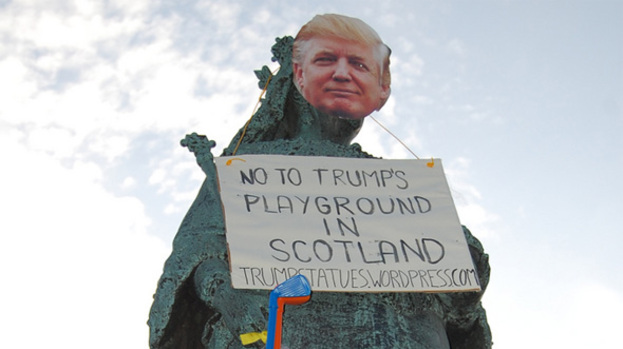
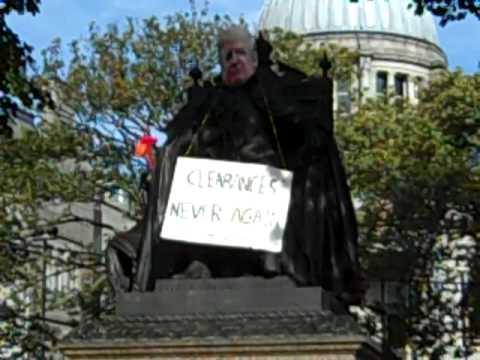
<p>A stunt pulled by the Menie Liberation Front (MLF) has seen around twenty statues in four of Scotland&#8217;s cities given a Donald Trump mask and a plastic toy golf club in an attempt at a light hearted protest against the American tycoon&#8217;s £1bn golf resort plans for Menie in Aberdeenshire, which Trump claims will be the greatest in the world.</p>
<div id="attachment_39565" class="wp-caption aligncenter" style="width: 633px"><a href="/wp-content/uploads/2009/09/3551-anti-trump-protest-stunts-held-across-scotland.jpg" data-lightboxplus="lightbox[997]" title="Donald Trump's Nation-Wide Tour"><img class="size-full wp-image-39565" alt="I am not amused" src="/wp-content/uploads/2009/09/3551-anti-trump-protest-stunts-held-across-scotland.jpg" width="623" height="349" /></a><p class="wp-caption-text">I am not amused</p></div>
<p>The Menie Liberation Fronts purpose is to help protect the people and especially the ecosystem of the coastal Aberdeenshire village. They believe that Trump&#8217;s golf course and resort would destroy a unique part of the regions flora and fauna, and would have negative long term ecological ramifications. They believe that it is also unacceptable for many of the people to be pressured out of their own homes.</p>
<p>However, Donald Trump claims that his resort, which would feature two golf courses, a 950 room hotel, and 500 houses would be extremely benefitial to Aberdeenshire and the whole of Scotland, providing the country with tourists and a financial security for generations, well after the oil in the North Sea has ran out.</p>
<div id="attachment_39566" class="wp-caption aligncenter" style="width: 490px"><a href="/wp-content/uploads/2009/09/mask.jpg" data-lightboxplus="lightbox[997]" title="Donald Trump's Nation-Wide Tour"><img class="size-full wp-image-39566" alt="Donald Trump's Nation-Wide Tou" src="/wp-content/uploads/2009/09/mask.jpg" width="480" height="360" /></a><p class="wp-caption-text">Donald Trump&#8217;s Nation-Wide Tou</p></div>
<p style="text-align: left;">The MLF will continue this campaign to get the public to understand the sort of the damage that Trump&#8217;s plans will have to Menie. The group explained the logic behind this particular stunt by saying, &#8220;We are dressing up famous Scottish statues as the American tycoon to symbolise the way Trump thinks he can walk over Scotland.&#8221; It has also been made clear that none of the statues used for this protest have been damaged in any way.</p>
<p>Aberdeen, Stirling, Edinburgh, and Glasgow are the cities that have been targeted so far, but people have been told to expect to see more of Trump over the next few days.</p>
<p>The post <a rel="nofollow" href="http://109.74.200.198/donald-trumps-nation-wide-tour/">Donald Trump&#8217;s Nation-Wide Tour</a> appeared first on <a rel="nofollow" href="http://109.74.200.198">ScotClans | Scottish Clans</a>.</p>
]]></content:encoded>
			<wfw:commentRss>http://109.74.200.198/donald-trumps-nation-wide-tour/feed/</wfw:commentRss>
		<slash:comments>1</slash:comments>
		</item>
	</channel>
</rss>