The post Top 5: Whisky of the Clans appeared first on ScotClans | Scottish Clans.
]]>1. Dalmore

Dalmore 12 Year Old Whisky
In 1263, an ancestor of Clan Mackenzie saved King Alexander III of Scotland from being gored by a stag whilst out hunting. The grateful King granted the Mackenzies the right to bear a stag’s head, with twelve points to its antlers, signifying a ‘Royal’ in their coat of arms. Today every bottle of the Dalmore single malt is adorned with the clan’s proud emblem. The distillery is located on the northern shores of the Firth of Cromarty overlooking the Black Isle, and was originally established in 1839 by Alexander Matheson, a trader who made his fortune in opium imports. The Mackenzie family bought the distillery in 1866 and have recently begun to use the Mackenzie motto of Luceo Non Uro (I shine, not burn) as the company’s philosophy. The Dalmore Single Highland Malt Collection is matured in a wooden casks (both sherry wood and American white oak) which, along with the years and the climate, contributes to the flavour of each malt.
2. Clan MacGregor

Clan MacGregor Blended Whisky
Clan MacGregor blended whisky takes its name from the highland clan, honouring one the descendents of ancient Celtic royalty as proclaimed in the motto ‘Royal is my Race’. The blend is made from 15 malt and grain whiskies from the heart of Scotland, blended to create a delicate, sweet aroma and smooth, mellow taste. The bottles proudly carry the Clan MacGregor badge and motto, and with his kind permission, the personal crest of the 24th Clan Chief, Sir Malcolm MacGregor of MacGregor. The Clan badge, a crowned lion’s head on a wreath encircled with a belt and buckle, signifies the unity and loyalty of the clan who suffered two centuries worth of oppression. It is enjoyed in over 60 countries around the world, from the USA to Venezuela and the Middle East to Thailand.
3. Talisker

Talisker 10 Year Old
My personal favourite, this wee gem of single malt is produced at the Talisker distillery on the shores of Loch Harport on the Isle of Skye. It’s the only distillery on the isle, with the distillery’s seaside home giving it a deep peaty character followed by a hint of sweet. The distillery was built in 1831 by brothers Hugh and Kenneth MacAskil after they acquired the lease of Talisker House from the chief of Clan MacLeod. When a new lease for the distillery was negotiated with the chief in 1892 the annual payment was to be £23.12s and a ten-gallon cask of best-quality Talisker. Today the single malt continues to be the preferred dram of clan chiefs – the MacNeil of Barra leases their seat of Kisimul Castle to Historic Scotland at a cost of £1 per annum and a bottle of Talisker. In 2007 Talisker 18 year old won ‘Best Single Malt in the World’ at the World Whiskies Awards and was one of three whiskies described by poet Robert Louis Stevenson as “The king o’ drinks, as I conceive it” in his poem The Scotsman’s Return From Abroad.
4. Clan Campbell

Clan Campbell Blended Whisky
While the link between this blended whisky and the actual clan is unclear, the whisky takes it names from the clan who have 14 million descendents around the globe. Clan Campbell is one of the largest clans in Scotland and renowned for its bravery and influence over the country’s history since the 13th century. The whisky is distilled, blended and aged in the Highlands, combining Scotch grain and malt whiskies that have aged in oak casks for at least three years. The present clan chief, Torquhil Ian, combines his duties as Duke or Argyll, chief and landowner with a consultant role with Pernod Ricard, promoting Scotch Whiskies including Chivas Regal and Glenlivet.
5. Drambuie and Glayva

Drambuie Liqueur

Glayva Liqueur
Technically not a Whisky, Drambuie is a sweet golden coloured liqueur made from malt whisky, honey, herbs and spices. Produced in Broxburn, West Lothian, Drambuie derives its name from the Gaelic phrase an dram buidheach, (the drink that satisfies). After the Battle of Culloden in 1746, Prince Charles Edward Stuart fled to the isle of Skye. There, he was given sanctuary by Captain John MacKinnon of Clan MacKinnon. According to family legend, after staying with the captain, the prince rewarded him with this prized drink recipe. This version of events is disputed by historians who believe it to be a story concocted to boost sales of the drink. The MacKinnon family produce the liqueur to this day. A similar liqueur is Glayva, produced in Leith since 1947. It made from a blend of aged Scotch whiskies, herbs, anise, cloves, almonds, heather honey, and citrus fruits. Legend has it that when Bonnie Prince Charlie was served a whisky based liqueur, he looked at his host, held up the glass and spoke the Gaelic “Gle mhath!”(very good) thus giving the drink the name it carries to this day.
The post Top 5: Whisky of the Clans appeared first on ScotClans | Scottish Clans.
]]>The post A Beginner’s Guide To The Jacobites appeared first on ScotClans | Scottish Clans.
]]>The reason I wrote this was to put together a newbies guide to what this period of history was all about, what started it and most importantly to dispel the misinformation that this was some Scotland V England struggle. Ive tried to keep it as light and simple as possible, I tested it on my 12 year old daughter last night and it made sense to her so fingers crossed here goes….

Charlie Tour T Shirt
It all started with King James the VII as we called him in Scotland or James II as he was known in England. He was the second surviving son of Charles I
First, A bit of Background…
Charles I had a pretty difficult relationship with parliament and this led to the English Civil War, which, actually started in Scotland not England when Charles managed to also get on the wrong side of the Church as well and started the bishop’s war. Incredibly the Bishops war was started by Charles attempting to introduce a new prayer book so two sides who couldn’t agree on how to give praise to the same god started a fight which spilled over into Ireland and then into England like some sort of viral cowboy bar brawl and ended up creating the biggest armed conflict on British soil. Say what you like about the Scots we are damned good at starting a fight.
Charles lost the war and his head in 1649 which in turn led to Oliver Cromwell, the Protectorate and a ban on Christmas, singing and anything else regarded as mildly fun. When Cromwell died of a mixture of malaria and kidney stones he was succeeded by his son who couldn’t get the hang of ‘protecting’ at all and the Monarchy was restored, Charles II became King with much rejoicing and Cromwell was executed, yes I know he was already dead but they hung him again anyway just to make sure.
Charles II was known as the ‘Merry Monarch’ and his reign began with one massive party although it wasn’t all fun since his reign also included the great plague and the great fire of London. Charles II had one last laugh on his people though when he converted to Catholicism on his deathbed.
Now it would take more time than I have here and more pages than I’d like to fill to explain why the Monarchy and parliament had a bit of an issue with Catholicism so trust me, from around the time of the Tudors they most definitely did, it goes without saying that the Church of England were not huge fans, after all they were the competition in the business of eternal life and The Catholic church had some pretty good moves like ‘give us lots of money and we will fast track you through purgatory’ etc.
Charles’ late entry into the world of Catholicism before his exit from the world of the living was inconvenient to say the least but with no heir the next in line was his brother James and what wasn’t so well known was that James had been a practicing Catholic for some time. Like it or not Britain was about to get a Catholic monarch.
James VII takes charge (briefly)…
This led to a number of problems for James. For starters two rebellions kicked off, one led by Duke of Monmouth and another by Campbell of Argyll in Scotland, Argyll’s rebellion came to nowt as they say and his head was soon gracing the space formerly occupied by Royalist hero and shampoo model the Marquis of Montrose. Monmouth was a tougher nut to crack and James also had another issue to deal with, literally as he had quite inexplicably allowed his daughter to marry his protestant Dutch nephew William of Orange, a bit of an own goal as this handed the protestant supporters a ready made replacement..
The protestant nobles called on William and over he came in 1688 to take the throne, James legged it and in the process chucked the Great Seal of the Realm into the River Thames. He was captured before he could leave England but William, not keen to create a Stuart martyr sort of turned his back, whistled a bit and left the cell door slightly open and allowed James to escape. After a great deal of parliamentary debate it was decided that James throwing the Great Seal in the Thames like Dirty Harry throwing away his cop badge was really an act of abdication so that was good enough for them (don’t let anyone ever tell you there aren’t any seals in the Thames). They also quickly shored up the legislation to make sure there could NEVER be another Catholic monarch, a statute that has stood to this day, albeit recently amended.
So that was it. The Stuart dynasty that had ruled Scotland for nearly 300 years and latterly the whole of the newly United Kingdom was over, or was it?
James was determined for a rematch and his campaign began and pretty much ended in Ireland with defeat at the Battle of the Boyne, an event that has been celebrated by the Orange Order to this day, mostly by people in bowler hats parading with flute bands round small towns in Northern Ireland and Lanarkshire.
If anyone wants to discover what is essentially wrong with Scotland then you have to look no further than the petty sectarian nonsense that has plagued this country since then. Where we have become a country divided by tribal lines mostly based on which Glasgow based football team you support, insular, inward looking and regressive.
But enough about that back to the Jacobites…
The Old Pretender…
James may have been done with the throne of Britain but his progeny were not. His second daughter, Anne became queen in 1702. Queen Anne gave us many things including the Act of Union and bow legged furniture (considering she had 17 pregnancies during here reign you can see where they got the idea from).
When Anne died in 1714 succession fell in a rather oblique way to George of Hannover, a German and grandson of James VI(and I) as the nearest non Catholic everyone could agree on. (there were 50 more eligible Catholics in the way which the Act of Settlement conveniently ignored).
A year later in 1715 the Whig party won a majority to become the new government defeating the Tory party. Many rebels in the Tory party were Jacobites (from ‘Jacobus’ the Latin for ‘James’) and supported the return of the Stuart Dynasty. James VII was long dead but his son James Francis Edward Stuart was very much alive and in exile in France. Although the support for his claim sprouted in the Tory rebellion in London it really took root in Scotland. There was still a strong Catholic contingent in Scotland and James was able to get support from them. He arrived in Scotland in 1715 to start his campaign to regain the throne but it didn’t go at all well. James (the Old Pretender) was timid, didn’t like crowds and couldn’t handle cold weather, not ideal traits for fighting battles in Scotland!
He abandoned the whole idea in 1716 and headed back to France where he was welcomed with… folded arms. And sent off to Italy to bother someone else.
In 1719 he married Maria Clementina Sobieska a Polish princess and they had two sons, the eldest being Charles Edward Louis John Casimir Sylvester Severino Maria Stuart (I’d hate to have been the one icing his birthday cakes), fortunately he was more commonly referred to as Charles Edward Stuart or ‘Bonnie Prince Charlie.
Charlie was a very different man to his father. Born in Italy he was determined to restore the Stuarts to the throne so his father named him regent in 1743 and his adventures began…
Bonnie Prince Charlie and the ’45…
Charlie managed to get some support in kind from France and was given a pair of well fitted out ships. His hopes of getting some well fitted out men too were less successful but nevertheless he set off for the West of Scotland, preferring his fathers recruiting ground to the North. The Jacobites still had much support from the Northern Clans mostly, but not exclusively Catholic, he also had Jacobite support from Ireland and places like Carlisle and Manchester in the North of England.
Resistance to the Jacobites came not just from England (who made up the bulk of the UK population and still do) but also from Scotland and Ireland.
As everyone probably knows by now the second Jacobite rebellion made it as far south as Derby before turning back when they picked up far less support along the way than they were expected, the additional French troops didn’t turn up and the Scots army were frustrated at the lack of square sausage and irn bru.
They headed back for Scotland, managing a last hurrah at Falkirk before the whole thing came to a sticky end on Culloden Moor in 1746. Bonny Prince Charlie fled the field and pursued by redcoats managed to hide in every cave in Scotland if tourist brochures are to be believed, disguised himself as a woman and high tailed it back to France, where after numerous affairs, not the least of which was with the bottle, he died in Italy.
The reason I was inspired to write this really is because all too often I see Culloden mentioned as some sort of romantic defeat where the dastardly English dashed Scotland’s hopes. This is sentimental rubbish. If you really want to understand Culloden and the Jacobite rising all you need to do is memorize this Sentence:
“Culloden was a battle between an army of Scots, English and Irish led by an Italian against an army of Scots, English and Irish led by an Englishmen with a German dad representing a German king over the throne of the United Kingdom.”
Simples…
The post A Beginner’s Guide To The Jacobites appeared first on ScotClans | Scottish Clans.
]]>The post Crowdfunding Appeal to Save Culloden Blunderbuss appeared first on ScotClans | Scottish Clans.
]]>
The National Trust for Scotland have launched an online crowdfunding appeal to save one of the few items removed from the historic battlefield at Culloden. The 343 year old blunderbuss, currently on display at the Culloden Battlefield Visitor Centre, is to be listed for sale in six months time, endangering it of being lost to an overseas buyer.
The historic weapon has been on loan to the National Trust and displayed at the visitor centre since 1996. However the private English owner, who wishes to remain anonymous, has indicated they wish to sell the blunderbuss, offering the trust ‘first refusal’ to purchase. If the trust is unable to secure funds within six months, the gun will be returned to the owner for sale. The trust have indicated that if this happens, the most likely scenario is that it will then be purchased by a collector overseas and removed from Scotland.
The blunderbuss was made in 1670 by John Finch, a leading London firearms maker, and is a rare survivor of its type – a muzzle-loading firearm with a flintlock mechanism and dog lock. It is connected to Culloden battlefield by its inscription ‘Taken at the battle of CULLODEN 16 April 1746 by Captain John Goodenough with 18 balls in it’. This particular blunderbuss would likely have made a good battle trophy for the captain, who is known to have fought with the Government forces at Culloden in Blakeney’s 27th Foot Regiment.
The trust launched their fundraising appeal last week, inviting local members of the trust to ‘The Secrets of Culloden’ event at the Culloden Battlefield Visitor Centre, where they were able to view the weapon first hand. Since then the appeal has gone viral online, helped by a post on Outlander author Diana Gabaldon’s Facebook page. The trust is hoping to raise £65,000 towards the purchase of the weapon, half coming from the appeal and the remainder from grant-funding bodies.
The National Trust for Scotland said the blunderbuss was an item of national interest and a key element of the collection at Culloden, providing a tangible link to the past. Individual Giving Manager Rebecca Amiel said: “The response to our call to arms last night was very positive. Our local members and supporters are unanimous in their agreement that Culloden is where the blunderbuss belongs and they left ready to champion the cause.
“As a conservation charity, we are so grateful for this support which we hope will help us to secure this important piece of Culloden’s history for the future.”
Donate via: www.justgiving.com/ntsculloden
If you’re in the UK, text BUSS14£5 to 70070 (to donate £5); you can also choose to donate £1, £2, £3, £4, £10 to the appeal by texting the word ‘BUSS14£(amount of donation) to 70070.
Via NTS website: www.nts.org.uk/Donations/
The post Crowdfunding Appeal to Save Culloden Blunderbuss appeared first on ScotClans | Scottish Clans.
]]>The post Glenfinnan Stone found at last appeared first on ScotClans | Scottish Clans.
]]>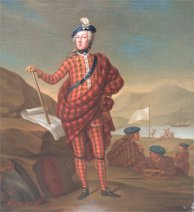
glenfinnan charlie
This week sees the return of the historically significant Glenfinnan Stone to Scotland. It is a round, weatherworn stone, about 12 inches in diameter, with a hole carved out at its centre, supposedly for the purpose of supporting the standard carried by Bonnie Prince Charlie when he arived at the shores of Loch Shiel. This event marks the beginning of the Jacobite Rebellion in 1745.
In 1988 an inscription was found on a flat rock near the original site of the stone which read “1745. In the name of the Lord the standards of Charles Edward Stuart, triumphaning at last, were set up”.
In 1989 however, the stone mysteriously vanished without a trace until recently when a local historian, Iain Thornber was contacted by a member of the public. She had watched a documentary which featured a piece on the Stone’s disappearance, and recognised it as a stone that was sitting in her garden. She had been given it as a gift many years ago and didn’t realise its significance.
As a piece of history, its return will rank alongside the Stone of Scone in terms of cultural significance, and after being displayed at the West Highland Museum in Fort William, it will be returned to its original home.
The post Glenfinnan Stone found at last appeared first on ScotClans | Scottish Clans.
]]>