The post Greyfriars’ Bobby and Bum the Dog! appeared first on ScotClans | Scottish Clans.
]]>Edinburgh has the tale of Greyfriars’ Bobby and San Diego has the story of Bum the dog, who for a homeless dog became something of a celebrity, loved by all in his hometown, much like our very own Bobby. When the two cities twinned in 1977, they each presented the other with a statue of these loveable dogs.

This statue of Bum the dog is found in Princes Street Gardens, alongside the following plaque…

San Diego has the original statue of Bum alongside a replica of Edinburgh’s Bobby statue…

Which includes a plaque explain more about Bum…
The love and loyalty of both legendary dogs forever joins San Diego and Edinburgh as sister cities.
The post Greyfriars’ Bobby and Bum the Dog! appeared first on ScotClans | Scottish Clans.
]]>The post Amazing Facts About Scottish Lochs! appeared first on ScotClans | Scottish Clans.
]]>
The post Amazing Facts About Scottish Lochs! appeared first on ScotClans | Scottish Clans.
]]>The post The Flower of Scotland! appeared first on ScotClans | Scottish Clans.
]]>
The thistle is the national flower of Scotland, much like the rose is the national flower of England and the United States. Today we’re going to look at two interesting things about this flower, the tale as to why it became the national flower and also the unofficial national anthem it inspired.

There are several different legends that tell how the thistle became Scotland’s symbol, but most date from the reign of Alexander III and in particular the events surrounding the Battle of Largs in 1263.
It is often forgotten, that for hundreds of years much of Scotland was part of the Kingdom of Norway. By 1263 however, Norway seems to have had little interest in their former territory. That was until King Alexander III proposed to buy back the Western Isles and Kintyre from the Norse King Haakon IV. The thought of relieving King Alexander of some of his riches and territories appears to have re-kindled Norse interest in Scotland.
Late in the summer of 1263 King Haakon of Norway, now intent on conquering the Scots, set off with a sizeable fleet of  longships for the Scottish coast. Gales and fierce storms forced some of the ships onto the beach at Largs in Ayrshire, and a Norwegian force was landed.
Legend has it that at some point during the invasion the Norsemen tried to surprise the sleeping Scottish Clansmen. In order to move more stealthily under the cover of darkness the Norsemen removed their footwear. But as they crept barefoot they came across an area of ground covered in thistles and one of Haakon’s men unfortunately stood on one and shrieked out in pain, thus alerting the Clansmen to the advancing Norsemen.
His shout warned the Scots who defeated the Norsemen at the Battle of Largs, thus saving Scotland from invasion. The important role that the thistle had played was recognised and so was chosen as Scotland’s national emblem.

‘Flower of Scotland’ is considered the unofficial national anthem of Scotland.
 There are several other songs that have been considered to be the unofficial national anthem of Scotland including; Scots Wha Hae, Scotland the Brave and the more recent Highland Cathedral. Although in July 2006, the Royal Scottish National Orchestra conducted an online poll in which voters could choose a national anthem from one of five candidates.10,000 people took part in the poll in which Flower of Scotland came out the winner.
The lyrics were written by Roy Williamson (1936-90) and the song was performed initially by The Corries, a Scottish folk band, and refers to the victory of the Scots, led by Robert the Bruce, over England’s Edward II at the Battle of Bannockburn in 1314. The music is actually somewhat older, and was composed by Peter Dodds McCormick (c1834-1916) who emigrated to Australia as a young man, and also composed the National Anthem of Australia, “Advance Australia Fair”.
The song is also known as Flùr Na H-Alba” in Scottish Gaelic, and “Flouer O Scotland” in Scots.
The title has also been used for a history book: The Flower Of Scotland: A History Of Scottish Monarchy by James J.  Sharp, and for the biography of Roy Williamson, which was published by his daughter Karen in 1993.
There also exists a Flower of Scotland tartan which was created in the early 90′s to honour the late Roy Williamson. The design is based on the setting and thread count of the Gunn tartan, as worn by Roy Williamson, using the traditional 18th-century colours of Lichen Green and Lochan Blue although it has no Clan or family affiliation and therefore is available for all to wear.
Thistle Products from ScotClans…


The post The Flower of Scotland! appeared first on ScotClans | Scottish Clans.
]]>The post Painting the Peats – Damian Callan appeared first on ScotClans | Scottish Clans.
]]>
Painting the Peats is a project that began when artist Damian Callan and his family started helping crofter Chris Spears stack his peats at his peat bank on North Uist. The experience led to a series of ink and wash studies that combined groups of working figures in the Hebridean landscape and were developed into oil paintings.
This week the artist will return to the islands to coincide with the cutting of next year’s peats in order to observe, draw and photograph the crofter at work. There will also be the opportunity to include the crofter’s Saturday shift as the local postman.
During the month of August the artist will be based on the island of Berneray where he will develop this new work in his ‘Painting the Peats’ studio which will be open to visitors who are interested in observing the process and who would like the opportunity to look at work in progress.
The trip to Berneray/North Uist will be documented as a blog: www.damiancallan.com/blog/Cutting the Peat


The post Painting the Peats – Damian Callan appeared first on ScotClans | Scottish Clans.
]]>The post The Northern Lights and The Merry Dancers appeared first on ScotClans | Scottish Clans.
]]>
Brian Doyle captured the kaleidoscope of colours over Stonehaven in Aberdeenshire

Northern Lights Moncreiffe Hill Perth Perthshire Scotland by tourscotland – 2016-02-01
Tim Peake up in the international space station also watched them.

The northern lights are also known as ‘Aurora borealis’ and the southern lights as ‘Aurora australis.’ In Roman mythology Aurora was the goddess of the dawn, so Aurora borealis means ‘dawn of the north,’ and Aurora australis means dawn of the south.
They are nature’s very own theatrical performance, very beautiful and awe-inspiring and at the same time mysterious and even frightening. Many different cultural and ethnic groups who lived in places where they are seen have developed many myths and legends to try and explain and make meaning of them in their own terms.

The Northern Lights feature prominently in norse mythology, they were believed to be the reflections of the shields of the Valkyries racing across the sky on their way to their resting place, Valhalla.
A spirit is often seen as coloured light rising from the body. The Cree Indians held that the Aurora was part of life’s circle and were the spirits of the dead who remained in the sky but apart from their loved ones. The Cree believed that the lights were spirits of these departed friends and relatives trying to communicate with those they had left behind on earth.
They were also seen as an omen, weeks before the French revolution broke out dramatic red northern lights were seen in Scotland and England, and people reported of having heard and seen massive armies fighting across the skies.
Some cultures see them as good luck. The Aurora Borealis have also been linked to fertility and childbirth, and in Chinese and Japanese cultures it is still believed that a child conceived under the northern lights will be blessed with good fortunes.
In old Icelandic folklore it was also believed that northern lights would ease the pain of childbirth. At the same time though, they believed that pregnant women looking at the Aurora would have cross eyed children.
There are some interesting beliefs of what you shouldn’t do during the lights:
The most widely known ´no-no´in the North is to avoid waving, singing or whistling at the northern lights. People used to believe that the spirits would come down and take you away. Many Sami people would keep their families and children indoors during the display, or if they were outside they would cover up and try to hide from the rays.
The Northern Lights in Scotland – The Nimble Men
In Scottish Gaelic folklore the Northern Lights are known as the Na Fir Chlis – “the Nimble Men” (or also known as the merry dancers).
In Northern Scotland and on Orkney and Shetland some still call the Northern lights ‘The Merry Dancers’. The Scottish names or the Northern Lights suggest moving forms. As one folk song relates: ‘She called them the heavily dancers, merry dancers in the sky’.(The Northern Lights of Old Aberdeen).
There is an old Scottish proverb which goes:
‘When the mirrie dancers play, they are like to slay’
The Lights were described as epic fights among sky warriors or fallen angels. Blood from the wounded fell to earth and spotted the “bloodstones” or heliotrope found in the Hebrides.
 There is an old story, a young boy goes out fishing and falls asleep in his boat. He wakes to see giants dancing around a great bonfire. But then he realises they are not dancing but fighting and his boat is adrift on a pool of blood. Returning to shore , he finds he has been gifted with second sight. The blood undoubtedly refers to the scarlet aurora that appears during particularly intense solar storms.
In another story, the Fir Chlis take part in a war called ‘an linne fhuil’ or ‘pool of blood’ and the local red and green ‘bloodstones’ were believed to be drops fallen from the sky warriors. In this way people drew features of their landscape into the story of the aurora and made its spectacle both supernatural and familiar.
The post The Northern Lights and The Merry Dancers appeared first on ScotClans | Scottish Clans.
]]>The post Behind the Anglo Norman Veil: A holiday message about Gaelic vernacular economics appeared first on ScotClans | Scottish Clans.
]]> One of the things that discourages individuals from recognizing and exploring, not to mention enjoying, their Scottish Gaelic heritage is the widespread view that the only distinct aspect of Gaelic culture was, and is, its Celtic language. Many people consciously and unconsciously are assured that beyond “Ceud Mile Failte” and “Slainte”, Gaelic culture is basically little different from, well, Scottish culture, and that Gaelic culture’s few fundamental distinctions are well represented in today’s Tartan melting pot. That was my view prior to a more detailed exploration, from the Gaelic perspective instead of the more popular and traditional Scottish perspective. I found that I was so wrong, and very happily so, because I have found, instead, an incredible treasure chest of Gaelic heritage.
Gaelic Scotland faced the world from a fundamentally different angle than did the Normans or the Anglo Saxons. The differences were especially apparent prior to the wide scale erosion of Gaelic-ness that began following launch of James I’s official fatwa against Gaelic culture in the 17th century. Gaelic was not just a bits and pieces society, but rather, a well developed culture with a future:
Indeed, politics, economy, marriage, kinship, possession of land and of property, were all woven together into an inextricable web in Highland society, to produce a culture which was both dynamic and self-perpetuating.
– Rosemary Ommer, Journal of Historical Geography (1986)
This broad distinct Gaelic identity is what makes Scottish Gaelic its own culture and ethnicity, worthy of separate study and understanding.
How do you say “Its the Economy Stupid!” in Gaelic? So here we are in these end of 2015 days that are so liberally seasoned with holidays of various sorts. Economics might seem to be an odd choice for a discussion topic for a holiday Gaelic post, but, as Gaels we should know by now that not everything is as it first appears to be. True here. For history’s Gaels, the economy was a child of Gaelic morals and spirituality.
Profit and Love. As we finally begin to work through this year’s celebrations, we are hit with a barrage of two primary ideas: Capitalism and Love. Across much of the world, those two seemingly disparate ideas are melded easily together at this time of year because Capitalism is based upon the idea of production and sale of surplus goods and services for personal profit while Western expressions of Love are best made by buying great stuff and giving it to those that you … love.
It’s almost magical in its elegance but this western European enlightenment approach has left many people unsatisfied with life, despite apparently having played the game in the correct manner all these years and by the rules. Depending upon which news channel one watches, the idea of runaway capitalism and the decline of community can dominate entire newscasts. Many people are looking for the right way forward but not enough of them are looking to the past for some direction.
So, for a moment, lets peek behind Scotland’s Anglo-Norman veil and take a look at the very different approach taken by Gaelic society regarding “the economy.”
Subsistence and Community. One of the things that some have loved to call “barbaric” about Scottish Gaels was their habit of maintaining a sustainable, subsistence economy. Although we have been taught that such an economy is a strong indicator of great poverty and oppression, Gaels did it as a strategy that was directly adapted to the land upon which they lived and the resources at their disposal. Individuals in Gaelic communities produced almost everything they needed. They did not, on the whole, produce surplus for cash trade outside of the community.
A clan’s wealth ultimately depended upon the amount of productive territory under its control, but productivity was measured in terms of social value rather than surplus for export.
– Michael Newton, Warriors of the Word (2009) at p.141
Yes, good years did produce surplus but the Scottish Gael didn’t just stand there in the middle of his field and marvel at all the potatoes. As a matter of Gaelic policy and practice, surplus was distributed to those in the community who needed it. And this was not done as capitalism disguised as social enterprise. Sharing was a critical pillar of Gaelic economics.
Writing of his own 20th century experience as a youth fishing for his family and “the neighbours” on Lewis/Harris, Alastair McIntosh reveals some of the last agonal breaths of what he calls “Gaelic vernacular economy.” In the 1960s, few households owned freezers or even refrigerators and the reason had little to do with the nasty Hebridean weather.
Whenever I came back with a good catch, I’d share it out as I cycled home the 5 miles through Ranish, Crossbost and Leurbost villages. This was the late 1960s and even then few people had fridges; still fewer freezers. There was just no demand for them. Neither was there money to buy such hardware. If you had a supply of something perishable, you shared. When your neighbours had a surplus, you received. People’s ‘deep freezes’ were, in effect, the village itself – with the advantage that what you got was always fresh and there was no need for nuclear power stations or defrost disaster insurance policies.
– Alastair McIntosh, Soil and Soul (2001) at p.28
In Soil and Soul, McIntosh uses a term taken from social thinker Ivan Illich to describe traditional Gaelic economy. In the Hebridean vernacular economy that dominated Lewis/Harris in those days, “people understood themselves to be responsible for one another.” (Soil and Soul at p.29) McIntosh has packaged the idea of a Gaelic vernacular economy into three traditional concepts – mutuality, reciprocity and exchange (barter) – and one introduced idea – cash.
In the twentieth century Lewis underwent an economic transition such as more ‘developed’ parts of the world had experienced much earlier in history. The island shifted along the spectrum of mutuality, reciprocity and exchange, headlong into the cash economy. Once surpluses were shared and this yielded goodwill. Mutual dependency was the glue that facilitated social cohesion. Now, because money (unlike fish and eggs) does not rot, it can be invested, yielding interest, a dividend or capital gains. Money thereby takes on second-order characteristics over and above its primary accounting role; it makes money out of itself. This has the effect of shifting benefit away from the community and towards individuals. It assists the concentration of wealth, and that leads to an increasing rigidity in access to resources for the majority.
Whereas the vernacular economy is necessarily mindful of the human biological processes by which goods and services come into being, the new way – capitalism – reduces human labour and nature’s providence to figures on the London or Tokyo stock exchanges.
– Alastair McIntosh, Soil and Soul (2001) at pp. 30 – 31
So as not to unnecessarily cause heartburn for our many Capitalist friends, while this wee post does identify a traditional Gaelic approach to an enduring human subject, it does not argue the merits of the past versus the present. However, like my far more talented kinsman Alastair McIntosh, I believe that the past “should be carried forward to inform the future. In this way, fresh light can be shed on the story of modern times and wisdom harnessed to knowledge.” Like Alastair, we should all recognize the tremendous value in not only saving our access to Gaelic cultural wisdom and experience but in exploring, learning, understanding and applying it to this rather prickly period of human history. We might find a few helpful ideas.
The post Behind the Anglo Norman Veil: A holiday message about Gaelic vernacular economics appeared first on ScotClans | Scottish Clans.
]]>The post Getting comfortable with Gaelic’s indigenous side – a few things to consider appeared first on ScotClans | Scottish Clans.
]]>Some of the advantages that accompany engagement with one’s Gaelic heritage are the wonderful and useful bits of relevance that a Gaelic past brings to modern life. That’s right. Lessons learned from a Gaelic perspective can be productively relevant to difficult problems we face today. Consider the following:
- Gaelic tradition introduces community oriented and inclusive perspective in an increasingly exclusive and inward looking modern world.
- Study of Gaelic culture encourages appreciation of diversity and an open, curious nature in a world with growing numbers of closed minds and an intolerant outlook.
- Gaelic tradition recognizes and celebrates the fact that humans are an integral part of the “natural” world and because we depend upon it for a vast array of values, we should pay very close attention to its health.
There is little question that Scottish Gaelic identity remains distinct from other cultures existing within the UK and Scotland. Certainly it bears a distinct history and tradition. To some observers, Gaelic distinctiveness shows most clearly through Gaelic society’s indigenous characteristics and experience and its historical existence within a larger not-very-indigenous dominant culture.
From the perspective of some in the Gaelic Diaspora, these indigenous characteristics of Gaelic tradition are of great interest. They allow us to begin to place our Gaelic heritage more closely and honestly within the histories of our own nations. Approaching Gaelic history and culture from an indigenous perspective opens windows and invites wonderful discussion.
But before diving too deeply into discussion of particular aspects of indigenousness, it is worth taking a moment to understand what it is, exactly, that links indigenous peoples’ experiences across the world, today and in their respective histories. What is an indigenous culture? It does not necessarily mean the first or only humans to set foot on certain soil.
The United Nations 2007 Declaration on the Rights of Indigenous Peoples includes this description:
Peoples … are regarded as indigenous on account of their descent from the populations which inhabited the country, or a geographical region to which the country belongs, at the time of conquest or colonization, who retain some or all of their own social, economic, cultural and political institutions.
Further guidance from the United Nations:
Considering the diversity of indigenous peoples, an official definition of “indigenous” has not been adopted by any UN-system body. Instead the system has developed a modern understanding of this term based on the following:
- Self-identification as indigenous peoples at the individual level and accepted by the community as their member.
- Historical continuity with pre-colonial and/or pre-settler societies
- Strong link to territories and surrounding natural resources
- Distinct social, economic or political systems
- Distinct language, culture and beliefs
- Form non-dominant groups of society
- Resolve to maintain and reproduce their ancestral environments and systems as distinctive peoples and communities.
You can read more about what the United Nations has to say about indigenous people and characteristics here.
A Few Things To Consider. Regarding consideration of Scottish Gaelic as an indigenous culture, here are five things – from a Diaspora perspective - that might be worth keeping in mind:
1. Gaelic Culture Is Not Just About Language and DNA. Although language and DNA can be seen as the entire shelf rather than just useful bookends, Gaelic identity is about so much more than language and DNA. In the void existing between those two things one finds all the rest of culture, socio-political institutions and spiritual outlook and learning, and basic life ways. Much of that has already been swept away in prior Scottish de-Gaelicicization efforts. What remains is threatened. Ultimately, however, these kinds of cultural markers are the things that remain of interest and about which we are still learning and trying to reclaim. Language is an incredibly important and enlightening element of culture but not the only one. It is important in its own right and for what it tells us about its mother culture. Language is also the key that opens the treasure chest of Gaelic historical perspective. If you cannot understand what Gaels have said in their own language – through your own study or by accessing some other reliable study – you cannot understand all of what you need to understand. Nevertheless, although language is the key tool, the ultimate prize is deeper cultural understanding.
2. Indigenous Does Not Mean Isolated. Indigenous cultures are not necessarily genetically pure or isolated from the outside world and from the additive cultural influence that warfare, trade and social interaction bring. Gaelic culture has enjoyed immigrant and trade influence as has almost every human culture and society including many indigenous ones. Pictish and Norse and Welsh and Irish influences make Gaelic a very rich and diverse culture today – but the admixture is still called Gaelic and diverse cultural influences do not necessarily argue against indigeneity nor do they make recognition of Gaelic less important.
3. “There can be only one.” NOT. Indigenousness is not a geopolitically exclusive status. Recognition of one culture as an indigenous culture does not mean that it has claimed exclusive right to that status throughout, in this case, Scotland and the UK. The many coexistent indigenous cultures in the US provide good examples, as does the history of North Britain itself to a certain extent. Fear of wiping out recognition of, or interest in the people that pre-dated and co-existed with the Gaels is unsupported. There is nothing about the idea of a recognized indigenous Gaelic culture that should lead to such an outcome. That, however, leads to the next really important thing to remember about indigenousness.
4. It’s Alive!!!! Indigenousness is, primarily, an element of a living global cultural structure that is actively and physically present today. Discussion of indigeneity is firmly hooked to living people and their contemporary lives. As demonstrated by the UN resources quoted above, whether there exists a logical basis for a culture to self-determine its own indigenous status is typically measured by historic continuity and status of living people. Reasonable claims to real rights are involved and so the determination is an important one not made lightly.
It is certainly wonderful news that some cultures that had gone missing from contemporary Earth have been successfully revitalized in recent years and even reclaimed from “sleeping beauty” status. Check out this great article on language (cultural) revival and video about the experience of the Barngarla people in Australia. These movements are difficult and sincere and they often demonstrate best how much is lost when a culture and society are thoroughly and intentionally suppressed as well as what amazing things can be achieved by people today who work to bring them back.
5. “I’m Gaelic, We Suck” Said Nobody Ever. Erosion and Anglicization of Gaelic culture and society did not happen without the need for consistent episodes of severe repression applied by various non-Gaelic kings over the course of several centuries to force ethnically stubborn Gaels to accept Anglo/Scottish incentives – or to leave Scotland. Near loss of Scottish Gaelic culture has not been an accident of history. In the largest of all nutshells, Gaelic culture and society have been specifically targeted for eradication and if not that, then severe containment. Gaelic society has been historically perceived by most Anglo, (non-Gaelic or anti-Gaelic) Scottish, and many American observers as barbaric, savage, uncivilized, backward, etc. Thus, under the general guise of “civilizing” the uncivilized, national policies have openly attempted to rid Scotland and America of significant and meaningful Gaelic influence. Culture-killing policies and projects have been clothed as beneficent reform and improvement. Such has been the imperial pattern across the globe. Did you watch that video linked above? You should. Gaelic culture, like many others, survives today because it has proven extremely stubborn in the face of centuries of repression.
In the event. Clearly, the Scottish Gaelic indigenous experience was broadly similar to other indigenous experience, but also different in a few stand-out ways. Scottish Gaels were some of the very earliest victims of the invasive Anglo influence flowing up from the south. Gaels are also closer geographically to England than indigenous people on other continents. Perhaps more interestingly than all of this, however, is the fact that Gaels look like the Europeans that they are and that makes the Gaelic indigenous experience its own. Gaels aren’t the only white indigenous people on the planet, but there aren’t all that many left.
Light skin and European features did not automatically provide keys to Anglo respect for Scottish Gaels. Nevertheless, those European physical traits did place Scottish and Irish Gaels in a peculiar posture as far as Anglo imperial victims generally go. Anglicized Gaels could be more readily and somewhat more deeply accepted by Anglos than were Anglicized dark skinned aboriginal peoples. Yet there is no evidence that suggests that giving up an ancient culture and way of life, pulling up roots and leaving a homeland under varying levels of duress was always easier or created less loss for Gaels than for other victims of similar cultural pressure elsewhere in the British empire.
There are many great reasons why it makes sense to examine Gaelic culture with an indigenous lens. In the end, it may be impossible for some people to attach the label “indigenous” to Scotland’s last remaining distinctly pre-Anglo culture. If so, at the least take a moment to appreciate the great variety of experiences and cultural characteristics that Scottish Gaelic culture shares with those people across the globe who have chosen to join the indigenous family.
One important indigenous marker has to do with the question of how humanity understands itself relative to the non-human world and how humans interact with that world. Questions such as whether we will continue to fuel extreme climate instability and how we adapt to climate changes that we fail to avoid are perfect opportunities to consider and integrate indigenous ideas. There are a growing number of people on the planet who recognize great personal and global value and potential in indigenous ideas and approaches to the world and are therefore keen to understand them more completely. Scottish Gaelic offers opportunity in this regard.
Speaking of land, heritage and indigenous souls, a far better McIntosh than I, Alastair McIntosh, along with a handful of other scholars in Scotland and North America, have been forging new ideas on the topic of Gaelic relationships with landscape. Especially through interdisciplinary insight and understanding offered by Alastair McIntosh’s climate and human ecology perspective, exploration of traditional Gaelic relationships to land and other “indigenous” Gaelic qualities has already contributed not just to the interests of Gaelic heritage but to humanity’s better understanding of itself and the planet.
More on this topic coming. In the meanwhile, some really great reading:
Soil and Soul: People Versus Corporate Power by Alastair McIntosh (2004)
Warriors Of The Word: The World Of Scottish Highlanders by Michael Newton (2009)
On The Other Side Of Sorrow: Nature And People In The Scottish Highlands by Jim Hunter (1996)
White People, Indians And Highlanders: Tribal People and Colonial Encounters In Scotland And America by Colin Calloway (2010)
The post Getting comfortable with Gaelic’s indigenous side – a few things to consider appeared first on ScotClans | Scottish Clans.
]]>The post The Status Of Fracking In Scotland appeared first on ScotClans | Scottish Clans.
]]> It just came to my attention that last night Earth experienced an earthquake just down the road from my home in Colorado. This quake measured 4.2 on the Richter scale and the likely cause of the shake is the practice of hydraulically (using water) fracturing the rock deep in the earth to facilitate collection and removal of various forms of natural gas. Everyone calls it “fracking” and it is a very hot topic all across America. The largest ever recorded earthquake in Colorado occurred in 2011 at 5.7 on the scale and is now acknowledged to have been caused by fracking. It’s happening more often.
Many environmentalists and those who claim to have been adversely affected by past fracking are aggressively on the attack warning of an array of environmental disasters that await the fracking society. The chemicals used are toxic, the water use is extremely high and the overall specter of increasing carbon based climate change makes large investments in gas recovery via hydraulic fracturing a bad bet they say. Then there are the earthquakes. Meanwhile fracking proponents see the potential for big boosts to local drilling economies, a more stable and secure energy resource for the nation and of course big profits for the extended oil and gas industry.
 Fracking is a Scottish problem too.
So which side is right? It turns out that people are asking this very same question around the globe, including in Scotland right now. Industry wants to frack Scotland and they have said so. Licenses for drilling have been issued. Responding to a very vocal anti-fracking grassroots lobby, last January the Scottish Government announced an indefinite ban on fracking in Scotland. We also know that Scottish First Minister and Deputy First Minister met with the big frackers, particularly the oil and gas company Ineos, on the very day that the Scottish moratorium was announced. Ineos sees big profits in fracking Scotland and they have not been shy about that. The fracking ban in Scotland is likely to last only so long as it takes for a national debate to occur and then the matter will be back on the table.
 England’s Frack-O-Rama.
Presently south of the border in England its a frack-a-thon as David Cameron just opened up an additional approximately 1,000 square miles to the opportunity for drilling and a plan to fast track industry applications. The oil and gas industry has plenty to do in England presently to hold them over during the dry spell in Scotland.
 You might be a bit concerned about where your own clan or family ancestral lands fit into Scotland’s terrestrial fossil fuel plans. Check out this cool interactive map to discover if your ancestral clan or family lands are in danger of disturbance from this extreme and extremely controversial energy practice.
A Poll! A Poll!
So how about a wee ScotClans family poll? If you have an opinion sound off with a comment below. Where do you stand on the question of Scottish fracking? “Frack Free” or “Drill Baby Drill”? Should Scotland keep the Fracking Ban or ditch it? Does it worry you in terms of ancestral lands? Do you think that Scotland is missing out on an economic windfall if it decides to ban fracking for good? Join the discussion as we follow along with a very important issue for our ancestral homeland.
The post The Status Of Fracking In Scotland appeared first on ScotClans | Scottish Clans.
]]>The post Scotland’s Most Inspiring Places: A Personal View appeared first on ScotClans | Scottish Clans.
]]>1. Skye: The Trotternish Peninsula.
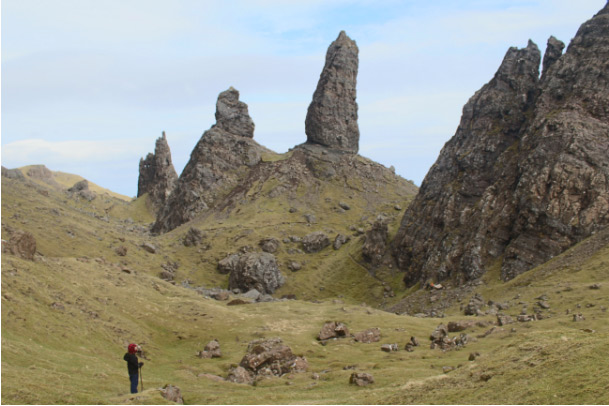
The Old Man of Storr
The Island of Skye is nearly always on peoples ‘bucket list’ and with good reason. The island is very large with so many different things to see its hard to know where to start. Dominated by the brooding ‘Black Cuillins’ a ragged mountain range that sits in its centre the island fans out to a number of peninsulas. All of them have spectacular views and hidden gems to explore but our favourite is the Trotternish peninsula.
Travelling north beyond Portree; the island’s main town a strange jagged ridge comes into view, this ridge features the Old Man of Storr, a giant rock tower that sits at an impossible angle near the rugged Storr cliffs. Further up the Quiraing extends the ridge line, the remnants of an ancient landslide of epic proportions. Walking through this area is like entering another world, the complexity of the landscape and broad vistas as you reach the ridge tops is quite simply astonishing.
What else is like this: In many ways it reminds me of Hadrian’s Wall (yes I know thats in England). Also the sea stacks of Orkney.
2. Glencoe and Rannoch Moor.
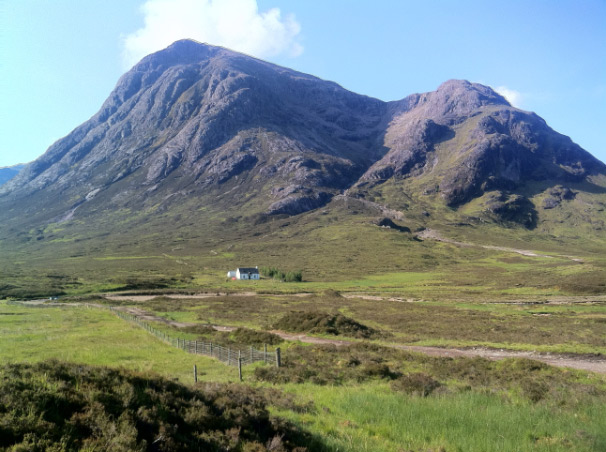
Glencoe
It would be impossible and indeed unforgivable to not include Glencoe in this list but I would extend it a little south to cover Rannoch Moor, an extraordinary landscape of bogland and small lochans that signal your approach to the glen as you venture north. The main road seems to float over the landscape and its hard not to find yourself trying to imagine what it must have felt like in the days before Thomas Telford build the first metalled road here as people picked their way through the moor. It must hold many dark secrets.
Then there is Glencoe. The majestic Buchaille Etive Mor stands guard at the entrance to the glen with her sister peaks lined up beside her, on the other side the Aonach Eagach ridge, the narrowest and most exposed ridge in Britain is a place not for the feint hearted. Handy parking places are scattered along the length of the glen, nearly always packed with tour busses and the odd bagpiper raking in the cash. The real rewards though, come when you take a step or two away from these busy lay byes and out into the glen itself. Despite its fearsome reputation in winter Glencoe has meny less challenging low level walks that get you away from the crowds and give you the space to contemplate life before the ‘quieting of the highlands’ and the tragic events that have been so linked to this place forever more. Caution and a sensible attitude (and footwear) of course goes without staying, this is a wild place that can claim lives in any season.
What else is like this: Scotland has many deep glens like Glencoe though few are so well known. Glenshiel with it towering 5 sisters comes to mind or for a more scaled down version Mennock and Enterkin passes in Dumfriesshire feels like a lowland rural equivalent.
3. The Border Abbeys
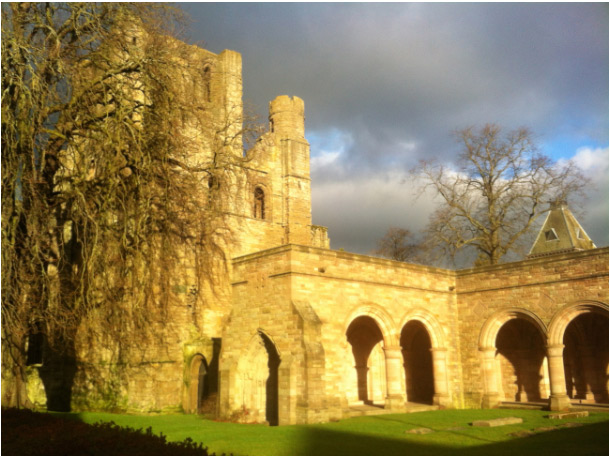
Kelso Abbey
The cluster of small border towns that nestle in the south east part of the Scottish borders feature a ring of magnificent ruined abbeys. In their heyday Monks from the Tironesian, Augustinian, Premonstratensian and Cistercian orders occupied these impressive buildings which became centres of learning and sat at the centre of many small communities. Inevitably though, sitting as they do in the heart of the sometimes lawless border region and with neighbouring England a few hours ride away the abbeys were partly destroyed, much of the damage being done during the ‘Rough wooing’ of King Henry VIII of England.
The violence of that time has long gone now and what is left of the abbeys are preserved as they were left all those centuries ago. Each has its own character and are peaceful places where you can sneak away from a busy market day and try to imagine the sounds of morning prayers being offered up in an echoing chapel.
For people of a fitter disposition it is possible to follow a 5 day walking route that takes in these wonderful buildings. The walk is not too challenging and gives you even more opportunity to explore this often missed part of Scotland.
What else is like this: Our own Holyrood Abbey in Edinburgh of course, Iona (featuring shortly) and Linlithgow Palace certainly have a similar feel in many ways.
4. Arisaig
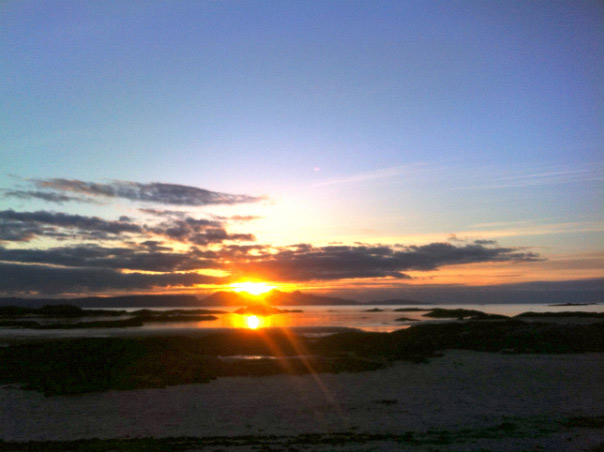
Arisiag at Sunset
As you take the route north to venture into the North West Highlands you hit the town of Fort William, spreading near the foot of Ben Nevis this busy town is an inevitable stop off for a quick snack and a stretch of the legs. Most travellers continue to the north towards Skye and Loch ness but just taking a left turn will lead you on a journey that rewards you with fantastic beaches, scenes from Harry Potter and romantic tales of Bonnie Prince Charlie. This road which was once a twisting and perilous single track is much improved, it takes in the Jacobite monument at Glenfinnan and an added bonus of a view from there of the Glenfinnan Viaduct a victorian marvel of railway engineering that will now forever be known as ‘the Harry Potter Bridge’. If you are very lucky you might catch the steam train that regularly travels this way on tourist trips puffing over the viaduct.
This was where the ‘Young Pretender’ (not the young wizard) first landed on the Scottish mainland in 1745, raised his standard and forever changed the covers of shortbread tins and tea towels, just a few minutes drive away loch Nan Uamh is where he set sail back to Europe a year later, his followers scattered in the highlands or buried in the mass graves at Culloden.
At the small village of Arisaig is what could only be described as a camper’s paradise, a collection of campsites sit along this stretch of coast set into grassy areas beside beaches with impossibly white sand. Its hard to compete with the feeling of settling down to a mug of tea or something stronger watching the waves on the shore as the sun sets over the islands of Rhum and Eigg. A sunset in Arisaig is not just a sunset, its gods own theatre, and he knows how to put on a good show!
For those who want to venture further though this route has one last gift to give, the Malliag ferry to Skye. An altogether gentler and more dignified way to reach our first destination on the list. As the ferry pulls out of Malliag harbour its inevitable that you catch yourself humming the Skye Boat Song to yourself.
What else is like this: The west coast and in particular the islands have incredible beaches, Tiree for example or Durness in the far north, The small island of Eriskay has the connection with Bonnie Prince Charlie too as of course does Culloden.
5. South Uist
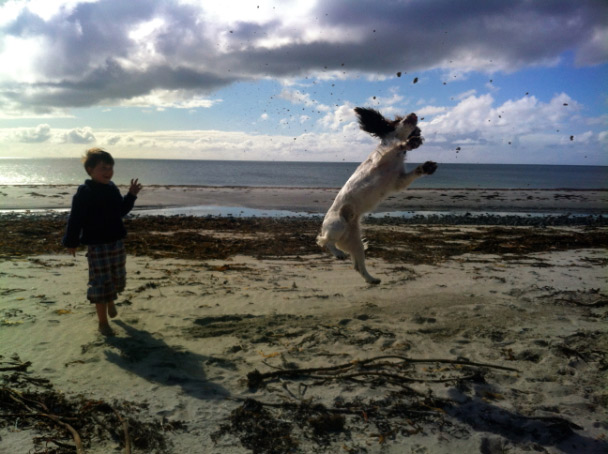
Happy Dog on South Uist!
The island of South Uist forms part of the Outer Hebrides (more of them to feature later). The island stretches from north to south linked by causeways to Benbecula and Eriskay. A modest range of low mountain peaks run like a spine down its east side and to the west is the legendary Machair. The Machair is a low lying coastal plain, formed by millennia of wind blown, calcium rich sand that forms a valuable fertile layer. The habitat is the fragile home to many species of birds and small crofting communities are scattered along the island’s east side.
There is something about the light here that feels like nowhere else on earth. There always seems to be some drama in the sky as another raincloud skids in over the Atlantic to the sound of oystercatchers and gulls.
This is an ancient place too – Settlers have been here since neolithic times and this is the only location in Britain where prehistoric mummies have been found. Looking at the ramshackle collection of little crofts you are reminded that now just as then the people who live here have a relationship with the land and pace of life that many of us would envy (in the summer at least).
What else is like this: Orkney and Shetland certainly have that feel of a link with the prehistoric past though the Machair is peculiar to the Outer Hebrides. also Barra and Vatersay just to the south and further on, the islands of Islay and Jura.
6. St Kilda
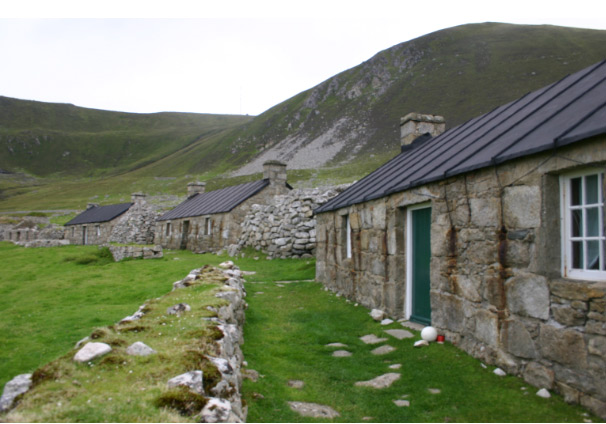
St Kilda
On 29 August 1930, 36 men women and children boarded a boat to the mainland from the island of St Kilda. Breaking a continuous period of settlement that had stretched back over two thousand years. These people were not evicted by harsh landlords, they had asked to be taken away to start a new life elsewhere. For them life in the most remote part of the British Isles had simply become too difficult.
Remote is too simple a word for St Kilda, just getting here is an adventure, and something of a hit and miss affair as the journey over rough seas is not always possible at all. Arriving at the small bay on Hirta, the main island in this small group is like arriving at the edge of the world, the deafening sounds of Gannets, Fulmars and Skuas fills the air and the island itself seems to rise out of the sea to meet you, one second there, one second disappearing as the boat lurches between the waves. As you step onto the shore you step back in time to the moment those last settlers left the island behind. The village street still stands as if trapped in amber, the remains of centuries of island life lie scattered up the hill side.
If you want to come to Scotland and get the feeling of being totally alone try spending a few days here with just the mice for company (and the army personnel who man a nearby base but thankfully never leave their quarters). There is a peculiar feeling to standing on the shore watching the tiny boat head back out into the open sea wondering if it really will be ‘back on Wednesday’ as promised.
Where else is like this: The Monach Islands off the coast of Uist were also until lately inhabited and North Rona is another remote destination. There are also a number of clearance villages such as Bororaig in skye and near Tongue in Sutherland.
7. The Isle of Lewis.
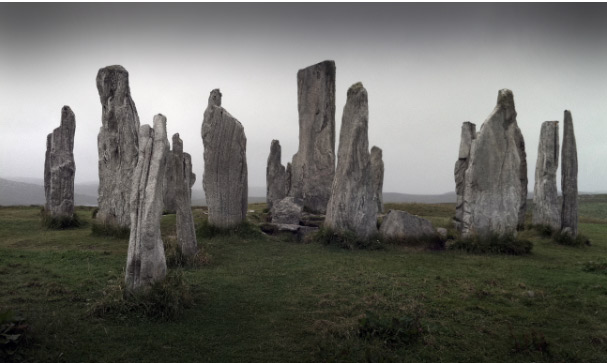
Callanish Standing Stones – Lewis
A few years ago I was on a flight back from Iceland on a clear summer evening. The flight path took us over the Butt of Lewis and as first sights of ‘home’ go, its about as good as it gets (also see entry number 10). Lewis has become a popular destination recently thanks to Peter May’s ‘Black House’ trilogy of books, May’s infectious description of the landscape has also inspired an excellent coffee table photography book. A trip to Lewis inevitably begins with the long ferry journey from Ullapool to Stornoway, passing by the Summer Isles, the setting for the classic British horror movie ‘The Wicker Man. Stornoway is a bustling small town that has a bit of a frontier feel about it, its a bit rough round the edges and can be a bit wild of a Saturday night before the ‘sabbath’ calls a halt to all activity. But before you disappear off to explore the island, stop off at MacLeod’s Butchers and stock up on as much Black Pudding as you can sensibly carry.
The stand out feature of Lewis is the standing stones at Callanish. For nearly 5,000 years these remarkable stones have stood here. Academics still argue over their true purpose, partly as a burial site possibly as a calendar no one can really say for certain. Folk tales say that they were a family of giants who refused to convert to Christianity and Saint Kieran turned them to stone as punishment.
Like many parts of the west coast, Lewis has its fair share of incredible coastal landscapes with wide open beaches and stark cliffs. As you travel south from Stornoway towards the mountains of Harris you pass seemingly endless expanses of peat bog, stacks of freshly cut peat stacked up and drying ready for collection. The smell of peat smoke is the air is a reminder once again that this is a place where people work and live not just a toilet stop and cafe.
What else is like this: Again, Orkney springs to mind for its unrivalled collection of ancient artefacts (the only reason Orkney is not on our list is because we have yet to visit there and this is our personal list). Wick and Thurso in Caithness have a similar frontier feel about them that Stornaway does and the wetlands of Caithness and Sutherland are very much like the Interior of Lewis in some ways.
8. Iona
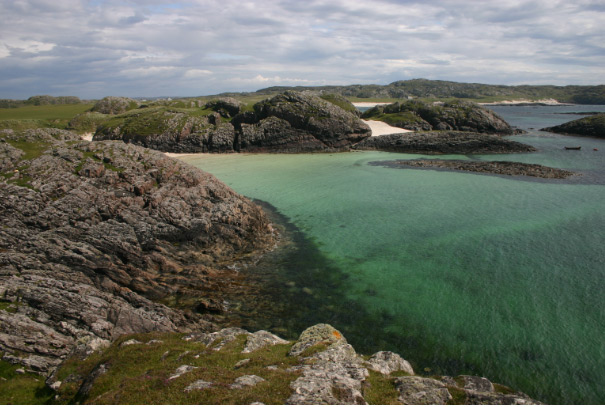
West Coast of Iona
Sometimes the beauty of a place is magnified by the effort it takes to get there. If thats the case then Iona must be one of the most beautiful places on earth! First of all you need to get to the island of Mull, that is either reached via a ferry from Oban or by a couple of smaller ferries and a long drive down towards Ardnamurchan. This is followed by a long drive down the Ross of Mull until you literally ‘run out of island’. From there a small ferry takes mostly foot passengers (theres is not much point in taking the car as theres not really anywhere to drive to) over the short hop to Iona. The famous abbey is immediately visible as you land in the tiny village that sits beside it.
Iona abbey is one of the most famous in Scotland. its by no means the largest and would be dwarfed by the Border abbeys though it is one of the best preserved. St Martins Cross is probably the most photographed and recognisable celtic cross there is and the abbey grounds have more than a few famous interments: Kenneth MacAlpine, Donald II, Malcolm I, Duncan I and Macbeth all lie here, as does the late Labour leader John Smith.
The island is tiny and can be walked round entirely in a day. If you chose to do this there is a good chance you will hardly spot a soul the whole time as pretty much all the tourists flock to the abbey. Their loss is your gain though, the island circuit takes in more sandy beaches on the north shore the rugged west coast with crustal clear waters and small secluded bays, a spouting cave and the remains of an abandoned marble quarry before returning back to the village for a well earned drink while you wait for the ferry back.
What else is like this: Right next to Iona is the small island of Erraid. its tidal so can easily be walked to. There is an incredible campsite at Fidden farm nearby too. Holy isle (in England,,, just) is also very similar and also Inchcolm Abbey in the Forth Estuary.
9. Plockton
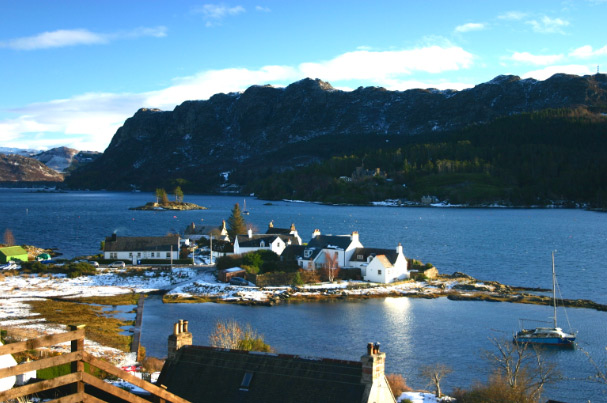
Plockton
The tiny village of Plockton sits at around the same line of latitude as Moscow, yet the little road around the bay is lined with palm trees! These are not made of plastic but thrive here thanks to a phenomena properly known as the Atlantic Conveyor though most of you know it as the Gulf Stream. a current of warmer water that runs North-East from the Gulf of Mexico makes landfall on Scotland’s north west coast leading to a far milder climate than we would expect. Before you pack your bermuda shorts and beach volleyball set though remember this is STILL Scotland.
The small village was a fishing community that sprung up in the 19th and 20th centuries in an attempt to slow down emigration from the highlands. The end result is possibly the most picturesque small village in Scotland. Just like Iona above, getting here is half the fun. There is the long drive skirting within touching distance of the Skye bridge and up the road to the ironically named ‘Stromferry (no ferry)’ , or you can take a more indirect route via Lochcarron, or you can treat yourself to one of the worlds greatest train journeys, travelling north to Inverness and then west via the tiny settlement of Achnasheen through some of the grandest majesty that the highlands can serve up, it might be a long journey but I really wouldn’t bother with a book unless its dark 
For those who like an element of terror on their days out then its not too far from Plockton to the small town of Applecross. The last half hour of your trip will be memorable as you wind up the notorious Bealach na Ba (the pass of the cattle) a single track road that twists steeply up an impossible looking slope before sliding down the other side. On the way back you can reward yourself with an early tea at the excellent seafood cafe at Kishorn, where the seafood is so fresh it answers you back.
What else is like this: Rothsay on the Isle of Bute is also known for its palm trees though its a much larger and busier town. The East Neuk of Fife also has a string of quaint fishing villages and Tobermory on Mull is also very picturesque.
10. Edinburgh
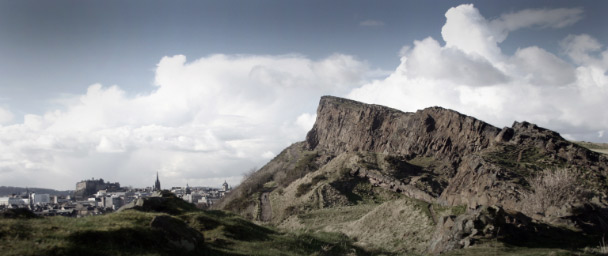
Salisbury Crags, Edinburgh
This comes as no surprise to anyone who knows us, after all its where we live. what can you say about Edinburgh that not already been said. Known as the Athens of the North the city has some of the most impressive architecture in the world covering the Middle ages, and Neo Classical eras in particular. Arriving in Edinburgh by train is one of the great tourist experiences of all time: As the train slips through the outskirts it could be anywhere in Britain, then the train dives into a long tunnel, for a moment you emerge to catch a glimpse of the castle rock and gardens before ducking under the art galleries on the mound and arriving in the station. If you have never been before (or even if its been a while) Then walk up the sloping roadway to emerge on Waverly Bridge. Ahead of you stands the impressive if rather rocket like structure of the Scott Monument, the Classical pillars of the National Gallery and Royal Scottish Academy and behind that Castle rock with the iconic Edinburgh Castle crowning the top. It really is one of the most impressive cityscapes in Europe if not the world.
Edinburgh is bursting to the point of overflowing with history and culture, the compact city centre makes most sites easily walkable (for those who can easily walk), you can take in an art gallery, loose yourself in a museum or scare yourself witless on one of the many ghost tours that run from the high street.
And if all that bustle is too much then in 15 minutes or so on foot you can find yourself at the bottom of the Royal Mile past Holyrood palace and into Holyrood park, Here you can leave the city behind and feel like you are back in the highland wildernesses that I’ve eulogised about above (in fact parts of Arthurs Seat in Holyrood park have been used to represent the wild highlands in film shoots). After half an hour or so of puffing you might find yourself on top of Arthurs seat or nearby Salisbury Crags giving you a reward of an incredible view over the city and down the east coast on one side and up to the Forth bridges on the other.
What else is like this: Glasgow’s west end is for Victorian architecture what Edinburgh is for Georgian. Stirling has its castle too and is handy for Wallace Monument and Bannockburn, Inverness too is worth visiting if only for the beautiful Ness islands and Leakeys bookshop.
Well thats our personal top ten list for now. I’ve set a date in the Calendar to revisit this list same time next year and see what new places we have discovered by then…
Rodger and Amanda Moffet – Scotclans
The post Scotland’s Most Inspiring Places: A Personal View appeared first on ScotClans | Scottish Clans.
]]>The post Watching Scotland: Your Midweek News Update appeared first on ScotClans | Scottish Clans.
]]> Scottish Environment: Scots Government Taking Heat For Banning GMOs

August 11: Expert who advised SNP slams move to ban GMO crops (Herald Scotland)
August 9: Scottish government under fire for GMO crops ban (Herald Scotland)
 Scottish Wildlife: Another Raptor Fatally Shot On Scottish Grouse Moor

August 11: RSPB Scotland appeal after rare raptor shot dead in south-west (Royal Society for the Protection of Birds, Scotland)
[Backgrounder] March 23: New drive to tackle Scottish wildlife crime (The Scotsman)
 Scottish Independence: A new Scottish Independence Party pops up, disappears and then …
August 11: Is the SNP about to split as a new Scottish Independence Party is formed? (Telegraph)
August 10: New Scottish pro-independence party aims to field candidates for next year’s Holyrood election (Daily Record)
 Scottish Youth: Scotland’s campaign to register 15 – 17 year old Scots to vote in May 2016 Scottish Parliamentary elections is underway
August 10: New campaign launched to encourage young voters in Dumfries and Galloway to register (Dumfries & Galloway What’s Going On)
[Backgrounder] March 8: Campaign to encourage young voters to register is launched across Scotland (UK Electoral Commission press release)
 Scottish Arts: August means things get weird in Edinburgh at the Fringe!

August 11: The Edinburgh Festival Fringe 2015 – In Pictures (FestivalSherpa.com)
August 6: Surviving 24 hours at the Edinburgh festival (BBC News)
The post Watching Scotland: Your Midweek News Update appeared first on ScotClans | Scottish Clans.
]]>