The post The Baobhan Sith – The Scottish Vampire appeared first on ScotClans | Scottish Clans.
]]>
This one warns of The Baobhan Sith – a female blood sucking fairy who terrorised the misty glens and the mountains of the Scottish Highlands, preying on unsuspecting travellers. The words baobhan sith (pronounced baa’-van shee) stand for fairy woman in Scottish Gaelic.
This blood sucking woman was also known as Baobhan Sidhe, Bavanshee, Baavan Shee or The White Woman of The Highlands. Like other legends she has the form of a who beautiful woman who would appear to men and try to seduce them. The Baobhan Sith were mostly attracted to male hunters drawn out by the smell of their blooded clothes. They are described as beautiful women dressed in green – the colour of magic and the fairies.
These vampires are different from the Bram Stoker Dracula kind of vampire, they don’t have pointed fangs that sink into their victims neck. The Baobban Sith when attacking use their long and sharp finger nails then drink the blood from the open scratch wounds. They look very ordinary until the they attack, then their delicate hands turn into talons to bleed their unsuspecting victims. They begin by asking their victim to dance, charming the young man until he is under their spell – then out come the nails.
If they attack and kill a woman she will return as one of their kin. Most of the Baobhan Sith where previously enchanters or witches who keep on using their skills after death.
The Baobhan Sith only come out when the darkness falls, during the day they rest in buried coffins. They only rise and feed once a year.

Some have hoofed feet
A lesser popular version tells they have hooves instead of feet, though they keep it hidden under their clothes. They may be of Human or Half-Elven stock, but they always appear as beautiful women and enchantresses, sometimes attacking in small groups with others of their kin. Baobhan Sith are supposed to be able to shift, but not into bats: their animal of choice is the wolf. Shapeshifting will lessen their power as they won’t be able to use their glamour in animal form.
They are clever and can speak any language their victim knows due to a form of telepathy, but they will sound as if they have a strange accent.
The only way to kill or harm a Baobhan Sith is with iron. They dislike horses because of their iron shoes – a clear warning to hunters leaving their wives at home it’s best to stay on their horse. A Baobhan Sith can be trapped in their buried coffin by building a stone cairn over their grave, this was thought to stop them from rising.
One encounter with these Scottish Vampires tells of four young friends who after hunting decided to spend their night in an abandoned cottage. As darkness fell they set a fire in the hearth and they started singing and dancing. As one of them expressed his wish to have female companions with them, four women knocked at their door and started dancing with the youths. As the baobhan sith started to attack their prey, one of the young men who was singing ran to the door, taking shelter between the horses. The creature that was running after him waited for him to get out of the safe circle formed by the animals but the man stayed within until dawn broke, and the woman disappeared shortly before the sun rose. The man returned to the cottage to find his friends dead and drained of blood. He was saved only because faery creatures are traditionally afraid of iron for it can harm and kill them, and the horses were shod with iron shoes.

The post The Baobhan Sith – The Scottish Vampire appeared first on ScotClans | Scottish Clans.
]]>The post The Treasure of Norries Law. appeared first on ScotClans | Scottish Clans.
]]>
Lower Largo
On The Fife coast sits the pretty village of Lower Largo. The village was the Birthplace of Alexander Selkirk, the inspiration behind the story of Robinson Crusoe and a sign in the village points to the Juan Fernandez Islands, some 7,500 miles away where Selkirk was a castaway. The history of the area goes back much much further though to a time before Scotland as we know even existed.
Outside the village sits Largo Law and around a mile to the North, Norrie’s Law, ancient burial mounds that indicate the great antiquity of the occupation of this area.
It was common among the children of the village to play a game that had a connection to Norrie’s Law. One child would stand before the others and recite a verse; “I’ll tell you a story, Aboot Tammie o Norrie, If ye dinna speak in the middle o’ it, Will ye no?” The object of the game was to lure another child into saving “No” at which point all the others would shout, “The spell is broken, ye hae spoken, Yell never hear the story o’ lang Tarn o Norrie.” Like so many other children games this has a story behind it – a story of the ghost of Norrie’s Law.
In a time long past Largo Law was reputed to be haunted by an earthbound spirit; a ghost sentenced to wander the earth until a spell was broken to release it. To break the spell the ghost had to give up his secret; the hiding place of a hoard of treasure, buried somewhere on Largo Law.
On the nearby farm of Balmain there was a fairly unscrupulous shepherd. Having heard the story he had spent many nights wandering the area around the Law in hope of discovering the treasure. Finally one evening as he walked around the Northern shoulder of the hill he was confronted by a shimmering cloud of smoke. Many others had met this apparition but all had fled in terror. Taken aback at first he gathered all his courage to approached it and asked what it was that kept it bound to this realm. The ghost fixed him with a stare and said:”If Auchendowie cock disnae craw, An the herd o Balmain disnae blaw, I’ll tell ye whar the gold is on Largo Law.” The ghost then quickly ran through the small print of his offer which also included the cut off time of 8 o’clock the following evening.
The shepherd was only concerned about getting his hand on the treasure and cared little of who he had to inconvenience to achieve his ends. He thought of the first part of the ghosts request and scurried off the Auchedowie farm. The next morning the farmer and his wife slept in, never awoken by the crowing of the cockerel. When they went off to investigate they found the cockerel strangled and tossed into a heap of straw by the barn. Phase one complete.
Now for the Herdsman of Balmain. The herdsman was called Tammie O’ Norrie and it was safe to say there was little love lost between him and the shepherd. As Tammie set off to take his cows to pasture the shepherd was waiting. He blocked his path and shouted to Tammie ‘Hey you, Tammie O Norrie, I want a word wae ye”. As Tammie approached the shepherd let his coat slip open to reveal a long knife tucked into his belt. “You had better no blaw yer horn to summon in yon cows the nicht or it will be the worse fur ye”. Tammie was confused; “How no! How will I caw the cows in with nae horn?” The shepherd gripped the handle of his knife; “Ye can use the dugs to round them up – now mind what a said or it will be the worse for ye”. At that he glowered at the herdsman and furtively took off.

Part of the Silver Hoard
With all the plans in place the shepherd made his way back to the north slope of the hill, just before 8:00 the spectre appeared again. As the shepherd approached the ghost the sound of Tam’s horn was heard in the distance. The ghost flew into a rage; “Woe to the man that blew that horn, For out of that spot he shall never be borne.” At that he vanished. The shepherd ran for all he was worth, determined to have it out with the herdsman but when he reached the spot he was met with an awful sight. There in the field stood Tam O Norrie, the horn horn still pressed to his lips but he had turned to stone – petrified literally by the wandering spirit.
The shepherd told no one of his involvement in the events and when the local people discovered what had befell Tam they tried to move him – but some sinister force prevented all attempts, finally they gave up and heaped the earth around him creating another small hill; this came to be known as ‘Norries Law’.
The shepherd never got his prize but many years later a hoard of silver (not gold) was unearthed nearby. It is one of the best silver hoards to be discovered in Scotland. a variation in this tale had been that the law was the burial sight of a viking called Norroway who had been buried on his horse in full armour. However investigation of the find discovered that the pieces were of Pictish rather than Norse origin. Sadly some of the hoard never made it to the protection of the museum, some coins and other pieces were reputed to have been sold off and melted down – we may never know just how extensive this treasure find really was.
‘Will we no’.
The post The Treasure of Norries Law. appeared first on ScotClans | Scottish Clans.
]]>The post The MacKenzie Poltergeist appeared first on ScotClans | Scottish Clans.
]]>
One of the most famous of these, and one that gets the crowds going is a walk through Greyfriers Graveyard. Best done as the light has disappeared to get the full effect, in this dark kirkyard it’s not difficult to feel spooked, large faceless angels surround you, skull and cross bones and eerie mausoleums with the tales that someone on the previous tour collapsed through fear. It’s not all about loyal dogs now.
The kirkyard is also the home of plague pits where the bodies of thousands of victims of the Black Death were buried in mass graves. Also on the grounds is the Covenanter prison, people that died here were buried in the kirkyard; some escaped, some executed. In the prison they would wait in terrible conditions for many months awaiting trial. Conditions were so inhumane that this prison is often described as the world’s first concentration camp. There was no shelter and the only food they were allowed was a daily ration of 4oz of bread.

Covenanters Prison
It is no wonder that Greyfriers has the reputation of being one of the most haunted places in Scotland. Here the dead do not rest.

The highlight of a ghost tour around Greyfriers graveyard comes when you approach an impressive forboding mausoleum. This is the final resting place of Sir George MacKenzie, chief persecutor and prison guard of the Covenanters.

The Black Mausoleum of Sir George Mackenzie

Sir George Mackenzie
MacKenzie was an infamous, brutal man with the nickname ‘Bluidy MacKenzie’. He was made advocate in August 1677 by King Charles II. From here MacKenzie organised an enthusiastic and bloody prosecution of Covenanters in retaliation for their refusal to replace Scotland’s Presbyterian Church with the Episcopalian Church that had come to dominate England to the south.
In 1679 the Covenanter were defeated at the Battle of Bothwell bridge, 3,000 of them were captured. These men were brought to Greyfriers. Some were beheaded, some hanged, decapitated heads rotted on walls around the city. It was a time of public torture. By just mid November of the same year 1,200 prisoners had died from starvations or exposure. The survivors were packed onto a boat bound for Australia.
MacKenzie is said to have been responsible for around 18,000 death of Covenanters (his fellow countrymen) during a reign of terror known as ‘The Killing Times’. Now his mausoleum is said to be the point of the ‘the world’s most recorded poltergeist activitiy’.
A chain and padlock holds the door to his mausoleum shut. An attempt to keep out the living, rather than keep in the dead. In 1998 a homeless man looking for shelter came across the Black Mausoleum and took refuge inside, at this time it was just a simple lock on the door. This break in is said to have woken the evil Bluidy MacKenzie from his slumber.
Inside were coffins of Mackenzie’s relatives, the homeless man opened one out of morbid curiosity. Suddenly beneath him the floor gave way and he fell down into a pit. Many bodies were contained here, they had filled the pit with plague bodies – basically they had so many that bodies were stuffed into anywhere they could find for quick disposal. Despite their age, the sealing up of these bodies had meant they were still in a state of decomposition. This scene could have come straight from a horror film, imagine the man’s terror as he tried to claw his way out of the pit, grasping body parts on his way.
From this point people started getting hurt. It was only a few days later that a woman looking into the mausoleum was blasted by a cold force. Then soon after another woman was found unconscious next to the mausoleum, her neck covered in bruises.

Locks can not keep the undead at bay. – Some of the injuries blamed on Buildy MacKenzie from people who have taken The City of Dead Tour
But the vagrant falling through the floor of his tomb wasn’t to be the last desecration to stir up the poltergeist. In 2003 to add insult to injury a group of 17 year olds out for mischief and trying to be all macabre and impress the local goths were caught playing in the graveyard with what was thought to be a football under one of the boys arms, this turned out to be the severed muffified head of George MacKenzie. The kids had broken into the tomb and chopped off his head with a penknife. According to coverage in the Daily Mirror of the trial the teenagers were throwing the head to each other jokingingly pretending it was performing sex acts on them and wearing it as a glove puppet. The teenager in question was given 200 hours community service and his partner in crime was given two years probation.

The severed head of George Mackenzie
Two years later unknown intruders gained access despite increased security at the churchyard, removed a head and posed it on one of the spikes that top the cemetery’s gates. They left behind a note with the message “The Vampire Lark”. They have not been traced.
Tours now start with the warning “The Mackenzie Poltergeist can cause genuine physical and mental distress. You join the tour at your own risk!”. Exorcisms have been carried out twice at the location, first by a spiritualist minister named Colin Grant and a year later by his son. Both were unsuccessful and the attacks continue.
Long before the homeless man fell into the corpse filled pit there is the story of John Haynes, a petty criminal, possibly a highwayman who used the second chamber in the mausoleum as a hideout for six long months. Eventually the police caught up with him and found him to be completely insane. Haynes kept insisting that the coffins kept moving around at night.
There are some other explanations for the feelings people have around the tomb. One suggests it’s the result of high voltage machinery which is housed to the rear of the mausoleum by Edinburgh University’s Artificial Intelligence Unit. These machines can give off electromagnetic energy, a force that some believe could create hallucinations in people that are ‘EM sensitive’ and be the explanation for certain paranormal activity. This, however, does not explain the physical attacks that visitors to the vault have suffered.
Another scientific explanation concerning these phenomenons looks deep underground. Sandstone forms much of the rock underneath the Greyfriars area. Brian Allen of SPI suggests that:
“If the pores of the sandstone were to become saturated with mineral electrolytes, this in effect would create thousands of tiny batteries. Given the right conditions, a micro-tremor perhaps, the stored energy could be discharged, creating an electrical field above the ground affecting a sensitive person by causing a tiny seizure in the temporal lobes of their brain. These seizures appear to run in distinct patterns, with the people affected experiencing the same or similar images”.
What ever you believe – would you dare challenge Bluidy MacKenzie by knocking the door of the Black Mausoleum three times saying” Bluidy Mackingie, come oot if ye daur, lift the sneck and draw the bar!”?
The post The MacKenzie Poltergeist appeared first on ScotClans | Scottish Clans.
]]>The post Scotland’s Most Inspiring Places: A Personal View appeared first on ScotClans | Scottish Clans.
]]>1. Skye: The Trotternish Peninsula.

The Old Man of Storr
The Island of Skye is nearly always on peoples ‘bucket list’ and with good reason. The island is very large with so many different things to see its hard to know where to start. Dominated by the brooding ‘Black Cuillins’ a ragged mountain range that sits in its centre the island fans out to a number of peninsulas. All of them have spectacular views and hidden gems to explore but our favourite is the Trotternish peninsula.
Travelling north beyond Portree; the island’s main town a strange jagged ridge comes into view, this ridge features the Old Man of Storr, a giant rock tower that sits at an impossible angle near the rugged Storr cliffs. Further up the Quiraing extends the ridge line, the remnants of an ancient landslide of epic proportions. Walking through this area is like entering another world, the complexity of the landscape and broad vistas as you reach the ridge tops is quite simply astonishing.
What else is like this: In many ways it reminds me of Hadrian’s Wall (yes I know thats in England). Also the sea stacks of Orkney.
2. Glencoe and Rannoch Moor.

Glencoe
It would be impossible and indeed unforgivable to not include Glencoe in this list but I would extend it a little south to cover Rannoch Moor, an extraordinary landscape of bogland and small lochans that signal your approach to the glen as you venture north. The main road seems to float over the landscape and its hard not to find yourself trying to imagine what it must have felt like in the days before Thomas Telford build the first metalled road here as people picked their way through the moor. It must hold many dark secrets.
Then there is Glencoe. The majestic Buchaille Etive Mor stands guard at the entrance to the glen with her sister peaks lined up beside her, on the other side the Aonach Eagach ridge, the narrowest and most exposed ridge in Britain is a place not for the feint hearted. Handy parking places are scattered along the length of the glen, nearly always packed with tour busses and the odd bagpiper raking in the cash. The real rewards though, come when you take a step or two away from these busy lay byes and out into the glen itself. Despite its fearsome reputation in winter Glencoe has meny less challenging low level walks that get you away from the crowds and give you the space to contemplate life before the ‘quieting of the highlands’ and the tragic events that have been so linked to this place forever more. Caution and a sensible attitude (and footwear) of course goes without staying, this is a wild place that can claim lives in any season.
What else is like this: Scotland has many deep glens like Glencoe though few are so well known. Glenshiel with it towering 5 sisters comes to mind or for a more scaled down version Mennock and Enterkin passes in Dumfriesshire feels like a lowland rural equivalent.
3. The Border Abbeys

Kelso Abbey
The cluster of small border towns that nestle in the south east part of the Scottish borders feature a ring of magnificent ruined abbeys. In their heyday Monks from the Tironesian, Augustinian, Premonstratensian and Cistercian orders occupied these impressive buildings which became centres of learning and sat at the centre of many small communities. Inevitably though, sitting as they do in the heart of the sometimes lawless border region and with neighbouring England a few hours ride away the abbeys were partly destroyed, much of the damage being done during the ‘Rough wooing’ of King Henry VIII of England.
The violence of that time has long gone now and what is left of the abbeys are preserved as they were left all those centuries ago. Each has its own character and are peaceful places where you can sneak away from a busy market day and try to imagine the sounds of morning prayers being offered up in an echoing chapel.
For people of a fitter disposition it is possible to follow a 5 day walking route that takes in these wonderful buildings. The walk is not too challenging and gives you even more opportunity to explore this often missed part of Scotland.
What else is like this: Our own Holyrood Abbey in Edinburgh of course, Iona (featuring shortly) and Linlithgow Palace certainly have a similar feel in many ways.
4. Arisaig

Arisiag at Sunset
As you take the route north to venture into the North West Highlands you hit the town of Fort William, spreading near the foot of Ben Nevis this busy town is an inevitable stop off for a quick snack and a stretch of the legs. Most travellers continue to the north towards Skye and Loch ness but just taking a left turn will lead you on a journey that rewards you with fantastic beaches, scenes from Harry Potter and romantic tales of Bonnie Prince Charlie. This road which was once a twisting and perilous single track is much improved, it takes in the Jacobite monument at Glenfinnan and an added bonus of a view from there of the Glenfinnan Viaduct a victorian marvel of railway engineering that will now forever be known as ‘the Harry Potter Bridge’. If you are very lucky you might catch the steam train that regularly travels this way on tourist trips puffing over the viaduct.
This was where the ‘Young Pretender’ (not the young wizard) first landed on the Scottish mainland in 1745, raised his standard and forever changed the covers of shortbread tins and tea towels, just a few minutes drive away loch Nan Uamh is where he set sail back to Europe a year later, his followers scattered in the highlands or buried in the mass graves at Culloden.
At the small village of Arisaig is what could only be described as a camper’s paradise, a collection of campsites sit along this stretch of coast set into grassy areas beside beaches with impossibly white sand. Its hard to compete with the feeling of settling down to a mug of tea or something stronger watching the waves on the shore as the sun sets over the islands of Rhum and Eigg. A sunset in Arisaig is not just a sunset, its gods own theatre, and he knows how to put on a good show!
For those who want to venture further though this route has one last gift to give, the Malliag ferry to Skye. An altogether gentler and more dignified way to reach our first destination on the list. As the ferry pulls out of Malliag harbour its inevitable that you catch yourself humming the Skye Boat Song to yourself.
What else is like this: The west coast and in particular the islands have incredible beaches, Tiree for example or Durness in the far north, The small island of Eriskay has the connection with Bonnie Prince Charlie too as of course does Culloden.
5. South Uist

Happy Dog on South Uist!
The island of South Uist forms part of the Outer Hebrides (more of them to feature later). The island stretches from north to south linked by causeways to Benbecula and Eriskay. A modest range of low mountain peaks run like a spine down its east side and to the west is the legendary Machair. The Machair is a low lying coastal plain, formed by millennia of wind blown, calcium rich sand that forms a valuable fertile layer. The habitat is the fragile home to many species of birds and small crofting communities are scattered along the island’s east side.
There is something about the light here that feels like nowhere else on earth. There always seems to be some drama in the sky as another raincloud skids in over the Atlantic to the sound of oystercatchers and gulls.
This is an ancient place too – Settlers have been here since neolithic times and this is the only location in Britain where prehistoric mummies have been found. Looking at the ramshackle collection of little crofts you are reminded that now just as then the people who live here have a relationship with the land and pace of life that many of us would envy (in the summer at least).
What else is like this: Orkney and Shetland certainly have that feel of a link with the prehistoric past though the Machair is peculiar to the Outer Hebrides. also Barra and Vatersay just to the south and further on, the islands of Islay and Jura.
6. St Kilda

St Kilda
On 29 August 1930, 36 men women and children boarded a boat to the mainland from the island of St Kilda. Breaking a continuous period of settlement that had stretched back over two thousand years. These people were not evicted by harsh landlords, they had asked to be taken away to start a new life elsewhere. For them life in the most remote part of the British Isles had simply become too difficult.
Remote is too simple a word for St Kilda, just getting here is an adventure, and something of a hit and miss affair as the journey over rough seas is not always possible at all. Arriving at the small bay on Hirta, the main island in this small group is like arriving at the edge of the world, the deafening sounds of Gannets, Fulmars and Skuas fills the air and the island itself seems to rise out of the sea to meet you, one second there, one second disappearing as the boat lurches between the waves. As you step onto the shore you step back in time to the moment those last settlers left the island behind. The village street still stands as if trapped in amber, the remains of centuries of island life lie scattered up the hill side.
If you want to come to Scotland and get the feeling of being totally alone try spending a few days here with just the mice for company (and the army personnel who man a nearby base but thankfully never leave their quarters). There is a peculiar feeling to standing on the shore watching the tiny boat head back out into the open sea wondering if it really will be ‘back on Wednesday’ as promised.
Where else is like this: The Monach Islands off the coast of Uist were also until lately inhabited and North Rona is another remote destination. There are also a number of clearance villages such as Bororaig in skye and near Tongue in Sutherland.
7. The Isle of Lewis.

Callanish Standing Stones – Lewis
A few years ago I was on a flight back from Iceland on a clear summer evening. The flight path took us over the Butt of Lewis and as first sights of ‘home’ go, its about as good as it gets (also see entry number 10). Lewis has become a popular destination recently thanks to Peter May’s ‘Black House’ trilogy of books, May’s infectious description of the landscape has also inspired an excellent coffee table photography book. A trip to Lewis inevitably begins with the long ferry journey from Ullapool to Stornoway, passing by the Summer Isles, the setting for the classic British horror movie ‘The Wicker Man. Stornoway is a bustling small town that has a bit of a frontier feel about it, its a bit rough round the edges and can be a bit wild of a Saturday night before the ‘sabbath’ calls a halt to all activity. But before you disappear off to explore the island, stop off at MacLeod’s Butchers and stock up on as much Black Pudding as you can sensibly carry.
The stand out feature of Lewis is the standing stones at Callanish. For nearly 5,000 years these remarkable stones have stood here. Academics still argue over their true purpose, partly as a burial site possibly as a calendar no one can really say for certain. Folk tales say that they were a family of giants who refused to convert to Christianity and Saint Kieran turned them to stone as punishment.
Like many parts of the west coast, Lewis has its fair share of incredible coastal landscapes with wide open beaches and stark cliffs. As you travel south from Stornoway towards the mountains of Harris you pass seemingly endless expanses of peat bog, stacks of freshly cut peat stacked up and drying ready for collection. The smell of peat smoke is the air is a reminder once again that this is a place where people work and live not just a toilet stop and cafe.
What else is like this: Again, Orkney springs to mind for its unrivalled collection of ancient artefacts (the only reason Orkney is not on our list is because we have yet to visit there and this is our personal list). Wick and Thurso in Caithness have a similar frontier feel about them that Stornaway does and the wetlands of Caithness and Sutherland are very much like the Interior of Lewis in some ways.
8. Iona

West Coast of Iona
Sometimes the beauty of a place is magnified by the effort it takes to get there. If thats the case then Iona must be one of the most beautiful places on earth! First of all you need to get to the island of Mull, that is either reached via a ferry from Oban or by a couple of smaller ferries and a long drive down towards Ardnamurchan. This is followed by a long drive down the Ross of Mull until you literally ‘run out of island’. From there a small ferry takes mostly foot passengers (theres is not much point in taking the car as theres not really anywhere to drive to) over the short hop to Iona. The famous abbey is immediately visible as you land in the tiny village that sits beside it.
Iona abbey is one of the most famous in Scotland. its by no means the largest and would be dwarfed by the Border abbeys though it is one of the best preserved. St Martins Cross is probably the most photographed and recognisable celtic cross there is and the abbey grounds have more than a few famous interments: Kenneth MacAlpine, Donald II, Malcolm I, Duncan I and Macbeth all lie here, as does the late Labour leader John Smith.
The island is tiny and can be walked round entirely in a day. If you chose to do this there is a good chance you will hardly spot a soul the whole time as pretty much all the tourists flock to the abbey. Their loss is your gain though, the island circuit takes in more sandy beaches on the north shore the rugged west coast with crustal clear waters and small secluded bays, a spouting cave and the remains of an abandoned marble quarry before returning back to the village for a well earned drink while you wait for the ferry back.
What else is like this: Right next to Iona is the small island of Erraid. its tidal so can easily be walked to. There is an incredible campsite at Fidden farm nearby too. Holy isle (in England,,, just) is also very similar and also Inchcolm Abbey in the Forth Estuary.
9. Plockton

Plockton
The tiny village of Plockton sits at around the same line of latitude as Moscow, yet the little road around the bay is lined with palm trees! These are not made of plastic but thrive here thanks to a phenomena properly known as the Atlantic Conveyor though most of you know it as the Gulf Stream. a current of warmer water that runs North-East from the Gulf of Mexico makes landfall on Scotland’s north west coast leading to a far milder climate than we would expect. Before you pack your bermuda shorts and beach volleyball set though remember this is STILL Scotland.
The small village was a fishing community that sprung up in the 19th and 20th centuries in an attempt to slow down emigration from the highlands. The end result is possibly the most picturesque small village in Scotland. Just like Iona above, getting here is half the fun. There is the long drive skirting within touching distance of the Skye bridge and up the road to the ironically named ‘Stromferry (no ferry)’ , or you can take a more indirect route via Lochcarron, or you can treat yourself to one of the worlds greatest train journeys, travelling north to Inverness and then west via the tiny settlement of Achnasheen through some of the grandest majesty that the highlands can serve up, it might be a long journey but I really wouldn’t bother with a book unless its dark 
For those who like an element of terror on their days out then its not too far from Plockton to the small town of Applecross. The last half hour of your trip will be memorable as you wind up the notorious Bealach na Ba (the pass of the cattle) a single track road that twists steeply up an impossible looking slope before sliding down the other side. On the way back you can reward yourself with an early tea at the excellent seafood cafe at Kishorn, where the seafood is so fresh it answers you back.
What else is like this: Rothsay on the Isle of Bute is also known for its palm trees though its a much larger and busier town. The East Neuk of Fife also has a string of quaint fishing villages and Tobermory on Mull is also very picturesque.
10. Edinburgh

Salisbury Crags, Edinburgh
This comes as no surprise to anyone who knows us, after all its where we live. what can you say about Edinburgh that not already been said. Known as the Athens of the North the city has some of the most impressive architecture in the world covering the Middle ages, and Neo Classical eras in particular. Arriving in Edinburgh by train is one of the great tourist experiences of all time: As the train slips through the outskirts it could be anywhere in Britain, then the train dives into a long tunnel, for a moment you emerge to catch a glimpse of the castle rock and gardens before ducking under the art galleries on the mound and arriving in the station. If you have never been before (or even if its been a while) Then walk up the sloping roadway to emerge on Waverly Bridge. Ahead of you stands the impressive if rather rocket like structure of the Scott Monument, the Classical pillars of the National Gallery and Royal Scottish Academy and behind that Castle rock with the iconic Edinburgh Castle crowning the top. It really is one of the most impressive cityscapes in Europe if not the world.
Edinburgh is bursting to the point of overflowing with history and culture, the compact city centre makes most sites easily walkable (for those who can easily walk), you can take in an art gallery, loose yourself in a museum or scare yourself witless on one of the many ghost tours that run from the high street.
And if all that bustle is too much then in 15 minutes or so on foot you can find yourself at the bottom of the Royal Mile past Holyrood palace and into Holyrood park, Here you can leave the city behind and feel like you are back in the highland wildernesses that I’ve eulogised about above (in fact parts of Arthurs Seat in Holyrood park have been used to represent the wild highlands in film shoots). After half an hour or so of puffing you might find yourself on top of Arthurs seat or nearby Salisbury Crags giving you a reward of an incredible view over the city and down the east coast on one side and up to the Forth bridges on the other.
What else is like this: Glasgow’s west end is for Victorian architecture what Edinburgh is for Georgian. Stirling has its castle too and is handy for Wallace Monument and Bannockburn, Inverness too is worth visiting if only for the beautiful Ness islands and Leakeys bookshop.
Well thats our personal top ten list for now. I’ve set a date in the Calendar to revisit this list same time next year and see what new places we have discovered by then…
Rodger and Amanda Moffet – Scotclans
The post Scotland’s Most Inspiring Places: A Personal View appeared first on ScotClans | Scottish Clans.
]]>The post The Benbecula Mermaid. appeared first on ScotClans | Scottish Clans.
]]> While touring recently around the islands of the Outer Hebrides we came upon this strange story.
In 1830 people were busy cutting seaweed at Sgeir na Duchadh near Grimnis on the west coat of the island of Benbecula. One woman spotted a creature several yards out in the water. The creature looked like a woman in miniature. Alarmed she called to the others working on the shore who also saw this strange sight. Men went into the water to try to catch the creature but she evaded them. A boy aimed a rock at her which struck her on the back, she cried out in pain and disappeared beneath the waves.
A few days later a creature was washed up dead on the beach at Culle bay near the township of Nunton which lies a few miles north of this spot. The creature was said to have the upper shape of a well developed woman but was around the size of a 4 year old girl. She had long dark glossy hair and white skin, however her lower half was described as being ‘like a salmon’ but without the scales.
As the crowds gathered on the beach they all agreed that this was the body of a mermaid.
The factor for the chief of MacDonald of Clanranald who was also the local sherif was called. On seeing the creature he called for a shroud and coffin to be brought to the beach and the creature was layer into this and buried in the nearby churchyard. It was said that the funeral for this creature was one of the largest attended on the island and was carried out like any proper christian burial.
No grave marker related to the incident can be seen at the churchyard and others have said that the creature was buried near the dunes and not in the churchyard at all, in fact a recent survey of a large stone near the south end of the bay was carried out, suspecting that this may indeed be the resting lave of the mermaid but this was inconclusive.

Culla Bay, Benbecula
So what do you think? evidence of mermaids or another ‘fishy tale’ from the islands. Certainly mermaid stories like this do bring in the tourists who were beginning to find their way to the islands in the mid 19th century. Many other tales of mermaids exist on the islands. A crofter from Barra called Colin Campbell spotted what looked like an otter fishing near the shore, he was about to shoot it but decided to check it though a telescope only to see what he described as a woman carrying a small baby in her arms. the creature then spotted him on the shore and disappeared. Whatever the truth is they do make great stories.
The post The Benbecula Mermaid. appeared first on ScotClans | Scottish Clans.
]]>The post Haunted Edinburgh! appeared first on ScotClans | Scottish Clans.
]]>
The spirit that stalks the kirkyard of Greyfriars, known as the ‘MacKenzie poltergeist’ is believed to have been one Sir George MacKenzie, known to the Scots as ‘Bluidy MacKenzie‘. The summer of 1679 saw defeat for the Covenanter’s at the Battle of Bothwell Bridge and 1,200 men were captured. It was MacKenzie who organised an enthusiastic and bloody persecution of these unlucky men. MacKenzie brought them to Greyfriar’s and they were held within a small courtyard to the back of the kirkyard, now referred to as the Covenanter’s Prison, in horrible conditions open to the elements. MacKenzie had some of the men hanged, others beheaded, their rotting skulls displayed around the city. The more unfortunate were publicly tortured. Many died due to this harsh treatment and those that didn’t were executed or sold to slavery. Their only way out was to swear an allegiance to the King, which they refused to do. Those that died in Greyfriars remain there to this day and ironically share their final resting place with Bloody George Mackenzie.

MacKenzie Tomb
Although stories of unusual occurrences within the kirkyard had been told for years, it seemed to intensify greatly after one incident 1998. A homeless man looking to get out of the Scottish weather, made the unfortunate decision that the MacKenzie tomb looked like a cosy and safe place. For reasons known only to himself, the man began to break into the coffin that lay within, whilst doing so he slipped dragging the coffin down with him and ending up sprawled on the floor with the remains of Bloody MacKenzie across him. He understandably fled the area, but it seems the disturbance he caused awoke something in the tomb.

Covenanters Prison
By early 1999 reports of strange goings on in the kirkyard had significantly risen, but not by the MacKenzie tomb but around the corner in the Covenanter’s prison, so much so that the council made the decision to close the area off from the public. Luckily for those looking for a thrill or keen on the paranormal a tour company was granted access to the prison, to guide small groups through the area in controlled visits. Those on these tours have reported many strange phenomena including being scratched, attacked, feeling nauseous, discovering large marks and bruises on their bodies the following day and drastic changes in temperature. There are even those that have been knocked unconscious! In 2000, an exorcist, Colin Grant was summoned to the graveyard to perform an exorcism ceremony; he was said to have picked up “evil forces” and claimed that the forces were too overpowering and feared that they could kill him. A few weeks later, he died suddenly of a heart attack.

Only a short walk from Greyfriar’s can be found the Edinburgh or South Bridge Vault’s, but only by venturing under the streets of Edinburgh. The vaults are a distinct series of chambers formed in the 19 arches of the South Bridge, built to span the Cowgate gorge between High Street and the growing University of Edinburgh on the Southside, which was completed in 1788. These vaults where walled in on either side due to the building of tenements leaving spaces ranging from 2m square to 40m square.
From taverns and tradesmen’s workshops, a red light district and even, a rumoured hunting ground for serial killers Burk and Hare – each vault has its place in history and a story to tell. They were also home to an infamous distillery that once labelled the area ‘Whisky Row’ and, at some point they served as stables to the Royal Families’ bodyguards, the French Cavalry. As the conditions in the vaults deteriorated, mainly because of damp and poor air quality, the businesses left and the very poorest of Edinburgh’s citizens moved in, though by around 1820, even they are believed to have left too. That people had lived there was only discovered in 1985 during an excavation, when middens were found containing toys, medicine bottles, plates, and other signs of human habitation. The vaults on the southside where converted into several very unique venues, the most well known being the Caves, the vaults on the northside however are used for ghost tours and are known to house several unique and characterful spirits…

The most famous of the spirits that roam the vaults is known to the guides as Mr Boots, an apparition that earned its nickname from the many unexplained reports of heavy footsteps heard since the vaults opened nearly 20 years ago. Mr Boots is regularly spotted within the vaults and has been described as being attired in a long blue frock, tri-corner hat and large leather boots. He seems to have an issue with the visitors that regularly explore the area and has been reported blocking doorways, shoving and breathing whisky fumes on the guests and has even been known to throw stones at those he deems unwelcome.
Another apparition, on who little is known, is a wee bit friendlier. Little Jack as he is known, is believed to be the spirit of a small boy who was murdered within the vaults. He is reported to take the hand of guests in the hopes they will lead him out of the dark and foreboding vaults. An unsettling event you might say, but with innocent intentions.
As with areas such as these other phenomena have been reported such as sudden drops in temperature, whispers heard in the distance and even fire doors opening of their own accord(these can only be opened from one side, and never is a figure seen on the side with a handle). Even stranger is events that go unnoticed until mentioned by the guide. One room in particular was believed to have been a men only drinking establishment, and guides advise the patrons that the feeling of segregation of the sexes pervades the room to this day. Invariably the guests then notice that the group has separated on it’s own accord, men on one side of the room, women on the other.

Another short walk away, a little up Edinburgh’s world famous Royal Mile, you will find another of Edinburgh’s most haunted areas, Mary King’s Close.
Mary King’s Close, possibly named after the daughter of Alexander King a wealthy property owner ran from High Street all the way down to Market Street, before Cockburn Street was built. In 1645 the inhabitants of the buildings served by Mary King’s Close were stricken with the plague. It had probably come from rats arriving in Edinburgh through Leith docks. In order to quarantine them and prevent the spread of the disease throughout Edinburgh, Mary King’s Close was sealed, possibly according to legend with some people still alive and suffering inside. Due to housing shortages becoming a worry, the people of Edinburgh wanted to open up Mary King’s Close and shortly after it was opened and the houses reoccupied due to overcrowding.
The new inhabitants of Mary King’s Close found the buildings to be haunted and various reports were made of apparitions including a dog, headless animals, a young girl and several severed limbs and body parts such as heads.
The inhabitants were then evicted in 1753 to make way for a new building project. The upper stories of the buildings around Mary King’s Close and its immediate neighbours were demolished and The Royal Exchange, now the City Chambers was built on top of them. The lower eight stories of beneath the City Chambers, dropping down to Cockburn Street were sealed up, including Mary King’s Close.
Sealed for two hundred and fifty years, Mary King’s Close has now been re-opened for tour groups and you can go down beneath the City Chambers to the lane and buildings that still exist, hidden away. Visitor’s still report to this day strange goings on and apparitions…

The most famous ghost to haunt Mary King’s Close is that of a little girl known as Annie. Her tale starts in 1992 when she scared the daylights out of a Japanese psychic. This lady had been unimpressed by the tour until she arrived at one of the many small rooms. There she was suddenly struck by an overwhelming feeling of sickness, hunger and cold and, when she tried to leave felt the ghastly tug of a ghostly hand on her leg. In order to placate the spirit the women left a small doll within the room, and was released and allowed to leave.
Annie’s story has been fleshed out since then, and it is now believed that she had been left to die in the close by her family during the plague outbreak, although there is very little evidence to back this up. A tradition has built up from the ‘gift’ the psychic left, and now many tourists leave a toy for Annie, and the room in which she was found has turned into something of a shrine…

Dr Caroline Watt of Edinburgh University’s Koestler Unit had her own experience when conducting experiments into the paranormal activity within the close…
“I was in a part of the close where no one else was supposed to be,” she says. “I heard footsteps and the sound of rustling clothing. From a professional point of view I was annoyed because I thought it was someone intruding on our experiment, but when I asked the tour guides I found out there was no one there.”

Another short walk, and almost taking us full circle through the Old Town, leads to Edinburgh’s biggest and most famous tourist attraction, Edinburgh Castle. With a history hundreds of years old it’s not surprising that the Castle has it’s own share of ghost stories.
Edinburgh’s hidden underworld is said to be strongly connected to the castle due to a series of secret tunnels leading from Edinburgh castle down the Royal Mile. One of these is even rumoured to lead all the way to Holyrood House, at the very bottom of the Royal Mile. When the tunnels were first discovered several hundred years ago, a piper was sent to explore. As he navigated the tunnels, he played his bagpipes, so that his progress could be tracked by those above. About half way down the Royal Mile the piping suddenly stopped. When a rescue party was sent, there was no trace of the piper. He had simply vanished. Several search parties went into the tunnel system but no trace of the piper was ever found. It is said that the Piper’s ghost still roams the tunnels to this day, and those on the Mile on a quiet evening can hear the sounds of the pipes drifting up from below the streets.
Another apparition commonly reported at the castle is that of a drummer on the battlements. One account, reported in 1960, told of a sentry who whilst patrolling the battlements heard the faint sound of the drums. On closer investigation the sentry witnessed a figure standing on the battlements and as he drew closer he found the figure was missing his head. As he watched, it turned to face him, then vanished completely. Who this drummer is and why he haunts the castle is something that still remains a mystery.

The next ghostly presence from Edinburgh castle is believed to be that of a rather desperate prisoner. In a rather unsanitary bid for freedom the man hid himself in the castles dung cart, ready to be carried out and down the Royal Mile where he could make a run for it. Unfortunately the men in charge of the dung cart were not willing to heave the smelly load quite so far and instead emptied it over the side of Castle Rock and the prisoner plummeted to his death. Visitors have claimed that this man attempts to push people from the battlements and is always accompanied by the strong and unpleasant stench of dung.
On April 6th 2001, a 10 day study scientific investigation into the paranormal events at Edinburgh castle took place. Dr. Richard Wiseman, a psychologist from Hertfordshire University enlisted the help of 240 volunteers to explore allegedly haunted sites. Chosen from visitors from around the world, each was carefully screened to ensure only those that knew nothing about Edinburgh’s hauntings were selected to participate.
The volunteers were not told of any areas previously reported as haunted and were led in groups through locations with a reputation for strange activity as well as ‘red herring’ sites that had no history of activity at all. Interestingly the volunteers only reported paranormal experiences in the areas with a history for it, and not one of the 240 volunteers reported activity in the ‘red herring’ areas.
Some of the activity recorded include seeing shadowy figures, and unseen presence touching the face, sudden drops in temperature and a feeling of being watched.
Wiseman, a sceptic who has in the past attempted to expose the myths of several British hauntings, admitted his surprise at the results. “The events that have been taking place over the last 10 days are much more extreme than we expected,” he said.
So although there is no solid proof, there is evidence to suggest that something odd is definitely going on at Edinburgh castle and the surrounding old town. But is it ghosts or something else? Let us know what you think in the comments…
The post Haunted Edinburgh! appeared first on ScotClans | Scottish Clans.
]]>The post The Cursing Stone appeared first on ScotClans | Scottish Clans.
]]>
The Cursing Stone
A stone discovered by chance in a graveyard on the Isle of Canna in the Inner Hebrides is Scotland’s first known example of a bullaun “cursing stone”, researchers and archaeologists have revealed.

The cursing stone fits into a stone base

Isle of Canna
The cursing stone dates from approximately 800 AD. Interestingly, these cursing stones are sometimes linked with the earlier forms of Christian crosses. The cursing stone itself was found by a National trust for Scotland farm manager Geraldine MacKinnon. Cursing stones were used by Christian pilgrims more than a thousand years ago to bring harm to their enemies.
The inscriptions on the stone include an engraving of the early Christian cross. It is also approximately 25cm in diameter. After measuring the diameter of the stone, BBC reported that it “was later found to fit exactly into a large rectangular stone with a worn hole which was located at the base of the Canna cross.”
This finding proves to be a remarkable one as it provides new information pertaining to older religious practice in old Scotland. Furthermore, it sheds light on the fact that there is still plenty to learn in this field. Apart from that, it is amazing to note that the cursing stones which were recently found are commonly discovered in Ireland. However, this is the first of its kind to be discovered in Scotland. During the earlier stages of Christianity, Canna had been a part of a monastery in Iona.
Geraldine says “It would be extremely interesting to find out what the exact purpose of the cursing stone is. Discoveries such as this one help people like us understand the origin of our ancestors and why religion is being practised the way it is practised today. Ancient history, mysteries and legends never fail to fascinate me. There’s just so much to learn from the people of the past, it’s practically invigorating.”
‘Cursing stones’

Using a Cursing Stone
Katherine Forsyth, an expert in the history and culture of early Celtic-speaking peoples, based at the University of Glasgow, described it as an “amazing find”.
“Stones like this are found in Ireland, where they are known as ‘cursing stones’, but this is the first to be discovered in Scotland,” she said.
“They date from the early Christian period but have continued to be used by pilgrims up to modern times.
“Traditionally, the pilgrim would recite a prayer while turning the stone clockwise, wearing a depression or hole in the stone underneath.”
Dr Forsyth said bowl-shaped lower stones had been found elsewhere in Scotland, including on Canna, but this was the first discovery of a top stone.
She added: “This exciting find provides important new insight into religious art and practice in early Scotland and demonstrates just how much there is still to be discovered out there.”
In the early-Christian period, Canna belonged to the monastery on Iona.
The island was gifted to the National Trust for Scotland in 1981 by Gaelic scholar John Lorne Campbell.
The post The Cursing Stone appeared first on ScotClans | Scottish Clans.
]]>The post Unloved boy’s grave gets Guardian Angels appeared first on ScotClans | Scottish Clans.
]]>
Card, note and newspaper cutting from Mrs Jill Sharp
Today a lovely pink envelope dropped through our letter box at the ScotClans office, always like pink envelopes – bills don’t tend to be in them. Inside was a thank you card, a newspaper cutting and a note all from Mrs Jill Sharp.
A while back Jills Pen-Pal had contacted us telling us Jill’s story and asking if we could send some MacNaughton tartan for Jill to put on a boys grave. We were happy to oblige, the story was so heart warming I thought I’d share it with you.
Pensioners Gordon and Jill Sharp had been visiting the graveyard at Tyringham Parish Church, which they often did.
“We often go to the churchyard and always sit on a particular bench that looks out over the fields watching the wildlife. It is one of our favourite places,” said 72-year old Jill. The bench is next to a hedge surrounded by dumped rubbish and overgrown with stinging nettles.
“One day we noticed this big stinging nettle kept giving out tiny puffs of smoke. People didn’t believe us when we told them, but my daughter came with us to check and she saw it too,” said Jill.
When the Sharps got close to the puffing nettle, they noticed part of an old headstone poking out of the overgrowth. They promptly cleared the weeds and removed years’ worth of debris to discover the grave of a 16-year-old boy. Stuart Balfour McNaughton killed himself in 1919 with his father’s shotgun.
Jill and Gordon researched old records and press reports to discover the lad had lived in nearby Filgrave rectory and was upset because his former Eton pupil father had been bullying him.
Said Jill: “In those days people who committed suicide were buried away from other graves. It could have been hidden for years and years.’
She and Gordon cleaned up the stone surrounded and planted the plot with flowers. This month Gordon took a photo of Jill sitting proudly by the transformed grave. But when it was developed, the couple could not believe their eyes.

Orb above Stuart’s grave
“There’s this big glowing orb of light right next to my head. We think it’s Stuart saying thank you to us,” said Jill.
She and Gordon are convinced the smoke-puffing nettle represented the smoking gun that lead them to the grave.
“It’s probably one of those things that can never be explained. But we’re glad it happened and that Stuart’s grave is being looked after,” said Jill.
Now Stuart’s grave will have some MacNaughton tartan on.
Thank you Jill for telling us your story.

Note from Ms Jill Sharp

Newspaper Article
The post Unloved boy’s grave gets Guardian Angels appeared first on ScotClans | Scottish Clans.
]]>The post Bobby Update – Police Launch Investigation appeared first on ScotClans | Scottish Clans.
]]>
Greyfriar’s nose shines again
Last week we reported that Edinburgh’s famous Greyfriar’s Bobby statue had undergone restoration work after years worth of tourists rubbing his nose for good luck. Less than 48 hours following the painstaking work to turn his shiny nose back to black, an abrasive material was “intentionally used” on the nose, stripping the repaired area. Police have launched an investigation, and are asking for anyone who witnessed suspicious behaviour near the statue in the last week to come forward.
The story is causing quite a stir in Scotland’s capital, with Bobby campaigners fighting it out on social media, and Bobby even gracing the cover of the nation’s newspaper, The Scotsman:

Bobby graces front page of The Scotsman
Here’s the latest from the BBC:
Edinburgh City Council confirmed it called the police after experts said the repair paint used should have lasted several years.
Police Scotland said the statue was damaged sometime between 13:00 on Tuesday and 17:00 on Wednesday.
The estimated cost of the damage is believed to be between £200 and £300.
Officers are conducting inquiries and urged witnesses to come forward.
PC Nick Davies, of Police Scotland, said: “This crime is as unusual as it is disappointing to observe.
“The statue is a beloved tourist attraction and is also very popular with Edinburgh’s local residents.
“The nose has recently been touched up to restore it following years of wear and at first it was believed the repair had not adhered correctly to the monument.
“However, we are now treating this as an act of vandalism after discovering that an abrasive has been used to remove the material from the repaired area.
“As such, anyone who remembers seeing any suspicious activity around Greyfriars Bobby in the past few days is asked to contact police.”
Richard Lewis, Edinburgh City Council’s culture and sport convener, said: “The work carried out should have lasted for a number of years and it is highly unlikely that it would have worn away naturally in such a short space of time.
“We will, of course, organise the repair work to be undertaken again and hope that in future people respect the statue of Greyfriars Bobby.”
We’ll keep our nose to the ground for any further developments in the case.
The post Bobby Update – Police Launch Investigation appeared first on ScotClans | Scottish Clans.
]]>The post The Real Treasure of Rosslyn Chapel appeared first on ScotClans | Scottish Clans.
]]>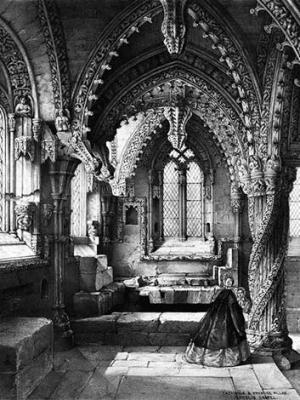 Rosslyn Chapel is famous for appearing in Hollywood blockbuster The Da Vinci Code, as the last resting place of the Holy Grail. The chapel has always been shrouded in legend, mainly concerning hidden treasure hidden within it’s grounds, clues within the ornate carvings, just waiting to be deciphered.
A new book just published claims to have found the real purpose of the 15th Century building. Following years of research the authors Alan Butler and John Ritchie came to conclusion that the chapel was built as a shrine – for the safe keeping for the skull of St Mathew. The skull had been smuggled from France for safe keeping. Religious artefacts were much sought-after, especially those with a direct link to Jesus.
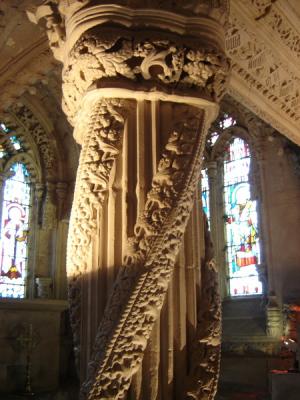
The Apprentice Pillar
The chapel is covered in amazing carvings, within these are clues to the chapel being a safe house for the skull of St Mathew. There is a beautiful ornate pillar known as The Apprentice Pillar, it has the representation of a miraculous honey laden tree that is associated with St Mathew.
In fact the whole building is designed so that honey from beehives hidden in the buttress roof dripped down onto the altar. Builders working on the Chapel had been shocked to find a 600-year-old bee hive built into the stones. “There has been so much written about Rosslyn Chapel and what the carvings mean,” says Butler. “But it does not stretch credibility that the chapel represents this story about St Mathew. Every single detail fits. “What we are saying is what is the most likely explanation. The chapel was built as a giant reliquary for the skull of St Mathew.”
The post The Real Treasure of Rosslyn Chapel appeared first on ScotClans | Scottish Clans.
]]>