<br />
<b>Deprecated</b>:  mysql_connect(): The mysql extension is deprecated and will be removed in the future: use mysqli or PDO instead in <b>/var/www/apps/scotclans_wp/wp-includes/wp-db.php</b> on line <b>1142</b><br />
<?xml version="1.0" encoding="UTF-8"?>
<rss version="2.0"
	xmlns:content="http://purl.org/rss/1.0/modules/content/"
	xmlns:wfw="http://wellformedweb.org/CommentAPI/"
	xmlns:dc="http://purl.org/dc/elements/1.1/"
	xmlns:atom="http://www.w3.org/2005/Atom"
	xmlns:sy="http://purl.org/rss/1.0/modules/syndication/"
	xmlns:slash="http://purl.org/rss/1.0/modules/slash/"
	>

<channel>
	<title>ScotClans &#124; Scottish Clans &#187; James IV</title>
	<atom:link href="http://109.74.200.198/category/scottish-history/scottish-kings-and-queens/house-of-stewart/james-iv/feed/" rel="self" type="application/rss+xml" />
	<link>http://109.74.200.198</link>
	<description></description>
	<lastBuildDate>Fri, 20 Jan 2017 08:08:09 +0000</lastBuildDate>
	<language>en-US</language>
	<sy:updatePeriod>hourly</sy:updatePeriod>
	<sy:updateFrequency>1</sy:updateFrequency>
	<generator>http://wordpress.org/?v=3.6.1</generator>
		<item>
		<title>Who Was St Ninian?</title>
		<link>http://109.74.200.198/who-was-st-ninian/</link>
		<comments>http://109.74.200.198/who-was-st-ninian/#comments</comments>
		<pubDate>Mon, 13 Sep 2010 15:44:31 +0000</pubDate>
		<dc:creator>Amanda Moffet</dc:creator>
				<category><![CDATA[James IV]]></category>
		<category><![CDATA[Robert I]]></category>
		<category><![CDATA[Scottish News]]></category>
		<category><![CDATA[St Ninian]]></category>

		<guid isPermaLink="false">http://www.scotclans.com/bletherskite/?p=2294</guid>
		<description><![CDATA[<p>Scotland is to welcome Pope Benedict XVI for his first visit to Britain on 16 September, which is St Ninian&#8217;s Day. The Pope begins his visit in Edinburgh, where a St Ninian&#8217;s Day parade will welcome him to the city. But who exactly was Saint Ninian, and what was his historical significance? The precise details [&#8230;]</p>
<p>The post <a rel="nofollow" href="http://109.74.200.198/who-was-st-ninian/">Who Was St Ninian?</a> appeared first on <a rel="nofollow" href="http://109.74.200.198">ScotClans | Scottish Clans</a>.</p>
]]></description>
				<content:encoded><![CDATA[<div id="attachment_2308" class="wp-caption alignright" style="width: 234px"><a href="http://www.letsbuyscottish.com/wp-content/uploads/2010/09/st_-ninian1.jpg" data-lightboxplus="lightbox[2294]" title="Pilgrims continue to visit Ninian's tomb in Whithorn"><img class="size-full wp-image-2308" title="Pilgrims continue to visit Ninian's tomb in Whithorn" alt="Pilgrims continue to visit Ninian's tomb in Whithorn" src="http://www.letsbuyscottish.com/wp-content/uploads/2010/09/st_-ninian1.jpg" width="224" height="299" /></a><p class="wp-caption-text">Pilgrims continue to visit Ninian&#8217;s tomb in Whithorn</p></div>
<p>Scotland is to welcome Pope Benedict XVI for his first visit to Britain on 16 September, which is St Ninian&#8217;s Day.</p>
<p>The Pope begins his visit in Edinburgh, where a St Ninian&#8217;s Day parade will welcome him to the city.</p>
<p>But who exactly was Saint Ninian, and what was his historical significance?</p>
<p>The precise details of Ninian&#8217;s life are disputed.</p>
<p>The Catholic Church described him as the man from south west Scotland &#8220;who first brought the Christian faith&#8221; to the country around 397AD, when he is said to have established a religious community at Whithorn in Galloway.</p>
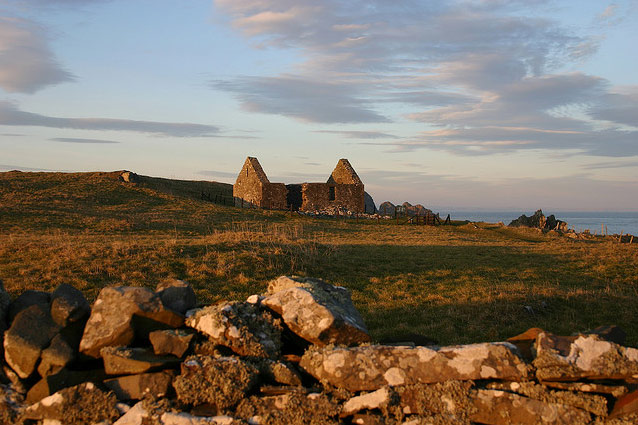
<div id="attachment_39371" class="wp-caption aligncenter" style="width: 648px"><a href="/wp-content/uploads/2010/09/stninian21.jpg" data-lightboxplus="lightbox[2294]" title="Who Was St Ninian?"><img class="size-full wp-image-39371" alt="St Ninian's Chapel" src="/wp-content/uploads/2010/09/stninian21.jpg" width="638" height="425" /></a><p class="wp-caption-text">St Ninian&#8217;s Chapel</p></div>
<div id="attachment_39370" class="wp-caption aligncenter" style="width: 651px"><a href="/wp-content/uploads/2010/09/st-ninian11.jpg" data-lightboxplus="lightbox[2294]" title="Who Was St Ninian?"><img class="size-full wp-image-39370" alt="St Ninians" src="/wp-content/uploads/2010/09/st-ninian11.jpg" width="641" height="426" /></a><p class="wp-caption-text">St Ninian&#8217;s Chapel</p></div>
<p>The church said Ninian studied in Rome before being ordained a bishop.</p>
<p>His monastery in the south of Scotland was known as Candida Casa, from the Latin meaning &#8220;White House&#8221;. The name possibly refers to the stone used to construct it or the whitewash used to paint it, and has survived as the modern name, Whithorn.</p>
<p>It was from this base that he is said to have set about proclaiming the Gospel to the southern Picts.</p>
<p>The first historical reference to Ninian of Whithorn came from the Northumbrian scholar and monk Bede, in his Ecclesiastical History of the English People, written around 731.</p>
<p>&#8216;Traditional&#8217; information</p>
<p>He described him as a Briton who was instructed in Rome and noted that his church was made of stone, which was unusual at the time.</p>
<p>Bede said Ninian named his episcopal see after Saint Martin of Tours, although other accounts claim he actually met the French patron saint on his return to Scotland.</p>
<p>The historian conceded he was only passing on &#8220;traditional&#8221; information in his brief reference to Ninian, and does not claim it is factual.</p>
<p>In the 12th Century, Aelred, the abbot of Rievaulx in Yorkshire, wrote A Life of Saint Ninian &#8211; thought to be at the behest of one of the new bishops of Galloway, who was eager to promote their bishopric to the wider world.</p>
<p>Aelred attributed 10 miracles to Ninian, six during the saint&#8217;s lifetime and four after his death.</p>
<p>Whatever the truth of Ninian&#8217;s life, over the centuries his tomb at Whithorn became one of the centres of Christian pilgrimage.</p>
<p>It was also an important place of worship for the Scots royal family. In the 14th Century it is said a dying <a href="/scotland/kings-queens/1306-robert1/">King Robert the Bruce</a> went there to pray for a cure from leprosy.</p>
<p>Two centuries later, <a href="/scotland/kings-queens/1488-james4/">King James IV</a> spent eight days walking to the shrine, and is said to have distributed money to the poor as he travelled.</p>
<p>When the visit of Pope Benedict was confirmed, Scotland&#8217;s most senior Catholic, Cardinal Keith Patrick O&#8217;Brien, said he wanted to resurrect the festivities that used to surround St Ninian&#8217;s Day.</p>
<p>He suggested organising &#8220;a grand Scottish spectacle to welcome Benedict XVI&#8221;.</p>
<p>This spectacle will be the St Ninian&#8217;s Day Parade, where more than 1,000 pipers will play as the Pope travels through the Scottish capital.</p>
<p>Hundreds of children from the 14 Scottish schools named after St Ninian, including Episcopalian and non-denominational schools, will take part.</p>
<p>The post <a rel="nofollow" href="http://109.74.200.198/who-was-st-ninian/">Who Was St Ninian?</a> appeared first on <a rel="nofollow" href="http://109.74.200.198">ScotClans | Scottish Clans</a>.</p>
]]></content:encoded>
			<wfw:commentRss>http://109.74.200.198/who-was-st-ninian/feed/</wfw:commentRss>
		<slash:comments>0</slash:comments>
		</item>
		<item>
		<title>Stewart Stamp Series Issued by Royal Mail</title>
		<link>http://109.74.200.198/stewart-stamp-series-issued-by-royal-mail/</link>
		<comments>http://109.74.200.198/stewart-stamp-series-issued-by-royal-mail/#comments</comments>
		<pubDate>Tue, 23 Mar 2010 14:32:43 +0000</pubDate>
		<dc:creator>donald</dc:creator>
				<category><![CDATA[House of Stewart]]></category>
		<category><![CDATA[James I]]></category>
		<category><![CDATA[James II]]></category>
		<category><![CDATA[James III]]></category>
		<category><![CDATA[James IV]]></category>
		<category><![CDATA[James V]]></category>
		<category><![CDATA[James VI]]></category>
		<category><![CDATA[Mary I]]></category>
		<category><![CDATA[Scottish News]]></category>
		<category><![CDATA[Stewart]]></category>

		<guid isPermaLink="false">http://www.scotclans.com/bletherskite/?p=1768</guid>
		<description><![CDATA[<p>A new series of stamps by the Royal Mail have been issued, depicting the Stewart monarchs who ruled Scotland between 1406 and 1603, the year of the Union of the Crowns. The series starts with James I (1406-1437) and stops at James VI (1567-1603) who went on the become the king of England, uniting to [&#8230;]</p>
<p>The post <a rel="nofollow" href="http://109.74.200.198/stewart-stamp-series-issued-by-royal-mail/">Stewart Stamp Series Issued by Royal Mail</a> appeared first on <a rel="nofollow" href="http://109.74.200.198">ScotClans | Scottish Clans</a>.</p>
]]></description>
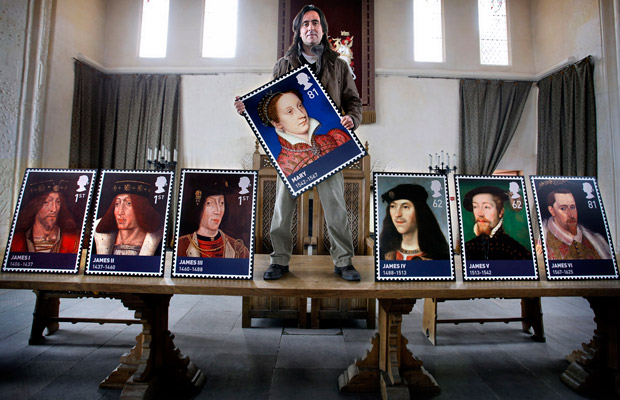
				<content:encoded><![CDATA[<div id="attachment_39488" class="wp-caption aligncenter" style="width: 630px"><a href="/wp-content/uploads/2010/03/stewartstamps1.jpg" data-lightboxplus="lightbox[1768]" title="Stewart Stamp Series Issued by Royal Mail"><img class="size-full wp-image-39488" alt="Neil Oliver with the stamps" src="/wp-content/uploads/2010/03/stewartstamps1.jpg" width="620" height="400" /></a><p class="wp-caption-text">Neil Oliver with the stamps</p></div>
<p>A new series of stamps by the Royal Mail have been issued, depicting the <a href="http://www.scotclans.com/scotland/kings-queens/the-house-of-stewart/" target="_blank">Stewart</a> monarchs who ruled Scotland between 1406 and 1603, the year of the <a href="http://www.scotclans.com/scotland/scottish-history/scottish-unification/1603-union/" target="_blank">Union of the Crowns</a>.</p>
<p>The series starts with <a href="/scotland/kings-queens/1406-james1/">James I </a>(1406-1437) and stops at <a href="/scotland/kings-queens/1567-james6/" target="_blank">James VI</a> (1567-1603) who went on the become the king of England, uniting to the two kingdoms, after the death of Elizabeth I. <a href="http://www.scotclans.com/scotland/kings-queens/1542-mary/" target="_blank">Queen Mary</a>, one of Scotland&#8217;s most famous monarchs, will also appear, in the series, and it will be her first time depicted on a stamp.</p>
<p>The series was launched by archaeologist and TV historian Neil Oliver at Stirling Castle. Along with images of seven of the nine Stewart monarchs, stamps representing significant events during this 200 year period, including the founding of the University of St Andrews in 1413 and an image of the religious leader John Knox will also feature.</p>
<p>Neil Oliver commented on the stamps, saying, &#8220;Mary, Queen of Scots is obviously the most famous and colourful of the Stewart monarchs and it is wonderful to see her represented on a stamp.</p>
<p>&#8220;I&#8217;m delighted that Royal Mail is helping bring history to life through its series of stamps celebrating the history of Britain&#8217;s Kings and Queens.&#8221;</p>
<p>The director of Scottish affairs for Royal Mail Group, Ian McKay, also commented: &#8220;These stamps will be popular with anyone who is interested in Scottish history and I hope they can add to the good work done by places like Stirling Castle to preserve and pass on Scotland&#8217;s heritage.&#8221;</p>
<p>The post <a rel="nofollow" href="http://109.74.200.198/stewart-stamp-series-issued-by-royal-mail/">Stewart Stamp Series Issued by Royal Mail</a> appeared first on <a rel="nofollow" href="http://109.74.200.198">ScotClans | Scottish Clans</a>.</p>
]]></content:encoded>
			<wfw:commentRss>http://109.74.200.198/stewart-stamp-series-issued-by-royal-mail/feed/</wfw:commentRss>
		<slash:comments>0</slash:comments>
		</item>
		<item>
		<title>Thomas the Rhymer</title>
		<link>http://109.74.200.198/thomas-the-rhymer/</link>
		<comments>http://109.74.200.198/thomas-the-rhymer/#comments</comments>
		<pubDate>Thu, 10 Sep 2009 14:56:11 +0000</pubDate>
		<dc:creator>donald</dc:creator>
				<category><![CDATA[House of Bruce]]></category>
		<category><![CDATA[House of Stewart]]></category>
		<category><![CDATA[James IV]]></category>
		<category><![CDATA[James VI]]></category>
		<category><![CDATA[Learmonth]]></category>
		<category><![CDATA[Robert I]]></category>
		<category><![CDATA[Scottish Myths]]></category>
		<category><![CDATA[Fairy]]></category>
		<category><![CDATA[Myth]]></category>
		<category><![CDATA[Thomas the Rymer]]></category>
		<category><![CDATA[Union of the Crowns]]></category>

		<guid isPermaLink="false">http://www.scotclans.com/bletherskite/?p=909</guid>
		<description><![CDATA[<p>Thomas Learmonth from Ercildoune (now Earlston), better known as Thomas the Rhymer was a 13th century Laird, poet and a supposed prophet. Legend tells us how Thomas the Rhymer went out walking one day and fell asleep beneath a tree on the side of the Eildon Hills. He awoke to find a shining woman sitting [&#8230;]</p>
<p>The post <a rel="nofollow" href="http://109.74.200.198/thomas-the-rhymer/">Thomas the Rhymer</a> appeared first on <a rel="nofollow" href="http://109.74.200.198">ScotClans | Scottish Clans</a>.</p>
]]></description>
				<content:encoded><![CDATA[<div id="attachment_60705" class="wp-caption aligncenter" style="width: 510px"><img src="http://www.scotclans.com/wp-content/uploads/2009/09/thomas.jpg" alt="ddd" width="500" height="402" class="size-full wp-image-60705" /><p class="wp-caption-text">Thomas meeting the Queen of the Fairies</p></div>
<p>Thomas <a href="http://www.scotclans.com/scottish-clans/clan-learmonth/">Learmonth</a> from Ercildoune (now Earlston), better known as Thomas the Rhymer was a 13th century Laird, poet and a supposed prophet.</p>
<p>Legend tells us how Thomas the Rhymer went out walking one day and fell asleep beneath a tree on the side of the Eildon Hills. He awoke to find a shining woman sitting on a grey horse at his side. This woman turned out to be the Queen of the Fairies. It was of no coincidence that they met, as it was Thomas that the queen seeked to meet. Thomas was struck by the Queen&#8217;s beauty and immediately fell in love with her and she asked him to kiss her, right under his favourite Eildon tree. The Queen asked Thomas if he would go back with her to the Land of the Fairies to be her lover and he agreed.</p>
<p>Thomas stayed with the fairies for what felt like three days, but was in fact seven years.</p>
<p>When he left the Queen, as a sign of her love for him, she gave Thomas the gift of poetry, of always speaking the truth (which apparently Thomas protested against), and the gift of prophecy.</p>
<p>Thomas made a lot of predictions, which he put into rhyme, about significant events that were to happen to Scotland.</p>
<p>Some of the prophecies attributed to Thomas the Rhymer:</p>
<p><em>&#8220;</em><em>On the morrow, afore noon, shall blow the greatest wind that ever was heard in Scotland.&#8221;</em></p>
<p>This apparently predicts the death of Alexander III in 1286 who died the day after Thomas said it. The Scottish king was killed on a stormy night when travelling from Edinburgh Castle to see his queen in Kinghorn, Fife, and it is believed that his horse lost it&#8217;s footing in the dark and the king was found the following morning on the shore with a broken neck. Alexander died without an heir.</p>
<p><em>&#8220;At Eildon tree, if yon shall be, a brig ower Tweed yon there may see.&#8221;</em></p>
<p>From the Eildon tree that Thomas is talking about you can now, in fact, see a bridge which crosses the river Tweed.<br />
<div id="attachment_60708" class="wp-caption aligncenter" style="width: 505px"><img src="http://www.scotclans.com/wp-content/uploads/2009/09/monument.jpg" alt="dd" width="495" height="311" class="size-full wp-image-60708" /><p class="wp-caption-text">A monument to Thomas the Rhymer</p></div></p>
<p>Other supposed predictions that were made by Thomas which have since come true are the succession of <a href="/scotland/kings-queens/1306-robert1/">Robert the Bruce</a> to the Scottish throne; Scotland&#8217;s decisive loss to the English at the <a href="/scotland/scottish-history/renaissance-scotland/1513-flodden/">Battle of Flodden Field in 1513</a>, at which Scotland&#8217;s <a href="/scotland/kings-queens/1488-james4/">James IV</a> was killed; and he foresaw the <a href="http://www.scotclans.com/scotland/scottish-history/scottish-unification/1603-union/">union of the Scottish and English crowns</a> which occured in 1603. Thomas allegedly said that when the Tweed flooded into Merlin&#8217;s grave, Scotland and England would have one king. Initally it seemed that this prophecy had turned out incorrect, but  on the day of <a href="/scotland/kings-queens/1567-james6/">James VI</a>&#8216;s coronation the supposed grave of Merlin in Drumelzier flooded with water from the Tweed.</p>
<p>Thomas went on and lived the rest of his life in the real world, until one day when it is said that Thomas finally went back to see his lover in the Land of the Fairies after he went out for a walk and was never seen again.</p>
<p>In the 17th century, a Scottish <a href="http://www.scotclans.com/scottish-clans/clan-learmonth/">Learmonth</a> settled in Russia, and the famous 19th century Russian romantic writer and poet, Mikhail Lermontov (1814-1841) claimed to be a descendent of this Learmonth. Lermontov was thought of as the most important poet in Russia after the death of Alexander Pushkin in 1837 and it has been claimed, however never proven, that Lermontov is related to Thomas the Rhymer.</p>
<p>The post <a rel="nofollow" href="http://109.74.200.198/thomas-the-rhymer/">Thomas the Rhymer</a> appeared first on <a rel="nofollow" href="http://109.74.200.198">ScotClans | Scottish Clans</a>.</p>
]]></content:encoded>
			<wfw:commentRss>http://109.74.200.198/thomas-the-rhymer/feed/</wfw:commentRss>
		<slash:comments>2</slash:comments>
		</item>
	</channel>
</rss>