The post The Battle of Baugé appeared first on ScotClans | Scottish Clans.
]]>
Battle of Baugé
Background:
The Battle was part of the ‘Hundred Years War’ between England and France. In 1419 King Henry V of England had turned the course of the war at Agincourt, a battle that has become synonymous with Anglo French ‘sparring’ ever since. There had been a formal alliance between France and Scotland since 1295, known as the ‘Auld Alliance’ though the ties between the two nations goes back much further, indeed the tradition of a ‘Guarde Eccosais’ goes back to the time of Charlemagne.
After Agincourt the French were in disarray. Charles VI of France was mad, and his heir, the future Charles VII, was only sixteen. Normandy was lost to the English and the Dukes of Burgundy were taking Paris. With the situation getting desperate the Dauphin appealed to Scotland for help.
King James I of Scotland was imprisoned by the English and the country was being ruled in his place by Robert Stewart, first duke of Albany. Albany decided to send a force of 6,000 volunteers to France under the command of Archibald Douglas, earl of Wigtown and Albany’s second son John Steward, third earl of Buchan. A fleet of ships from Castile reached Scotland in September 1419, and on 29 October 1419 the Scottish army reached the Dauphin’s court at Bourges.
The Scots made up by far the largest component of the Dauphin’s defensive forces in the Loire Valley. The English army still recording successes in France was commanded by Henry V’s oldest brother Thomas of Lancaster, duke of Clarence. Estimates of the strength of this force vary from between 7,000 to 12,000 men, a considerable number of which were drawn from the English nobility.
In March 1421 Clarence led a series of raids through the Anjou and Maine and by Good Friday they were camped near the little town of Vieil-Baugé where their progress was halted by the Franco-Scots army who had also arrived in the area. Clarence was keen to engage them but some of his forces were dispersed and also Easter Sunday was unthinkable as a date to start a battle. The following day a party of English who had been on a foraging mission returned to their camp with some captured Scots soldiers, The party had stumbled upon the Scot’s forces and Clarence keen to press his advantage of surprise and also to avoid a conflict on a holy day decided to engage despite his weakened force.
The Battle

Carmichael Clan Crest
Clarence made the fateful decision to attack immediately with a small force of mounted men-at-arms, leaving The earl of Salisbury to gather the other troops who were still out foraging on their return. Clarence headed for the bridge at Baugé, the only crossing available to reach the Scots. It would appear he was desperate to match the exploits of his brother at Agincourt. The Franco-Scots army were largely unprepared for the attack, many were at morning prayers or playing sports. As they attempted to cross the Bridge a small Scottish force nearby raised the alarm and the English were immediately held by a rain of arrows. It took them some time to force a crossing of the river. In his haste he had not brought his own archers and the remainder of this initial force were stretched back along the road.
Despite this Clarence still pressed forward towards the village, only to be met by the main bulk of the Scots and French who were concealed behind a ridge on the approach. The Scots came over the crest and charged headlong at the English army. Clarence was an early casualty. John Carmichael of Douglasdale unhorsed him, breaking his lance in the process – an event which is immortalised in the crest of clan Carmichael. The battle was reduced to a vicious hand to hand melee and its unclear who stuck the final blow that finished off Clarence. Alexander Makcaustelayn (a Lennox highlander), the lord of Fontaines, Charles le Bouteiller and William de Swinton have all been credited with finishing off the King’s brother.
Aftermath
The result was a crushing defeat for the English which set them back on the course of the war, Henry was forced to return to France but he contracted an illness and died during the campaign. Many of the English who had never even made it to the battle were able to escape and the war raged on for many years to come with victories and defeats on both sides.
The Scots Army in France who had been largely criticised by many French before the battle were now seen in an altogether different light and this French guard in later years formed the core of the Royal Scots – the oldest regiment in the British army, honoured for their antiquity by their nickname ‘Pontius Pilate’s Bodyguard’
The post The Battle of Baugé appeared first on ScotClans | Scottish Clans.
]]>The post Drumnacoub – A Bloody Battle in the Far North appeared first on ScotClans | Scottish Clans.
]]>
The Kyle of Tongue
This battle was an internal feud among the men of Clan MacKay but also involved some Sutherland men. A disastrous battle, it led to the loss of many senior members of the clan and most of the belligerents on both sides.
The origins of the battle begin with an ongoing feud between the MacKays and their neighbours the Sutherland Clan. In 1370 the MacKay chief had been murdered by the Sutherlands in Dingwall. This had led to considerable acrimony between both clans as you can imagine and finally in 1426 Angus Du MacKay and his son Neil marched into Sutherland lands to take revenge. They met the Sutherland clan at Harpisdale.
The battle was more or less fought to a stalemate with no clear winner and considerable slaughter on either side. News of the conflict reached James I in Edinburgh. James wasn’t exactly having the easiest of times and frustrated by yet another inter-clan war he rode north to Inverness and demanded that the clan leaders submit to him. Angus duly complied and volunteered his son as a hostage to guarantee his clan’s good behaviour. Neil was taken to the Bass rock. an island prison in the outer Firth of Forth. During his imprisonment he was given the nickname ‘Vass’ a phonetic spelling of ‘Bass’
While this was going on three cousins of Angus Du: the brothers Thomas Mackay, Morgan Mackay, and Neil Neilson Mackay had a dispute with the Laird of Freswick – a man by the name of Mowat. Thomas pursued him to the chapel of St Duffus in the town of Tain. Mowat claimed sanctuary at the chapel but Thomas killed him anyway and burned down the chapel for good measure. As anyone who has followed the fortunes of Robert the Bruce will know murdering someone in a house of worship was a serious breach of etiquette and burning it down was even worse, so once again James I was forced to intervene so he denounced and outlawed Thomas, promising his land and possessions as a reward for his capture dead or alive.
Angus Moray (of Clan Sutherland) apprehended Thomas and handed him over to the law, however there was clear suspicion that Thomas’ own brothers; Morgan and Neil Neilson had assisted Angus Murray for a share of the spoils. Thomas was carted off to Inverness and executed and this apparent betrayal within the clan (made even worse by conspiring with a Sutherland) split the clan.
The Earl of Sutherland – seeing a good opportunity to break the power of the MacKay clan further supported Morgan and Neil Neilson by offering his own daughters in marriage (though they had already married Moray’s daughters). As well as helping them make a bid for the MacKay lands.
Back in Caithness Angus Du and his illegitimate son John Aberach Mackay were in a tight spot. Angus was by now an old man and had no will to fight, preferring to make some sort of settlement with his cousins. He offered all his land apart from Strathnaver but they refused the deal, intending to take all of MacKay lands for themselves. At this point Angus’ illegitimate second son John Aberach Mackay stepped in to advise the elderly chief and offered to defend the MacKay lands or die trying.
Some time between 1427 and 1433 (exact dates are unclear) the two sides met at Drumnacoub (Druim na coub, Drum-ne-coub) a few miles from the coastal village of Tongue on the North East coast.
The battle was a long and terrible one with both sides suffering heavy losses, by the end of the day Neil Mackay, Morgan Mackay and Angus Moray were all dead, John Aberach Mackay was severely wounded (possibly loosing an arm) and lay critical on the battlefield and very few from around 3,000 men (around 1,500 on either side by some estimates) were left standing.
Angus Du in despair asked to be carried to the battlefield to search for his son John but an opportunistic Sutherland archer spotted him and killed him with a well aimed arrow.
Shortly after the battle the remaining MacKay clan had to consider who would succeed as chief. Many supported John despite his illegitimacy but as fortune would have it Neil ‘Vass’ MacKay escaped from imprisonment at the Bass rock and made his way back north (it turned out the governor was married to a MacKay and she possibly helped him break out). John deferred to the legitimate heir and Neil was made chief. John was given lands around Lochnaver.
Neil pursued the Sutherlands who had supported the potential usurpers and a year later took revenge at the Battle of Sandside Chase. The widow of Neil Neilson and his son were given fairly rough treatment at the hands of those loyal to Angus Du’s side and for their own safety the moved to Olrig in Caithness. John dropped the name MacKay and became known as John Bain, progenitor of the Bain Family.
The post Drumnacoub – A Bloody Battle in the Far North appeared first on ScotClans | Scottish Clans.
]]>The post ‘Birth certificate of Scotland’ unearthed by archaeologists appeared first on ScotClans | Scottish Clans.
]]>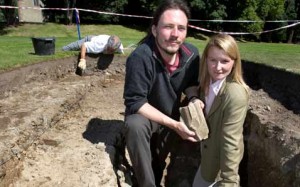
Oliver O’Grady with Suzanne Urquhart of Scone Abbey
The ancient mound known as the Moot Hill in the ground of Scone Palace was once the site of the “lost” abbey of Scone, founded in 1114 by Alexander I, where Scottish kings are believed to have assumed the mantle of power on the Stone of Destiny.
It was revealed yesterday that archaeologists studying the historic site have been able to use radiocarbon dating to push back the origins of the ancient seat of ecclesiastical and royal power to at least 1,000 years ago, in a remarkable breakthrough that has been hailed as uncovering the “birth certificate of Scotland”.
The critical dating evidence came from scientific analysis of carbon samples retrieved during excavations of a massive ditch that once surrounded the Moot Hill.
Dr Oliver O’Grady, the archaeologist who has been leading the excavations at Scone for the past five years, said: “The radiocarbon dates confirm Moot Hill as one of Europe’s extraordinary survivals, unique in Britain and the first assembly-mound in Scotland to be scientifically dated.
“The lab results are in a sense nothing less than a birth certificate for Scotland.”
Dr O’Grady said the radiocarbon dating, carried out by the Scottish Universities Environmental Research Centre laboratories in East Kilbride, had proven beyond doubt the genuine antiquity of Scotland’s ancient inauguration mound.
He said the findings had put paid to the legend that the hill was created by the soil brought to Scone in the shoes of nobility who came to pay homage to Robert the Bruce at his crowning in 1306.
The radiocarbon dating had been based on the samples of burned wood recovered from the base of ditch which surrounds the mound. Dr O’Grady said: “The analysis shows that Moot Hill likely dates to some point between the late ninth century and early 11th century.”
Significantly, the new dating evidence also matches the earliest historical accounts of royal ceremonies being held at Scone contained in a tenth-century chronicle, dating from the reign of King Constantine II, which began in 900.
Dr O’Grady said: “It will probably be debated amongst archaeologists for time to come as to when the hill was first used for a crowning ceremony.
ut it is very striking that the date that we’ve got is so close to the first genuine historical record of Scone in the chronicles of the kings of Alba.
“From a point of probability, until I have other evidence, it seems entirely plausible to me to suggest that King Constantine II, or at least one of his successors, was responsible for the creation of this mound.
“And that should be seen as a very significant moment in Scotland’s history because they are no longer identifying themselves as Picts and they are gathering, as its says in the text ‘in the manner of the Gaels’ and they are holding their most important royal ceremonies on that mound.”
Moot Hill that was centre of power for centuries:
c 700-900 – Scone established as power centre of the Pictish province of Gowrie.
906 – Meeting of Constantine II at Scone with Bishop Cellach of St Andrews.
1114 – Founding of new monastery, with building works continuing over many decades.
1249 – Alexander III inaugurated on Stone of Destiny in abbey cemetery.
1296 – Stone of Destiny (along with other treasures and documents) are removed to Westminster by Edward I.
1298 – Abbey attacked.
1306 – Robert Bruce crowned King of Scots at Scone.
1360s – Abbey in poor state, young canons instructed not to frequent taverns.
1371/1390 – Robert II and Robert III both hold parliaments on Montem (Moot Hill) of Scone.
1400s – Pilgrims attracted to shrine of St Fergus in the abbey church.
1437 – James I assassinated at Blackfriars in Perth.
1551 – Major church repairs.
1559 – Abbey sacked by Protestant reformers.
1606 – Abbey lands granted to David Murray, Lord Stormont.
1618 – Parish church built on Moot Hill.
1631 – 1st Lord Stormont dies, buried in mausoleum on Moot Hill.
1651 – Charles II last king crowned on Moot Hill
The post ‘Birth certificate of Scotland’ unearthed by archaeologists appeared first on ScotClans | Scottish Clans.
]]>The post Stewart Stamp Series Issued by Royal Mail appeared first on ScotClans | Scottish Clans.
]]>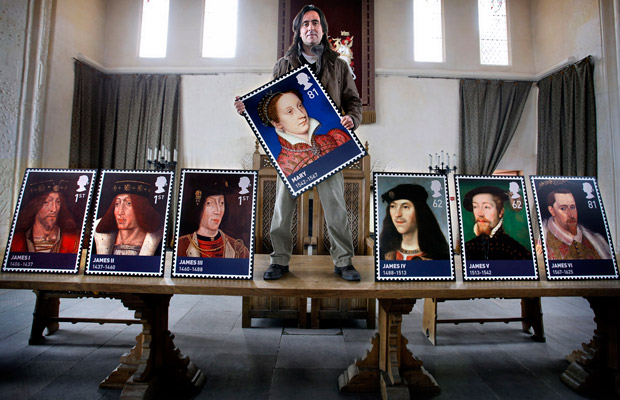
Neil Oliver with the stamps
A new series of stamps by the Royal Mail have been issued, depicting the Stewart monarchs who ruled Scotland between 1406 and 1603, the year of the Union of the Crowns.
The series starts with James I (1406-1437) and stops at James VI (1567-1603) who went on the become the king of England, uniting to the two kingdoms, after the death of Elizabeth I. Queen Mary, one of Scotland’s most famous monarchs, will also appear, in the series, and it will be her first time depicted on a stamp.
The series was launched by archaeologist and TV historian Neil Oliver at Stirling Castle. Along with images of seven of the nine Stewart monarchs, stamps representing significant events during this 200 year period, including the founding of the University of St Andrews in 1413 and an image of the religious leader John Knox will also feature.
Neil Oliver commented on the stamps, saying, “Mary, Queen of Scots is obviously the most famous and colourful of the Stewart monarchs and it is wonderful to see her represented on a stamp.
“I’m delighted that Royal Mail is helping bring history to life through its series of stamps celebrating the history of Britain’s Kings and Queens.”
The director of Scottish affairs for Royal Mail Group, Ian McKay, also commented: “These stamps will be popular with anyone who is interested in Scottish history and I hope they can add to the good work done by places like Stirling Castle to preserve and pass on Scotland’s heritage.”
The post Stewart Stamp Series Issued by Royal Mail appeared first on ScotClans | Scottish Clans.
]]>The post Dropped balls prove fatal for Scotland’s first king appeared first on ScotClans | Scottish Clans.
]]>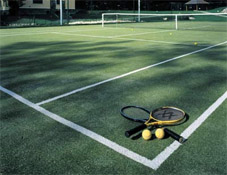
tennis
Having discovered the game of tennis while in captivity as a child, King James I had his own court built when he returned to Scotland in 1424. When he was constantly losing balls down a nearby sewer, he ordered it to be blocked up.
James I had numerous enemies – the nobilty were unhappy with the reforms he tried to introduce, and many questioned his legitamacy to the throne. Assasins were eventually sent to Friars Preachers Monastery in Perth. The king attempted to hide in the sewer, forgetting that it was blocked and was killed by his attackers.
The queen escaped with their son James, who later became king.
The history of tennis in Scotland goes back to the 13th century – it was originally introduced from France and was played by hitting the ball with hands until the 16th century
James I’s court was one of the earliest, but has not survived to the present day.
The post Dropped balls prove fatal for Scotland’s first king appeared first on ScotClans | Scottish Clans.
]]>