The post The Luckenbooth Brooch! appeared first on ScotClans | Scottish Clans.
]]>
The Royal Mile, one of the most famous streets in Edinburgh, runs from the castle all the way down to Holyrood Palace. When Edinburgh castle was first established this was the only accessible route, a natural ramp formed thousands of years ago gave access to a castle otherwise impregnable from the east.
With the establishment of Holyrood palace, or rather the original monastery in the 12th century, the route between the two became an important thoroughfare. Businesses and government offices sprang up as well as several churches such as the magnificent St Giles Cathedral.
 By the 16th century many parts of this route became dedicated to markets and the wide area running down from St Giles towards the Canongate featured some of the city’s first permanent shops. Many of these housed small trade people who made and sold their wares, and among the most popular were the jewellers. The shops themselves were very small and were known as ‘Locked Booths’. From this we get the word ‘Luckenbooth’.
The Luckenbooth brooch became a very popular item in 16th century Scotland. It featured the ‘Heart & Crown of Scotland’ and was romantically linked to the tragic Mary, Queen of Scots as it was the brooch she had given to Lord Darnley.
The style of the Luckenbooth brooch became very popular throughout the UK. By the 18th century the trade in silver to the new world featured the little brooch and many ended up traded with Native Americans, particularly the Iroquois of the Six Nations. As a result of this the Luckenbooth became a popular decorative symbol in their costumes.
The tradition was that the young man would give his lady a Luckenbooth brooch on their wedding day. When their first  child arrived the brooch would then be pinned to the babies shawl to protect it from “evil spirits”. As such it had very similar connotations to the Irish ‘Claddagh’ ring especially with the similar heart shaped theme. This tradition can be carried over to today. A Luckenbooth Brooch makes a fantastic gift for your bride on your wedding day, or a gift for a newborn as a symbol of protection and love. Whatever you pick one up for, it is and always will be an enduring symbol of Edinburgh and of Scotland.

The post The Luckenbooth Brooch! appeared first on ScotClans | Scottish Clans.
]]>The post The Battle of Baugé appeared first on ScotClans | Scottish Clans.
]]>
Battle of Baugé
Background:
The Battle was part of the ‘Hundred Years War’ between England and France. In 1419 King Henry V of England had turned the course of the war at Agincourt, a battle that has become synonymous with Anglo French ‘sparring’ ever since. There had been a formal alliance between France and Scotland since 1295, known as the ‘Auld Alliance’ though the ties between the two nations goes back much further, indeed the tradition of a ‘Guarde Eccosais’ goes back to the time of Charlemagne.
After Agincourt the French were in disarray. Charles VI of France was mad, and his heir, the future Charles VII, was only sixteen. Normandy was lost to the English and the Dukes of Burgundy were taking Paris. With the situation getting desperate the Dauphin appealed to Scotland for help.
King James I of Scotland was imprisoned by the English and the country was being ruled in his place by Robert Stewart, first duke of Albany. Albany decided to send a force of 6,000 volunteers to France under the command of Archibald Douglas, earl of Wigtown and Albany’s second son John Steward, third earl of Buchan. A fleet of ships from Castile reached Scotland in September 1419, and on 29 October 1419 the Scottish army reached the Dauphin’s court at Bourges.
The Scots made up by far the largest component of the Dauphin’s defensive forces in the Loire Valley. The English army still recording successes in France was commanded by Henry V’s oldest brother Thomas of Lancaster, duke of Clarence. Estimates of the strength of this force vary from between 7,000 to 12,000 men, a considerable number of which were drawn from the English nobility.
In March 1421 Clarence led a series of raids through the Anjou and Maine and by Good Friday they were camped near the little town of Vieil-Baugé where their progress was halted by the Franco-Scots army who had also arrived in the area. Clarence was keen to engage them but some of his forces were dispersed and also Easter Sunday was unthinkable as a date to start a battle. The following day a party of English who had been on a foraging mission returned to their camp with some captured Scots soldiers, The party had stumbled upon the Scot’s forces and Clarence keen to press his advantage of surprise and also to avoid a conflict on a holy day decided to engage despite his weakened force.
The Battle

Carmichael Clan Crest
Clarence made the fateful decision to attack immediately with a small force of mounted men-at-arms, leaving The earl of Salisbury to gather the other troops who were still out foraging on their return. Clarence headed for the bridge at Baugé, the only crossing available to reach the Scots. It would appear he was desperate to match the exploits of his brother at Agincourt. The Franco-Scots army were largely unprepared for the attack, many were at morning prayers or playing sports. As they attempted to cross the Bridge a small Scottish force nearby raised the alarm and the English were immediately held by a rain of arrows. It took them some time to force a crossing of the river. In his haste he had not brought his own archers and the remainder of this initial force were stretched back along the road.
Despite this Clarence still pressed forward towards the village, only to be met by the main bulk of the Scots and French who were concealed behind a ridge on the approach. The Scots came over the crest and charged headlong at the English army. Clarence was an early casualty. John Carmichael of Douglasdale unhorsed him, breaking his lance in the process – an event which is immortalised in the crest of clan Carmichael. The battle was reduced to a vicious hand to hand melee and its unclear who stuck the final blow that finished off Clarence. Alexander Makcaustelayn (a Lennox highlander), the lord of Fontaines, Charles le Bouteiller and William de Swinton have all been credited with finishing off the King’s brother.
Aftermath
The result was a crushing defeat for the English which set them back on the course of the war, Henry was forced to return to France but he contracted an illness and died during the campaign. Many of the English who had never even made it to the battle were able to escape and the war raged on for many years to come with victories and defeats on both sides.
The Scots Army in France who had been largely criticised by many French before the battle were now seen in an altogether different light and this French guard in later years formed the core of the Royal Scots – the oldest regiment in the British army, honoured for their antiquity by their nickname ‘Pontius Pilate’s Bodyguard’
The post The Battle of Baugé appeared first on ScotClans | Scottish Clans.
]]>The post Drumnacoub – A Bloody Battle in the Far North appeared first on ScotClans | Scottish Clans.
]]>
The Kyle of Tongue
This battle was an internal feud among the men of Clan MacKay but also involved some Sutherland men. A disastrous battle, it led to the loss of many senior members of the clan and most of the belligerents on both sides.
The origins of the battle begin with an ongoing feud between the MacKays and their neighbours the Sutherland Clan. In 1370 the MacKay chief had been murdered by the Sutherlands in Dingwall. This had led to considerable acrimony between both clans as you can imagine and finally in 1426 Angus Du MacKay and his son Neil marched into Sutherland lands to take revenge. They met the Sutherland clan at Harpisdale.
The battle was more or less fought to a stalemate with no clear winner and considerable slaughter on either side. News of the conflict reached James I in Edinburgh. James wasn’t exactly having the easiest of times and frustrated by yet another inter-clan war he rode north to Inverness and demanded that the clan leaders submit to him. Angus duly complied and volunteered his son as a hostage to guarantee his clan’s good behaviour. Neil was taken to the Bass rock. an island prison in the outer Firth of Forth. During his imprisonment he was given the nickname ‘Vass’ a phonetic spelling of ‘Bass’
While this was going on three cousins of Angus Du: the brothers Thomas Mackay, Morgan Mackay, and Neil Neilson Mackay had a dispute with the Laird of Freswick – a man by the name of Mowat. Thomas pursued him to the chapel of St Duffus in the town of Tain. Mowat claimed sanctuary at the chapel but Thomas killed him anyway and burned down the chapel for good measure. As anyone who has followed the fortunes of Robert the Bruce will know murdering someone in a house of worship was a serious breach of etiquette and burning it down was even worse, so once again James I was forced to intervene so he denounced and outlawed Thomas, promising his land and possessions as a reward for his capture dead or alive.
Angus Moray (of Clan Sutherland) apprehended Thomas and handed him over to the law, however there was clear suspicion that Thomas’ own brothers; Morgan and Neil Neilson had assisted Angus Murray for a share of the spoils. Thomas was carted off to Inverness and executed and this apparent betrayal within the clan (made even worse by conspiring with a Sutherland) split the clan.
The Earl of Sutherland – seeing a good opportunity to break the power of the MacKay clan further supported Morgan and Neil Neilson by offering his own daughters in marriage (though they had already married Moray’s daughters). As well as helping them make a bid for the MacKay lands.
Back in Caithness Angus Du and his illegitimate son John Aberach Mackay were in a tight spot. Angus was by now an old man and had no will to fight, preferring to make some sort of settlement with his cousins. He offered all his land apart from Strathnaver but they refused the deal, intending to take all of MacKay lands for themselves. At this point Angus’ illegitimate second son John Aberach Mackay stepped in to advise the elderly chief and offered to defend the MacKay lands or die trying.
Some time between 1427 and 1433 (exact dates are unclear) the two sides met at Drumnacoub (Druim na coub, Drum-ne-coub) a few miles from the coastal village of Tongue on the North East coast.
The battle was a long and terrible one with both sides suffering heavy losses, by the end of the day Neil Mackay, Morgan Mackay and Angus Moray were all dead, John Aberach Mackay was severely wounded (possibly loosing an arm) and lay critical on the battlefield and very few from around 3,000 men (around 1,500 on either side by some estimates) were left standing.
Angus Du in despair asked to be carried to the battlefield to search for his son John but an opportunistic Sutherland archer spotted him and killed him with a well aimed arrow.
Shortly after the battle the remaining MacKay clan had to consider who would succeed as chief. Many supported John despite his illegitimacy but as fortune would have it Neil ‘Vass’ MacKay escaped from imprisonment at the Bass rock and made his way back north (it turned out the governor was married to a MacKay and she possibly helped him break out). John deferred to the legitimate heir and Neil was made chief. John was given lands around Lochnaver.
Neil pursued the Sutherlands who had supported the potential usurpers and a year later took revenge at the Battle of Sandside Chase. The widow of Neil Neilson and his son were given fairly rough treatment at the hands of those loyal to Angus Du’s side and for their own safety the moved to Olrig in Caithness. John dropped the name MacKay and became known as John Bain, progenitor of the Bain Family.
The post Drumnacoub – A Bloody Battle in the Far North appeared first on ScotClans | Scottish Clans.
]]>The post Johnnie Armstrong and the Border Reivers appeared first on ScotClans | Scottish Clans.
]]>
Gilnockie Tower
Johnnie Armstrong of Gilnockie was once one of the most popular, powerful, and feared clan chiefs in the Scottish borders. However, after his execution in 1530 by order of James V, Clan Armstrong have been without a chief for over 450 years.
The Border Reivers were a band of raiders along the Scottish-English border from the late 1400s to the beginning of the 1600s, with their heyday arguably during the last 100 years of their existence. They consisted of families from both sides of the border, and one of the most significant and powerful of these border clans was the Armstrongs.
The Armstrongs had a rather uneasy relationship with the Scottish monarchy for a long time, and one of the most notable incidents between the two was the execution of Johnnie Armstrong of Gilnockie along with a number of his men.
Johnnie Armstrong was a popular character who had a lot of followers, and he was also a wealthy man, having amassed great wealth. There has been a lot of speculation as to how Armstrong gained such a fortune in which he was able to maintain his high style of living. It is said that after disappearing for a number of years he reappeared with immense wealth, which allowed him to pay his brother a commission to build Langholm Castle.
It is generally considered that a lot of his fortune came from reiving throughout the lands just south of the border, into England, though there is not a single complaint of reiving recorded. It has also been suggested that Armstrong’s wealth came from piracy.

Langholm Castle today
Some say that Johnnie Armstrong specialised in black mail or black rent, and that there was no town of prominence between his home Gilnockie Tower and Newcastle, that did not pay protection money to him. This protection racket Johnnie had was there to act for security for each town so they would not be attacked by the Border Reivers.
Armstrong’s power and influence was considered an embarrassment to the Scottish monarchy, and this enraged the 17 year old King James V. The Scottish king had already been under some pressure to put an end to the raids that were encroaching south-of-the-border by his English counterpart Henry VIII because they were threatening the peace between the two countries.

Mosspaul – in the narrow defile on the A7 Johnnie and his followers were ambushed on their way to join the King
James V decided that he would hold talks with Johnnie Armstrong, sending a letter to Armstrong inviting him to meet up with the royal hunting party at Carlinrigg Chapel. Johnnie rode north from Gilnockie Tower with his men to Carlinrigg dressed in their fine clothes which was to show their wealth and status, and hoping that they would be well recieved by the king, they were all unarmed. But they were greeted by an ambushed of the king’s accompanying army, which was said to have been 10,000 men strong, and the demonstration of wealth did nothing but infuriate the short tempered and education deprived young James V especially since he was said to not have been dressed as well.
It became clear to Johnnie Armstrong that the king had no intention of holding talks, and knowing that his life was in danger he attempted to bribe the king, and even make reassurances that he never killed a fellow Scotsman. But these promises of wealth did nothing for the king and he ordered the execution of Armstrong and all of his men.
In a final act of defiance it is claimed that Armstrong said directly to James these words,
“I am but a fool to seek grace at a graceless face, but had I known you would have taken me this day, I would have lived in the Borders despite King Harry (Henry VIII) and you both.”
Johnnie Armstrong and his men (figures range between 24, 36, and 50+) were all taken out and hanged from the trees, and then buried in a mass, unmarked grave. It is believed that Armstrong only attended such a meeting with the King because he had given unequivocal assurance that he would be safe. In the king’s official statement he said the reason for the hanging was because Johnnie Armstrong attended their meeting better dressed than himself which was a public display of disrespect for his King.
History states that one of Johnnie Armstrong’s sons managed to escape the scene and fled to England where he settled under a different name. It was not uncommon for some of the border reivers to flee and change there names by either adopting something completely different such as Blackburn or Walker, but they have even been known to have simply just spelt their name backwards to avoid detection. So a blood line of the last Chief of the Armstrong‘s exists.
Even though over the years a lot of the border families fought amongst each other, even to the point of death, whenever one of them was attacked by an outsider they would stand shoulder to shoulder, united. The death of the popular Johnnie Armstrong by James V caused great indignation throughout the border clans. The King’s actions were considered underhand and unjust, especially since Armstrong and his men were unarmed, and the King’s popularity along the borders hit a low.

The mass grave of Johnnie Armstrongs and his followers was discovered

A memorial stone to Johnnie Armstrong
The grave of Johnnie Armstrong and his men remained undiscovered until around 30 years ago when a farmer working the field opposite Carlinrigg Chapel overturned a large stone. The stone was rectangular in shape and had unusal markings. The farmer contacted the Armstrong Association who were excited at the thought that he may have found discovered the final resting place of the infamous Johnnie Armstrong.
A group of dowsers were brought in and positioned at different points of the field. They all set off, each of them finally came to a hot point at the same place -where the stone sat. Archaeologist arrived to survey the area and a mass grave was found at the point of the stone, which contained a large number of men, and it is generally accepted to be the grave of Armstrong and his men.
The border reivers finally came to an end around the time of the Union of the Crowns in 1603. James VI, the grandson of James V, forcefully put an end to the raids by splitting up the families and deporting them to Ulster, or conscripting them off to Holland, or just executing them.
There have been stories as to what happened to Johnnie Armstrong’s vast fortune. One of the most prominent stories is that it is in fact buried at Langholm Castle, under a point where there is a risen part of the ground where a vault could easily be hidden.
Quick Links to Clan Armstrong Products from The Clan Shop
- Armstrong Tartan Tie
- Armstrong Tartan Pocket Square Handkerchief
- Armstrong Tartan Scarves
- Armstrong Tartan Kilts
- Armstrong Clan Crest Badge
- Armstrong Clan Crest Mug
- Armstrong Clan Crest T-Shirts
- Armstrong Clan Crest Belt Buckle
- Armstrong Phone Covers
- Armstrong Tartan
- Armstrong Clan Crest Crystal Glasses
- Armstrong Clan Crest Cufflinks
- Armstrong Clan Crest Sgain Dubh
- Armstrong Clan Crest Kilt Pin
- Armstrong Clan Crest Plaques
The post Johnnie Armstrong and the Border Reivers appeared first on ScotClans | Scottish Clans.
]]>The post Who Was St Ninian? appeared first on ScotClans | Scottish Clans.
]]>
Pilgrims continue to visit Ninian’s tomb in Whithorn
Scotland is to welcome Pope Benedict XVI for his first visit to Britain on 16 September, which is St Ninian’s Day.
The Pope begins his visit in Edinburgh, where a St Ninian’s Day parade will welcome him to the city.
But who exactly was Saint Ninian, and what was his historical significance?
The precise details of Ninian’s life are disputed.
The Catholic Church described him as the man from south west Scotland “who first brought the Christian faith” to the country around 397AD, when he is said to have established a religious community at Whithorn in Galloway.
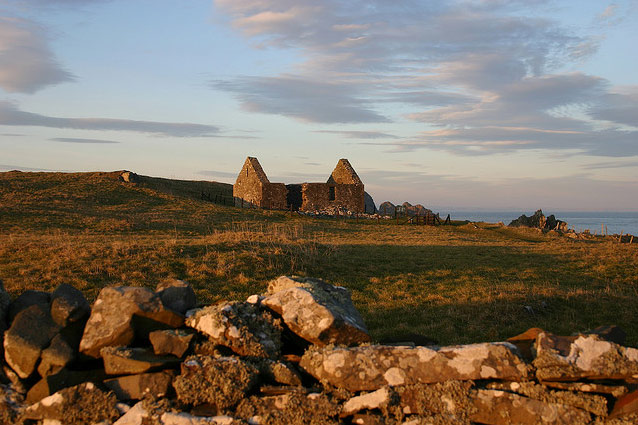
St Ninian’s Chapel

St Ninian’s Chapel
The church said Ninian studied in Rome before being ordained a bishop.
His monastery in the south of Scotland was known as Candida Casa, from the Latin meaning “White House”. The name possibly refers to the stone used to construct it or the whitewash used to paint it, and has survived as the modern name, Whithorn.
It was from this base that he is said to have set about proclaiming the Gospel to the southern Picts.
The first historical reference to Ninian of Whithorn came from the Northumbrian scholar and monk Bede, in his Ecclesiastical History of the English People, written around 731.
‘Traditional’ information
He described him as a Briton who was instructed in Rome and noted that his church was made of stone, which was unusual at the time.
Bede said Ninian named his episcopal see after Saint Martin of Tours, although other accounts claim he actually met the French patron saint on his return to Scotland.
The historian conceded he was only passing on “traditional” information in his brief reference to Ninian, and does not claim it is factual.
In the 12th Century, Aelred, the abbot of Rievaulx in Yorkshire, wrote A Life of Saint Ninian – thought to be at the behest of one of the new bishops of Galloway, who was eager to promote their bishopric to the wider world.
Aelred attributed 10 miracles to Ninian, six during the saint’s lifetime and four after his death.
Whatever the truth of Ninian’s life, over the centuries his tomb at Whithorn became one of the centres of Christian pilgrimage.
It was also an important place of worship for the Scots royal family. In the 14th Century it is said a dying King Robert the Bruce went there to pray for a cure from leprosy.
Two centuries later, King James IV spent eight days walking to the shrine, and is said to have distributed money to the poor as he travelled.
When the visit of Pope Benedict was confirmed, Scotland’s most senior Catholic, Cardinal Keith Patrick O’Brien, said he wanted to resurrect the festivities that used to surround St Ninian’s Day.
He suggested organising “a grand Scottish spectacle to welcome Benedict XVI”.
This spectacle will be the St Ninian’s Day Parade, where more than 1,000 pipers will play as the Pope travels through the Scottish capital.
Hundreds of children from the 14 Scottish schools named after St Ninian, including Episcopalian and non-denominational schools, will take part.
The post Who Was St Ninian? appeared first on ScotClans | Scottish Clans.
]]>The post ‘Birth certificate of Scotland’ unearthed by archaeologists appeared first on ScotClans | Scottish Clans.
]]>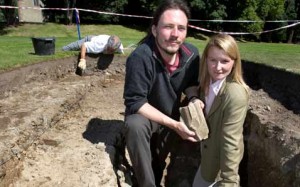
Oliver O’Grady with Suzanne Urquhart of Scone Abbey
The ancient mound known as the Moot Hill in the ground of Scone Palace was once the site of the “lost” abbey of Scone, founded in 1114 by Alexander I, where Scottish kings are believed to have assumed the mantle of power on the Stone of Destiny.
It was revealed yesterday that archaeologists studying the historic site have been able to use radiocarbon dating to push back the origins of the ancient seat of ecclesiastical and royal power to at least 1,000 years ago, in a remarkable breakthrough that has been hailed as uncovering the “birth certificate of Scotland”.
The critical dating evidence came from scientific analysis of carbon samples retrieved during excavations of a massive ditch that once surrounded the Moot Hill.
Dr Oliver O’Grady, the archaeologist who has been leading the excavations at Scone for the past five years, said: “The radiocarbon dates confirm Moot Hill as one of Europe’s extraordinary survivals, unique in Britain and the first assembly-mound in Scotland to be scientifically dated.
“The lab results are in a sense nothing less than a birth certificate for Scotland.”
Dr O’Grady said the radiocarbon dating, carried out by the Scottish Universities Environmental Research Centre laboratories in East Kilbride, had proven beyond doubt the genuine antiquity of Scotland’s ancient inauguration mound.
He said the findings had put paid to the legend that the hill was created by the soil brought to Scone in the shoes of nobility who came to pay homage to Robert the Bruce at his crowning in 1306.
The radiocarbon dating had been based on the samples of burned wood recovered from the base of ditch which surrounds the mound. Dr O’Grady said: “The analysis shows that Moot Hill likely dates to some point between the late ninth century and early 11th century.”
Significantly, the new dating evidence also matches the earliest historical accounts of royal ceremonies being held at Scone contained in a tenth-century chronicle, dating from the reign of King Constantine II, which began in 900.
Dr O’Grady said: “It will probably be debated amongst archaeologists for time to come as to when the hill was first used for a crowning ceremony.
ut it is very striking that the date that we’ve got is so close to the first genuine historical record of Scone in the chronicles of the kings of Alba.
“From a point of probability, until I have other evidence, it seems entirely plausible to me to suggest that King Constantine II, or at least one of his successors, was responsible for the creation of this mound.
“And that should be seen as a very significant moment in Scotland’s history because they are no longer identifying themselves as Picts and they are gathering, as its says in the text ‘in the manner of the Gaels’ and they are holding their most important royal ceremonies on that mound.”
Moot Hill that was centre of power for centuries:
c 700-900 – Scone established as power centre of the Pictish province of Gowrie.
906 – Meeting of Constantine II at Scone with Bishop Cellach of St Andrews.
1114 – Founding of new monastery, with building works continuing over many decades.
1249 – Alexander III inaugurated on Stone of Destiny in abbey cemetery.
1296 – Stone of Destiny (along with other treasures and documents) are removed to Westminster by Edward I.
1298 – Abbey attacked.
1306 – Robert Bruce crowned King of Scots at Scone.
1360s – Abbey in poor state, young canons instructed not to frequent taverns.
1371/1390 – Robert II and Robert III both hold parliaments on Montem (Moot Hill) of Scone.
1400s – Pilgrims attracted to shrine of St Fergus in the abbey church.
1437 – James I assassinated at Blackfriars in Perth.
1551 – Major church repairs.
1559 – Abbey sacked by Protestant reformers.
1606 – Abbey lands granted to David Murray, Lord Stormont.
1618 – Parish church built on Moot Hill.
1631 – 1st Lord Stormont dies, buried in mausoleum on Moot Hill.
1651 – Charles II last king crowned on Moot Hill
The post ‘Birth certificate of Scotland’ unearthed by archaeologists appeared first on ScotClans | Scottish Clans.
]]>The post Border Reivers-Kinmont Willie Armstrong appeared first on ScotClans | Scottish Clans.
]]>Kinmont was well prized by the English who had no answer to his constant raids into northern England. His organised forays south of the English Scottish Border Line, coupled with his contempt for English authority and its hapless attempts to curtail his reiving, had made him enemy number one to the Lord Scropes. They were members of the English aristocracy who, father and son, were Wardens of the English West March from 1561 to 1603.
Kinmont raided Tarset in Tynedale, Northumberland on more than one occasion and was party, in these particularly vicious forays, to the murder of many men. One of these raids was carried out in daylight, unusual in itself as the reivers usually operated at night, and contained over a thousand men from the valleys of southern Scotland. They returned to the Scottish Border valleys with thousands of sheep and cattle and left homelessness and destitution in their wake.
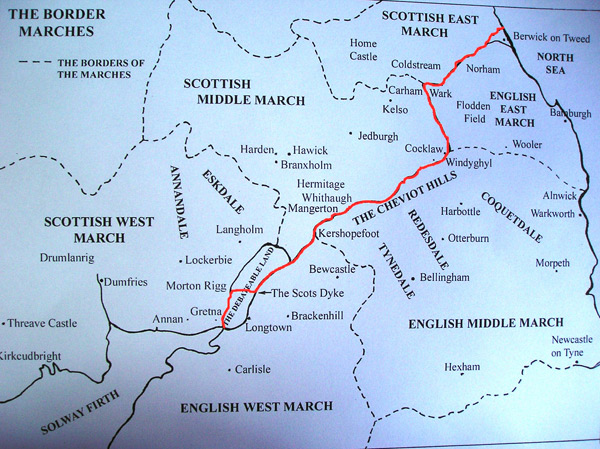
Border Marches showing the Border Line
The ‘Day of Truce’ at the Dayholme of Kershope.
In March 1596 a ‘Day of Truce’ was held near Kershopefoot on the Border of England and Scotland. It was a day purportedly to be held at monthly intervals in each of the East, Middle and West Marches of both countries; a day when felons were brought to the very Border Line to answer for their crimes in an open-air venue. Many men, both English and Scottish, were requested to attend the court and witness that the proceedings were both honourable and fair and upheld the principle and spirit of the Border Law. All who attended were granted safe conduct whilst the Truce lasted through the medium of the ‘Assurance of the Truce’. Such a measure was necessary as both the Scots and English invited to attend as witnesses might, outside the Truce, be at Feud or deadly enemies of each other, the result of previous reiving or family disagreement. Many a man viewed his neighbour of the day with suspicion, hatred or scorn.
Theft of cattle, sheep and ‘insight’, i.e. household and farming goods and tools, were the most common reasons for trial but murder, the result of constant feud and searing animosity against neighbour or enemy from across the Border Line, was ever present. Murder was the inevitable outcome of the hatred that hardened in men’s hearts. It mattered not a whit should such enmity concern a fellow countryman. The product of the Feud often encompassed many generations.
Kinmont Willie is Present at the Truce
Kinmont Willie was called by the Keeper of Liddesdale, Walter Scott of Branxholme and Buccleuch, to attend the ‘Day of Truce’ at the Dayholme of Kershope to represent the Scots. The trials of the Border Reivers on the day went without incident and both Deputy Wardens, presidents of the proceedings, were satisfied that justice had been achieved. Just before sunset both English and Scottish parties began to make their way home. The safe conduct or ‘Assurance’ of the Truce was enshrined in Border Law and lasted until sun-up of the following day. Thereby all who had attended were confident that they could make their way home unmolested by erstwhile enemies who, on this occassion, were required to honour the Law.
Kinmont Willie is Captured by the English.
As Kinmont Willie rode down the Scottish bank of the river Liddel, he was seen by a party of English making their way home on the opposite side of the river, down the English bank. They could not resist the temptation of seeing the greatest Reiver of the age tantalisingly within their grasp. Safe conduct and ‘Assurance’ thrown to the wind, they turned and rode hard across the river Liddel and chased Kinmont down. He was bound and taken to Carlisle castle where he was imprisoned.
War of Words leads to Deadlock
When Buccleuch, Keeper of Liddesdale, learned that Kinmont Willie was in prison as a result of being taken against the honour of the ‘Assurance of the Truce’, he was incandescent with rage. He took no time in writing to the English March Warden, Thomas Lord Scrope, demanding Kinmont’s immediate release. Scrope, like his father Henry before him as Warden, so coveted the neck of the much vaunted Reiver that he refused to succumb to Buccleuch’s forthright petitions. Rather he met the fury with measured indifference and cited more than one spurious reason why he would not comply. Even James Vl of Scotland and Elizabeth l became embroiled in the acrimonious affair.
Eventually tiring of the impasse, Buccleuch resolved to breach the defences of Carlisle castle and rescue Kinmont. He was heartened by the fact that he would have inside help from members of the English garrison of the castle who had tired of Thomas Lord Scrope’s dictatorial rule as well as aid from the premier English clan, the Grahams of Netherby and Mote.
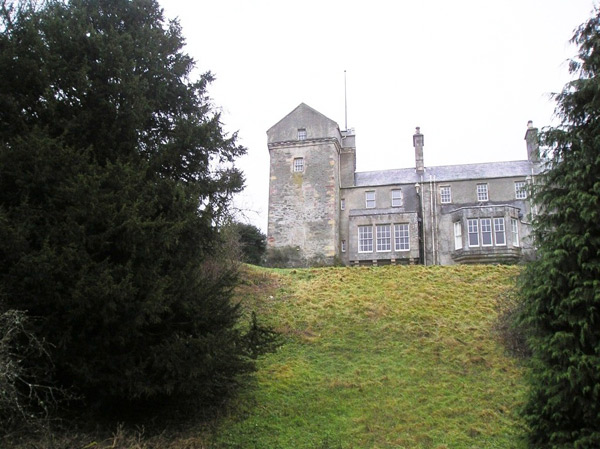
Branxholme-the Nesby Tower-Home of Walter Scott
A Small Rescue Party achieves its Aims
On 13th April 1596 the rescue party led by Buccleuch and consisting mainly of Armstrongs, moved south through English territory to Carlisle. It was a horrendous night of heavy rain and thick cloud. They were adeptly aided by members of the Grahams who had been at odds with the Scropes for years.
The rescue was achieved with an ease that defied logic. A postern gate was opened from the inside by one of the friends of the English Carletons, another family who had vowed to see the end of Thomas Lord Scrope. Having previously been told exactly where Kinmont was warded, the five of the rescue party who entered the castle lost little time in freeing the great Scottish Reiver. The remainder of the rescue band were outside the castle walls banging on drums, blowing trumpets at a strident pitch and making such a discordant noise that the English garrison, already sheltering under coverlets from the veritable downpour, refused to stir. They thought there was an army outside the walls.
Kinmont was soon across the river Eden and heading north sheltered by his comrades in arms. He was to lie low in the valley of the Ewes, north of Langholm.
The Aftermath
Elizabeth l was furious when she received the news of the rescue. How dare any Scot attack one of her premier Border fortresses when peace existed between the two countries? The diplomatic wrangle between various ambassadors and the two monarchs went on for over a year. Elizabeth demanded that Buccleuch be handed over to the English for punishment as he was the one who had orchestrated the affair. James Vl, reluctant to upset his countrymen who to a man applauded Buccleuch’s outrageous actions, refused to do so.
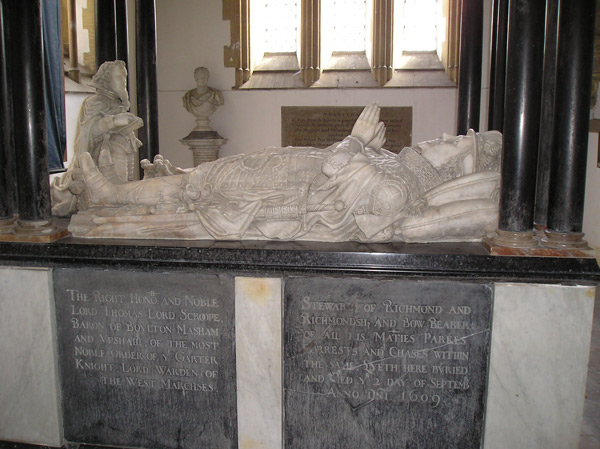
Tomb of Thomas Lord Scrope in the Village of Langar, Nottinghamshire
As was usual in the Borders of the times where a catalogue of crime superceded the event, the heat finally went out of the situation but not before the strained allegiance between England and Scotland was severely tested.
Kinmont Willie? He went on to reive for many another day and died in his bed about 1603.
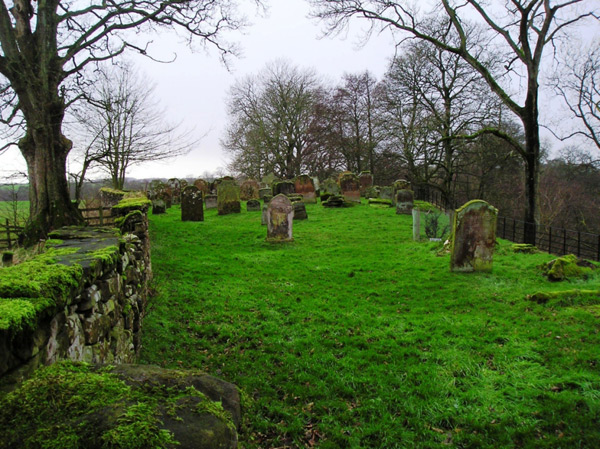
Sark Churchyard-Burial Place of Kinmont Willie.
Sark Churchyard-Burial Place of Kinmont Willie.
Quick Links to Clan Armstrong Products from The Clan Shop
- Armstrong Tartan Tie
- Armstrong Tartan Pocket Square Handkerchief
- Armstrong Tartan Scarves
- Armstrong Tartan Kilts
- Armstrong Clan Crest Badge
- Armstrong Clan Crest Mug
- Armstrong Clan Crest T-Shirts
- Armstrong Clan Crest Belt Buckle
- Armstrong Phone Covers
- Armstrong Tartan
- Armstrong Clan Crest Crystal Glasses
- Armstrong Clan Crest Cufflinks
- Armstrong Clan Crest Sgain Dubh
- Armstrong Clan Crest Kilt Pin
- Armstrong Clan Crest Plaques
The post Border Reivers-Kinmont Willie Armstrong appeared first on ScotClans | Scottish Clans.
]]>The post Stewart Stamp Series Issued by Royal Mail appeared first on ScotClans | Scottish Clans.
]]>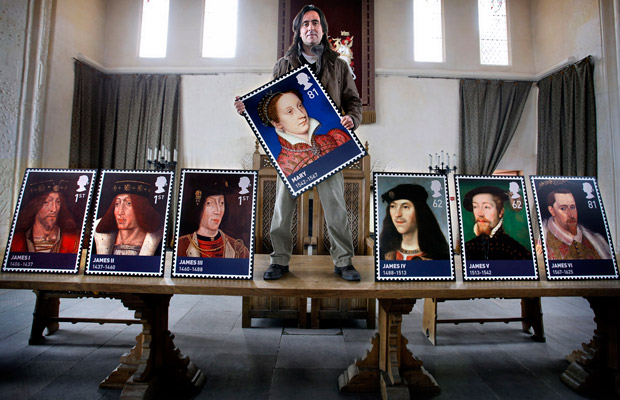
Neil Oliver with the stamps
A new series of stamps by the Royal Mail have been issued, depicting the Stewart monarchs who ruled Scotland between 1406 and 1603, the year of the Union of the Crowns.
The series starts with James I (1406-1437) and stops at James VI (1567-1603) who went on the become the king of England, uniting to the two kingdoms, after the death of Elizabeth I. Queen Mary, one of Scotland’s most famous monarchs, will also appear, in the series, and it will be her first time depicted on a stamp.
The series was launched by archaeologist and TV historian Neil Oliver at Stirling Castle. Along with images of seven of the nine Stewart monarchs, stamps representing significant events during this 200 year period, including the founding of the University of St Andrews in 1413 and an image of the religious leader John Knox will also feature.
Neil Oliver commented on the stamps, saying, “Mary, Queen of Scots is obviously the most famous and colourful of the Stewart monarchs and it is wonderful to see her represented on a stamp.
“I’m delighted that Royal Mail is helping bring history to life through its series of stamps celebrating the history of Britain’s Kings and Queens.”
The director of Scottish affairs for Royal Mail Group, Ian McKay, also commented: “These stamps will be popular with anyone who is interested in Scottish history and I hope they can add to the good work done by places like Stirling Castle to preserve and pass on Scotland’s heritage.”
The post Stewart Stamp Series Issued by Royal Mail appeared first on ScotClans | Scottish Clans.
]]>The post The Maxwell Johnstone Feud-The Theft of Ane Black Horse and the Aftermath appeared first on ScotClans | Scottish Clans.
]]>Whilst the culmination of the feud would result in the Battle of Dryfe Sands which has already been well recorded in these articles, it is more than interesting to consider the events which would lead up to the battle, the biggest family ‘set to’ in British history.

THE FORLORN REMAINS OF LOCHWOOD TOWER. HOME OF THE JOHNSTONES.
The most powerful position in the Border Country during the turbulent times of the Border Reiver was that of March Warden. In the Scottish south-west it was a post which brought a spurious legality to the nefarious activities of the Maxwells and Johstones who vied with each other for decades to rule supreme in the Scottish West March.
The role of Warden was consigned on a too frequent basis from one to the other of the great Border warlords, Maxwell and Johnstone with the result that the Scottish south-west experienced nothing but upheaval, death and mayhem.
At one time, when the King appointed a Johnstone, the Maxwell Laird told his clan and followers to ignore the dictates of the new Warden. At another a Johnstone laird died, it is said, heartbroken that yet again Maxwell was to take the role.
There are thus many recorded instances of the hatred that existed between the two families during the sixteenth century but none would compare with the events that unfolded from the stealing of ‘ane black horse’.
In 1593 a small party of Johnstones, five in all, made their way to the head of Nithsdale in the twilight of a July evening, to the Crichton stronghold there, and stole a black mare from the stables. The theft was witnessed by Lord Crichton and his followers who immediately pursued the Johnstone raiders.
Whilst four of the five Johnstones easily evaded pursuit, their trustworthy nags more than a match for the uneven and rocky ground which confronted them in their descent down the valley, one, known as the ‘Galliard’, not content with stealing the black mare, had determined to ride it home to Wamphrey in Annandale. He little knew that the fine looking beast was partially blind and that it would stumble and fret and be unsure of its footing as he spurred it into action to distance himself from the chase.
He was soon ridden down, bound to his horse, and conveyed to the nearest tree where he was hanged without any ceremony.
The other four Johnstones, hiding nearby, witness to the summary justice and now led by Willie of Kirkhill, vowed vengeance for the death of one of their own.
Within a short time, without informing their leader, James Johnstone of Dunskellie, they had raided Crichton lands, burned farms and villages, stolen insight (household and farming gear) and murdered fifteen of the Crichton clansmen. The offenders then went into hiding, miles from their homelands of Wamphrey.
Lord Crichton, well aware of both the advantages and limitations of the Border Law, sought redress through advances to his March Warden John, Lord Maxwell.
Sir James Johnstone, holder of a special commission from the King for exacting justice among his own clan, vowed to try his recalcitrant kinsmen himself. He refused to hand them over to the Maxwells.
Though Maxwell had previously been keen to see an end to the Johnstones of Annandale, he was reluctant to act without due consideration of the amity that now existed between the two clans. Before the present trouble it seemed that their differences would be resolved thus he called for time to seriously consider the matter.
Crichton was infuriated at the dalliance and journeyed to Edinburgh to petition the King, James VI. He well knew of James’ penchant for prevarication, and seizing the issue with both hands, he advertised the crimes of the Johnstone clan in a novel way to the common folk of Edinburgh.
He spoke loudly and vehemently at the Mercat Cross, inviting the populace to listen to his plea for justice. Moreover, within his followers from Sanquar, were the wives and girl friends of the fifteen men who had been murdered in the Johnstone raids on his lands in reprisal for the hanging of the ‘Galliard’. They brought out the blood-stained sarks (shirts) of the dead ones and paraded them up to the castle and back to Holyrood House. By the time they arrived there, many of the Edinburgh folk had joined the throng. All bayed for justice.
James VI was now quick to act and a proclamation at the Mercat Cross seemed to seal the fate of Sir James Johnstone. The King demanded that Johnstone hand himself over to Maxwell before trial in Edinburgh. Should he refuse to be taken then Maxwell was given a free hand to use what force he saw fit.
Matters took a new turn when the Lairds of Closeburn, Lag, Drumlanrig and the Crichtons offered to be bonded to Maxwell in ‘manrent’ , in effect become his vassals. They were prepared to do this because, whilst outwardly throwing their force behind Maxwell and thus adding to his already almost omnipotent hold on the south-west of Scotland , they, themselves, wished to see an end to all the Johnstones of Annandale.
Maxwell signed the deeds of manrent yet was not happy with his decision.

CAERLAVEROCK CASTLE. STRONGHOLD OF THE MAXWELLS.
It was all to come to a head and lead to the Battle of Dryfe Sands when the parchment detailing the agreement between Maxwell and the scheming Lairds was found by a kitchen maid. She could not read but was entranced by the flowery writing and the magnificent colours used. Rather than burn it she took it to her uncle who recognised the name Johnstone on the parchment. Very soon it was in Sir James’ hands.
The die was cast. The result – the humiliation of the Maxwells at the ensuing battle. The story was not to end with Dryfe Sands in 1593.
Fifteen years later in 1608, the son of the John, Lord Maxwell, who was to die at Dryfe Sands held out the hand of friendship to Sir James Johnstone, still at that time, head of the clan, and requested that the latter meet him to resolve their differences.
There were only four men present; Maxwell, Johnstone and a servant of each. The servants drew aside whilst Maxwell and Johnstone talked of how to overcome the animosity which presided over the two clans.
All of a sudden the two servants started to argue and Johnstone walked towards them to intervene in their differences. As he moved he had his back to Maxwell who pulled a pistol from beneath his cloak and shot Johnstone twice in the back. He fell dead.
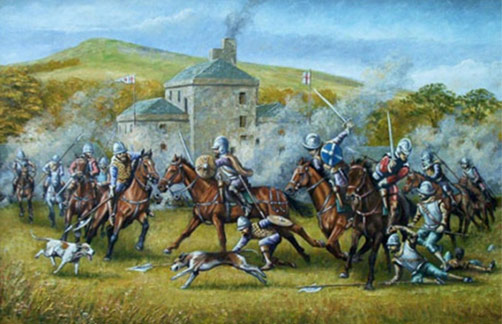
BORDER REIVERS AT LANGHOLM CASTLE. (Painting courtesy of Bill Ewart of Langholm.)
Maxwell fled abroad. His crime was that of treason as the meeting had been convened under terms which ensured the safety of all present. In 1612 he made his way back to the north of Scotland but was recognised and reported by a near relative. He was beheaded in Edinburgh. Thus in the short space of twenty-five years, between 1587 and 1612, four of the clan leaders of the Maxwells and Johnstones were to die because of a clan feud which took a century to resolve.
The post The Maxwell Johnstone Feud-The Theft of Ane Black Horse and the Aftermath appeared first on ScotClans | Scottish Clans.
]]>The post Border Reivers-West March Warden is Murdered by the Armstrongs. appeared first on ScotClans | Scottish Clans.
]]>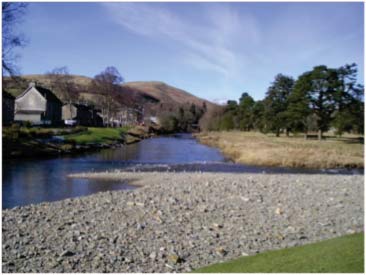
THE RIVERS ESK AND EWES AT LANGHOLM.
Sir John was born in 1542, son to an illustrious family which hailed from Lanarkshire. He was a direct ancestor of the Earls of Hindford.
He was Scottish Deputy March Warden at the ‘Day of Truce’ which was held on the Border in the hills aside present day Carter Bar in July 1575. The Day of Truce, a meeting to try the perpetrators of crime, both English and Scottish, was enshrined in Border Law. March Wardens from each side of the Border presided over the affairs and were charged with bringing the criminals for trial; juries were a mix of both Scots and English. Yet the ‘Day’ was a time when many men attended from both England and Scotland to witness that fair play presided throughout.
In 1575 numbers who attended were limitless; it was not unusual for a thousand men from each country to witness the events. Thus it was nigh on impossible to bring Scots and English together without inviting many who were at feud. Such was the turmoil that reigned in the Border country that even blood-feud prevailed as men from the same clans and same side of the Border rubbed shoulders at the Truce but smarted for revenge at the sight of an adversary with whom they were at odds. The atmosphere was charged with belligerence and aggression, yet there was little alternative. All invited might ostensibly be there to see fair play but there was another reason, unspoken yet acknowledged by all. Their presence was some insurance that neither side would take advantage of the other, nor resort to violence should any judgement be deemed unfair by family or friend of the accused. All who attended the Truce were to arrive unarmed but the reality was so different. No man would have been so foolish as to adhere to this code in the cauldron of ill feeling which prevailed. The Wardens turned a blind eye to the steel which swung at each man’s belt.
All took an oath to honour the precept of the Truce. They swore that they would not offend ‘by word, deed or countenance’.
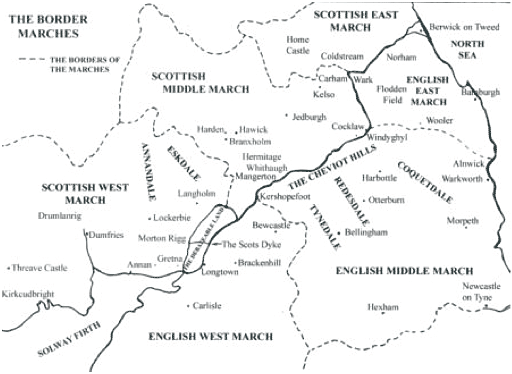
THE BORDER MARCHES
At the Raid of the Redeswire Carmichael fell victim to the invective and guile of Sir John Forster, seventy-five years old, and English Middle March Warden. Reaction to the aggressive exchanges of the two Wardens soon spilled over to the men of both sides who attended and all hell let loose.
The Redeswire affair was the last battle between English and Scottish Border Reivers and the last time that the English used the longbow in warfare. The English came off the worse in this encounter and Carmichael was warded in York in an effort to appease the wrath of Elizabeth l of England. Sir George Heron of Chipchase in Tynedale, Northumberland was murdered in the affray.
There was at least one other occasion where Sir John Carmichael played a prominent part. In the Raid of Ruthven in 1582 the sixteen year old king of Scotland, James Vl, was captured by William Ruthven, 1st Earl of Gowrie, and confined for ten months. Gowrie was unhappy at the influence of Catholicism and the effect this might have on the young king. Carmichael held the same views and readily espoused the cause of ridding the nation of the pro-catholic and pro-French influences epitomised in the young king’s cousin, Esme Stuart.
Carmichael was soon pardoned for his part in the affair. In 1588 he was one of the ambassadors sent to Denmark to negotiate the marriage between James Vl and Anne, daughter of the king of Denmark.
When Carmichael was made Warden of the Scottish West March in 1598 he had come of age. For all his turbulent past he was respected as a Warden who would see fair play between the English and Scots. There were many in the Scottish Border Lands who resented his impartial approach; none more so than the Armstrongs of Liddesdale.

LIDDESDALE
In 1600 Carmichael made it plain that he would use his power as March Warden even against his own people and especially the Armstrongs whose raids south of the Border were a particular embarrassment to a man dedicated to bringing peace to the Borders. The Armstrongs decided to plead for leniency on the promise of amendment to their nefarious ways and sought an audience with Sir John. They sent a brother of William Armstrong of Kinmont to parley with Carmichael, one Alexander Armstrong, known as Sandeis Ringane. Carmichael had heard the promises too many times before and would have no truck with the Armstrong clan. Their past outrages deserved the punishments he held in store.
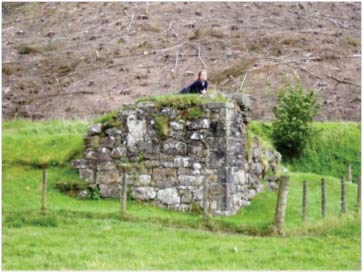
THE RUINS OF MANGERTON TOWER; THE MAIN ARMSTRONG STRONGHOLD
At the meeting with Carmichael were a few of his young followers. They began to taunt the elderly Armstrong and endeavoured to humiliate him at every opportunity. It would seem that Carmichael did little to curb their youthful pranks and overt hostility to the once powerful warlord. At one stage they removed his sword and filled his scabbard with egg yolks. Having replaced the sword it was now impossible to remove it from the scabbard.
Sandeis Ringane was besides himself with fury and swore that should any of the present company of Carmichael ever stray on Armstrong land he would have no compunction in pulling his sword and ridding the world of their odious presence. The meeting broke up with acrimony.
On his return home Sandeis Ringane told his sons of his mistreatment. His eldest son, Thomas Armstrong, said little in the way of comfort to calm the distress and shame of his unfortunate father but the thought of revenge was soon at the forefront of his mind.
He knew that next morning Sir John Carmichael was to leave Langholm and ride for Lochmaben where he was to preside over a Warden Court. The journey, through hilly woodland, would surely present the perfect opportunity to confront the illustrious March Warden.
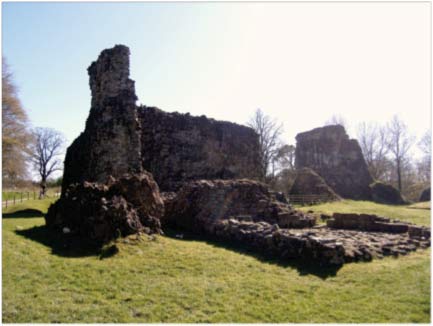
THE RUINS OF LOCHMABEN CASTLE
Accordingly next morning a party of Armstrongs including Thomas Armstrong and his father along with a Taylor, a Forrester, a Scott and a Graham lay in wait for Carmichael at a place still known to this day as the Raesknowes, on the way to Lochmaben. As the March Warden passed the ambush party a number of hagbutts rang out and Carmichael fell dead.
The ambush party scattered and sought refuge at the homes of friends who had been apprised of the intention to kill Carmichael but they were relentlessly pursued on the orders of King James.
Carmichael was a king’s Warden of the Marches and the perpetrators of the murder were therefore considered as traitors. Murder in the Border lands was pretty commonplace in the 16th century but this one was different. Murder of a man appointed by the King himself was not to be tolerated. The wrongdoers would pay the ultimate price for their rash and impetuous crime against a King’s man.
In 1601 Thomas Armstrong, son to Sandies Ringane, was apprehended, taken to the Mercat Cross at Edinburgh and hanged. Before he stood the drop that ended his life his right hand was cut off. Subsequently his body was wrapped in chains, the lifeless corpse hung up at the Borroughmuir.
‘And Thomas Armstrang, “sone to Sandeis Ringane” was condemned to be “tane to the mercat croce of Edinburgh, and thair his richt hand to be stricken fra his arme; and thaireeftir, to be hanget upoune ane gibbet, quhill he be deid; and thaireefter, to be tane to the Gallows on the Burrowmure, and thair his body to be hangit in irn chains…
Thomas Armstrong was the first man ever to be hanged in chains after death; at least he is the first recorded as such in the Scottish records. Even in death he was to suffer for his crime, his body subject to the butt of endless atrocity by the Edinburgh populace.
One man evaded capture until 1606.
Should you ever find yourself taking the road from Canonbie to Newcastleton in the Scottish Borders, you will come across a statue to Lang Sandy as you pass through the village of Rowanburn. It is on your right as you pass through the village.
Lang Sandy, as his name implies, was a huge man. His real name was Alexander Armstrong, the board at his feet simply declaring that he was hanged in 1606.
He took part in the ambush and murder of Sir John Carmichael in June 1600 but was not caught until six years later.
At his trial he admitted the murder but not before saying that the crime was brought on against his will.
The murder of Sir John Carmichael would herald the end of the Armstrongs as the superior force in the Scottish Border Lands. Within three years of the murder, James Vl of Scotland would also rule in England on the death of Elizabeth l. He would not forget the atrocity committed by a clan that had often been the bane of his endeavours to cement a lasting and firm relationship with the English queen before her death. Many of the Armstrongs would be unjustly hounded and persecuted, evicted from their lands, deported and executed without trial.
Carmichael‘s death would signal their demise.

LANG SANDY OF ROWANBURN

Border Reivers
Quick Links to Clan Armstrong Products from The Clan Shop
- Armstrong Tartan Tie
- Armstrong Tartan Pocket Square Handkerchief
- Armstrong Tartan Scarves
- Armstrong Tartan Kilts
- Armstrong Clan Crest Badge
- Armstrong Clan Crest Mug
- Armstrong Clan Crest T-Shirts
- Armstrong Clan Crest Belt Buckle
- Armstrong Phone Covers
- Armstrong Tartan
- Armstrong Clan Crest Crystal Glasses
- Armstrong Clan Crest Cufflinks
- Armstrong Clan Crest Sgain Dubh
- Armstrong Clan Crest Kilt Pin
- Armstrong Clan Crest Plaques
The post Border Reivers-West March Warden is Murdered by the Armstrongs. appeared first on ScotClans | Scottish Clans.
]]>