The post Filling The Gaelic Gap: Cultural Reclamation and Revival In The Diaspora appeared first on ScotClans | Scottish Clans.
]]> This is the first in a series of Bletherskite blog posts that we like to call “Not Your Father’s Gaelic”. We briefly introduced the series a few weeks back. The broad goal of the NYFG project is to provide needed support and energy for a growing Gaelic cultural and language revitalization movement within the Scottish Diaspora and in Scotland. NYFG will be spreading the gospel in pursuit of filling the Gaelic Gap in Scottish history and heritage and in keeping the Gaelic language alive.
Just to get us all on the same page before going too far forward, lets talk a little about what and where Scottish Gaelic culture is found in history and where it is today. Gaelic culture set a permanent foothold on the western Scottish mainland around the 4th century A.D., not too long after the Romans abandoned ship and went back to Rome. It is generally acknowledged that in 843 A.D. Kenneth MacAlpine gained control of the Gaelic and Pictish portions of what we today call Scotland and began a ruling Gaelic dynasty in North Britain that lasted relatively unscathed until the 12th century. In 1124 A. D. Scottish King David I began aggressively to supplant the Kingdom of Alba’s Gaelic culture in Scotland with Anglo Norman culture, language, institutions and individuals . The result was the birth of a Kingdom of Scotland that was and continued to be solidly Anglo-Norman at the top end, albeit equipped with a rather independent national mindset.

15th Century Gaelic culture. Blue = Gaelic, Yellow = Scots, Orange = Norn
The force of the Anglo-Norman flood into and through the Gaelic world was sudden and massive when David, a Gael by only the slimmest of threads and with considerable support from the English King, added the Gaelic Kingdom of Scotland to his existing title and allegiance as Prince of Cumbria and right hand man to England’s King Henry I. From that point forward the Kingdom of Scotland and Scotland’s indigenous Gaelic culture and civilization began a centuries long divergence from one another. The divide can still be seen today.
Despite not seeing eye to eye with the increasingly Anglo-Norman influenced Scottish Kingdom, a distinct and very vibrant Gaelic culture and civilization resisted assimilation and continued to blossom reaching its greatest Scottish inflorescence with the Finlaggan based Lordship of the Isles during the 14th and 15th centuries. Despite the more limiting name and reputation, the Lordship of the Isles was not a civilization limited to a single clan – Clan Donald – nor was it limited by the geographical extent of Scotland’s western islands. Rather, the protection and influence of the Gaelic Lordship extended across much of the remaining Gaelic speaking portions of Scotland.

Gaelic speakers reflected in Scottish decennial census 1891 – 2001
Unfortunately the Lordship collapsed near the close of the 15th century and began to suffer open and direct Scottish anti-Gaelic policies ranging from forced assimilation to extermination. Despite reductions caused by the persistent implementation of an anti-Gaelic mindset, native Gaelic culture and language has not been extirpated and it survives in the far western Scottish mainland and in the Hebrides. Today efforts aimed toward Gaelic cultural and language revitalization are well underway and even supported to a certain degree by the Scottish government.
Beginning in the 17th century and over the course of the following two and a half centuries, a significant Gaelic diaspora left Scotland and became planted in the New World. We are the progeny of that Diaspora. With perhaps the sole exception of Cape Breton, Nova Scotia, Canada and perhaps a few small pockets elsewhere in that Commonwealth nation, native Gaelic culture and language have disappeared from New World shores.
The point of a Scottish Gaelic revitalization movement in places like America is not to create a warlike tattooed ethnic Gaelic mob that overtakes our present federal government and issues broad swords, great kilts and bagpipes to all citizens no matter how much fun that seems like it would be. The principal point is to join in the movement to save Scotland’s indigenous culture – our culture – from extinction (an event which lies not that distant on the Gaelic horizon) and to ensure that Gaelic culture remains alive and expanding in the Gaelic ancestral homeland and across the Gaelic world. By engaging in this journey with and in support of our Gaelic brothers and sisters in Alba our own interests will be enriched in previously unanticipated ways – more on that below.
Members of the Gaelic Diaspora are descendants of a distinctive indigenous culture that has been forced to fight for its own intellectual sovereignty and cultural autonomy since the 12th century. The remarkable thing is it is still fighting.
So to begin the project, and again, just to ensure that we are all starting from the same place with regard to what we are discussing and why, here’s NYFG’s Gaelic Cultural Revitalization elevator speech (this is the Empire State Building version):
1. Scottish heritage presents the potential for far more diversity than what is generally reflected at modern Scottish heritage celebrations and what is understood by the Scottish Diaspora. Scottish heritage, as practiced today, is but a narrow slice of the potential world of Scottish heritage that is yet to be uncovered and reclaimed. What we celebrate today is primarily a monochrome reflection of the Walter Scott-ish romanticized Scotland – heavy on the Highlands – that British Victorian culture appreciated as fashionable in the mid 19th century and that has been perpetuated by the mainstream of 19th and 20th century Scottish historical writing. The rich and vibrant Gaelic culture is rarely if ever acknowledged and explained.
2. Our current understanding of Scottish heritage is incomplete and includes a good deal of mis-information. There is truth and important substance in today’s understanding and performance of Scottish heritage but it must be teased out of the larger romanticized picture and when found it presents only anglicized, truncated and incomplete versions of important historically based events.
3. There is actually a very rich and largely untapped back-story to the Scottish heritage that we actively celebrate today. The back-story is the story of a native Gaelic culture that has for centuries been resisting but ever retreating westward through the lifeless remains of abandoned Gaelic identities of assimilated Celtic brothers and sisters – new “Scots”. Since the 12th century the history of Scotland has been the history of the competition between an aggressively expansionist and ultimately imperial Anglo-Norman culture in England and a persistently resilient native Gaelic culture that had been present in numbers in North Britain since the 4th century and in possession and cultural control of most of modern Scotland since the 9th century. That competitive story continues to shape Scottish events and culture to this day.
4. Gaelic Lives. One of the oft repeated falsehoods of today’s version of Scottish heritage is the perception that “Gaelic is dead.” We are told with sadness that the Gaelic culture (whatever that was is not important) died along with the clan system in 1745 following a systemic illness that began in the 17th century. Even worse, we are fed the story that wild unfriendly isolated unlearned Gaelic tribes without art or a reasonable religion failed because the progress of human civilization depended upon a conversion of such savages to Britannia. Good job Britain and good riddance to the scruffy Gaelic culture. The reality is that Gaelic culture and therefore our Gaelic heritage is certainly not dead and never has been. Indeed, there presently is a strong Gaelic revival and revitalization movement growing in Scotland and across a global Gaelic diaspora.
5. Our generations’ task: Filling the Gaelic Gap. Our parents and grand parents left us with a vibrant, proud, colorful edition of Scottish heritage that is actively celebrated across the globe at hundreds of annual highland games, Burns Suppers and on St. Andrews Day. Of many achievements, perhaps their most important contribution in the long term was to keep the fire lit and to bring an awareness of Scottish heritage to a broader base of people. The next step – and our generation’s duty – is to fill in the Gaelic back-story and to do all that we can to support the revitalization and re-invigoration of our global Gaelic culture in the Gaelic homeland and abroad.
6. Benefits of Gaelic Revitalization in the Diaspora: The benefits of this multi-lifetime, multi-generational endeavor are clear and compelling:
- Participating in a broad-based Gaelic cultural revitalization movement will result in a more diverse, complete and precise understanding of Scottish heritage that speaks to a broader range of the Scottish Diaspora, particularly including younger generations.
- The process of regaining a solid ethnic connection by shining a new light and energy on a threatened ancestral culture results in a boosted sense of ethnic pride, usefulness and community and a greater tolerance and capacity to understand other ethnicities, including other native ethnic groups who have suffered fates similar to the Gael sometimes at the hands of displaced Gaels themselves.
- Gaining a better understanding and focus on the complete picture of our Scottish heritage is likely to yield improved relationships with many native Gaels who hold a differing view of the Victorian expression of Scottish heritage. We too often blindly celebrate processes, results, individuals and activities that have caused and continue to cause great tension in Scotland even today. Even though the Diaspora is willing to bury the hatchet so to speak, there are many in Scotland who suffer a still open wound and are much less prepared to let it go.
Summing it up and looking ahead. The Diaspora’s first and primary contribution to the Gaelic revival should be the reclamation of Gaelic culture and language within our own national boundaries. It was here and now it’s gone. It’s well worth recovering. Further, the more of us that are prepared and have the capacity to support the Scottish Gaelic revival as it occurs in Scotland the better. This is our niche. In terms of new research and work, that’s where we should start – in our own backyards.
Well, here’s a problem. In America and for the most part for the global Diaspora we will be starting from scratch in terms of reclaiming a Gaelic cultural legacy and we simply are not prepared to do that.
Gaelic culture disappeared from our shores almost immediately, usually within a generation or two of arrival. There were pockets of resiliency of course and some of those lasted even into the early 20th century. Today Gaelic language and the culture that goes along with it is pretty much gone as far as native Gaelic speakers in the New World.
The disappearance of Gaelic culture so quickly and so completely from diaspora shores is a bit of a puzzle itself. Gaelic culture and language arrived in significant force in the New World in a robust and healthy condition on the tongues of some of the increasingly rare native Gaelic speakers then remaining in Scotland. Those who arrived in the New World with their Gaelic identity intact were those whose families had held onto their Gaelic heritage come hell or high water through centuries of harassment in Scotland. And then it was gone.
That is a story that yet needs to be told. For now, it is sufficient to note that Scottish Gaelic studies in the Diaspora will essentially be looking back through the centuries and starting from near ground level to build up the story from there. It is easy and accurate to lament the present lack of scholarly resources available to help tell the Gaelic Diaspora story. Its worse than that. We don’t presently have the academic and scholarly capacity to tell that story. To identify what it is from its own expressions in its own language. To learn it and understand it and then tell it. We can’t do that. We don’t have a single Scottish studies program in North America that is equipped to investigate, analyze and relate the Gaelic story in the New World. Period. Not one. Not a single one. Not one program, not one scholar. Rectifying that deficiency is step number one. There will be more on that subject in the very next Not Your Father’s Gaelic blog post.
In the meanwhile get a better handle on this sad state of affairs here.
Want to learn more about Gaelic Revival in Scotland?
Although seriously endangered and having lost language speakers steadily for many years, some of the most recent statistics are showing an uptick in the success of Gaelic revitalization efforts in Scotland. Recently an English speaking dad whose children are learning Gaelic on Skye told the New Statesman “There has always been an impression that Gaelic is a bit of a nostalgic, inward-looking culture, but it seems to have a lot of energy and passion behind it now.”
The post Filling The Gaelic Gap: Cultural Reclamation and Revival In The Diaspora appeared first on ScotClans | Scottish Clans.
]]>The post Symbols of Edinburgh appeared first on ScotClans | Scottish Clans.
]]>
The story of the Luckenbooth begins on the Royal Mile, the famous street that runs from the Castle all the way down to the palace of Holyrood. This street became the only acceptable trade route to and from the castle and as such became a very important thoroughfare.
By the 16th century many parts of this route became dedicated markets and featured some of the cities first permanent shops. Many of which housed trades people who made and sold their small selection of wares, and amongst the most popular were the jewellers. These shops were known as locked booths, and from this derived the term ‘Luckenbooth’ used to describe one of their most popular designs. It featured the ‘heart and crown of Scotland’ and was romantically linked to the tragic Mary, Queen of Scots, as it was the brooch she had given to Lord Darnley.
The tradition that rose up around the brooch was that a young man would give his lady the brooch on their wedding day. Once their first child the brooch would then be passed on to the newest member to protect it from ‘evil spirits’. As such it had very similar connotations to the Irish ‘Claddagh’ ring, especially with the similar heart shaped theme.
The style of the Luckenbooth brooch became very popular throughout the UK. By the 18th century the trade in silver to the New World included the little brooch and many ended up being traded with Native Americans, Particularly the Iroquois of the Six Nations. As a result of this the Luckenbooth became a popular decorative symbol in their traditional costumes.

Not a symbol of Edinburgh that you would see if you were not looking for it, the City Coat of Arms present version is a modified version of the arms registered by the Lord Lyon in 1732. This previous version had been used for centuries, but had not been officially recognised.
As with any Coat of Arms there is a fair amount of symbolism within the arms. The castle within the centre shield represents Edinburgh castle, it’s most prominent landmark. The anchor above this, or the crest, represents the Lord Provost’s position as the Admiral of the Firth of Forth. The sinister supporter, a doe, is a link to the city’s patron saint St Giles who, as the story goes, spent much of his life in solitude in the forests of Provence with only a doe for company. The dexter supporter, a “woman richly attired with her hair hanging over her shoulders” represents the fact that Edinburgh Castle was historically known as the “Castle of the Maidens” probably due to it being used to protect princesses and noblewomen in times of war.

Coat of Arms on a window in the City Chambers
The motto Nisi Dominus Frustra means “Except the Lord in Vain”, a shortened version of a verse from Psalm 127: “Except the Lord build the house, they labour in vain that build it: except the Lord keep the city, the watchman waketh but in vain.”
There was some controversy surrounding the arms as in Scotland it is a statutory requirement to register register armorial bearing with the Lord Lyon, who is responsible for regulating the system of Scottish Heraldry, in a process known as “matriculation”. An action was begun against Edinburgh council in 1732, for failing to matriculate it’s Burgh arms. But the council received the following legal opinion ”that the town would not be bound in law to matriculat”. Unfortunately no record exists of any subsequent action, suggesting that the case was dropped.
The Lyon issued a general statement in 1771 that “all persons whether Nobility, Gentry, Towns or Bodies Corporate, bearing arms any manner or way which are recorded in terms of the Act…to give in or send to the Lyon Office an account of such Arms and of the title whereby they claim to wear the same”. Edinburgh Councils reaction wa smuch the same as before and refused to comply on the grounds that Scotland’s royal burghs ”had possessed the privilege of using seals and armorial bearings from a remote period which far outdated the Acts of 1592 and 1672, from which the Lord Lyon derived his jurisdiction, and that since neither of these Acts specifically mentioned the Burghs, they did not apply to them”.
It was only 3 years later that a document was discovered among the papers of an Edinburgh lawyer - a Certificate of Matriculation of “the Ensigns Armorial or Coat of Arms of the good town of Edinburgh” signed by the Lyon and dated 21 April 1732. It seems the Edinburgh City Coat of Arms had been matriculated years before!

The Heart of Midlothian is a heart shaped mosaic formed in coloured granite setts, built into the pavement near the West Door of St Giles on the High Street section of the Royal Mile.
Together with brass markers bearing building dates, it records the position of the 15th-century Old Tolbooth, demolished in 1817, which was the administrative centre of the town, prison and one of several sites of public execution. This is believed to be were the modern tradition of spitting on the Heart came from. The spot lay directly outside the prison entrance, and people would spit on the heart to show their disdain for the former institution. Others believe the tradition may have been started even earlier, with former occupants of the prison spitting on the Heart upon their release. These days it is done for good luck.
The mosaic is named after the historic county of Midlothian of which Edinburgh is the county town. This is not to be confused with the council area of the same name which covers a smaller area and does not include the capital. The crest of the Edinburgh football team Hearts of Midlothian is based upon this Heart.

The stag with a cross between it’s antlers is a common site around the palace of Holyrood, found at the bottom of the Royal Mile. The tale of this intriguing symbol is believed to date back to the time of David I.
The son of King Malcolm Canmore and St Margaret, David was a keen hunter and there was nothing he liked better than to hunt stags in the forests of Drumsheugh. One day in the year 1128, he prepared to go hunting but he was approached by a priest who reminded him that it was the 14th September; Holy Rood Day. The term ‘Rood’ was at the time used as a term for the Holy Cross, and that day was considered to be a sacred one indeed, not a day for sport. King David ignored the rebuke and gathered together the hunters to saddle the horses ready for the hunt.

As the party rode through the forest King David found himself separated from his companions when out of nowhere a large white stag burst through the forest and knocked the King from his horse. The stag lowered it’s mighty antlers and seemed ready to gore the King, whose lips were moving in silent prayer, and was sure his time had come. In a moment of bravery the King seized the stag by the antlers and grappled with the fierce beast. But to his amazement the antlers twisted and reformed in his hands to form the shape of a Cross, and the stag bounded away out of sight. Shaken by the experience the King returned home to Edinburgh castle and the comfort and safety of his court.
That night as King David lay asleep in his bed, he dreamed that a voice spoke to him, commanding him to have an abbey built on the spot he had wrestled with the magnificent stag. The next morning spurred on by what he believed to be a Holy vision he ordered the construction of Holyrood Abbey.His orders were carried out and a fine abbey was built to house a community of Augustinian Canons who flourished there fro many years.
The ruins of Holyrood Abbey can still be visited to this day
The post Symbols of Edinburgh appeared first on ScotClans | Scottish Clans.
]]>The post The Wizard laird of Skene’s dance with the devil appeared first on ScotClans | Scottish Clans.
]]>
Loch Skene
Skene Loch is an eerie and forbidding place, particularly on cold evenings in the dead of winter – when the waters on the loch can freeze over. If you were to brave the icy conditions and venture down to the lochside and look across the frozen loch you might see what seems like a mysterious set of curved tracks embedded in the ice. Tracks which look newly made by a coach or carriage.
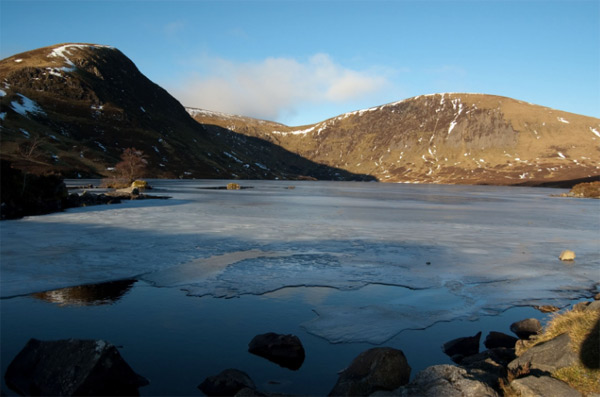
Frozen Loch
So the tracks on the ice? are they a lasting reminder of the day Auld Nick himself paid a visit to his devil-worshipping friend the Wizard Laird of Skene.

Did Auld Nick pay a visit to the Wizard Laird of Skene?
Alexander Skene, the 16th Laird, was the man the devil had come to Aberdeenshire to see. It was said the laird never cast a shadow, was followed everywhere by magpies or crows and had the power to reest, or glue, his enemies to the spot where they stood. On at least one occasion Skene was kept awake by neighbours enjoying a ceilidh. His reaction was to cast a spell on the revellers which made them unable to stop dancing – until their feet bled and they cried in agony.
His mastery of the black arts had been learned while he was a young student at the University of Padua in northern Italy. One of the most famous seats of learning in Europe, Padua was noted for the views some of its members held on the then-controversial subjects of astronomy and necromancy. Many returned with “peculiar ideas” about the heavens and the black arts. The Wizard Laird went one step further and formed a pact with the devil.
The wizard’s coachman was named Kilgour and was well used to his master’s eccentricities – but nothing could have prepared him for the night the devil came calling.
Kilgour was ordered to prepare the coach and horses at midnight to transport his special guest from Skene House, the family mansion. But the laird made Kilgour promise that on no account was he to turn round and look at the stranger.
As the coach and horses sped through the dark countryside, the laird told Kilgour to take the more direct route across the Loch of Skene. There had only been one night’s frost and the coachman said such a journey would be impossible – but the wizard told him not to worry, the ice was strong enough.
The night would have passed without incident had Kilgour’s curiosity not got the better of him. As they were approaching the other side of the loch he did what his master had told him not to do – he turned round. What he saw terrified him. For there sat the unmistakable horned, cloven-footed figure of the devil himself – Auld Nick.
As soon as Kilgour turned to look the ice cracked, the devil turned into a raven and flew off and the coach and horses sank to the bottom of the loch. Whether the laird and his coachman escaped depends on which variation of the tale you hear.
Sheena Blackhall, a poet and historian in north-east Scotland, spent part of her childhood in Skene and remembers local children saying that if they ran 100 times round the Wizard Laird’s gravestone he would rise from the dead.
Despite his supposed deal with the devil, the laird is buried in the churchyard in the village of Kirkton of Skene. The wizard lived from around 1680 until 1724 but his activities had such an impact on the superstitious local people that, even last century, fires were lit at Halloween to keep him at bay. The author William Somerset Maugham heard the story while recovering from tuberculosis at Glen O’Dee Hospital in Banchory, Kincardineshire, and used it as inspiration for his novel, The Magician, in which evil deeds take place at Skene House.
The Skene family are said to have been a sept of the Clan Robertson. According to tradition one young clan member saved the life of King Malcolm III (Canmore) by killing a wolf with his sgian, or knife. The king then granted him as much land as could be covered by a hawk’s flight and the family received a charter in 1318 from Robert the Bruce. The line died out in the 19th century with the 20th laird, who was deaf. The reputedly cursed Skene House is now in a sad state of repair.

skene house
If you think stories of warlocks, curses and visitations by the devil are fanciful nonsense then consider the words of Stanley Robertson, a former gypsy traveller who lived in the Skene area and claims to possess psychic powers.
“The travellers say that if there is something demonic about a place, the frisson will rise up your back instead of down. That is why the hackles rise at the back of your head. And that is exactly the feeling I got when I once visited Skene House, my hackles rose and I had the feeling something very evil had taken place there.”
The post The Wizard laird of Skene’s dance with the devil appeared first on ScotClans | Scottish Clans.
]]>The post ‘Birth certificate of Scotland’ unearthed by archaeologists appeared first on ScotClans | Scottish Clans.
]]>
Oliver O’Grady with Suzanne Urquhart of Scone Abbey
The ancient mound known as the Moot Hill in the ground of Scone Palace was once the site of the “lost” abbey of Scone, founded in 1114 by Alexander I, where Scottish kings are believed to have assumed the mantle of power on the Stone of Destiny.
It was revealed yesterday that archaeologists studying the historic site have been able to use radiocarbon dating to push back the origins of the ancient seat of ecclesiastical and royal power to at least 1,000 years ago, in a remarkable breakthrough that has been hailed as uncovering the “birth certificate of Scotland”.
The critical dating evidence came from scientific analysis of carbon samples retrieved during excavations of a massive ditch that once surrounded the Moot Hill.
Dr Oliver O’Grady, the archaeologist who has been leading the excavations at Scone for the past five years, said: “The radiocarbon dates confirm Moot Hill as one of Europe’s extraordinary survivals, unique in Britain and the first assembly-mound in Scotland to be scientifically dated.
“The lab results are in a sense nothing less than a birth certificate for Scotland.”
Dr O’Grady said the radiocarbon dating, carried out by the Scottish Universities Environmental Research Centre laboratories in East Kilbride, had proven beyond doubt the genuine antiquity of Scotland’s ancient inauguration mound.
He said the findings had put paid to the legend that the hill was created by the soil brought to Scone in the shoes of nobility who came to pay homage to Robert the Bruce at his crowning in 1306.
The radiocarbon dating had been based on the samples of burned wood recovered from the base of ditch which surrounds the mound. Dr O’Grady said: “The analysis shows that Moot Hill likely dates to some point between the late ninth century and early 11th century.”
Significantly, the new dating evidence also matches the earliest historical accounts of royal ceremonies being held at Scone contained in a tenth-century chronicle, dating from the reign of King Constantine II, which began in 900.
Dr O’Grady said: “It will probably be debated amongst archaeologists for time to come as to when the hill was first used for a crowning ceremony.
ut it is very striking that the date that we’ve got is so close to the first genuine historical record of Scone in the chronicles of the kings of Alba.
“From a point of probability, until I have other evidence, it seems entirely plausible to me to suggest that King Constantine II, or at least one of his successors, was responsible for the creation of this mound.
“And that should be seen as a very significant moment in Scotland’s history because they are no longer identifying themselves as Picts and they are gathering, as its says in the text ‘in the manner of the Gaels’ and they are holding their most important royal ceremonies on that mound.”
Moot Hill that was centre of power for centuries:
c 700-900 – Scone established as power centre of the Pictish province of Gowrie.
906 – Meeting of Constantine II at Scone with Bishop Cellach of St Andrews.
1114 – Founding of new monastery, with building works continuing over many decades.
1249 – Alexander III inaugurated on Stone of Destiny in abbey cemetery.
1296 – Stone of Destiny (along with other treasures and documents) are removed to Westminster by Edward I.
1298 – Abbey attacked.
1306 – Robert Bruce crowned King of Scots at Scone.
1360s – Abbey in poor state, young canons instructed not to frequent taverns.
1371/1390 – Robert II and Robert III both hold parliaments on Montem (Moot Hill) of Scone.
1400s – Pilgrims attracted to shrine of St Fergus in the abbey church.
1437 – James I assassinated at Blackfriars in Perth.
1551 – Major church repairs.
1559 – Abbey sacked by Protestant reformers.
1606 – Abbey lands granted to David Murray, Lord Stormont.
1618 – Parish church built on Moot Hill.
1631 – 1st Lord Stormont dies, buried in mausoleum on Moot Hill.
1651 – Charles II last king crowned on Moot Hill
The post ‘Birth certificate of Scotland’ unearthed by archaeologists appeared first on ScotClans | Scottish Clans.
]]>