The post The Wizard laird of Skene’s dance with the devil appeared first on ScotClans | Scottish Clans.
]]>
Loch Skene
Skene Loch is an eerie and forbidding place, particularly on cold evenings in the dead of winter – when the waters on the loch can freeze over. If you were to brave the icy conditions and venture down to the lochside and look across the frozen loch you might see what seems like a mysterious set of curved tracks embedded in the ice. Tracks which look newly made by a coach or carriage.
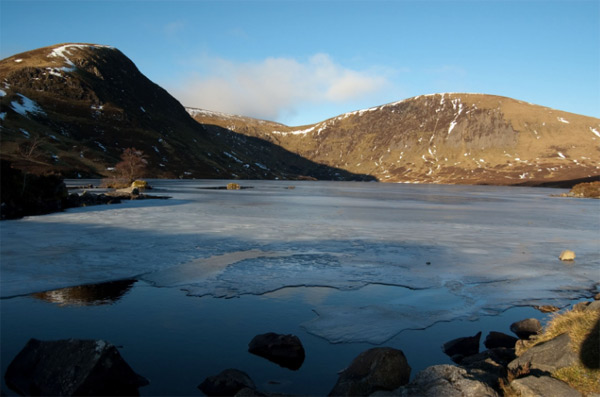
Frozen Loch
So the tracks on the ice? are they a lasting reminder of the day Auld Nick himself paid a visit to his devil-worshipping friend the Wizard Laird of Skene.

Did Auld Nick pay a visit to the Wizard Laird of Skene?
Alexander Skene, the 16th Laird, was the man the devil had come to Aberdeenshire to see. It was said the laird never cast a shadow, was followed everywhere by magpies or crows and had the power to reest, or glue, his enemies to the spot where they stood. On at least one occasion Skene was kept awake by neighbours enjoying a ceilidh. His reaction was to cast a spell on the revellers which made them unable to stop dancing – until their feet bled and they cried in agony.
His mastery of the black arts had been learned while he was a young student at the University of Padua in northern Italy. One of the most famous seats of learning in Europe, Padua was noted for the views some of its members held on the then-controversial subjects of astronomy and necromancy. Many returned with “peculiar ideas” about the heavens and the black arts. The Wizard Laird went one step further and formed a pact with the devil.
The wizard’s coachman was named Kilgour and was well used to his master’s eccentricities – but nothing could have prepared him for the night the devil came calling.
Kilgour was ordered to prepare the coach and horses at midnight to transport his special guest from Skene House, the family mansion. But the laird made Kilgour promise that on no account was he to turn round and look at the stranger.
As the coach and horses sped through the dark countryside, the laird told Kilgour to take the more direct route across the Loch of Skene. There had only been one night’s frost and the coachman said such a journey would be impossible – but the wizard told him not to worry, the ice was strong enough.
The night would have passed without incident had Kilgour’s curiosity not got the better of him. As they were approaching the other side of the loch he did what his master had told him not to do – he turned round. What he saw terrified him. For there sat the unmistakable horned, cloven-footed figure of the devil himself – Auld Nick.
As soon as Kilgour turned to look the ice cracked, the devil turned into a raven and flew off and the coach and horses sank to the bottom of the loch. Whether the laird and his coachman escaped depends on which variation of the tale you hear.
Sheena Blackhall, a poet and historian in north-east Scotland, spent part of her childhood in Skene and remembers local children saying that if they ran 100 times round the Wizard Laird’s gravestone he would rise from the dead.
Despite his supposed deal with the devil, the laird is buried in the churchyard in the village of Kirkton of Skene. The wizard lived from around 1680 until 1724 but his activities had such an impact on the superstitious local people that, even last century, fires were lit at Halloween to keep him at bay. The author William Somerset Maugham heard the story while recovering from tuberculosis at Glen O’Dee Hospital in Banchory, Kincardineshire, and used it as inspiration for his novel, The Magician, in which evil deeds take place at Skene House.
The Skene family are said to have been a sept of the Clan Robertson. According to tradition one young clan member saved the life of King Malcolm III (Canmore) by killing a wolf with his sgian, or knife. The king then granted him as much land as could be covered by a hawk’s flight and the family received a charter in 1318 from Robert the Bruce. The line died out in the 19th century with the 20th laird, who was deaf. The reputedly cursed Skene House is now in a sad state of repair.

skene house
If you think stories of warlocks, curses and visitations by the devil are fanciful nonsense then consider the words of Stanley Robertson, a former gypsy traveller who lived in the Skene area and claims to possess psychic powers.
“The travellers say that if there is something demonic about a place, the frisson will rise up your back instead of down. That is why the hackles rise at the back of your head. And that is exactly the feeling I got when I once visited Skene House, my hackles rose and I had the feeling something very evil had taken place there.”
The post The Wizard laird of Skene’s dance with the devil appeared first on ScotClans | Scottish Clans.
]]>The post Who Was St Ninian? appeared first on ScotClans | Scottish Clans.
]]>
Pilgrims continue to visit Ninian’s tomb in Whithorn
Scotland is to welcome Pope Benedict XVI for his first visit to Britain on 16 September, which is St Ninian’s Day.
The Pope begins his visit in Edinburgh, where a St Ninian’s Day parade will welcome him to the city.
But who exactly was Saint Ninian, and what was his historical significance?
The precise details of Ninian’s life are disputed.
The Catholic Church described him as the man from south west Scotland “who first brought the Christian faith” to the country around 397AD, when he is said to have established a religious community at Whithorn in Galloway.

St Ninian’s Chapel

St Ninian’s Chapel
The church said Ninian studied in Rome before being ordained a bishop.
His monastery in the south of Scotland was known as Candida Casa, from the Latin meaning “White House”. The name possibly refers to the stone used to construct it or the whitewash used to paint it, and has survived as the modern name, Whithorn.
It was from this base that he is said to have set about proclaiming the Gospel to the southern Picts.
The first historical reference to Ninian of Whithorn came from the Northumbrian scholar and monk Bede, in his Ecclesiastical History of the English People, written around 731.
‘Traditional’ information
He described him as a Briton who was instructed in Rome and noted that his church was made of stone, which was unusual at the time.
Bede said Ninian named his episcopal see after Saint Martin of Tours, although other accounts claim he actually met the French patron saint on his return to Scotland.
The historian conceded he was only passing on “traditional” information in his brief reference to Ninian, and does not claim it is factual.
In the 12th Century, Aelred, the abbot of Rievaulx in Yorkshire, wrote A Life of Saint Ninian – thought to be at the behest of one of the new bishops of Galloway, who was eager to promote their bishopric to the wider world.
Aelred attributed 10 miracles to Ninian, six during the saint’s lifetime and four after his death.
Whatever the truth of Ninian’s life, over the centuries his tomb at Whithorn became one of the centres of Christian pilgrimage.
It was also an important place of worship for the Scots royal family. In the 14th Century it is said a dying King Robert the Bruce went there to pray for a cure from leprosy.
Two centuries later, King James IV spent eight days walking to the shrine, and is said to have distributed money to the poor as he travelled.
When the visit of Pope Benedict was confirmed, Scotland’s most senior Catholic, Cardinal Keith Patrick O’Brien, said he wanted to resurrect the festivities that used to surround St Ninian’s Day.
He suggested organising “a grand Scottish spectacle to welcome Benedict XVI”.
This spectacle will be the St Ninian’s Day Parade, where more than 1,000 pipers will play as the Pope travels through the Scottish capital.
Hundreds of children from the 14 Scottish schools named after St Ninian, including Episcopalian and non-denominational schools, will take part.
The post Who Was St Ninian? appeared first on ScotClans | Scottish Clans.
]]>The post ‘Birth certificate of Scotland’ unearthed by archaeologists appeared first on ScotClans | Scottish Clans.
]]>
Oliver O’Grady with Suzanne Urquhart of Scone Abbey
The ancient mound known as the Moot Hill in the ground of Scone Palace was once the site of the “lost” abbey of Scone, founded in 1114 by Alexander I, where Scottish kings are believed to have assumed the mantle of power on the Stone of Destiny.
It was revealed yesterday that archaeologists studying the historic site have been able to use radiocarbon dating to push back the origins of the ancient seat of ecclesiastical and royal power to at least 1,000 years ago, in a remarkable breakthrough that has been hailed as uncovering the “birth certificate of Scotland”.
The critical dating evidence came from scientific analysis of carbon samples retrieved during excavations of a massive ditch that once surrounded the Moot Hill.
Dr Oliver O’Grady, the archaeologist who has been leading the excavations at Scone for the past five years, said: “The radiocarbon dates confirm Moot Hill as one of Europe’s extraordinary survivals, unique in Britain and the first assembly-mound in Scotland to be scientifically dated.
“The lab results are in a sense nothing less than a birth certificate for Scotland.”
Dr O’Grady said the radiocarbon dating, carried out by the Scottish Universities Environmental Research Centre laboratories in East Kilbride, had proven beyond doubt the genuine antiquity of Scotland’s ancient inauguration mound.
He said the findings had put paid to the legend that the hill was created by the soil brought to Scone in the shoes of nobility who came to pay homage to Robert the Bruce at his crowning in 1306.
The radiocarbon dating had been based on the samples of burned wood recovered from the base of ditch which surrounds the mound. Dr O’Grady said: “The analysis shows that Moot Hill likely dates to some point between the late ninth century and early 11th century.”
Significantly, the new dating evidence also matches the earliest historical accounts of royal ceremonies being held at Scone contained in a tenth-century chronicle, dating from the reign of King Constantine II, which began in 900.
Dr O’Grady said: “It will probably be debated amongst archaeologists for time to come as to when the hill was first used for a crowning ceremony.
ut it is very striking that the date that we’ve got is so close to the first genuine historical record of Scone in the chronicles of the kings of Alba.
“From a point of probability, until I have other evidence, it seems entirely plausible to me to suggest that King Constantine II, or at least one of his successors, was responsible for the creation of this mound.
“And that should be seen as a very significant moment in Scotland’s history because they are no longer identifying themselves as Picts and they are gathering, as its says in the text ‘in the manner of the Gaels’ and they are holding their most important royal ceremonies on that mound.”
Moot Hill that was centre of power for centuries:
c 700-900 – Scone established as power centre of the Pictish province of Gowrie.
906 – Meeting of Constantine II at Scone with Bishop Cellach of St Andrews.
1114 – Founding of new monastery, with building works continuing over many decades.
1249 – Alexander III inaugurated on Stone of Destiny in abbey cemetery.
1296 – Stone of Destiny (along with other treasures and documents) are removed to Westminster by Edward I.
1298 – Abbey attacked.
1306 – Robert Bruce crowned King of Scots at Scone.
1360s – Abbey in poor state, young canons instructed not to frequent taverns.
1371/1390 – Robert II and Robert III both hold parliaments on Montem (Moot Hill) of Scone.
1400s – Pilgrims attracted to shrine of St Fergus in the abbey church.
1437 – James I assassinated at Blackfriars in Perth.
1551 – Major church repairs.
1559 – Abbey sacked by Protestant reformers.
1606 – Abbey lands granted to David Murray, Lord Stormont.
1618 – Parish church built on Moot Hill.
1631 – 1st Lord Stormont dies, buried in mausoleum on Moot Hill.
1651 – Charles II last king crowned on Moot Hill
The post ‘Birth certificate of Scotland’ unearthed by archaeologists appeared first on ScotClans | Scottish Clans.
]]>The post Thomas the Rhymer appeared first on ScotClans | Scottish Clans.
]]>
Thomas meeting the Queen of the Fairies
Thomas Learmonth from Ercildoune (now Earlston), better known as Thomas the Rhymer was a 13th century Laird, poet and a supposed prophet.
Legend tells us how Thomas the Rhymer went out walking one day and fell asleep beneath a tree on the side of the Eildon Hills. He awoke to find a shining woman sitting on a grey horse at his side. This woman turned out to be the Queen of the Fairies. It was of no coincidence that they met, as it was Thomas that the queen seeked to meet. Thomas was struck by the Queen’s beauty and immediately fell in love with her and she asked him to kiss her, right under his favourite Eildon tree. The Queen asked Thomas if he would go back with her to the Land of the Fairies to be her lover and he agreed.
Thomas stayed with the fairies for what felt like three days, but was in fact seven years.
When he left the Queen, as a sign of her love for him, she gave Thomas the gift of poetry, of always speaking the truth (which apparently Thomas protested against), and the gift of prophecy.
Thomas made a lot of predictions, which he put into rhyme, about significant events that were to happen to Scotland.
Some of the prophecies attributed to Thomas the Rhymer:
“On the morrow, afore noon, shall blow the greatest wind that ever was heard in Scotland.”
This apparently predicts the death of Alexander III in 1286 who died the day after Thomas said it. The Scottish king was killed on a stormy night when travelling from Edinburgh Castle to see his queen in Kinghorn, Fife, and it is believed that his horse lost it’s footing in the dark and the king was found the following morning on the shore with a broken neck. Alexander died without an heir.
“At Eildon tree, if yon shall be, a brig ower Tweed yon there may see.”
From the Eildon tree that Thomas is talking about you can now, in fact, see a bridge which crosses the river Tweed.

A monument to Thomas the Rhymer
Other supposed predictions that were made by Thomas which have since come true are the succession of Robert the Bruce to the Scottish throne; Scotland’s decisive loss to the English at the Battle of Flodden Field in 1513, at which Scotland’s James IV was killed; and he foresaw the union of the Scottish and English crowns which occured in 1603. Thomas allegedly said that when the Tweed flooded into Merlin’s grave, Scotland and England would have one king. Initally it seemed that this prophecy had turned out incorrect, but on the day of James VI‘s coronation the supposed grave of Merlin in Drumelzier flooded with water from the Tweed.
Thomas went on and lived the rest of his life in the real world, until one day when it is said that Thomas finally went back to see his lover in the Land of the Fairies after he went out for a walk and was never seen again.
In the 17th century, a Scottish Learmonth settled in Russia, and the famous 19th century Russian romantic writer and poet, Mikhail Lermontov (1814-1841) claimed to be a descendent of this Learmonth. Lermontov was thought of as the most important poet in Russia after the death of Alexander Pushkin in 1837 and it has been claimed, however never proven, that Lermontov is related to Thomas the Rhymer.
The post Thomas the Rhymer appeared first on ScotClans | Scottish Clans.
]]>