The post Hugh Munro and the Eagle appeared first on ScotClans | Scottish Clans.
]]>
The Eagle Stone
Nestling among the houses on a quiet hillside there is a small fenced off patch of grass, in the centre a modest standing stone with ancient carvings – this is the famous ‘Eagle Stone’, also known as the Clach an Tiompain or ‘Sounding Stone’
The stone is featured in one notable prophesy by the Brahan Seer – he foresaw a great tragedy that would befall the area should the stone topple over three times, over the years it has been known to have fallen twice and superstitious locals have ensured it moves no more by cementing it in place.
Local legends have claimed the stone was erected after a skirmish between the Clan Munro and the McDonalds of the Isles on the way to the battle of Harlaw in 1411 – a sort of practice friendly on the way to the knockout stages. Recent evidence has proven it to be much older though.
Although almost certainly Pictish in origin one famous folk tale links the stone again to Clan Munro, who’s crest symbol also depicts an eagle, the Eagle of Foulis.
On a high ridge on the other side of the valley lies the remains of an iron age fort known as Knockfarrel (literally ’stone fort’). The very first chief of Clan Munro lived here as the clan established its presence in the area. Around the fortification a small village or ‘clachan’ grew. The valley has lush farmland, ideal for grazing and growing all manner of crops, sheltered from the worst of the weather.
Knockfarrel is easily approached via a gently sloping trail up the side of the ridge but treacherous cliffs fall steeply away to one side – high on a rocky pinnacle in these cliffs a great eagle had made its nest. whether the Munro clan took their symbol from this eagle or it was just a remarkable coincidence we do not know but the clansmen saw the eagle as a good omen and were happy to share the valley with this magnificent creature. Even when the bird would lift a young lamb or goat kid they would take this as just an acceptable loss and the chief forbade anyone from doing harm to the eagle.
All was peaceful in the valley until one summers evening. It had been a beautiful day and the womenfolk worked preparing the evening meals and sewing. The children laughed and played between the small houses, outside one house towards the edge of the village one small boy sat, Lachlan, barely a toddler he rested on the grass and watched as his mother busied herself around him.
All at once a great dark shadow was cast across the valley and a terrible screeching was heard, In a blur of feathers and claws the huge eagle swooped down from its nest and caught the poor child in its massive talons. Before anyone could react he lifted the boy high into the air and carried him up the cliffside.
The cries of alarm went up throughout the village and the wailing of the grief stricken mother alerted young Hugh, the chieftain of the clan. When Hugh arrived at the scene he realised that he had to act and act quickly. He called for a length of rope and set off up the cliffside in pursuit. Not entirely sure what he would face when he reached the pinnacle.
Higher and higher Hugh clambered up the sheer face, as the village fell away below he heard a beating of wings and a rush of air – the great eagle was bearing down upon him. Holding onto the rope for dear life he tried to fend off the angry bird. The eagle soared away again and Hugh pressed on. In the fading light he caught a glimpse of a tangle of branches above him and with one last effort he hauled himself up and into the eagles nest.
Lying in the centre of the nest lay baby Lachlan. cooing away to himself as if nothing had happened. Hugh was relived that the boy despite his ordeal had barely a scratch on him but he realised that the hardest work lay ahead. No sooner had this thought crossed his mind than the huge eagle appeared again – even angrier than before. Hugh grabbed a large branch and swinging it like a club tried to fend it off, time and time again the eagle pecked and clawed and Hugh soon became exhausted. His clothes torn and his body bruised and bloody from the ferocious attack.
All this time little Lachlan laughed away thinking it no more than a silly game for his own amusement.

Munro Clan Crest
As the eagle made one more pass Hugh decided on an other tactic; he ducked under the thrashing wings and grabbed at the birds legs. Unsettling the creature just for a second he was able to pull it towards the nest and turn it over onto its back. With the advantage of surprise he reached up and got hold of the bird by the throat and squeezed with all his might.
Gradually the bird began to loose its grip on life, the struggle began to die and with one last effort Hugh squeezed the life from the mighty creature.
Meanwhile far below the cliff the villagers looked up, not knowing if the poor boy or Hugh for that matter were alive or dead. They had heard the terrifying shrieks of the bird and feared the worst. Then suddenly the distant figure of Hugh appeared, holding the corpse of this massive Eagle in his hand. They cheered and shouted and Hugh tossed the bird down, A gust of wind caught the feathers and the eagle’s broken body wheeled and glided down to the valley below, coming to rest at the edge of the village. Where the eagle fell the villagers placed a stone – the Eagle stone in recognition of the brave deeds of their chief and from respect to the noble creature that was such a powerful symbol of their clan.
The post Hugh Munro and the Eagle appeared first on ScotClans | Scottish Clans.
]]>The post The Treasure of Norries Law. appeared first on ScotClans | Scottish Clans.
]]>
Lower Largo
On The Fife coast sits the pretty village of Lower Largo. The village was the Birthplace of Alexander Selkirk, the inspiration behind the story of Robinson Crusoe and a sign in the village points to the Juan Fernandez Islands, some 7,500 miles away where Selkirk was a castaway. The history of the area goes back much much further though to a time before Scotland as we know even existed.
Outside the village sits Largo Law and around a mile to the North, Norrie’s Law, ancient burial mounds that indicate the great antiquity of the occupation of this area.
It was common among the children of the village to play a game that had a connection to Norrie’s Law. One child would stand before the others and recite a verse; “I’ll tell you a story, Aboot Tammie o Norrie, If ye dinna speak in the middle o’ it, Will ye no?” The object of the game was to lure another child into saving “No” at which point all the others would shout, “The spell is broken, ye hae spoken, Yell never hear the story o’ lang Tarn o Norrie.” Like so many other children games this has a story behind it – a story of the ghost of Norrie’s Law.
In a time long past Largo Law was reputed to be haunted by an earthbound spirit; a ghost sentenced to wander the earth until a spell was broken to release it. To break the spell the ghost had to give up his secret; the hiding place of a hoard of treasure, buried somewhere on Largo Law.
On the nearby farm of Balmain there was a fairly unscrupulous shepherd. Having heard the story he had spent many nights wandering the area around the Law in hope of discovering the treasure. Finally one evening as he walked around the Northern shoulder of the hill he was confronted by a shimmering cloud of smoke. Many others had met this apparition but all had fled in terror. Taken aback at first he gathered all his courage to approached it and asked what it was that kept it bound to this realm. The ghost fixed him with a stare and said:”If Auchendowie cock disnae craw, An the herd o Balmain disnae blaw, I’ll tell ye whar the gold is on Largo Law.” The ghost then quickly ran through the small print of his offer which also included the cut off time of 8 o’clock the following evening.
The shepherd was only concerned about getting his hand on the treasure and cared little of who he had to inconvenience to achieve his ends. He thought of the first part of the ghosts request and scurried off the Auchedowie farm. The next morning the farmer and his wife slept in, never awoken by the crowing of the cockerel. When they went off to investigate they found the cockerel strangled and tossed into a heap of straw by the barn. Phase one complete.
Now for the Herdsman of Balmain. The herdsman was called Tammie O’ Norrie and it was safe to say there was little love lost between him and the shepherd. As Tammie set off to take his cows to pasture the shepherd was waiting. He blocked his path and shouted to Tammie ‘Hey you, Tammie O Norrie, I want a word wae ye”. As Tammie approached the shepherd let his coat slip open to reveal a long knife tucked into his belt. “You had better no blaw yer horn to summon in yon cows the nicht or it will be the worse fur ye”. Tammie was confused; “How no! How will I caw the cows in with nae horn?” The shepherd gripped the handle of his knife; “Ye can use the dugs to round them up – now mind what a said or it will be the worse for ye”. At that he glowered at the herdsman and furtively took off.

Part of the Silver Hoard
With all the plans in place the shepherd made his way back to the north slope of the hill, just before 8:00 the spectre appeared again. As the shepherd approached the ghost the sound of Tam’s horn was heard in the distance. The ghost flew into a rage; “Woe to the man that blew that horn, For out of that spot he shall never be borne.” At that he vanished. The shepherd ran for all he was worth, determined to have it out with the herdsman but when he reached the spot he was met with an awful sight. There in the field stood Tam O Norrie, the horn horn still pressed to his lips but he had turned to stone – petrified literally by the wandering spirit.
The shepherd told no one of his involvement in the events and when the local people discovered what had befell Tam they tried to move him – but some sinister force prevented all attempts, finally they gave up and heaped the earth around him creating another small hill; this came to be known as ‘Norries Law’.
The shepherd never got his prize but many years later a hoard of silver (not gold) was unearthed nearby. It is one of the best silver hoards to be discovered in Scotland. a variation in this tale had been that the law was the burial sight of a viking called Norroway who had been buried on his horse in full armour. However investigation of the find discovered that the pieces were of Pictish rather than Norse origin. Sadly some of the hoard never made it to the protection of the museum, some coins and other pieces were reputed to have been sold off and melted down – we may never know just how extensive this treasure find really was.
‘Will we no’.
The post The Treasure of Norries Law. appeared first on ScotClans | Scottish Clans.
]]>The post Getting comfortable with Gaelic’s indigenous side – a few things to consider appeared first on ScotClans | Scottish Clans.
]]> Some of the advantages that accompany engagement with one’s Gaelic heritage are the wonderful and useful bits of relevance that a Gaelic past brings to modern life. That’s right. Lessons learned from a Gaelic perspective can be productively relevant to difficult problems we face today. Consider the following:
- Gaelic tradition introduces community oriented and inclusive perspective in an increasingly exclusive and inward looking modern world.
- Study of Gaelic culture encourages appreciation of diversity and an open, curious nature in a world with growing numbers of closed minds and an intolerant outlook.
- Gaelic tradition recognizes and celebrates the fact that humans are an integral part of the “natural” world and because we depend upon it for a vast array of values, we should pay very close attention to its health.
There is little question that Scottish Gaelic identity remains distinct from other cultures existing within the UK and Scotland. Certainly it bears a distinct history and tradition. To some observers, Gaelic distinctiveness shows most clearly through Gaelic society’s indigenous characteristics and experience and its historical existence within a larger not-very-indigenous dominant culture.
From the perspective of some in the Gaelic Diaspora, these indigenous characteristics of Gaelic tradition are of great interest. They allow us to begin to place our Gaelic heritage more closely and honestly within the histories of our own nations. Approaching Gaelic history and culture from an indigenous perspective opens windows and invites wonderful discussion.
But before diving too deeply into discussion of particular aspects of indigenousness, it is worth taking a moment to understand what it is, exactly, that links indigenous peoples’ experiences across the world, today and in their respective histories. What is an indigenous culture? It does not necessarily mean the first or only humans to set foot on certain soil.
The United Nations 2007 Declaration on the Rights of Indigenous Peoples includes this description:
Peoples … are regarded as indigenous on account of their descent from the populations which inhabited the country, or a geographical region to which the country belongs, at the time of conquest or colonization, who retain some or all of their own social, economic, cultural and political institutions.
Further guidance from the United Nations:
Considering the diversity of indigenous peoples, an official definition of “indigenous” has not been adopted by any UN-system body. Instead the system has developed a modern understanding of this term based on the following:
- Self-identification as indigenous peoples at the individual level and accepted by the community as their member.
- Historical continuity with pre-colonial and/or pre-settler societies
- Strong link to territories and surrounding natural resources
- Distinct social, economic or political systems
- Distinct language, culture and beliefs
- Form non-dominant groups of society
- Resolve to maintain and reproduce their ancestral environments and systems as distinctive peoples and communities.
You can read more about what the United Nations has to say about indigenous people and characteristics here.
A Few Things To Consider. Regarding consideration of Scottish Gaelic as an indigenous culture, here are five things – from a Diaspora perspective - that might be worth keeping in mind:
1. Gaelic Culture Is Not Just About Language and DNA. Although language and DNA can be seen as the entire shelf rather than just useful bookends, Gaelic identity is about so much more than language and DNA. In the void existing between those two things one finds all the rest of culture, socio-political institutions and spiritual outlook and learning, and basic life ways. Much of that has already been swept away in prior Scottish de-Gaelicicization efforts. What remains is threatened. Ultimately, however, these kinds of cultural markers are the things that remain of interest and about which we are still learning and trying to reclaim. Language is an incredibly important and enlightening element of culture but not the only one. It is important in its own right and for what it tells us about its mother culture. Language is also the key that opens the treasure chest of Gaelic historical perspective. If you cannot understand what Gaels have said in their own language – through your own study or by accessing some other reliable study – you cannot understand all of what you need to understand. Nevertheless, although language is the key tool, the ultimate prize is deeper cultural understanding.
2. Indigenous Does Not Mean Isolated. Indigenous cultures are not necessarily genetically pure or isolated from the outside world and from the additive cultural influence that warfare, trade and social interaction bring. Gaelic culture has enjoyed immigrant and trade influence as has almost every human culture and society including many indigenous ones. Pictish and Norse and Welsh and Irish influences make Gaelic a very rich and diverse culture today – but the admixture is still called Gaelic and diverse cultural influences do not necessarily argue against indigeneity nor do they make recognition of Gaelic less important.
3. “There can be only one.” NOT. Indigenousness is not a geopolitically exclusive status. Recognition of one culture as an indigenous culture does not mean that it has claimed exclusive right to that status throughout, in this case, Scotland and the UK. The many coexistent indigenous cultures in the US provide good examples, as does the history of North Britain itself to a certain extent. Fear of wiping out recognition of, or interest in the people that pre-dated and co-existed with the Gaels is unsupported. There is nothing about the idea of a recognized indigenous Gaelic culture that should lead to such an outcome. That, however, leads to the next really important thing to remember about indigenousness.
4. It’s Alive!!!! Indigenousness is, primarily, an element of a living global cultural structure that is actively and physically present today. Discussion of indigeneity is firmly hooked to living people and their contemporary lives. As demonstrated by the UN resources quoted above, whether there exists a logical basis for a culture to self-determine its own indigenous status is typically measured by historic continuity and status of living people. Reasonable claims to real rights are involved and so the determination is an important one not made lightly.
It is certainly wonderful news that some cultures that had gone missing from contemporary Earth have been successfully revitalized in recent years and even reclaimed from “sleeping beauty” status. Check out this great article on language (cultural) revival and video about the experience of the Barngarla people in Australia. These movements are difficult and sincere and they often demonstrate best how much is lost when a culture and society are thoroughly and intentionally suppressed as well as what amazing things can be achieved by people today who work to bring them back.
5. “I’m Gaelic, We Suck” Said Nobody Ever. Erosion and Anglicization of Gaelic culture and society did not happen without the need for consistent episodes of severe repression applied by various non-Gaelic kings over the course of several centuries to force ethnically stubborn Gaels to accept Anglo/Scottish incentives – or to leave Scotland. Near loss of Scottish Gaelic culture has not been an accident of history. In the largest of all nutshells, Gaelic culture and society have been specifically targeted for eradication and if not that, then severe containment. Gaelic society has been historically perceived by most Anglo, (non-Gaelic or anti-Gaelic) Scottish, and many American observers as barbaric, savage, uncivilized, backward, etc. Thus, under the general guise of “civilizing” the uncivilized, national policies have openly attempted to rid Scotland and America of significant and meaningful Gaelic influence. Culture-killing policies and projects have been clothed as beneficent reform and improvement. Such has been the imperial pattern across the globe. Did you watch that video linked above? You should. Gaelic culture, like many others, survives today because it has proven extremely stubborn in the face of centuries of repression.
In the event. Clearly, the Scottish Gaelic indigenous experience was broadly similar to other indigenous experience, but also different in a few stand-out ways. Scottish Gaels were some of the very earliest victims of the invasive Anglo influence flowing up from the south. Gaels are also closer geographically to England than indigenous people on other continents. Perhaps more interestingly than all of this, however, is the fact that Gaels look like the Europeans that they are and that makes the Gaelic indigenous experience its own. Gaels aren’t the only white indigenous people on the planet, but there aren’t all that many left.
Light skin and European features did not automatically provide keys to Anglo respect for Scottish Gaels. Nevertheless, those European physical traits did place Scottish and Irish Gaels in a peculiar posture as far as Anglo imperial victims generally go. Anglicized Gaels could be more readily and somewhat more deeply accepted by Anglos than were Anglicized dark skinned aboriginal peoples. Yet there is no evidence that suggests that giving up an ancient culture and way of life, pulling up roots and leaving a homeland under varying levels of duress was always easier or created less loss for Gaels than for other victims of similar cultural pressure elsewhere in the British empire.
There are many great reasons why it makes sense to examine Gaelic culture with an indigenous lens. In the end, it may be impossible for some people to attach the label “indigenous” to Scotland’s last remaining distinctly pre-Anglo culture. If so, at the least take a moment to appreciate the great variety of experiences and cultural characteristics that Scottish Gaelic culture shares with those people across the globe who have chosen to join the indigenous family.
One important indigenous marker has to do with the question of how humanity understands itself relative to the non-human world and how humans interact with that world. Questions such as whether we will continue to fuel extreme climate instability and how we adapt to climate changes that we fail to avoid are perfect opportunities to consider and integrate indigenous ideas. There are a growing number of people on the planet who recognize great personal and global value and potential in indigenous ideas and approaches to the world and are therefore keen to understand them more completely. Scottish Gaelic offers opportunity in this regard.
Speaking of land, heritage and indigenous souls, a far better McIntosh than I, Alastair McIntosh, along with a handful of other scholars in Scotland and North America, have been forging new ideas on the topic of Gaelic relationships with landscape. Especially through interdisciplinary insight and understanding offered by Alastair McIntosh’s climate and human ecology perspective, exploration of traditional Gaelic relationships to land and other “indigenous” Gaelic qualities has already contributed not just to the interests of Gaelic heritage but to humanity’s better understanding of itself and the planet.
More on this topic coming. In the meanwhile, some really great reading:
Soil and Soul: People Versus Corporate Power by Alastair McIntosh (2004)
Warriors Of The Word: The World Of Scottish Highlanders by Michael Newton (2009)
On The Other Side Of Sorrow: Nature And People In The Scottish Highlands by Jim Hunter (1996)
White People, Indians And Highlanders: Tribal People and Colonial Encounters In Scotland And America by Colin Calloway (2010)
The post Getting comfortable with Gaelic’s indigenous side – a few things to consider appeared first on ScotClans | Scottish Clans.
]]>The post The Mystery of the Rhynie Man appeared first on ScotClans | Scottish Clans.
]]>

General oblique aerial view looking across the excavation of the enclosures at Barflat, with Rhynie village and Tap O’Noth beyond, taken from the SSE.
Back in 1978, Gavin Alston, an Aberdeenshire farmer was ploughing his field when he uncovered a 6 foot high Pictish stone. The stone was carved with a distinctive figure carrying an axe, it quickly earned the name the ‘Rhynie Man’, coined from the village in which it was found. It was ploughed up on Barflat Farm in March 1978 and is a rare example of a small series of Pictish stones depicting figures, probably dating from the sixth or seventh centuries AD.
The Rynie Man is widely acknowledged as the finest carved single figure in Pictish art ever found in Scotland. Only a hand full of carvings depicting figures have been found dating back to the Pictish period. The Picts are one of the great mystery of pre Scottish history so clues about this time would unearth a time lost.
The stone depicts a man, with a large pointed nose wearing a headdress and carrying an axe over his shoulder, he is clad in some sort of sleeved garment that comes to his knee. He appears to be walking.
So who was he? There is now a theory that The Rhynie Man may have guarded a Pictish Fort. The stone was placed at what looks like the entrance to a large Pictish fort, which evidence is pointing to it being a Royal Pictish site, and that the so-called Rhynie Man’s ax may have been a type that was used for ceremonies and animal sacrifice.
The Barflat – a Royal Pictish Fort?
Discoveries around Rhynie show how significant this region was during the time of the Picts, making it likely to be the key seat of power and a royal settlement in the 5th and 6th centuries AD. Rhynie’s local mountain, Tap o’ Noth, with its supremely defensive Caledonian triple-ringed hillfort, can be seen for 30 miles in all directions. It is an Aberdeenshire landmark.

The “Tap” as it is locally known can be seen from all over Aberdeenshire, and is as much a symbol of Rhynie as the picturesque Square and Church. It was home to more than 100 individual homes and the settlement was protected by a massive stone-and-timber wall that shows significant vitrification.
Eight Pictish symbol stones have been found at Rhynie, the other notable stone is the Craw Stone, this still stands in it’s original position. The Universities of Aberdeen and Chester have found definitive evidence of three fortified enclosures south of the town — a triple power center — in Rhynie’s ‘Royal Mile’ at Barflat, where an unprecedented total of eight Pictish (AD5th-6thCC) carved stones have been unearthed over the years, under the unseeing gaze of Caledonian Tap o’Noth.
It is also speculated that the famous Roman battle of Mons Graupius (AD83) took place in this area.
How to date him?
Because there is nothing really to compare the Rhynie Man and the stone he is carved on makes dating him extremely difficult. The absence of even a vague idea of a date makes it very difficult to agree what the stone actually depicts.
But there are no shortage of theories. The stone could date to any time between the 500s and the 800s. If it is of an early date, then Rhynie Man could be a depiction of the Celtic God Esus, who the Picts’ predecessors, the Celts, depicted as a woodman with an axe (and to whom they sacrificed victims who they strung up from trees). Alternatively, if the stone is of a later date, it could represent a Pictish King or a figure from legend, or even St Matthew.
Whoever the figure is intended to represent, he has a disproportionately large head complete with a distinctive haircut, beaked nose, pointed teeth and a long beard. He is wearing a tunic belted at the waist. It has been suggested that the very thin shaft of the axe Rhynie Man is carrying means it is intended for ceremonial purposes rather than as a weapon or a tool.
Where he lives
After the stone was first unearthed, Rhynie Man was housed in a small museum in the primary school until that was dismantled. It was decided then it should go to Aberdeen and everybody at that time allowed it to happen. The council said there was no suitable place to house the stone in Rhynie. A fibreglass replica was installed at the entrance to Rhynie School.

The Rhynie Man is kept at Woodhill House headquarters of Aberdeenshire Council in Aberdeen, standing next to all the mugshots of the council employees
2011/2012
New findings at the same site
In 2011 excavations at Rhynie, near the site of the “Rhynie Man”, by archaeologists from Aberdeen University and Chester University uncovered a substantial fortified settlement dating to the early medieval period.
Shards of a Roman amphora, dating to c. 600, were found at Rhynie. Similar pots have been found at other high status royal sites across Europe; in Scotland, these are limited to Whithorn and Dumbarton.
Archaeologists working at the excavation have speculated that the settlement may have been a royal site occupied by Pictish kings
In 2012, the team found an axe-headed pin–their ‘star find’–which is very similar in appearance to the axe the ‘Rhynie Man’ carries (both pictured below). Dr Noble suggested this may have been a depiction of a ceremonial axe used to sacrifice cattle. The pin features an animal head biting down on the blade, with a curved tail sweeping down the shaft.

Axe-headed pin (top) and the ‘Rhynie Man’ (below).
2013

The remains of what could be a member of early Pictish royalty have been discovered as part of an archaeological dig.
A Body Discovered
The remains of a body, believed to be that of a Pictish prince or princes were uncovered in a carefully made sandstone grave at the same site the Rhynie Man was found, adding to the theory that this was a royal site.
More Discoveries
In 2013, archaeologists excavated a projecting ditch at the entrance of the site. Dr Noble compared this to Roman camps which had similar features intended to prevent a direct charge. While the site at Rhynie was clearly not defensible, the ditch may have been a symbolic defense of the site. Dr Noble concluded by highlighting the successful community engagement enjoyed by the excavation team, which included a Pictish café selling Rhynie Man gingerbread!

Rhynie Man biscuits
Rhynie Man stone scanned
The original Rhynie Man sculpture laser. This was a massive undertaking done by professionals from Liverpool Museum. The laser scan should provide us with a high quality 3D dataset. By analysing this dataset, they aim be able to ask questions about how the stone was carved. I can not find anything about what the results of this were
Custody Battle
A custody battle between the residents of the village where it was unearthed and the local authority headquarters where it is on display. The most important Pictish Stone had just been placed at the entrance to the Woodhill House headquarters of Aberdeenshire Council in Aberdeen, standing next to all the mugshots of the council employees. A female artists collective known as “Rhynie Woman”, spearheaded a campaign backed by the local community council to have Rhynie Man returned to the village to help boost tourism.
Sadly this ancient stone is still in the entrance of the council offices.
2015

Rhynie Man project Anne Murray and Bruce Mann
On valentines day this year the Aberdeenshire community celebrated it’s love for this famous stone; letters and poems written by pupils at Rhynie School were delivered to the Pictish stone known as the Rhynie Man.
Council Archaeologist, Bruce Mann, said: “This is the first time I’ve heard of Valentine’s cards being sent to a Pictish stone and I love that members of the Rhynie community have done this to celebrate their area’s history.”
Claire Conner, Head Teacher at Rhynie Primary School, said: “The children loved making the cards. The project has fired imaginations and we will be taking this work forward in school through writing and art, to make sure Rhynie Man is never far from our thoughts.”

This is Sandy Forbes who grew up in the village.
Now a team of archaeologists from Aberdeen University are preparing to dig deep into an Aberdeenshire field to solve a 1,000-year-old mystery.
Dr Gordon Noble, a senior lecturer in archaeology at the university, will be leading the excavation.
He said: “We did significant work at Rhynie in 2011 and 2012, and identified that the area was a high-status and possibly even royal Pictish site.
“We found many long distance connections such as pottery from the Mediterranean, glass from France and Anglo-Saxon metal work with evidence to suggest that intricate metalwork was produced on site.
“However, we don’t have a huge amount of archaeology to back any of these up so we want to explore the area in which he was found in much greater detail to yield clues about how and why he was created, and what the carved imagery might mean.”
So The Rhynie Man, a Royal Guard, a God or just a local man?
The post The Mystery of the Rhynie Man appeared first on ScotClans | Scottish Clans.
]]>The post What did the Picts really wear? appeared first on ScotClans | Scottish Clans.
]]>
A late-16th century, fanciful Giclee print of a Pictish warrior with spear and shield. (clearly based on Herodian’s description of the “barbarians” of Caledonia) by John White.
We see these depictions all the time, of naked blue people adorned with tattoos and maybe a severed head or two. But evidence shows us they looked was quite the opposite. It’s an incomplete jigsaw puzzle as not much is known, but what we do know is they didn’t look like this, well not all the time.
So Why Blue?
The overall blue tinting of the body is inspired by a remark made by Julius Caesar, who had spent a few weeks in the south-eastern corner of Britain in 55BC and 54BC: “All the Britons, without exception, stain themselves with woad, which produces a blueish tint; and this gives them a wild look in battle.”. Julius Caesar never spent any time here and certainly never travelled up to the North (Pictland).
Who were the Picts?
The origins of the name Pict has been much debated. . What they called themselves is not known – the Picts left no literature – but the Latin word Picti would appear to mean ‘painted people’ (pictus = ‘painted’, hence the English word ‘picture’). It was the Romans that termed the various tribes people of Britain ‘Picts’. In 208, Septimius Severus arrived in Britain to campaign against the tribes of Caledonia (the Maeatae and the Caledonians). Herodian, a contemporary of Severus, writes:
“Most of the regions of [northern] Britain are marshy, since they are flooded continually by the tides of the ocean; the barbarians are accustomed to swimming or wading through these waist-deep marsh pools; since they go about naked, they are unconcerned about muddying their bodies. Strangers to clothing, they wear ornaments of iron at their waists and throats; considering iron a symbol of wealth, they value this metal as other barbarians value gold. They tattoo their bodies with coloured designs and drawings of all kinds of animals; for this reason they do not wear clothes, which would conceal the decorations on their bodies. Extremely savage and warlike, they are armed only with a spear and a narrow shield, plus a sword that hangs suspended by a belt from their otherwise naked bodies. They do not use breastplates or helmets, considering them encumbrances in crossing the marshes.”
Herodian ‘History of the Empire after Marcus’ Book III Chapter 14
Almost a century after Severus, the name Pict appeared (297). Another century later, in 400, the poet Claudian talked of Britain (in female personification) being:
“… clothed in the skin of some Caledonian beast, her cheeks tattooed, and an azure cloak, rivalling the swell of Ocean, sweeping to her feet …”
Claudian ‘De Consulatu Stilichonis’ (On the Consulship of Stilicho) Book II
And, in 402, of:
“… the strange devices tattooed on dying Picts.”
Claudian ‘De Bello Gothico’ (On the Gothic War)
And he had, in 396, referred to:
“… the well-named Picts …”
Claudian ‘Panegyricus de Tertio Consulatu Honorii’ (Panegyric on the Third Consulship of Honorius)
Possibly, then, it was their tendency to decorate themselves with extravagant body-art that caused the Romans to nickname them Picti: ‘painted people’. On the other hand, maybe the association of tattooing with British “barbarians” was based not on reality, but on a stereotyped notion of those distant savages. In other words, perhaps it was a myth that the Picts tattooed their bodies. The British cleric Gildas, writing in about 545(?), who refers to the Picts and the Scots as “dark swarms of worms”, and says of them:
“Differing partly in their habits, yet alike in one and the same thirst for bloodshed – in a preference also for covering their villainous faces with hair rather than their nakedness of body with decent clothing …”
Gildas ‘De Excidio Britanniae’ Chapter 19
Gildas most definitely been disparaging when describing these ‘barbarians’. Nevertheless, in the early-600s, the Spanish bishop and encyclopaedist, Isidore of Seville wrote:
“It is not simply in clothing but in physical appearance also that some groups of people lay claim to features peculiar to themselves as marks to distinguish them, so that we see the curls [perhaps topknot] of the Germans, the mustaches and goatees of the Goths, the tattoos of the Britons. The Jews circumcise the foreskin, the Arabs pierce their ears, the Getae with their uncovered heads are blond, the Albanians shine with their white hair. The Moors have bodies black as night, while the skin of the Gauls is white. Without their horses, the Alans are idle. Nor should we omit the Picts, whose name is taken from their bodies, because an artisan, with the tiny point of a pin and the juice squeezed from a native plant, tricks them out with scars to serve as identifying marks, and their nobility are distinguished by their tattooed limbs.”
sidore of Seville ‘Etymologiae’ (or ‘Origines’) Book XIX Part 23 No. 7
The image of the highly decorate Pict seems to have stuck in the public’s imagination. Their defining feature to the point they are depicted naked and covered in tattoos.
So what ‘evidence’ do we really have about Pictish Dress
While it is nearly impossible to say anything absolutely conclusive about Pictish dress, this need to carefully piece together the information that does exist makes for very interesting research.
Pictish Dress shown on Stone Carvings

Picture Rhynie Man Pictish Standing Stone

St Viegans stone
From stone carvings we can tell they would have worn tunics and been very covered up, especially the women who are all depicted as wearing ankle length tunics. Men were a bit more daring and wore varied lengths.


Pictish Hilton of Cadboll stone
The Orkney Hood

The Orkney Hood – real evidence
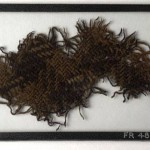
This is the most complete clothing found from Pictish times. Is incredible it’s survived.
It’s from St Andrew’s Parish, Orkney. The Orkney Hood is dates to about 200-615AD and so may be earlier than the Pictish period, but evidence is so sparse. The entire hood is made of wool and the body of the hood is a 2/2 herringbone twill while the bands are tablet woven with two or four hole tablets. The fringe is woven as part of one of the two tablet woven bands and is as long as 11-12 inches. The primary construction stitches are running stitches, hem stitches, and overcast or whip stitches. Based on the wear on the fibers and that the fringed tablet weaving does not seem to be quite long enough, it seems that the fibers may be recycled from other garments.
Other Archaeological Evidence
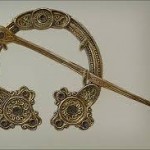
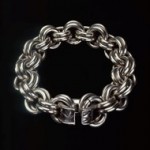
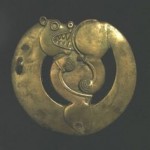
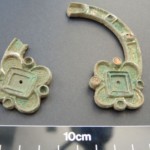
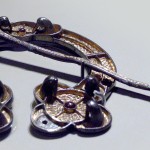
Here’s a great pdf showing the evidence in archaeology and in stone carvings about what the Picts would have worn:
http://eithni.com/referencedesk/TheWell-DressedPict.pdf
So Picts maybe weren’t straight out of Avatar.
The post What did the Picts really wear? appeared first on ScotClans | Scottish Clans.
]]>